Accounting Firm M&A: What Makes Your Practice Worth Buying and How to Prepare
Most CPA firm owners spend decades building their practice but only weeks preparing to sell it — and buyers notice. This guide breaks down exactly what sophisticated acquirers look for in accounting firm M&A, from recurring revenue quality to documented SOPs and AI-native systems, so you can close…
Accounting firm M&A activity has accelerated sharply over the past several years, with private equity roll-ups, regional consolidators, and strategic acquirers all competing for quality practices. Yet most firm owners approaching a sale discover a frustrating truth: what they believe their firm is worth and what a buyer is willing to pay are rarely the same number — and the gap usually comes down to factors they never thought to document.
Sophisticated acquirers aren't just buying your client list or your revenue run rate. They're buying predictability. They want to see that revenue will survive the transition, that workflows won't collapse when you hand over the keys, and that the operational infrastructure — intake, document handling, billing, and client communication — runs on repeatable systems rather than institutional knowledge locked inside your head. In accounting firm M&A, sophisticated acquirers aren't just buying your client list or your revenue run rate — they're buying predictability.
This guide walks you through exactly what buyers evaluate when they underwrite a CPA practice acquisition, which valuation levers most sellers overlook, and how to systematically close the gaps in the 12 to 24 months before you go to market. You don't need to be a large firm to attract premium offers — but you do need to look like one on paper and in practice. This guide walks you through exactly what buyers evaluate in accounting firm M&A when they underwrite a CPA practice acquisition, which valuation levers most sellers overlook, and how to systematically close the gaps in the 12 to 24 months before you go to market.
How Buyers Underwrite Accounting Firm Acquisitions
Before you can improve your firm's attractiveness, you need to understand how acquirers actually think. Most accounting firm acquisitions are priced as a multiple of annual revenue or, increasingly, a multiple of seller's discretionary earnings (SDE) or EBITDA. According to NACVA valuation standards, the range for CPA practices has historically run from 0.8x to 1.5x gross revenue, but that band is expanding in both directions depending on practice quality. Before you can improve your firm's attractiveness, you need to understand how acquirers actually think about accounting firm M&A, starting with how deals are priced.
What pushes a firm to the top of the range? Buyers consistently cite four factors: the proportion of recurring, contracted revenue; client retention rate over rolling three-year windows; the degree to which operations are documented and transferable; and the modernity of the technology stack. A firm billing primarily on flat annual retainers with 90%+ retention and a documented onboarding process commands materially more than a firm with similar revenue built on one-time tax returns and handshake relationships. For firms evaluating their accounting firm M&A approach, this trade-off compounds over time.
Private equity-backed consolidators add a fifth lens: scalability. They're not just paying for today's revenue — they're paying for the infrastructure that lets their platform firm absorb your client base without breaking. If your processes live in a spreadsheet and your team's heads, integration costs and attrition risk get priced in as discounts. Reviewing SBA acquisition financing guidance also underscores that lenders applying SBA 7(a) financing to practice acquisitions scrutinize revenue concentration and transferability just as hard as buyers do. Each of these factors directly shapes how accounting firm M&A plays out in practice.
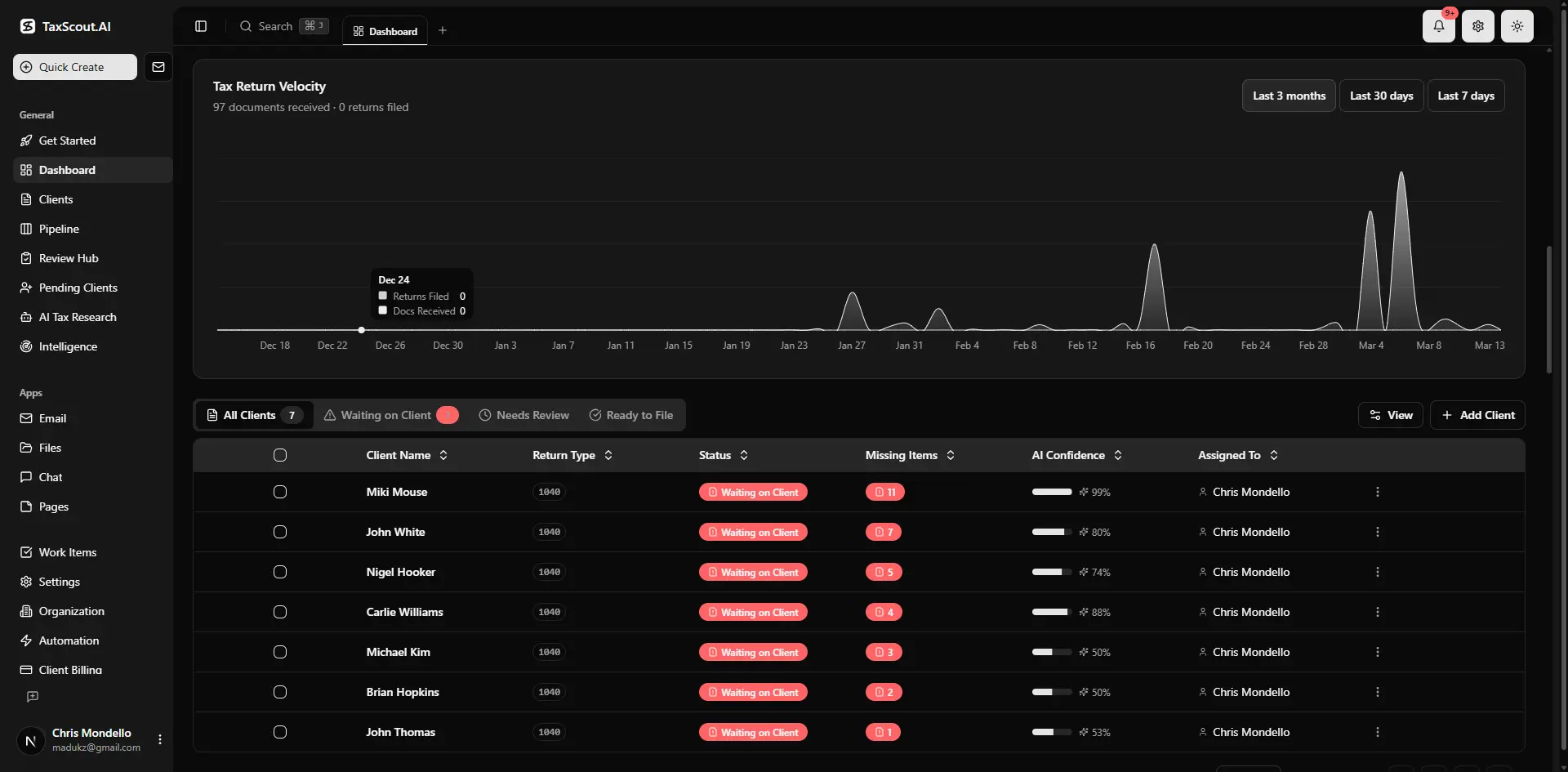
Real-time dashboard showing returns in progress, revenue, and upcoming deadlines
Revenue Quality: The Single Biggest Valuation Lever
Not all revenue is valued equally. A dollar of recurring, annually contracted revenue is worth more to a buyer than a dollar billed on a one-time project — sometimes by a factor of two or more in the multiple applied. This is why glossary/value-based-pricing and flat-fee structures matter far beyond their cash-flow benefits: they directly improve the revenue quality score a buyer assigns your firm. Understanding accounting firm M&A in this context is what separates firms that scale from those that stall.
Buyers differentiate between three tiers: (1) contracted recurring revenue — annual service agreements with clear scope, auto-renewing invoices, and low historical cancellation; (2) recurring but informal revenue — clients who return every year but on an at-will basis with no formal agreement; and (3) transactional revenue — one-off projects, new tax returns from new clients, late-season walk-ins. Your goal before a sale is to migrate as much revenue as possible from tier 2 and tier 3 into tier 1. This is precisely where a deliberate accounting firm M&A strategy pays off.
Practically, this means issuing formal engagement letters for every ongoing relationship, transitioning hourly billing clients to flat annual retainers, and establishing a documented renewal process. Our guide to flat-fee billing for CPAs walks through the conversion mechanics in detail. Even converting 30% of informal recurring clients to formal retainers can shift your blended revenue quality score enough to move your valuation multiple by 0.2x to 0.3x — a meaningful number on a $500,000 revenue firm. Accounting firm M&A sits at the center of this decision — get it wrong and the rest unravels.
Wondering whether your current tech stack is helping or hurting your firm's sale price? When firms revisit their accounting firm M&A priorities, the gaps usually surface here.
TaxScout's AI-native platform gives acquirers exactly what they want to see: documented workflows, automated intake, and verifiable retention metrics — all in one system.
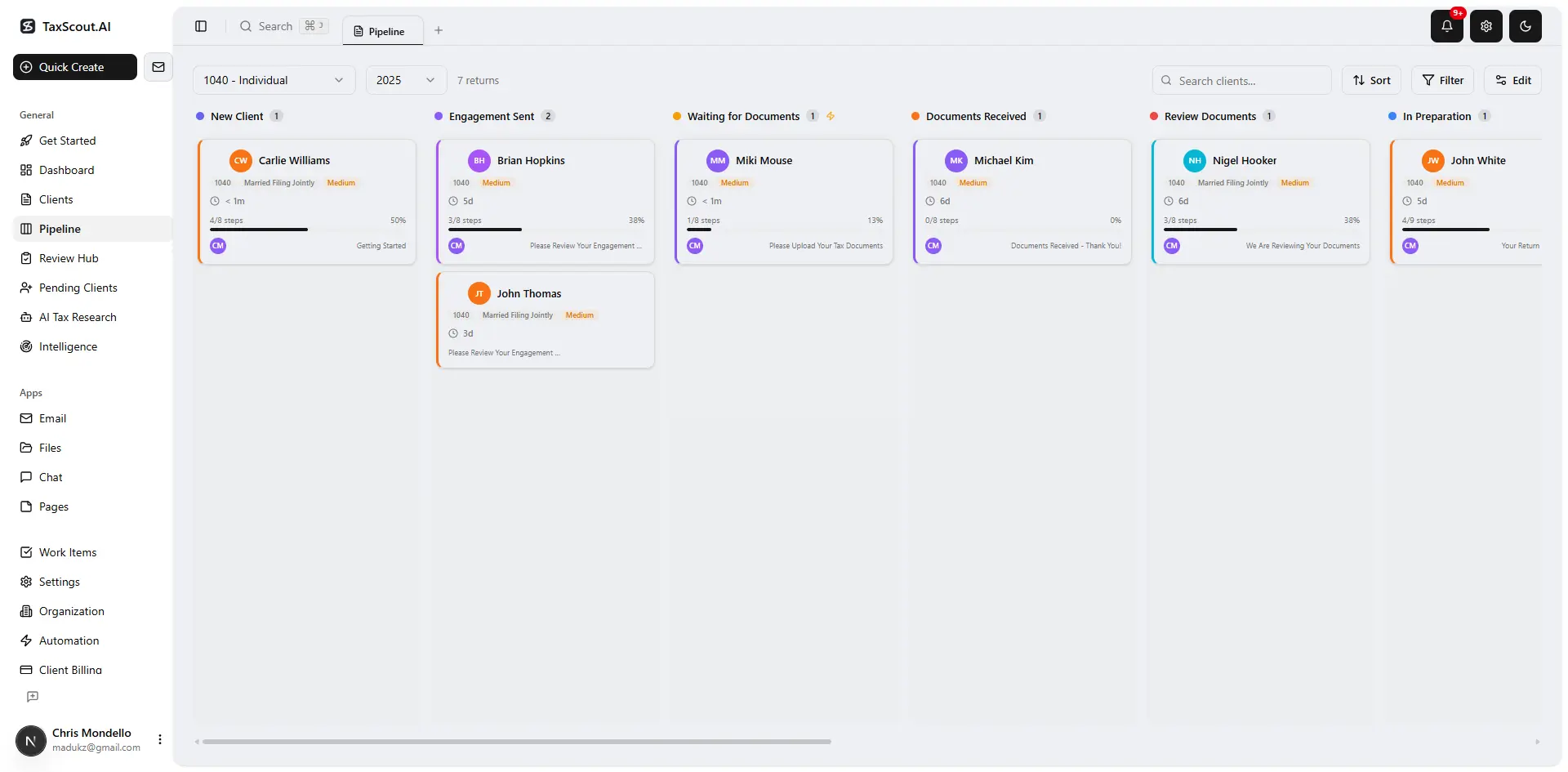
Track every return from intake to filed with drag-and-drop pipeline management

Click any extracted field to see its source highlighted on the original PDF
Client Retention Rates and How Buyers Verify Them
Client retention is the number one proxy for revenue transferability in a CPA practice acquisition, and buyers will ask for it with receipts. They want at minimum three years of client-by-client revenue data showing who stayed, who left, and why. A firm that can produce clean retention cohort data — by service line, by client size, by year — projects confidence and reduces the buyer's perceived risk. A firm that says 'we retain most of our clients' without supporting data gets discounted.
The Journal of Accountancy regularly reports that attrition risk during principal transitions is the most common reason acquirers build in earnouts rather than paying full price upfront. Earnout structures — where part of the sale price is contingent on client retention post-close — shift risk back to the seller. The best defense is demonstrable retention history and a client relationship infrastructure that survives a change of ownership.
This is where a branded client portal and systematic communication history become balance-sheet assets. Clients who interact with your firm through a consistent digital interface — uploading documents, signing forms, receiving status updates — have a relationship with the practice, not just with you personally. When an acquirer can point to high portal engagement rates and documented communication logs, they have evidence that the client base is institutionalized rather than principal-dependent. Tracking these metrics proactively is part of any serious exit strategy — see our accounting firm KPI dashboard guide for the specific data points that matter most.
Documented Workflows and SOPs: Operational Due Diligence
The operational due diligence phase of an accounting firm acquisition is where sellers most often lose value they thought they had. Buyers send a checklist — sometimes 40 to 60 line items — asking for documented processes: client onboarding, document intake, return preparation workflow, quality review, billing and collections, and staff role definitions. Firms that can produce complete, current documentation for each stage are valued more highly and close faster. Firms that respond with 'we train our staff verbally' or 'it's all in my head' trigger risk flags.
A glossary/workflow-management system built on defined, trackable stages accomplishes two things simultaneously: it makes your firm run better day-to-day and it generates the documentation buyers demand. When every return moves through a visible pipeline with timestamped stage transitions, you can produce a process map for any buyer in hours rather than weeks. TaxScout's pipeline management gives you 12 customizable stages with drag-and-drop kanban — and because every transition is logged, your operational history IS your due diligence documentation.
Beyond pipeline stages, buyers want to see intake standardization. A firm that uses an ad-hoc email intake process has undocumented variability — different staff ask for different documents, clients submit different formats, and the error rate is hard to quantify. A firm running a structured AI intake process modeled on IRS Form 13614-C, with four-layer prefill and documented gap analysis, can show exactly how every engagement starts. That predictability has real dollar value in a sale.

Your clients see your brand — OTP login, document upload, and real-time status
Why Your Technology Stack Is a Valuation Signal
Acquirers — especially PE-backed platforms — have strong views on technology. They're running due diligence on dozens of firms simultaneously, and they're building integration playbooks that assume a minimum level of infrastructure. A firm still managing documents in shared drives, tracking deadlines in spreadsheets, and billing through QuickBooks invoices manually is an integration project. A firm running on an AI-native practice management platform is a plug-in.
The technology evaluation typically covers five dimensions: document management and security, client communication infrastructure, workflow visibility and reporting, billing and collections automation, and compliance readiness (e-signatures, data retention, audit trails). Gaps in any of these require the acquirer to invest post-close, and that investment gets subtracted from what they'll pay you upfront. Our comparison of practice management options shows how much of this infrastructure a single flat-rate platform can consolidate.
The security dimension deserves particular attention. Acquirers who have dealt with cybersecurity incidents during integrations are highly sensitized to data handling practices. Firms with documented encryption standards, role-based access controls, MFA requirements, and a written information security plan command a material trust premium. Buyers reviewing your tech stack want to see that client data has been handled responsibly — because any breach liability transfers with the acquisition. TaxScout's security infrastructure includes encryption in transit and at rest, role-based access with MFA, and data-subject deletion support: features that show up as checkmarks on a buyer's due diligence form.
For a broader view of how AI-native document workflows translate into operational efficiency — and why this matters to buyers evaluating scalability — see our AI document extraction guide for CPAs.
What Acquirers Score During CPA Practice Acquisition Due Diligence
| Evaluation Area | Weak Signal (Discount) | Strong Signal (Premium) |
|---|---|---|
| Revenue quality | Mostly transactional, hourly billing, informal relationships | Flat-fee retainers, engagement letters, auto-renewing agreements |
| Client retention | No cohort data, principal-dependent relationships | 3+ years of client-level retention data, portal engagement metrics |
| Workflow documentation | Verbal training, informal processes, tribal knowledge | Documented pipeline stages, timestamped transitions, written SOPs |
| Technology stack | Shared drives, spreadsheet tracking, manual billing | AI-native platform, automated intake, integrated e-signatures, audit trails |
| Security posture | No WISP, shared logins, no MFA | Documented WISP, role-based access, MFA, encryption in transit and at rest |
| Staff transferability | Processes dependent on key individuals | Roles defined by documented workflows independent of any individual |
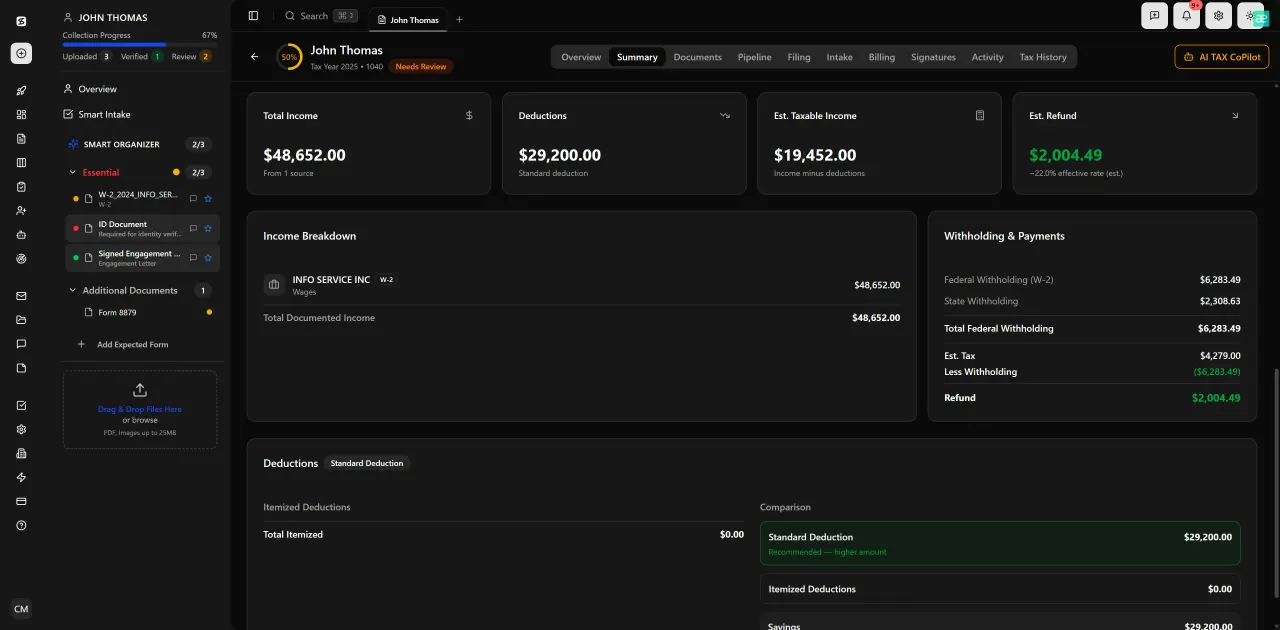
Review with AI assist — 9 agents answer questions with full client context

Smart intake auto-fills from uploaded documents and prior-year data
The 12 to 24 Month Pre-Sale Preparation Checklist
Serious exit planning for accounting firm M&A starts at least 12 months before you want to close — and 24 months gives you the best leverage. The goal is to run your firm for that period as if every decision will be scrutinized by a sophisticated buyer, because it will be. Here is the operational checklist that maps to the valuation factors buyers score.
On revenue quality: audit your billing agreements and convert informal recurring clients to formal annual retainer contracts with signed engagement letters. Implement auto-invoicing so your collections history shows consistent, on-time payment. See our automated invoicing guide for the tactical steps. On retention documentation: pull three years of client revenue by engagement type, identify churned clients, and build a written narrative explaining any significant attrition. If your attrition was due to client deaths, business closures, or deliberate pruning of unprofitable work (see our guide to firing your worst clients), document that — it's a positive story.
On workflow documentation: map every major service line through a defined pipeline with stage definitions and average time-in-stage benchmarks. On technology: if you're running on legacy or fragmented tools, begin consolidation now. The 12 months of operational data you generate on a modern platform becomes evidence of system quality. On security: engage a qualified IT advisor to draft or update your written information security plan, and run a data subject access review to confirm your data handling practices are clean. On staffing: document every role with written responsibilities so a buyer can see that your team can operate without you from day one.
The Bureau of Labor Statistics Occupational Employment data shows the accountant and auditor labor market remains tight — which means buyers who acquire your firm and immediately lose key staff face real replacement costs. The more you can show that staff retention is supported by documented roles and transferable systems, the lower the risk premium a buyer applies to your deal.
E-Signatures and Document Trails
Every engagement letter, Form 8879, and authorization that lives in a signed, retrievable digital format adds to the audit trail a buyer will request. E-signatures via a compliant platform also demonstrate that your firm has moved beyond paper-based workflows — a baseline expectation for acquirers running modern practices. For compliance context on electronic signature validity in tax engagements, the IRS guidance on electronic signatures is the controlling reference.
Financial Reporting Cleanliness
Buyers will request three years of financial statements — income statements, balance sheets, and ideally a reconciliation of owner add-backs to normalize SDE. Start working with your own CPA or M&A advisor now to clean up any intermingling of personal and business expenses, document all non-recurring items, and prepare a management representation letter explaining the numbers. The IRS Tax Exempt and Government Entities guidance on record retention also sets the baseline for what financial records you should be able to produce on demand.
How AI-Native Practice Management Closes Valuation Gaps
The cumulative argument for AI-native practice management as an exit strategy tool is straightforward: every feature that makes your firm more efficient for day-to-day operations also generates the documentation, metrics, and audit trail that acquirers demand. These are not separate investments — they're the same investment with two payoff horizons.
Consider AI document extraction: it processes W-2s, 1099s, K-1s, and the full document set through a 5-layer validation pipeline — document quality routing, AI extraction with confidence scoring, OCR cross-verification, 15 deterministic math rules, 18 post-extraction rules, and cross-document validation. The operational benefit is speed and accuracy during tax season. The exit benefit is a documented, auditable processing standard that tells a buyer your firm has built quality control into its systems rather than relying on individual reviewer judgment.
The same logic applies to AI research agents: nine specialized agents with real-time search across IRS, Treasury, Cornell Law, SSA, and Congress. A buyer looking at your firm sees a research infrastructure that doesn't walk out the door when your senior staff leave. It's institutionalized expertise rather than personal expertise — and that distinction is worth real money in an acquisition. Browse other blog resources on firm operations to see how these system investments compound over time.
For firms that haven't yet benchmarked their current operations against what buyers expect, a demo walk-through of TaxScout's platform makes the gap analysis concrete. You'll see exactly which operational dimensions the platform addresses and which ones you'd still need to document separately.
Ready to close the valuation gap before you go to market?
TaxScout gives your firm the documented workflows, AI-native infrastructure, and client retention tools that push CPA practice acquisitions to premium multiples.
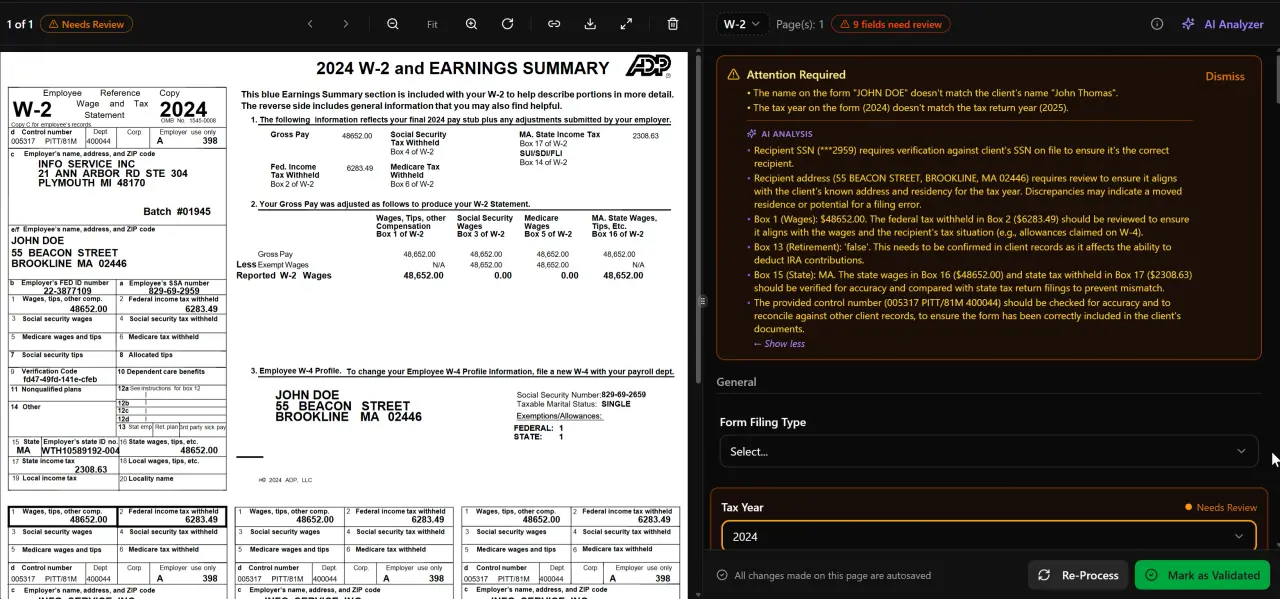
AI classifies, extracts, and validates every document automatically
Frequently Asked Questions
Most CPA practice acquisitions are priced between 0.8x and 1.5x gross annual revenue, but this range is expanding. Firms with high proportions of recurring, contracted revenue, strong client retention documentation, and modern technology infrastructure routinely achieve multiples at or above the top of the traditional range, while firms dependent on transactional revenue and informal client relationships are typically discounted toward the low end.
Keep reading
Business Valuation for CPAs: How to Price a Client Company Without Hiring an Appraiser
Sep 18, 2026 · 1 min read
Equity Partner Compensation: How CPA Firms Structure Pay for Owners
Sep 18, 2026 · 1 min read
Accountant Shortage Solutions: How CPA Firms Survive the Talent Crisis Without Overpaying
Sep 18, 2026 · 1 min read
Stay up to date
Get the latest tax tech insights delivered to your inbox.