Accountant Shortage Solutions: How CPA Firms Survive the Talent Crisis Without Overpaying
The accounting workforce shortage isn't just an HR problem — it's an operations problem. Firms that redesign their workflows around AI-native practice management can serve the same client volume with fewer staff. Here's how early adopters are turning the talent crisis into a competitive moat.
The accounting talent shortage has reached a structural inflection point. The number of candidates sitting for the CPA exam has declined more than 30% over the past decade, according to data cited by Karbon and corroborated by AICPA pipeline reports. Combine that with near-record retirements as Baby Boomer partners exit, and the supply of credentialed accountants is shrinking faster than most firm owners anticipated. Accountant shortage solutions that stop at 'offer better culture' or 'pay more' are fighting a structural problem with a transactional tool.
The conventional narrative frames this as a talent and HR challenge. Post better job descriptions, add flexibility, improve your employer brand. That advice isn't wrong — but it's incomplete. Firms that win the next decade won't win by out-recruiting competitors for the same shrinking pool of CPAs. They'll win by redesigning operations so that each person they do employ produces dramatically more output. Understanding accountant shortage solutions requires looking beyond recruitment tactics to the deeper operational inefficiencies that make firms so dependent on headcount in the first place.
This article makes the case that the CPA hiring shortage is fundamentally an operations problem, and that AI-native practice management software is the most direct lever firms have for solving it. Firms that automate intake, document collection, extraction, research, and workflow routing don't just reduce costs — they create a structural advantage that competitors still relying on manual processes cannot easily replicate. Among the most overlooked accountant shortage solutions is the strategic adoption of AI-native practice management software that reduces the firm's reliance on manual labor at every stage of the workflow.
Why the Accounting Workforce Shortage Is an Operations Problem
Most discussions of the accounting workforce shortage focus on pipeline: fewer accounting graduates, fewer CPA exam sitters, fewer new entrants to the profession. The Bureau of Labor Statistics projects that accountant and auditor employment will grow modestly through the late 2020s, but that projection masks the mismatch between demand at CPA firms and the actual supply of credentialed staff. The problem isn't just that fewer people are entering — it's that the work itself hasn't changed. While pipeline discussions dominate the conversation, the most actionable accountant shortage solutions focus on what firms can control today — namely, how efficiently their existing team operates.
Think about what a typical tax associate actually does during busy season: they chase clients for documents, manually key data from W-2s and 1099s into tax software, look up IRS guidance for edge cases, route files between reviewers, and email clients asking where the missing K-1 is. Almost none of that requires a CPA license. But because most practice management platforms weren't designed around automation, licensed professionals spend hours per day on tasks that could be handled by software. That's the operations problem. The talent shortage makes it more visible, but it existed long before the pipeline dried up. For firms evaluating their accountant shortage solutions approach, this trade-off compounds over time.
Reframing the accounting talent shortage as an operations problem changes the solution set entirely. Instead of asking 'how do we attract more staff?', the better question is 'how do we reduce the number of manual steps each return requires?' When those two questions get equal airtime, firms discover that technology investments have a faster ROI than retention bonuses — and they don't walk out the door. Each of these factors directly shapes how accountant shortage solutions plays out in practice.
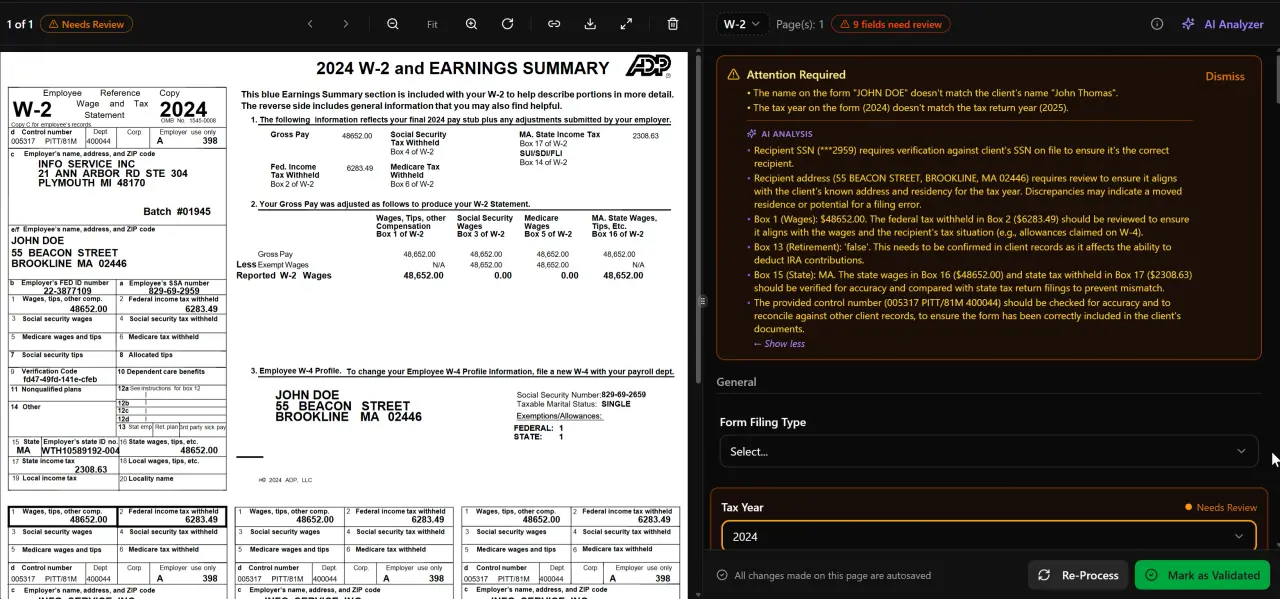
AI classifies, extracts, and validates every document automatically
What AI-Native Practice Management Actually Automates
The phrase 'AI-powered' gets applied to almost every software product today, making it nearly meaningless. What matters for CPA staffing solutions is whether the automation touches the actual bottlenecks in a tax workflow: document collection, data extraction, research, review routing, and client communication. A platform with an AI chatbot bolted onto a manual workflow doesn't move the needle on headcount efficiency. Understanding accountant shortage solutions in this context is what separates firms that scale from those that stall.
TaxScout's AI document extraction processes 180+ tax form types — W-2s, all 1099 variants, K-1s, the full 1098 and 1095 series, 1040 with all schedules — through a 5-layer validation pipeline. That pipeline includes document quality routing, AI extraction with confidence scoring, OCR cross-verification, 15 deterministic math rules, 18 post-extraction rules, and cross-document validation. A staff member who previously spent 45 minutes manually transcribing a client's document packet now spends 5 minutes reviewing flagged exceptions in a split-screen PDF viewer where every extracted field is click-linked back to its source in the original document. This is precisely where a deliberate accountant shortage solutions strategy pays off.
The smart intake engine, modeled on IRS Form 13614-C, adds a second layer of automation. It uses a 4-layer prefill sequence — document-first, prior-year data, profile data, and AI gap analysis — so clients aren't asked for information you already have. Fewer back-and-forth emails means less staff time managing client communication. The pipeline management system, with 12 customizable stages on a drag-and-drop kanban board, eliminates the 'who owns this return right now?' questions that generate dozens of internal messages per week. For a detailed look at how AI extraction specifically transforms document workflows, see our guide to AI document extraction for CPAs. Accountant shortage solutions sits at the center of this decision — get it wrong and the rest unravels.
Tired of hiring just to keep up with document chasing and manual data entry?
TaxScout automates intake, extraction, research, and routing — so your team focuses on advisory work, not admin. Flat pricing, no per-user fees, unlimited clients. When firms revisit their accountant shortage solutions priorities, the gaps usually surface here.

Click any extracted field to see its source highlighted on the original PDF
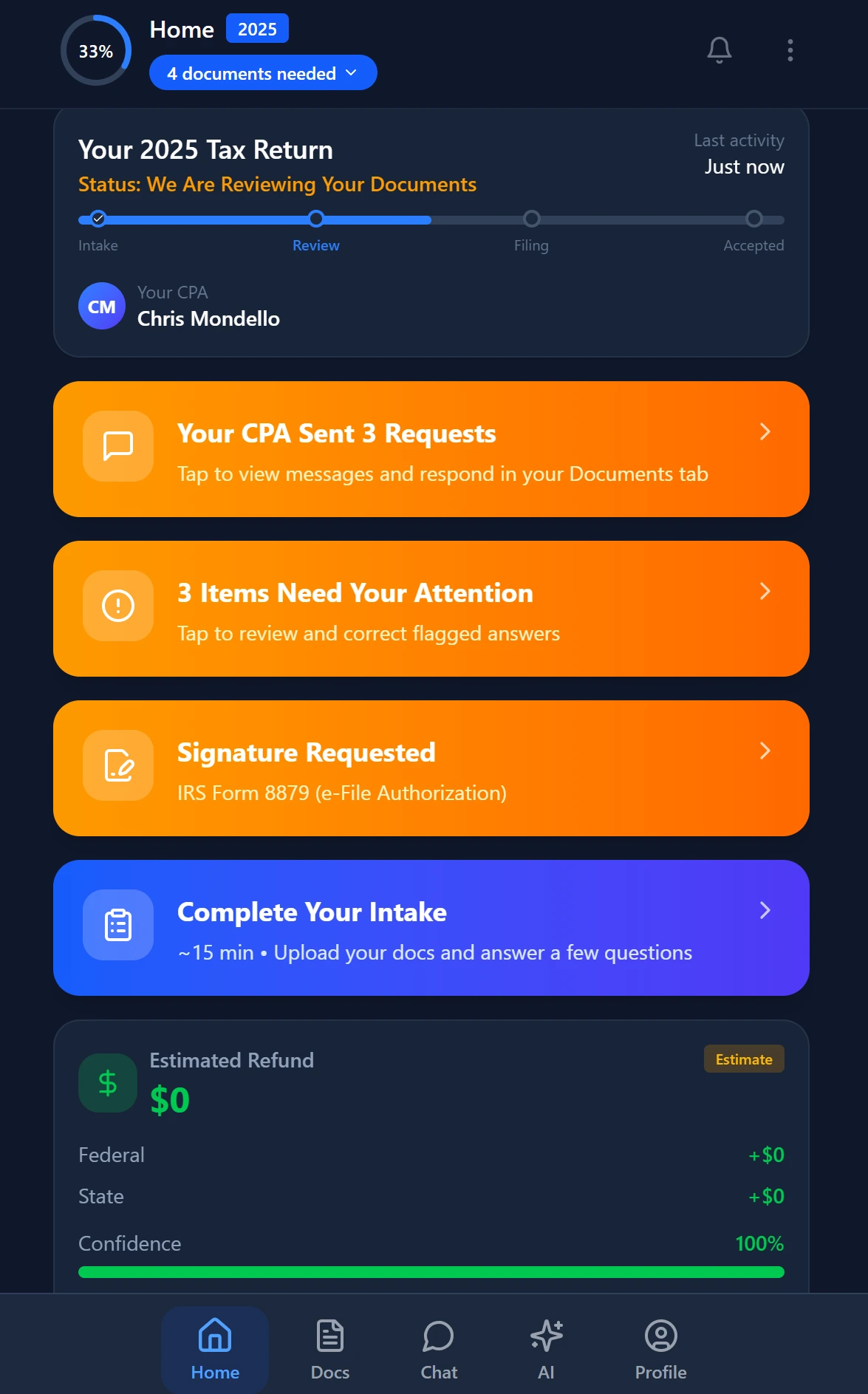
Smart intake auto-fills from uploaded documents and prior-year data
How AI Research Agents Replace Hours of Staff Lookup Time
One of the most underappreciated time sinks in a CPA firm isn't data entry — it's research. A client has a multi-state rental property, a late K-1 from a partnership, and a question about the deductibility of a home office that doesn't fit neatly into the instructions. A junior associate might spend two hours searching IRS publications, Treasury regulations, and state guidance to arrive at a defensible answer. A senior reviewer spends another 30 minutes verifying it.
TaxScout's AI research agents — nine specialized agents with real-time search across IRS, Treasury, Cornell Law, SSA, and Congress databases — compress that research cycle significantly. Answers are grounded in live primary sources, not cached training data, which matters for IRS compliance questions where guidance changes mid-season. The agents also maintain client-context memory — entity structures, filing history, prior return details — so research doesn't start from scratch for returning clients.
According to Treasury guidance on tax professional standards, practitioners are responsible for the accuracy of positions they take. Having research grounded in authoritative, current sources isn't just an efficiency play — it's a risk management one. Firms that rely on staff memory or Google searches for edge-case guidance are exposed in ways that AI-assisted research with cited primary sources is not. For firms also exploring how AI handles complex multi-state scenarios, this breakdown of AI agents for multi-state tax returns is worth reading.
The Real Cost of Per-User Pricing During a CPA Hiring Shortage
There's a cruel irony in how most practice management platforms are priced during an accounting talent shortage: the more staff you hire to handle growing client volume, the more your software costs. Per-user pricing at scale punishes exactly the behavior firms need — adding capacity. TaxDome runs approximately $100 per user per month. Canopy charges roughly $45 per user per month per module, with smart intake costing an additional $11 per client. Karbon is approximately $59 per user per month.
For a 10-person firm, those costs add up fast: TaxDome at roughly $500 per month, Canopy near $660, Karbon around $590. TaxScout's Prep Pro plan is $149 per month total — 10 seats, 500 returns per year, all 9 AI research agents, the full PDF toolbox, and no per-client intake fees. That's not just a pricing difference; it's a structural one. When adding a new team member doesn't increase your software costs, the calculus on hiring changes. See the full breakdown on the TaxScout pricing page or compare directly on the Karbon alternative page.
The pricing model also matters for firms exploring fractional or contract staffing as a CPA staffing solution. If every contractor you onboard adds to your software bill, the economics of flexible staffing get worse. Flat, seat-inclusive pricing means you can staff up for busy season without a software cost spike, then right-size afterward without losing access to your data or workflows.
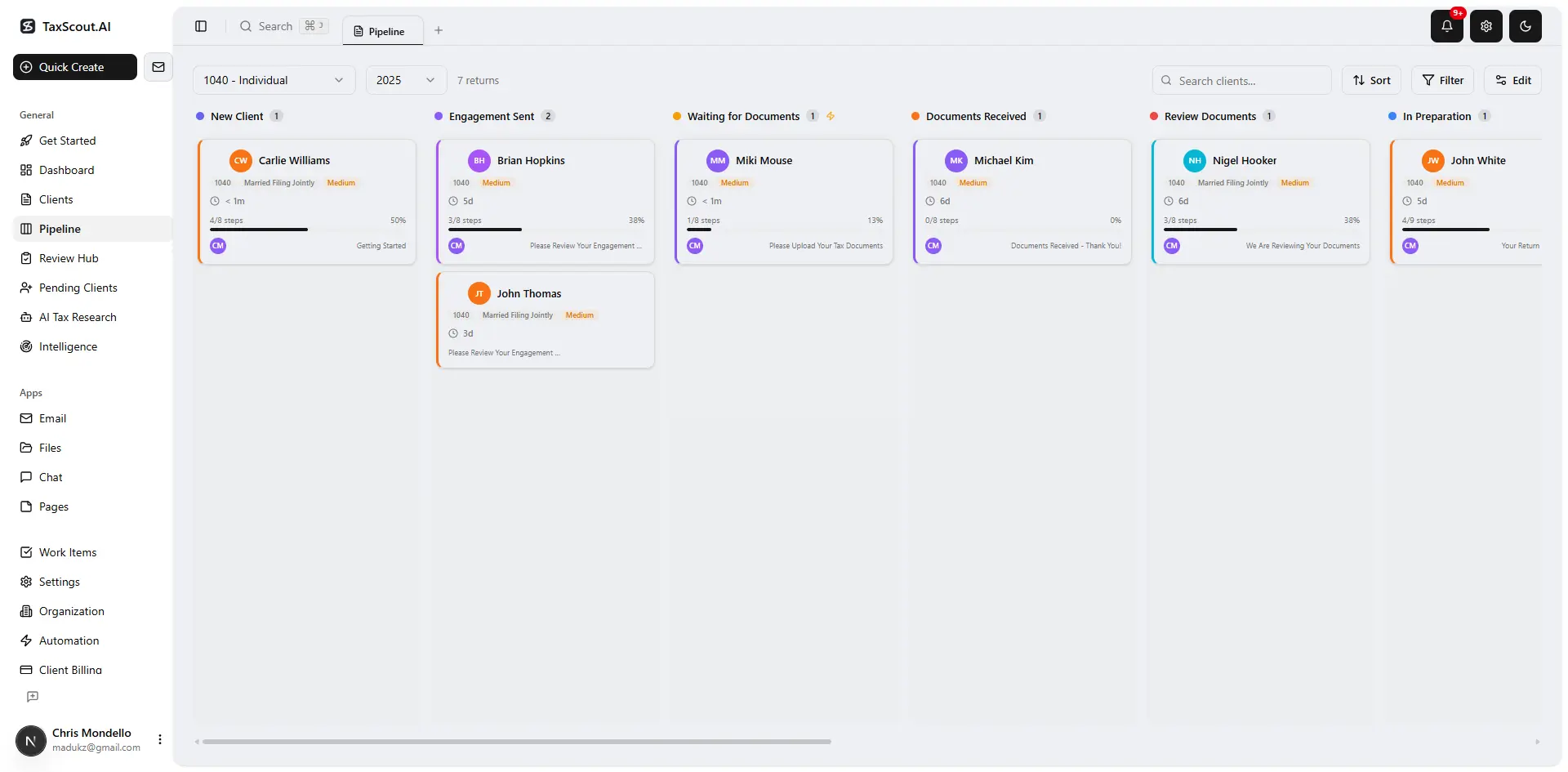
Track every return from intake to filed with drag-and-drop pipeline management
Practice Management Platform Cost for a 10-Person CPA Firm (2026)
| Platform | Monthly Cost (10 Users) | AI Document Extraction | AI Research Agents | SSN Vault |
|---|---|---|---|---|
| TaxScout Prep Pro | $149/mo flat | Yes — 180+ form types, 5-layer validation | Yes — 9 specialized agents | Yes — AES-256-GCM encrypted |
| TaxDome | ~$500/mo ($100/user) | No | No | No |
| Canopy | ~$660/mo ($45/user + modules) | No | No | No |
| Karbon | ~$590/mo ($59/user) | No | No | No |
Workflow Redesign: Turning the Talent Crisis Into a Competitive Moat
Early adopters of AI-native practice management aren't just reducing costs — they're widening the gap between themselves and competitors who are still fighting the accounting talent shortage the old way. A firm that automates document intake, extraction, research, and routing can handle 30-40% more returns with the same staff. A firm that doesn't is constrained by headcount in a market where headcount is the scarce resource.
The workflow redesign isn't complicated, but it does require intention. Start with the intake layer: implement a smart client portal that collects documents, prefills from prior-year data, and flags gaps before a human ever touches the file. Layer in AI extraction so that by the time a return reaches a preparer, all structured data is already pulled and validated. Use pipeline management to enforce consistent routing — reviewers see files only when they're actually ready for review, not when someone remembers to move them. Add AI research agents for edge cases. The result is a workflow where professional judgment is applied at the decision points that actually require it, not squandered on document hunting.
For firms that want a concrete capacity planning framework, this accounting firm capacity planning guide walks through the math of matching workflow design to team size. The underlying principle is the same: operations efficiency is the multiplier that makes every staff member you do have more valuable. Combined with insights from other blog resources on firm growth, the path from talent-constrained to capacity-confident becomes much clearer.
It's worth noting that TaxScout is designed to complement the tax preparation software your team already uses. It works alongside Drake, CCH Axcess, UltraTax CS, Lacerte, ProConnect, and ProSeries — so workflow redesign doesn't require ripping out your existing prep stack. The platform handles everything upstream and downstream of the return itself: intake, document processing, research, communication, e-signatures via Documenso, and invoicing via Stripe Connect Express.
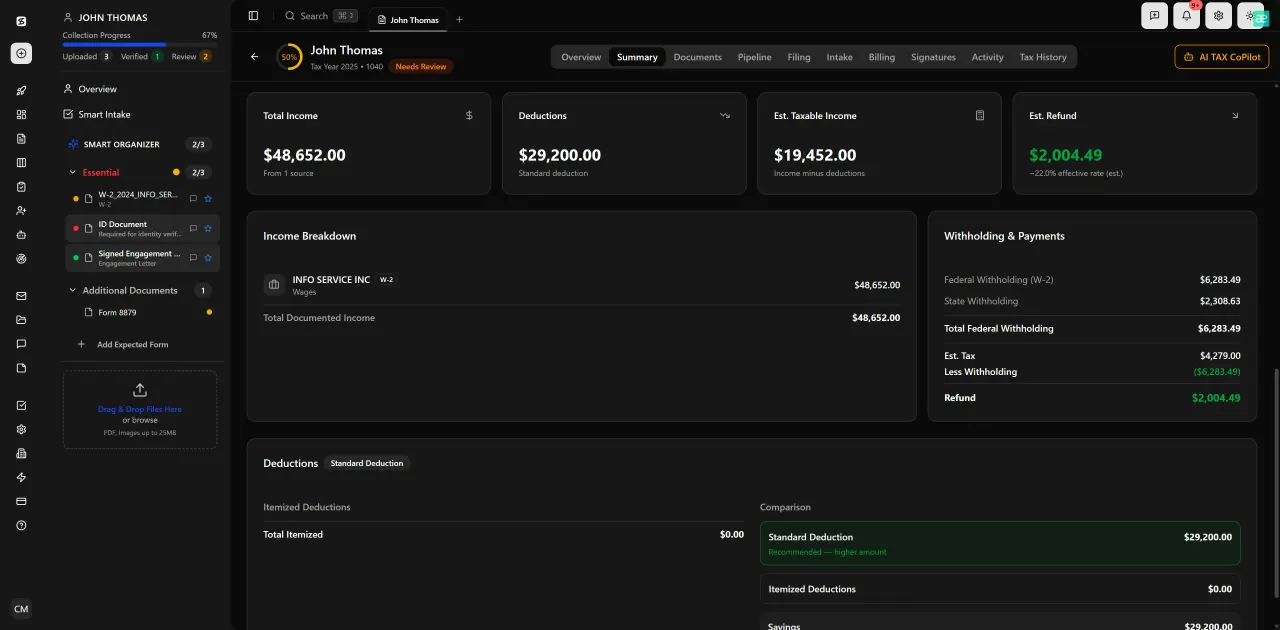
Review with AI assist — 9 agents answer questions with full client context

Every client gets organized documents, status tracking, and a complete history
Accounting Firm Talent Retention Gets Easier When the Work Is Less Frustrating
The retention conversation changes when the job itself improves. Accounting firm talent retention research consistently points to workload, not just compensation, as a primary driver of turnover. According to research on workforce trends from the SSA's longitudinal data, professionals in high-administrative-burden roles report significantly higher burnout rates than peers in roles focused on skilled judgment work. When staff spend their days on document chasing and manual data entry, they leave — not necessarily for a higher salary, but for a job that feels less like a treadmill.
Automating the administrative layer of tax work doesn't eliminate jobs — it elevates them. Preparers become reviewers. Reviewers become advisors. The role becomes more intellectually engaging, which is the retention lever that salary adjustments can't replicate. Firms that have implemented AI accounting productivity workflows report that staff appreciate having more time for client-facing work. That's a meaningful competitive advantage in a market where every firm is competing for the same credentialed professionals.
There's also a hiring signal value here. Firms that can demonstrate to candidates that their workflows are modern and their tools are purpose-built for the profession attract better applicants. A candidate choosing between two firms at similar salary levels will lean toward the one where their first week isn't spent learning to manage a shared email inbox. Email integration with AI classification — Gmail OAuth, Outlook Graph, and IMAP/POP3 all supported — is a small example of the kind of detail that signals operational maturity to experienced hires.
Accountant Shortage Solutions That Actually Scale
The firms that will be best positioned in five years are the ones that stop treating the accounting talent shortage as a temporary hiring problem and start treating it as a permanent operating constraint — one that requires a permanent operational response. That means investing in AI-native practice management that reduces the per-return staff hours required, not just tools that make existing manual processes slightly faster.
Concrete accountant shortage solutions worth prioritizing: (1) Automate document intake end-to-end with a smart client portal and AI extraction, eliminating the back-and-forth that consumes the most associate time. (2) Replace manual IRS research workflows with AI agents that return cited, current-source answers in minutes rather than hours. (3) Standardize workflow routing through a pipeline system that prevents returns from stalling in ambiguous handoff states. (4) Move to flat-rate practice management pricing so that adding staff or contract help doesn't trigger per-seat cost spikes. (5) Use e-signature workflows for engagement letters, Form 8879, extensions, and FBAR to eliminate the printing and scanning loop that burns time on both sides of the client relationship.
The law.cornell.edu resources on tax regulations and IRS publications aren't getting simpler — the compliance surface is expanding. Firms that give their staff better tools to navigate that complexity will outperform those that simply try to hire their way through it. The talent crisis is real. The operational response to it is a choice.
Ready to see how AI-native practice management changes the headcount math at your firm?
TaxScout Prep Pro is $149/month flat for 10 seats — with AI extraction, 9 research agents, smart intake, and pipeline management built in.

Your clients see your brand — OTP login, document upload, and real-time status
Keep reading
Business Valuation for CPAs: How to Price a Client Company Without Hiring an Appraiser
Sep 18, 2026 · 1 min read
Equity Partner Compensation: How CPA Firms Structure Pay for Owners
Sep 18, 2026 · 1 min read
CPA Firm Standard Operating Procedures: Build an SOP Library That Runs Without You
Sep 18, 2026 · 1 min read
Stay up to date
Get the latest tax tech insights delivered to your inbox.