Firing Your Worst Clients: A Practical Guide to Enforcing Strict Boundaries in Your CPA Practice
Not every client deserves a renewal. High-performing CPA firms know that firing problem clients — those who drain time, dispute invoices, and ignore deadlines — is often the highest-ROI decision a firm owner can make. This guide walks you through the when, the why, and the professional how of…
When Firing a Client Is the Most Professional Thing You Can Do
Most CPA firm owners know within the first month which clients will cost them more than they earn. The one who calls every other day with questions outside the engagement scope. The one who submits documents three weeks past your stated deadline, then demands a 48-hour turnaround. The one who disputes every invoice, pays six months late, and cc's their attorney on the follow-up email. You keep them because they represent revenue on a spreadsheet — and because nobody taught you that firing a client is, in many cases, the single highest-ROI decision you can make for your practice. For firms evaluating their firing clients CPA practice approach, this trade-off compounds over time.
Firing clients — or more precisely, strategic client disengagement — is how high-performing CPA firms protect their staff, reduce liability exposure, and create capacity for work that actually builds the practice. This guide covers the professional standards, legal considerations, timing rules, documentation requirements, and firm-level strategy behind a deliberate client termination process. Each of these factors directly shapes how firing clients CPA practice plays out in practice.
Why Strategic Client Disengagement Is a Firm Management Tool
The accounting profession treats client termination as a last resort. It shouldn't. Accounting Today's analysis of the art of firing clients frames it plainly: pruning your client roster is a proactive business management decision, not a failure. Firms that systematically evaluate client fit — and exit relationships that no longer fit — tend to see measurable improvements in staff morale, realization rates, and partner bandwidth within a single billing cycle. Understanding firing clients CPA practice in this context is what separates firms that scale from those that stall.
The math is straightforward. A 1,500-client practice with 300 clients generating friction disproportionate to their fees is effectively a 1,200-client practice running at full staffing capacity to service everyone. Exiting those 300 clients doesn't just cut revenue — it cuts hidden costs: the write-offs on underpriced work, the staff overtime during scope creep incidents, the liability exposure on rushed returns, the partner time spent managing escalations that should never have escalated. This is precisely where a deliberate firing clients CPA practice strategy pays off.
The Journal of Accountancy identifies the professional and ethical considerations that govern how termination must be handled — but the underlying premise is clear: termination is a legitimate professional option when a client relationship has become unworkable. The key is doing it correctly, not avoiding it. Firing clients CPA practice sits at the center of this decision — get it wrong and the rest unravels.
Common legitimate grounds for disengagement include:
- Chronic non-payment or partial payment history — clients who routinely pay 60–90 days late or dispute fees without basis
- Scope creep with refusal to authorize additional fees — work consistently exceeding the engagement letter without written amendments
- Non-cooperation with document requests — repeated failure to provide materials needed to complete the engagement on time
- Integrity concerns — misrepresentation of facts, pressure to take unsupported positions, or suspected fraud
- Personality conflicts or staff harassment — abusive behavior toward your team that creates a hostile work environment
- Unprofitable work — engagements priced years ago that now run at a loss and cannot be repriced to market rates. When firms revisit their firing clients CPA practice priorities, the gaps usually surface here.
None of these require personal conflict to resolve. Each of them represents a business fit problem — and fit problems have objective, documented solutions.
Spending hours chasing non-responsive clients while managing your existing pipeline? See how TaxScout's pipeline management and automated workflow tools let your firm track exactly where every client stands — and flag the ones creating bottlenecks. → Book a 15-Min Demo — See It Live
The Legal and Ethical Framework: What Professional Standards Actually Require
Before sending any disengagement communication, understand the professional obligations in play. CPA disengagement is governed by state board regulations, your state's Rules of Professional Conduct, your engagement letter terms, and — if the client has active IRS matters — circular 230 practitioner rules.
The core obligation is avoiding abandonment. An "abandonment" claim arises when a CPA withdraws from an engagement at a time or in a manner that damages the client's legal or financial position. The risk is highest when:
- A filing deadline is imminent (within 30 days)
- An IRS examination or audit is pending and active
- The client is mid-transaction (sale, acquisition, refinancing) where tax representations are required
- State-specific rules impose additional notice requirements
The AICPA guidance on firing a client without getting sued is direct: timing is the most controllable liability factor. Whenever possible, disengage immediately after a major filing deadline, never immediately before one. If you must exit before a deadline — due to fraud concerns, for example — document the reason clearly and provide maximum reasonable notice. Firms that handle firing clients CPA practice decisions well almost always cite timing discipline as the key factor in avoiding liability.
The Cornell Law School's overview of professional liability standards provides useful context on what constitutes adequate notice in professional service relationships. While CPA-specific rules vary by state, the general standard is that adequate notice gives the client sufficient time to secure replacement services before suffering harm.
Key procedural requirements across most state boards:
- Written disengagement letter (required in virtually all jurisdictions)
- Return of client-owned documents within a reasonable period (often 45 days)
- Clear statement that the firm will not provide further services after a specific date
- No retention of documents as leverage for unpaid fees (most state ethics rules prohibit this)
- Referral to the client's right to seek alternate representation

Click any extracted field to see its source highlighted on the original PDF
How to Build an Objective Disengagement Decision Process
The firms that handle client termination best treat it as a scheduled, structured review — not a reactive decision made after a bad phone call. A quarterly or annual client profitability review that includes disengagement criteria removes the emotional component and makes the decision defensible. Approaching firing clients CPA practice as a data-driven process rather than a personal judgment call is what keeps these reviews productive and consistent.
Build a scoring matrix that captures objective data points per client:
| Factor | Weight | Scoring Basis |
|---|---|---|
| Realization rate (fees collected / time billed) | High | Below 60% flags for review |
| Average days to pay | High | 60+ days triggers review |
| Scope creep incidents per year | Medium | 3+ unauthorized requests |
| Document submission compliance | Medium | Miss rate vs. intake deadlines |
| Staff escalations or complaints | High | Any documented incident |
| Integrity flags | Critical | Any instance = immediate review |
This matrix converts subjective frustration into objective evidence. When you send a disengagement letter, you're responding to a documented pattern — not a personality conflict. That distinction matters if a client ever challenges your decision.
For firms that moved away from time-based billing, as discussed in our flat-fee billing analysis for CPA firms, realization rate becomes even more important as a disengagement signal. Clients who take 40 hours to service on a $1,500 flat-fee return are subsidized by clients who take 8 hours on the same fee — and your disengagement review should surface that math explicitly.
The Disengagement Letter: What It Must Include
The disengagement letter is the legal document that ends the professional relationship. It is not a courtesy note. Every word matters — and in the context of firing clients CPA practice, a poorly drafted letter is often where otherwise clean terminations go wrong.
A properly drafted disengagement letter must:
- State clearly that the engagement is terminated and the effective date
- Identify what services are included in the termination scope
- Confirm that the firm has no further responsibility for monitoring, filing, or advising
- Describe the client's document return process and timeline
- Note any pending deadlines the client needs to address
- Recommend that the client retain alternative professional services promptly
- Specify the final invoice or balance due, if any
template CPA Client Disengagement Letter — Standard Form
[Firm Letterhead] [Date]
[Client Full Legal Name] [Client Address]
Re: Termination of Professional Services Engagement
Dear [Client Name],
This letter serves as formal notice that [Firm Name] is terminating its professional services engagement with [Client Name / Entity Name], effective [Termination Date — minimum 30 days from letter date, or after next major filing deadline].
As of the effective date above, [Firm Name] will no longer provide tax preparation, advisory, compliance monitoring, or any other professional services to [Client Name]. We will have no responsibility for any filings, deadlines, IRS correspondence, or other tax matters arising after that date.
We recommend that you engage a qualified tax professional as soon as possible to ensure continuity of your tax and financial obligations. The following deadlines may require attention:
[List any upcoming deadlines — estimated payments, extensions, state filings, etc.]
All original documents you provided to our firm will be returned to you by [Date — typically within 30 days]. You will receive [describe delivery method — certified mail / secure client portal / in-person pickup]. Copies of work product prepared by our firm will be made available per our document retention policy upon written request.
The current outstanding balance on your account is $[Amount]. [Payment terms and instructions.]
This letter does not reflect on the quality of your affairs or the professionalism of our interaction. This decision reflects a determination that our firm is not the right fit for your current needs. We wish you well in securing appropriate representation.
Please do not hesitate to contact [Contact Name] at [Email/Phone] with questions regarding document return or the transition process.
Sincerely,
[Partner/Owner Name, CPA] [Firm Name] [License Number, State] Send the disengagement letter via certified mail with return receipt requested, and retain the proof of delivery. Email a copy simultaneously. Store both in the client file with a timestamp. This documentation record is your protection if an abandonment or malpractice claim surfaces later.
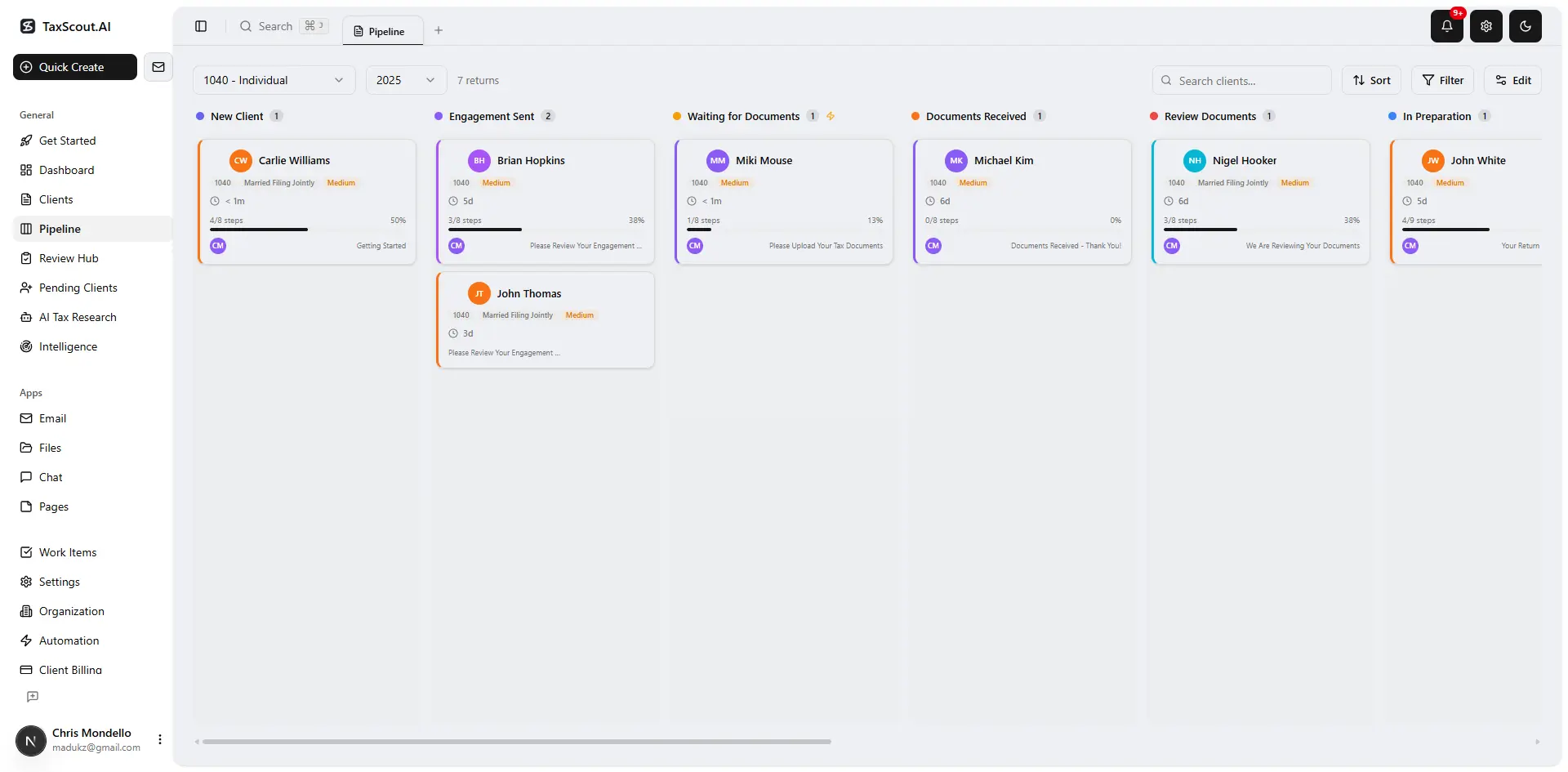
Track every return from intake to filed with drag-and-drop pipeline management
Timing Rules: When to Disengage and When to Wait
The single most common mistake in client termination is acting on impulse after a conflict, without regard to timing. Courts and state boards generally hold CPAs to a standard of reasonable notice — meaning you cannot terminate in a way that predictably damages the client's position. This is one of the most consequential variables in any firing clients CPA practice decision.
Practical timing guidelines:
Safe windows:
- 60–90 days after the April 15 filing deadline (or extension filing date)
- Immediately after completing a discrete project (business sale, audit resolution)
- At natural engagement renewal points (engagement letter anniversaries)
High-risk windows (proceed only with documented cause and maximum notice):
- 30 days or fewer before a major federal or state filing deadline
- During an open IRS examination where you are the practitioner of record
- Mid-transaction on a deal requiring tax representations
If integrity concerns force immediate disengagement — the client is asking you to take a fraudulent position, for instance — you may exit even in a high-risk window. In that case, your documentation must be exceptionally detailed, your notice must be immediate and in writing, and you should consult with your professional liability insurer before sending the letter. The IRS Circular 230 rules for practitioners are clear that a practitioner cannot continue representation that requires violating those standards.
For firms tracking the 2026 deadline calendar — a schedule our IRS deadline calendar for CPAs covers in full — map your planned disengagement dates against upcoming filing obligations before sending any termination letters. The April–May window immediately following tax season is generally the most legally defensible period to disengage calendar-year individual clients.
What to Do With Outstanding Documents and Unpaid Fees
Two practical problems create the most friction in client termination: returning documents and collecting outstanding balances.
Document return: Most state ethics rules require returning client-supplied originals. They do not require giving the client copies of your internal workpapers, though many firms do provide them as a matter of professional practice. Do not withhold documents as leverage for unpaid fees — this is an ethics violation in most jurisdictions and will cost you far more in board proceedings than the fee amount you are trying to collect.
Unpaid fees: Invoice for completed work before or simultaneously with the disengagement letter. For disputed amounts, consider whether collection is worth the relationship cost. For amounts over your small claims threshold that the client refuses to pay, your engagement letter's dispute resolution clause controls — which is another reason why a well-drafted engagement letter is your first line of defense. Our engagement letter templates and best practices guide covers the specific provisions that make disengagement cleaner.
If you are collecting outstanding balances through your practice management system, automated overdue reminders — like the daily 9 AM billing reminders TaxScout's invoicing system runs on unpaid invoices — can prompt payment before the formal disengagement process begins, sometimes resolving the fee dispute before termination becomes necessary.
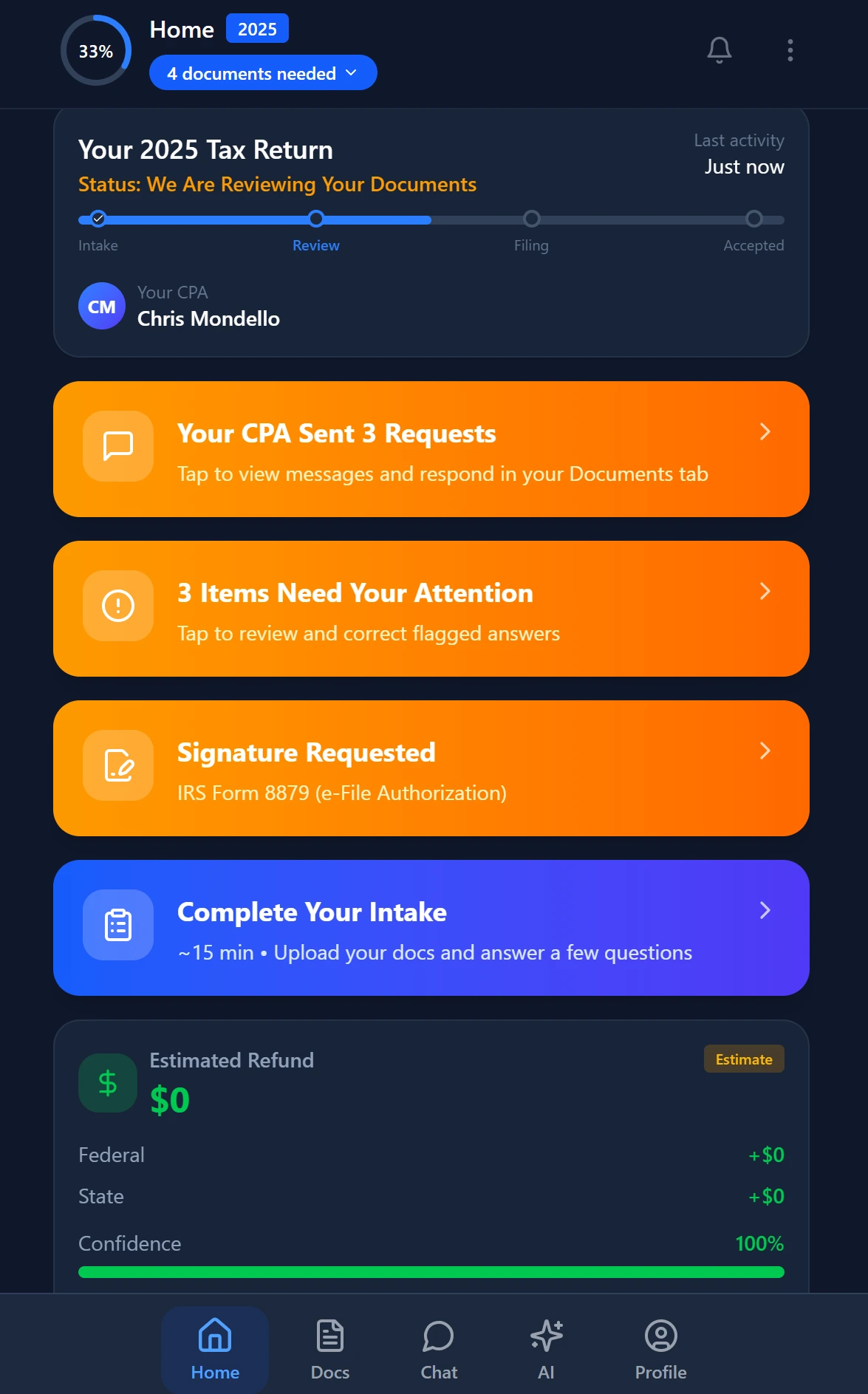
Smart intake auto-fills from uploaded documents and prior-year data
Building Systems That Reduce Bad-Fit Clients Before They Start
The best disengagement strategy is a strong client intake process. Clients who become termination candidates in year three often showed warning signs at intake: vague about income sources, resistant to engagement letter terms, pushing back on fee estimates before work began. Treating firing clients CPA practice as something that starts at onboarding — not at the point of crisis — is the mindset shift that transforms reactive firms into deliberate ones.
Your intake process should screen for fit as aggressively as it screens for documents. TaxScout's client portal and smart intake engine — modeled on IRS Form 13614-C with AI gap analysis running in the background — captures the signals that identify high-maintenance clients early: incomplete document submissions, inconsistent data, delays in engagement letter execution.
A pipeline management system with 12 customizable stages from New Client through Filed also gives you a real-time view of which clients are moving through your workflow cleanly and which are creating bottlenecks. That visibility makes the quarterly client review more objective: instead of relying on memory or staff anecdotes, you have documented stage-by-stage delays tied to specific clients.
Pairing intake screening with an annual client profitability review — and actually acting on the results — is what separates firms that manage their client base strategically from firms that accumulate problematic clients by default.
The Capacity Argument: What You Gain When You Let Go
A 10-person CPA firm that bills $2 million annually but carries 50 clients who collectively generate $180,000 in revenue and consume 35% of available staff hours is running a structural inefficiency. Exiting those 50 clients — even at a short-term revenue cost — frees capacity that can be redirected to more profitable work, business development, or service quality improvements for the top 200 clients. This is the core capacity argument for making firing clients CPA practice a standing item on your firm's annual strategic agenda.
The Bureau of Labor Statistics data on accounting and auditing occupations shows persistent talent shortages in the profession. Staff hours are the most constrained resource most CPA firms operate with. Spending those hours on low-yield, high-friction clients is an allocation choice — and it is revisable.
Firms that build a deliberate disengagement practice report that the capacity freed by a 10–15% client reduction is often more valuable than the revenue it represented. That capacity absorbs higher-fee engagements, reduces overtime, and directly impacts staff retention — which, given current market conditions, is itself a significant financial variable.
Ready to build a practice where your pipeline reflects your best clients — not your most difficult ones? TaxScout gives your firm AI-powered intake, pipeline visibility, and automated billing workflows for $49/mo flat. → Book a 15-Min Demo

Every client gets organized documents, status tracking, and a complete history
A Practical Disengagement Workflow End-to-End
Here is what a clean client termination looks like when run through a structured process:
Week 1: Partner review of client profitability data identifies three clients meeting disengagement criteria. Scoring matrix scores documented. Decision recorded in client file.
Week 2: Check calendar against upcoming deadlines. Confirm no major filings due within 45 days. Confirm no open IRS examinations. Draft disengagement letter per firm template. Legal review if complex circumstances.
Week 3: Send disengagement letter via certified mail and email simultaneously. Log delivery confirmation. Issue final invoice for completed work. Set 30-day document return deadline in pipeline system.
Week 4: Client portal access disabled on effective date. Documents packaged and returned per stated method. Invoice status monitored. Client record archived with disengagement documentation, delivery proof, and complete file.
Post-disengagement: Close record for new work. Retain archived file per seven-year retention requirement. If client contacts firm after effective date, respond in writing that the engagement has concluded and recommend they contact current representation.
The entire process, when systematized, takes approximately two to four hours of partner time per client. That investment returns months of recovered staff capacity, reduced liability exposure, and a more coherent client roster.
Strategic client disengagement is not a sign that your firm failed. It is evidence that your firm operates with professional discipline, values its staff, and understands that the right clients — not the most clients — define a sustainable CPA practice. For any firm serious about long-term growth, treating firing clients CPA practice as a core management discipline is as important as any billing or workflow system you put in place.
Ready to see the difference? TaxScout gives your firm AI extraction, 5-layer validation, and complete practice management — for $49/mo flat. → Book a 15-Min Demo — See It Live
Frequently Asked Questions
AICPA standards require CPAs to provide reasonable notice before disengaging, avoid withdrawing at a point that causes foreseeable harm to the client (such as mid-audit or days before a filing deadline), and document the business reason for termination. A formal disengagement letter sent via certified mail is considered best practice. TaxScout's client management module includes a library of attorney-reviewed disengagement letter templates and auto-generates a termination timeline that flags risky withdrawal windows — such as within 30 days of a statutory deadline — so you disengage cleanly and on the record.
Keep reading
Amended FBAR Procedures: How CPAs Correct Foreign Account Errors Without Triggering Penalties
Oct 12, 2026 · 1 min read
Transparency in Coverage Final Rules: What CPA Firms Must Do Now
Oct 12, 2026 · 1 min read
Backdoor Roth IRA: How CPAs Execute the Strategy for High-Income Clients
Oct 12, 2026 · 1 min read
Stay up to date
Get the latest tax tech insights delivered to your inbox.