Worker Classification for CPAs: IRS Employee vs Independent Contractor Rules
Worker classification is one of the most audit-prone areas of small-business tax compliance — and most CPAs only engage with it when the IRS is already knocking. This guide covers the IRS common law test, Section 530 safe harbor, Form SS-8 strategy, and how AI-native practice management can…
Worker classification for CPAs is not a one-time checkbox during entity setup. It is an ongoing audit-risk monitoring obligation that sits quietly in nearly every small-business client file — until it isn't quiet anymore. A single IRS employment tax examination can generate back payroll taxes, interest, and Trust Fund Recovery Penalties that dwarf the original filing fees your client ever paid you.
The landscape has grown more treacherous as the gig economy matures. Clients who engaged two or three freelancers a decade ago may now run workforces of 15 to 20 mixed-status workers — some legitimate independent contractors, some that would fail every prong of the IRS common law test. When that client's returns carry your firm's PTIN, the exposure does not belong solely to the client. Worker classification for CPAs has never been more complex, as the gig economy has transformed small freelance arrangements into large mixed-status workforces that demand careful scrutiny.
This guide walks through the core IRS classification framework, the Section 530 relief election, the Form SS-8 filing strategy, and the practical workflow a CPA firm can run to identify and document high-risk engagements before an examiner requests payroll records. We also examine where AI-native tools change the advisory calculus — shifting classification review from reactive firefighting to systematic risk management across your entire client base. Understanding worker classification for CPAs means mastering not just the IRS common law framework but also the relief provisions, filing strategies, and documentation workflows that protect clients from costly misclassification penalties.
The IRS Common Law Test: What CPAs Must Evaluate
The IRS uses a common law framework organized around three broad categories — behavioral control, financial control, and type of relationship — each containing multiple sub-factors. IRS Publication 15-A describes the full framework, but no single factor is determinative. The IRS weighs the totality of the relationship between the worker and the business. Worker classification for CPAs requires a thorough grasp of how behavioral control, financial control, and type of relationship interact, since the IRS weighs all sub-factors together rather than applying any single determinative test.
Behavioral control examines whether the business has the right to direct how work is performed, not just the result. This includes instructions about when, where, and how work is done; training requirements; and integration into company workflows. A contractor who must follow a rigid daily schedule, attend mandatory staff meetings, and use only company-provided software looks more like an employee regardless of what the contract says. For firms evaluating their worker classification for CPAs approach, this trade-off compounds over time.
Financial control looks at investment in tools, opportunity for profit or loss, services available to the general market, payment method, and whether the business relationship is permanent or project-specific. A worker paid a flat weekly retainer with no invoicing, no outside clients, and no personal financial risk in the engagement scores poorly as an independent contractor on every financial-control sub-factor. Each of these factors directly shapes how worker classification for CPAs plays out in practice.
The type-of-relationship category scrutinizes written contracts, employee benefits, the permanency of the relationship, and whether the work is integral to the business. Courts and the IRS have consistently found that a contractor whose work is core to the hiring firm's revenue stream — rather than a peripheral specialty — faces the highest reclassification risk. Understanding worker classification for CPAs in this context is what separates firms that scale from those that stall.
The ABC Test and State-Level Variation
Federal IRS analysis is only one dimension of the problem. Many states use a more restrictive ABC test that presumes worker status is employee unless the hiring firm can prove all three prongs: (A) the worker is free from control, (B) the work is performed outside the usual course of the business, and (C) the worker is customarily engaged in an independently established trade. California's AB5 codified the ABC test and triggered years of litigation that is still producing new case law. CPAs with clients in multi-state markets should consult your state CPA society's current guidance on applicable state tests, since federal clearance under the common law framework does not guarantee state-level compliance. This is precisely where a deliberate worker classification for CPAs strategy pays off.
The practical implication: a client staffing pattern that passes IRS review might simultaneously create liability to a state labor agency or workers' compensation board. Worker classification for CPAs requires mapping the client's workforce against both federal and applicable state standards — not just the federal common law test.
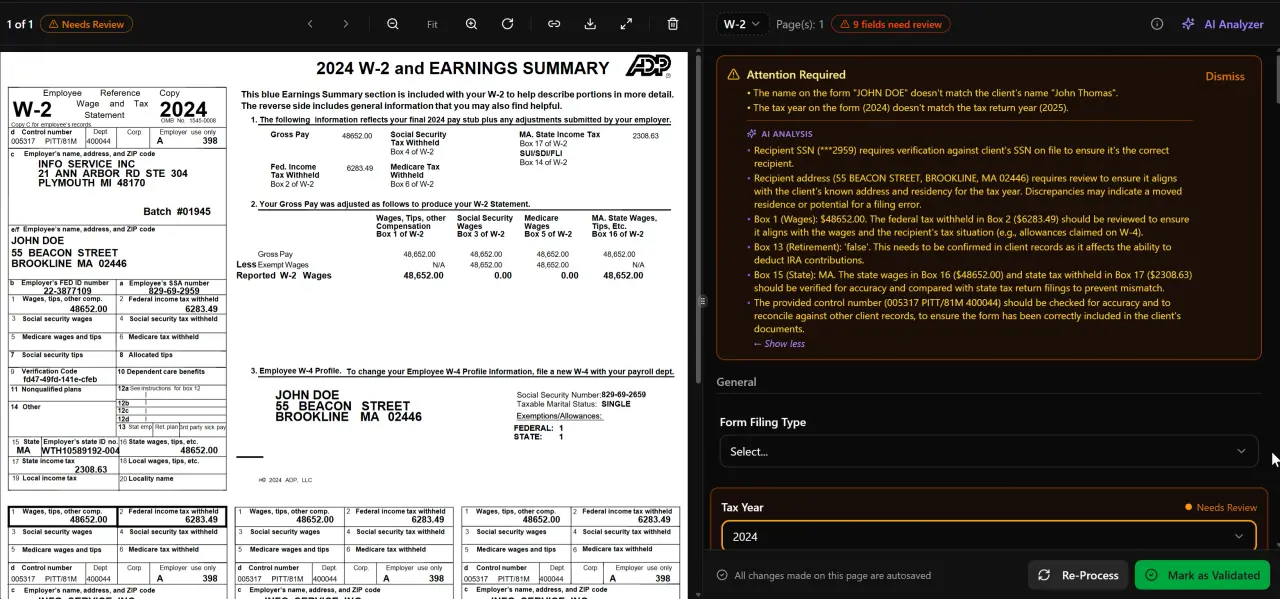
AI classifies, extracts, and validates every document automatically
Section 530 Relief: The Safe Harbor CPAs Underuse
Section 530 of the Revenue Act of 1978 provides employment tax relief when a business has a reasonable basis for treating workers as independent contractors, even if the IRS later determines the workers were employees. This is not a classification defense — it is a penalty-relief mechanism that can eliminate the employment tax liability that would otherwise attach on reclassification. IRS Publication 1976 explains the three reasonable-basis standards: reliance on a judicial precedent or IRS ruling, past IRS audit findings that did not reclassify similar workers, or long-standing industry practice. Worker classification for CPAs sits at the center of this decision — get it wrong and the rest unravels.
To qualify for Section 530 relief, the business must also meet two consistency requirements. First, it must have filed all required Form 1099s for the workers in question. Second, it must have treated all workers in substantially similar positions as independent contractors — you cannot claim relief for contractor A while treating identical-role contractor B as an employee. When firms revisit their worker classification for CPAs priorities, the gaps usually surface here.
The advisory opportunity here is significant and almost entirely unmonetized by most CPA firms. Section 530 relief can be raised as an affirmative position in an IRS employment tax examination, but the documentation must pre-exist the audit. That means CPAs who proactively gather industry-practice evidence, review prior audit histories, and document the reasonable-basis analysis during engagement onboarding can position Section 530 as a standing shield — not a last-minute argument. This is precisely the kind of service that justifies a recurring advisory fee rather than a one-time compliance charge. See our flat-fee billing guide for how to structure and price these repeatable advisory workflows.
Critically, Section 530 relief ends prospectively once the IRS issues formal guidance to a specific industry or employer. CPAs tracking new Treasury guidance for their client's industry need to flag when a previously safe harbor position becomes untenable going forward.
Tired of discovering worker classification problems only after the IRS notice arrives?
TaxScout.ai's AI research agents surface misclassification risk signals across your client base — so you can act before an examiner requests payroll records.

Click any extracted field to see its source highlighted on the original PDF
Form SS-8: When to File and When to Avoid It
Form SS-8 asks the IRS to make an official determination of a worker's status. It can be filed by either the business or the worker. The strategic implications are very different depending on who files and why.
When a worker files Form SS-8, it almost always triggers an IRS examination of the hiring business. The IRS contacts the employer, requests documentation, and renders a formal determination — a process that routinely uncovers additional misclassified workers beyond the one named in the original filing. For CPAs advising business clients, an unsolicited SS-8 filed by a departing contractor is a five-alarm signal that requires immediate response planning.
Proactive SS-8 filings by the business itself are rarer but strategically defensible in specific situations: when a business genuinely cannot determine classification under the common law test, when the industry lacks clear precedent, or when the client wants a documented IRS blessing before scaling a contractor-heavy model. The risk is that a formal IRS determination locks in the answer and eliminates the ambiguity that sometimes works in the client's favor. For most clients, the better approach is building a well-documented classification analysis internally rather than inviting a formal IRS ruling.
CPAs should document the SS-8 risk conversation in the engagement file. If a client self-classifies over your written objection, that documentation matters — both for Section 530 positioning and for your own professional liability exposure. Review our guidance on professional liability for CPAs and how documentation disciplines protect the firm.
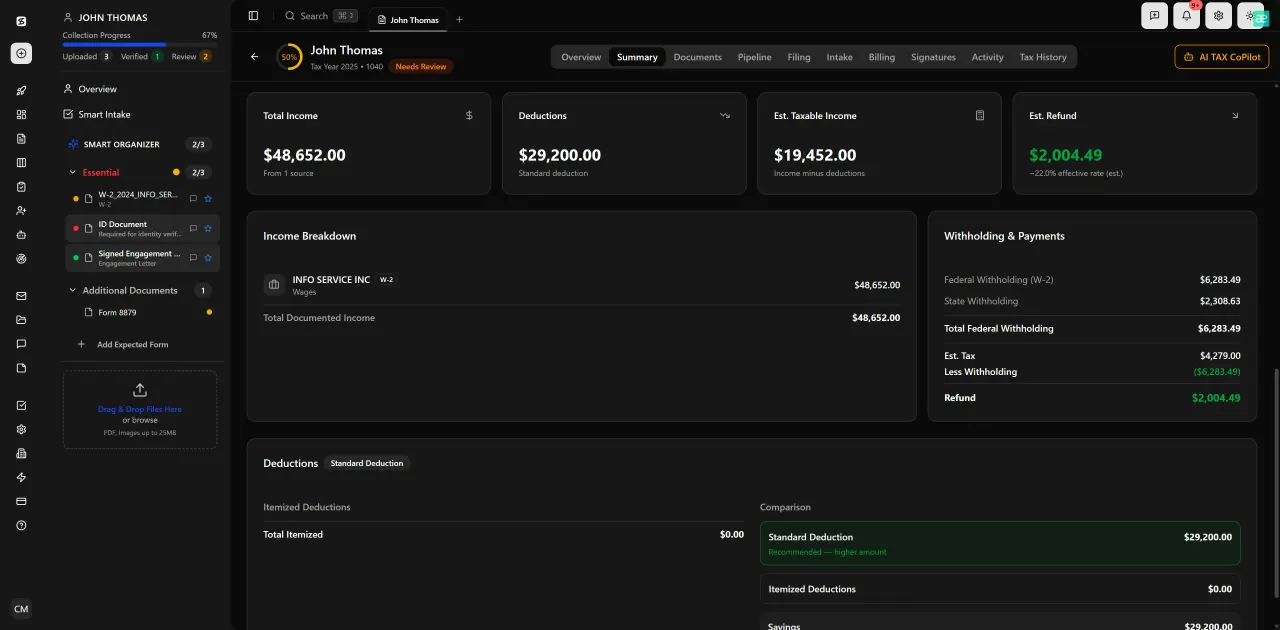
Review with AI assist — 9 agents answer questions with full client context
Misclassification Penalties and Audit Defense Strategy
The financial exposure from misclassification is substantial. Under IRC Section 3509, reduced rates apply when the employer did not intentionally disregard the law — typically 1.5% of wages for income tax withholding and 20% of the FICA employee share. When intentional disregard is found, the full withholding and FICA amounts apply, and the Trust Fund Recovery Penalty can attach liability personally to officers and responsible parties.
Beyond the tax itself, interest accrues from the original due date, and the IRS can reach back three years under the standard statute of limitations — or six years if more than 25% of gross income was omitted. IRS guidance on employment tax examinations outlines the examination process, including the industry-specific programs that have targeted construction, healthcare, and staffing industries for worker classification audits.
Audit defense begins with the quality of your client's contemporaneous documentation, not the arguments assembled after a notice arrives. Classification rationale documented at the time of engagement — written contracts with independent-contractor-consistent terms, evidence of multiple clients, records of equipment ownership, invoices — is far more credible than reconstructed evidence assembled years later. CPAs building a classification defense workflow into client onboarding materially improve audit outcomes.
When an examination does commence, the sequence matters: assess whether Section 530 applies before engaging on the merits of the classification question. If Section 530 applies, the IRS cannot collect employment taxes for the disputed period — the relief is complete. Starting with the merits of the common law analysis before raising Section 530 is a common strategic error that can waive the stronger argument.

Your clients see your brand — OTP login, document upload, and real-time status
CPA Liability When Clients Self-Classify Incorrectly
The professional liability dimension of worker classification is one of the most underappreciated risks in a CPA practice. When a client classifies workers as independent contractors and you prepare their 940, 941, and business returns without flagging the classification risk in writing, you may be implicitly endorsing a filing position you never formally evaluated. If an examiner later reclassifies those workers, the client's first question is often whether the CPA should have caught it.
State CPA licensing boards and professional liability carriers increasingly scrutinize whether firms had documented procedures for identifying misclassification risk. An engagement letter that explicitly carves out responsibility for worker classification determinations — and a file note documenting what the client was told — provides meaningful protection. Firms that say nothing create ambiguity about whether classification advisory services were in scope.
This is not a theoretical concern. Journal of Accountancy has documented cases where malpractice claims arose from CPA firms preparing returns for clients later found to have systemically misclassified workers, particularly in industries like construction, home health, and platform-based gig businesses. The defensive posture is simple: document the classification question was considered, advise the client of the risk, and get acknowledgment of the client's decision in writing.
For firms that want to transform this liability exposure into a revenue-generating service, the niche pricing strategy guide covers how CPAs in high-risk-industry specialties can build audit-defense retainers that clients actually pay for — because they understand the stakes.
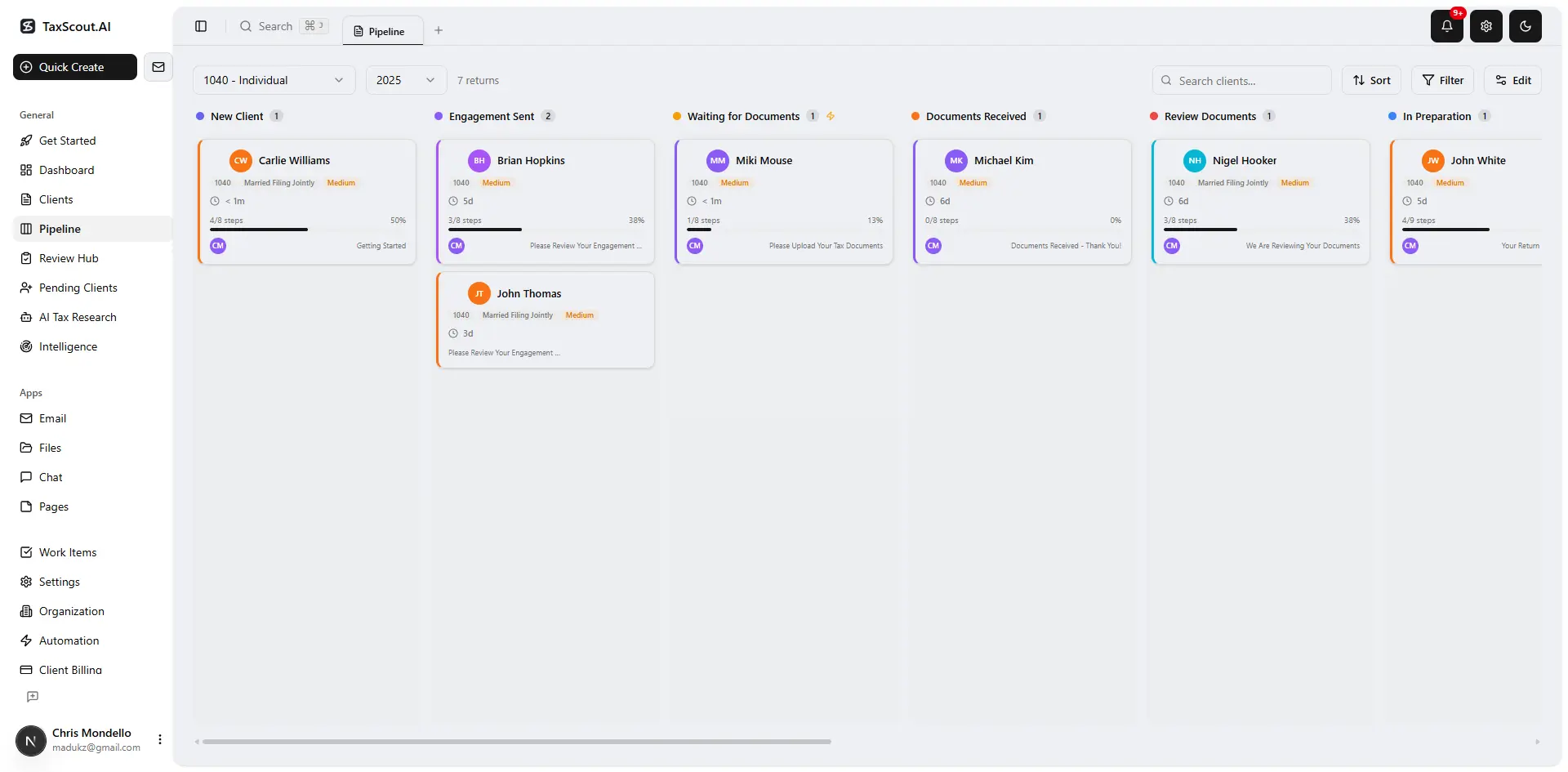
Track every return from intake to filed with drag-and-drop pipeline management
AI-Native Tools and Worker Classification Risk Triage
The manual challenge in worker classification advisory is scale. A firm with 200 business clients cannot review every contractor relationship every year. The clients who present the highest misclassification risk — those with large mixed workforces, inconsistent 1099 filing histories, industries under IRS examination focus, or rapid contractor-count growth — need to be surfaced automatically rather than discovered reactively.
This is where AI-native practice management changes the workflow. TaxScout.ai's AI research agents can be directed to monitor IRS guidance, Treasury announcements, and industry-specific audit initiatives that signal heightened classification scrutiny for specific client types. Rather than manually checking IRS guidance for every client's industry, the agents surface material developments and flag affected clients in your pipeline.
The AI document extraction layer processes 1099-NEC and W-2 documents through a 5-layer validation pipeline — including cross-document validation that can surface inconsistencies like a worker receiving both a 1099-NEC and a W-2 from the same entity in the same year, a pattern that is both a red flag for classification confusion and a common audit trigger. Our related guide on 1099-NEC vs 1099-MISC distinctions covers why accurate form selection is itself a classification signal.
Client-context AI memory retains entity structures, workforce profiles, and prior-year filing patterns. When a client's contractor headcount doubles year-over-year, or when 1099 payments to a single recipient exceed wage thresholds that would be unusual for a true independent contractor, the system can flag the engagement for CPA review before the return is filed — not after an IRS notice arrives. This transforms worker classification from a reactive problem into a systematic, documentable advisory discipline. You can also browse other blog resources on building AI-powered compliance workflows into your practice.
Workflow comparison: Reactive vs. AI-assisted worker classification advisory
| Workflow Step | Traditional CPA Approach | AI-Assisted Approach (TaxScout.ai) |
|---|---|---|
| Risk identification | Discovered during IRS examination or client call | AI flags mixed-workforce clients and 1099/W-2 anomalies at document intake |
| IRS guidance monitoring | Manual review when CPA remembers to check | 9 AI research agents monitor IRS, Treasury, and Cornell Law for classification guidance changes |
| Documentation | Reconstructed after audit notice | Classification rationale captured in client-context memory and engagement file during onboarding |
| Section 530 readiness | Assessed under audit pressure | Reasonable-basis evidence gathered proactively during annual advisory review |
| Form SS-8 response | Ad hoc, high-stress triage | Pipeline stage flags SS-8 triggers; prior returns and contractor records accessible instantly |
| Firm liability protection | Generic engagement letter carve-out | Written classification advice documented in client portal with e-signature acknowledgment |
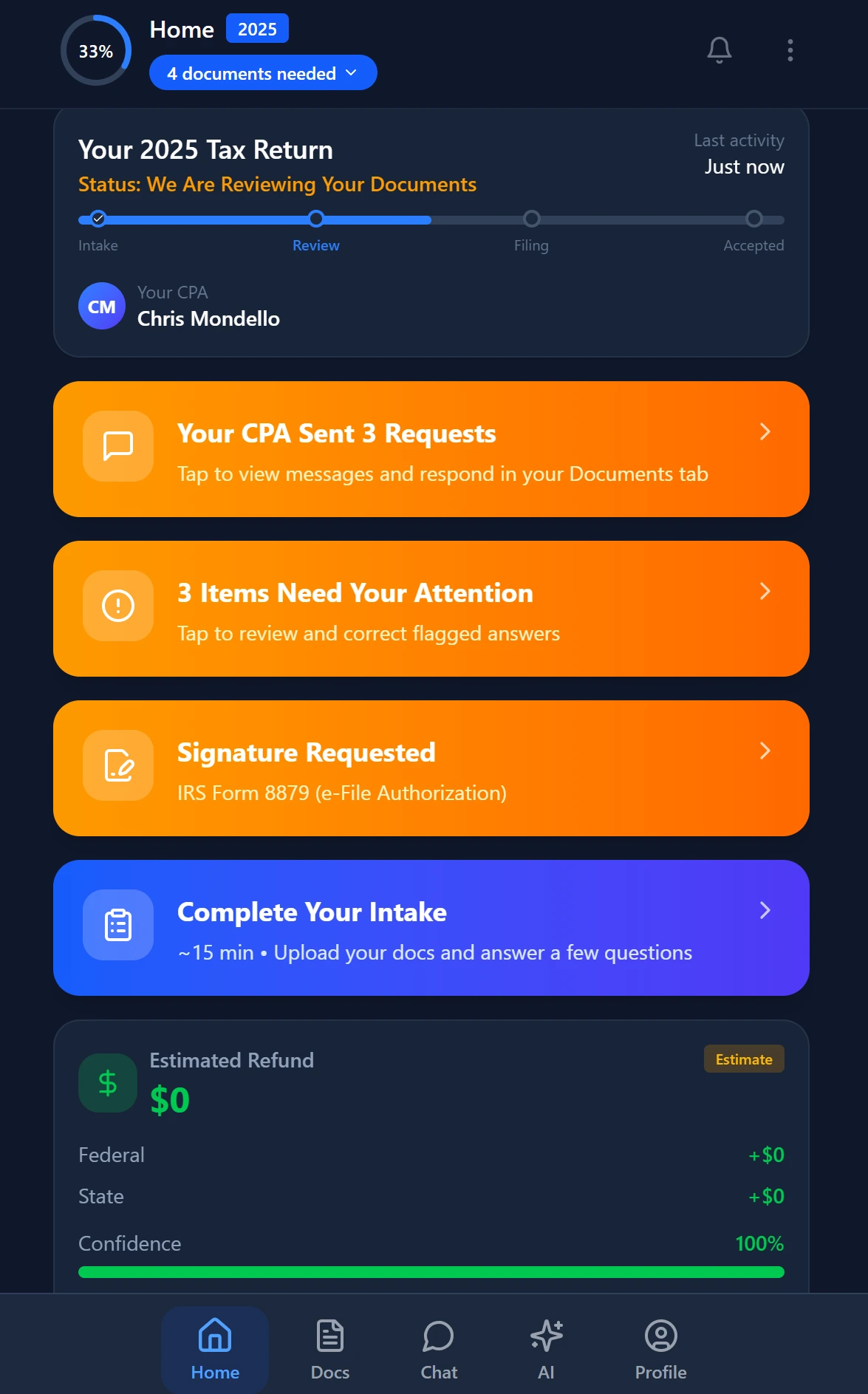
Smart intake auto-fills from uploaded documents and prior-year data

Every client gets organized documents, status tracking, and a complete history
Building a Repeatable Classification Advisory Service
The firms that generate the most value from worker classification expertise are not those who handle it better in audits — they are the ones who have productized the annual review into a standing engagement. The components are straightforward: an annual workforce classification review, a written analysis memo for the client file, a Section 530 readiness assessment, and 1099 consistency verification before year-end filing.
Priced as a fixed annual add-on to the business tax engagement, this service typically justifies a $500 to $2,500 fee depending on workforce complexity — far less than the cost of a single IRS employment tax examination response. Because the documentation produced also protects the CPA firm's own liability position, the economics work in both directions.
Delivery infrastructure matters. The client portal can collect contractor questionnaires and classification documentation directly from the business client. E-signatures via the platform capture the client's acknowledgment of classification advice in a legally enforceable record. The pipeline management workflow with 12 customizable stages lets you build a dedicated Classification Review stage that triggers each fall — before W-2 and 1099 decisions are locked.
For the IRS reporting side, the annual 1099 threshold changes make 1099-NEC accuracy an increasingly visible audit trigger. A classification advisory service that also ensures 1099 completeness and accuracy positions your firm as the proactive advisor rather than the one explaining problems after the fact.
Want to turn worker classification risk into a recurring advisory service your clients actually pay for?
TaxScout.ai gives your firm AI research agents, client-context memory, and an e-signature workflow to deliver and document classification advisory at scale — for one flat monthly price with no per-user fees.
Frequently Asked Questions
The IRS uses a common law test organized around three categories: behavioral control (does the business direct how work is performed?), financial control (does the worker have investment, profit/loss risk, and other clients?), and type of relationship (are there benefits, a permanent arrangement, and is the work integral to the business?). No single factor is determinative — the IRS weighs the totality of the relationship. IRS Publication 15-A provides the full multi-factor framework.
Keep reading
Backdoor Roth IRA: How CPAs Execute the Strategy Without Triggering Pro-Rata Tax
Oct 12, 2026 · 1 min read
Amended FBAR Procedures: How CPAs Correct Foreign Account Errors Without Triggering Penalties
Oct 12, 2026 · 1 min read
Transparency in Coverage Final Rules: What CPA Firms Must Do Now
Oct 12, 2026 · 1 min read
Stay up to date
Get the latest tax tech insights delivered to your inbox.