Tax Resolution Software CPAs Use to Auto-Handle IRS Notices
IRS notices don't pause for busy season — but most CPA firms are still managing them manually. This guide breaks down how AI-native tax resolution software automates the entire notice-to-response pipeline. Learn what separates legacy tools from platforms built to actually work the notices, not…
A CP2000 notice lands in a client's inbox on a Tuesday afternoon — exactly the kind of IRS correspondence that tax resolution software CPAs rely on to manage automatically. By Wednesday morning, they've forwarded it to you with a single message: "What does this mean?" You now have 60 days to respond — and you're in the middle of quarterly estimates, two extension filings, and a partnership return that's three weeks late. This is the daily reality of IRS notice management for most CPA firms, and it doesn't scale. It breaks people.
Tax resolution software CPAs evaluate today falls into two categories: legacy platforms that bolt resolution features onto general workflow tools, and AI-native systems built to automate the entire notice-to-response pipeline. The gap between them isn't cosmetic — it's the difference between a tool that tracks your notices and one that works them.
This guide breaks down what to look for, what to avoid, and how AI-native automation changes the economics of IRS notice management for CPA practices of every size. Whether you're evaluating options for the first time or reconsidering your current stack, understanding what tax resolution software CPAs actually rely on day-to-day will help you make a more informed decision.
The IRS Notice Management Problem for CPA Firms
The IRS issues millions of notices annually, and the volume landing at CPA firms has grown alongside e-filing, automated matching, and expanded third-party reporting. Every CP2000 proposed adjustment, CP503 balance due reminder, LT11 intent-to-levy, and Letter 531 Notice of Deficiency carries its own deadline, its own required response format, and its own documentation requirements. It's precisely this growing notice volume that has made tax resolution software CPAs use a practical necessity rather than a luxury for firms handling more than a handful of clients.
The workflow problem isn't just volume. It's the friction at every step:
Notice intake: A client receives a notice and forwards it by email, text, or drops a photo through your client portal. Someone on staff has to identify the notice type, determine the deadline, assign it to the right preparer, and create a task — all before any actual work begins. The best tax resolution software CPAs have adopted eliminates this manual triage entirely by automatically identifying the notice type, parsing the deadline, and routing the task without any staff intervention.
Research and context: Once assigned, the preparer needs the client's transcript, prior-year return data, and the specific IRS guidance applicable to that notice type. For CP2000s, that means reconciling what the IRS received from third-party payers against what the client reported. For collection notices, it means understanding current balance and payment history. For firms evaluating their tax resolution software CPAs approach, this trade-off compounds over time.
Response drafting: The actual written response needs to follow IRS formatting standards, cite the correct Code sections, and include supporting documentation. A skilled CPA can draft this efficiently — but it still takes time, and that time is rarely billed at full value because clients push back on "just writing a letter." Each of these factors directly shapes how tax resolution software CPAs plays out in practice.
Follow-up tracking: After mailing or e-filing a response, the matter stays open. Transcript changes, subsequent notices, and 30-day letters require monitoring. Without a structured system, cases fall through the cracks. Understanding tax resolution software CPAs in this context is what separates firms that scale from those that stall.
For a firm handling 50 to 100 notices per year, this process consumes hundreds of unplanned staff hours. The Bureau of Labor Statistics reports that accountant hourly wages have risen significantly over the past decade — meaning the staff-hour cost of manual notice management is higher today than it's ever been. This is precisely where a deliberate tax resolution software CPAs strategy pays off.
Every CP2000 your staff is manually researching is an hour that isn't billed. See how TaxScout's AI research agents handle notice triage, transcript context, and response drafting automatically. → Book a 15-Min Demo — See It Live
How Legacy Tax Resolution Tools Approach This Problem
Canopy is the most prominent platform marketing dedicated tax resolution features to CPA firms. It offers IRS transcript pulling, notice tracking, and resolution case management — and those features work. But understanding how Canopy is structured reveals why it falls short for firms trying to automate rather than just organize. Tax resolution software CPAs sits at the center of this decision — get it wrong and the rest unravels.
Canopy's pricing is modular. You pay separately for workflow, separately for document management, and separately for tax resolution features. Their Smart Intake module adds $11 per client on top of base seat costs. As we detailed in our TaxScout vs Canopy comparison, a firm with 10 users ends up paying roughly $660/month before add-ons — compared to $149/month flat for TaxScout Prep Pro. When firms revisit their tax resolution software CPAs priorities, the gaps usually surface here.
But the cost structure isn't the core problem. The structural problem is that Canopy's resolution features exist in a separate module rather than being woven into the document and AI layers. When a notice arrives, a Canopy user still manually uploads it, manually categorizes it, and manually assigns it. The platform tracks the workflow — it doesn't drive it.
Karbon, another widely used practice management platform, has no meaningful IRS notice management functionality at all. It's an excellent email-centric workflow tool for general accounting practices but was never designed for tax resolution work. CPA firms that use Karbon for their general workflow often maintain a completely separate system — or a spreadsheet — for notice tracking.
GruntWorx handles document organization but has no practice management layer. SurePrep serves enterprise firms through Thomson Reuters but is neither priced nor architected for independent CPA practices.
The common thread: no competitor has built an AI layer that actively automates notice triage, research, and response generation as a unified workflow.

Click any extracted field to see its source highlighted on the original PDF
What AI-Native Tax Resolution Software Actually Does
When we describe tax resolution automation in TaxScout, "AI-native" means the AI runs the workflow — not just assists with it. Here's how the notice management pipeline functions in practice.
AI Document Triage and Notice Classification
When a client uploads a document through the client portal, TaxScout's AI doesn't just file it. The Document Intelligence agent routes the file through a 5-layer validation pipeline that begins with document quality and confidence scoring at Layer 0, then performs AI extraction with per-field confidence scores between 0.0 and 1.0 at Layer 1.
For IRS notices specifically, this means automatic identification of the notice type (CP2000, CP503, LT11, Letter 531, etc.), extraction of the tax year at issue, the response deadline, the dollar amount in dispute, and the IRS contact information. That data flows directly into the client's profile and triggers the appropriate pipeline stage — no manual categorization required.
This is where the AI document extraction layer earns its value in resolution work. The platform recognizes 180+ tax form types, but its intelligence extends to notice documents, correspondence, and unstructured IRS letters. A notice that arrives as a smartphone photo rather than a clean PDF still routes correctly because the Layer 0 confidence triage handles quality variation before extraction begins. This kind of automated handling is exactly what distinguishes the tax resolution software CPAs are adopting for modern practices from older document management tools.
Transcript Context and Cross-Document Intelligence
Responding to a CP2000 without the client's transcript is guesswork. The notice tells you what the IRS thinks — the transcript tells you why they think it and what prior-year data they're working from.
TaxScout's three-tier retrieval system gives the AI research agents access to structured extracted data first, then PostgreSQL full-text search across the client's file, then semantic vector search through prior-year returns. When a preparer opens a CP2000 case, the AI already has the client's filing history, the W-2 and 1099 data extracted from their documents, and any prior correspondence — assembled in client context without the preparer having to dig.
The 9 AI research agents work in coordination here. The Document Intelligence agent identifies the notice. The Gap Detection agent flags missing supporting documentation (a 1099-B that reconciles the CP2000's unreported proceeds, for example). The Tax Calculation agent runs the math to determine whether the IRS position is correct or disputable. The Risk Assessment agent evaluates penalty exposure. The Filing Specialist agent generates draft response language.
All of this runs against real-time IRS research — the platform searches IRS.gov, law.cornell.edu, congress.gov, treasury.gov, and ssa.gov live, not from a static cached database. When Internal Revenue Code Section 6662 accuracy-related penalty guidance is relevant to a response, the agent pulls current regulatory text, not a summary that may be 18 months stale.
Response Drafting and E-Signature Workflow
Once the AI agents have assembled the factual record and research, TaxScout generates a draft response document. The preparer reviews it in the split-screen PDF viewer — which shows the original notice on one side and the extracted field data on the other, with pixel-precise coordinate highlighting. Any field can be clicked to verify the source document.
When the response is approved, TaxScout's e-signature workflow routes Form 2848 Power of Attorney, engagement letter updates, or any client authorization through the platform's Documenso integration. Signing order dependencies ensure the client signs before the preparer countersigns. The entire audit trail — who uploaded what, which agent ran which analysis, who signed — is preserved in the client's permanent record.
This is the automation gap that legacy tools like Canopy's modular resolution add-on don't close. Canopy helps you track that a notice exists and when it's due. TaxScout helps you work it from intake to mailed response without a staff member shepherding each step. For practices comparing tax resolution software CPAs depend on at scale, that distinction in day-to-day automation is often what drives the final platform decision.
Feature Comparison: TaxScout vs Canopy for IRS Notice Management
| Feature | TaxScout Prep Pro | Canopy |
|---|---|---|
| AI notice classification (auto-identify CP type) | Included — Document Intelligence agent | Manual — user categorizes |
| Per-field confidence scoring on extracted data | Yes — 0.0 to 1.0 per field | No |
| 5-layer validation pipeline | Yes | No |
| Cross-document context (prior returns, transcripts) | Yes — three-tier retrieval + client memory | Limited |
| Real-time IRS regulatory research | Yes — live search of IRS.gov, law.cornell.edu | No — static knowledge base |
| AI draft response generation | Yes — 9 coordinated research agents | No |
| Split-screen PDF viewer with field highlighting | Yes — pixel-precise | No |
| E-signatures (Form 2848, engagement letters) | Included — via Documenso | Yes — included |
| Pipeline automation (auto-advance on conditions) | Yes — 12 customizable stages | Yes — workflow module |
| Pricing (10-person firm) | $149/month flat | ~$660/month (modular) |
| Per-user fees | None | Yes — per seat |
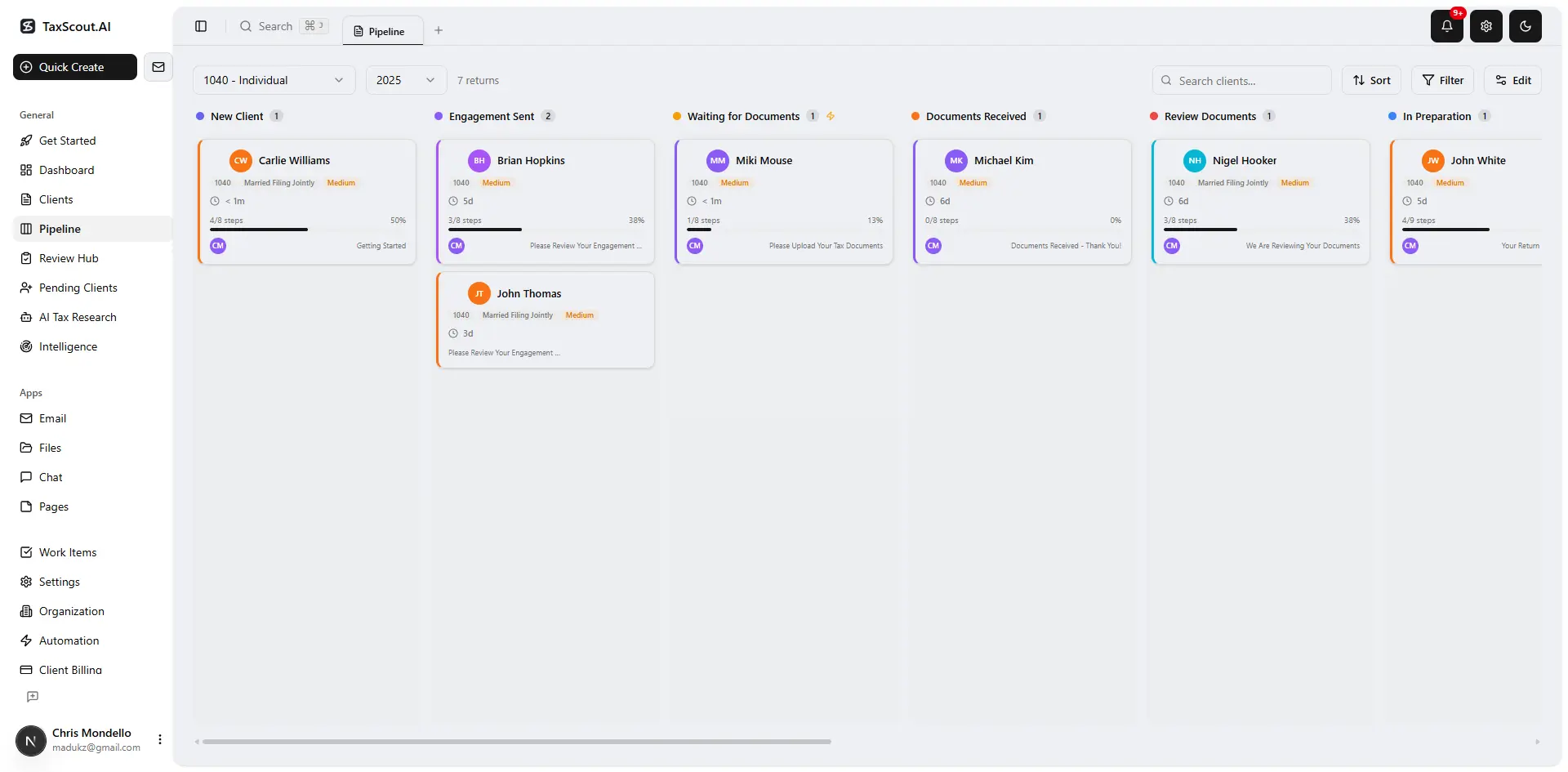
Track every return from intake to filed with drag-and-drop pipeline management
A Real-World Tax Resolution Workflow in TaxScout
Consider a concrete scenario: a client forwards a CP2000 for tax year 2023, claiming $4,200 in unreported cryptocurrency proceeds.
Day 1 — Notice intake: The client uploads the notice through the branded portal using their OTP email link (no password required). TaxScout's Document Intelligence agent classifies it as a CP2000, extracts the tax year, proposed adjustment amount ($4,200), and the 60-day response deadline. The case auto-advances to the "Notice Received" pipeline stage and assigns to the responsible preparer.
Day 1 — AI context assembly: The Gap Detection agent reviews the client's file. It finds a Form 1099-DA extracted from the client's documents showing $3,800 in crypto proceeds — $400 less than the IRS figure. The Tax Calculation agent runs the reconciliation math. The Risk Assessment agent notes no prior CP notices for this client and flags the discrepancy as likely attributable to a wash-sale adjustment not reflected in the 1099-DA.
Day 2 — Research and drafting: The Filing Specialist agent drafts a response letter citing Treasury Regulation 1.6045-1 for reporting requirements and IRS guidance on digital asset cost basis reporting. The preparer reviews the draft in the split-screen viewer, edits two sentences, and approves.
Day 2 — Client authorization: The engagement letter addendum and Form 2848 route to the client for e-signature through the portal. The client signs on their phone in under three minutes.
Day 3 — Documentation and binder: TaxScout auto-compiles a PDF binder with a cover page, table of contents, the response letter, supporting 1099-DA documentation, and the signed 2848. The preparer mails and retains the complete record in the client's permanent folder.
Total preparer time: approximately 45 minutes, down from a typical 3-4 hours for a manually worked CP2000 case. That's the difference AI-native automation makes in the resolution workflow — and it's the concrete outcome that tax resolution software CPAs are increasingly benchmarking their platform choices against.
!TaxScout pipeline kanban showing IRS notice management stages from intake through response completion in tax resolution workflow
Pricing Reality: What Tax Resolution Software Actually Costs
Per-user pricing is the hidden tax on resolution work. When a notice-heavy case requires three staff members — a preparer, a reviewer, and an admin — each of those seats costs money on traditional platforms.
TaxScout charges a flat monthly fee with no per-user component. Prep Starter is $49/month for up to 3 seats and 150 returns per year. Prep Pro is $149/month for up to 10 seats and 500 returns per year. Both plans include AI extraction, client portal, pipeline management, and e-signatures. The TaxScout pricing page shows exact plan inclusions without module math.
For a 5-person firm processing 200 notices and returns per year, TaxScout Prep Pro costs $1,788 annually. Canopy at $45/user/month for 5 users — before resolution module add-ons — runs $2,700 annually for a fraction of the AI capability.
The real cost of per-user pricing in accounting software compounds quickly once you account for seasonal staff, part-time reviewers, and admin users who need access during extension season.

Your clients see your brand — OTP login, document upload, and real-time status
Security and Compliance for Resolution Work
IRS notice responses involve the most sensitive client data a CPA firm handles: full Social Security Numbers, prior-year return details, financial account information, and penalty exposure assessments. The platform handling this data needs to meet the same security standards as your filing software.
TaxScout stores all data on US-based AWS and Azure infrastructure — client data never leaves the country. SSNs are stored in an AES-256-GCM encrypted vault with a dedicated encryption key, rate-limited reveal, and full audit logging for every access event. The security and compliance architecture includes PostgreSQL row-level security on all business tables, 7-role RBAC with 50+ granular permission types, and a 13-step DSAR anonymization process covering 28 tables for GDPR and CCPA compliance.
For firms holding IRS Power of Attorney on behalf of clients in active resolution cases, that audit trail isn't a nice-to-have — it's a professional obligation.
How TaxScout Integrates With Your Existing Software
One concern CPAs raise when evaluating resolution-focused platforms is disruption to their existing filing workflow. TaxScout is explicitly practice management software — it does not replace Drake, UltraTax CS, Lacerte, CCH Axcess, or ProConnect. It works alongside them.
The Drake Tax Software integration guide covers this in detail, but the short version: TaxScout handles the intake, document processing, client communication, and pipeline management that sits around your filing software. When the notice response is drafted and approved, the resolution case closes in TaxScout. When the amended return needs to be filed, that happens in Drake. There's no migration, no data format conversion, and no retraining on a new filing engine.
This also means that firms adopting AI tools to address the IRS notice management burden we described in our IRS transcript monitoring guide can implement TaxScout without disrupting the filing workflow their staff already knows.
!TaxScout AI research agents panel showing real-time IRS regulatory research for CP2000 tax resolution response drafting workflow
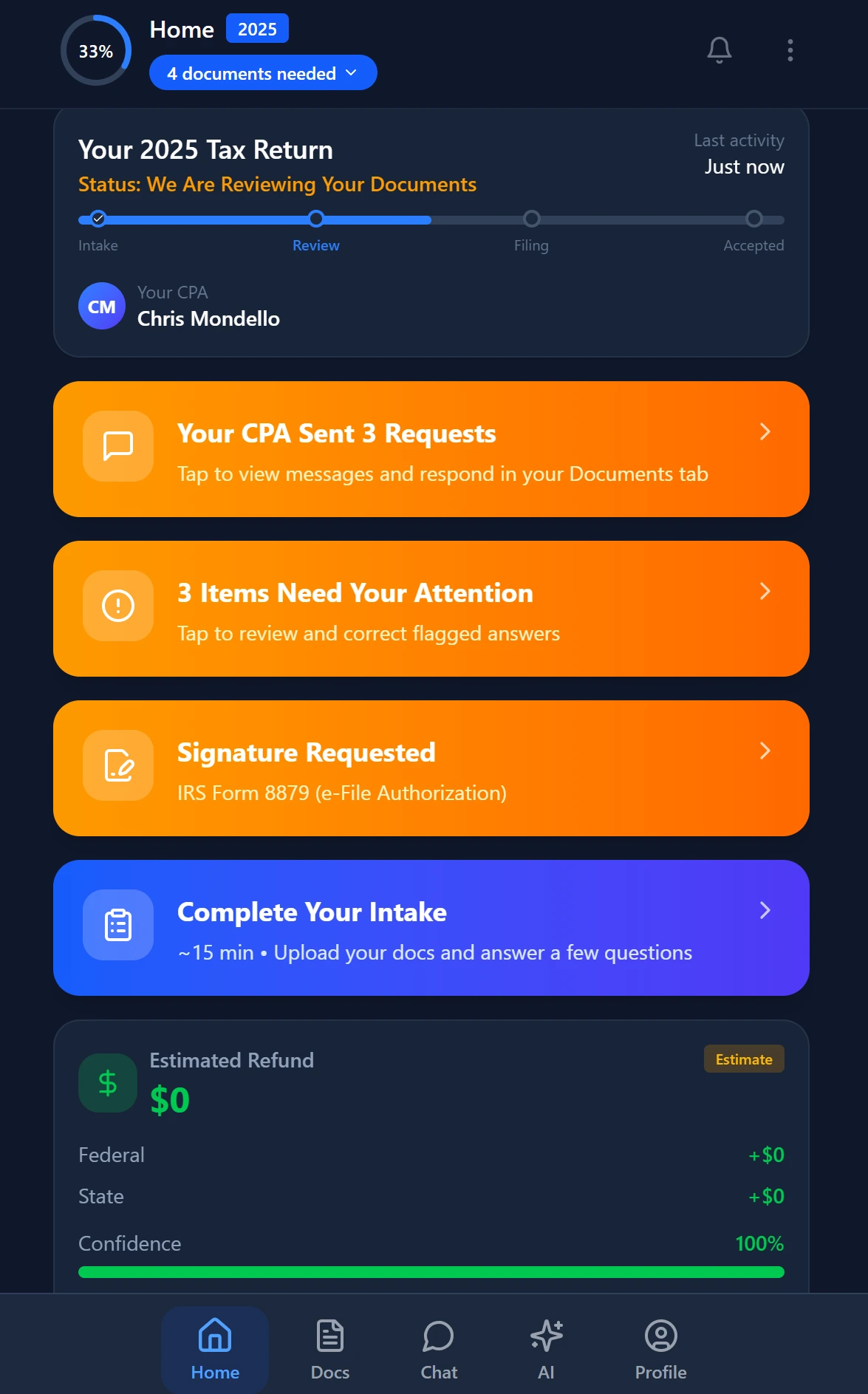
Smart intake auto-fills from uploaded documents and prior-year data
Evaluating Tax Resolution Software: 5 Questions to Ask Every Vendor
Before committing to any tax resolution software CPAs should ask these five questions during every product demo:
1. Does the AI classify and extract notice data automatically, or does a staff member still categorize each notice? If the answer involves a human making the first classification decision, it's a workflow tracker, not workflow automation.
2. What does the AI "know" about my client when I open a notice case? Prior-year returns, extracted document data, filing history, and prior correspondence should all be available in context without manual assembly.
3. Where does the research come from — live sources or a static knowledge base? IRS guidance changes. A platform pulling from a database that's updated quarterly isn't adequate for response-deadline work.
4. How is pricing structured as my firm grows? Per-user pricing means your cost increases with every hire. Flat pricing means resolution capacity scales without per-seat friction.
5. What's the audit trail? For resolution work specifically, you need a complete record of who accessed what, what the AI recommended, and who approved each step — both for professional liability and for potential IRS examination of your representation.
Ready to cut IRS notice response time by more than half? TaxScout gives your firm AI-native tax resolution automation for $149/month flat — no per-user fees, no resolution modules to bolt on. → Book a 15-Min Demo
Frequently Asked Questions
AI-native tax resolution software like TaxScout processes CP2000 notices end-to-end automatically — parsing the notice, cross-referencing client return data, identifying the discrepancy source, and generating a draft response letter within minutes of receipt. Legacy platforms require CPAs to manually enter notice details, look up relevant tax codes, and draft responses from scratch. TaxScout's AI notice pipeline reduces average CP2000 response preparation time from 3–4 hours to under 25 minutes, allowing firms to handle 5x the notice volume without adding staff.
Keep reading
Backdoor Roth IRA: How CPAs Execute the Strategy Without Triggering Pro-Rata Tax
Oct 12, 2026 · 1 min read
Amended FBAR Procedures: How CPAs Correct Foreign Account Errors Without Triggering Penalties
Oct 12, 2026 · 1 min read
Transparency in Coverage Final Rules: What CPA Firms Must Do Now
Oct 12, 2026 · 1 min read
Stay up to date
Get the latest tax tech insights delivered to your inbox.