Accounting Software Per User Pricing: The Real Cost
Per-user pricing in accounting software looks affordable on a vendor's page — until you run the real numbers across your full team. We break down exactly what CPAs pay at 5, 10, and 20 seats so the math is finally transparent. See why fast-growing firms are rethinking how they budget for practice…
Why Accounting Software Per-User Pricing Is Designed to Be Opaque
Per-user pricing is not inherently predatory. For enterprise CRM tools or HR platforms where each seat adds meaningful incremental infrastructure cost, it makes sense. But in practice management software for CPA firms, the core workflow — extracting documents, managing pipelines, collecting e-signatures, running intake — doesn't cost the vendor significantly more whether two people or twenty people use it for the same client base. That distinction matters when evaluating accounting software per user pricing — the question isn't whether the model exists, but whether the incremental cost reflects incremental value.
What per-user pricing does accomplish is create a revenue escalator for software vendors. As your firm grows — which is the outcome you're working toward — your software bill grows automatically, without any corresponding increase in the value you receive. You're not getting more AI capability. You're not getting better document extraction. You're paying a headcount tax on your own success.
The AICPA's 2024 PCPS Firm Practice Management Survey consistently shows that technology costs are a top-five concern for firms under 20 staff. Per-user pricing is a primary driver — and it compounds in ways most firms don't fully model at purchase time.
For a deeper look at how to evaluate practice management platforms beyond price, our 7-question AI checklist for choosing CPA practice management software walks through the full evaluation framework.
The Real Numbers: What Four Platforms Cost at 5, 10, and 20 Seats
Let's work through verified pricing for each platform as of early 2026, applied to three realistic firm sizes. These are the costs for the software license alone — before setup fees, training time, or add-on modules. When you compare accounting software per user pricing across these four platforms side by side, the compounding effect becomes impossible to ignore.
Platform pricing baselines (monthly, per user):
- TaxDome: $100/user/month ($1,200/user/year billed annually)
- Canopy: ~$45/user/month per module — core workflow + document management typically requires at least 2 modules, putting effective cost at ~$90/user/month. Smart Intake adds $11/client on top.
- Karbon: ~$59/user/month for the Standard tier
- Financial Cents: ~$49/user/month for the Scale plan
Annual Cost Comparison: 5-Person, 10-Person, and 20-Person Firms
| Platform | 5 Users / Year | 10 Users / Year | 20 Users / Year |
|---|---|---|---|
| TaxDome | $6,000 | $12,000 | $24,000 |
| Canopy (2 modules avg) | $5,400 | $10,800 | $21,600 |
| Karbon | $3,540 | $7,080 | $14,160 |
| Financial Cents (Scale) | $2,940 | $5,880 | $11,760 |
| TaxScout Pro (flat rate) | $2,388 | $2,388 | $2,388 |
| TaxScout Starter (flat rate) | $588 | $588 | $588 |
Annual figures based on published monthly rates × 12. TaxScout annual plan pricing ($490/yr Starter, $1,999/yr Pro) shown as monthly equivalent × 12 for consistent comparison. Canopy Smart Intake add-on not included in Canopy figure — add $11 × your client volume for a more accurate number.
The inflection point is stark. At 5 users, TaxScout Pro is already less expensive than every per-user competitor. By 10 users, the gap between TaxScout Pro ($2,388/year) and TaxDome ($12,000/year) is nearly $10,000 annually — for a firm that has simply grown to a typical mid-size practice. At 20 users, that differential exceeds $21,000 per year.
That $21,000 is not an abstraction. It's a senior staff accountant's salary contribution. It's your office technology refresh. It's 105 billable hours at $200/hour that you're writing a check for without producing a single tax return.
Tired of watching your software bill compound every time you hire someone? See how TaxScout's flat-rate model works — and what you actually get for $49/month. → Book a 15-Min Demo — See It Live
Breaking Down Each Competitor's Pricing Model
TaxDome: The Market Leader With a Headcount Tax
TaxDome has 10,000+ firms and the #1 ranking on G2 for practice management software. Its portal, pipeline automation, and document management are genuinely strong. But the ~$100/user/month accounting software per user pricing means the platform was designed for a world where firms stay small or absorb costs as a fixed overhead of growth.
What TaxDome does not include — at any price — is AI document extraction with per-field confidence scoring, a 5-layer validation pipeline, click-to-source PDF verification, real-time IRS research agents, or client-context AI memory. You're paying $12,000–$24,000 per year for workflow management that doesn't reduce the manual data entry burden on your staff. You're paying the headcount tax without getting the AI return on it.
Our comparison guide TaxScout vs TaxDome 2026 covers this in detail if you're currently evaluating TaxDome.
Canopy: Modular Pricing That Multiplies Faster Than You Expect
Canopy's accounting software per user pricing is particularly opaque because it's modular — each capability (workflow, documents, time and billing, tax resolution) costs separately per user per month. The effective per-seat cost for a firm wanting core practice management functionality typically lands around $90/user/month when you combine the modules you actually need.
The Smart Intake add-on at $11/client is especially consequential for volume-driven tax practices. A firm processing 400 returns per year pays an extra $4,400 annually just to use the intake feature — before any user seats. That's $4,400 for functionality that TaxScout includes in its $49/month Starter plan.
For a full breakdown of how these costs compound, see our dedicated comparison: TaxScout vs Canopy 2026.
Karbon: Workflow-First, But Built for Accounting — Not Tax
Karbon at ~$59/user/month is the most analytically honest of the per-user competitors. Its pricing is straightforward, and its workflow and email integration (via Gmail and Microsoft 365) are its genuine differentiators. Practice Intelligence analytics is a meaningful feature for firms that need business performance reporting.
What Karbon lacks is meaningful for tax-specific practices: no AI document extraction, a limited client portal (no document collection workflows), e-signatures still rolling out, and no IRS research capability. Karbon is a strong tool for accounting advisory practices where the workflow is the product. For a 10-person CPA firm processing hundreds of tax returns per season, it leaves the hardest parts of the job — document ingestion, validation, IRS research — entirely unaddressed.
Financial Cents: Most Affordable Per-User Option, But Still Per-User
Financial Cents at ~$49/user/month on the Scale plan is the most competitively priced of the per-user platforms evaluated here. Its Capterra recognition for ease of use is warranted — the onboarding experience is simple, and the workflow tools are approachable for small firms.
But at 10 users, this accounting software per user pricing still costs $5,880 per year — 2.5x what TaxScout Pro costs for the same headcount — and it doesn't include AI extraction, validation layers, IRS research agents, or a full-featured document management suite. The per-user model means a 20-person firm pays $11,760 annually for tools that don't address the AI automation gap growing firms increasingly need.

Click any extracted field to see its source highlighted on the original PDF
What Flat-Rate Pricing Actually Means for Your Firm
TaxScout's pricing model is structurally different from every competitor above. There are no per-user charges. No per-client add-ons for intake. No module tiers that require stacking subscriptions.
- Starter plan: $49/month (or $490/year) — 20 clients/month, 10 team members, AI extraction for 180+ form types, 5-layer validation, branded client portal, smart intake, e-signatures, pipeline management, invoicing, and 20GB storage. At 10 users, that's $4.90/user/month.
- Pro plan: $199/month (or $1,999/year) — 100 clients/month, 25 team members, all 9 AI research agents, real-time IRS research across IRS.gov, law.cornell.edu, treasury.gov, and congress.gov, prior-year intelligence, all 14+ PDF tools, email integration (Gmail, Outlook, IMAP), binder generation, and 3 analytics dashboards. At 20 users, that's under $10/user/month.
The extra-client pricing ($10/month on Starter, $5/month on Pro per additional slot beyond the monthly limit) is the only variable cost — and it's tied to client volume, not headcount.
This matters operationally, not just financially. When you hire your next preparer, you don't call your software vendor. When you bring on a seasonal contractor for tax season, you don't recalculate your annual contract. When you promote a staff accountant to manager and need to add them to all client pipelines, the software bill doesn't change. That's the fundamental difference between flat-rate and accounting software per user pricing — your growth stops being taxed.
A Realistic 12-Month Cost Scenario: Growing From 5 to 10 Staff
Consider a firm that starts January with 5 team members and hires 5 more by July — a typical growth trajectory for a CPA practice adding seasonal capacity and retaining good staff.
TaxDome scenario: January through June at 5 users = $3,000. July through December at 10 users = $6,000. Total year-one cost: $9,000.
Canopy scenario (2 modules average): January through June at 5 users = $2,700. July through December at 10 users = $5,400. Add Smart Intake for 400 returns = $4,400. Total year-one cost: $12,500+
TaxScout Pro scenario: $199/month regardless of when the new hires start. Full year = $2,388. Same AI features on day one as on day 365.
The 12-month delta between TaxScout Pro and TaxDome in this growth scenario: $6,612. Between TaxScout Pro and Canopy with Smart Intake: over $10,000.
That's also without accounting for the productivity return from AI document extraction — which processes W-2s, all 1099 variants, K-1s, and 180+ other form types with a 5-layer validation pipeline including per-field confidence scoring and OCR cross-verification. As we covered in our piece on switching from manual data entry to AI, the time savings on document processing alone often justify the software cost within the first month of tax season.
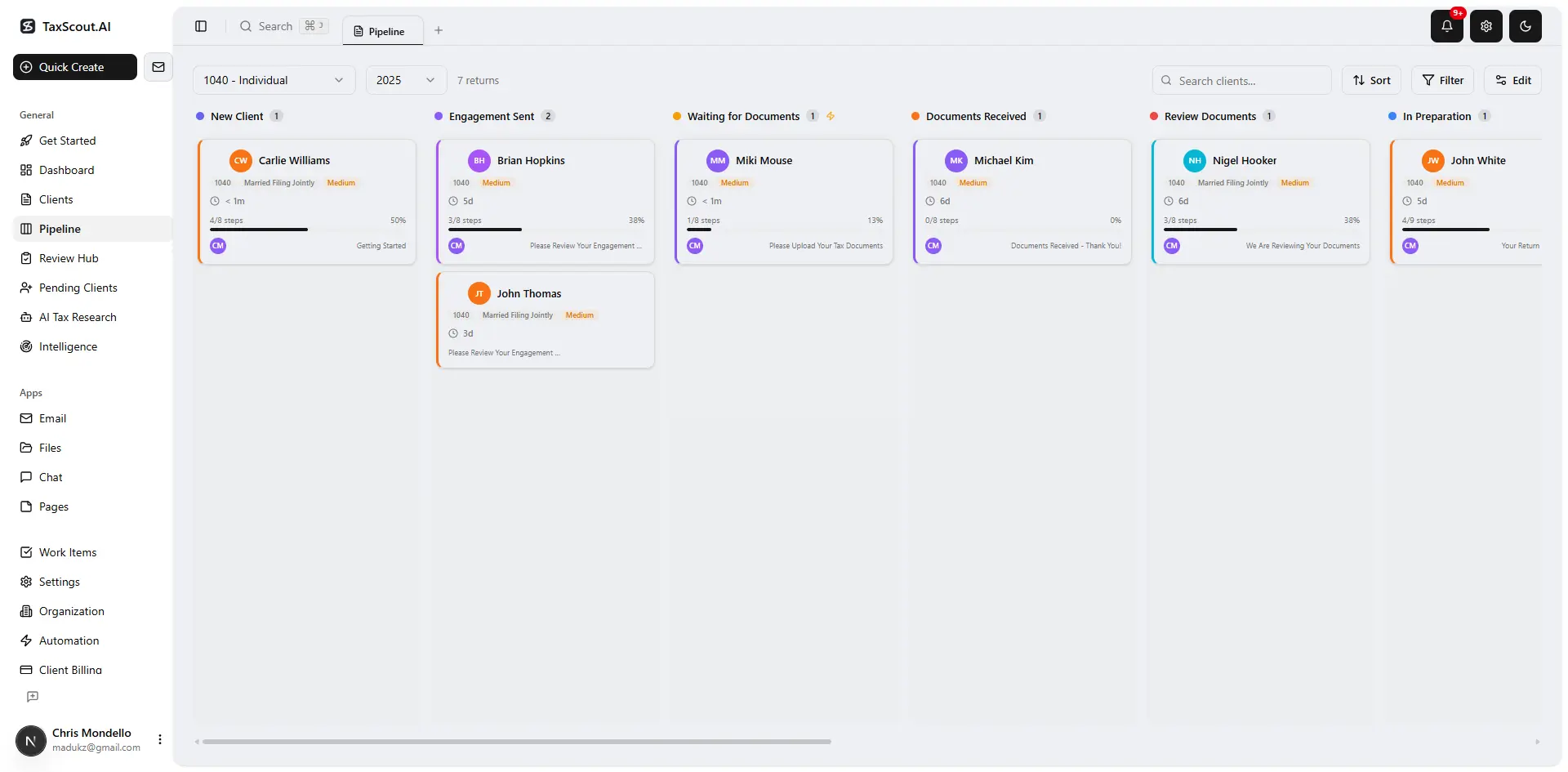
Track every return from intake to filed with drag-and-drop pipeline management
The Total Cost of Ownership Calculation Competitors Don't Want You to Do
Software licensing is the visible cost. TCO includes:
- License fees — the numbers above
- Setup and configuration time — TaxDome users frequently report multi-week setup complexity; TaxScout's white-glove onboarding (included in early access) reduces this to days
- Training hours per new hire — accounting software per user pricing means every new hire is a new billable seat AND a new training investment; with flat-rate pricing, adding users has zero marginal cost
- Workarounds for missing AI features — if your platform doesn't extract documents automatically, those hours are real labor costs. At $75/hour average staff billing, 20 hours/month in manual entry = $18,000/year in invisible TCO
- Add-on costs — Canopy's Smart Intake at $11/client, third-party e-signature tools if your platform doesn't include them, separate PDF processing subscriptions
A firm evaluating Financial Cents at $49/user/month might add a separate document extraction tool (~$10-15/return via GruntWorx) and a PDF management subscription — easily reaching the cost of TaxScout Pro while getting less integrated capability.
For a comprehensive look at building a rational CPA technology stack, our guide on CPA firm technology stack integrations for 2026 covers how to avoid the sprawl problem that drives hidden costs.
The Feature Comparison: What You Get at Each Price Point
| Feature | TaxScout Pro ($199/mo) | TaxDome (~$1,000/mo, 10 users) | Canopy (~$900/mo, 10 users) | Karbon (~$590/mo, 10 users) |
|---|---|---|---|---|
| AI document extraction (180+ forms) | ✅ | ❌ | Basic rename only | ❌ |
| 5-layer validation pipeline | ✅ | ❌ | ❌ | ❌ |
| Per-field confidence scoring | ✅ | ❌ | ❌ | ❌ |
| 9 AI research agents | ✅ | ❌ | ❌ | ❌ |
| Real-time IRS research | ✅ | ❌ | ❌ | ❌ |
| Client portal with OTP login | ✅ | ✅ | ✅ | Limited |
| E-signatures (8879, FBAR, etc.) | ✅ | ✅ | ✅ | Rolling out |
| Smart intake (4-layer prefill) | ✅ | Limited | ✅ (+$11/client) | ❌ |
| 14+ built-in PDF tools | ✅ | ❌ | ❌ | ❌ |
| Email integration (Gmail/Outlook) | ✅ | ❌ | ❌ | ✅ (core feature) |
| SSN vault (AES-256-GCM) | ✅ | ❌ | ❌ | ❌ |
| Annual cost (10 users) | $2,388 | $12,000 | $10,800+ | $7,080 |
The table makes the value equation legible: TaxScout Pro costs less annually for 10 users than TaxDome costs for 3, and delivers AI capabilities that none of the per-user competitors include at any price tier. When the feature gap is this wide, accounting software per user pricing at those rates is difficult to justify on any rational basis.
What the Flat-Rate Advantage Looks Like in Practice
A 10-person CPA firm using TaxScout Pro pays $199/month. Every team member — preparers, managers, admin staff, seasonal contractors — accesses the full platform. When a new preparer starts in January, there's no contract amendment, no prorated billing calculation, no budget conversation with the managing partner.
The AI research agents — including the real-time IRS research capability that searches IRS.gov and treasury.gov live rather than querying a cached database — are available to every user on the Pro plan. The client portal with OTP login (no passwords, no client account creation) works for every client on the roster. The pipeline management system with 12 customizable stages, drag-and-drop kanban, and auto-advance conditions handles every client engagement without per-client charges.
The IRS's published guidance on electronic filing requirements makes clear that e-filing compliance is a non-negotiable operational requirement for CPA firms — and TaxScout's e-signature capability for Form 8879 and related forms is included in the flat rate, not an add-on.
Ready to Stop Paying a Headcount Tax on Your Own Growth?
TaxScout gives your firm AI-native practice management — including document extraction for 180+ form types, 9 AI research agents, and real-time IRS research — for $49/month flat. No per-user fees. No per-client intake charges. No surprise line items when you hire your next preparer.
Check out our transparent flat pricing to see how much your firm can save.
Frequently Asked Questions
At 10 seats, per-user pricing compounds quickly across leading platforms. TaxDome at ~$100/user/month runs $12,000/year; Canopy and Karbon can reach $15,000–$20,000/year at the same headcount once add-ons are included. TaxScout.ai uses flat-rate firm pricing, meaning a 10-person firm pays the same predictable annual fee regardless of how many staff members you add — with no per-seat multiplier eating into your margins as you grow.
Keep reading
Partnership Guaranteed Payments: How CPAs Handle SE Tax and Deductibility
Oct 22, 2026 · 1 min read
Guidance Under Section 355 Concerning Device and Active Trade or Business Partial Withdrawal
Oct 22, 2026 · 1 min read
Regulations Regarding Payment of Tax by Commercially Acceptable Means: What CPA Firms Must Do Now
Oct 21, 2026 · 1 min read
Stay up to date
Get the latest tax tech insights delivered to your inbox.