Key Employee Departure Plan: What CPA Firm Owners Must Do When a Critical Staff Member Quits
When a solo or small CPA firm loses its one indispensable employee, client relationships and filing deadlines hang in the balance. This guide gives firm owners a practical key employee departure plan — from emergency triage through long-term knowledge-transfer systems — so a single resignation…
Without a key employee departure plan in place, nothing can prepare you for the moment it actually happens."A staffmember who has handled your entire document intake, built your client relationships, and kept the machine running hands in a resignation — or simply stops showing up. For solo and small CPA firm owners who have concentrated responsibility in a single trained employee, the fallout is immediate and brutal: deadlines loom, clients call, and the firm owner suddenly realizes how much institutional knowledge walked out the door.
This scenario played out publicly on r/taxpros when one owner admitted, "I put all my eggs in one employee's basket — they just quit." The replies confirmed it is far from rare. The U.S. Bureau of Labor Statistics reports that professional and business services see some of the highest quit rates in the economy, meaning any firm without a key employee departure plan is one resignation away from a crisis.
A key employee departure plan is not a luxury reserved for large firms. It is a documented set of processes, technology choices, and contingency steps that any CPA firm — even a two-person shop — can build before a departure hits. The sections below walk through every phase: immediate triage, knowledge capture, client communication, and the systemic changes that prevent the same vulnerability from recurring.
Why Single Employee Dependency Is a Structural Risk
Small accounting firms naturally concentrate expertise. The owner handles business development, and a single skilled preparer handles everything else: document collection, data entry, client callbacks, deadline tracking, and software management. This arrangement feels efficient until it collapses. The IRS Taxpayer Advocate Service regularly documents how preparation errors spike during periods of staff disruption — a cautionary signal for any firm operating lean. Without a key employee departure plan, this concentration of responsibility becomes an existential vulnerability the moment that person decides to leave.
The core problem is that critical knowledge lives in one person's head rather than in a system. Clients call that employee directly. Passwords, client preferences, filing quirks, entity structures, and prior-year notes exist in emails, sticky notes, or informal memory. When that person leaves — voluntarily or not — the firm owner is left reconstructing context from scratch while simultaneously trying to hit deadlines. A well-structured key employee departure plan addresses exactly this risk by ensuring institutional knowledge is captured in documented systems before a departure ever occurs.
Staff succession at a small CPA firm is not only a people problem; it is a technology and documentation problem. Firms that have invested in structured practice management systems — where client history, documents, and workflows live in a shared platform rather than in one employee's inbox — experience far less disruption when staff changes occur. Firms that rely on a single person's tribal knowledge experience the worst outcomes. Building that infrastructure is, in fact, one of the most practical components of any key employee departure plan.
See other blog resources on running a resilient firm, including capacity planning, billing, and AI-assisted workflows that reduce single-point-of-failure risk across the practice. For firms evaluating their key employee departure plan approach, this trade-off compounds over time.
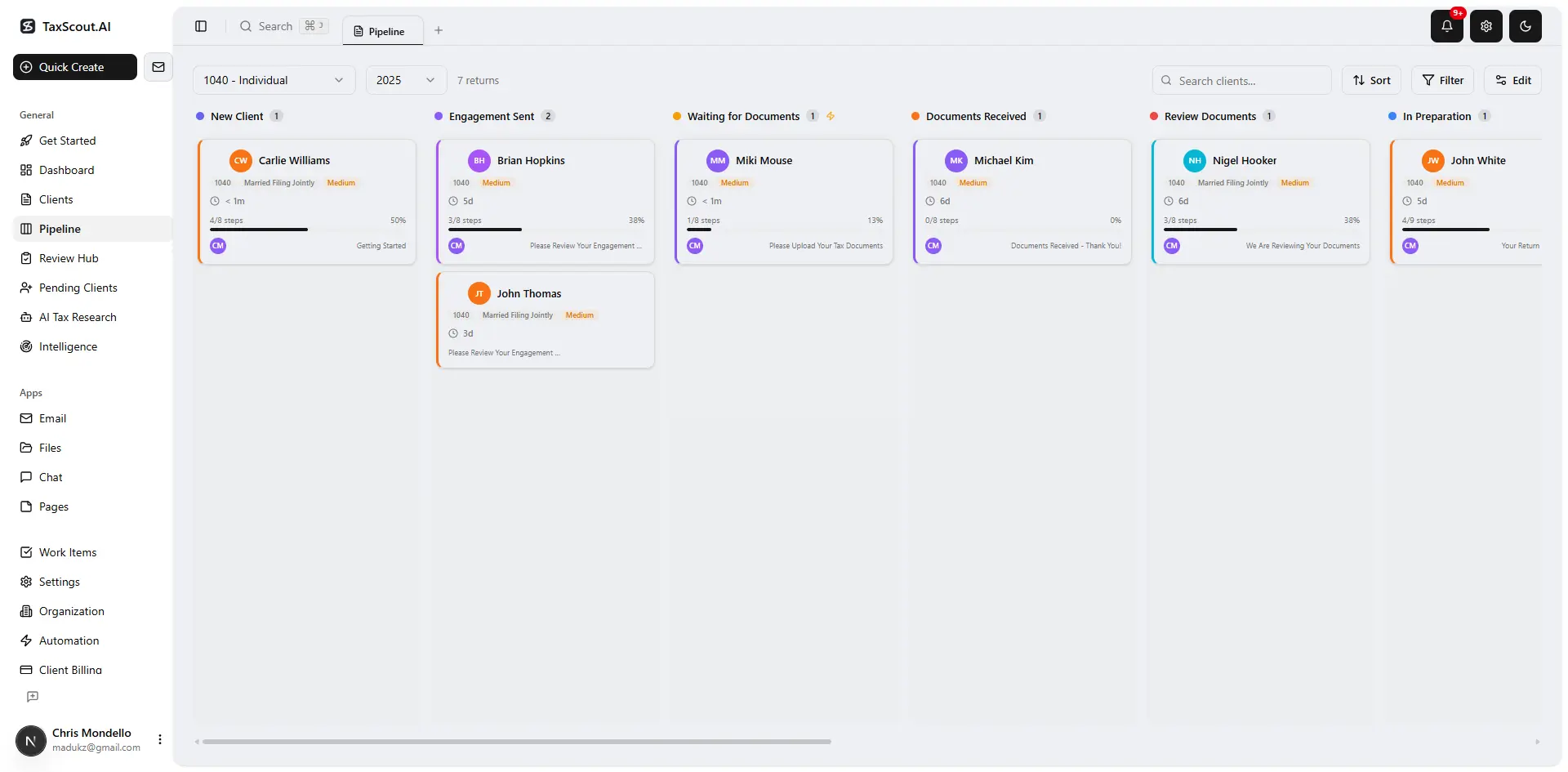
Track every return from intake to filed with drag-and-drop pipeline management
Step 1: Conduct an Immediate Knowledge Audit
The moment a critical employee announces departure — or the moment you realize they are gone — the first task is a knowledge audit. List every process that employee owned exclusively. This includes client-facing tasks (who do they call, what do they say, how do they handle difficult clients), technical tasks (which software do they configure, what workarounds do they use), and administrative tasks (billing follow-up, deadline reminders, portal management). Each of these factors directly shapes how key employee departure plan plays out in practice.
Request an exit interview even if the departure is acrimonious. Frame it around client welfare and professional obligations. Most preparers — even those leaving on bad terms — will cooperate when framed around their professional reputation and the clients they served. Ask them to record short screen-capture walkthroughs of recurring workflows. Those videos become your transition documentation. Understanding key employee departure plan in this context is what separates firms that scale from those that stall.
Simultaneously, audit access credentials. Identify every tool, login, and shared inbox the employee controlled. Change passwords immediately to prevent unauthorized access after the departure date, and review your firm's data security posture as described in your security protocols. The IRS Publication 4557 on safeguarding taxpayer data requires firms to maintain controls over who can access client records — a departing employee's credentials must be revoked promptly. This is precisely where a deliberate key employee departure plan strategy pays off.

Click any extracted field to see its source highlighted on the original PDF
Step 2: Triage Active Client Files and Deadlines
After the knowledge audit, shift focus to active work. Pull every open client file and categorize it by urgency: returns due within 30 days, returns on extension, advisory engagements in progress, and dormant files. For a firm without a centralized pipeline system, this triage can take days. For a firm using structured pipeline management, every client's stage is visible at a glance. Key employee departure plan sits at the center of this decision — get it wrong and the rest unravels.
Prioritize clients with imminent IRS deadlines. Contact those clients directly — from the firm owner's email, not the departed employee's — to confirm status, reassure them that their return is being handled, and reset any outstanding document requests. Clients are more forgiving of transitions than firm owners expect, provided communication is proactive and professional. When firms revisit their key employee departure plan priorities, the gaps usually surface here.
For each active engagement, document: what has been received, what is still outstanding, where the return stands in preparation, and any open questions. This becomes the handoff record for a replacement hire or contractor brought in to cover peak volume. Without this documentation, a temp or new hire has no baseline and will recreate work unnecessarily.
Tired of realizing your firm's workflows only exist in one person's memory?
TaxScout centralizes every document, client note, and pipeline stage in one platform — so knowledge stays with the firm, not the employee.
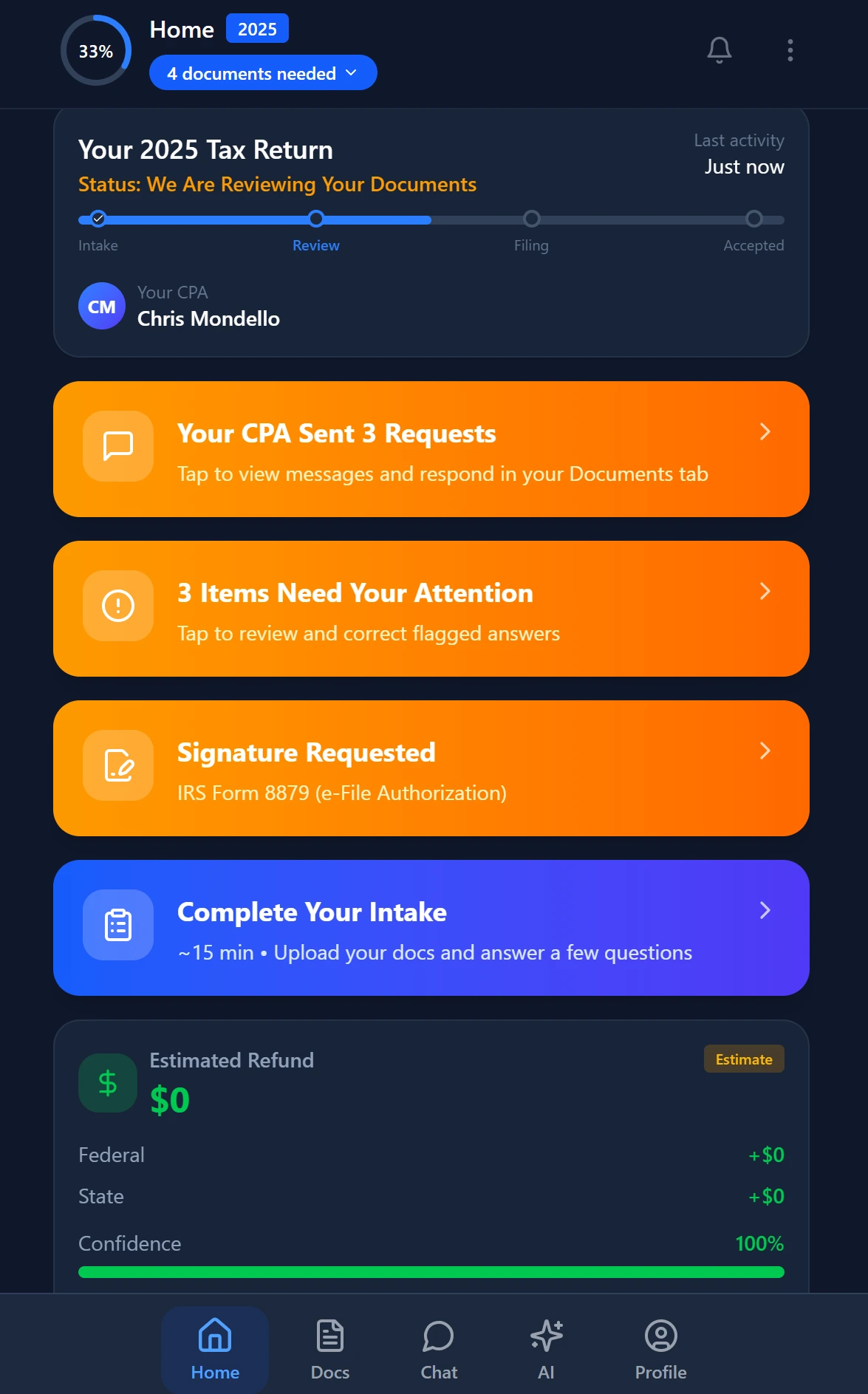
Smart intake auto-fills from uploaded documents and prior-year data
Step 3: Communicate With Clients Before They Hear It Elsewhere
Client communication after losing a key employee accounting firm depends on is the highest-stakes task in the first 48 hours. Do not let clients discover the transition from the departing employee's out-of-office message or a returned call that goes unanswered. Send a proactive message — email works, a portal message works better — that acknowledges the transition, names who is now responsible, and confirms that their work is on track.
Keep the message brief and confident. You do not owe clients a detailed explanation of the circumstances. A simple acknowledgment that a team member has moved on, combined with reassurance that their service is uninterrupted, is sufficient. Clients who sense panic will leave; clients who sense competent management will stay and often become more loyal after a handled transition.
A branded client portal with one-tap login — no passwords, no friction — makes this communication seamless. You can push a message to every active client simultaneously, request any outstanding documents, and keep the engagement moving without relying on an employee-managed inbox. For firms already using email integration tools, segment clients by filing status and send targeted updates rather than a generic mass email.

Your clients see your brand — OTP login, document upload, and real-time status
Step 4: Capture and Systematize Institutional Knowledge
Once the immediate crisis is stabilized, the most valuable long-term work is converting tacit knowledge into documented systems. Every process that lived in an employee's head should be rebuilt as a written standard operating procedure, a video walkthrough, or a structured workflow in your practice management platform.
For tax firms, the highest-value knowledge to capture includes: client-specific filing quirks and preferences, entity structures and multi-entity relationships, recurring advisory topics discussed with specific clients, software shortcuts and workarounds your team has developed, and the intake questions that surface issues the standard organizer misses. A structured smart intake tool — one modeled on IRS Form 13614-C with AI gap analysis — can encode much of this institutional knowledge directly into the client onboarding process so it is not person-dependent.
Pair this with a knowledge base inside your practice management system where procedures are stored, versioned, and accessible to any team member regardless of tenure. The goal is that a new hire on day one can open any client file, read the history, and know exactly what that client needs — without debriefing a senior staff member. This is what knowledge transfer in a tax firm looks like in practice.
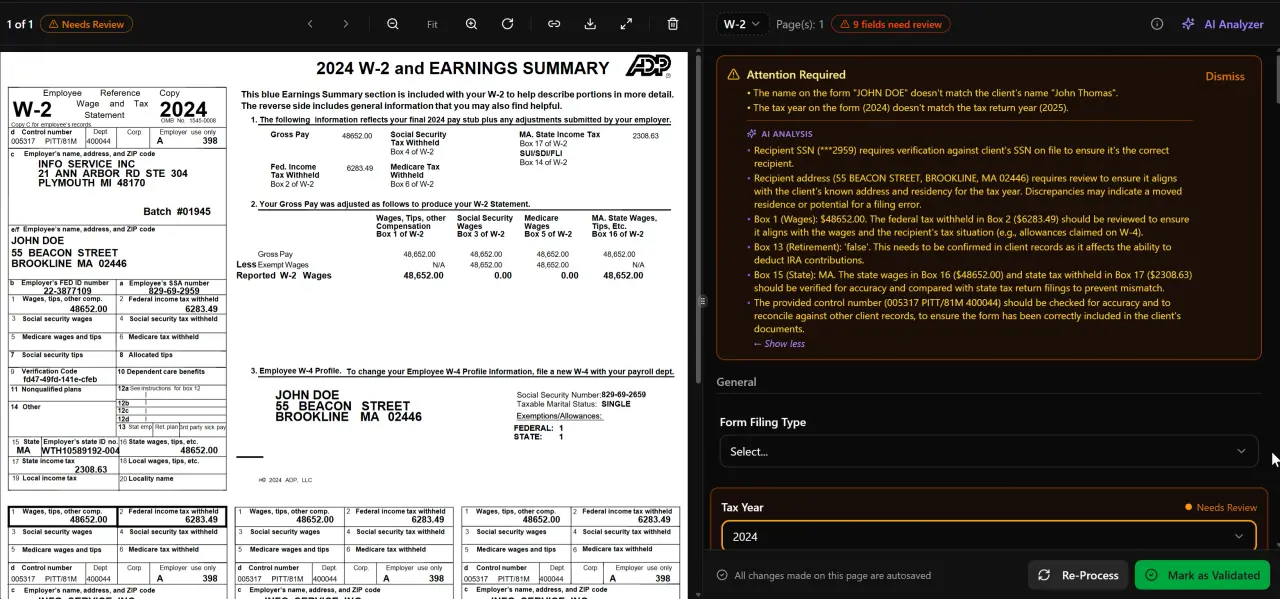
AI classifies, extracts, and validates every document automatically
Step 5: Evaluate Technology That Reduces Person-Dependency
The most durable protection against single employee dependency at an accounting firm is replacing person-dependent workflows with platform-dependent ones. When client documents are automatically extracted, classified, and validated by software rather than manually sorted by a single preparer, the workflow is resilient to staffing changes.
TaxScout's AI document extraction processes 180+ tax form types — W-2s, all 1099 variants, K-1s, 1098 and 1095 series, and full 1040 packages with all schedules — through a 5-layer validation pipeline that includes OCR cross-verification, 15 deterministic math rules, and cross-document validation. A new preparer or contractor can open a client file and immediately see extracted, validated data rather than a stack of unprocessed PDFs. The split-screen PDF viewer with click-to-source field highlighting makes review fast and auditable, regardless of who is sitting at the desk.
Similarly, pipeline management with 12 customizable stages and drag-and-drop kanban gives any team member — or the firm owner working alone during a gap — full visibility into where every client stands. Nothing hides inside an employee's to-do list or email drafts folder. For a deeper look at how document systems reduce manual dependency, see what AI document extraction really does for CPA firms.
On the billing side, automated invoicing via Stripe Connect Express means recurring clients are billed on schedule even when no one is manually generating invoices. Firms that have automated recurring invoicing report that revenue continues without interruption through staff transitions — a material difference when cash flow is already stressed by the cost of replacing a key hire.

Every client gets organized documents, status tracking, and a complete history
Building a Permanent Staff Succession Framework for Small CPA Firms
A key employee departure plan should not be a one-time response — it should become permanent firm infrastructure. The AICPA's guidance on succession planning emphasizes that even solo practices need documented continuity plans, particularly when they hold fiduciary responsibilities for client data and signed tax filings.
A sustainable framework includes four pillars. First, documentation: every recurring workflow is written down and stored in the firm's platform, not in an individual's memory or personal files. Second, cross-training: even in a two-person firm, both people can perform the core functions — at minimum, the owner can execute the critical steps without depending on the staffer. Third, technology redundancy: platforms store client data, document history, and communication logs so that a new person can onboard to a client relationship in hours, not weeks. Fourth, contracts: engagement letters and scope-of-service agreements are stored and e-signed through the platform, not in an employee's email thread, so the firm's legal position is always clear regardless of who managed the relationship.
Firms using law.cornell.edu's guidance on employment agreements should also review whether non-solicitation agreements are appropriate for staff who have direct client relationships. While enforcement varies by state, a well-drafted agreement establishes expectations and protects client lists in the event of a contentious departure.
The U.S. Small Business Administration notes that small businesses that document their processes and reduce key-person dependency command higher valuations — a secondary benefit for firm owners thinking about eventual sale or merger.
Cross-Training Without Adding Headcount
For firms that cannot afford a second full-time preparer, cross-training means ensuring the owner can execute core workflows without the key staffer present. The fastest path is running shadow sessions during tax season where the owner observes — not delegates — the full workflow on a handful of returns. Document every step in real time. This creates both a training record and a process manual.
Consider a part-time contractor relationship with a freelance preparer who can surge capacity during transitions. Platforms with clean client files, structured document storage, and visible pipeline stages dramatically reduce the ramp time for contractors, making this option practical even for small firms.
Protecting Client Relationships During and After Transition
Client relationships in small CPA firms are often personal — clients call their preparer, not the firm. A departing employee who was the primary contact can, intentionally or not, take clients with them. To reduce this risk, ensure the firm — not the employee — is the named contact on all client correspondence, portal invitations, and engagement documents. When clients receive communications from your branded portal and your firm email, their loyalty attaches to the practice rather than to an individual.
After the transition, schedule brief check-in calls with high-value clients. Use the interaction to introduce yourself or a replacement contact, confirm satisfaction, and listen for any concerns. Clients who receive proactive attention during a transition almost never leave. Clients who feel abandoned during one almost always do.
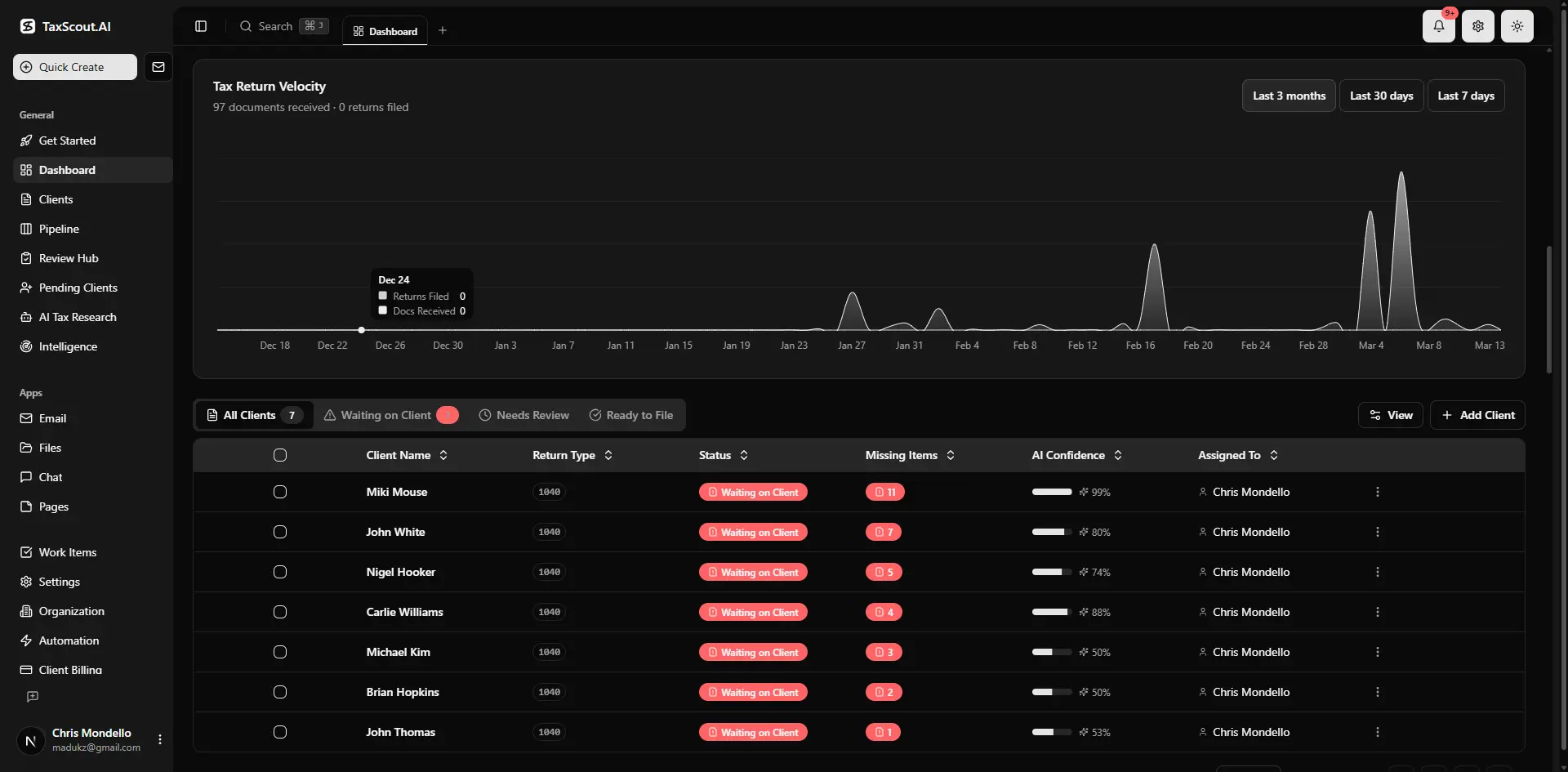
Real-time dashboard showing returns in progress, revenue, and upcoming deadlines
Person-Dependent Firm vs. Platform-Dependent Firm: What Changes When a Key Employee Leaves
| Risk Area | Person-Dependent Firm | Platform-Dependent Firm |
|---|---|---|
| Client file access | Files in employee's email or local folders | All documents in centralized, searchable platform |
| Pipeline visibility | Only the departing employee knew every status | Every stage visible to all authorized team members |
| Document intake | Employee manually sorted and entered data | AI extraction processes 180+ form types automatically |
| Client communication history | Email threads on employee's account | Full thread history in shared communication hub |
| Billing continuity | Manual invoices stall when employee leaves | Automated recurring billing continues uninterrupted |
| Client portal access | Employee-managed logins and file sharing | Branded portal with OTP login, firm-controlled access |
| Knowledge transfer timeline | Weeks to reconstruct context | New hire onboards from documented history in hours |
How TaxScout Reduces Single Employee Dependency
TaxScout is purpose-built for the small and mid-size CPA firm that cannot afford the fragility of person-dependent workflows. The platform stores every client document, communication, pipeline stage, e-signature, and invoice in one place — accessible to any authorized team member, not locked in a single preparer's toolset.
The AI research agents give any preparer — including the firm owner stepping in during a gap — real-time access to 9 specialized research agents drawing from IRS, Treasury, Cornell Law, SSA, and Congress sources. A preparer who is new to a complex client's situation can get authoritative research in minutes rather than waiting for the departed expert's institutional knowledge.
For firms currently evaluating practice management options, TaxScout's flat pricing eliminates a common objection: at $149/month for Prep Pro, a 10-person firm pays the same total whether two people use the platform or ten — no per-seat penalty for adding redundant access to reduce key-person risk. Compare that to TaxDome at roughly $500/month for the same headcount, or Canopy at roughly $660/month with smart intake charged separately per client. See full details at /pricing.
Ready to ensure one resignation never threatens your firm again?
TaxScout's AI-native platform puts every workflow, document, and client history into a system your whole team owns — not just the person who built it.
Frequently Asked Questions
Immediately audit what knowledge the employee held exclusively, revoke their system access, triage active client files by deadline urgency, and send proactive communications to affected clients. Do not wait for clients to notice the gap — reach out first with a confident, brief message confirming their work is on track.
Keep reading
Amended FBAR Procedures: How CPAs Correct Foreign Account Errors Without Triggering Penalties
Oct 12, 2026 · 1 min read
Transparency in Coverage Final Rules: What CPA Firms Must Do Now
Oct 12, 2026 · 1 min read
Backdoor Roth IRA: How CPAs Execute the Strategy for High-Income Clients
Oct 12, 2026 · 1 min read
Stay up to date
Get the latest tax tech insights delivered to your inbox.