CPA Firm Hiring Without Job Boards: How to Find Tax Staff When LinkedIn Sends Bots
Job boards are flooded with unqualified applicants and AI-generated resumes that waste hours of a firm owner's time. This guide breaks down practical, high-signal channels for CPA firm hiring without job boards — including university pipelines, niche recruiters, referral networks, and how the…
If you have posted a tax staff opening on Indeed or LinkedIn lately, you already know the drill: 200 applications in 72 hours, roughly 180 of which are either completely unqualified, AI-generated cover letters addressed to the wrong firm, or recruiters trying to upsell you on their own services. CPA firm hiring without job boards is not a niche strategy anymore — it is becoming the default for small and mid-size firms that have simply burned out on the noise.
A recent thread on r/taxpros captured the frustration perfectly. Dozens of firm owners reported that traditional job boards had become almost useless for tax staff, with the most successful hires coming from referrals, local university relationships, and niche accounting-specific recruiters. The consensus was blunt: the signal-to-noise ratio on general job boards has collapsed. The conversation reinforced what many owners already suspected: cpa firm hiring without job boards isn't just a workaround — it's becoming the standard approach for practices that actually want to find qualified people.
This guide covers the channels that are actually producing results for small CPA firms — and, just as importantly, how to make your firm attractive enough that good candidates choose you over the Big 4 feeder firms down the street. If you've been searching for a reliable framework around cpa firm hiring without job boards, the strategies outlined here reflect what's working for real practices right now.
Why Job Boards Fail Small CPA Firms
The structural problem is simple: general job boards optimize for volume, not quality. LinkedIn and Indeed charge based on impressions and clicks, so their incentive is to send you as many applicants as possible — not to filter for candidates with relevant tax experience. For a large company with a full HR department, volume sourcing is manageable. For a five-person CPA firm where the owner is also reviewing returns, it is a liability. Understanding why the platforms themselves are broken is the first step toward embracing cpa firm hiring without job boards as a deliberate, long-term talent strategy rather than a last resort.
There is also a supply issue. The Bureau of Labor Statistics projects accountant and auditor employment to grow through the end of the decade, but the pipeline of new CPA candidates has shrunk as the 150-hour education requirement has deterred some career switchers. The candidates who do have credentials and real tax prep experience are not sitting idle on job boards — they are already employed and not actively applying anywhere. For firms evaluating their cpa firm hiring without job boards approach, this trade-off compounds over time.
Add to that the proliferation of AI-generated applications: a motivated candidate can blast 500 tailored cover letters in a weekend using freely available tools, making it nearly impossible to gauge genuine interest from keyword matching alone. For firms doing CPA firm hiring without job boards, bypassing this noise is the entire point.
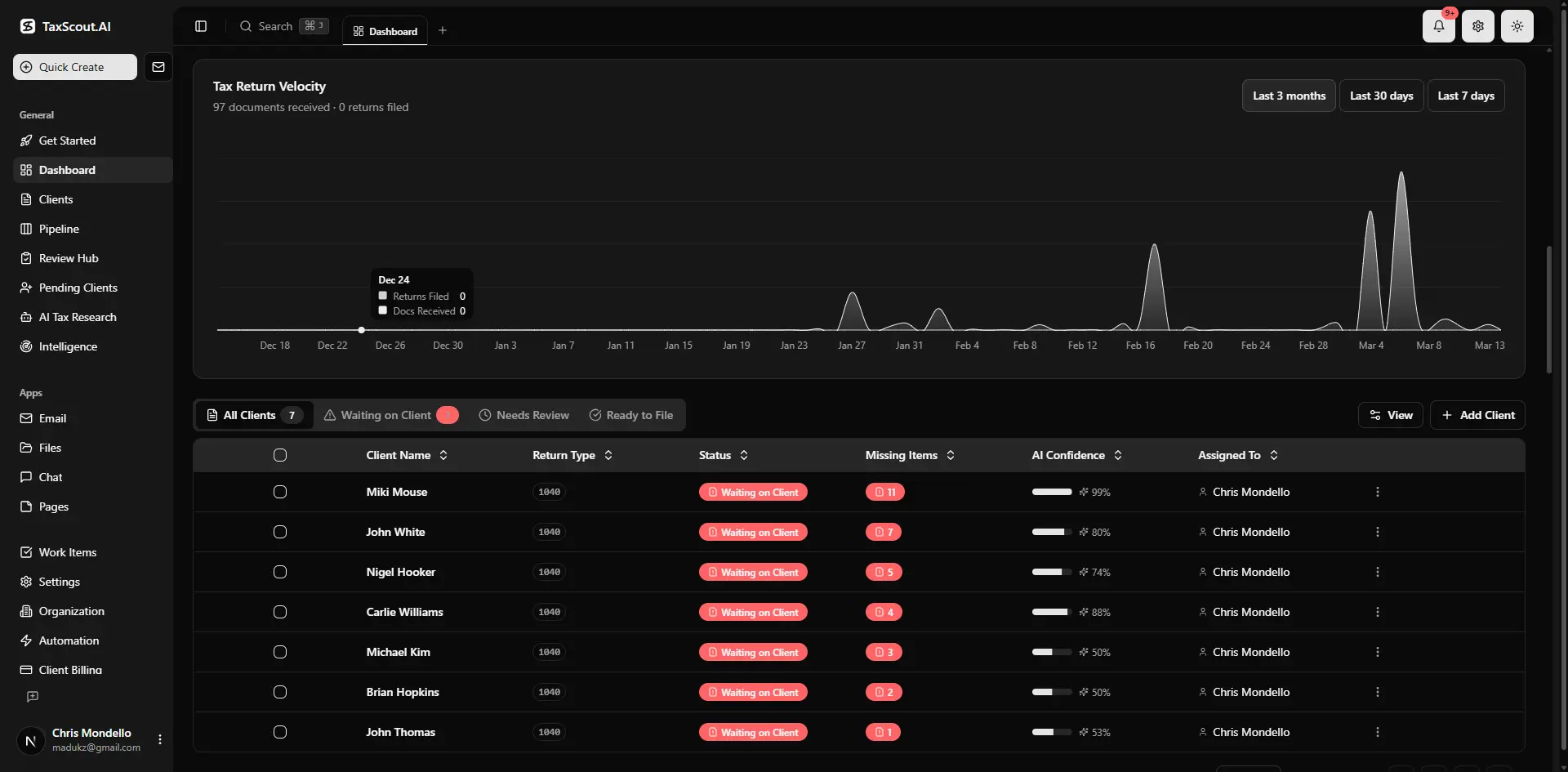
Real-time dashboard showing returns in progress, revenue, and upcoming deadlines
Tired of losing good candidates because your firm looks disorganized from the outside? Each of these factors directly shapes how cpa firm hiring without job boards plays out in practice.
TaxScout gives your firm a professional, AI-native workflow — branded client portal, automated intake, and a clean pipeline — that makes top tax staff actually want to join you. Understanding cpa firm hiring without job boards in this context is what separates firms that scale from those that stall.
University Recruiting for Accounting Firms
University recruiting is the most consistently cited alternative to job boards among small firm owners, and it is far more accessible than most people assume. You do not need a Big 4 budget to show up on a campus — you need a relationship with one accounting department faculty member and a willingness to attend a beta-career fair. This is precisely where a deliberate cpa firm hiring without job boards strategy pays off.
Start by contacting the beta-program coordinator or department chair at a regional state university with an active MAcc or accounting undergraduate program. Many of these programs are actively looking for small-firm partners because Big 4 and national firms absorb only a fraction of their graduates. Offering to guest lecture on a topic like small business tax or pass-through entity taxation costs you two hours and puts your firm's name in front of 30-60 students who will be job hunting in six months. Cpa firm hiring without job boards sits at the center of this decision — get it wrong and the rest unravels.
Internship programs are the most reliable funnel. A paid summer intern who works a full tax season with you is essentially a 10-week working interview. Conversion rates from intern to full-time hire at small firms consistently outperform cold job board hires because both sides have already tested the relationship. The AICPA's CPA pipeline resources include tools for small firms looking to structure internship programs that comply with Department of Labor guidelines. When firms revisit their cpa firm hiring without job boards priorities, the gaps usually surface here.
One practical note: when recruiting accounting staff for a small firm via campus channels, position your firm as a place where a new grad will touch a broader range of returns faster than they would at a large firm. That narrative is true, and it resonates with students who want to build skills quickly.

Click any extracted field to see its source highlighted on the original PDF
Professional Referral Networks and CPA Society Channels
State CPA society job boards are meaningfully different from Indeed. Candidates browsing the Illinois CPA Society job board or the Texas Society of CPAs career center have self-selected into the profession — they are either licensed, sitting for the exam, or pursuing licensure. That base-level qualification filter alone saves hours of screening.
Beyond posted listings, state society chapter meetings are underused sourcing channels. Monthly chapter meetings, young CPA group events, and committee volunteer positions put you in direct contact with practitioners who are actively engaged with the profession — and people who show up to a chapter meeting on a Tuesday night after a full workday are self-selected for initiative and commitment.
Do not overlook your own client base as a referral network for tax staff hiring. Business owner clients who respect your work often know other accountants who might be looking for a change. A brief, straightforward ask — 'We are growing and looking for a senior preparer; do you know anyone in accounting who might be exploring opportunities?' — costs nothing and occasionally produces your best hire. For more ideas on building structured referral systems, see our guide on growing your accounting firm through referral programs.
Former colleagues are another underused channel. Most CPAs have worked at two or three firms before landing somewhere stable. Reconnecting with former coworkers who you respected — via a direct LinkedIn message or a coffee meeting — is qualitatively different from posting an open role. You are not asking a stranger to apply; you are having a professional conversation with someone whose work you already know.
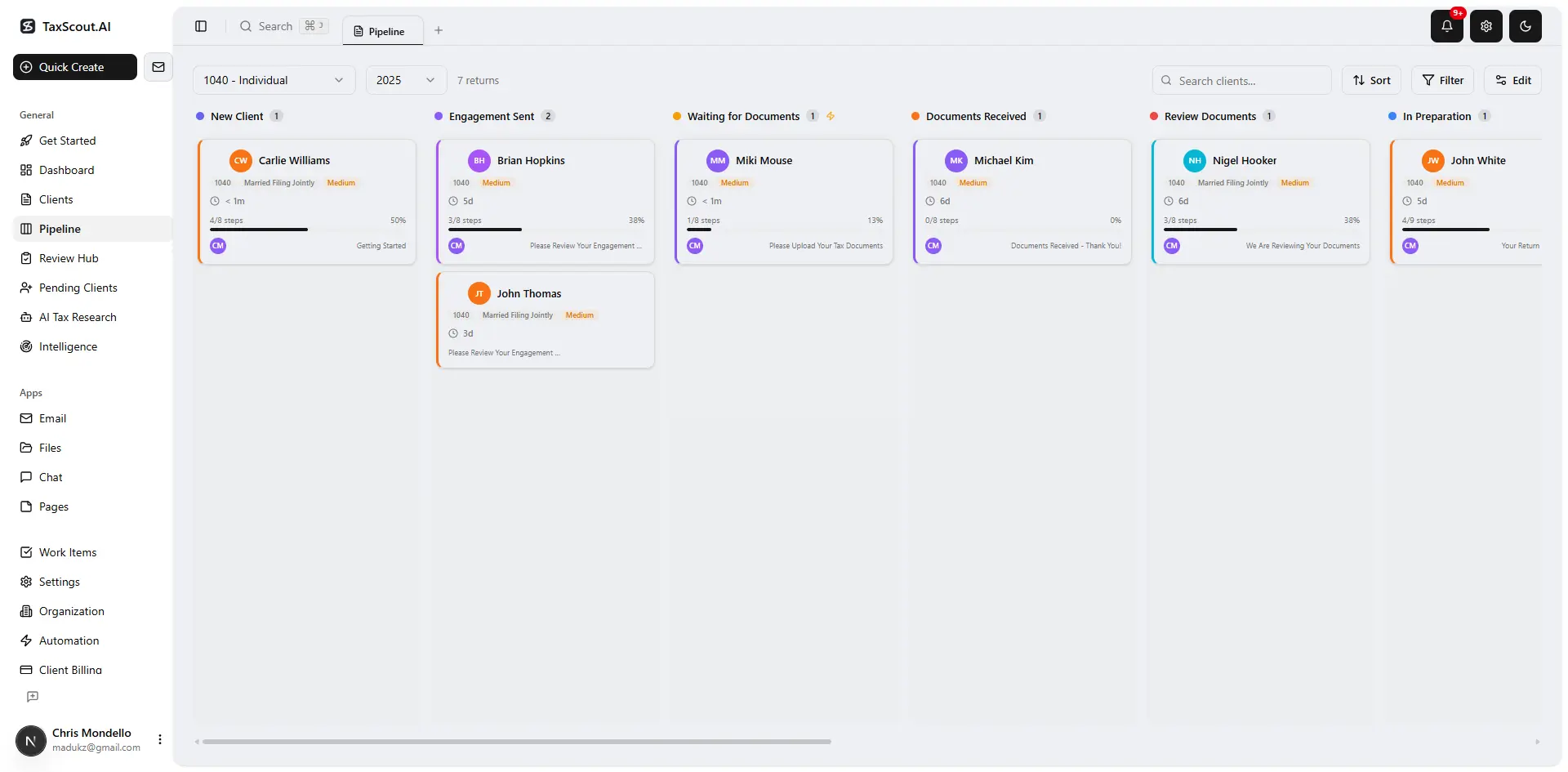
Track every return from intake to filed with drag-and-drop pipeline management
Accounting Recruiter vs Job Board: When to Hire a Specialist
Niche accounting recruiters operate in a fundamentally different market than general job boards. The best accounting-specific recruiters maintain ongoing relationships with passive candidates — preparers and managers who are not actively job hunting but would consider the right opportunity. That is a candidate pool that no job posting can reach.
The trade-off is cost. Contingency accounting recruiters typically charge 15-25% of the candidate's first-year salary. For a $65,000 senior preparer role, that is $9,750-$16,250. For many small firms, that feels steep — but compare it to the fully loaded cost of a three-month vacancy during tax season: missed returns, overtime for existing staff, and lost revenue from clients who left because you could not serve them.
When evaluating whether to use an accounting recruiter versus a job board, the key question is urgency and seniority. For an entry-level seasonal hire, a local university pipeline or a state society posting is usually sufficient. For a key employee hire — a senior manager, a future partner-track candidate, or your first dedicated tax director — a specialist recruiter with a verified passive candidate network is almost always worth the fee.
Ask any recruiter you are considering how many of their placements in the last 12 months were passive candidates versus active applicants. A recruiter who cannot answer that question confidently is likely just reposting your job on the same boards you already tried.
Sourcing channels for tax staff: key trade-offs at a glance
| Channel | Candidate Quality | Time to Hire | Cost |
|---|---|---|---|
| Indeed / LinkedIn | Low-Medium (high volume noise) | 1-3 weeks to screen | Low / free to moderate |
| State CPA Society Boards | Medium-High (self-qualified) | 2-4 weeks | Low ($150-$500 posting fee) |
| University Internship Pipeline | Medium (junior; high conversion) | Semester-long lead time | Low (time investment) |
| Professional Referral Network | High (pre-vetted by trust) | Variable (passive) | None (relationship cost) |
| Niche Accounting Recruiter | High (passive candidates) | 3-6 weeks | 15-25% of first-year salary |
| Former Colleague Outreach | Very High (known quality) | Variable | None |
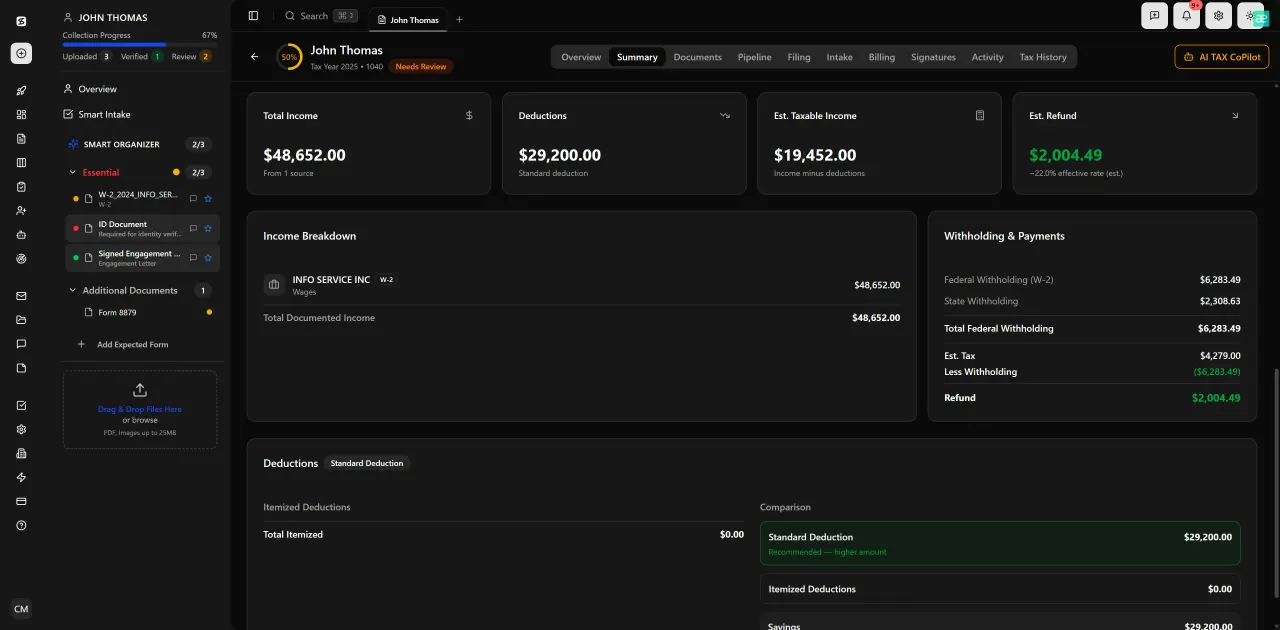
Review with AI assist — 9 agents answer questions with full client context

Your clients see your brand — OTP login, document upload, and real-time status
How Your Firm's Technology Stack Affects Candidate Decisions
Here is a dimension of tax staff recruiting that almost no hiring guide mentions: experienced preparers and CPAs are evaluating your technology stack as part of their decision to join your firm. In a tight labor market, a candidate who has worked at a firm with modern practice management tools will hesitate to step backward into a firm still emailing PDFs and tracking deadlines in spreadsheets.
This matters because the candidates you most want — organized, detail-oriented, technically capable preparers — are also the ones who care most about working in a structured environment. Showing up to a second interview and walking a candidate through a clean pipeline management board with 12 customizable stages, an AI-assisted intake workflow, and a professional client portal signals that your firm is run like a business, not a side hustle.
Operationally, the right platform also makes onboarding new staff dramatically faster. When document extraction, validation, and organization are handled automatically — as with TaxScout's AI document extraction, which covers 180+ tax form types through a 5-layer validation pipeline — a new preparer can reach productive output in days rather than weeks. That faster ramp time is a real argument you can make in the hiring conversation.
For a deeper look at how technology enables a more attractive and efficient firm, our post on running a paperless accounting firm in 2026 covers the infrastructure that modern staff expect to find when they join.
Structuring the Offer: What Small Firms Can Compete On
Small CPA firms cannot match the starting salary of a Big 4 or large regional firm on paper. What they can offer is a legitimately different value proposition — and the key is to articulate it explicitly rather than hoping candidates figure it out.
Flexibility is the most commonly cited non-salary factor in accounting job changes, according to recent workforce surveys published by the Journal of Accountancy. Remote or hybrid schedules, flexible hours outside of core tax season peaks, and predictable off-season workloads are all things a small firm can offer that large firms structurally cannot. Be specific: 'From May through December, your workweek averages 38 hours and you have full flexibility on start and end times' is more credible than 'we offer work-life balance.'
Skill breadth is the other genuine advantage. A preparer at a Big 4 firm spends years in a narrow lane — corporate returns for a specific industry, for example. A preparer at a small firm handles individual returns, S-corps, partnerships, and maybe some trust work within their first two years. For candidates who want to sit for the CPA exam or build a broad technical foundation, that breadth is genuinely valuable. Frame it honestly: 'You will touch more return types in your first year here than most preparers see in three years at a national firm.'
Equity and path to ownership are the long-game offer. For a hiring CPA key employee — someone you want to retain for five or more years — a clearly defined buy-in path is often more compelling than a salary bump. Outline the criteria explicitly: revenue thresholds, client relationships managed, and timeline. Ambiguity about partnership track is one of the most common reasons strong senior staff leave small firms.
Finally, consider how your compensation structure is documented. If you are moving toward flat-fee billing — a model covered in depth in our flat fee billing guide for CPAs — you can explain to candidates how predictable firm revenue translates into stable compensation, which is a meaningful differentiator from commission-heavy environments.
Benefits That Do Not Require a Large Budget
CPE reimbursement, professional association dues, and exam fees for CPA candidates are low-cost benefits that signal professional investment. The IRS requires 72 hours of CPE every three years for enrolled agents, and most state boards have comparable requirements for CPAs. Covering those costs entirely — typically $500-$1,500 per year per staff member — is a highly visible signal of commitment that costs less than a month of Indeed sponsored posts.
Home office stipends for remote staff, flexible PTO policies that do not require accrual tracking, and clearly documented overtime policies during peak season all reduce ambiguity and anxiety for candidates evaluating your offer. Candidates who have been burned by vague 'flexible' policies at prior firms will read explicit written terms as a sign of a well-run operation. Document these terms in your engagement letter templates and employment agreements, and make them part of the offer conversation.
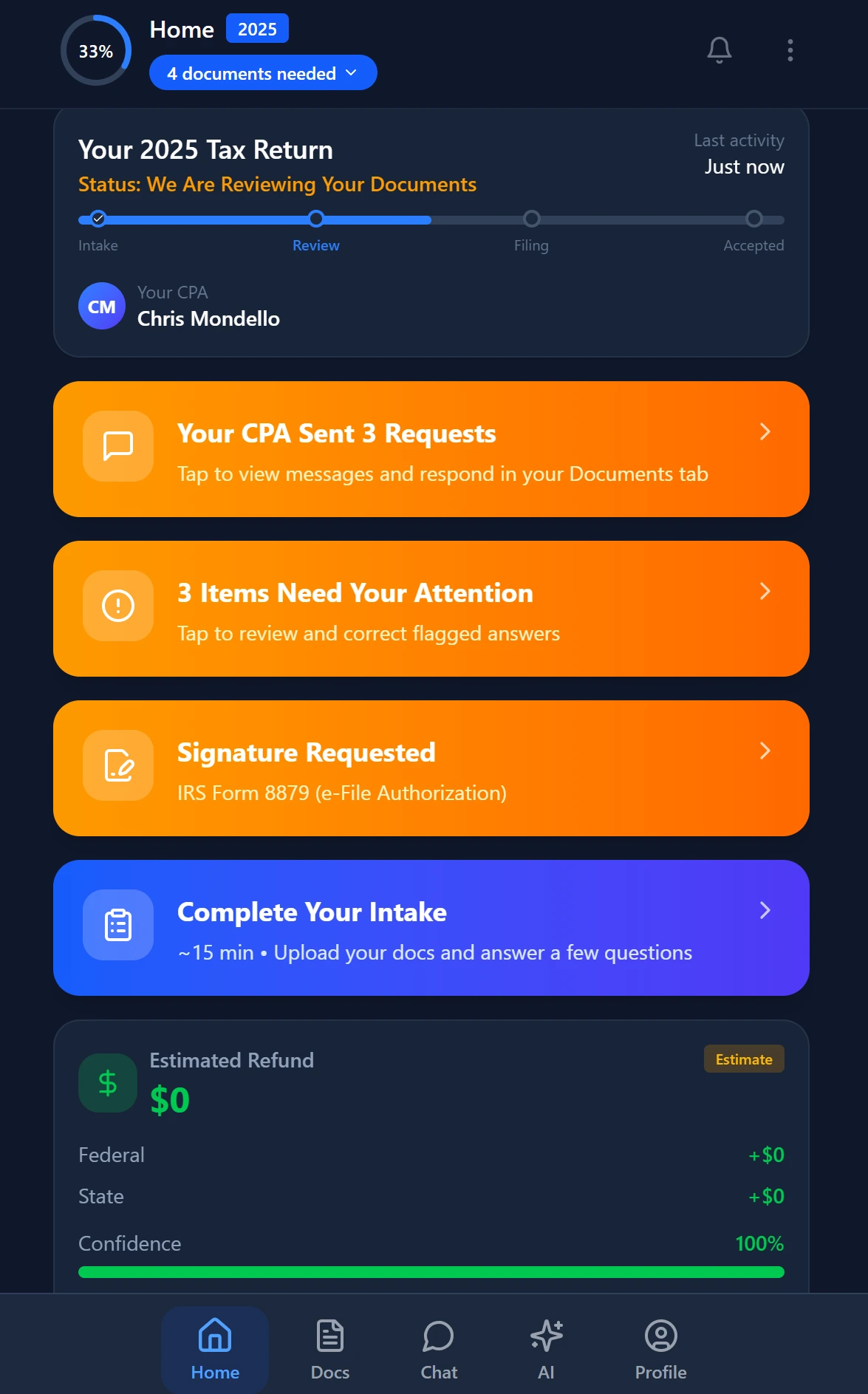
Smart intake auto-fills from uploaded documents and prior-year data
Building a Passive Candidate Pipeline Before You Need to Hire
The best time to build a candidate pipeline is when you are not actively hiring. Firms that maintain relationships with potential future employees — through professional networks, alumni connections, and local accounting communities — hire faster, hire better, and spend less when a position opens.
Practically, this means staying active in at least one state CPA society committee, attending regional accounting events even off-season, and maintaining a short list of two or three people you would call first if a role opened. A quarterly coffee with a former colleague who is 'happy where they are but always open to a conversation' is not a waste of time — it is pipeline maintenance.
Your firm's online presence also feeds your passive pipeline. A well-maintained LinkedIn company page that posts substantive content — actual tax insights, not just promotional fluff — makes it easier for passive candidates to find and evaluate you before they ever apply. Treasury.gov updates on tax policy and IRS guidance summaries are easy, credible content formats that establish your firm's technical credibility to both prospective clients and prospective staff.
For a complete view of how small accounting firms are approaching growth and staff planning together, browse other blog resources covering capacity planning, client systems, and practice management strategies that directly affect how and when you need to hire.
Ready to build a firm that top tax staff actually want to join?
TaxScout's AI-native practice management platform gives your team clean workflows, automated document extraction, and a professional client experience — all for a flat monthly fee with no per-user charges.
Frequently Asked Questions
The most effective channels for CPA firm hiring without job boards include state CPA society career centers, university accounting department internship programs, direct outreach to former colleagues, professional referral networks, and niche accounting-specific recruiters who maintain passive candidate pools.
Keep reading
Business Valuation for CPAs: How to Price a Client Company Without Hiring an Appraiser
Sep 18, 2026 · 1 min read
Equity Partner Compensation: How CPA Firms Structure Pay for Owners
Sep 18, 2026 · 1 min read
Accountant Shortage Solutions: How CPA Firms Survive the Talent Crisis Without Overpaying
Sep 18, 2026 · 1 min read
Stay up to date
Get the latest tax tech insights delivered to your inbox.