Buying a CPA Firm: Due Diligence Checklist Before You Sign
Buying a CPA firm is one of the highest-leverage moves a practitioner can make — but only if you enter with eyes open. This comprehensive due diligence checklist walks you through staff risk, client concentration, revenue quality, SBA financing, and post-close transition planning so you negotiate…
Buying a CPA firm can compress a decade of organic growth into a single transaction. You acquire revenue, staff, client relationships, and — if you negotiate well — intellectual property and systems that would take years to build from scratch. Yet the r/taxpros community is full of cautionary tales: buyers who discovered that 60% of a book walked out the door because it was tied to one retiring partner, or that the 'consistent' revenue they paid 1.3× gross for was actually seasonal project work that didn't repeat.
The due diligence process for an accounting practice acquisition differs meaningfully from buying a manufacturing business or a retail location. Client relationships are intangible and portable. Revenue is often undocumented with handshake agreements. Staff loyalty follows the seller, not the entity. If you are serious about buying an accounting practice, you need a structured framework — not just a lawyer and a gut feeling. Buying a CPA firm presents unique challenges that differ meaningfully from acquiring a manufacturing business or retail location, largely because client relationships are intangible and portable.
This checklist covers the seven critical domains every buyer must evaluate before signing a letter of intent: financial quality, client concentration, staff risk, operational infrastructure, legal and compliance exposure, financing mechanics (including SBA loans), and post-close transition planning. Work through each section systematically, and you will identify the risks worth accepting and the deal-breakers worth walking away from. Whether you are buying a CPA firm for the first time or expanding an existing practice, this checklist covers the seven critical domains every buyer must evaluate before signing a letter of intent.
Step 1: Evaluate Revenue Quality and Financial Records
Raw gross revenue is the least useful number in any CPA firm acquisition checklist. What matters is the quality, repeatability, and margin behind that revenue. Request at minimum three years of compiled or reviewed financial statements, monthly revenue ledgers broken out by service line, and billing records tied to individual client files. One of the most common mistakes made when buying a CPA firm is treating raw gross revenue as the primary valuation metric, when in reality the quality, repeatability, and margin behind that revenue matter far more.
Classify every dollar of revenue into one of three buckets: recurring annual engagements (1040s, 1120S filings, payroll, bookkeeping), recurring but variable (advisory retainers, quarterly estimates), and one-time project work (cost segregation, estate returns, audit representation). A healthy acquisition target should have 70%+ of trailing twelve-month revenue in the first two buckets. Heavy project concentration inflates the multiple and masks year-to-year volatility. For firms evaluating their buying a CPA firm approach, this trade-off compounds over time.
Recast the seller's profit and loss statement to normalize for owner benefits: personal insurance, vehicle expenses, above-market owner compensation, and any family payroll. The resulting Seller's Discretionary Earnings (SDE) is the number you are actually buying. According to SBA lender guidance on professional service acquisitions, most lenders underwrite to a debt service coverage ratio of 1.25× — meaning your post-close SDE must comfortably cover the note payment before your own draw. Each of these factors directly shapes how buying a CPA firm plays out in practice.
Also request the accounts receivable aging report. A pile of receivables older than 120 days is a red flag: it signals either collection problems or client relationships on the verge of attrition. For context on how AI-native tools can surface billing analytics automatically after close, see our guide on recurring invoicing for accounting firms. Understanding buying a CPA firm in this context is what separates firms that scale from those that stall.
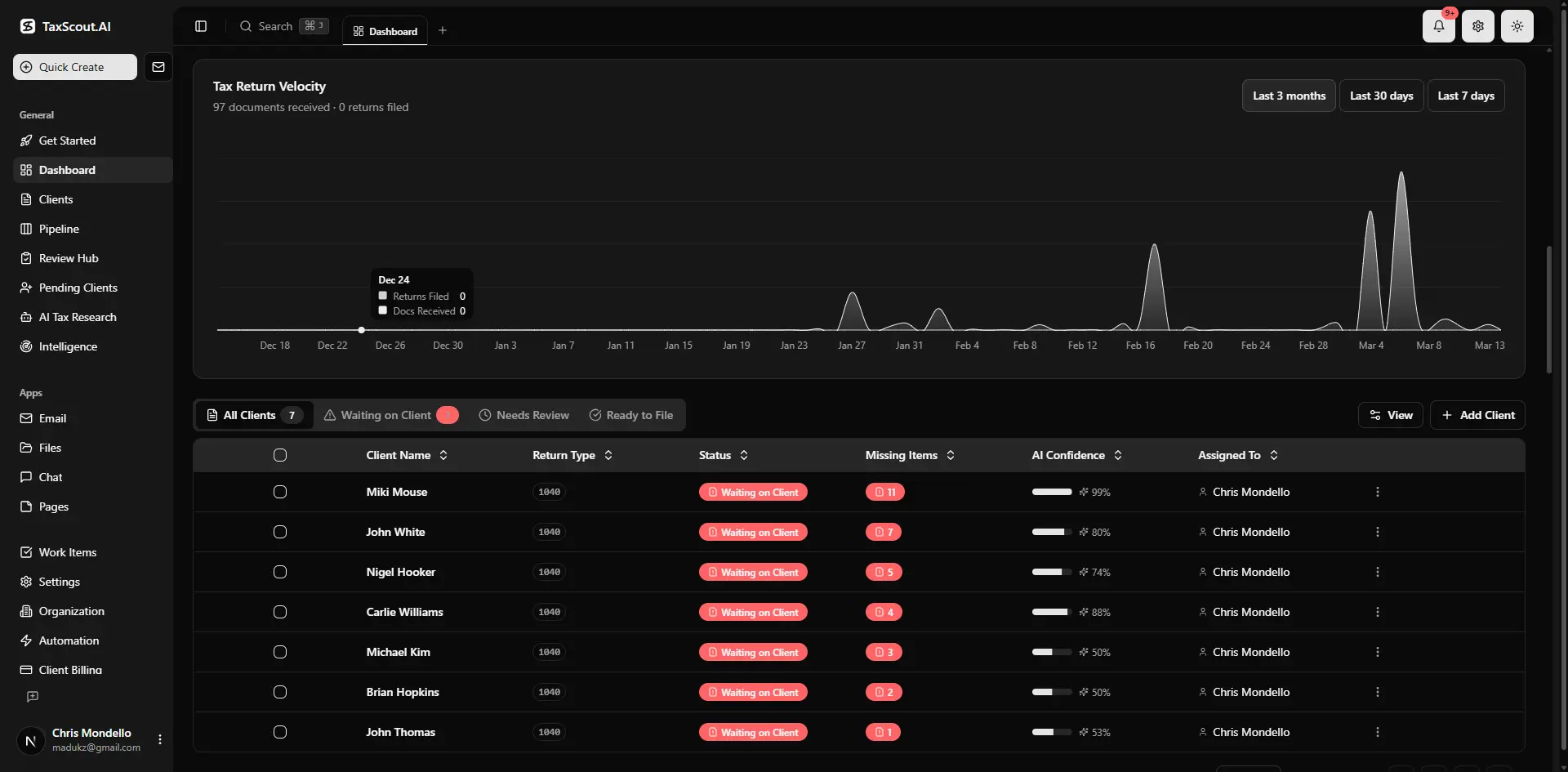
Real-time dashboard showing returns in progress, revenue, and upcoming deadlines
Step 2: Audit Client Concentration and Retention Risk
Client concentration is the single most common cause of post-acquisition revenue loss. If 20% of the firm's gross revenue comes from three clients, you are not buying a diversified book — you are making a three-client bet. Ask for a revenue-ranked client list (anonymized by industry if the seller insists on confidentiality at LOI stage, but fully disclosed before close). This is precisely where a deliberate buying a CPA firm strategy pays off.
Apply the 80/20 rule rigorously: identify which clients produce 80% of gross fees, then assess each one for portability risk. Key questions include: Does the client relationship sit with the selling CPA personally, or with a staff member who will stay? Has the client worked with other team members, or only the owner? Is the client's contact at their company the same person who originally hired the firm? Clients whose only relationship is with a departing owner carry the highest attrition risk post-close. Buying a CPA firm sits at the center of this decision — get it wrong and the rest unravels.
Industry concentration is a secondary concern. If 40% of the book is oil and gas clients in a region experiencing sector contraction, that concentration multiplies both attrition and revenue volatility risk. The Journal of Accountancy's practice succession research consistently finds that client retention rates in unmanaged transitions average 70-80%, but well-structured transitions — with formal introductions and relationship handoff protocols — can push retention above 90%. When firms revisit their buying a CPA firm priorities, the gaps usually surface here.
In your LOI, negotiate an earnout tied to client retention over the first 12-18 months. A common structure: 100% of purchase price if gross revenue from acquired clients stays above 90% of the trailing baseline, stepping down proportionally below that threshold. This aligns seller incentives with a smooth transition and gives you financial protection if the book shrinks unexpectedly.
Acquiring a firm and wondering how to onboard 300 new clients without drowning your staff?
TaxScout's AI-native practice management handles document extraction across 180+ form types, branded client portals, and 12-stage pipeline management — all at a flat rate, no per-user fees.
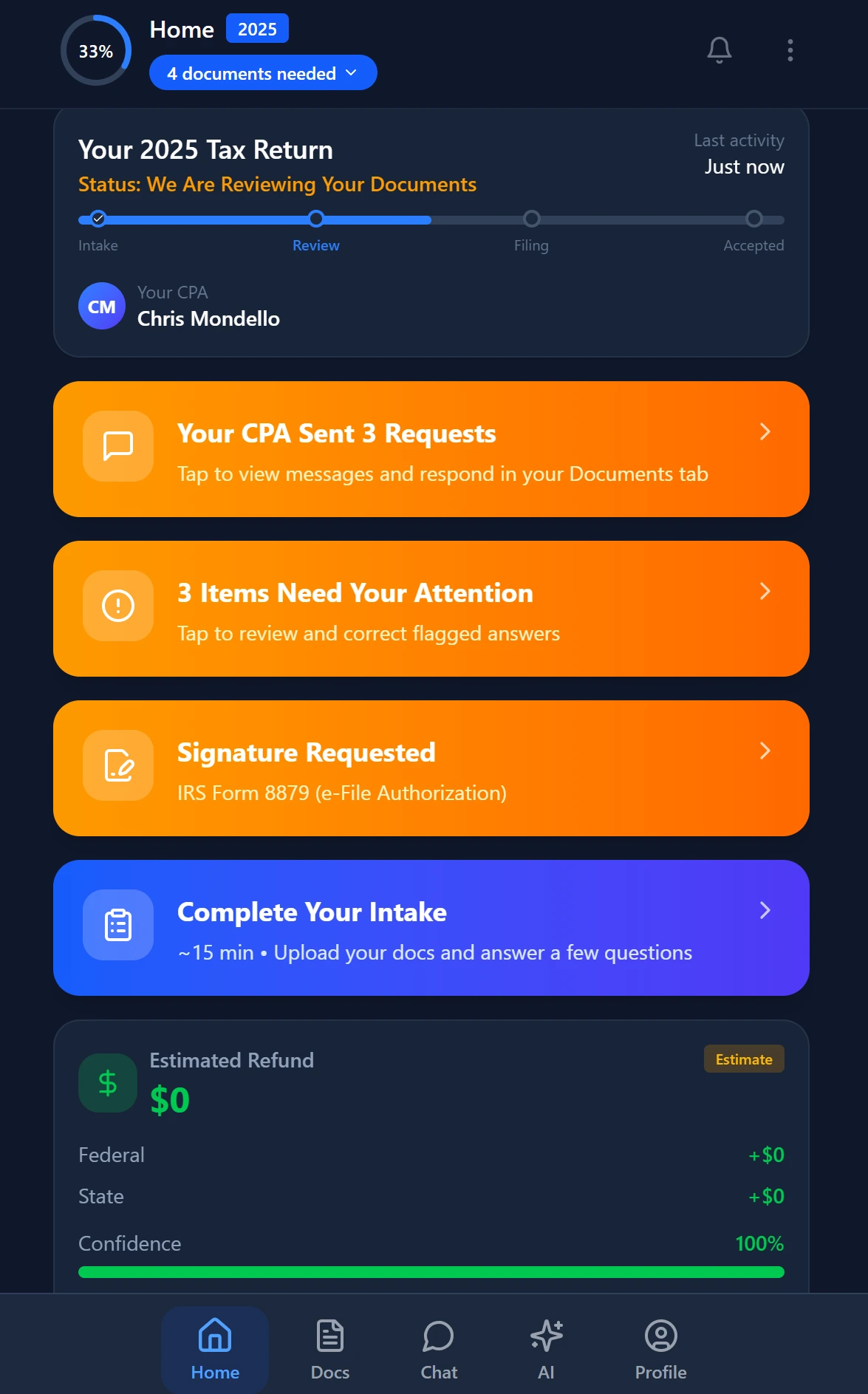
Smart intake auto-fills from uploaded documents and prior-year data
Step 3: Assess Staff Risk and Key-Person Dependency
People risk is the most underestimated variable in buying an accounting practice. Staff members at a small firm often have their own client relationships, and their departure post-close can trigger client attrition that has nothing to do with the selling owner. Request an org chart with tenure dates, compensation levels, and role descriptions for every team member. Buyers who skip this step when buying a CPA firm often discover the real org chart only after close, when it is too late to renegotiate.
Identify key-person dependencies: who handles the top 20 revenue clients day-to-day? Who manages the billing cycle, tax workflow, and software logins? In many small practices, a single senior manager or bookkeeper is the operational backbone. If that person is not under a retention agreement, you are absorbing significant transition risk. Build key-employee retention bonuses into the deal structure — funded either by the seller at close or by the purchase price allocation.
Request copies of existing employment agreements and non-solicitation clauses. Many smaller practices have no written agreements at all, which cuts both ways: you can negotiate new agreements as a condition of close, but you also cannot prevent departing staff from taking clients with them to a competitor. The Bureau of Labor Statistics Occupational Outlook for accountants shows accountant turnover running higher than in prior decades — a buyer's market for talent, but also a risk factor in any acquisition.
Ask to meet individually with the top two or three staff members during diligence — ideally framed as 'understanding the team's expertise' rather than an explicit retention interview. Their candor about why they stay, what frustrates them, and how they feel about the transition will tell you more than any HR document.
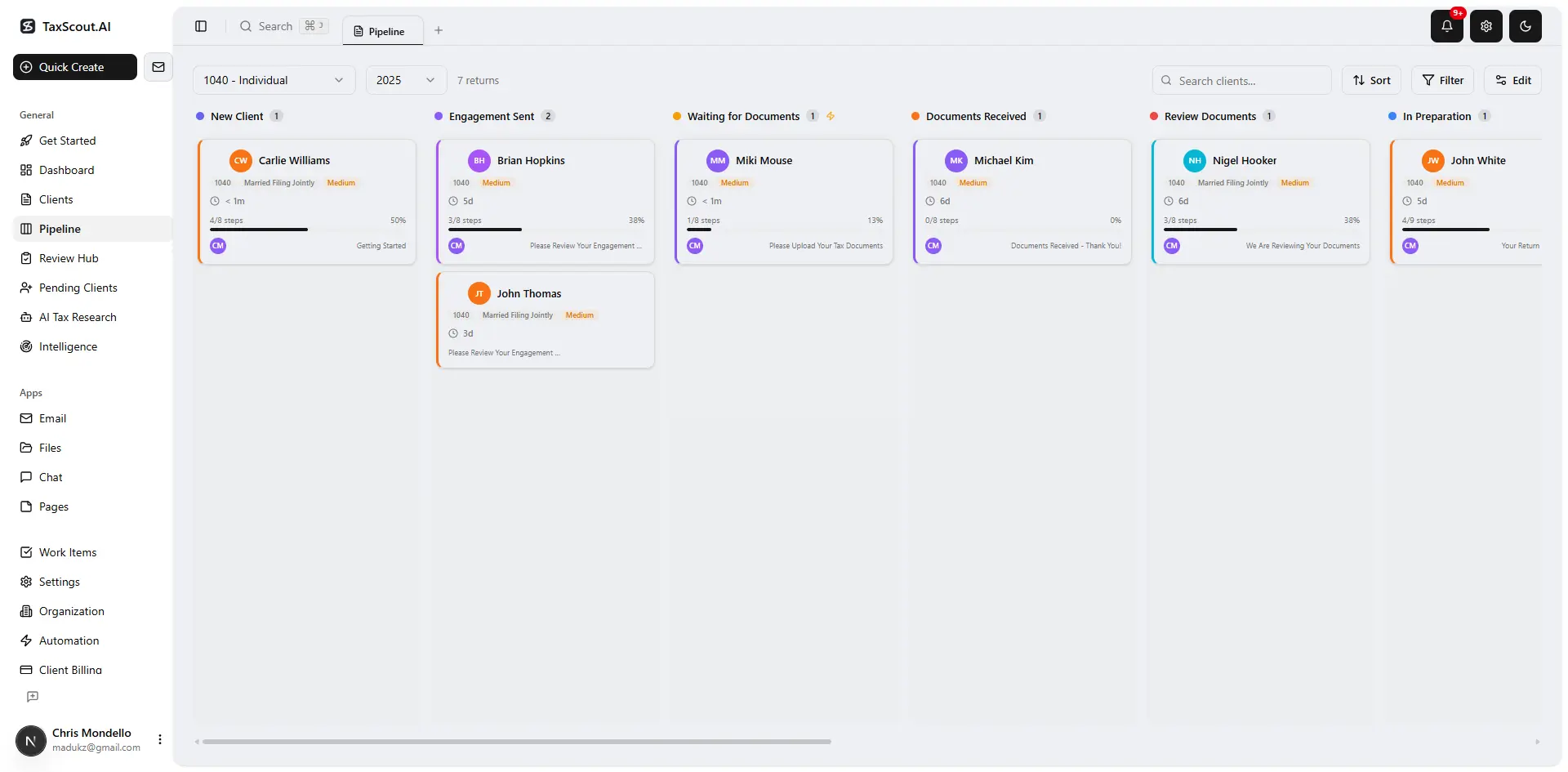
Track every return from intake to filed with drag-and-drop pipeline management
Step 4: Review Operational Infrastructure and Technology
A firm's operational infrastructure — its software stack, document management processes, and workflow systems — determines how much post-close friction you will absorb. A practice running on paper files, a shared network drive, and aging desktop software will require substantial migration investment before it can integrate into your existing operation. This infrastructure gap is one of the most overlooked costs when buying a CPA firm, and failing to budget for it can erode the returns you projected at LOI.
Audit the complete technology stack: tax preparation software, document storage, practice management, billing, and client communication tools. Confirm software license transferability — many per-seat licenses do not automatically transfer to a new entity. If the acquired firm runs Drake, CCH Axcess, UltraTax, Lacerte, or ProSeries, TaxScout integrates with all five, which means you can layer AI document extraction and pipeline management on top of the existing prep workflow without forcing a software change during the first tax season.
Evaluate document retention practices against IRS recordkeeping guidance for tax return preparers. Many small practices store client documents in ways that would not survive a PTIN compliance review. Post-close, you will be responsible for those records. The cost of retroactively organizing years of poorly filed documents — or the liability exposure if documents are missing — should factor into your purchase price negotiation.
For a deeper look at document management best practices you will want to implement after close, see our CPA firm document management software guide. Also check our resources on running a paperless accounting firm, which outlines the migration path from paper-heavy workflows to a fully digital operation — a transition you may need to lead for the acquired practice.

Click any extracted field to see its source highlighted on the original PDF
Step 5: Examine Legal, Compliance, and Liability Exposure
Legal diligence on a CPA firm acquisition covers three distinct risk areas: professional liability claims, regulatory compliance history, and entity-level obligations that survive the close.
Request a full claims history from the seller's professional liability insurer for the past five years. Even claims that were resolved without payout reveal patterns: the types of services that generated disputes, the clients most likely to escalate, and whether the firm's quality control processes are adequate. Confirm whether the seller carries occurrence-based or claims-made coverage — claims-made policies require a tail policy (extended reporting period) to cover pre-close work after the policy lapses.
Review the firm's PTIN registration and CAF number history with the IRS Tax Professionals page. Check for any active or resolved disciplinary actions with the state CPA licensing board. Many state boards maintain public disciplinary records — search the relevant state's Board of Accountancy before any letter of intent is signed. If the firm performs audits or reviews, confirm peer review compliance under AICPA standards — a lapsed peer review can disqualify the firm from certain engagements and trigger state board sanctions.
On the entity side: if you are buying the legal entity (stock or membership interest purchase) rather than just the assets, you absorb all legacy liabilities including tax obligations, undisclosed employment disputes, and lease commitments. An asset purchase is almost always preferable from a liability standpoint, though it may create seller tax consequences that affect negotiation. Have a transactional attorney review the purchase agreement and confirm the precise assets and liabilities being transferred. This distinction becomes especially consequential when buying a CPA firm with a history of audit or attest work, where legacy liability exposure can be significant.
Engagement Letter and Client Contract Review
Request samples of the seller's standard engagement letters and review whether they contain limitation of liability clauses, arbitration provisions, and clear scope definitions. Firms with vague engagement letters carry higher professional liability risk because scope creep disputes are harder to defend. If you plan to introduce standardized engagement letters post-close — a best practice — budget for a client re-engagement campaign in the first 90 days.
Also confirm that existing engagement letters do not include change-of-control termination clauses. Some clients negotiate terms allowing them to exit without obligation if the firm is sold. These clauses are rare but not unheard of in high-fee advisory relationships.
Typical CPA Firm Acquisition Valuation Multiples by Service Mix (2024-2025 market)
| Service Mix | Typical Multiple of Gross Revenue | Key Risk Factors |
|---|---|---|
| Pure 1040 / individual tax | 0.8× – 1.1× | Owner-relationship dependency, seasonal revenue |
| Business tax + advisory mix | 1.0× – 1.4× | Staff retention, key-person concentration |
| Bookkeeping / payroll heavy | 1.1× – 1.5× | Software migration cost, margin compression |
| Audit / attest practice | 0.7× – 1.0× | Peer review compliance, staff licensing requirements |
| Niche / specialized (R&D, cost seg) | 1.3× – 1.8× | Referral source dependency, methodology transfer |

Your clients see your brand — OTP login, document upload, and real-time status
Step 6: Structure SBA Financing for an Accounting Practice Purchase
The SBA 7(a) loan program is the most common financing vehicle for buying an accounting practice, and for good reason: it offers up to $5 million at favorable rates, requires as little as 10% buyer equity injection, and can be fully amortized over 10 years, dramatically improving cash flow compared to conventional bank financing.
SBA lenders underwriting a tax practice acquisition will scrutinize three things above all else: the quality of the seller's financial records (three years of tax returns and financial statements are standard), the buyer's industry experience and management capability, and the projected debt service coverage ratio post-close. If the practice's recast SDE does not cover 1.25× the annual debt payment, the deal will not underwrite regardless of how attractive the multiple appears.
Per SBA Standard Operating Procedure 50 10 7, goodwill financing in professional service acquisitions is explicitly permitted under 7(a), which is not the case with many conventional bank products. However, lenders will typically require an independent third-party valuation of the practice, a non-compete agreement from the seller lasting at least as long as the loan term, and a seller note (usually 10-15% of purchase price on standby for the first 24 months) to demonstrate seller confidence in the transition.
Buyer tip: approach lenders who have direct SBA 7(a) preferred lender status and who have closed professional service deals specifically — not just SBA loans generically. A lender experienced with buying a CPA firm understands intangible asset valuation and will structure the deal more efficiently. Get your personal financial statement, three years of personal tax returns, and a business plan drafted before your first lender conversation.

Track firm performance with real-time analytics and client activity monitoring
Step 7: Build a 90-Day Client Retention and Transition Plan
The purchase price you pay is only realized if the clients stay. Client retention after firm sale is where most acquisitions succeed or fail, and it is almost entirely determined by the quality of the transition plan — not by the purchase agreement terms.
The single most important retention lever is a joint introduction from the selling CPA to every client in the book. This should happen via personalized letter signed by both parties, followed by phone calls for the top 30% of revenue clients. The message must be consistent: the selling CPA chose the buyer specifically because of professional alignment, client interests will be protected, and service quality will improve. Clients do not leave because a firm was sold — they leave because they feel abandoned or uncertain.
Operationally, the first 90 days must be seamless. That means migrating client files before the announcement, ensuring staff continuity on key accounts, and delivering on the first due date after close without any service degradation. A branded client portal with OTP login (no passwords for clients to forget) signals to acquired clients that the new firm is modern and client-focused. Introducing a structured intake process via AI-powered smart intake can actually improve the client experience from day one rather than simply maintaining the status quo.
Set measurable retention targets at 30, 60, and 90 days post-close: track which clients have engaged with the new firm (uploaded documents, signed new engagement letters, paid invoices), which are unresponsive, and which have explicitly requested transfers. Unresponsive clients at 60 days need a personal outreach call — not another email. For more on building the right infrastructure to support the clients you acquire, explore other blog resources covering onboarding, client communication, and practice management.
Closed the deal and now inheriting 400 client files in a shared drive and a stack of PDFs?
TaxScout gives your newly acquired practice AI document extraction, a branded client portal, and flat-rate pricing at $149/month total — no per-user fees no matter how many clients you bring over.
Frequently Asked Questions
Most CPA firm acquisitions in 2024-2025 closed between 0.8× and 1.5× gross annual revenue, depending on service mix, client concentration, staff retention, and geographic market. Pure 1040 practices with strong owner-client dependency trade at the lower end (0.8×–1.1×), while diversified business tax and advisory practices with retained staff command 1.2×–1.5×. Niche practices with recurring advisory revenue can occasionally reach 1.8× gross. Always recast the seller's financials to Seller's Discretionary Earnings before applying any multiple.
Keep reading
Business Valuation for CPAs: How to Price a Client Company Without Hiring an Appraiser
Sep 18, 2026 · 1 min read
Equity Partner Compensation: How CPA Firms Structure Pay for Owners
Sep 18, 2026 · 1 min read
Accountant Shortage Solutions: How CPA Firms Survive the Talent Crisis Without Overpaying
Sep 18, 2026 · 1 min read
Stay up to date
Get the latest tax tech insights delivered to your inbox.