CPA Firm Merger: How to Evaluate, Negotiate, and Close a Deal
Most CPA firm merger guides are written by M&A advisors selling their services — not by practitioners who have to live with the integration afterward. This operational playbook covers every stage of an accounting firm acquisition: pre-deal due diligence, client book valuation, staff retention…
A CPA firm merger is one of the highest-stakes decisions a practice owner will ever make. Whether you are buying a retiring partner's book, merging with a peer firm to gain capacity, or being approached by a larger regional player, the financial and operational consequences will echo for years. Yet most of the guidance available online comes from M&A intermediaries whose interest is in closing transactions — not from practice management professionals whose interest is in making those transactions work after the ink dries.
This guide takes the practitioner's view. It walks through the four operational phases of a successful accounting firm acquisition: pre-merger due diligence, client book valuation, staff and culture integration, and post-merger technology consolidation. Each phase contains the specific questions, checklists, and decision frameworks CPAs need — not generic corporate M&A advice repackaged for accounting. Whether you are early in exploring a CPA firm merger or already in active negotiations, understanding each operational phase will help you avoid costly mistakes.
If you are considering whether to buy a CPA practice, sell your accounting practice, or merge with a complementary firm, the sections below give you the operational playbook that M&A advisors rarely provide. A CPA firm merger introduces unique complexities that differ significantly from other professional service transactions, which is why having a clear operational framework matters.
Phase 1: Accounting Firm Due Diligence Before You Sign Anything
Accounting firm due diligence is the phase where deals either build a solid foundation or expose fatal flaws. Unlike a manufacturing acquisition where you evaluate equipment and inventory, a CPA practice acquisition is primarily about the quality and stickiness of client relationships, the reliability of recurring revenue, and the hidden operational risks that never appear on a profit-and-loss statement. In a CPA firm merger, due diligence must go beyond financial statements to assess the true drivers of client retention and recurring revenue.
Start with a structured document request list before any valuation discussion. You need the last three years of tax returns and compiled financials for the target firm, a complete client roster broken down by service type, fee size, and tenure, copies of all engagement letters in force, and any active or threatened professional liability claims. The IRS Circular 230 obligations of the selling firm's practitioners also transfer reputationally to the acquirer, so review any disciplinary history through your state CPA society. For firms evaluating their CPA firm merger approach, this trade-off compounds over time.
Red flags to watch for during due diligence include: client concentration (any single client representing more than 15% of gross fees is a retention risk), a high proportion of one-time versus recurring engagements, aged receivables exceeding 90 days on more than 20% of billings, and missing or expired engagement letters. Our client onboarding checklist guide covers the documentation standards that healthy practices maintain — use it as a benchmark when evaluating a target. Each of these factors directly shapes how CPA firm merger plays out in practice.
Operational infrastructure matters as much as financials. Assess the seller's document management system, workflow tools, and how client data is stored. If the target firm relies on unsecured shared drives or personal email for document exchange, you are inheriting a cybersecurity liability that will require immediate remediation after closing. Ask specifically whether client SSNs and EINs are stored in an encrypted vault or in unprotected spreadsheets. Understanding CPA firm merger in this context is what separates firms that scale from those that stall.

Every client gets organized documents, status tracking, and a complete history
CPA Firm Valuation: How Client Books Are Priced
CPA firm valuation is not a science — it is a negotiated outcome informed by several overlapping methodologies. The dominant convention in accounting firm M&A is a multiple of gross recurring revenue, typically ranging from 0.8x to 1.3x for a standard tax-and-bookkeeping practice. Advisory-heavy practices with retainer revenue command higher multiples, sometimes reaching 1.5x or above, because retainer revenue is more predictable and less price-sensitive than transactional tax prep. This is precisely where a deliberate CPA firm merger strategy pays off.
The American Institute of CPAs has documented that the average CPA firm acquisition multiplier has risen over the past decade as baby-boomer practitioners retire and supply exceeds buyer demand in smaller markets. Understanding where your target sits on that spectrum requires adjusting the headline multiple for several quality factors. CPA firm merger sits at the center of this decision — get it wrong and the rest unravels.
Key valuation adjusters include client retention rate (historical attrition above 10% per year discounts the multiple), service mix (individual 1040 practices carry lower multiples than business-services practices), fee realization rate (if the firm bills $200/hour but collects at an effective rate of $140/hour, the stated revenue overstates economics), and geographic concentration risk. A rural practice where the selling CPA is also the mayor, local sports coach, and church treasurer has relationship concentration risk that no multiple calculation captures adequately. When firms revisit their CPA firm merger priorities, the gaps usually surface here.
Earn-out structures are common in CPA firm M&A precisely because of client retention uncertainty. A typical structure pays 70-80% of the purchase price at closing and the remainder over 12-24 months based on collected revenue from the transferred client base. The SBA 7(a) loan program is a frequent financing vehicle for buyers who cannot fund the full purchase price from internal cash flow — SBA guidelines require a business valuation from a qualified appraiser for loans above $500,000.
Tired of evaluating a potential acquisition without knowing how its clients will migrate to your workflow?
TaxScout's unified platform absorbs acquired client books without per-client or per-user fees — flat pricing means your cost structure does not spike when headcount doubles.
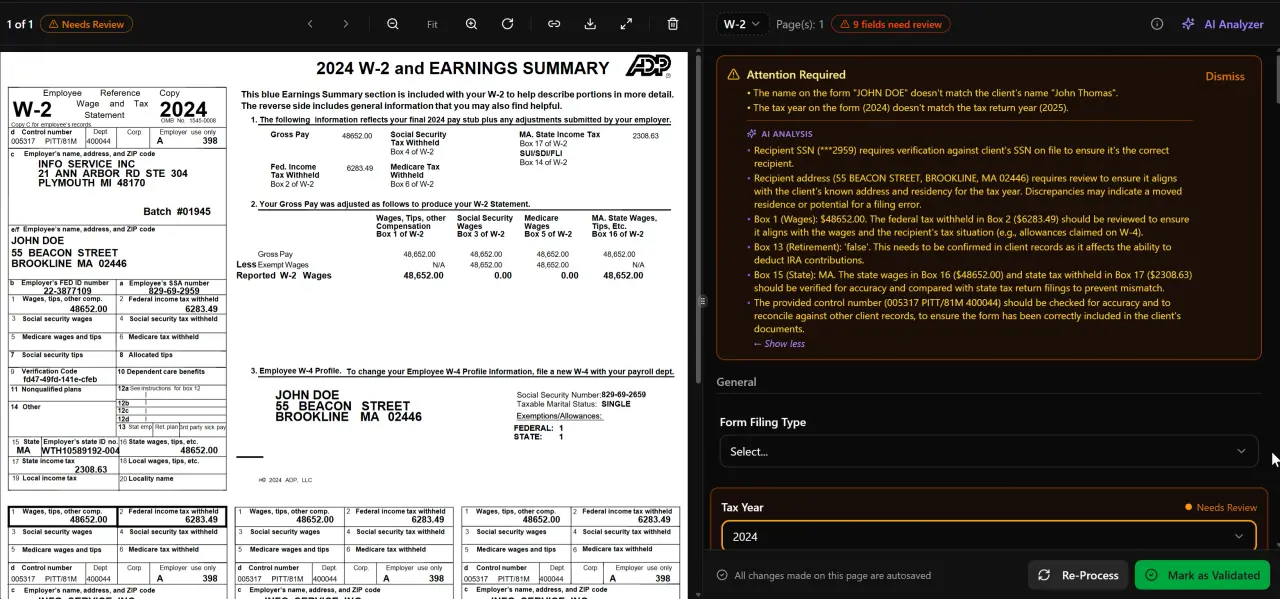
AI classifies, extracts, and validates every document automatically
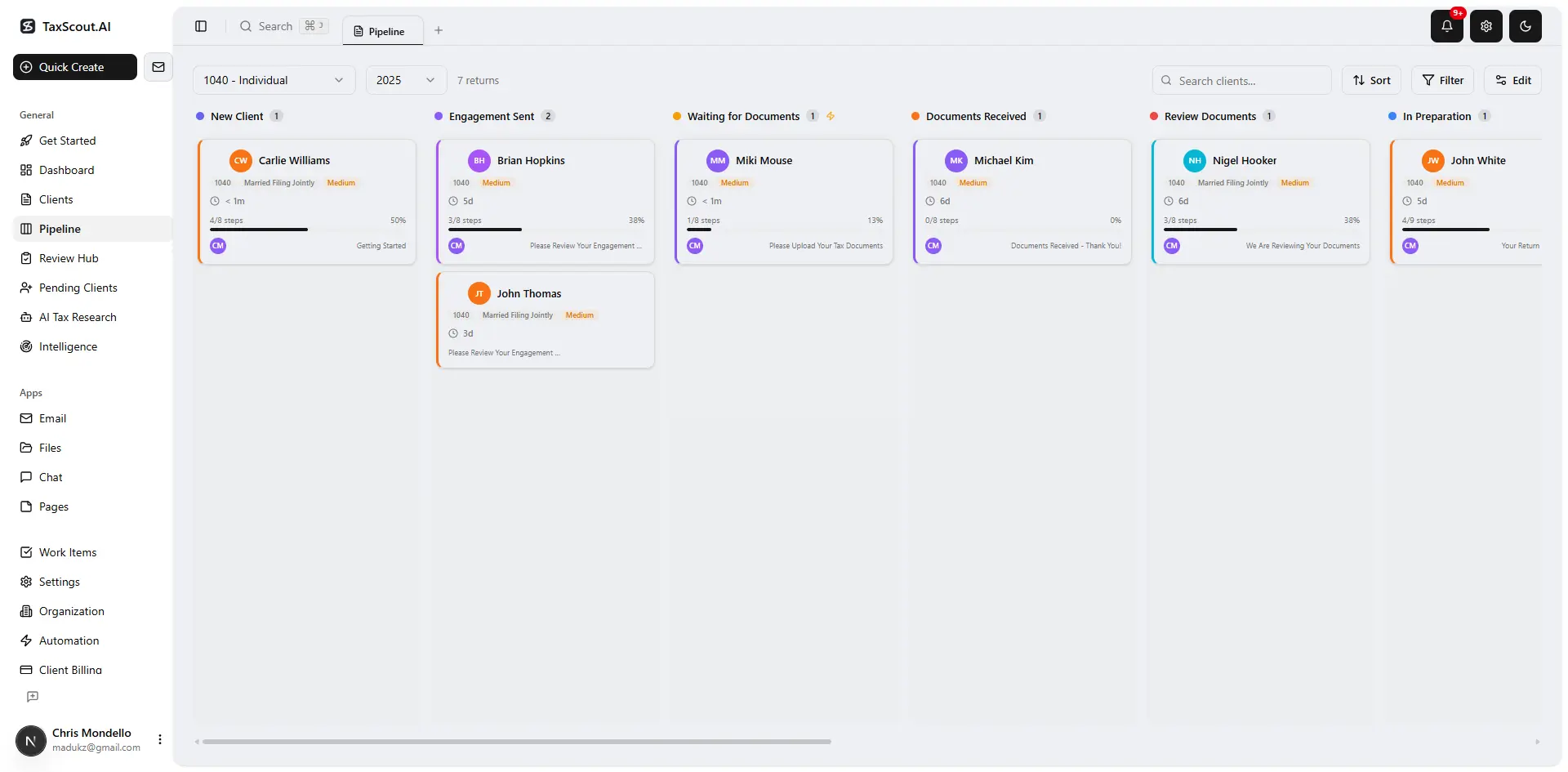
Track every return from intake to filed with drag-and-drop pipeline management
Negotiating the Accounting Firm Purchase Agreement
The accounting firm purchase agreement is where deal economics get translated into enforceable obligations. Retaining a CPA-specialized M&A attorney — not a generalist — matters here because the representations and warranties in an accounting practice sale differ materially from a standard business sale. Specific clauses to negotiate carefully include the client non-solicitation period for the seller (typically 3-5 years), the definition of 'collected revenue' used to calculate earn-out payments, and the allocation of professional liability exposure for pre-closing work.
Non-compete and transition assistance provisions deserve particular attention. A seller who agrees to a two-year non-compete but is also obligated to make active introductions to clients for only 30 days is creating conditions for client attrition. Best practice is to structure a 90-to-180-day transition period during which the seller participates in client meetings, co-signs communications, and explicitly endorses the acquiring firm. The Treasury Department's guidance on practice standards and Circular 230 require that any practitioner signing returns has reviewed the underlying work — agree in advance on how the transition period handles return signing authority.
Staff matters belong in the purchase agreement, not as an afterthought. Identify which employees are essential to client retention, document their current compensation and benefit levels, and include employment offer letters as a closing condition if key staff are critical. A firm where three senior staff members hold all meaningful client relationships is functionally un-transferable if those staff members resign on closing day.
Consider including a technology transition covenant. The agreement should specify who is responsible for migrating client data, what format data will be delivered in, and how long the seller will maintain access to legacy systems to support the migration. This prevents the common situation where the buyer discovers, post-closing, that client files exist only in a proprietary software format that the acquired firm is now canceling.
Staff Retention and Culture Integration After a Firm Merger
Staff retention is where most CPA firm mergers either accelerate or stall. The Bureau of Labor Statistics consistently reports that experienced accounting staff are in short supply, and senior staff who leave during a merger transition almost never return. The window to secure key employees is the 30-60 days immediately following announcement — after that, competing offers accumulate and loyalty calculus shifts.
Retention bonuses structured as stay agreements — payable 12-18 months post-close — are the standard tool. A typical stay bonus equals 15-25% of annual compensation and is forfeited if the employee resigns voluntarily. Pair these with title clarity and career path discussions. Staff who understand what their role looks like in the combined firm are significantly less likely to interview elsewhere than staff who are left to speculate.
Culture integration is harder to structure but equally important. Differences in billing philosophy (hourly vs. value-based), client communication norms, remote work policy, and staff meeting cadence all generate friction that erodes productivity in the 6-12 months post-merger. Conducting a structured culture assessment before closing — even a simple survey comparing how each firm's staff describes their ideal working environment — surfaces misalignments early enough to address them in onboarding design.
For firms scaling from solo to multi-partner, a merger often represents the first time the owner has had to manage someone else's existing team culture rather than building their own from scratch. The operational cadence — weekly team standups, capacity reporting, project assignment protocols — needs to be standardized and communicated within the first 30 days to prevent the merged firm from operating as two parallel practices sharing a name.
Track every return from intake to filed with drag-and-drop pipeline management

Your clients see your brand — OTP login, document upload, and real-time status
Post-Merger Tech Stack Consolidation and Workflow Migration
Post-merger technology consolidation is the operational phase that M&A advisors almost never address — and it is where most of the real integration cost lives. When two CPA firms merge, they rarely use the same practice management software, document management system, or client portal. Reconciling two incompatible tech stacks while simultaneously serving a doubled client base during tax season is the scenario that turns good deals into operational emergencies.
The consolidation decision should be made before closing, not after. Evaluate each firm's existing technology across five dimensions: document storage and retrieval, client communication and portal, workflow and pipeline management, tax preparation software compatibility, and billing and invoicing. The goal is to select one platform as the system of record and migrate the other firm's clients into it within the first 90 days post-close.
TaxScout is purpose-built for exactly this integration scenario. Its AI document extraction engine handles 180+ tax form types — meaning that documents from an acquired firm's legacy system can be uploaded and re-extracted without manual re-keying, regardless of the original format. The 5-layer validation pipeline (AI extraction with confidence scoring, OCR cross-verification, 15 deterministic math rules, 18 post-extraction rules, and cross-document validation) catches data quality issues introduced during migration before they reach a preparer's desk.
The client portal with OTP login (no passwords for clients) and the smart intake engine modeled on IRS Form 13614-C with four-layer prefill are particularly valuable during client migration: acquired clients can be onboarded into the new firm's portal and complete their intake digitally without requiring a phone call or in-person meeting. For a firm that has just absorbed 200-300 new clients, that is a substantial capacity advantage.
TaxScout's pipeline management system offers 12 customizable stages with drag-and-drop kanban — allowing the merged firm to design a unified workflow that reflects its combined service model from day one rather than inheriting two conflicting process maps. Because pricing is flat with no per-user fees and unlimited clients, absorbing an acquired firm's client base does not trigger a pricing ratchet the way per-user tools like TaxDome ($100/user/month) or Canopy ($45/user/month per module) would. See the full comparison at TaxDome alternative and Canopy alternative.
For firms that use different tax preparation software — Drake, CCH Axcess, UltraTax CS, Lacerte, ProConnect, or ProSeries — TaxScout works alongside all of them rather than replacing them. The acquisition does not force a tax software migration on top of a practice management migration, which is a meaningful risk reduction. Review how TaxScout integrates with Drake Tax Software for a concrete example of the side-by-side workflow.
Document System Migration Checklist
Before decommissioning the acquired firm's document system, complete the following: export all client files in a non-proprietary format (PDF or original source), verify that all prior-year returns are present and legible, confirm that engagement letters and signed 8879s are retained per your firm's document retention policy (generally 7 years per IRS guidance on record retention), and catalog any client files that are incomplete or missing source documents. Our document management guide for CPA firms covers retention standards in detail.
Client Communication During Platform Transition
Clients experience a merger primarily through its disruption to their communication habits. If an acquired client has been emailing their CPA at a legacy domain address for ten years, migrating them to a new portal requires an explicit, personal outreach — not just a form letter. Best practice is a co-signed email from both the departing and acquiring firm principals, followed by a portal invitation with a one-click OTP login that removes password friction. Track portal adoption by client in the weeks following migration; any client who has not logged in within 30 days of invitation should receive a personal outreach from a named staff member, not an automated reminder.
Practice management platform cost comparison for a merged 10-person firm with 400+ clients
| Platform | Pricing Model | Monthly Cost (10 Staff) | AI Extraction | Unlimited Clients |
|---|---|---|---|---|
| TaxScout Prep Pro | Flat per firm | $149/mo | Yes — 180+ form types | Yes |
| TaxDome | Per user | ~$500/mo | No | Yes |
| Canopy | Per user + per module | ~$660/mo | No | No (intake $11/client) |
| Karbon | Per user | ~$590/mo | No | Yes |
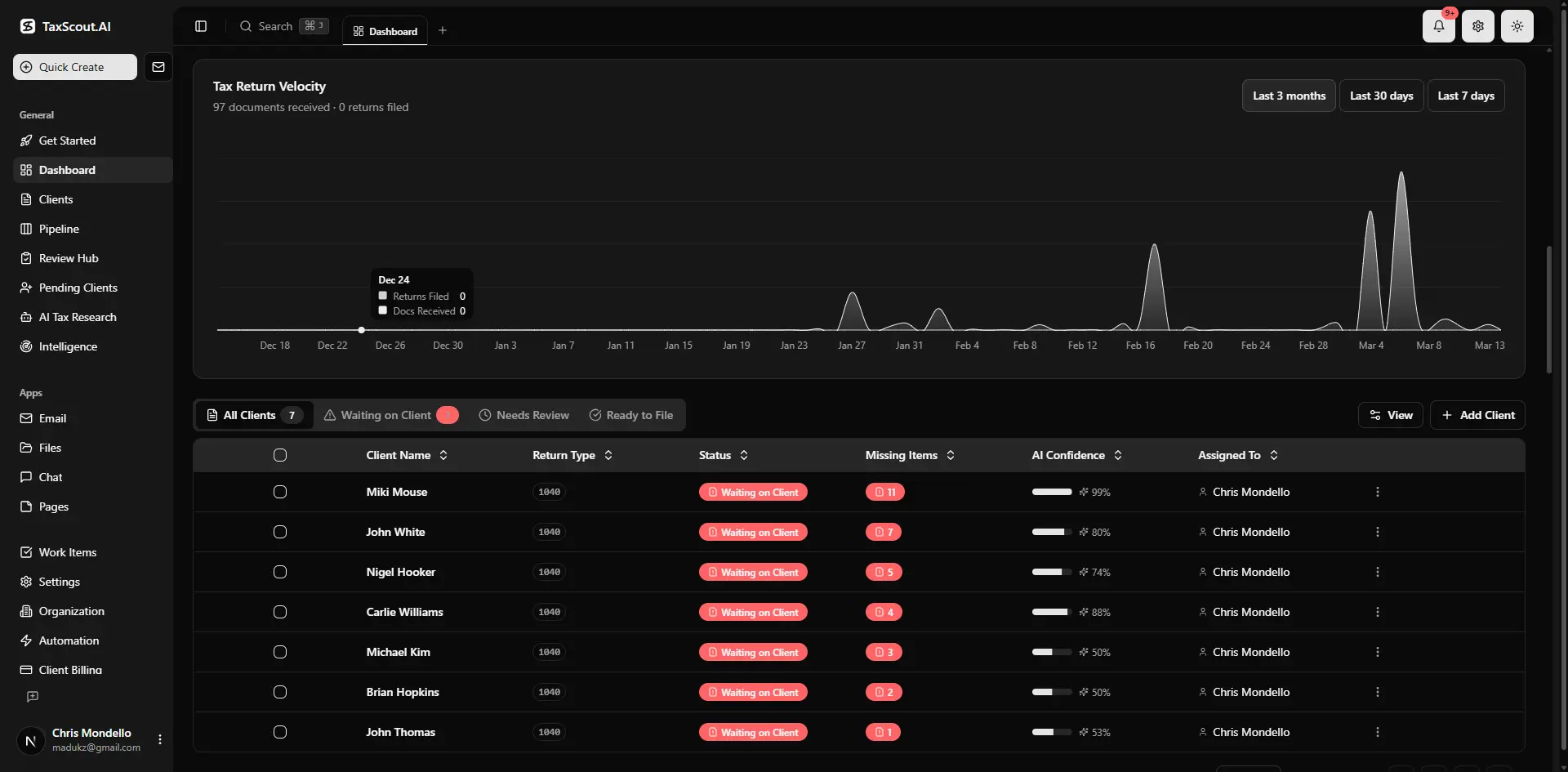
Real-time dashboard showing returns in progress, revenue, and upcoming deadlines
Building a 90-Day Post-Merger Integration Timeline
The 90 days following a CPA firm merger closing are the highest-risk period for client attrition and staff defection. A structured integration timeline reduces uncertainty for both staff and clients and creates accountability checkpoints that prevent tasks from slipping.
Days 1-30 should focus on immediate stabilization: issue staff retention agreements, send co-signed client announcement letters, transfer domain and email accounts, and begin exporting the acquired firm's document library. The acquiring firm's practice management platform should be configured with the merged firm's branding and the new client roster loaded before any client-facing portal invitations are sent.
Days 31-60 focus on workflow unification: map the acquired firm's existing client engagements into the acquiring firm's pipeline management stages, standardize engagement letters and fee schedules, and complete portal onboarding for all active clients. The e-signature workflow supporting Form 8879, engagement letters, and 4868 extensions should be live and tested before any returns are ready for delivery.
Days 61-90 focus on operational normalization: run a full post-tax-season review format on the merged firm's first completed filing cycle to identify workflow bottlenecks introduced by the integration, confirm that all acquired client files are accessible in the new system, decommission legacy software subscriptions, and hold a structured staff feedback session. Track key integration metrics — client portal adoption rate, average days from document receipt to return delivery, and invoice collection time — against the acquiring firm's pre-merger baseline to quantify whether the integration is on track. Our guide to accounting firm KPI dashboards provides the measurement framework.
Ready to absorb an acquired firm's client base without doubling your software costs or rebuilding your workflow from scratch?
TaxScout's flat-rate, unlimited-client platform is designed for exactly the integration challenge a CPA firm merger creates — AI extraction, unified pipeline, branded portal, and e-signatures all included.

Click any extracted field to see its source highlighted on the original PDF
Frequently Asked Questions
Most CPA firm acquisitions are priced at 0.8x to 1.3x gross recurring revenue, depending on service mix, client retention history, and fee realization rates. Advisory-heavy practices with retainer revenue can command multiples up to 1.5x or higher. Earn-out structures — paying 70-80% at closing and the remainder over 12-24 months based on collected revenue — are common to manage client retention risk.
Keep reading
Amended FBAR Procedures: How CPAs Correct Foreign Account Errors Without Triggering Penalties
Oct 12, 2026 · 1 min read
Transparency in Coverage Final Rules: What CPA Firms Must Do Now
Oct 12, 2026 · 1 min read
Backdoor Roth IRA: How CPAs Execute the Strategy for High-Income Clients
Oct 12, 2026 · 1 min read
Stay up to date
Get the latest tax tech insights delivered to your inbox.