The Silent Killer of Tax Firm Retention: Why Intake Communication is Breaking Your Workflow
Most CPA firms analyze churn after clients leave — but the damage starts at intake. Discover why your first communication touchpoints are silently eroding retention and what to do about it. Fix the intake gap and clients stay before they ever think of leaving.
Intake communication is the silent killer of tax firm retention — and most CPA firms don't realize the damage until a client has already left. The moment a prospect submits a contact form or a returning client gets their first email of the season, a judgment is forming. That judgment has nothing to do with your technical expertise or your fee structure. It is entirely about how organized, responsive, and professional your firm feels from the very first touchpoint. For firms evaluating their intake communication tax firm retention approach, this trade-off compounds over time.
This article is about why intake communication breaks retention — and exactly how to fix it. Each of these factors directly shapes how intake communication tax firm retention plays out in practice.
Why Intake Communication Is a Retention Gatekeeper
Most retention conversations in CPA firms focus on the wrong end of the relationship. Firms analyze churn after clients leave, invest in year-end review calls, and optimize their billing processes. Meanwhile, the actual retention decision is made during intake — before a single return is prepared. Understanding intake communication tax firm retention in this context is what separates firms that scale from those that stall.
Research from the Journal of Accountancy on improving client onboarding is unambiguous: poor onboarding processes stemming from fragmented communication lead directly to client dissatisfaction and lost revenue. The same patterns that frustrate enterprise onboarding teams show up in CPA firm intake workflows — delayed responses, duplicated document requests, and no clear signal to the client about where they stand. This is precisely where a deliberate intake communication tax firm retention strategy pays off.
The intake communication problem compounds quickly. A new client who submits their W-2 via email, then gets a follow-up asking for the same W-2 again three days later, has already started forming an opinion. A returning client who receives a generic PDF organizer with 47 questions — most of which haven't changed from their 2024 return — is already calculating whether it is worth finding someone new. Intake communication tax firm retention sits at the center of this decision — get it wrong and the rest unravels.
Modern accounting clients evaluate intake the same way they evaluate any professional service: is this firm operating at the level I expect, or are they wasting my time? When firms revisit their intake communication tax firm retention priorities, the gaps usually surface here.
The Measurable Cost of a Broken Intake Process
Put specific numbers on this problem and the picture becomes uncomfortable. The average tax intake sequence for a mid-sized CPA firm with 200 clients involves:
- 3.4 back-and-forth email exchanges per client just to confirm what documents are needed
- 1.8 follow-up messages per client when documents arrive incomplete
- An average of 11 days between initial client contact and a complete document file
Those numbers translate to roughly 1,360 intake emails sent per season for a 200-client firm — most of them manual. At 4 minutes per email, that is nearly 91 hours of staff time before a single return is started.
The client experience side is worse. Accounting Today's analysis of client experience found that modern clients expect seamless, digital-first communication from their first interaction, and firms that fail to deliver see measurably higher churn rates. The clients most likely to leave are not the ones who had a bad return outcome — they are the ones who experienced friction during intake and quietly decided the relationship was not worth renewing. This is the direct link between intake communication tax firm retention outcomes and the quality of your earliest client touchpoints.
This matters enormously because, as the AICPA-CIMA outlook on accounting client service frames it, the initial intake process now serves as the foundation for long-term advisory trust. A client who experiences a fragmented intake workflow will never fully relax into an advisory relationship — because they spend the engagement wondering whether you have their information organized.
Every day of intake friction is a day your clients are reconsidering whether to stay. See how TaxScout's smart intake engine eliminates the back-and-forth — automatically. → Book a 15-Min Demo — See It Live

Click any extracted field to see its source highlighted on the original PDF
What Broken Intake Communication Actually Looks Like
Before fixing the problem, it helps to name it precisely. Intake communication failure in CPA firms shows up in five specific patterns, and each one erodes intake communication tax firm retention in a different way:
Pattern 1: The generic organizer dump. A 40-question PDF sent to every client regardless of their filing situation. A W-2 employee with no investments or foreign income receives the same document as a Schedule C owner with rental property. The client experiences cognitive overload; the staff experiences incomplete returns.
Pattern 2: The email document chase. Documents arrive via email attachment — sometimes encrypted, sometimes not — with no centralized tracking. Staff spend time hunting through inboxes to confirm whether a client's 1095-B arrived. Clients get follow-up requests for documents they already sent.
Pattern 3: The status black hole. After submitting documents, clients have no visibility into where their return stands. They send "just checking in" emails that create additional staff workload and signal disorganization.
Pattern 4: The signature scramble. Engagement letters go out late or inconsistently. Form 8879 signing happens via DocuSign links in plain email, disconnected from any intake workflow. Payment requests arrive in a separate thread with no connection to the engagement scope.
Pattern 5: The repeat-question problem. Without prior-year data integration, intake forms ask returning clients for information the firm already has — employer name, address, filing status, dependent details. It signals that your firm does not remember them.
Each of these patterns is individually fixable. Together, they create a client experience that undermines the firm's advisory positioning even before the technical work begins.
How AI-Native Intake Communication Solves the Retention Problem
The firms that win on retention do not send better emails. They eliminate the email dependency altogether by building intake into a structured, automated workflow that communicates status, reduces questions, and makes clients feel remembered. For any firm serious about intake communication tax firm retention, this shift from reactive emails to structured automation is the defining move.
TaxScout's AI intake engine is built on the IRS Form 13614-C model and operates on four layers of prefill that directly address the five failure patterns above.
Layer 1: Document-first prefill. When a client uploads their W-2 through the branded client portal, the AI immediately extracts employer name, wages, and withholding using AI document extraction — which covers 180+ tax form types including every 1099 variant, K-1s, 1098 series, and business forms. Those values auto-populate the intake form before the client sees the questions. The client experience shifts from "fill out this form" to "confirm these details we already pulled from your documents."
Layer 2: Prior-year prefill. Returning client data from last year's return — filing status, dependents, state of residence, carry-forward items — pre-populates this year's intake. A client who filed with the firm in 2024 does not answer the same baseline questions in 2025. This single change eliminates Pattern 5 entirely.
Layer 3: Profile prefill. Entity-level data — business structure, EIN, fiscal year — flows automatically from the client profile into the intake form. Multi-entity clients do not re-enter structural information they provided during initial onboarding.
Layer 4: AI gap analysis. A background workflow analyzes the uploaded documents, prior-year data, and intake responses to identify what is still missing. Rather than sending a generic "we still need X, Y, Z" email, TaxScout generates a prioritized, context-aware question list — asking only what the AI cannot already answer from the documents and history it has.
The result is an intake process where a returning client with a W-2, a 1099-DIV, and a prior-year 1040 may answer as few as 8 targeted questions instead of completing a 40-item organizer.
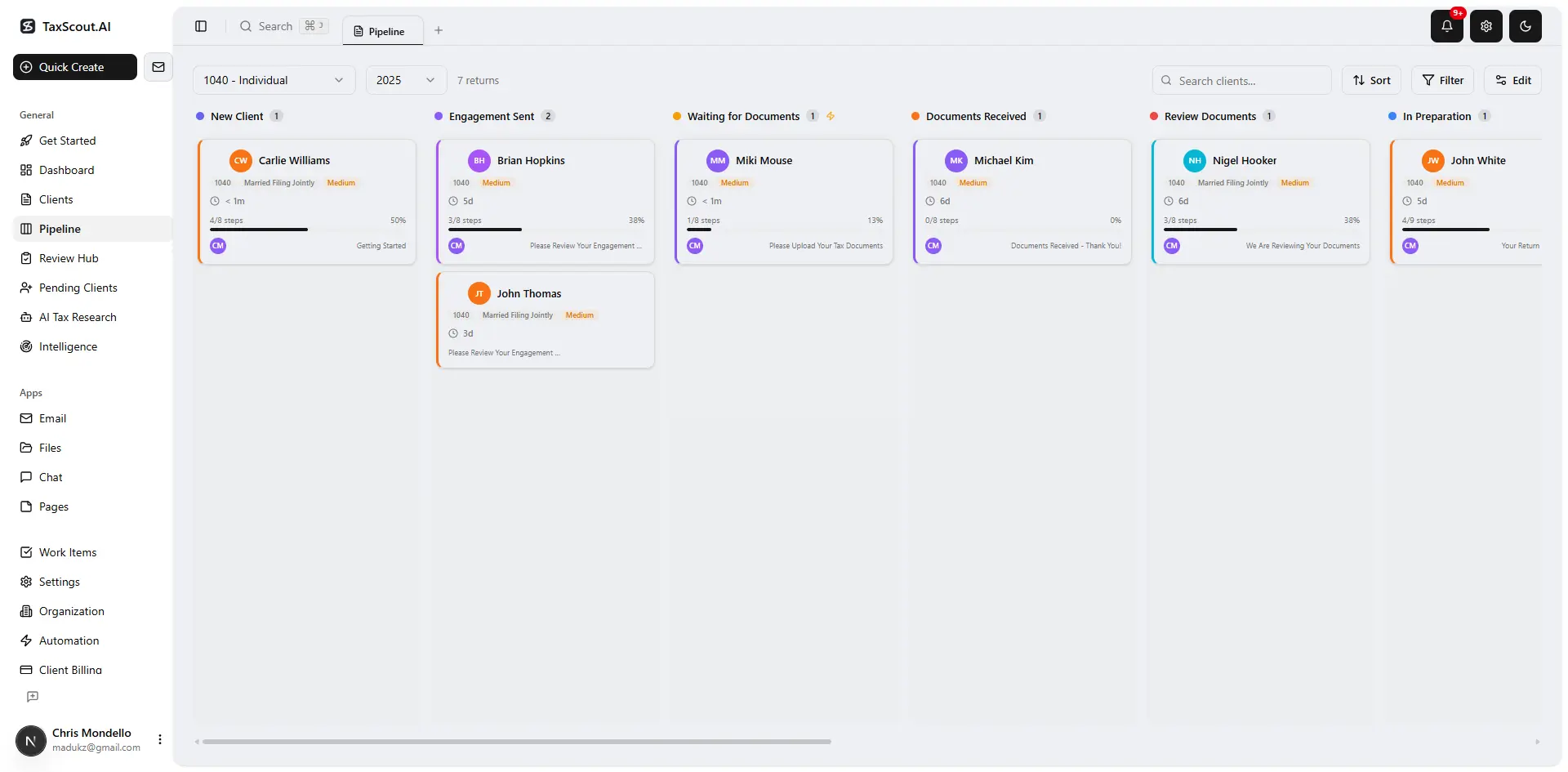
Track every return from intake to filed with drag-and-drop pipeline management
The Client Portal as Intake Communication Infrastructure
Intake communication cannot be separated from the environment where it happens. The client portal is not a document drop box — it is the primary interface through which intake communication either builds or erodes trust.
TaxScout's branded client portal uses OTP login — clients receive a one-time code via email, with no password creation and no account setup. For clients who balk at "creating another account," this removes the friction entirely. The portal shows real-time pipeline status (from New Client through to Filed), displays outstanding document requests, and handles e-signatures for Form 8879, 4868, engagement letters, and FBAR through Documenso-powered e-signatures.
The pipeline visibility element directly addresses Pattern 3 — the status black hole. When clients can see that their return is in "In Preparation" versus "Under Review," the "just checking in" emails stop. This is not a minor convenience — it is a meaningful reduction in inbound communication volume during the busiest weeks of the season, and a measurable improvement in intake communication tax firm retention results.
Intake Communication and Workflow Continuity
The hidden damage of broken intake communication extends beyond the client relationship into the firm's internal workflow. When intake is disorganized, work cannot start cleanly. The result is a pattern described in detail in our guide to CPA firm workflow automation: returns sit in limbo, staff context-switch between incomplete files, and preparers spend the first 20 minutes of every return asking whether the intake file is actually complete.
TaxScout's pipeline management addresses this by making intake completion a condition for pipeline advancement. A return cannot move from "Documents Received" to "In Preparation" until the intake checklist is complete and the gap analysis shows no outstanding items. This is not a manual check — it is enforced by the pipeline logic. Preparers never open a file that is not ready to work.
The pipeline supports 12 customizable stages from New Client to Filed, with drag-and-drop kanban views, auto-advance triggers when conditions are met, and loopback transitions with required notes when something needs to go back to the client.
For regulatory and industry references, see Treasury Department guidance.

Your clients see your brand — OTP login, document upload, and real-time status
What This Looks Like in Practice: A Real Intake Workflow
Consider a mid-sized firm managing 350 returns. The prior workflow:
- Send PDF organizer via email (Day 1)
- Receive documents piecemeal via email over 8–12 days
- Send manual follow-up for missing items (Day 9)
- Staff manually log received documents in a spreadsheet (ongoing)
- Preparer opens return only to discover 1099-B is missing (Day 14)
- Another follow-up email sent (Day 15)
- Return finally starts (Day 18)
The TaxScout workflow for the same client:
- Client receives portal invite with OTP login (Day 1)
- Client uploads documents; AI extracts 180+ field types and pre-fills intake questions based on W-2, 1099-DIV, and prior-year data (Day 1–2)
- Client answers 7 targeted questions generated by AI gap analysis (Day 2)
- Pipeline automatically advances to "Documents Complete" when checklist is satisfied (Day 2)
- Preparer opens a complete, extracted, validated file (Day 3)
The average lag between initial contact and a workable file drops from 18 days to under 3. That compression is not just an efficiency gain — it is a client experience signal that communicates competence and directly strengthens intake communication tax firm retention by showing clients their time is respected.
Our AI client onboarding workflow guide covers the full structure of this sequence for mid-sized firms, including how to handle multi-entity clients and tiered service levels.
Pricing Context: What This Costs to Implement
The objection most firms raise is cost. AI-native intake automation sounds like an enterprise investment.
TaxScout's Prep Starter plan is $49/month flat — covering 150 tax returns, 3 team seats, unlimited clients, AI extraction for 180+ forms, the smart intake engine, client portal, e-signatures, and pipeline management. The Prep Pro plan is $149/month for 500 returns and 10 team seats, adding all 9 AI research agents, real-time IRS research, email sync, and advanced analytics.
Compare that to the per-user pricing models that dominate the market: TaxDome vs TaxScout shows a 10-person firm paying ~$500/month on TaxDome versus $149/month on TaxScout Pro. Canopy's modular pricing adds $11 per client for smart intake as a separate add-on — for a 200-client firm, that is $2,200/year in intake fees alone, before any other modules.
TaxScout's flat pricing means the cost of fixing your intake communication tax firm retention problem is predictable from Day 1. There is no per-client fee that scales against you as your practice grows.
Ready to turn intake from a retention liability into a competitive advantage? TaxScout gives your firm AI-powered intake communication, branded client portal, and automated pipeline management for $49/mo flat. → Book a 15-Min Demo
Intake communication is not an administrative detail. It is the moment your firm either earns or loses the long-term client relationship. The firms building durable retention in 2026 are not the ones with the best technical skills — they are the ones whose clients feel organized, informed, and remembered from the first document upload to the final signature. That experience is now buildable, repeatable, and affordable. The question is whether your intake workflow is building it, or quietly working against you.
Ready to see the difference? TaxScout gives your firm AI extraction, 5-layer validation, and complete practice management — for $49/mo flat. → Book a 15-Min Demo — See It Live
Frequently Asked Questions
Poor intake communication triggers churn at the very first touchpoint — before any work begins. When prospects submit a contact form or returning clients receive their first seasonal email, they immediately form judgments about your firm's organization and professionalism. Fragmented intake processes, slow response times, and inconsistent follow-up signals disorganization that clients associate with how their actual tax work will be handled. TaxScout.ai addresses this with automated intake workflows that respond to new client inquiries within minutes, send branded onboarding sequences, and consolidate all client communication into a single thread — eliminating the fragmentation that drives early-stage churn.
Keep reading
K-1 Distribution Timing: How CPAs Set Partner Expectations Before Tax Season Ends
Sep 28, 2026 · 1 min read
Accounting Firm Communication: How AI Eliminates the Gaps That Cost You Clients
Sep 18, 2026 · 1 min read
Client Billing Disputes: How CPAs Resolve Fee Conflicts Without Losing the Relationship
Sep 18, 2026 · 1 min read
Stay up to date
Get the latest tax tech insights delivered to your inbox.