Charitable Lead Trust: How CPAs Reduce Estate and Income Tax for Philanthropic Clients
Charitable lead trusts remain one of the most underutilized estate-freeze vehicles available to high-net-worth clients who have already maximized donor-advised funds and direct giving. This guide walks CPAs through CLAT and CLUT mechanics, the section 7520 rate interplay, and the critical grantor…
For philanthropically inclined clients with taxable estates exceeding the 2026 unified exclusion of $15,000,000 per person, a charitable lead trust can accomplish two objectives simultaneously: it generates a stream of charitable deductions today and transfers the remaining trust assets to heirs at a steeply reduced transfer-tax cost. Yet most CPA-authored content on charitable giving never reaches the charitable lead trust — stopping instead at donor-advised funds, qualified charitable distributions, and charitable remainder trusts that benefit the donor first.
The mechanics require more upfront analysis than a simple DAF contribution, but the payoff is proportionate. A properly structured CLAT or CLUT can freeze the taxable estate, generate a front-loaded income tax deduction in grantor form, and deliver appreciated assets to the next generation essentially free of gift and estate tax if the trust's investment returns outpace the IRS section 7520 hurdle rate. For high-net-worth clients who have already exhausted conventional charitable vehicles, the charitable lead trust is often the next logical instrument.
This guide is written for CPAs in the advisory or estate planning lane — not for first-year tax prep. It assumes familiarity with irrevocable trust basics, section 664 charitable trust rules, and gift tax mechanics. What it provides is an operational walkthrough: CLAT versus CLUT, grantor versus non-grantor trade-offs, the 7520 rate window analysis, and how to position these instruments in a broader estate freeze strategy. Before diving into advanced structuring strategies, it helps to establish a working definition: a charitable lead trust is an irrevocable arrangement in which a charity receives income payments for a specified term, with the remaining assets passing to non-charitable beneficiaries.
Charitable Lead Trust Structure: CLAT vs CLUT Mechanics
A charitable lead trust is an irrevocable split-interest trust that pays an income stream to one or more qualified charities for a fixed term or a measuring life, then distributes the remaining trust corpus to noncharitable beneficiaries — typically the grantor's children or a dynasty trust. It is the structural mirror image of a charitable remainder trust: in a CRT, the donor receives the lead interest and charity receives the remainder; in a CLT, charity receives the lead interest and family receives the remainder.
There are two principal variants. A charitable lead annuity trust (CLAT) pays a fixed dollar annuity to charity each year, regardless of the trust's actual investment performance. Because the payout is fixed, the IRS tables lock in the charitable deduction at the moment of funding. A charitable lead unitrust (CLUT) pays a fixed percentage of the trust's fair market value, revalued annually — structurally analogous to a CRUT. The CLUT's annuity fluctuates with investment performance, which means the remainder interest is harder to model at inception. Understanding which variant best serves your client begins with recognizing that every charitable lead trust must choose between these two payout structures before funding, since the choice has permanent tax and investment implications.
From a wealth-transfer standpoint, the CLAT is almost always the preferred vehicle for estate-freeze purposes. Because the annuity is fixed, any investment return above the section 7520 hurdle rate accrues entirely to the remainder beneficiaries. If the 7520 rate is 4.0% and the trust earns 7%, the excess 3% compounding each year passes to heirs gift- and estate-tax free. The CLUT does not isolate this spread as cleanly — the annual revaluation resets the base, diluting the mathematical leverage that makes CLATs so powerful in wealth-transfer planning. This spread between the hurdle rate and actual portfolio performance is often called the 'mortality arbitrage' of a charitable lead trust, and it is the core reason advisors pursue this structure during low interest-rate environments.
Both trust types require a qualifying charitable lead interest under IRC §2055(e)(2)(B) for estate tax purposes and §2522(c)(2)(B) for gift tax purposes. The governing instrument must specify the payout amount (CLAT) or percentage (CLUT), the charitable term, and the remainder beneficiaries. There is no IRS form equivalent to a Form 5227 filing requirement for CLTs in the same manner as CRTs, but the trust instrument must satisfy the split-interest rules and the trustee must track distributable net income under Subchapter J. For firms evaluating their charitable lead trust approach, this trade-off compounds over time.
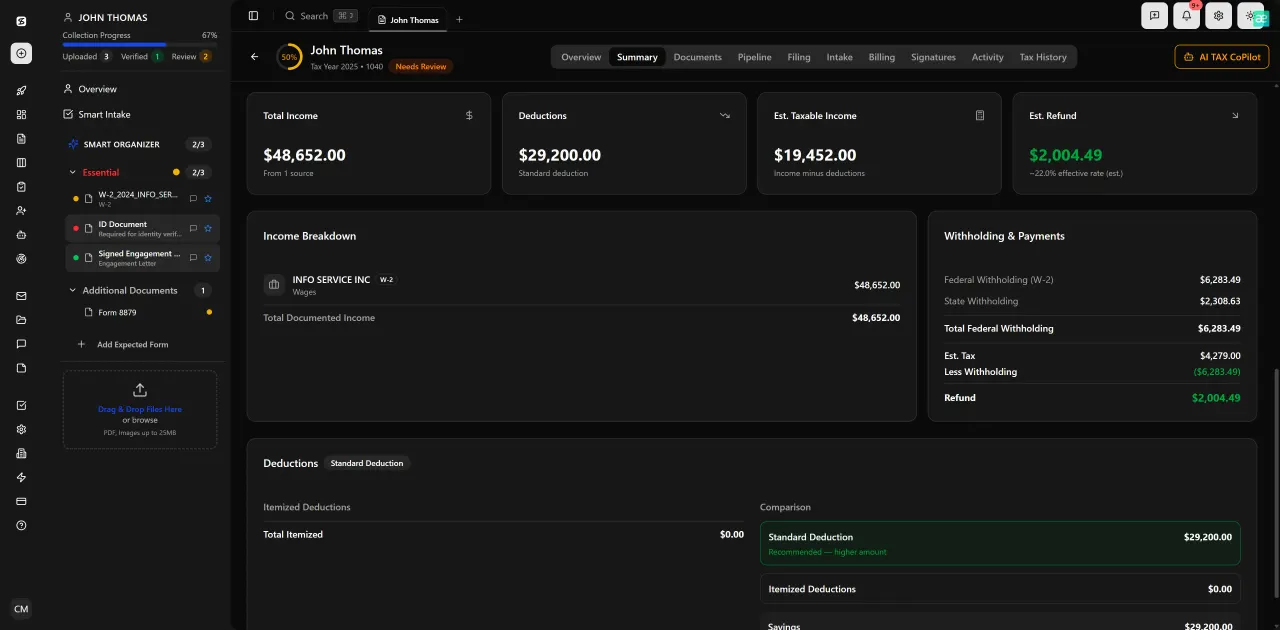
Review with AI assist — 9 agents answer questions with full client context
Section 7520 Rate Planning: Identifying the Optimal CLT Window
Tired of manual workflows slowing your firm down? See how TaxScout handles this with AI-powered automation. → Book a 15-Min Demo Each of these factors directly shapes how charitable lead trust plays out in practice.
The IRS section 7520 rate — published monthly as 120% of the applicable federal mid-term rate — is the single most important external variable in CLAT planning. It functions as the IRS's assumed rate of return on trust assets. The higher the 7520 rate, the higher the IRS values the charity's lead interest and the lower it values the family's remainder interest, which reduces the taxable gift at funding. Conversely, a lower 7520 rate reduces the assumed present value of the charity's lead stream, which inflates the remainder's taxable value — making CLATs less attractive for estate-freeze purposes when rates are low. Understanding charitable lead trust in this context is what separates firms that scale from those that stall.
This is the opposite of how rates affect charitable remainder trusts. CRTs benefit from higher rates because the IRS assigns more present value to the donor's retained income stream. CLTs benefit from moderate-to-higher rates — but the relationship is nuanced: what matters most for a zeroed-out CLAT is whether the trust's actual investment return can outpace the hurdle rate over the trust term. A CLAT is 'zeroed out' when the charitable annuity is set exactly equal to the amount needed to reduce the taxable remainder gift to zero (or near zero) based on the IRS tables. If the trust subsequently earns more than the 7520 rate, the entire excess passes to heirs without additional transfer tax. This is precisely where a deliberate charitable lead trust strategy pays off.
Rate sensitivity analysis should be standard practice before recommending a CLAT. Model the zeroed-out annuity payment at the current month's 7520 rate, then stress-test at rates 100 and 200 basis points higher and lower. For a ten-year CLAT funded with $5 million and a 4.5% 7520 rate, the zeroed-out annuity is approximately $618,000 per year — meaning the trust must generate at least that return annually to break even from a charity-fulfillment standpoint. Every dollar of return above the hurdle flows to the remainder beneficiaries free of gift and estate tax. CPAs should also note that the grantor may elect the 7520 rate in effect for either the month of funding or either of the two preceding months, creating a planning window to select the most favorable rate. Charitable lead trust sits at the center of this decision — get it wrong and the rest unravels.
No competitor article in the charitable planning space addresses this rate-sensitive window explicitly. Given that the 7520 rate changes monthly, high-net-worth clients with pending liquidity events — a business sale, a large stock award vest, or an appreciated real estate disposition — should be benchmarked against current and trailing rates before trust execution. For additional context on estate-freeze transactions involving rate-sensitive valuations, see our guide to SALT deduction cap workarounds and how timing decisions interact with overall income tax strategy. When firms revisit their charitable lead trust priorities, the gaps usually surface here.
Tired of researching IRS rate tables and IRC cross-references in separate browser tabs?
TaxScout's 9 AI research agents pull live IRS, Treasury, and Cornell Law data directly into your workflow — so you can model CLT structures without leaving the platform.
Grantor vs Non-Grantor Treatment: The Core Practitioner Decision
The grantor versus non-grantor election is arguably the most consequential structural choice in charitable lead trust planning, and it is the dimension most conspicuously absent from general-audience charitable giving content. The choice governs whether the trust's income is taxed to the grantor or to the trust itself — and it determines whether a front-loaded income tax charitable deduction is available at all.
A grantor CLAT is treated as a grantor trust under IRC §§671–679. Because the grantor is treated as the owner of the trust for income tax purposes, the grantor receives a charitable contribution deduction in the year of funding equal to the present value of the entire lead interest — calculated using the same section 7520 tables used for gift tax purposes. For a $5 million CLAT with a ten-year term and a 4.5% 7520 rate, this front-loaded deduction can approach the full funding amount. Subject to the AGI percentage limitations under IRC §170(b) — generally 30% of AGI for appreciated property contributed to a non-operating foundation equivalent or 60% for cash to public charities — the deduction reduces the grantor's current-year income tax liability significantly, with a five-year carryforward for any excess.
The trade-off is structural: in a grantor CLAT, the grantor reports all trust income each year on their personal return, regardless of whether any cash is distributed to them. The trust pays out its annuity to charity in cash, but the grantor is taxed on all income the trust earns — including capital gains, dividends, and interest. Over a ten-year trust term, this can create substantial phantom income, particularly if the trust is invested in growth assets with high turnover. The grantor's after-tax cash position must be modeled carefully.
A non-grantor CLAT avoids phantom income taxation. The trust files its own income tax return (Form 1041) and is taxed as a complex trust or simple trust depending on its terms. Charitable distributions to the lead beneficiaries generate a charitable deduction at the trust level under IRC §642(c), offsetting trust-level income. No deduction flows to the grantor. The remainder transfer is still a completed gift for gift tax purposes at funding — valued using the same 7520 tables — but no personal income tax deduction offsets the grantor's return. For clients in lower income tax brackets or those whose AGI limitations would strand a large deduction, the non-grantor structure is often cleaner.
The decision matrix is roughly: use a grantor CLAT when the client has a high-income year with sufficient AGI headroom to absorb the deduction (a business sale year is the classic example), and use a non-grantor CLAT when the estate-freeze objective dominates and the income tax tail is less important. Engage the client's estate attorney early — the grantor trust trigger must be built into the governing instrument, typically via a retained power under §674 or §675, and reversing grantor trust status post-execution requires a trust modification that may itself be a taxable event. For related guidance on structuring complex trust instruments for high-net-worth clients, see our walkthrough on divorce tax planning for CPAs, which covers similar split-interest and property-transfer considerations.

Track every return from intake to filed with drag-and-drop pipeline management
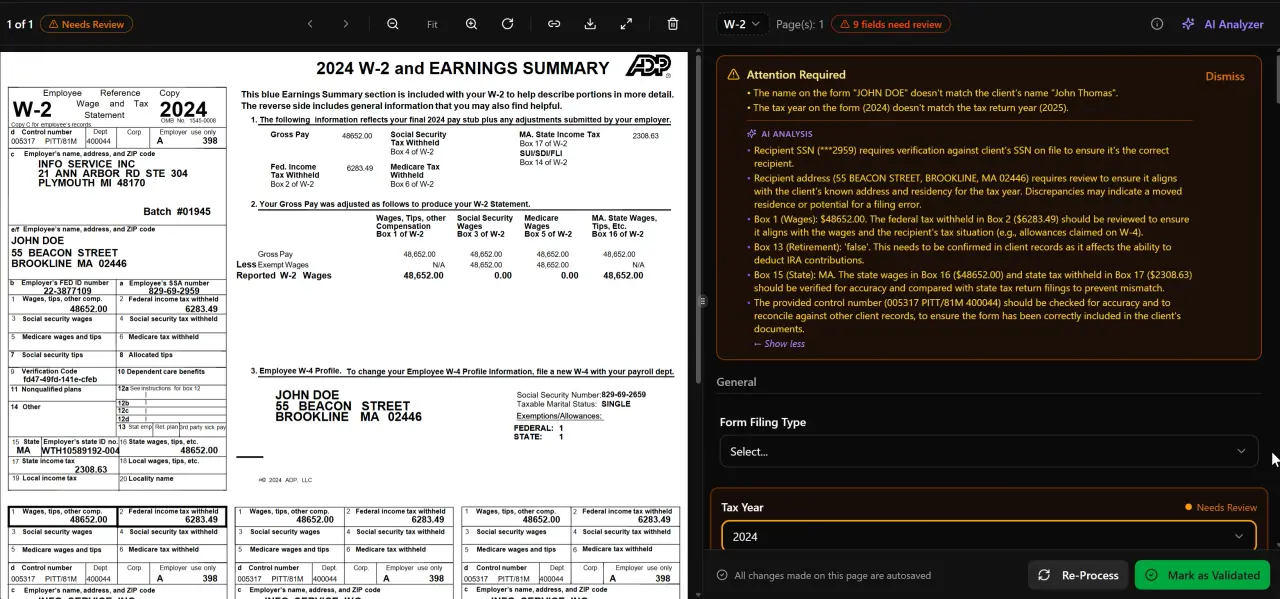
AI classifies, extracts, and validates every document automatically
CLT vs CRT: Why Philanthropic Clients Need Both Conversations
CPAs advising philanthropic clients frequently default to charitable remainder trusts because the client receives an income stream — a feature that resonates intuitively. The charitable lead trust flips this priority: the charitable mission is funded first, and wealth passes to heirs after the charitable term. This makes CLTs appropriate for a specific client profile: those who do not need trust income for living expenses, have estate tax exposure above the unified exclusion, and have an identified charitable purpose they are prepared to fund irrevocably for a fixed term.
The table below summarizes the core mechanical distinctions between a CLAT, CLUT, and the two major CRT forms to help CPAs position each instrument correctly in a client conversation.
CLT vs CRT: Key Structural and Tax Distinctions for CPA Advisors
| Feature | CLAT | CLUT | CRAT (CRT Annuity) | CRUT (CRT Unitrust) |
|---|---|---|---|---|
| Lead / income beneficiary | Charity | Charity | Donor / family | Donor / family |
| Remainder beneficiary | Family / heirs | Family / heirs | Charity | Charity |
| Payout type | Fixed annuity | Fixed % of FMV (revalued annually) | Fixed annuity | Fixed % of FMV (revalued annually) |
| Estate-freeze tool | Yes — strong | Limited | No | No |
| Income tax deduction to grantor | Yes (grantor form only) | Yes (grantor form only) | Yes (at funding) | Yes (at funding) |
| 7520 rate effect on remainder gift | Higher rate = lower taxable gift | Moderate sensitivity | Higher rate = larger deduction | Higher rate = larger deduction |
| Trust-level income tax (non-grantor) | Trust files Form 1041; §642(c) offsets | Trust files Form 1041; §642(c) offsets | Generally tax-exempt trust | Generally tax-exempt trust |
| IRS governing code section | §2055(e)(2)(B); §2522(c)(2)(B) | §2055(e)(2)(B); §2522(c)(2)(B) | §664 | §664 |
Estate Freeze Mechanics: How the Zeroed-Out CLAT Works
The 'zeroed-out' or 'Jackie O' CLAT — named for its use in the estate of Jacqueline Kennedy Onassis — is the archetype estate-freeze application. The mechanics are straightforward in principle: the annuity payout is set high enough that the IRS present-value calculation assigns the entire funding amount to the charity's lead interest, leaving the taxable remainder gift at or near zero. The grantor has effectively made a completed gift to the remainder beneficiaries without using any gift or estate tax exemption, provided the IRS tables value the remainder at zero.
In practice, the trust instrument cannot guarantee a zero remainder valuation due to rounding and minimum gift tax regulations, but a grantor can structure the CLAT so that the taxable remainder gift is de minimis — well below the annual exclusion or absorbed by any remaining unified credit. The 2026 unified exclusion is $15,000,000 per person ($30,000,000 for married couples using portability), so clients with estates below that threshold may not need a zeroed-out structure. For clients above the exclusion, the zeroed-out CLAT converts otherwise-taxable estate value into a charitable lead stream and a tax-free remainder transfer.
The critical caveat: the trust must actually earn the 7520 hurdle rate over its full term. If the trust underperforms — say, the 7520 rate is 4.5% but the trust only earns 3% — the charity receives its full annuity stream (which may require distributions from principal), and the remainder beneficiaries receive whatever is left, which could be substantially less than the original funding amount. This downside risk must be disclosed to the client explicitly. The CLAT is not a risk-free strategy; it is a bet that the trust's investment returns will outpace the IRS hurdle rate. CPAs should coordinate with the client's investment advisor on asset allocation before trust execution.
Clients with concentrated stock positions, private equity interests, or closely held business interests are natural CLAT candidates — these assets often carry high expected returns that can outpace the 7520 rate, and contributing appreciated property at fair market value avoids recognizing gain at funding (because the contribution is to an irrevocable trust, not a direct charitable transfer, capital gain recognition rules differ from a direct DAF contribution; confirm with the client's estate attorney). For a broader picture of appreciated-asset planning tools, our guide on Section 1231 gain planning covers complementary strategies for business asset dispositions.
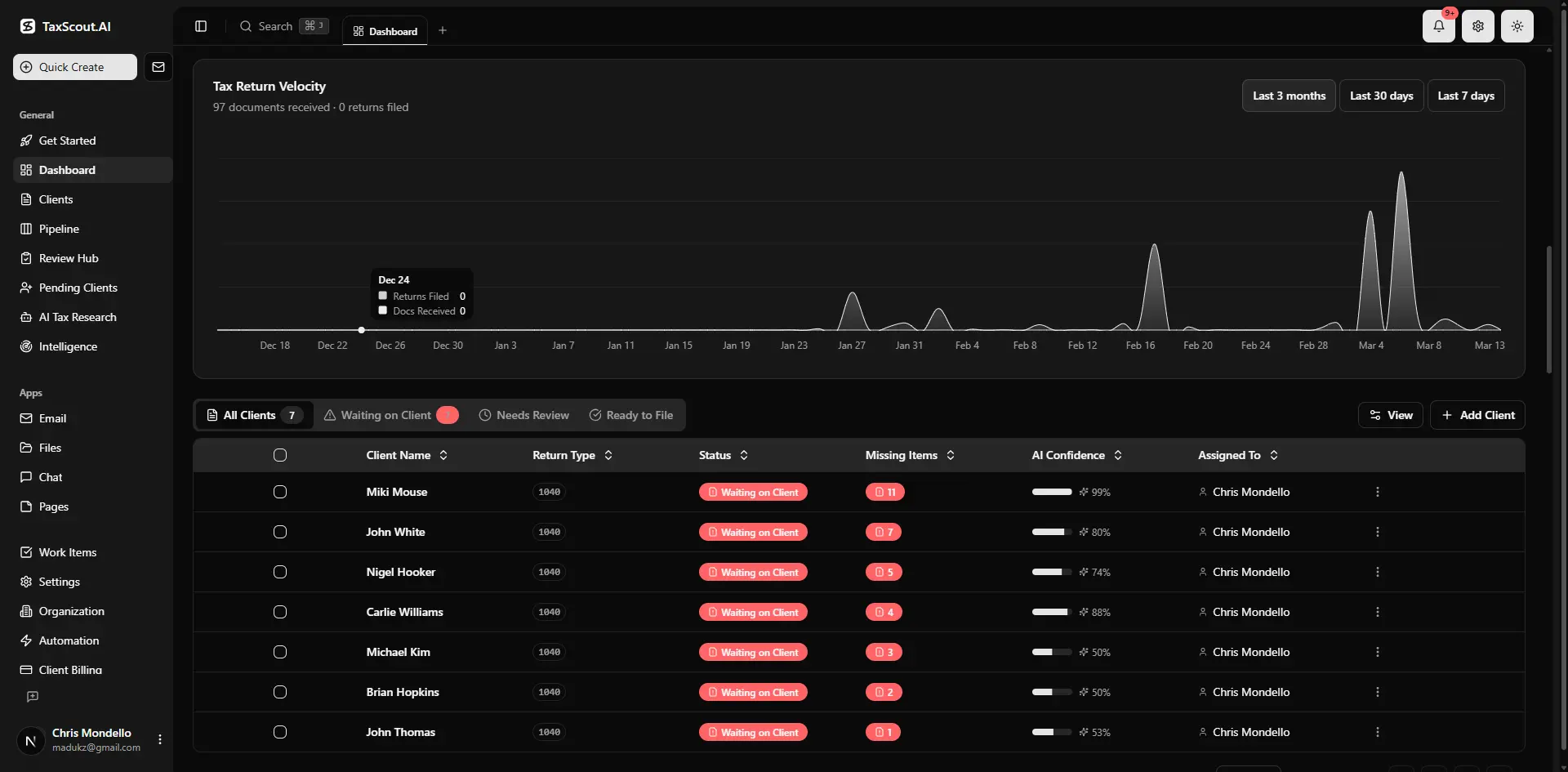
Real-time dashboard showing returns in progress, revenue, and upcoming deadlines

Smart intake auto-fills from uploaded documents and prior-year data
Positioning the CLT in a Comprehensive Philanthropic Estate Plan
A charitable lead trust rarely stands alone in a high-net-worth client's estate plan. It typically enters the picture after the client has already established a donor-advised fund for current-year giving flexibility, made direct charitable bequests in the will or revocable trust, and considered or executed charitable remainder trusts for income-producing assets. The CLT's role is the irrevocable, wealth-transfer layer — the instrument that simultaneously fulfills a multi-year charitable commitment and removes assets from the taxable estate.
The sequencing conversation matters for CPAs. Clients who fund a grantor CLAT in a high-income year — a business sale, an IPO lock-up expiration, or an executive deferred-compensation payout — can apply the front-loaded deduction against ordinary income in the same year the inclusion event occurs. Because the section 170 deduction generated by a grantor CLAT is treated as a contribution to the charitable lead interest (not a direct gift), it is subject to the percentage-of-AGI limitations, but the five-year carryforward under IRC §170(d) provides substantial runway. Clients should model post-transaction AGI carefully to determine whether a grantor or non-grantor structure maximizes after-tax net worth.
State income tax treatment requires separate analysis. Not all states conform to the federal grantor trust rules, and some states impose their own trust income tax regardless of grantor trust status. CPAs practicing in high-income-tax states — California, New York, New Jersey — must check state conformity before representing that a grantor CLAT eliminates state income tax on trust income. See our complete guide to tax advisory strategies for related state-specific planning content.
From a practice management standpoint, CLT engagements are multi-year relationships. The trustee (which may be a corporate trustee, a family member, or in some structures the grantor's CPA firm acting in a fiduciary capacity) must file annual Form 1041 returns, track annuity payments to charity, maintain the split-interest trust records, and coordinate with investment advisors on annual rebalancing toward the hurdle rate. TaxScout's AI research agents and client management tools are designed to support exactly these long-horizon, multi-document engagements — where cross-year context and real-time regulatory monitoring matter as much as current-year compliance. You can review our pricing to see how these tools fit a firm-level advisory practice without per-seat cost increases as your team grows.
Documentation, IRS Compliance, and CPA Due Diligence Checklist
Charitable lead trusts do not require IRS pre-approval, but the governing instrument must be drafted to meet the split-interest trust requirements under IRC §2055(e)(2) and the corresponding gift tax provisions. CPAs serving in an advisory (non-drafting) capacity should review the trust instrument for at least the following elements before accepting the engagement as the preparer of record: (1) fixed annuity amount or unitrust percentage clearly stated; (2) qualified charitable organizations named as lead beneficiaries; (3) trust term specified as a fixed number of years or a measuring life; (4) remainder beneficiary designation; and (5) the grantor trust trigger (or its absence) documented by the drafting attorney.
Annual compliance obligations include: Form 1041 (non-grantor CLTs), Schedule K-1 to remainder beneficiaries if applicable, annual valuations for CLUT assets and closely held interests, and documentation of each charitable annuity payment. While there is no Form 5227 annual information return requirement for CLTs as there is for CRTs under IRS Form 5227 instructions, some states impose separate charitable trust registration and annual reporting requirements through their attorney general offices. CPAs should verify state-specific obligations, particularly in California (Registry of Charitable Trusts) and New York (Charities Bureau).
For CPAs whose practices span document-intensive advisory engagements, TaxScout's file management and AI document extraction tools reduce the friction of managing multi-year trust records alongside annual compliance filings. The platform's pipeline management module — with 12 customizable stages — can be configured to track CLT engagements from trust execution through annual Form 1041 preparation, annuity payment documentation, and the eventual remainder distribution at trust termination. The charitable giving strategies guide on this site covers complementary instruments that often appear alongside CLTs in a high-net-worth client's philanthropic plan.
Finally, CPAs should document their analysis in the workpaper file: the 7520 rate used and the two-month election window evaluated, the grantor-versus-non-grantor decision rationale, the income tax deduction calculation and AGI headroom analysis, and any state conformity issues identified. This documentation supports the reasonable basis defense if the IRS later challenges the trust's structure or valuation, and it demonstrates the professional standard of care expected in complex split-interest trust engagements under Treasury Circular 230.
Advising clients on complex irrevocable trusts while managing your firm's full tax season pipeline?
TaxScout gives CPA firms AI research agents, multi-year client memory, and a full pipeline management system — all at a flat firm-level price with no per-seat fees.

Click any extracted field to see its source highlighted on the original PDF
Frequently Asked Questions
A charitable lead trust (CLT) is an irrevocable split-interest trust that pays an income stream to charity for a fixed term, then distributes the remaining assets to noncharitable beneficiaries such as the grantor's children. A charitable remainder trust (CRT) reverses this priority: the donor or family receives the income stream and charity receives the remainder at the trust's termination. CLTs are primarily estate-freeze and wealth-transfer tools; CRTs are primarily income-planning and current charitable deduction tools.
Stay up to date
Get the latest tax tech insights delivered to your inbox.