Charitable Giving Strategies: How CPAs Reduce Client Tax Liability Beyond Simple Donations
Most charitable giving content covers individual vehicles in isolation. This guide gives CPAs a unified decision framework — matching donor-advised funds, QCDs, appreciated stock donations, and bunching strategies to each client's age, income level, and asset type — with the IRS thresholds and…
Charitable giving strategies are among the most underused tools in a CPA's advisory toolkit. While most preparers know the mechanics of a donor-advised fund or a qualified charitable distribution, the harder question — which vehicle fits this specific client, right now, given their income, age, and asset mix — rarely gets a structured answer. The result: clients make suboptimal donations, miss deduction windows, and come to their CPA after the fact when the planning opportunity has closed.
The problem is compounded by how the topic is covered elsewhere. Content written for donors explains what a DAF is. Content written for advisors often stops at a checklist. Neither provides a decision framework that accounts for the interaction between charitable planning and adjacent strategies like Roth conversions, capital gains harvesting, or required minimum distributions — the coordination layer where real tax savings live. Most of the existing literature fails to address how charitable giving strategies interact with estate planning, Roth conversion timing, and capital gains harvesting in a cohesive way.
This guide is built for CPAs who want to move past explaining options and start prescribing them. It covers the four primary charitable vehicles — donor-advised funds, qualified charitable distributions from IRAs, appreciated stock donations, and deduction bunching — with the income thresholds, form requirements, and substantiation rules you need to enforce at the return level. It also covers how to package this work as a recurring advisory service line, not just a December phone call. Rather than treating each vehicle in isolation, effective charitable giving strategies require understanding how each option performs across different client profiles and tax situations.
The Client-Matching Framework: Choosing the Right Charitable Vehicle
The first discipline in charitable giving strategies is diagnosing before prescribing. Four client variables drive the optimal vehicle: age (specifically, whether they are 70½ or older and hold a traditional IRA), income level relative to AGI-based deduction caps, asset type (cash, publicly traded securities, or non-publicly-traded property), and itemization status after the TCJA standard deduction increase.
A client under 70½ with appreciated stock and income above the 32% bracket almost always benefits more from a donor-advised fund funded with securities than from a direct cash donation. A client over 73 with a large traditional IRA balance who is charitably inclined should nearly always route gifts through a qualified charitable distribution before considering a DAF. These are not interchangeable — the QCD excludes up to $105,000 (2024 figure, indexed annually) from gross income entirely, whereas a DAF funded with a cash distribution from the IRA first creates taxable income, then a potentially limited deduction. These client-specific patterns are exactly why charitable giving strategies must be tailored rather than applied as a one-size-fits-all recommendation.
The framework collapses to four questions: (1) Is the client 70½ or older with IRA assets? Route up to the annual QCD limit through direct IRA transfers first. (2) Does the client hold long-term appreciated securities? Donate shares, not cash — you eliminate the capital gain and deduct fair market value. (3) Will the client itemize this year? If not, bunching two or more years of intended donations into a DAF in a single year can manufacture an itemization year. (4) Does the client hold non-publicly-traded property worth more than $5,000? Engage a qualified appraiser and prepare for Form 8283 Section B requirements before the gift is made, not after. For firms evaluating their charitable giving strategies approach, this trade-off compounds over time.
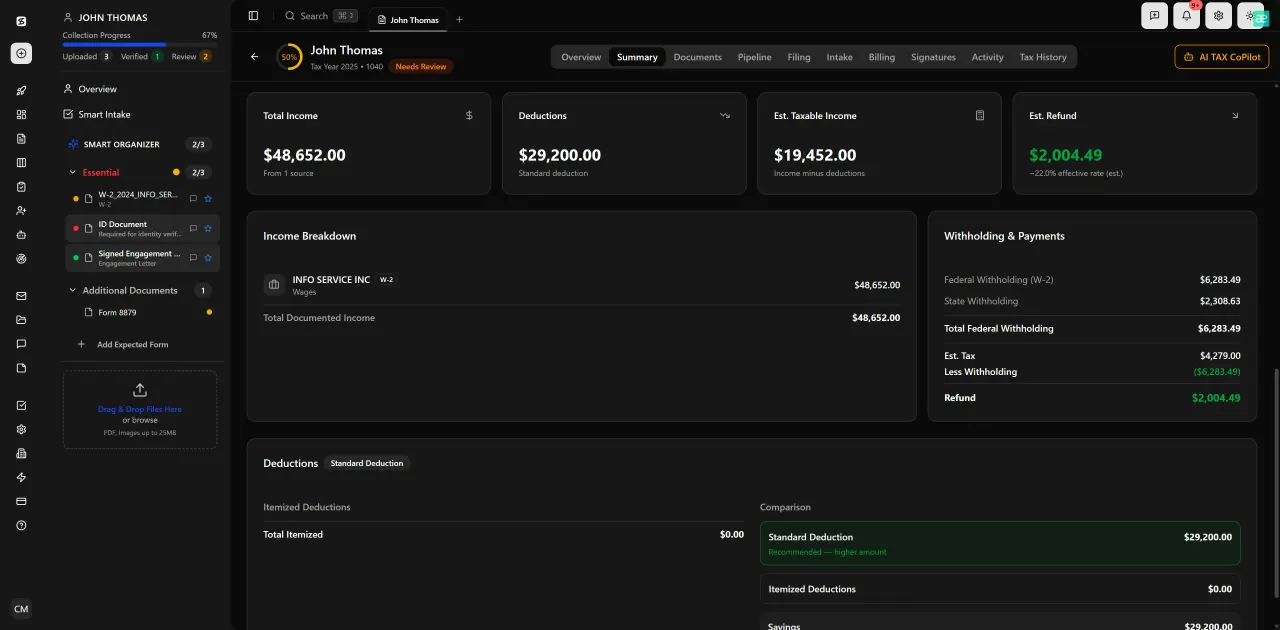
Review with AI assist — 9 agents answer questions with full client context
Donor-Advised Funds: Tax Strategy Beyond the Contribution Year
A donor advised fund tax strategy delivers three distinct tax events that direct giving cannot: an immediate deduction in the contribution year (regardless of when grants are distributed), permanent elimination of embedded capital gains on donated securities, and removal of the asset from the donor's taxable estate. The CPA's job is to time the contribution event, not just document it. Each of these factors directly shapes how charitable giving strategies plays out in practice.
The AGI deduction limits matter and are frequently misapplied. Cash contributions to a DAF are deductible up to 60% of AGI under IRC § 170(b)(1)(G). Long-term appreciated securities contributed to a DAF are deductible up to 30% of AGI at fair market value. Amounts exceeding these thresholds carry forward for up to five years — a planning fact that most clients are not aware of and that opens multi-year coordination opportunities. Understanding charitable giving strategies in this context is what separates firms that scale from those that stall.
The bunching use case is where DAFs most directly interact with the TCJA standard deduction. A married filing jointly client in 2025 faces a standard deduction of $30,000. If their normal annual charitable giving is $12,000, they are unlikely to itemize. By front-loading three years of donations ($36,000) into a DAF in a single tax year, they generate an itemizable deduction well above the standard deduction threshold in year one, then distribute grants from the DAF to their chosen charities over years two and three without needing to itemize. This is the core charitable deduction bunching strategy, and it is most effective when coordinated with other itemized deductions like state and local taxes subject to the $10,000 SALT cap. This is precisely where a deliberate charitable giving strategies plan pays off most — clients who apply consistent charitable giving strategies year over year consistently outperform those who give reactively.
For the return-level workflow, DAF contributions are reported on Schedule A as cash or noncash contributions depending on asset type. If the contributed property is publicly traded securities, no appraisal is required, but the brokerage transfer records must be retained. If the securities are non-publicly-traded, Form 8283 Section B and a qualified appraisal apply — see the Form 8283 section below. Charitable giving strategies sits at the center of this decision — get it wrong and the rest unravels.
Spending December chasing charitable documentation your clients forgot to gather? When firms revisit their charitable giving strategies priorities, the gaps usually surface here.
TaxScout.ai's AI intake engine collects, classifies, and cross-validates charitable contribution records before you open the return — so you can advise, not chase paper.
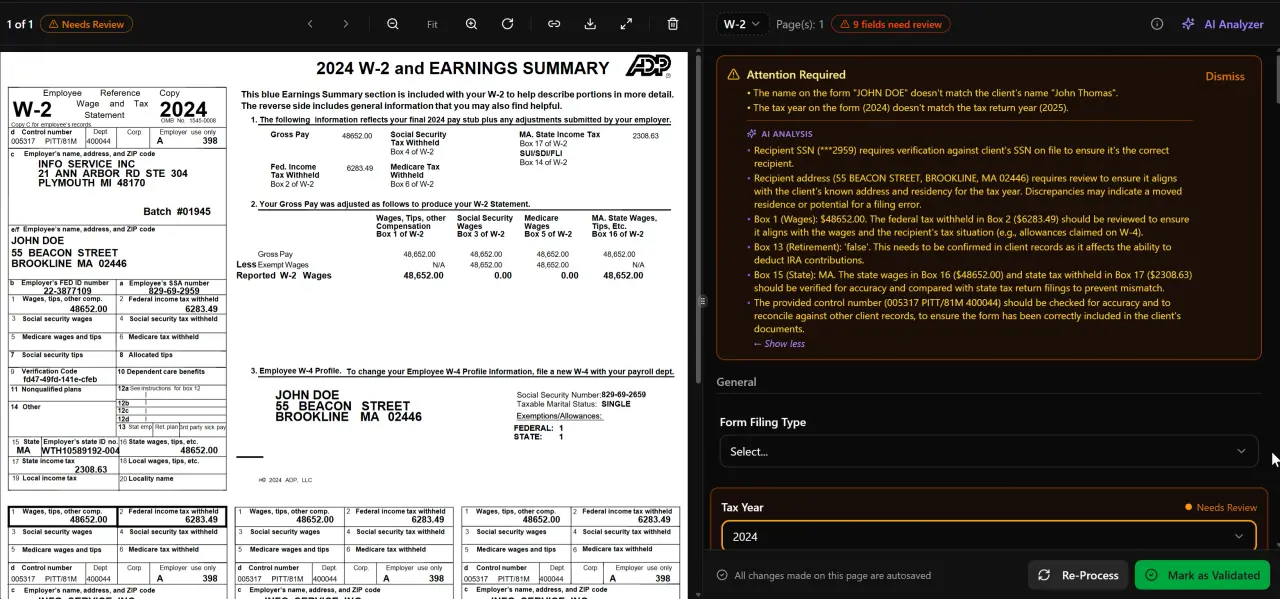
AI classifies, extracts, and validates every document automatically

Every client gets organized documents, status tracking, and a complete history
Qualified Charitable Distributions: The IRA Strategy Most CPAs Underuse
The qualified charitable distribution CPA workflow begins with a simple eligibility check: the client must be at least 70½ years old, the distribution must go directly from the IRA custodian to the qualifying charity (not to the client first), and the receiving organization must be a 501(c)(3) public charity — private foundations and donor-advised funds do not qualify for QCDs. These exclusions are hard stops that require verification before the client acts, not after.
The 2024 QCD annual limit is $105,000 per taxpayer, indexed for inflation under the SECURE 2.0 Act. For a married couple where both spouses hold traditional IRAs, each can take up to $105,000, for a combined $210,000 exclusion from gross income. Starting in 2023, SECURE 2.0 also allows a one-time QCD of up to $53,000 (2024, indexed) to a charitable remainder annuity trust, a charitable remainder unitrust, or a charitable gift annuity — a provision that significantly expands the planning surface for wealthy clients with large IRA balances.
The interaction with RMDs is the most important coordination point. A QCD counts toward satisfying the client's required minimum distribution for the year but is excluded from gross income — unlike a standard RMD, which is fully taxable. For clients with significant RMDs who are charitably inclined, the QCD reduces AGI dollar-for-dollar, which in turn can reduce Medicare IRMAA surcharges, minimize taxation of Social Security benefits, and lower exposure to the net investment income tax for clients near the $200,000/$250,000 NIIT thresholds. CPAs who incorporate QCDs into their broader charitable giving strategies consistently capture tax savings that direct giving cannot replicate.
On the return, a QCD is reported on Form 1040 Line 5b as a pension and annuity distribution. The taxable amount on Line 5b should reflect the reduction for the QCD. The IRA custodian will issue a Form 1099-R showing the full distribution without distinguishing the QCD portion — so the CPA must track this manually and annotate the return with a notation (typically 'QCD' next to Line 5b) per IRS Publication 590-B guidance. The acknowledgment letter from the charity is the substantiation record.
Appreciated Stock Donations: Eliminating Capital Gains Through Giving
The appreciated stock donation deduction is mechanically straightforward but frequently bypassed by clients who default to writing checks. The core benefit: a donor who contributes appreciated long-term securities to a public charity or DAF deducts fair market value on the date of transfer and permanently avoids the embedded capital gain. A client holding $50,000 in Apple shares purchased for $10,000 faces $40,000 of long-term capital gain if they sell. If they donate the shares directly, they deduct $50,000 and recognize zero capital gain — a dual benefit that cash giving cannot replicate. Framing this opportunity explicitly as part of a client's charitable giving strategies plan is often what moves them from intention to action.
The holding period requirement is strict: the securities must be held more than 12 months for the donor to claim FMV as the deduction. Short-term property (held 12 months or less) is deductible only at the lower of cost basis or FMV — eliminating most of the planning benefit. This makes cost basis tracking a prerequisite for the strategy, and it is an area where the CPA's document review workflow adds direct value.
The AGI ceiling for appreciated securities donated to public charities is 30% of AGI at FMV, with a five-year carryforward for excess amounts. Contributions to private non-operating foundations are capped at 20% of AGI. These limits interact with the 60% cash contribution limit — the ordering rules under Treasury Regulation § 1.170A-8 apply the most restrictive percentage limitation first, which matters for clients making both cash and securities contributions in the same year.
Publicly traded securities donated to a charity do not require a qualified appraisal, and Form 8283 Part I (Section A) is sufficient for donations over $500. Transfers to a DAF sponsor are handled administratively by the DAF, but the CPA should confirm the transfer was completed and dated within the tax year — brokerage settlement can lag by several business days in late December, a timing risk that has cost clients their current-year deduction.

Your clients see your brand — OTP login, document upload, and real-time status
Form 8283 and Substantiation: What CPAs Must Enforce
Form 8283 is the preparers' substantiation checkpoint, and the thresholds that trigger each section are frequently misunderstood. For noncash charitable contributions, Section A of Form 8283 applies when the total contribution value exceeds $500 but is $5,000 or less (or for publicly traded securities at any value above $500). Section B applies when any single item or group of similar items exceeds $5,000 — and Section B requires a qualified appraisal completed no earlier than 60 days before the donation and no later than the due date of the return on which the deduction is first claimed.
The appraisal must be conducted by a qualified appraiser as defined under IRC § 170(f)(11)(E): an individual with verifiable education and experience in valuing the type of property, who charges fees not contingent on the appraised value, and who is not the donor, donee, or a related party. The CPA cannot serve as the qualified appraiser for their own client's donation. The appraiser must sign Part III of Form 8283 Section B, and the donee organization must sign the Acknowledgment section.
Special rules apply to clothing and household items (must be in good used condition or better), vehicles donated to charity (Form 1098-C required from the organization, with deduction limited to the gross proceeds of sale if the vehicle is sold rather than used by the charity), and conservation easements (subject to heightened scrutiny and 150%-of-basis limitation under IRS Notice 2017-10 for syndicated transactions). Conservation easement donations have been listed transactions since 2017 — any return claiming such a deduction warrants careful review of the transaction structure and appraiser qualifications before filing.
For CPAs using practice management platforms, attaching Form 8283 substantiation to the client file and flagging it for review before the return is assembled is a workflow discipline that reduces amended return risk. TaxScout.ai's AI document extraction classifies incoming charitable acknowledgment letters and appraisal documents on intake, surfacing them in the client file before the preparer opens the return — reducing the chance that a Section B deduction is claimed without the underlying documentation in hand.
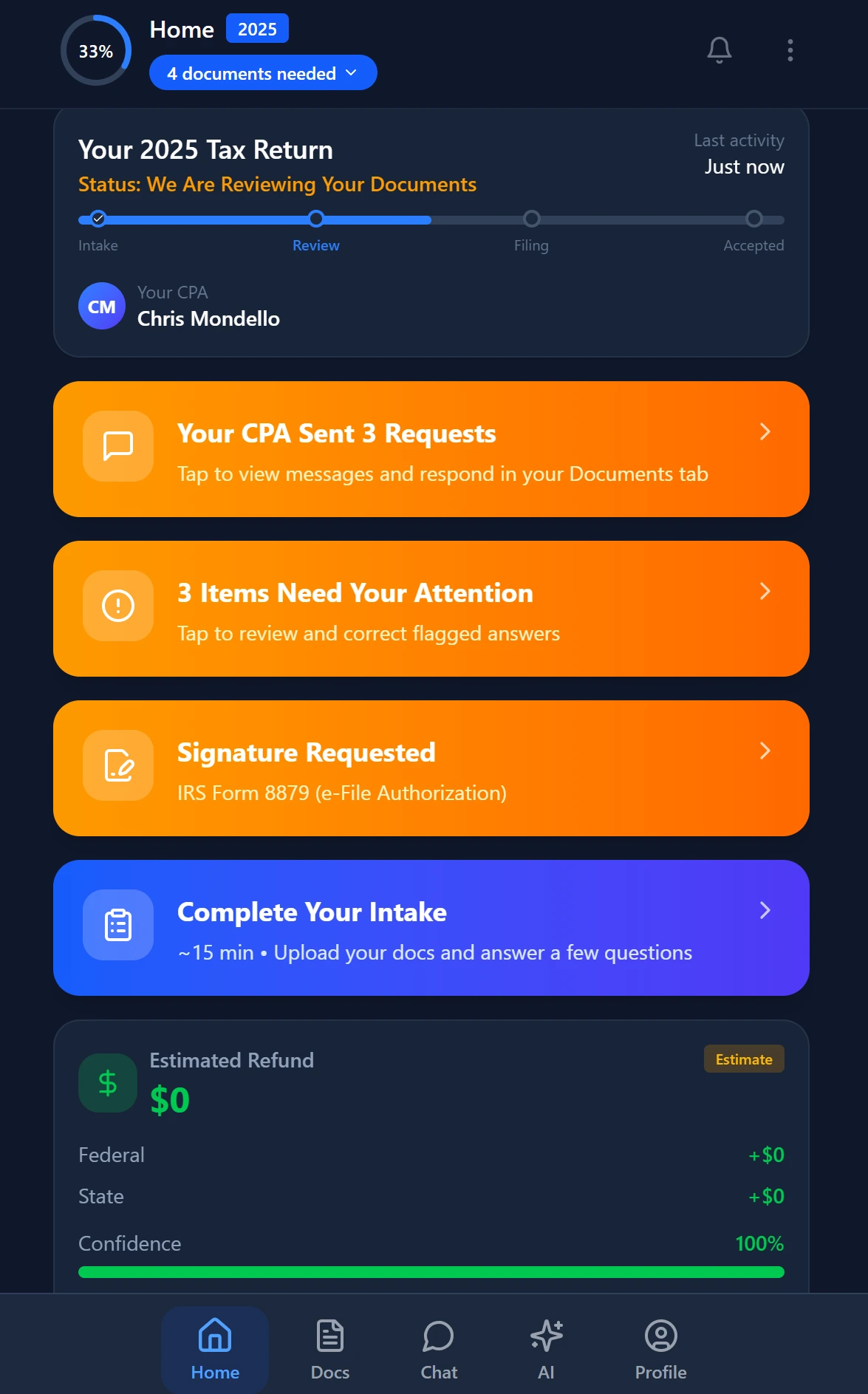
Smart intake auto-fills from uploaded documents and prior-year data
Coordinating Charitable Planning With Roth Conversions and Capital Gains Harvesting
The most durable charitable giving strategies are built as part of a year-end planning package, not as standalone transactions. The coordination logic is straightforward: charitable deductions reduce AGI (through QCDs) or offset taxable income (through itemized deductions), which creates room for Roth conversions or capital gains realization at lower marginal rates.
Consider a client who is 65, retired, with $800,000 in a traditional IRA and $300,000 in a taxable brokerage account with significant embedded gains. They are charitably inclined and give approximately $15,000 per year. A bundled strategy might look like this: (1) In years approaching RMD age, execute Roth conversions up to the top of the 22% bracket, using a large DAF contribution funded with appreciated securities to partially offset the conversion income in itemization years. (2) At 73, pivot to QCDs to satisfy RMDs and reduce IRMAA exposure, pairing with continued capital gains harvesting in the taxable account at the 0% rate (available up to $94,050 for MFJ in 2024). (3) Use the DAF for multi-year grant distributions to maintain the client's charitable impact without needing new contributions every year.
This coordination is precisely the work that separates advisory CPAs from return preparers, and it is the type of planning that supports a premium retainer fee. Our Roth conversion strategy guide covers the bracket management mechanics in detail — the charitable deduction interaction is a natural extension of that framework. For clients with sole proprietorship income, the sole proprietor tax strategy guide covers SE income reduction strategies that also affect the AGI baseline on which charitable deduction limits are calculated.
The practical workflow implication is that charitable planning conversations need to happen in Q3 or early Q4 — not after Thanksgiving. By the time year-end arrives, appreciated securities need time to transfer, DAF contributions must be received by the sponsoring organization before December 31, and IRA custodians need adequate lead time to process QCD transfers. A client who calls on December 28 wanting to execute a QCD is already in a compressed timeline. CPAs who use the pipeline management tools in their practice management platform can schedule proactive outreach to high-net-worth clients with charitable history as a standing Q3 task — converting reactive calls into planned advisory engagements.
Charitable Vehicle Decision Matrix: Matching Strategy to Client Profile
| Vehicle | Best Client Profile | Key AGI Limit | Primary Form |
|---|---|---|---|
| Donor-Advised Fund (cash) | Itemizer, high income, wants multi-year grant flexibility | 60% of AGI (5-yr carryforward) | Schedule A + Form 8283 if noncash |
| Donor-Advised Fund (securities) | Holds appreciated long-term stock, itemizer or bunching | 30% of AGI at FMV (5-yr carryforward) | Schedule A; no appraisal for public securities |
| Qualified Charitable Distribution | Age 70½+, traditional IRA, charitably inclined, near RMD age | $105,000/yr per taxpayer (2024) | Form 1040 Line 5b notation |
| Appreciated Stock Direct Donation | Itemizer, holds long-term appreciated securities | 30% of AGI at FMV | Schedule A + Form 8283 Section A |
| Deduction Bunching (cash via DAF) | Near-itemizer, predictable annual giving, SALT-capped | 60% of AGI in contribution year | Schedule A in contribution year |
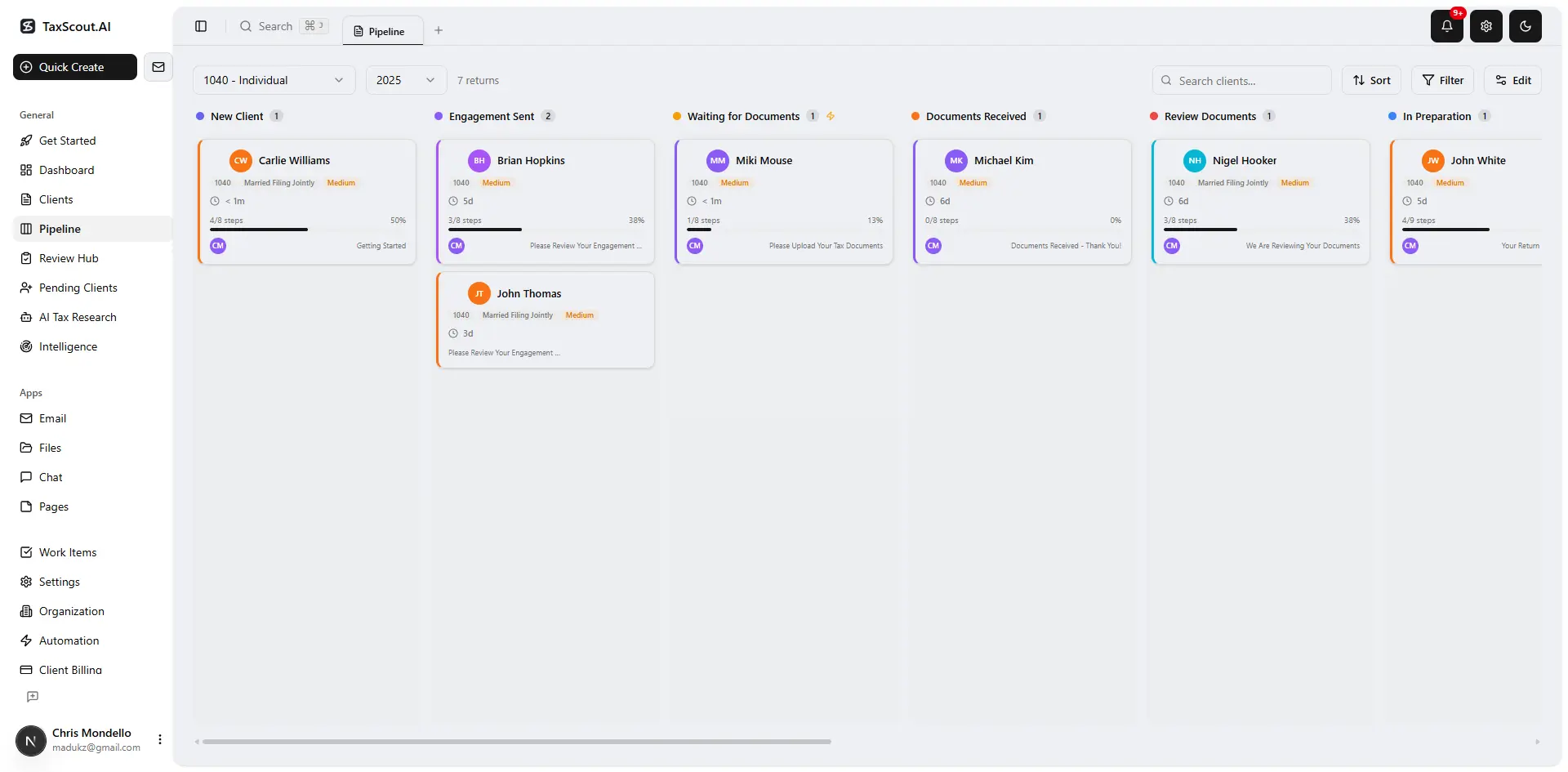
Track every return from intake to filed with drag-and-drop pipeline management

Click any extracted field to see its source highlighted on the original PDF
Packaging Charitable Planning as a CPA Advisory Service Line
Most CPA firms deliver charitable giving advice informally — a comment on the return, a December call, a note in the organizer. That model limits both the quality of the advice and the firm's ability to price for it. Packaging charitable giving strategies as a defined advisory service changes the economics: the client knows what they are paying for, the CPA has a structured deliverable, and the work happens on a timeline that allows execution rather than documentation.
A defensible service offering might include: (1) an annual charitable planning review in September or October covering the client's intended giving, current itemization status, IRA balance and RMD schedule, and any appreciated positions in the taxable account; (2) a written recommendation memo documenting the recommended vehicle, estimated tax savings versus baseline, and any action items (custodian QCD instructions, DAF contribution transfers, appraisal engagement if needed); and (3) year-end execution support ensuring transfers, acknowledgments, and appraisals are completed before December 31.
This service works best as part of a broader advisory retainer rather than a standalone engagement. Clients who receive this level of proactive planning rarely leave the firm and generate referrals from peers who are not receiving comparable advice. For CPAs building out other advisory service resources, charitable giving strategies pairs naturally with estate planning coordination, business succession work, and retirement income planning — all areas where the CPA's access to the complete financial picture creates value that investment advisors and estate attorneys cannot replicate alone.
From a technology standpoint, the intake workflow matters. A client portal with a structured annual questionnaire that captures charitable intent, IRA balances, and security positions — populated from prior-year data — makes the September planning review efficient rather than a manual data-gathering exercise. TaxScout.ai's AI intake engine is modeled on Form 13614-C logic with multi-layer prefill from prior returns and document extraction, which means the preparatory data collection happens automatically before the advisory conversation, not during it. Combined with AI research agents that can surface current-year QCD limits, AGI thresholds, and relevant IRS guidance in real time, the platform reduces the research burden that makes advisory work feel expensive to deliver.
Want to deliver year-round charitable planning without adding hours to your workflow?
TaxScout.ai automates document intake, prefills client data from prior returns, and surfaces IRS research in real time — so your advisory conversations start where they should: on strategy, not paperwork.
Frequently Asked Questions
The 2024 qualified charitable distribution limit is $105,000 per taxpayer, indexed annually for inflation under SECURE 2.0. A QCD counts toward satisfying the required minimum distribution for the year but is excluded from gross income entirely — unlike a standard RMD, which is fully taxable. For clients subject to Medicare IRMAA surcharges or near the net investment income tax threshold, the AGI reduction from a QCD can generate savings well beyond the charitable deduction itself.
Keep reading
Multistate Payroll Tax Compliance: How CPAs Keep Distributed Clients Out of Trouble
Oct 4, 2026 · 1 min read
Multistate Payroll Tax Compliance: How CPAs Handle Remote Employees for Business Clients
Oct 4, 2026 · 1 min read
Federal Scholarship Tax Credit: What CPA Firms Must Do Now
Oct 4, 2026 · 1 min read
Stay up to date
Get the latest tax tech insights delivered to your inbox.