Reasonable Basis Defense: How CPAs Shield Clients From Accuracy-Related Penalties
Most CPA content focuses on penalty abatement after the IRS strikes. This guide takes a different approach: walking through how CPAs proactively invoke the reasonable basis defense at return-preparation time, choose between the reasonable basis and substantial authority thresholds, and use Form…
The reasonable basis defense is one of the most underused tools in a CPA's professional arsenal — and the most misunderstood. Most practitioners know they can seek first-time penalty abatement or reasonable cause relief after the IRS issues a notice. Far fewer know that a well-documented reasonable basis defense, built into the return at filing time, can prevent a Section 6662 accuracy-related penalty from attaching in the first place.
The difference matters enormously. Post-assessment abatement is uncertain, time-consuming, and often requires the client to pay and refile. A proactive defense — grounded in Reg. 1.6664-4, the substantial authority standard under Reg. 1.6662-4, and a properly executed Form 8275 disclosure — puts the IRS in the position of having to overcome your documented position rather than simply asserting a penalty the client must rebut. A well-constructed reasonable basis defense, documented before filing, keeps the CPA and client ahead of any IRS challenge rather than scrambling to respond after the fact.
This guide explains the legal framework CPAs need to understand, how to calibrate the threshold of authority required for each position, when and how to file Form 8275 or 8275-R, and how contemporaneous documentation practices make the difference between a penalty that sticks and one that never attaches. For CPAs managing a high volume of complex returns, getting this workflow right at scale requires the right infrastructure — and that is where practice management technology becomes mission-critical. Central to that framework is understanding exactly when and how a reasonable basis defense applies, and what distinguishes it from the higher substantial authority standard.
The Section 6662 Accuracy-Related Penalty Framework
Under IRC Section 6662, the IRS may impose an accuracy-related penalty of 20% of the underpayment attributable to a substantial understatement of income tax, negligence, or disregard of rules and regulations. For a substantial understatement, the threshold is the greater of 10% of the tax required to be shown on the return or $5,000 — a bar that is surprisingly easy to exceed on a return with a single aggressive position on a Schedule C, rental property, or business deduction. Knowing which penalty tier a position triggers is the first step in determining whether a reasonable basis defense, paired with adequate disclosure, is sufficient to avoid exposure.
The penalty reaches 40% for a gross valuation misstatement. Critically, Section 6662 penalties are strict-liability by design: the IRS need not show intent. Once an understatement is identified, the burden shifts to the taxpayer — and to the CPA who signed the return — to establish that one of the statutory exceptions applies. For firms evaluating their reasonable basis defense approach, this trade-off compounds over time.
The three primary exceptions to Section 6662 are: (1) substantial authority for the tax treatment adopted, (2) adequate disclosure combined with a reasonable basis for the position, and (3) reasonable cause and good faith under Section 6664. Understanding which exception applies to a given position, and how to document it contemporaneously, is the core competency that separates penalty-proofed returns from vulnerable ones. For related guidance on penalty relief strategies, see our article on late filing penalty relief. Each of these factors directly shapes how reasonable basis defense plays out in practice.
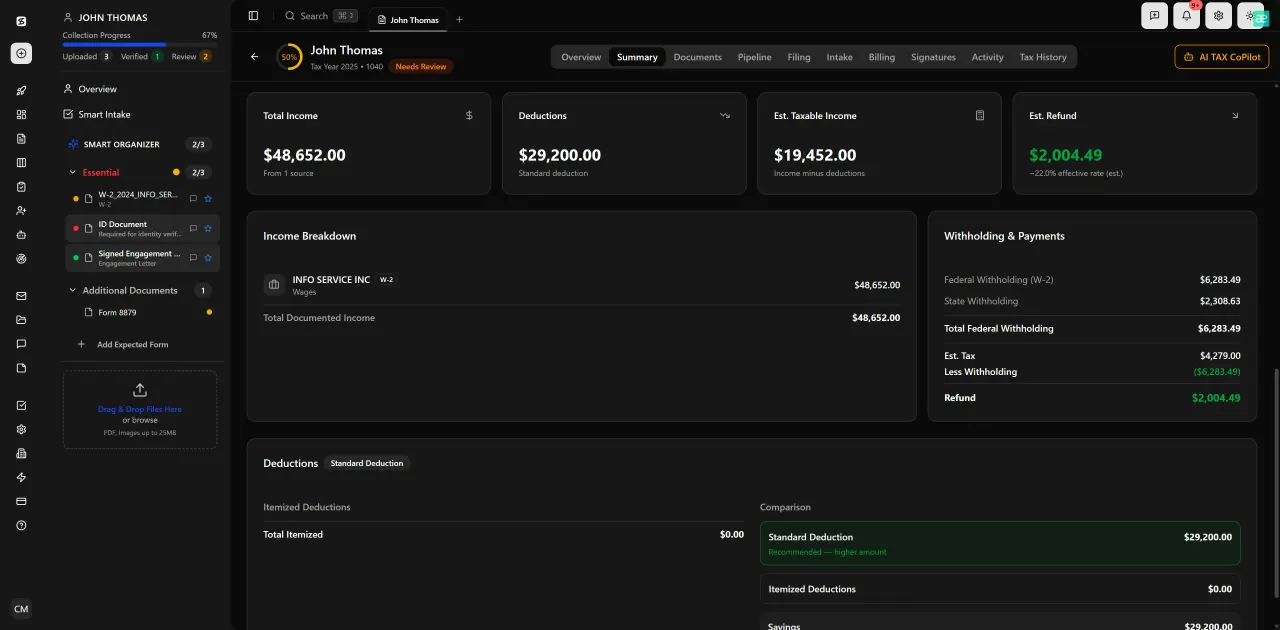
Review with AI assist — 9 agents answer questions with full client context
Reasonable Basis vs. Substantial Authority: Calibrating the Threshold
The two primary position-defense thresholds operate at different levels of confidence and carry different documentation requirements. Getting this calibration wrong is one of the most common errors CPAs make when preparing complex returns. Understanding reasonable basis defense in this context is what separates firms that scale from those that stall.
Substantial authority under Reg. 1.6662-4(d) is an objective standard requiring that the weight of authorities supporting the taxpayer's treatment is substantial in relation to the weight of authorities opposing it. The IRS has historically interpreted this as approximately a 40% or greater chance of being sustained on the merits. Authorities that count include the Code, proposed and final Treasury regulations, revenue rulings, revenue procedures, tax court decisions, IRS technical advice memoranda, and the legislative history of the relevant provision. Importantly, a position can have substantial authority even if the IRS disagrees with it — the standard is objective, not dependent on the examining agent's view. This is precisely where a deliberate reasonable basis defense strategy pays off.
Reasonable basis under Reg. 1.6662-3(b)(3) is a lower threshold — roughly a 20% or greater likelihood of being sustained — but it comes with a mandatory condition: the position must be adequately disclosed on the return or on a properly completed Form 8275. Without disclosure, a reasonable basis position does not shield the taxpayer from the negligence component of the Section 6662 penalty. With disclosure, it does. Reasonable basis defense sits at the center of this decision — get it wrong and the rest unravels.
The practical decision tree looks like this: if a position has substantial authority, no disclosure is required (though disclosure is never harmful). If a position lacks substantial authority but has a reasonable basis, disclosure via Form 8275 is required to avoid the penalty. If a position cannot meet even the reasonable basis threshold, the CPA should not sign the return with that position included — the preparer penalty rules under Section 6694 create independent exposure. When firms revisit their reasonable basis defense priorities, the gaps usually surface here.
Tired of building penalty defenses in spreadsheets and scattered workpapers after the fact?
TaxScout.ai gives CPAs a centralized research and document management platform so penalty-defense workpapers are built into the return workflow from day one — not reconstructed under audit pressure.

Every client gets organized documents, status tracking, and a complete history
Form 8275 and 8275-R: The Disclosure Mechanism CPAs Overlook
Form 8275, Disclosure Statement, is the IRS-approved vehicle for making adequate disclosure of a non-frivolous position that does not meet the substantial authority standard. When properly completed, it transforms a reasonable basis position from a penalty exposure into a protected one. Form 8275-R is the parallel form used specifically to disclose positions contrary to a Treasury regulation — a distinct situation that requires regulatory-level disclosure rather than simply statutory authority disclosure.
Completing Form 8275 correctly requires the CPA to identify the item by its schedule and line number, describe the nature of the disclosure, provide the amount involved, and attach any explanatory statement that gives the IRS sufficient information to understand the nature and basis of the position. The IRS guidance in Rev. Proc. 2024-34 and related annual procedures specifies disclosure adequacy standards that have evolved over time — CPAs who relied on older templates should verify their forms meet current IRS expectations.
A common misconception is that filing Form 8275 invites audit. The evidence does not support this. Disclosure is a legal right, and the return selection process does not use Form 8275 filings as an audit flag under current DIF scoring methodology. More importantly, failing to disclose a reasonable basis position because you fear audit scrutiny eliminates the only statutory protection available for that position — trading a speculative audit risk for a near-certain penalty exposure if the position is later challenged.
For positions contrary to regulations — the 8275-R scenario — the analysis is more demanding. The CPA must demonstrate that the regulatory position itself is inconsistent with the Code, or that a valid argument exists that the regulation is invalid or inapplicable. This typically requires a formal legal memorandum, not a brief workpaper notation. The S Corp reasonable compensation context is one area where practitioners sometimes face this exact situation when a position diverges from existing guidance.

Click any extracted field to see its source highlighted on the original PDF
Building the Contemporaneous Documentation File
The single most important phrase in Reg. 1.6664-4 — the reasonable cause and good faith exception under Section 6664 — is "all pertinent facts and circumstances." The regulation requires that the taxpayer's reliance on the advice of a tax professional be reasonable and in good faith, and the IRS scrutinizes whether that reliance was documented at the time the return was filed, not reconstructed afterward.
A contemporaneous documentation file for a significant tax position should include: (1) a research memorandum citing the specific authorities relied upon, with an analysis of contrary authority and why it was distinguished; (2) a description of the facts the CPA understood at the time the position was taken; (3) identification of the threshold applied (substantial authority vs. reasonable basis); (4) a record of whether Form 8275 was filed and why; and (5) the engagement letter language or advisory memo delivered to the client explaining the position and its risk profile.
The AI research agents available through TaxScout's tax intelligence platform can dramatically accelerate the research phase of this documentation workflow. The platform's 9 specialized AI research agents perform real-time searches across IRS publications, Treasury guidance, Cornell Law's U.S. Code database, and congressional records — producing a sourced research summary that becomes the foundation of the contemporaneous memo rather than a starting point for hours of manual Westlaw or RIA searching.
One area where documentation is frequently insufficient is the facts-and-circumstances layer. CPAs often document the legal authority well but fail to memorialize the client-provided facts that undergird the position. If an audit examiner later disputes a home office deduction, the question is not just whether the legal standard was met — it is whether the CPA documented what the client told them about exclusive and regular use at the time of filing. A robust client intake process that captures this information systematically is as important as the legal research. TaxScout's AI-powered intake engine, modeled on IRS Form 13614-C with four layers of prefill and gap analysis, creates a defensible factual record for every return processed through the platform.

Track firm performance with real-time analytics and client activity monitoring
Identifying Positions That Require a Formal Defense
Not every line item on a return requires a formal penalty-defense analysis. The CPA's professional judgment about which positions merit elevated scrutiny is itself part of the reasonable cause analysis. A useful framework is to trigger a formal defense workflow any time a position involves: (1) a gray area of tax law with competing authority; (2) a position the IRS has challenged in published guidance or recent litigation; (3) a transaction type the IRS has identified as a listed or reportable transaction; or (4) an amount large enough that a 20% penalty would be material to the client.
Positions that frequently require formal defense include: the deductibility of certain business meals and entertainment expenses after the TCJA modifications, cryptocurrency transaction characterization (see the IRS's ongoing digital asset guidance), conservation easement deductions, research and development tax credits under Section 41, and the application of the passive activity rules to real estate professionals. Each of these areas has active IRS examination programs and published guidance that must be analyzed against the client's specific facts.
For QSBS positions — another area with substantial authority questions — our detailed analysis in the QSBS exclusion guide walks through how CPAs structure the analysis. The same documentation discipline applies: identify the authority, assess its weight, determine the threshold, and decide on disclosure.
Client Communication and Engagement Letter Mechanics
The reasonable basis defense is not just a technical tax matter — it is a client communication discipline. Clients who understand the risk profile of their return positions are less likely to blame their CPA when a position is challenged, and more likely to cooperate with the documentation process that makes the defense viable.
Best practice is to include position-specific risk disclosures in the engagement letter or in a separate advisory memo delivered contemporaneously with the return. The memo should explain: the position taken, the authority relied upon, the threshold met (substantial authority or reasonable basis), whether Form 8275 was filed, and the estimated penalty exposure if the position is ultimately disallowed. This is not alarmism — it is the professional standard contemplated by Circular 230 and the Section 6694 preparer standards.
Engagement letter language should also address who bears responsibility for providing accurate and complete facts. The CPA's reasonable cause defense depends in part on the reasonableness of reliance on client-provided information. A well-drafted engagement letter that requires the client to represent the accuracy of factual inputs, and places the burden of disclosure of material changes on the client, strengthens the CPA's position significantly. You can find broader resources on firm documentation practices and other blog resources across the TaxScout content library.
TaxScout's e-signature capabilities via Documenso make it straightforward to deliver, obtain signatures on, and archive these advisory memos in the same workflow as the engagement letter and Form 8879 — creating a complete, timestamped file that documents the client communication at the time of filing. The underpayment penalty glossary entry also provides a useful client-facing explanation of how these thresholds interact with estimated tax obligations.
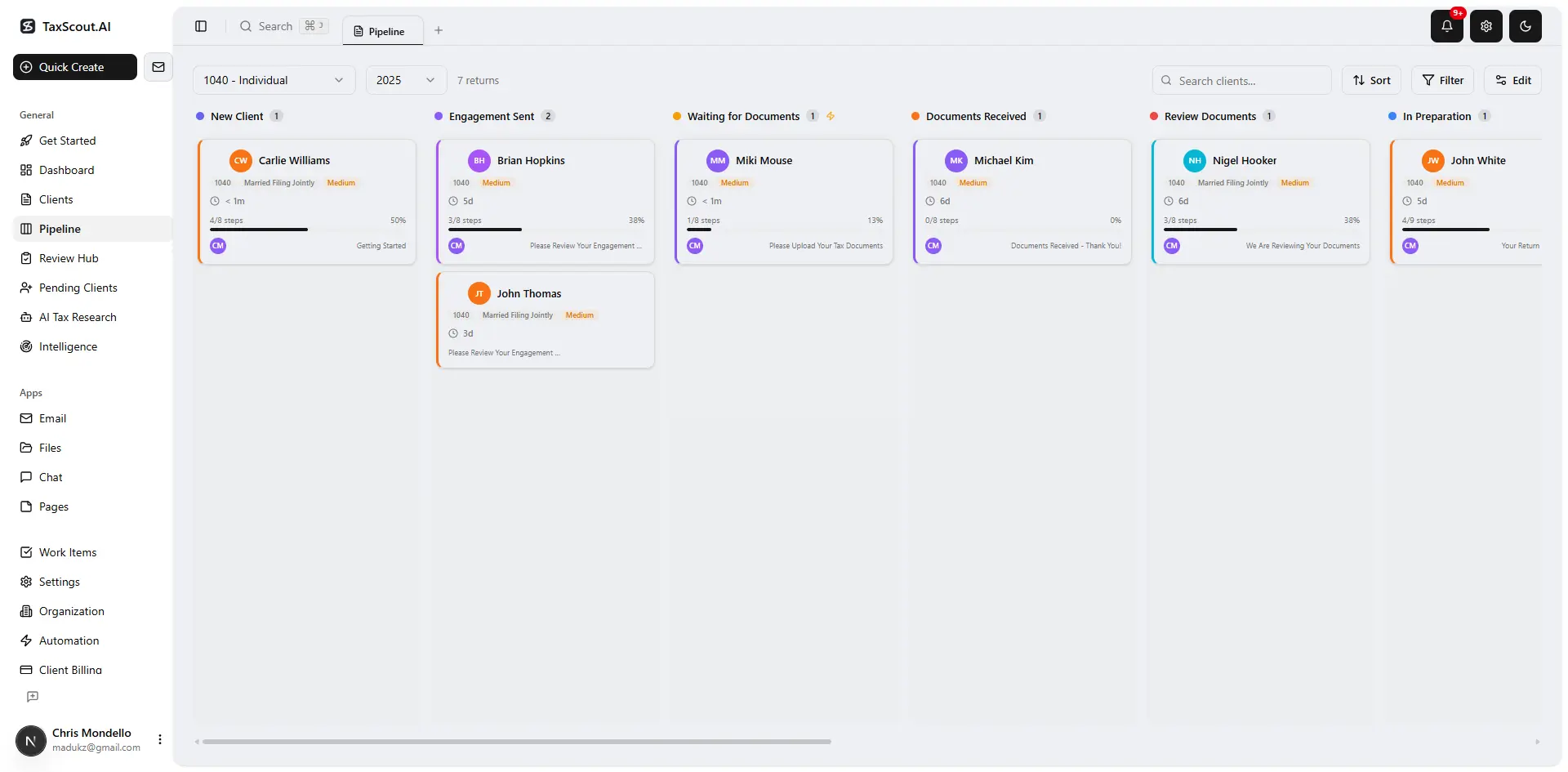
Track every return from intake to filed with drag-and-drop pipeline management
How Practice Management Infrastructure Supports the Defense
The reasonable basis defense is procedurally intensive. It requires research documentation, factual records, disclosure forms, client communications, and workpaper organization — all timestamped and retrievable on short notice if an audit notice arrives two or three years after filing. For a firm processing hundreds of complex returns, maintaining this discipline manually across staff members is a genuine operational challenge.
The right practice management infrastructure turns this from a heroic individual effort into a repeatable firm process. TaxScout's file management system provides structured document storage with version control so that the research memo, the Form 8275, and the advisory memo are stored against the specific return year rather than floating in a general client folder. The pipeline management module with its 12 customizable stages allows firms to build a "penalty defense review" stage into every complex return workflow — ensuring that a senior reviewer signs off on position documentation before the return is transmitted.
The split-screen PDF viewer with click-to-source field highlighting is particularly useful during audit response, when the examiner questions the factual basis of a position. The ability to pull up the source document, cross-reference it against the return entry, and produce the extraction audit trail in seconds is far more compelling than reconstructing a paper trail from email attachments. Firms evaluating their current platforms against TaxScout's integrated approach can compare the feature sets at TaxScout vs. TaxDome or review pricing options for flat-rate access with unlimited team members.
Penalty Defense Threshold Summary: Section 6662 Position Standards
| Standard | Confidence Threshold | Disclosure Required | Primary Authority |
|---|---|---|---|
| Substantial Authority | ~40% likelihood of success | Not required (but permitted) | Reg. 1.6662-4(d) |
| Reasonable Basis + Disclosure | ~20% likelihood of success | Required — Form 8275 or 8275-R | Reg. 1.6662-3(b)(3) |
| Reasonable Cause and Good Faith | Facts-and-circumstances test | Not required, but documentation essential | IRC § 6664(c); Reg. 1.6664-4 |
| No Defense Available | Below reasonable basis | Disclosure does not cure | IRC § 6662(b); Circular 230 § 10.34 |
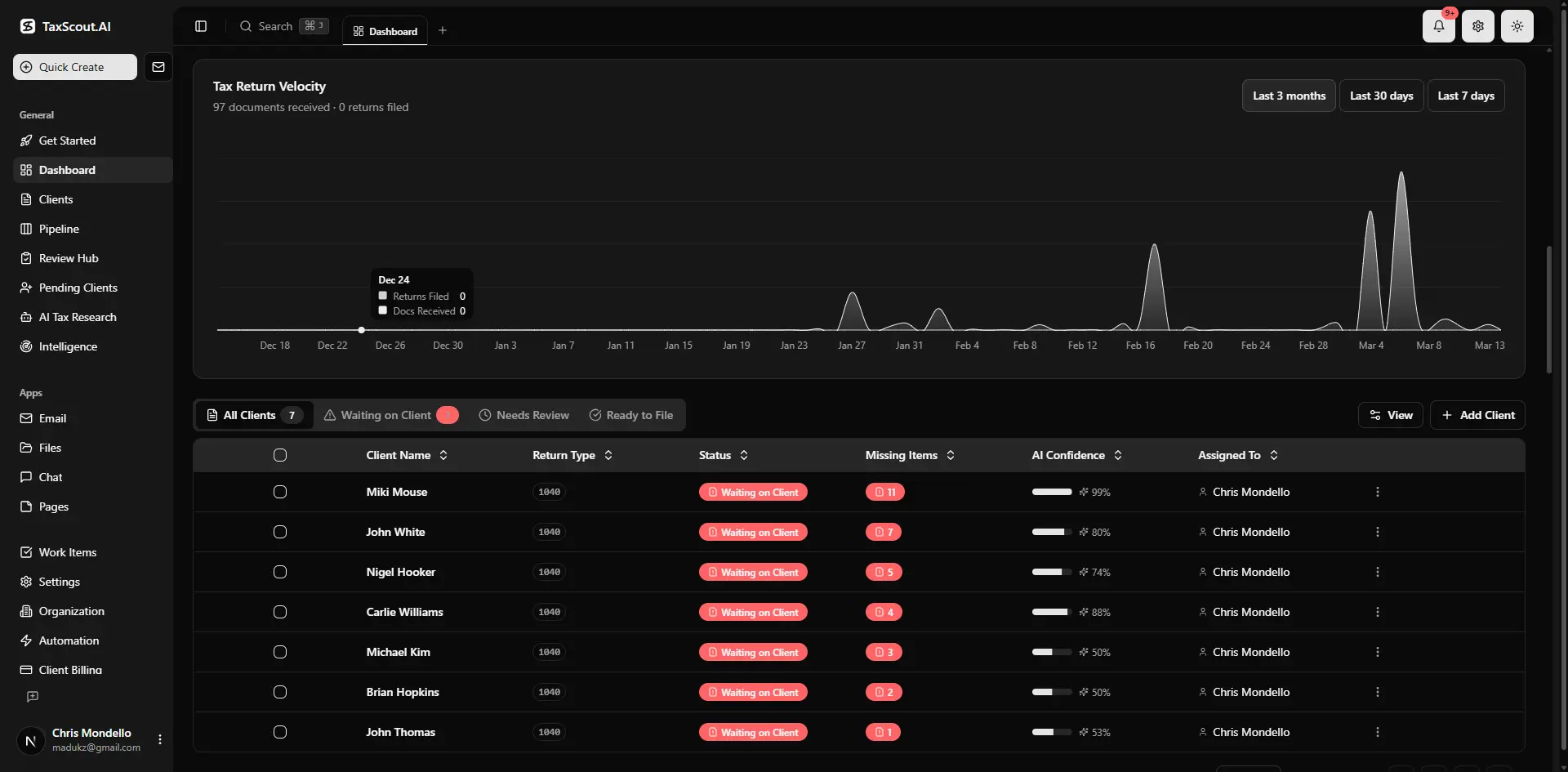
Real-time dashboard showing returns in progress, revenue, and upcoming deadlines
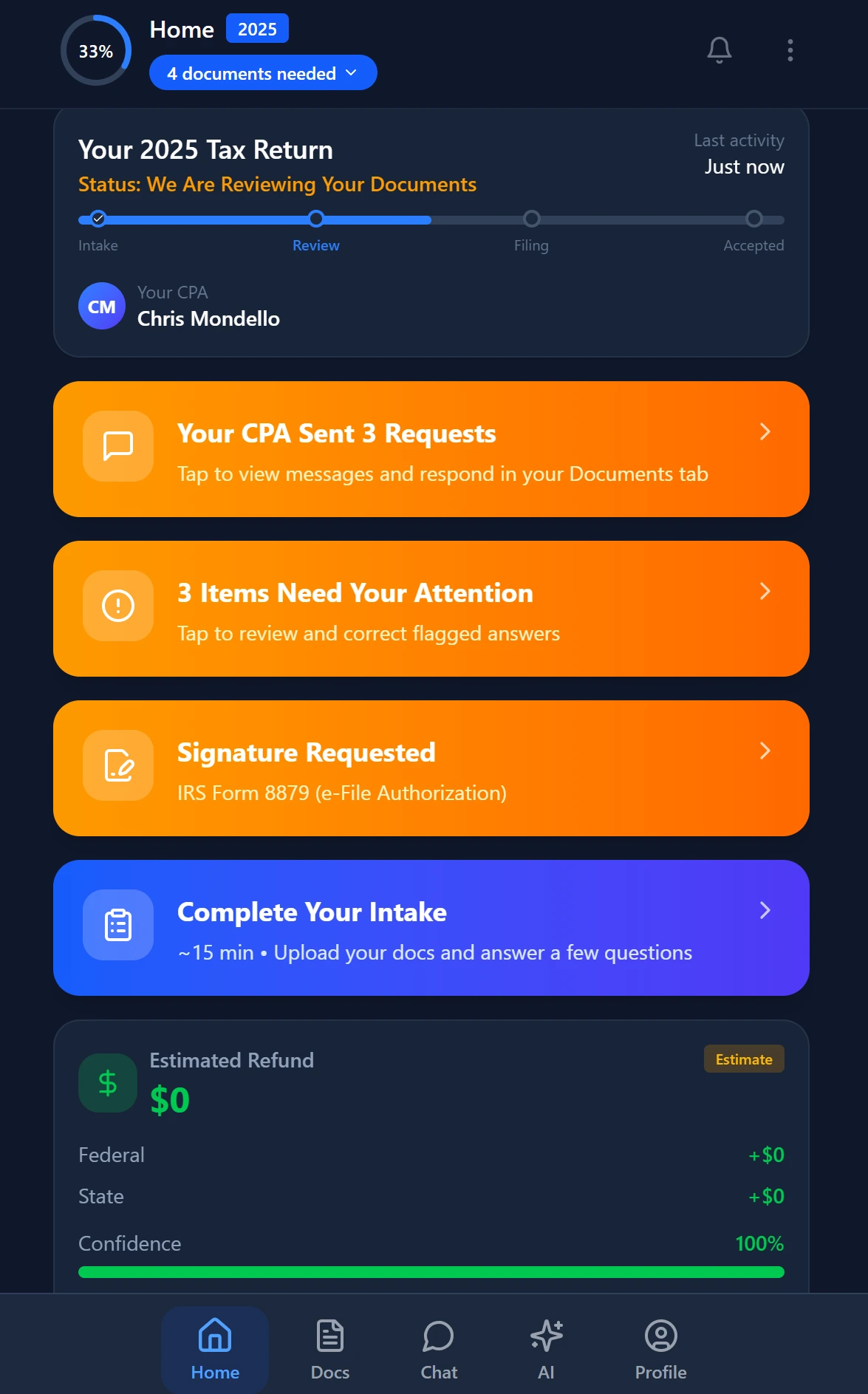
Smart intake auto-fills from uploaded documents and prior-year data
Estimated Tax Underpayments and the Intersection With Section 6662
One nuance CPAs sometimes miss is the interaction between the Section 6662 accuracy-related penalty and the Section 6654 estimated tax underpayment penalty. These are separate penalties with separate defenses. The reasonable basis defense addresses the accuracy penalty on the understatement; it does not address the mechanical penalty for failing to make sufficient estimated tax payments during the year.
For clients with significant non-wage income — partners, S corp shareholders, real estate investors — the CPA's penalty defense strategy must address both layers. The estimated tax penalty waiver guide covers the safe harbor mechanics under Section 6654 in detail. When a position is uncertain enough to require a Form 8275 disclosure, the CPA should also model whether the position's potential disallowance would trigger an estimated tax penalty in addition to the accuracy penalty, and advise the client on protective estimated payments accordingly.
According to IRS data on examination results, accuracy-related penalties are asserted in a significant percentage of examined returns where an understatement is identified. CPAs who build proactive defenses into their return preparation process — rather than relying on post-assessment abatement — consistently achieve better outcomes for clients and generate fewer professional liability concerns for their firms. The statute of limitations for penalty assessment generally runs concurrent with the tax assessment period, giving the IRS up to three years (or six for substantial omissions) to assert these penalties — another reason why contemporaneous documentation that is still legible and organized years later is a genuine professional differentiator.
Ready to build a penalty-proof return preparation workflow your entire team can execute consistently?
TaxScout.ai combines AI research agents, structured document management, e-signatures, and pipeline management into one flat-rate platform — so your firm documents reasonable basis defenses at the time of filing, every time.
Frequently Asked Questions
The reasonable basis defense is a statutory exception to the Section 6662 accuracy-related penalty. Under Reg. 1.6662-3(b)(3), a taxpayer avoids the negligence and substantial understatement components of the penalty if the position has at least a reasonable basis — generally interpreted as roughly a 20% or greater chance of being sustained — and the position is adequately disclosed on Form 8275 or Form 8275-R attached to the return.
Keep reading
Uniform Capitalization Rules: How CPAs Apply UNICAP to Inventory and Self-Constructed Assets
Oct 17, 2026 · 1 min read
Non-Applicability of Section 357(c) to Consolidated Groups: What CPA Firms Must Do Now
Oct 17, 2026 · 1 min read
Tangible Property Regulations: How CPAs Apply Capitalization vs Expensing Rules
Oct 15, 2026 · 1 min read
Stay up to date
Get the latest tax tech insights delivered to your inbox.