Self-Employment Tax Planning: How CPAs Reduce SE Liability for Sole Owners
Most CPAs address S corp elections and sole proprietor basics in separate conversations — leaving the full SE tax reduction decision tree disconnected. This guide unifies SE tax calculation mechanics, entity restructuring triggers, health insurance deduction interplay, retirement offsets, and QBI…
Self-employment tax planning is one of the highest-leverage advisory services a CPA can offer, yet most firms still address it in silos — S corp election advice in one engagement, sole proprietor deductions in another, retirement planning in a third. The result is a client who has heard of each tactic but never had the full math modeled in a coordinated way. SE tax runs at 15.3% on the first $176,100 of net self-employment income and 2.9% above that threshold for 2025 — with the employer-equivalent half deductible above the line — and every dollar of reduction ripples through AGI, QBI, and the above-the-line health insurance deduction simultaneously. Without a unified approach, self-employment tax planning never reaches its full potential as a value driver for either the client or the firm.
For CPAs serving sole proprietors, single-member LLC owners, and under-optimized S corp shareholders, the opportunity is not just in picking the right entity structure. It is in modeling the coordinated impact of entity type, compensation design, retirement contributions, and health insurance premiums as a single reduction system. This guide covers that complete decision tree: how to calculate SE tax correctly, when restructuring pencils out, and how to stack every legitimate offset so clients see the full savings potential — and understand exactly what advisory work delivered it. Effective self-employment tax planning requires treating these variables as an interconnected system rather than a checklist of isolated tactics.
The commercial angle matters too. A well-documented SE tax projection, showing a client going from $18,000 in annual SE tax to $7,000 through restructuring and coordinated offsets, is the most persuasive justification for an advisory fee that most tax practitioners never build. The frameworks here are designed to make that projection repeatable and defensible — across your entire sole-owner client base. Clients who experience the tangible savings of proactive self-employment tax planning are also the most likely to refer peers and expand into ongoing advisory relationships.
SE Tax Calculation Mechanics Every CPA Must Model Correctly
Schedule SE planning starts with getting the base calculation right. Net self-employment income is net profit from Schedule C (or the distributive share of SE income from a partnership), multiplied by 0.9235 to arrive at net earnings from self-employment — the figure that actually appears in the SE tax computation. That 0.9235 multiplier reflects the employer-equivalent deduction baked into the statute: it reduces the base the same way an employer's share of FICA would reduce an employee's W-2 earnings before the employer remits its portion. For firms evaluating their self-employment tax planning approach, this trade-off compounds over time.
From the resulting net earnings, the Social Security component (12.4%) applies to amounts up to the annual wage base — $176,100 for 2025, adjusted annually by Social Security Administration cost-of-living adjustments. The Medicare component (2.9%) applies to all net earnings with no cap. Above $200,000 of combined wages and self-employment income (or $250,000 married filing jointly), the Additional Medicare Tax adds another 0.9% under IRC §3101(b)(2), though this does not appear on Schedule SE — it is computed on Form 8959. Each of these factors directly shapes how self-employment tax planning plays out in practice, making accurate calculation an essential starting point for any advisory conversation.
The above-the-line deduction for one-half of SE tax is frequently undervalued by clients and occasionally miscalculated by preparers. It equals exactly 50% of the total SE tax computed on Schedule SE and flows to Schedule 1, Line 15. This deduction reduces AGI directly, which means it affects the self-employed health insurance deduction threshold, the QBI deduction computation, and the phase-in range for various income-sensitive credits. Modeling SE tax correctly therefore requires treating this deduction as a dynamic input, not a static output — it feeds back into the tax base it is reducing. Understanding self-employment tax planning in this context is what separates firms that scale from those that stall.
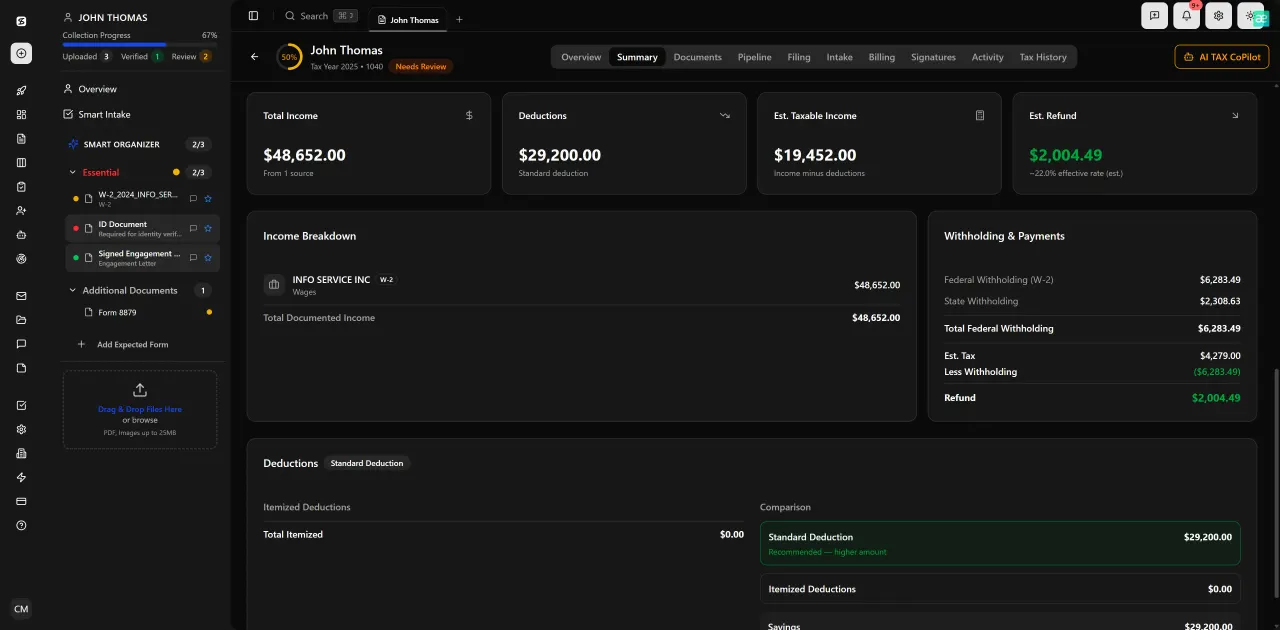
Review with AI assist — 9 agents answer questions with full client context
Entity Restructuring Decision Tree: When the S Corp Election Pencils Out
The S corp election for SE tax savings is widely discussed but rarely modeled rigorously. The core mechanism: an S corp shareholder-employee pays SE tax only on W-2 wages, not on the remaining pass-through distributions. But the decision tree has five checkpoints CPAs must clear before recommending the election. This is precisely where a deliberate self-employment tax planning strategy pays off.
First, net SE income must be sufficient to support a reasonable salary and still generate meaningful distribution. IRS guidance on S corporation officer compensation requires that shareholder-employees performing services receive a salary comparable to what the corporation would pay an unrelated employee for the same work. If net income is $80,000 and a reasonable salary is $65,000, the SE tax savings on $15,000 of distributions is modest and may not offset S corp administrative costs (state franchise taxes, payroll processing, separate return preparation). Most practitioners use a working threshold of $50,000 to $60,000 in net SE income above the reasonable salary before the election generates meaningful savings. Self-employment tax planning sits at the center of this decision — get it wrong and the rest unravels.
Second, model the friction costs. S corp compliance includes Form 1120-S preparation, state-level entity fees (some states impose annual minimums or franchise taxes on S corps regardless of income), payroll tax deposits, quarterly Form 941 filings, and W-2 issuance. For a TaxScout Firm client, AI research agents can pull current state franchise tax schedules for a quick friction-cost estimate during the modeling session. When firms revisit their self-employment tax planning priorities, the gaps usually surface here.
Third, examine the QBI interaction. Wages paid to the shareholder reduce the S corp's QBI — but the wage-base W-2 limitation for the §199A deduction simultaneously increases once the shareholder is on payroll. For non-SSTB businesses with income above the phase-in threshold, higher W-2 wages can actually increase the §199A deduction, partially offsetting the employment tax cost of salary. This three-way interaction — SE tax, §199A, and above-the-line deductions — is where coordinated modeling delivers advisory value competitors simply do not illustrate.
Fourth, confirm the state tax treatment. Several states do not recognize S corp elections for state income tax purposes, and others impose entity-level taxes that erode the federal savings. Check state conformity before projecting total tax savings. Our SALT deduction cap workarounds guide covers related state-level considerations that often surface alongside entity restructuring, and thorough self-employment tax planning must account for these state-level variables before a recommendation is finalized.
Fifth, assess the multi-owner complexity. When a client owns a multi-member LLC and wants to elect S corp status while co-owners do not, the entity cannot simply elect S status — all members must consent, and the LLC must satisfy S corp eligibility requirements (no more than 100 shareholders, single class of stock, eligible shareholders only). One member's SE tax optimization goal can be blocked by co-owner preferences or ineligibility. The practical solution in these cases is often a partial restructuring: the active member contributes their interest to a newly formed S corp that becomes a member of the LLC, though this approach requires careful analysis under IRC §1361 and state LLC law.
Tired of modeling SE tax savings on spreadsheets that don't connect to the client file?
TaxScout's AI research agents and document extraction pipeline give CPAs the infrastructure to run coordinated SE tax projections — and deliver them as a billable advisory service.
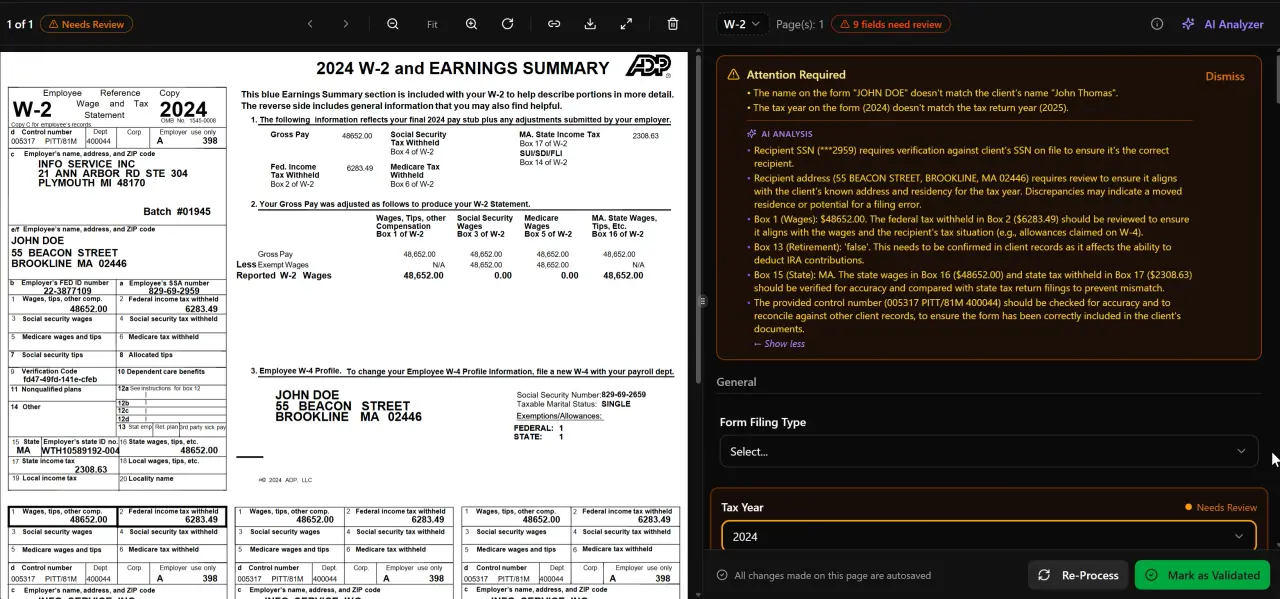
AI classifies, extracts, and validates every document automatically

Click any extracted field to see its source highlighted on the original PDF
Health Insurance Deduction Interplay With SE Tax
The self-employed health insurance deduction under IRC §162(l) interacts with SE tax in a way that creates a circular dependency few tax software packages model explicitly. The deduction reduces AGI and therefore affects the SE tax half-deduction, which in turn affects AGI, which affects the §162(l) limitation itself. The practical resolution is that tax software iterates to convergence — but CPAs advising clients prospectively need to understand the structure so they can estimate the impact manually. Incorporating this circular dependency into self-employment tax planning ensures that projected savings figures hold up under scrutiny.
For S corp shareholders, the health insurance deduction mechanics shift entirely. The S corp must pay or reimburse the premiums and include them in the shareholder's W-2 wages in Box 1 (but not Boxes 3 and 5 — no FICA applies). The shareholder then deducts the premium above the line on Schedule 1. This treatment means the S corp shareholder avoids FICA on the premium amount, while the sole proprietor deducts the same premium but still bears SE tax on the gross income that funded it. For a shareholder in the 15.3% combined SE tax range, the differential can be $1,500 to $3,000 annually on a $20,000 family premium — a concrete number worth including in any restructuring proposal.
One constraint applies to both structures: the §162(l) deduction cannot exceed the net profit (or W-2 wages, for S corp shareholders) from the trade or business under which the insurance is established. A spouse covered under an employer plan at their job eliminates the deduction entirely for months of that coverage. CPAs should capture this marital coverage detail during intake — smart intake tools that prefill from prior-year data can flag months where the limitation applies.
Retirement Contribution Offsets: Stacking the SE Tax Reduction
Retirement contributions are the most powerful above-the-line offset available to self-employed clients, and their SE tax interaction is often modeled in reverse. CPAs calculate net SE income, then suggest a SEP-IRA contribution — but the correct approach is to model the contribution as part of the SE tax reduction strategy from the start, because the contribution reduces QBI-eligible income, AGI, and the taxable base for estimated tax simultaneously. Integrating retirement contributions into self-employment tax planning from the outset produces more accurate savings projections and stronger client buy-in.
For sole proprietors and single-member LLC owners, a Solo 401(k) allows both an employee elective deferral (up to $23,500 for 2025, plus $7,500 catch-up if age 50 or older) and an employer profit-sharing contribution (up to 25% of net SE earnings after the SE tax deduction). The combined limit for 2025 is $70,000 (or $77,500 with catch-up). Importantly, the employer portion is deductible on Schedule 1, reducing SE income for QBI and income tax — but it does not reduce the SE tax base itself, because SE tax is computed on net profit before retirement contributions. The employee elective deferral is deducted on Schedule 1 as well, following the same logic.
A SEP-IRA is simpler administratively but caps contributions at 25% of net SE earnings (after the SE deduction), with a 2025 maximum of $70,000. For clients with variable income or a spouse also earning SE income, the Solo 401(k)'s employee deferral component allows a larger contribution at lower net income levels — making it more effective at AGI reduction for clients earning $80,000 to $150,000 net.
When advising S corp shareholders, retirement contribution mechanics shift to the corporate side. The S corp sponsors the plan and makes employer contributions based on W-2 wages. The shareholder's elective deferrals come from W-2 compensation, not distributions. This means the reasonable salary level directly constrains maximum retirement contributions — another variable the S corp salary decision must account for. Coordinating reasonable compensation, retirement plan design, and §199A optimization simultaneously is the analytical work that separates an advisory CPA from a compliance preparer. See other blog resources for additional planning guides across entity types.
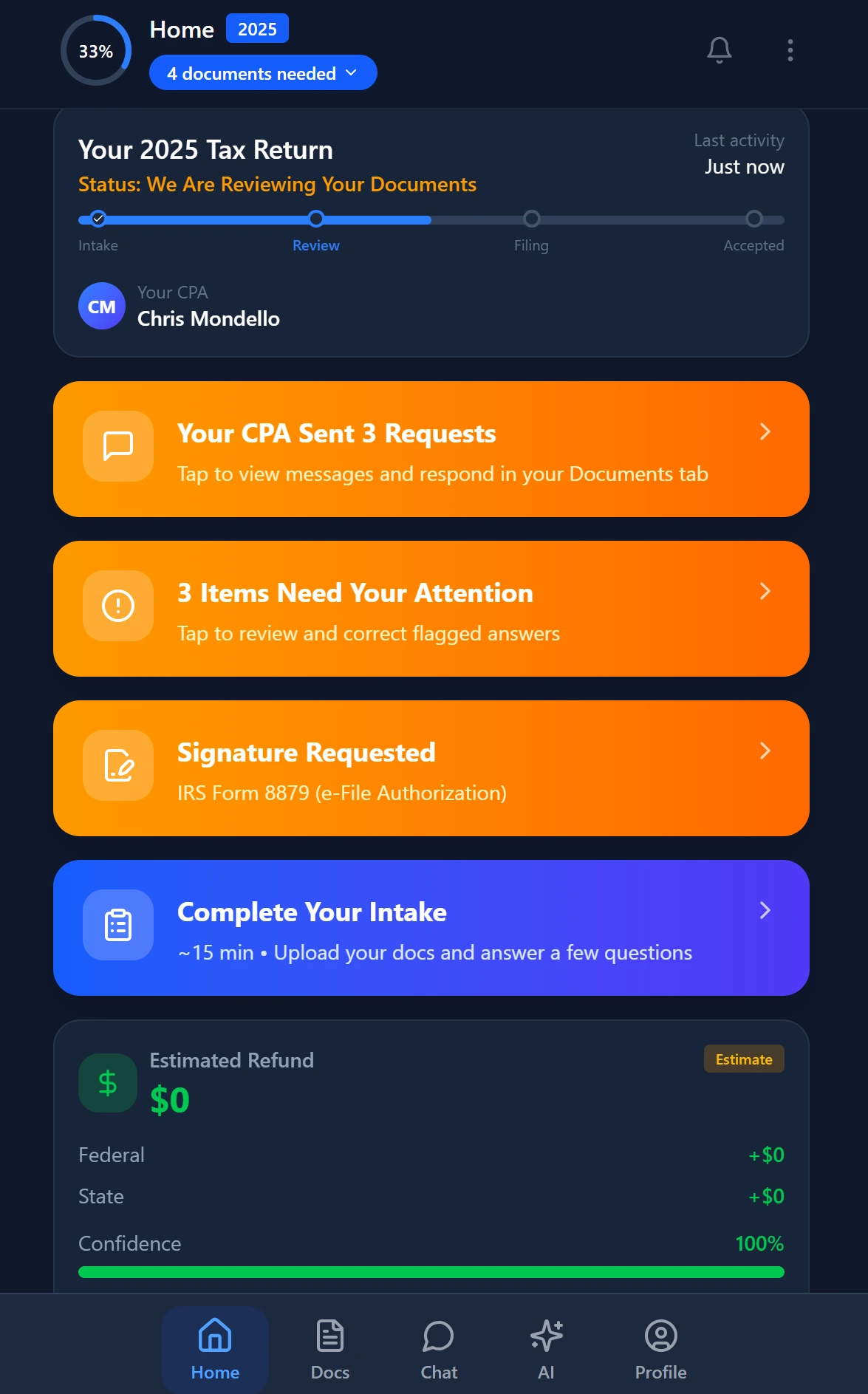
Smart intake auto-fills from uploaded documents and prior-year data
Coordinating SE Tax, QBI, and the Above-the-Line Deduction Simultaneously
The three-way interaction between SE tax, the §199A QBI deduction, and the above-the-line SE tax deduction is the most analytically dense area of self-employment tax planning — and the one competitors address least. Here is the structural logic CPAs need to internalize.
QBI under §199A is generally net income from the qualified trade or business, reduced by the deductible portion of SE tax, the self-employed health insurance deduction, and the retirement contribution deduction. This means every dollar of above-the-line deduction that reduces AGI also reduces QBI — and therefore reduces the 20% §199A deduction. For a client in a 22% income tax bracket with $150,000 of QBI, a $10,000 above-the-line deduction saves $2,200 in income tax but costs $400 in §199A benefit (20% of $2,000 net QBI reduction × 22%), for a net benefit of $1,800 after the QBI haircut. The math still favors the deduction, but CPAs who model it correctly can present a more precise savings figure — and demonstrate why self-employment tax planning requires a systems-level view rather than isolated tactic selection.
For clients near the §199A phase-in threshold — $197,300 single or $394,600 joint for 2026, above which SSTB limitations and W-2 wage caps phase in — above-the-line deductions that reduce AGI below the threshold can unlock the full §199A deduction. A client with $215,000 of net SE income who maximizes a Solo 401(k) contribution and health insurance deduction might reduce AGI to $185,000, preserving the full 20% deduction on the remaining QBI. That single interaction can be worth $6,000 to $8,000 in income tax savings beyond the retirement and health insurance deductions themselves.
The partnership guaranteed payments context is related but distinct. As discussed in our partnership guaranteed payments guide, guaranteed payments to partners are subject to SE tax in the same way as sole proprietor income — making the same reduction strategies applicable for LLC members who receive guaranteed payments rather than pure profit allocations.
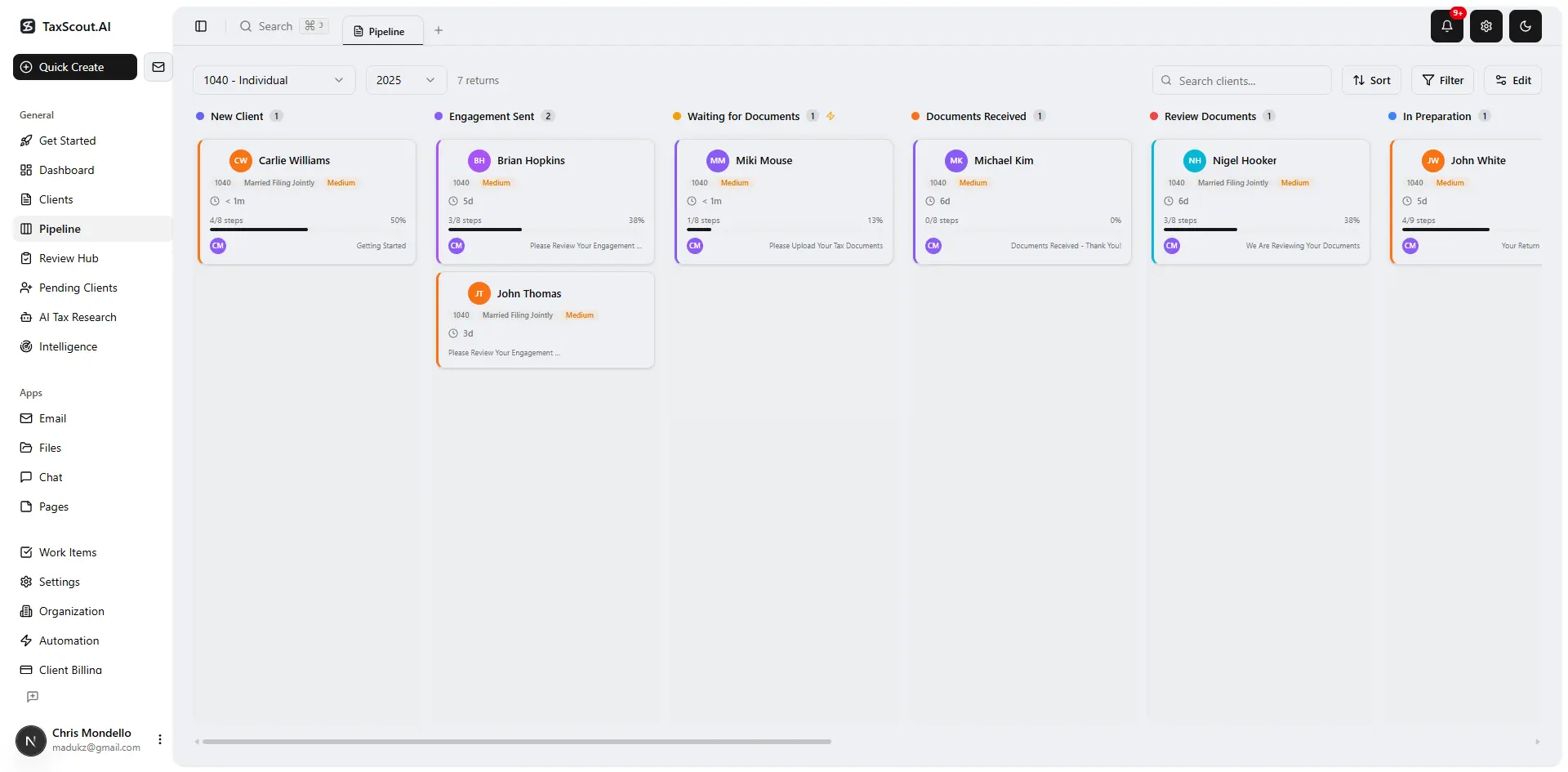
Track every return from intake to filed with drag-and-drop pipeline management
SE Tax Treatment and Key Planning Levers by Entity Type (2025)
| Entity Type | SE Tax Base | Key Reduction Levers | QBI Eligible |
|---|---|---|---|
| Sole Proprietor | Net Schedule C profit × 0.9235 | Retirement contributions, health insurance deduction, entity conversion | Yes — full net income less above-the-line deductions |
| Single-Member LLC (disregarded) | Same as sole proprietor — Schedule C treatment | Same as sole proprietor; S corp election available | Yes — same as sole proprietor |
| S Corp Shareholder | W-2 wages only (distributions exempt from SE tax) | Reasonable salary optimization, employer retirement plan, W-2 health insurance inclusion | Yes — pass-through income less W-2 wages paid |
| Partnership / Multi-Member LLC | Distributive share of SE income plus guaranteed payments | Retirement contributions, health insurance deduction, restructuring one member's interest | Yes — subject to SSTB and W-2 wage limitations above threshold |
Building the SE Tax Savings Projection as a Billable Advisory Deliverable
The gap between CPAs who grow advisory revenue and those who do not is often not technical knowledge — it is documentation. A one-page SE tax savings projection, showing a client's current SE tax liability alongside modeled outcomes for two or three restructuring scenarios, is the single most effective advisory deliverable in the self-employed client space. It creates a concrete, dollar-denominated case for the recommendation and positions the CPA's fee as a multiple of the projected savings. Framing the deliverable explicitly around self-employment tax planning makes it easier for clients to connect the advisory fee to a tangible financial outcome.
The projection should include four columns: current structure, scenario A (optimized sole proprietor or LLC with full above-the-line stacking), scenario B (S corp with reasonable salary), and scenario B+ (S corp plus retirement plan optimization). For each column, show SE tax, income tax impact of above-the-line deductions, §199A deduction value, estimated annual total tax, and net savings versus current structure. For a client earning $200,000 net, the difference between scenario A and scenario B+ can exceed $10,000 annually — a figure that justifies a $2,000 to $3,000 advisory engagement without difficulty.
Practice management infrastructure matters here. Running these projections manually for dozens of sole-owner clients across tax season is not sustainable. Platforms like TaxScout that combine AI document extraction with pipeline management allow firms to systematize the identification of restructuring candidates — flagging every Schedule C client over a net income threshold during intake, queuing them for an advisory conversation, and tracking the engagement through to implementation. The TaxScout Firm plan supports unlimited team members, meaning advisory workflow does not create a per-seat cost as the team scales.
For CPAs who want a research shortcut, IRS Publication 334 (Tax Guide for Small Businesses) remains the authoritative reference for SE tax mechanics, and law.cornell.edu's annotation of IRC §1401 provides the statutory basis for every SE tax rate discussion. Supplement these with state-specific guidance — state conformity to federal SE tax treatment varies, and a handful of states impose their own self-employment or business income taxes that affect the net savings calculation.
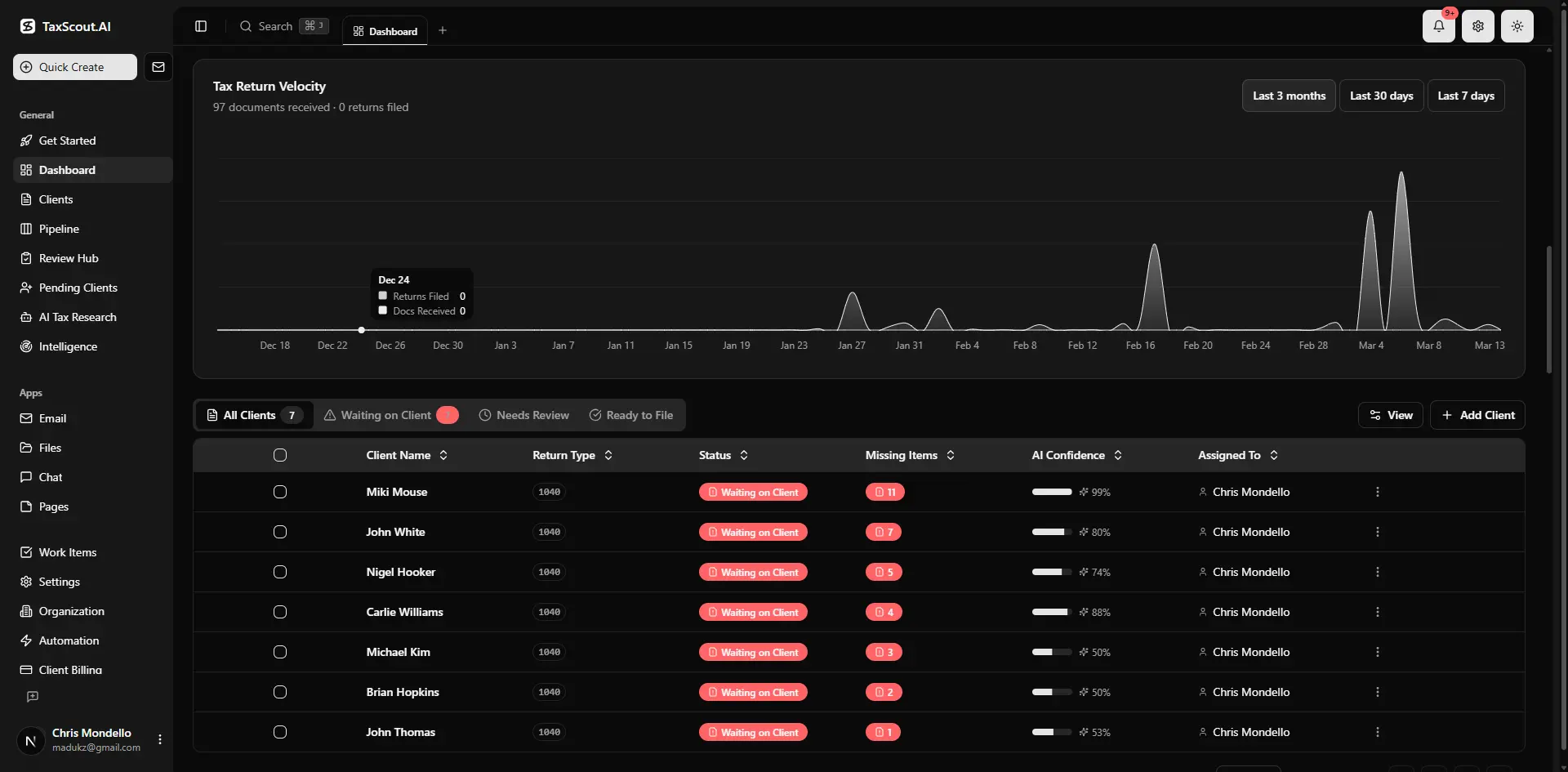
Real-time dashboard showing returns in progress, revenue, and upcoming deadlines
Ongoing Schedule SE Planning: Estimated Taxes and Year-Round Monitoring
Self-employment tax planning is not a one-time election decision — it requires year-round monitoring, particularly for clients with variable income. SE tax is paid through estimated tax payments on Form 1040-ES, with quarterly due dates that do not shift based on when the income was earned. For clients who restructure mid-year — converting from sole proprietor to S corp effective July 1, for example — the Q3 and Q4 estimated payments must reflect the shift from Schedule C SE tax to payroll tax withholding and deposits. Revisiting self-employment tax planning at each quarterly checkpoint helps prevent underpayment surprises that can erode the savings a restructuring was designed to capture.
Under-withholding penalties under IRC §6654 apply when total estimated payments fall below the safe harbor thresholds: 90% of current-year tax or 110% of prior-year tax for clients with AGI over $150,000. For a client who elected S corp status mid-year and failed to adjust payroll to account for the change, the underpayment penalty can offset a portion of the SE tax savings — a detail worth building into the savings projection to avoid surprises.
The underpayment penalty computation is also affected by the timing of income recognition, which matters for clients on a cash basis with large year-end receivables. CPAs who serve clients across multiple states should also verify whether the state imposes its own estimated tax requirements on SE income — conformity is inconsistent. Our state tax deadlines tool can help teams track quarterly due dates by jurisdiction without maintaining a manual calendar.
Spending tax season reacting to returns instead of building advisory pipelines?
TaxScout gives CPA firms the AI extraction, research, and pipeline tools to systematically identify SE tax planning opportunities across every sole-owner client — and deliver them as a recurring revenue service.

Every client gets organized documents, status tracking, and a complete history
Frequently Asked Questions
Most practitioners use a working threshold of $50,000 to $60,000 of net SE income above the required reasonable salary. Below that level, S corp compliance costs — Form 1120-S preparation, payroll processing, state franchise taxes, and separate W-2 issuance — tend to offset or exceed the SE tax savings. Model the full friction cost before recommending the election.
Stay up to date
Get the latest tax tech insights delivered to your inbox.