Internal Revenue Service Advisory Council Public Meeting Notes
The IRS Advisory Council (IRSAC) has announced a public meeting, published in the Federal Register on October 28, 2026. While the priority signal is low, CPA firm owners should understand what IRSAC does, which client segments may be touched by its recommendations, and what minimal action is…
The Internal Revenue Service Advisory Council public meeting notice landed in the Federal Register on October 28, 2026 — document number 2026-21966. The announcement confirms that IRSAC, the IRS's primary external advisory body, will convene a public session where council members present findings and recommendations to IRS leadership on tax administration, compliance, and taxpayer service.
For most small and mid-size CPA firms, an IRSAC meeting is background noise. But the council's annual report routinely surfaces recommendations that later become guidance affecting 1040 filers, S-corporations, partnerships, and nonprofit organizations — sometimes within a single filing season. Knowing the meeting is happening, and monitoring what comes out of it, is a low-effort way to stay ahead of incremental IRS policy shifts. Tracking the internal revenue service advisory council public meeting each year is one of the most cost-effective ways for small and mid-size firms to anticipate regulatory shifts before they reach client returns.
This brief explains what IRSAC is, which client segments are most likely to feel downstream effects, and what your firm should do — or not do — in the next seven days. Understanding the scope of the internal revenue service advisory council public meeting helps your firm prioritize which recommendations to monitor across your specific client segments.
What Is IRSAC and Why Does It Matter to CPA Firms
The IRS Advisory Council was established under the Federal Advisory Committee Act to provide an organized public forum for discussion of tax administration issues. IRSAC members — typically CPAs, tax attorneys, enrolled agents, and business representatives — are appointed by the IRS Commissioner and serve three-year terms. Their annual report is submitted to the Commissioner and made publicly available. The internal revenue service advisory council public meeting serves as the primary venue where these appointed members present findings and engage with IRS leadership on pressing tax administration concerns.
IRSAC does not set binding rules. It issues recommendations. However, its recommendations carry significant weight: past IRSAC cycles have influenced IRS guidance on digital asset reporting, practitioner penalties, and the scope of the Practitioner Priority Service. For a deeper look at how IRS advisory processes translate into actionable changes, see our other news resources covering recent Federal Register notices. For firms evaluating their internal revenue service advisory council public meeting approach, this trade-off compounds over time.
The primary source for this announcement is the Internal Revenue Service Advisory Council; Public Meeting notice published October 28, 2026 on FederalRegister.gov. CPA firms that want to comment or attend should check that page for the meeting date, location or virtual access instructions, and comment submission deadlines. Each of these factors directly shapes how internal revenue service advisory council public meeting plays out in practice.
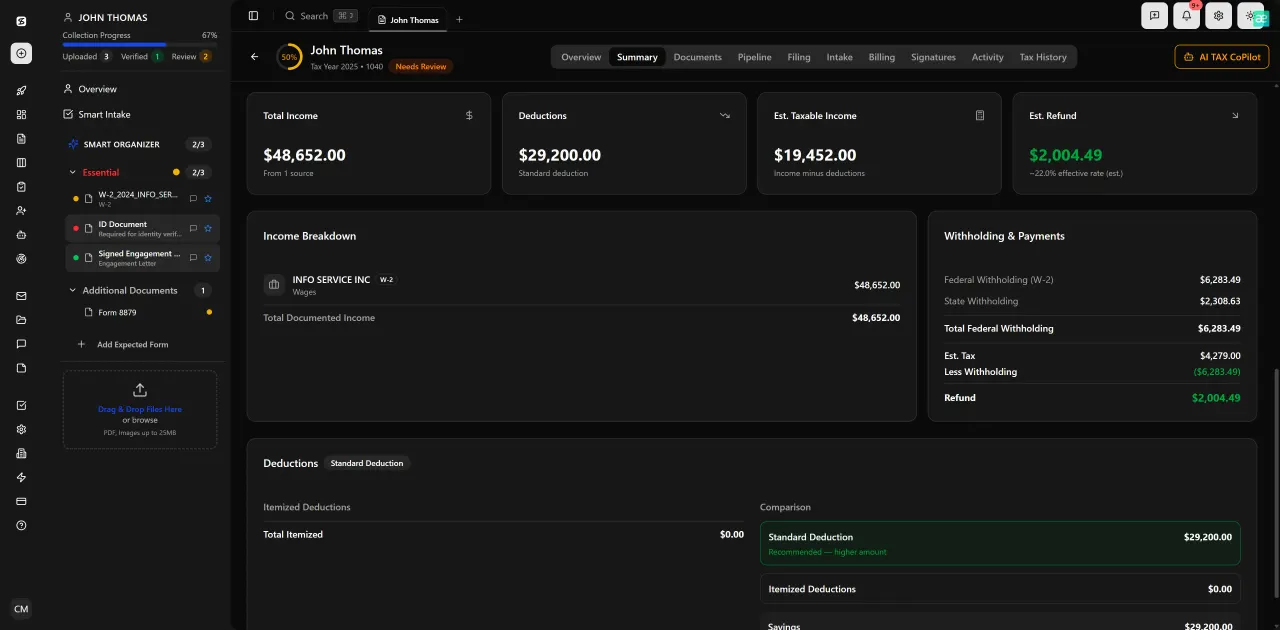
Review with AI assist — 9 agents answer questions with full client context
Which Client Segments and Filing Types Are Most Likely Affected
Tired of manual workflows slowing your firm down? See how TaxScout handles this with AI-powered automation. → Book a 15-Min Demo Understanding internal revenue service advisory council public meeting in this context is what separates firms that scale from those that stall.
IRSAC working groups typically span several issue areas simultaneously. Based on recent council composition and prior annual reports, the client segments most likely to see downstream guidance following a 2026 IRSAC cycle include: This is precisely where a deliberate internal revenue service advisory council public meeting strategy pays off.
Individual filers (Form 1040): IRSAC has repeatedly addressed taxpayer service, digital notices, and penalty abatement procedures. Recommendations here can affect how the IRS communicates with clients who receive CP2000 notices or underpayment assessments. Firms with high individual-return volume should monitor the annual report. For practical penalty-abatement strategy, see our late filing penalty relief guide.
S-corporations and partnerships (Forms 1120-S and 1065): Pass-through entity reporting has been a recurring IRSAC topic, including Schedule K-2/K-3 complexity and the burden of international information reporting on domestic partners. If you prepare returns for closely-held businesses, watch for any IRSAC language on simplifying these schedules. Our Schedule K-3 reporting guide covers the current filing requirements in detail.
Exempt organizations (Form 990 series): IRSAC has examined e-filing mandates and the IRS's processing backlog for determination letters. Nonprofits waiting on 501(c)(3) status or annual return acknowledgments may be affected if IRSAC recommendations prompt procedural changes at the Exempt Organizations unit.
Tax practitioners broadly: IRSAC consistently addresses Circular 230, preparer penalties, and the IRS Office of Professional Responsibility enforcement priorities. Any recommendations touching penalty standards under 26 U.S.C. § 6694 or preparer registration requirements would affect every CPA firm regardless of client mix.
Spending hours tracking IRS notices that may or may not affect your clients?
TaxScout's AI Research Agents monitor IRS, Treasury, and Federal Register sources in real time — so your firm surfaces only the guidance that matters for your client roster.
What to Do This Week: A Short Action List for CPA Firms
Because the priority signal on this notice is low, the action list is short. There is no immediate compliance deadline triggered by an IRSAC meeting announcement itself. However, a few low-cost steps will keep your firm positioned to respond quickly if the council's recommendations gain traction.
1. Bookmark the primary source. Pull up the Federal Register notice 2026-21966 and confirm the exact meeting date and any public comment window. IRSAC public meetings are typically open to observers, and written comments can be submitted in advance.
2. Check whether your firm has S-corp or partnership clients on K-2/K-3 watch. If IRSAC addresses pass-through reporting burden this cycle, IRS guidance could arrive before the 2027 filing season. Flag those files now so you are not scrambling in March.
3. Review your practitioner penalty exposure. If IRSAC recommends tightened accuracy standards under IRC § 6694, firms with high-volume return preparation should revisit their reasonable basis defense documentation practices before any new guidance drops.
4. Sign up for IRS e-News for Tax Professionals. The IRS Newsroom delivers free email alerts when IRSAC releases its annual report — typically in November. That is when recommendations become readable and actionable.
5. No client communication required this week. This is an advisory body meeting, not a rule change, revenue procedure, or proposed regulation. There is nothing to communicate to individual clients at this stage.
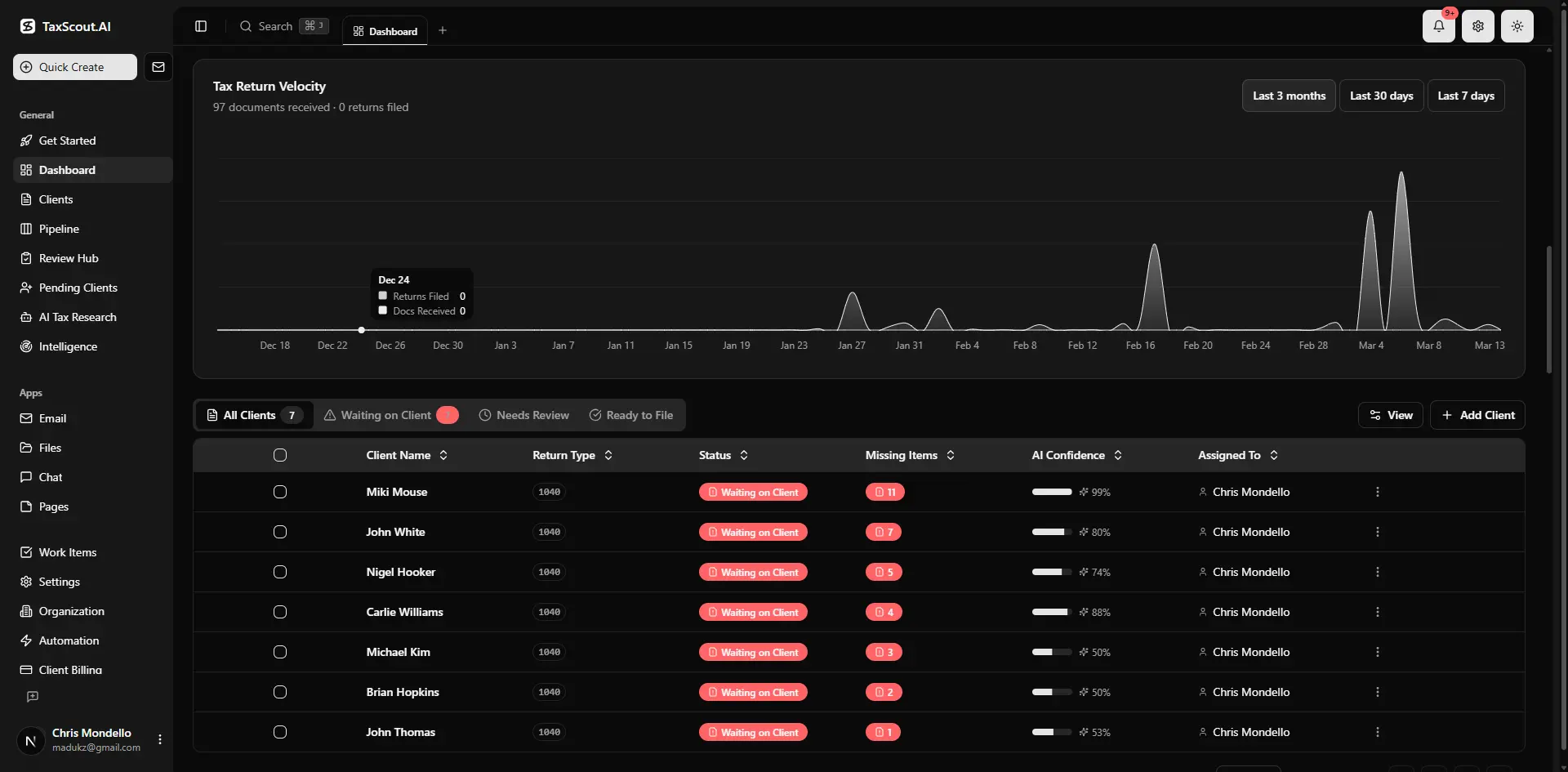
Real-time dashboard showing returns in progress, revenue, and upcoming deadlines
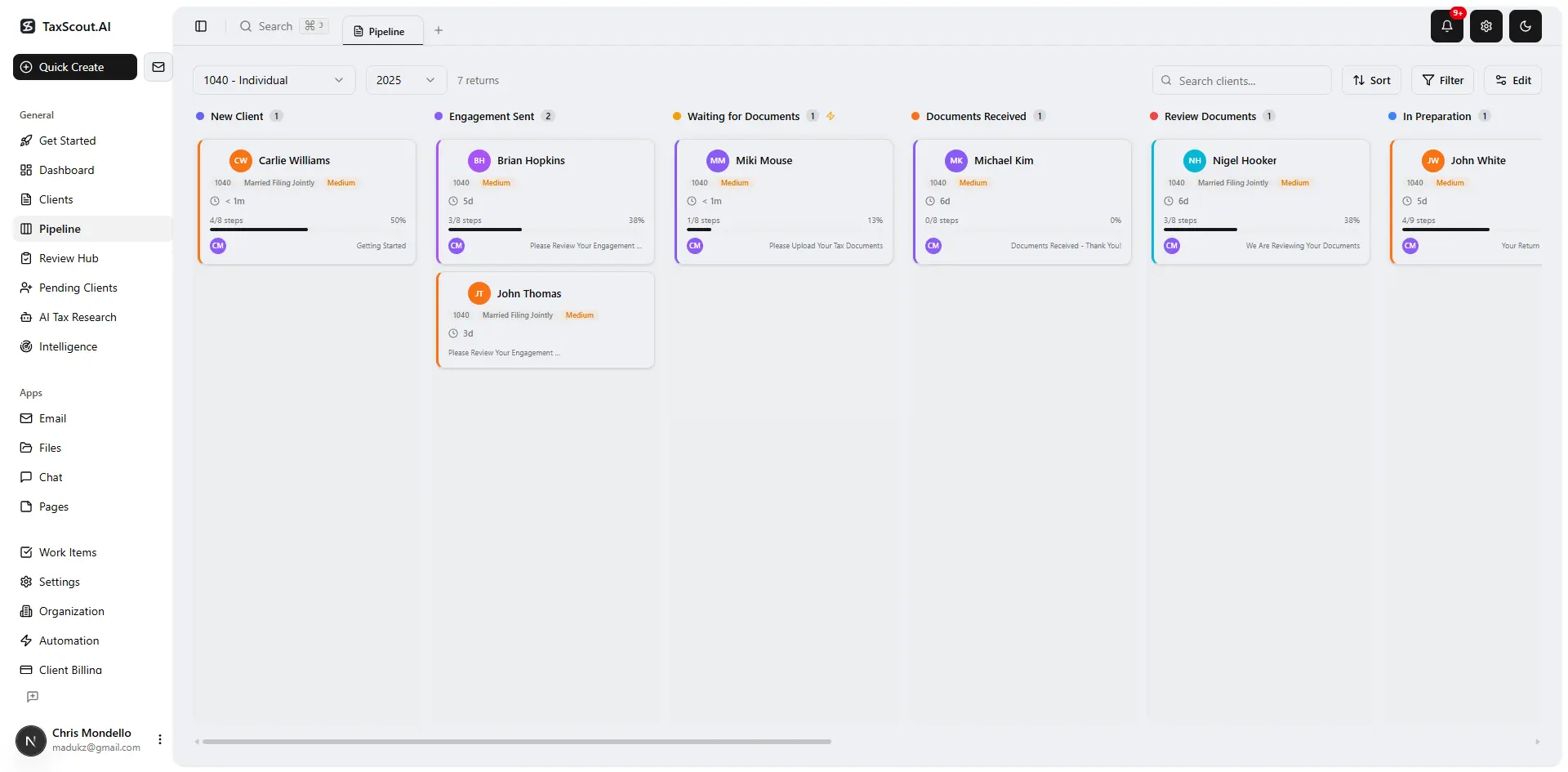
Track every return from intake to filed with drag-and-drop pipeline management
How to Monitor IRSAC Recommendations Without Adding to Your Workload
The real operational challenge for CPA firms is not this single IRSAC notice — it is the cumulative volume of Federal Register publications, IRS news releases, revenue procedures, and proposed regulations that arrive every week. Most small firms lack a dedicated staffer to triage that stream.
TaxScout's AI research agents are specifically designed for this problem. The platform runs nine specialized agents that monitor IRS, Treasury, law.cornell.edu, the Social Security Administration, and Congressional sources in real time, surfacing only guidance relevant to your active client base. Rather than reading every Federal Register entry yourself, your team gets a filtered signal.
Combined with client management that tracks entity type, filing history, and prior-year context, TaxScout can help your firm identify which specific clients would be affected if an IRSAC recommendation becomes formal guidance — before the guidance is finalized.
If you are currently using Drake, CCH Axcess, UltraTax CS, Lacerte, or ProSeries, TaxScout works alongside your existing preparation software — it does not require you to switch. You can explore the regulatory intelligence feature to see how it integrates with a firm's existing workflow.
The Bigger Picture: Why Advisory Council Meetings Signal Longer-Term Shifts
IRSAC is one of several advisory bodies that inform IRS policy, alongside the Taxpayer Advocacy Panel and the Electronic Tax Administration Advisory Committee (ETAAC). Their collective output shapes the IRS Strategic Operating Plan and, by extension, enforcement priorities, digital services investment, and practitioner program changes.
For CPA firms, the most operationally significant IRSAC outputs in recent years have been recommendations on digital communication preferences for taxpayers, simplification of international information returns for domestic S-corps and partnerships, and revisions to the IRS's Voluntary Correction Program for retirement plans. None of these moved fast, but all of them eventually required firms to update workflows.
Staying current with these slower-moving signals is part of the value a CPA firm provides to clients. If your firm prepares returns for partnership clients navigating complex reporting, our partnership guaranteed payments guide is a useful reference while you wait for any IRSAC-influenced guidance on pass-through simplification.
The Small Business Administration also tracks IRS administrative changes that affect small business filers — a useful secondary monitor for firms with a heavy SMB client base.
Want to stop reading every Federal Register notice and start acting only on what moves the needle for your clients?
TaxScout gives CPA firms AI-powered regulatory monitoring, document processing, and client management in one flat-rate platform — no per-user fees, unlimited team members.

Every client gets organized documents, status tracking, and a complete history
Frequently Asked Questions
IRSAC is an external advisory body established under the Federal Advisory Committee Act. Its members — CPAs, tax attorneys, enrolled agents, and business representatives — provide recommendations to the IRS Commissioner on tax administration, compliance, and taxpayer service. IRSAC issues an annual report but does not set binding rules.
Keep reading
Stay up to date
Get the latest tax tech insights delivered to your inbox.