SALT Deduction Cap Workarounds: How CPAs Reduce State Tax Burden for High-Income Clients
The $10,000 SALT cap continues to punish high-income clients in California, New York, New Jersey, and Illinois — but CPAs have more levers than ever to push back. This guide delivers a tactical playbook covering PTET elections, charitable offset structures, entity restructuring, and multi-state…
The $10,000 state and local tax deduction limit created by the Tax Cuts and Jobs Act has quietly become one of the most expensive provisions in the code for high-income households. Clients in California, New York, New Jersey, and Illinois with combined property and income taxes well above that ceiling are absorbing real dollar losses every April — and most of them are still waiting for Congress to fix it. For CPAs, SALT deduction cap workarounds are no longer a niche planning footnote; they are a core deliverable that separates advisors who create measurable value from those who simply file returns.
The legislative picture remains unsettled heading into 2026. TCJA extension negotiations have opened the door to a possible SALT cap increase or repeal, but nothing is law yet. In the meantime, the IRS has formally blessed pass-through entity tax elections as a legitimate federal workaround under Notice 2020-75, and more than 30 states have enacted conforming PTET regimes. Charitable structuring, entity conversion, and timing strategies add further layers. CPAs who understand how these tools interact — and in what sequence to deploy them — can deliver advisory value that extends well beyond tax season. Until Congress acts, SALT deduction cap workarounds remain the most reliable tools practitioners have to protect high-income clients from the full bite of the $10,000 limit.
This guide is written for practitioners, not clients. It covers the mechanical steps, the IRS authority behind each strategy, and the practical conflicts — multi-state estimated tax collisions, entity-level cash flow timing, and PTET election deadlines — that generic articles skip. By the end, you will have a workflow you can open in a client meeting today. This guide is written for practitioners who need a technically grounded roadmap to the most effective SALT deduction cap workarounds available under current law.
Why the SALT Cap Hits Certain Clients So Hard
The IRC Section 164(b)(6) cap limits the combined deduction for state and local income taxes, sales taxes, and real property taxes to $10,000 for individuals and married-filing-jointly filers alike. That marriage penalty alone costs dual-income households thousands. For a California resident paying 13.3% on income above $1 million and property taxes on a $1.5 million home, the disallowed deduction can easily exceed $60,000 per year — producing an incremental federal tax cost of $22,000 or more at the 37% bracket. For firms evaluating their SALT deduction cap workarounds approach, this trade-off compounds over time and makes proactive planning far more valuable than reactive filing.
The impact is concentrated in states with both high income tax rates and high property values. The Tax Foundation's state tax competitiveness index consistently ranks California, New York, New Jersey, and Illinois among the highest combined-burden jurisdictions in the country. Clients who own real estate, receive pass-through K-1 income, or earn W-2 wages above $300,000 in these states are your highest-priority SALT planning candidates. Identifying them systematically — before tax season rather than during return preparation — is the first operational step. Each of these factors directly shapes how SALT deduction cap workarounds plays out in practice, and firms that build a screening process around these variables consistently find more planning opportunities than those relying on client self-reporting.
Before deploying any strategy, confirm the client's deduction profile: actual state income tax paid, estimated tax payments, property tax bills, and any local taxes. Clients who are already in the standard deduction territory gain nothing from SALT strategies that depend on itemizing. Use your intake data to filter this group early; the AI intake feature in TaxScout can flag the mismatch automatically when prior-year returns are on file. Understanding SALT deduction cap workarounds in this context is what separates firms that scale from those that stall.
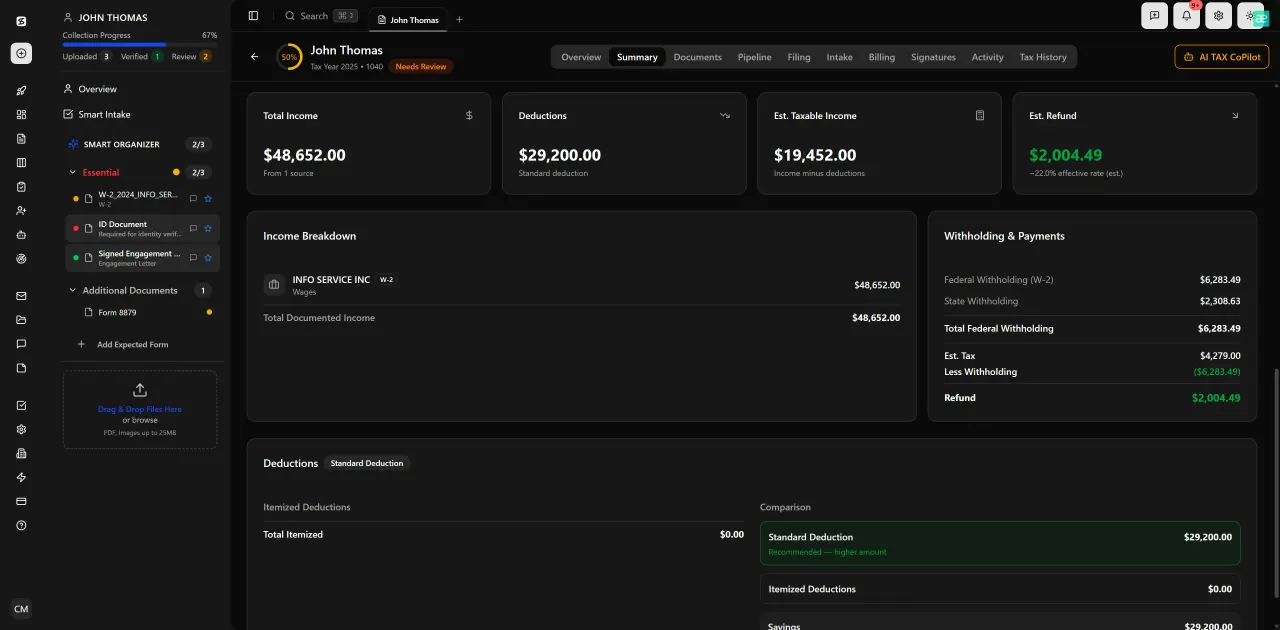
Review with AI assist — 9 agents answer questions with full client context
Pass-Through Entity Tax Elections: The Most Powerful SALT Cap Workaround
Tired of manual workflows slowing your firm down? See how TaxScout handles this with AI-powered automation. → Book a 15-Min Demo This is precisely where a deliberate SALT deduction cap workarounds strategy pays off.
The PTET workaround exploits a structural asymmetry: the $10,000 SALT cap applies to individual taxpayers, but it does not apply to business deductions. When a state imposes an entity-level income tax on a partnership or S corporation and allows the owners a corresponding state credit or income exclusion, the federal deduction flows through as a business expense under IRC Section 162 — entirely outside the cap. The IRS confirmed this treatment in Notice 2020-75 and did not condition it on any passthrough structure requirements. Among all available SALT deduction cap workarounds, the PTET election sits at the center of this decision — get it wrong and the rest unravels.
As of 2026, more than 30 states have enacted PTET legislation. High-tax states with active regimes include California (effective for tax years beginning January 1, 2021), New York (effective 2021 with mandatory election procedures), New Jersey (effective 2020), and Illinois (effective 2023). Each state's mechanics differ on three critical variables: (1) the election deadline relative to the tax year, (2) whether estimated payments are required at the entity level, and (3) how the owner credit or exclusion is structured to avoid double-dipping. For the current list of PTET election states and their deadlines, the Journal of Accountancy's PTET tracker is a reliable reference. When firms revisit their SALT deduction cap workarounds priorities, the gaps usually surface here — particularly in multi-state situations where election deadlines fall on different calendars.
The federal benefit is straightforward in principle: the entity deducts the PTET payment as a state tax expense, reducing ordinary income before it flows to Schedule K-1. The owner then receives a state credit that offsets the same liability at the individual level. Net result: the state tax is effectively deducted federally as a business expense rather than an itemized deduction. For a client with $500,000 of pass-through income in New York and an 11.4% PTET rate, the entity-level deduction can shelter roughly $57,000 from the cap — worth over $21,000 in federal tax savings at the top rate.
CPAs managing K-1 timing for these clients should also review K-1 distribution timing considerations, since PTET elections can shift the income and credit recognition into different tax years depending on the entity's fiscal year and payment schedule.
Multi-State PTET Conflicts and Estimated Tax Timing
The most underreported complication in PTET planning involves clients with income in multiple states simultaneously — for example, a New York resident who is also a partner in a California LLC. Each state's PTET election operates independently, but the federal treatment of each state's credit interacts with the client's individual estimated tax obligations in ways that most planning articles ignore. Practitioners who have worked through SALT deduction cap workarounds in multi-state contexts know that the coordination challenge is often more time-consuming than the election itself.
Consider the cash flow problem: California requires PTET payments based on the prior year's net income with specific installment dates (June 15 and December 15 of the current year for calendar-year entities). New York requires a March 15 or April 15 payment depending on the entity type. If the entity is paying PTET to both states, and those payments reduce K-1 income to the owner, the owner's individual estimated tax obligations in both states must be recalculated — or the client faces underpayment penalties. See the IRS safe harbor rules under IRC Section 6654 and review whether the client qualifies for a penalty waiver if the adjustment is mid-year. Our estimated tax penalty waiver guide walks through the safe harbor mechanics in detail.
Practically, this means PTET elections for multi-state clients require a coordinated cash flow model — not just a state-by-state election checklist. Build a simple spreadsheet that maps each state's PTET payment dates, the entity's available cash, and the resulting adjustment to each owner's quarterly federal and state estimated payments. Do this analysis before the election deadline, not after the first installment is due.
Election Mechanics and Common Filing Errors
The most common PTET filing error is missing the irrevocability window. California's election is made on the entity's return and is irrevocable once filed. New York's election must be made by the first estimated payment date for the tax year — miss it and the entire year's benefit is forfeited. Illinois requires a separate election form filed with the state. Build a calendar reminder into your pipeline management system at least 45 days before each state's election deadline so staff can confirm entity-level decisions with partners or managing members before the window closes.
A second common error involves the credit ordering rules. In California, the PTET credit cannot reduce tax below the tentative minimum tax, and unused credits carry forward for up to five years. New York's credit is fully refundable for resident partners but not for nonresidents. Failing to track these differences across clients creates mismatched expectations — clients who expect a full credit offset and receive a carryforward instead will generate billing disputes and trust problems. Document the credit limitation clearly in every engagement letter that includes a PTET election, and use that conversation as an opportunity to explain how SALT deduction cap workarounds function across multiple state regimes so clients understand what they are authorizing.
Managing PTET elections across multiple states for a growing client roster?
TaxScout's AI research agents search IRS, Treasury, and state tax authority sources in real time — so you can verify PTET deadlines, credit mechanics, and regulatory changes without leaving the platform.

Click any extracted field to see its source highlighted on the original PDF
Entity Restructuring as a SALT Cap Strategy
For clients currently operating as sole proprietors or single-member LLCs filing Schedule C, conversion to a multi-member partnership or S corporation unlocks PTET eligibility in most states. This is not a trivial decision — it involves state formation costs, operating agreement drafting, payroll setup, and potential S corporation reasonable compensation analysis — but the tax savings frequently justify the one-time friction cost. A California Schedule C filer with $400,000 in net income who converts to an S corporation and elects PTET can eliminate the federal SALT cap entirely on the pass-through portion of income, making entity restructuring one of the more permanent SALT deduction cap workarounds available to self-employed high earners.
For clients already operating as S corporations, the PTET election is generally straightforward because most state regimes accommodate both partnerships and S corps. The more complex scenario involves clients with existing C corporation subsidiaries or tiered structures. C corporations are not eligible for PTET elections — the entity-level tax they pay is already a business deduction and does not generate individual owner credits. If a client's structure includes a C corporation above a partnership, PTET planning must work around that tier rather than through it.
S corporation restructuring also creates an opportunity to revisit reasonable compensation levels. Higher W-2 wages increase Social Security and Medicare tax exposure but reduce the pass-through income subject to PTET — a trade-off that needs to be modeled explicitly. The S corp reasonable compensation guide covers the IRS scrutiny threshold and defensible salary benchmarks that apply in this analysis.
Entity restructuring decisions also interact with the qualified business income deduction under IRC Section 199A. Changing entity type or shifting income allocations between owners can alter QBI eligibility or W-2 wage limitations. Always model both the SALT benefit and the QBI impact before recommending a conversion, since SALT deduction cap workarounds that improve one metric can inadvertently reduce another if the full interaction is not mapped in advance.
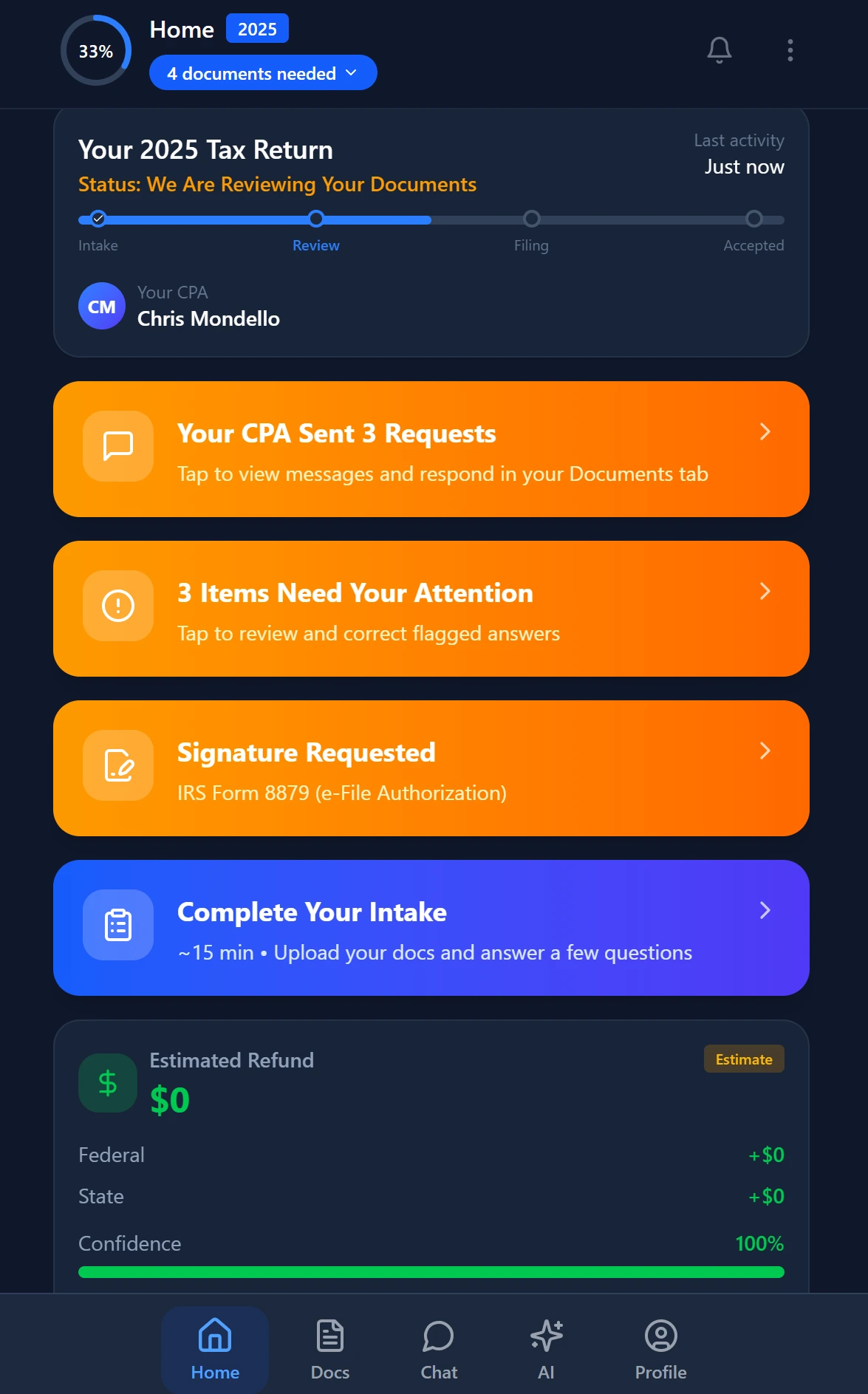
Smart intake auto-fills from uploaded documents and prior-year data
Charitable Vehicles as a Partial SALT Offset Strategy
Charitable structuring does not eliminate the SALT cap — but it can meaningfully reduce the effective cost of lost deductions for clients who are already inclined toward philanthropy. The mechanism works through the interaction between the standard deduction, the SALT cap, and the unlimited federal deduction for charitable contributions under IRC Section 170. Clients who itemize above the standard deduction threshold ($30,000 for MFJ in 2025 under the TCJA inflation adjustment) can convert would-be SALT deductions into dollar-for-dollar charitable deductions by accelerating giving.
A donor-advised fund is the most flexible vehicle for this strategy. A client contributes appreciated stock or cash to the DAF in a high-income year, takes the full charitable deduction immediately, and recommends grants to charities over subsequent years. This front-loads the federal deduction without requiring the client to make immediate charitable decisions. For clients in California or New York with capital gains from stock sales, contributing appreciated securities avoids both federal and state capital gains tax on the appreciation while generating a deduction at fair market value. Our charitable giving strategies guide covers DAF mechanics and the documentation requirements CPAs need to satisfy the IRC Section 170 substantiation rules.
Some states — most notably Arizona, Georgia, and South Carolina — operate state tax credit programs for contributions to certain qualifying organizations. These are distinct from federal charitable deductions: the donor receives a state tax credit (not just a deduction) for contributions to school tuition organizations or rural hospital programs. For clients with income in both a high-tax state and one of these credit-bearing states, layering a state-credit contribution on top of a federal deduction effectively creates a double benefit. The IRS addressed the federal deductibility of these payments in Revenue Ruling 2019-11 — review it carefully before recommending this approach, as the federal deduction is limited to the amount exceeding the state credit value. When charitable vehicles are paired with PTET elections and evaluated together as SALT deduction cap workarounds, the combined federal tax benefit can meaningfully exceed what either strategy delivers in isolation.
For a broader exploration of tax-reduction strategies that complement SALT planning, other blog resources on the TaxScout site cover net investment income tax minimization and Roth conversion planning, both of which intersect with high-income client advisory work.
TCJA SALT Cap 2026 Legislative Outlook and What to Tell Clients Now
The TCJA SALT cap is scheduled to expire at the end of 2025 along with the rest of the individual provisions — meaning that without Congressional action, the pre-TCJA rules would theoretically return in 2026 with no cap on state and local tax deductions. However, the current budget reconciliation process has generated multiple competing proposals: full repeal, an increase to $20,000 for MFJ, a tiered cap based on adjusted gross income, and full extension of the existing $10,000 limit. As of March 2026, no final legislation has been enacted.
The Treasury Department's Office of Tax Policy has not issued formal guidance on SALT in the context of TCJA extension negotiations, and the IRS website reflects only the existing statutory framework. This uncertainty creates a planning challenge: clients want to know whether to accelerate PTET elections, defer income, or restructure entities before a potential law change makes those steps unnecessary or counterproductive.
The practical guidance for most clients is to proceed with PTET elections for tax years already in progress — the cost of not electing if the cap persists is larger than the cost of unwinding a PTET election if the cap is repealed. Entity restructuring decisions with multi-year implications require more caution; model scenarios under both cap persistence and cap repeal before recommending irreversible changes. For W-2 earners with no pass-through income, the legislative outcome matters more because they lack access to PTET elections entirely and are dependent on Congress for relief — a reminder that the most impactful SALT deduction cap workarounds remain out of reach for purely salaried clients until their income structure changes or the law does.
Set client expectations clearly: SALT planning under current law is actionable and beneficial today. Legislative changes, if they come, will create new planning opportunities rather than eliminating existing ones. Build that message into your advisory communications so clients understand the value of acting now rather than waiting for a political resolution that may not arrive on a predictable schedule.
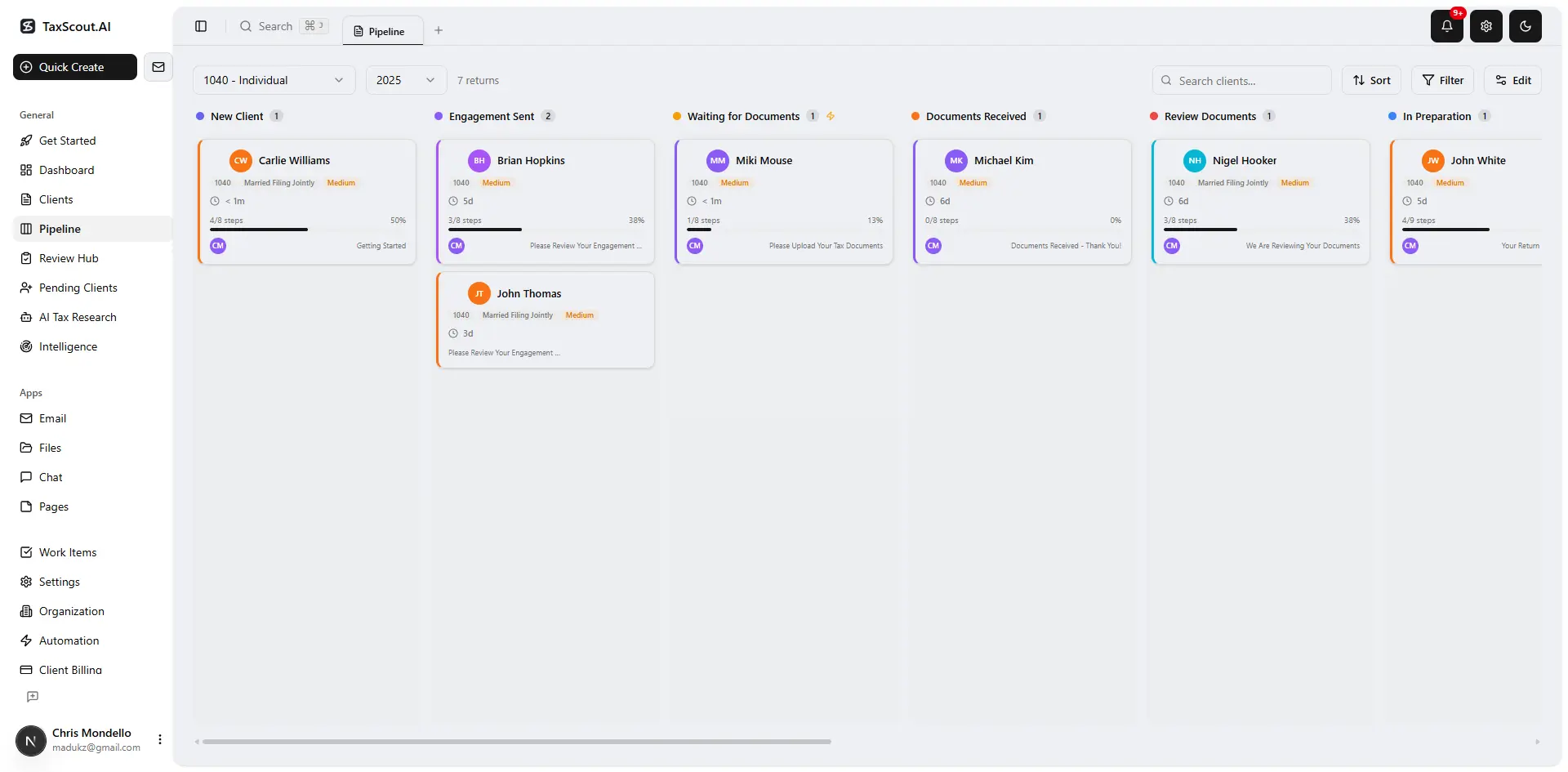
Track every return from intake to filed with drag-and-drop pipeline management
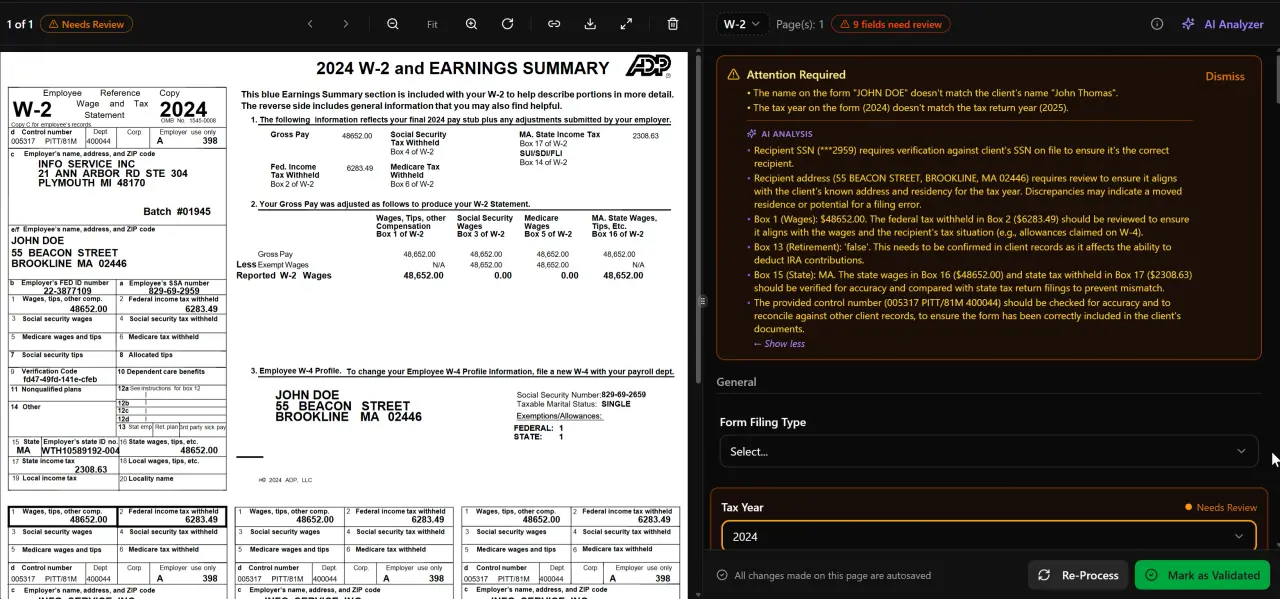
AI classifies, extracts, and validates every document automatically
A CPA Workflow for SALT Advisory Engagements
The following five-step workflow synthesizes the strategies above into a repeatable engagement process you can apply across your high-income client base.
Step 1: Screen and prioritize. Run a report on clients with prior-year Schedule A state tax deductions above $10,000 and pass-through K-1 income from states with active PTET regimes. Clients with both characteristics are your highest-priority advisory targets. Use your pipeline management system to tag these clients and move them into an advisory review stage separate from standard return preparation.
Step 2: Gather entity and income data. Pull prior-year returns, operating agreements, state registration documents, and any existing PTET election history. Confirm the entity type, state of formation, and states where the entity has nexus. If the client has income in multiple states, map each state's PTET regime and election deadline before the first client meeting. TaxScout's AI document extraction can process K-1s and prior returns to surface the relevant data automatically.
Step 3: Model the PTET benefit and alternatives. Build a projection showing: (a) federal and state tax under current structure with no election; (b) federal and state tax with PTET election in each applicable state; (c) the net cash flow impact including entity-level payment obligations and estimated tax adjustments. For clients also considering charitable strategies, add a DAF scenario showing the incremental deduction value above what PTET alone achieves. This comparison across multiple SALT deduction cap workarounds gives clients a clear basis for prioritizing which elections and vehicles to pursue first.
Step 4: Execute elections and coordinate filings. File PTET elections before each state's deadline. Adjust entity-level estimated payments. Recalculate individual estimated tax payments for each owner. Document every election in the client file and update the engagement letter to reflect the expanded scope of services. Use e-signatures to obtain authorization on any amended estimated tax payment instructions without creating mail delays.
Step 5: Monitor and reassess. PTET legislation changes frequently — new states enact regimes, existing states modify credit rules, and IRS notices refine the federal treatment. Schedule a mid-year advisory touchpoint with each SALT planning client to review any state law changes, assess whether income projections have shifted enough to warrant adjusting PTET payments, and update the legislative outlook. The AI research agents in TaxScout monitor IRS, Treasury, and state tax authority publications so you can surface relevant changes without manual research sweeps.
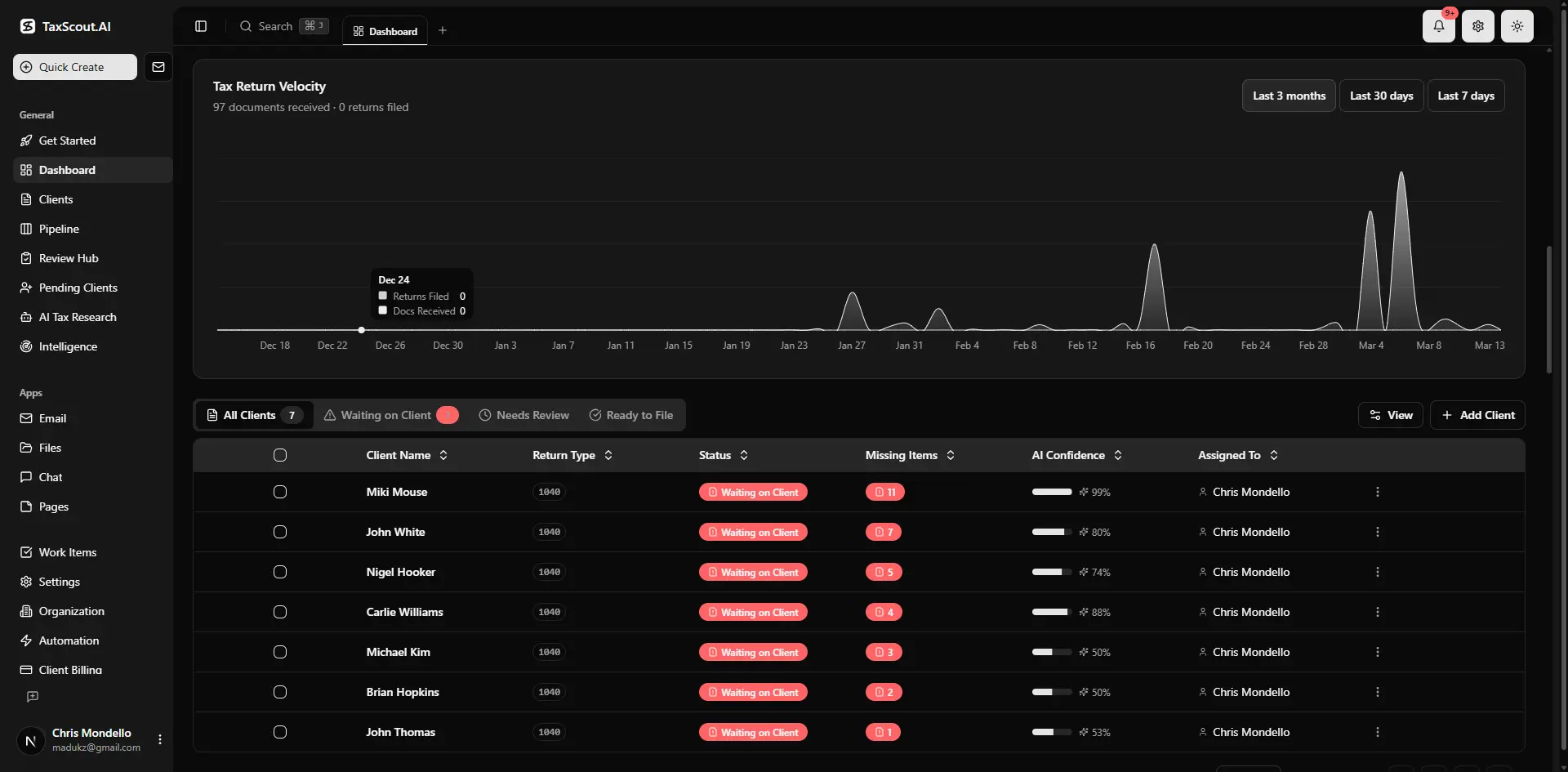
Real-time dashboard showing returns in progress, revenue, and upcoming deadlines
How TaxScout Supports SALT Advisory Work at Scale
SALT planning engagements generate more research, more document review, and more multi-state coordination than standard return preparation. The workflow described above is manageable for a handful of clients but becomes operationally difficult to sustain at 30 or 50 advisory clients without purpose-built tooling.
TaxScout's AI research agents include 9 specialized agents that search IRS, Treasury, Cornell Law, SSA, and Congressional sources in real time. When a state modifies its PTET election deadline or the IRS issues a new notice on entity-level taxes, the research agents surface it without requiring you to maintain a separate regulatory monitoring subscription. This is particularly valuable for the multi-state scenarios described above, where California, New York, New Jersey, and Illinois frequently update their PTET mechanics on different legislative calendars.
Document processing for PTET clients typically involves K-1s from multiple entities, state tax returns from multiple jurisdictions, prior-year PTET election confirmations, and credit carryforward schedules. TaxScout's AI document extraction handles K-1s and 1040 schedules natively, with a 5-layer validation pipeline that cross-references extracted values against math rules and prior-year data to flag discrepancies before they reach your review queue. The split-screen PDF viewer with click-to-source field highlighting makes it fast to verify that PTET credits from state returns are correctly reflected in the federal projection.
For firms considering how TaxScout compares to alternatives on advisory workflow support, see the detailed breakdown on the TaxDome alternative page. TaxScout's flat pricing — $149 per month for the Firm plan with unlimited team members and all 9 AI research agents — means the per-client cost of SALT advisory work drops substantially as your advisory client count grows, without the per-seat fees that make scaling expensive on other platforms. Visit /pricing to compare plan details.
Handling SALT planning for 20+ high-income clients across multiple states?
TaxScout gives your whole team real-time AI research, automated document extraction, and pipeline management — all at a flat monthly rate with no per-user fees.

Every client gets organized documents, status tracking, and a complete history
Frequently Asked Questions
Most states that have enacted pass-through entity tax regimes allow both S corporations and partnerships to make the election. California, New York, New Jersey, and Illinois all cover both entity types. However, single-member LLCs taxed as disregarded entities are generally not eligible — the entity must have at least two owners or be taxed as a partnership or S corporation at the federal level. Always verify the specific state statute before advising a client to restructure for PTET purposes.
Keep reading
Backdoor Roth IRA: How CPAs Execute the Strategy Without Triggering Pro-Rata Tax
Oct 12, 2026 · 1 min read
Amended FBAR Procedures: How CPAs Correct Foreign Account Errors Without Triggering Penalties
Oct 12, 2026 · 1 min read
Transparency in Coverage Final Rules: What CPA Firms Must Do Now
Oct 12, 2026 · 1 min read
Stay up to date
Get the latest tax tech insights delivered to your inbox.