Big 4 to Small Firm Transition: How CPAs Rebuild Their Practice Identity and Client Base
Moving from a Big 4 firm to a boutique or solo practice is one of the most disorienting career pivots in public accounting — not because the technical work is harder, but because everything else changes at once. This guide walks through the hidden skill gaps, identity shifts, and practical steps…
The big 4 to small firm transition is deceptively hard. On paper, a senior manager or director leaving Deloitte or PwC to open a boutique practice looks like a logical step down in stress and up in autonomy. In practice, it often feels like the accounting equivalent of Walter White — someone who was exceptional inside a system suddenly realizing the system was doing most of the heavy lifting.
Inside a large firm, infrastructure is invisible. There are specialized teams for marketing, billing, IT, HR, conflict checks, and malpractice coverage. Client relationships are managed by rainmakers above you. The work product is polished by layers of review. When you leave, all of that scaffolding disappears overnight, and you are responsible for things that no Big 4 training program ever touched. This invisible scaffolding is precisely what makes the big 4 to small firm transition so disorienting — it disappears overnight.
This guide is written for experienced CPAs who are in the middle of that transition — or seriously considering it. We cover the mindset resets that matter most, the practical gaps nobody warns you about, and the tools that can compress years of trial-and-error into a much shorter ramp. If you want to see how other practitioners are navigating the shift, other blog resources from our community cover adjacent ground worth bookmarking. Whether you are weeks or months into your big 4 to small firm transition, the challenges covered here are ones nearly every departing CPA encounters.
Why the Big 4 to Small Firm Transition Feels Like Starting Over
The culture shock of leaving a Big 4 firm is real and under-discussed. At a large firm, your identity is largely borrowed from the institution. The brand opens doors, the name on your email builds trust before you say a word, and your title communicates a whole résumé of credibility. At a small firm — or worse, a solo practice — you are the brand, and most of your new prospective clients have never heard of you. That identity reset is one of the least-discussed but most psychologically demanding aspects of the big 4 to small firm transition.
This is not a confidence problem; it is a structural one. According to the Bureau of Labor Statistics, the vast majority of CPA firms in the United States employ fewer than ten people. The skills those firms need from an owner are fundamentally different from those rewarded at a global partnership. Rainmaking, scope management, collections, and client-facing communication — often handled by partners above you at a Big 4 shop — suddenly land entirely on your desk. For firms evaluating their big 4 to small firm transition approach, this trade-off compounds over time.
The technical work, ironically, is often simpler. You are no longer preparing ASC 842 lease accounting footnotes for Fortune 500 companies. You are helping a local dental practice understand pass-through entity elections and whether an S-corporation election makes sense for their cash flow. The complexity drops, but the accountability multiplies — and that asymmetry is what trips up the most experienced people. Each of these factors directly shapes how big 4 to small firm transition plays out in practice.
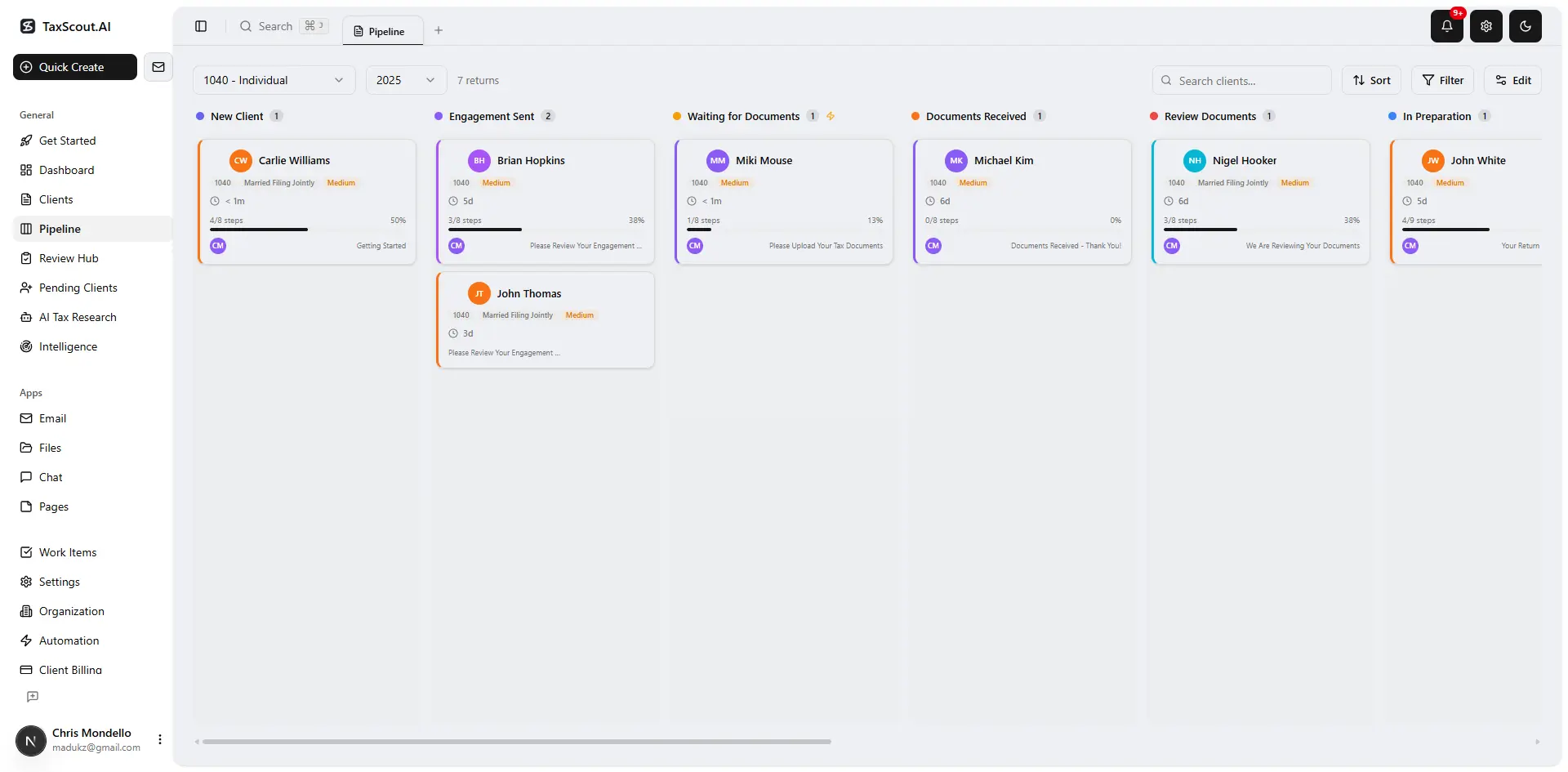
Track every return from intake to filed with drag-and-drop pipeline management
The Hidden Skill Gaps Nobody Warns You About
Big 4 training is deep and narrow. You become excellent at a specific type of work inside a specific type of client. Small firm ownership requires breadth that feels uncomfortable at first — not because the concepts are unfamiliar, but because you have never had to own the execution end-to-end. Understanding big 4 to small firm transition in this context is what separates firms that scale from those that stall.
Billing and collections is the most common blind spot. At a large firm, billing is handled by finance and reviewed by partners. Rates are set by pricing committees. At a small firm, you set your own rates, send your own invoices, and have that uncomfortable conversation when a client is 60 days past due. Many CPAs coming from large firms dramatically underprice their services in the first year because they have no internal reference point for what the market will bear outside of institutional rates. Our guide on flat fee billing for CPAs is a useful starting point for rethinking pricing from scratch. This is precisely where a deliberate big 4 to small firm transition strategy pays off.
Client onboarding is another gap. Big 4 firms have elaborate intake and conflict-check workflows built over decades. When you go small, the absence of a structured client onboarding process means you are likely to miss critical information at the start of an engagement — scope, prior-year data, entity structure, filing history — and pay for it during busy season. Building that intake process deliberately, rather than relying on memory and email threads, is one of the highest-leverage investments you can make in the first ninety days. Big 4 to small firm transition sits at the center of this decision — get it wrong and the rest unravels.
The IRS's Publication 1345 and related Authorized IRS e-file Provider requirements create compliance obligations that large firm IT departments handle automatically. When you go independent, those obligations are yours to track — ERO registration, e-file transmittal procedures, data security requirements, and acknowledgment monitoring all need an owner. When firms revisit their big 4 to small firm transition priorities, the gaps usually surface here.
Tired of rebuilding your practice infrastructure from scratch after leaving a large firm?
TaxScout.ai gives independent CPAs enterprise-grade document extraction, AI research agents, and a branded client portal — all for a flat $149/month with no per-user fees.

Your clients see your brand — OTP login, document upload, and real-time status

Click any extracted field to see its source highlighted on the original PDF
Repositioning Your Expertise for Smaller Clients
One of the most disorienting parts of the downshift CPA career move is figuring out how to present your background to small business owners and individual tax clients who neither know nor care about your Big 4 pedigree. A dental practice owner does not know what a SEC engagement partner is. A real estate investor does not care that you spent three years on a multinational transfer pricing study.
What small business clients care about is whether you understand their world. The fastest way to reposition is to translate your technical depth into client-language outcomes. 'I spent five years reviewing partnership structures at the entity level' becomes 'I help business owners set up their company structure so they pay less in self-employment tax and protect their personal assets.' The underlying expertise is identical; the framing is entirely different.
Niche selection accelerates this repositioning dramatically. Generalist small firms compete on price; specialist firms compete on fit. If your Big 4 experience was in real estate, financial services, healthcare, or manufacturing, you already know more about the tax and compliance nuances of those industries than 90 percent of local practitioners. Our niche pricing strategy guide walks through how to package that expertise into premium-rate service offerings that clients in specialized markets will actually pay for.
The Journal of Accountancy has documented the accelerating wave of small firm acquisitions and mergers that is creating space for well-positioned boutique practices. Experienced CPAs who can articulate a specialty are better positioned to inherit clients from retiring sole practitioners than generalists competing purely on fee.
Building a Client Base Without a Big Firm Brand Behind You
Client acquisition is the skill Big 4 CPAs are least prepared for. At a large firm, clients come through the institution — cross-selling by other service lines, referrals from industry groups, inbound from marketing budgets that dwarf the annual revenue of most small practices. When you leave, the pipeline stops cold.
The most reliable early-stage client acquisition strategy for CPAs in transition is structured referral development. Former colleagues, attorneys, financial advisors, insurance brokers, and commercial bankers are all natural referral partners who deal with the same small business owners you want to serve. A deliberate program — not just 'staying in touch' but a systematic cadence of value-add touchpoints — converts those relationships into a steady introduction stream. Our accounting firm referral program guide covers how to structure this without it feeling transactional.
Digital presence matters more than most transitioning CPAs expect. Small business owners increasingly search for CPAs online before asking for referrals, and a firm that has no website or an outdated one is filtered out before the conversation starts. A Treasury.gov small business resource reinforces that the majority of small business owners now expect professional service providers to have a verifiable digital footprint — phone number, address, credentials, and client reviews at minimum.
Retaining the clients you do land requires a client experience that matches your technical quality. A branded client portal with secure document exchange, OTP login, and e-signature capability closes more engagement letters than a generic email attachment workflow. TaxScout's client portal gives small firm CPAs the same client-facing polish as enterprise firms, without enterprise pricing.
For CPAs who handled corporate or partnership returns at the Big 4, the adjustment to high-volume individual returns can be a capacity shock. Learning to manage a pipeline of 200 to 500 individual returns requires workflow discipline that was never needed when you were managing ten large-fee engagements. Our accounting firm capacity planning guide is specifically written for firms scaling through this kind of transition.
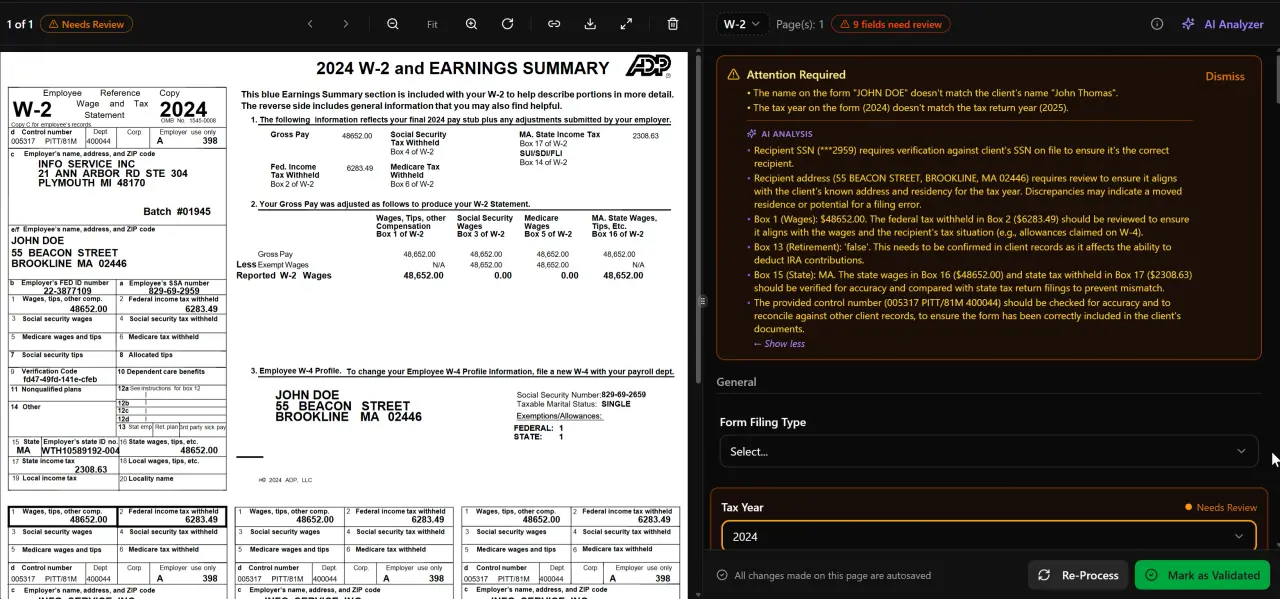
AI classifies, extracts, and validates every document automatically
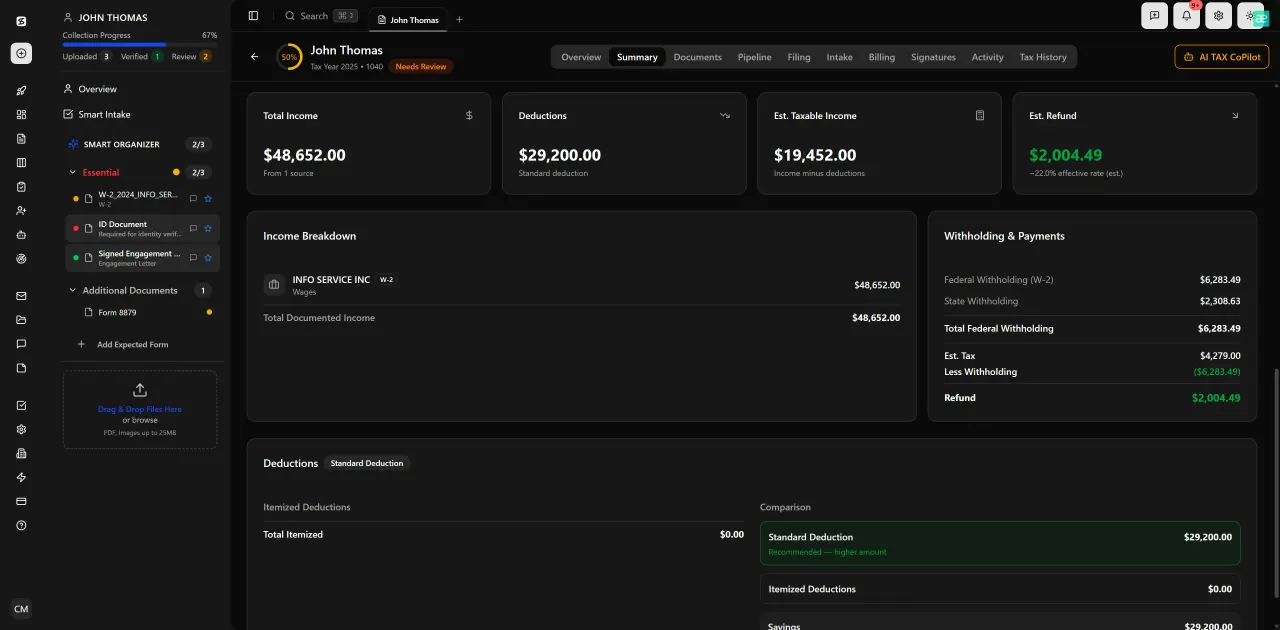
Review with AI assist — 9 agents answer questions with full client context
Technology Infrastructure for the Lean Practice
Big 4 firms run on expensive, heavily customized technology stacks. CCH Axcess, Thomson Reuters GoSystem, custom workflow tools, and dedicated IT teams supporting all of it. When you go small, you need a stack that delivers equivalent capability at a fraction of the cost — and ideally one that does not require a dedicated IT person to maintain.
The three non-negotiable technology categories for an independent or small firm CPA are: a tax preparation platform that integrates with your existing software (Drake, Lacerte, UltraTax CS, CCH Axcess, ProConnect, or ProSeries), a document management and extraction layer that eliminates manual data entry, and a client communication and intake tool that creates a professional onboarding experience. TaxScout works alongside your existing tax prep software rather than replacing it, so the transition cost is low.
AI document extraction is particularly high-value for small firm CPAs because it eliminates the time that large firm associates previously absorbed. TaxScout's extraction covers 180+ tax form types — W-2s, all 1099 variants, K-1s, the complete 1098 and 1095 series, and 1040 with all schedules — and runs them through a 5-layer validation pipeline that catches math errors and cross-document inconsistencies before you ever open the return. Our AI document extraction guide for CPAs explains what that pipeline actually checks.
Security is another area where small firms tend to underinvest — not from negligence but from not knowing what enterprise-grade actually requires. The IRS has published data security requirements for tax professionals that include written information security plans, multi-factor authentication, and breach notification procedures. TaxScout's AES-256-GCM encrypted SSN vault, 7-role RBAC, and 13-step DSAR anonymization give independent CPAs compliance posture that used to require a dedicated IT security team. More detail is available on the security features page.
Practice management — pipeline tracking, deadline monitoring, engagement letter execution, invoicing — is where small firm CPAs lose the most unbillable time. A dedicated pipeline management tool with 12 customizable stages and drag-and-drop kanban replaces the spreadsheet chaos that most new solo practitioners default to in their first year. Combined with e-signatures via Form 8879, 4868, and engagement letters, the administrative overhead of running a practice drops substantially.
Practice Management Platform Cost Comparison for a 10-Person Firm
| Platform | Monthly Cost (10 users) | AI Document Extraction | IRS Research Agents | Flat Pricing |
|---|---|---|---|---|
| TaxScout Prep Pro | $149/mo total | Yes — 180+ form types | Yes — 9 specialized agents | Yes — unlimited clients |
| TaxDome | ~$500/mo (per-user) | No | No | No |
| Canopy | ~$660/mo (per-user + modules) | No | No | No |
| Karbon | ~$590/mo (per-user) | No | No | No |
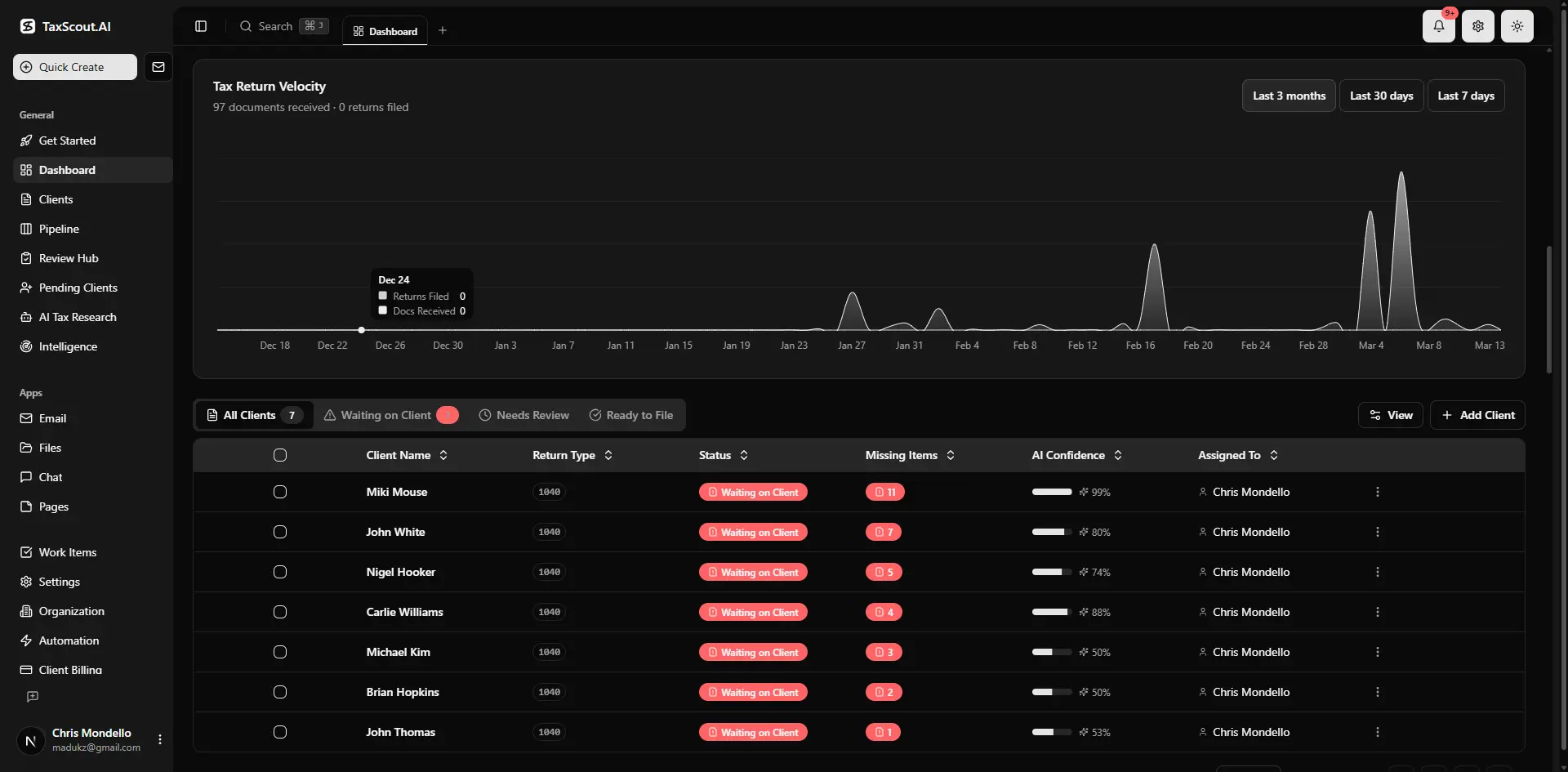
Real-time dashboard showing returns in progress, revenue, and upcoming deadlines
Resetting Expectations: What Small Firm Success Actually Looks Like
One of the most common psychological traps in the CPA career transition is benchmarking small firm success against Big 4 metrics. Total revenue, headcount, client count — these numbers are meaningless comparisons across firm models. A solo CPA clearing $300,000 in net income working 1,800 hours a year is objectively more successful, by most personal financial measures, than a Big 4 senior manager billing 2,800 hours at $180,000 in W-2 compensation.
The better benchmarks are profit per client, realization rate, and client retention. These metrics reward the quality of your work and the fit of your client base rather than volume. The SSA's data on self-employment income and longevity shows that self-employed professionals who build sustainable practices tend to work longer and report higher career satisfaction than those in institutional employment — which matters for a profession where many practitioners work well into their sixties.
Capacity planning in a small firm is entirely self-determined. You can choose to stay lean and maximize hourly yield, or you can build a team and scale. But unlike a Big 4 track where the escalator moves whether you want it to or not, the small firm CPA sets the speed. That autonomy is the entire point — and protecting it requires the discipline to fire clients who cost more than they contribute before they erode the margins that make the whole model work.
If you are evaluating practice management software as part of your transition, compare your options carefully. The TaxScout vs TaxDome comparison is a useful reference for understanding what AI-native platforms offer versus legacy tools that were built before document extraction and AI research were feasible at the small firm price point. See the full TaxScout pricing page for current flat-rate options.
Ready to stop rebuilding your practice infrastructure one painful spreadsheet at a time?
TaxScout.ai gives transitioning CPAs the full-stack practice platform — AI extraction, research agents, client portal, pipeline management, and e-signatures — at $149/month flat, no per-user fees, unlimited clients.
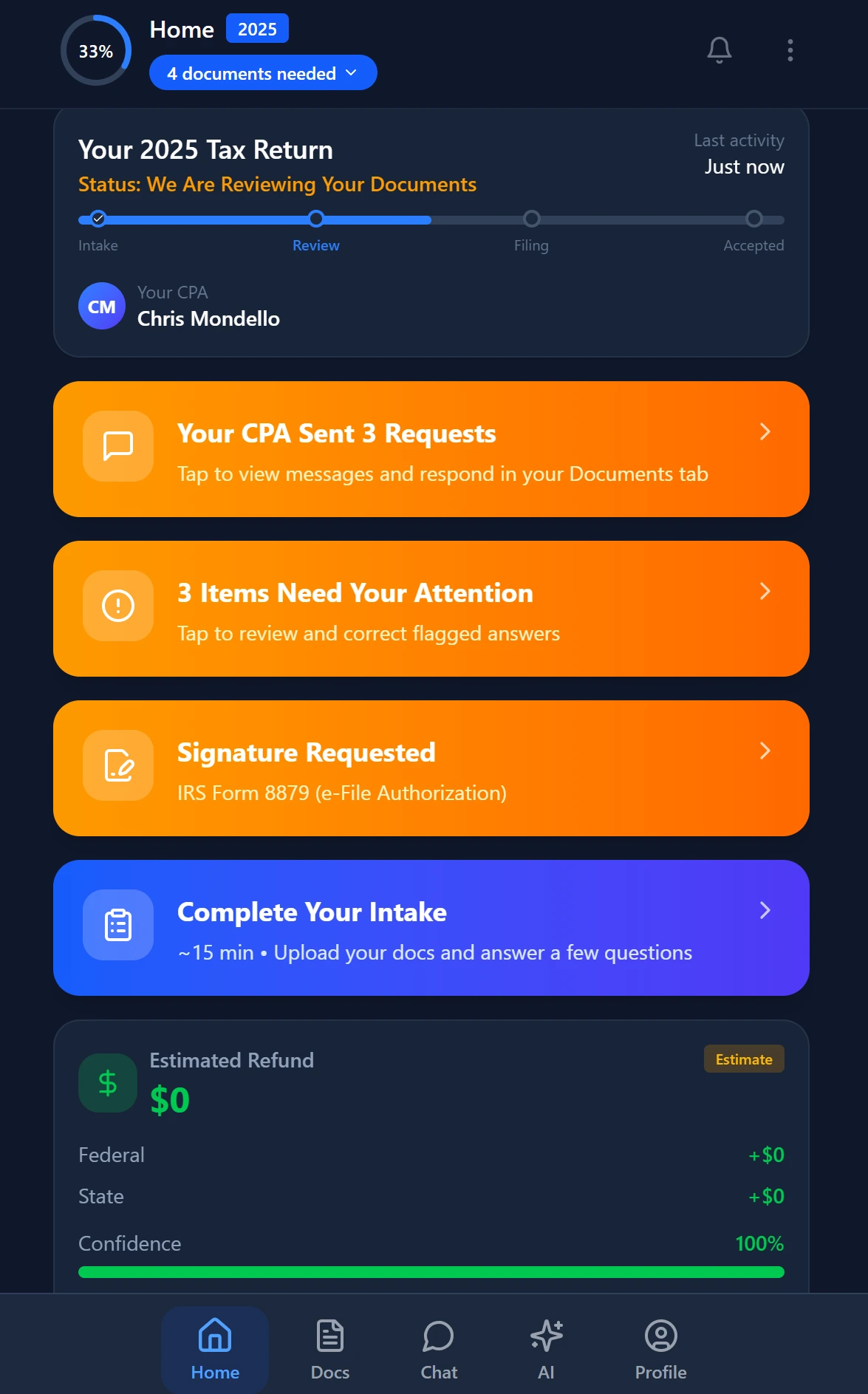
Smart intake auto-fills from uploaded documents and prior-year data
Frequently Asked Questions
Most CPAs who transition from Big 4 to independent practice report reaching a stable client base — one that covers operating expenses and delivers a target income — within 18 to 36 months. The range is wide because it depends heavily on niche clarity, referral network quality, and how quickly the CPA builds a systematic intake and onboarding process. CPAs who enter with a defined specialty and structured referral strategy typically compress this timeline to 12 to 18 months.
Keep reading
AMT Planning for CPAs: How to Shield Business Clients From the Corporate Alternative Minimum Tax
Oct 19, 2026 · 1 min read
Schedule K-3 Reporting: How CPAs Handle International Pass-Through Items for Domestic Partners
Oct 19, 2026 · 1 min read
Uniform Capitalization Rules: How CPAs Apply UNICAP to Inventory and Self-Constructed Assets
Oct 17, 2026 · 1 min read
Stay up to date
Get the latest tax tech insights delivered to your inbox.