Uniform Capitalization Rules: How CPAs Apply UNICAP to Inventory and Self-Constructed Assets
IRC Section 263A's uniform capitalization rules require producers and resellers to capitalize indirect costs into inventory — but the mechanics differ sharply depending on whether a client manufactures goods, resells them, or constructs assets for its own use. This guide walks CPAs through the…
Uniform capitalization rules under IRC Section 263A are among the most consistently misapplied provisions CPAs encounter with manufacturing, wholesale distribution, and real property construction clients. The statute requires taxpayers to capitalize all direct and indirect costs allocable to property produced or acquired for resale — a deceptively simple mandate that conceals an elaborate cost-allocation framework most practitioners only encounter when an IRS examiner asks for the Section 263A computation.
The compliance gap is real and costly. Clients who crossed the gross receipts threshold for the first time after the Tax Cuts and Jobs Act raised it now face a UNICAP obligation they have never navigated. Meanwhile, clients who have been applying Section 263A for years may be using the wrong simplified method, computing their absorption ratio incorrectly, or failing to document the election in a way that survives scrutiny. In either scenario, the CPA is the last line of defense before an adjustment that can restate inventory values and trigger interest on multiple tax years. Understanding the uniform capitalization rules is essential for any client crossing the gross receipts threshold for the first time.
This guide is written for the practitioner in the room: the CPA managing a manufacturer, a wholesaler, or a business that builds assets for its own use. We cover the threshold analysis, the method elections, the interaction with bonus depreciation, and the workpaper structure that makes an IRS inquiry a non-event rather than a crisis. Mastering the uniform capitalization rules is no longer optional for CPAs advising manufacturers, wholesalers, or businesses constructing their own assets.
What IRC Section 263A Actually Requires
IRC Section 263A requires producers and resellers to include in the cost of inventory — or in the basis of self-constructed assets — all costs that are 'properly allocable' to property produced or acquired for resale. The statute overrides the natural tendency to deduct indirect costs like warehousing, purchasing department salaries, and storage insurance in the period incurred. Instead, those costs must ride with inventory until the inventory is sold. The uniform capitalization rules codified under IRC Section 263A represent a deliberate policy choice to match the full cost of production against the revenue it generates.
The costs subject to capitalization fall into two categories. Direct costs — raw materials and direct labor — were already being capitalized by most accrual-method taxpayers before Section 263A existed. The UNICAP provisions add a second layer: 'additional Section 263A costs,' which are indirect costs that would not be capitalized under a taxpayer's normal cost accounting method but are allocable to production or resale activities under the statute. Common examples include off-site storage, handling, quality control, purchasing, payroll processing attributable to production employees, and a portion of depreciation on production-use assets. For firms evaluating their uniform capitalization rules approach, this trade-off compounds over time.
Notably, Section 263A does not require capitalization of selling, advertising, or research and experimental costs. Treasury Regulation 1.263A-1(e)(3) provides a detailed list of excluded costs, and understanding that boundary is critical to avoiding over-capitalization — a problem that harms clients just as surely as under-capitalization, by overstating taxable income in the current period. Our article on tangible property regulations addresses the related capitalization-versus-expensing analysis under the repair regulations, which often overlaps with UNICAP in manufacturing-heavy practices. Each of these factors directly shapes how uniform capitalization rules plays out in practice.
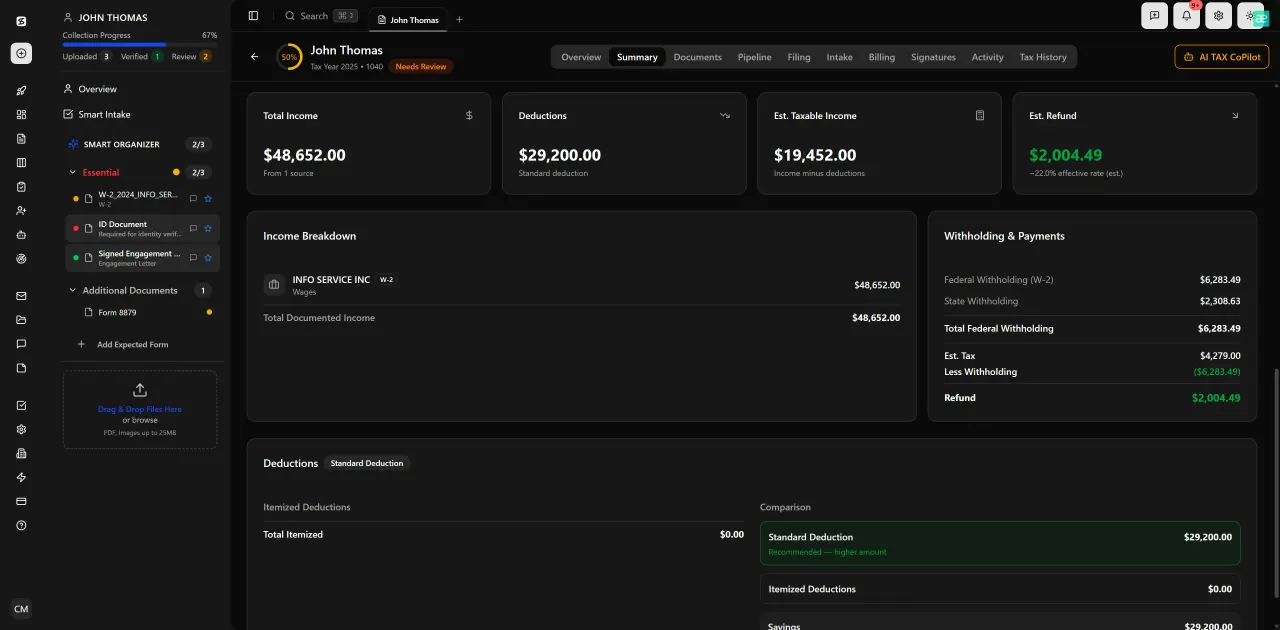
Review with AI assist — 9 agents answer questions with full client context
The Post-TCJA Small Business Exemption Threshold
Tired of manual workflows slowing your firm down? See how TaxScout handles this with AI-powered automation. → Book a 15-Min Demo Understanding uniform capitalization rules in this context is what separates firms that scale from those that stall.
Before the Tax Cuts and Jobs Act, the gross receipts threshold for the Section 263A small business exemption was $10 million, averaged over three years. TCJA raised that threshold dramatically. For tax years beginning after December 31, 2017, a taxpayer is exempt from the uniform capitalization rules if its average annual gross receipts for the three preceding taxable years do not exceed $29 million — a threshold indexed for inflation that reached $30 million for 2024 tax years under IRS Revenue Procedure 2023-34.
The practical consequence for CPA practices is significant. A client who was exempt at $15 million in gross receipts is still exempt. But a client who crossed $29 million for the first time in 2023 or 2024 now faces a mandatory accounting method change to comply with Section 263A — one that requires filing Form 3115 and computing a Section 481(a) adjustment to account for the cumulative effect of costs that should have been capitalized in prior years. This is precisely where a deliberate uniform capitalization rules strategy pays off.
CPAs should run a rolling three-year gross receipts test for every manufacturer, producer, and reseller client annually. The exemption applies separately to each trade or business, so a client with two distinct business units might clear the threshold in one and not the other. The exemption is also unavailable to tax shelters, regardless of gross receipts, per IRC Section 448(d)(3). Treating the threshold test as a year-end checklist item — rather than discovering the problem after the return is filed — is the difference between a clean Form 3115 and an amended return under pressure. Uniform capitalization rules sits at the center of this decision — get it wrong and the rest unravels.
One nuance that frequently catches practitioners: the TCJA threshold applies to the Section 263A exemption but does not automatically exempt the same taxpayer from the accrual method requirement. A client near the $30 million mark may be exempt from UNICAP while still being required to use an accrual method for inventory purposes under IRC Section 471. Those are separate analyses, and conflating them leads to planning errors. When firms revisit their uniform capitalization rules priorities, the gaps usually surface here.
Tired of rebuilding UNICAP workpapers from scratch every filing season?
TaxScout.ai's AI research agents pull current IRS guidance, Treasury regulations, and Cornell Law sources in real time — so your Section 263A analysis is built on current authority, not last year's notes.
Simplified Production Method vs. Simplified Resale Method
Taxpayers subject to Section 263A who do not qualify for the small business exemption must choose a cost allocation method. The two primary simplified methods — the simplified production method and the simplified resale method — are frequently confused, and electing the wrong one produces an incorrect absorption ratio that flows into every subsequent year's computation. Correctly applying the uniform capitalization rules from the start is the only way to avoid a cascade of downstream restatements.
The simplified resale method, described in Treasury Regulation 1.263A-3(d), is available to resellers — taxpayers who acquire finished goods for resale without further production activity. The method computes an absorption ratio by dividing additional Section 263A costs allocable to resale activities by the total inventory costs incurred during the year (before the Section 263A adjustment). That ratio is applied to ending inventory to compute the additional costs to capitalize.
The simplified production method under Treasury Regulation 1.263A-2(b) applies to producers — taxpayers who manufacture, build, install, or improve property. The absorption ratio under this method divides additional production costs by total production costs (again before the Section 263A uplift). Producers who also engage in resale may use the simplified production method for all inventory, or may bifurcate and apply the simplified resale method to the resale portion alone. Most practitioners default to the simplified production method for simplicity, but clients with significant resale activity alongside lighter manufacturing operations sometimes find the bifurcated approach produces a lower capitalization amount.
The method election is made by consistently applying the chosen method on the return. Once made, a change requires IRS consent via Form 3115 under the automatic consent procedures of Revenue Procedure 2015-13. This is not a year-by-year decision, and treating it as one — or failing to document the initial election — is a common source of IRS adjustments on examination. For practice management purposes, tracking which clients have made which elections and when is the kind of client context that belongs in a searchable system, not in a partner's memory. TaxScout.ai's client management features let you store entity-level tax attributes and filing history so the election is always visible when you open a client file.
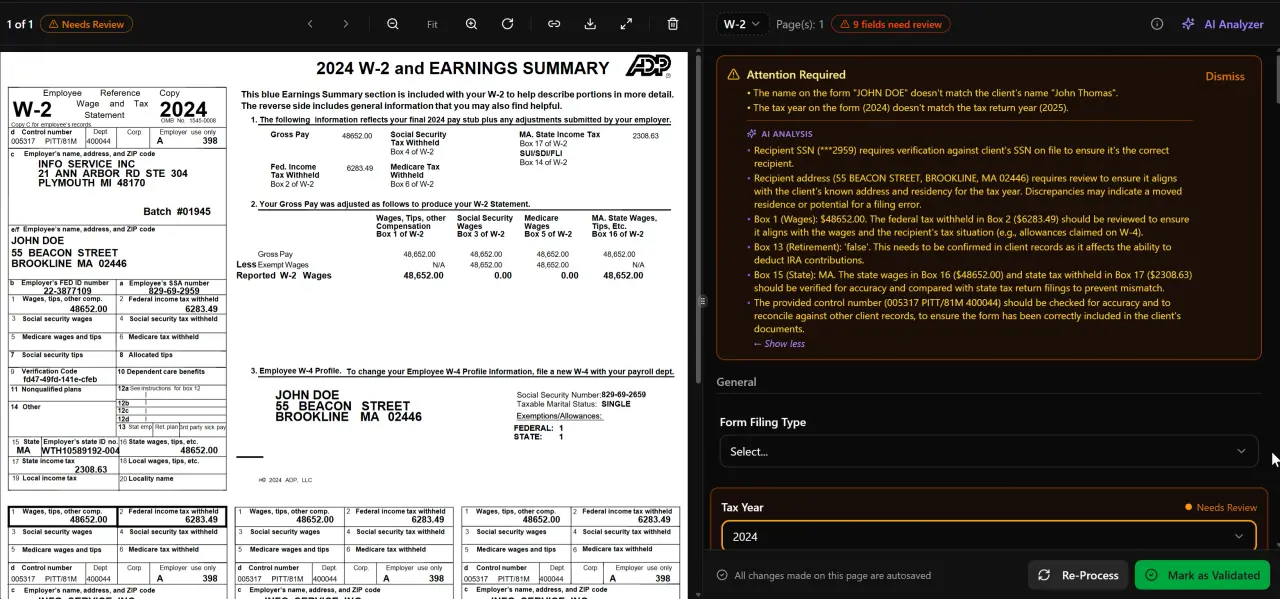
AI classifies, extracts, and validates every document automatically

Click any extracted field to see its source highlighted on the original PDF
Self-Constructed Assets and Section 263A
When a taxpayer constructs, builds, or improves tangible property for its own use — rather than for sale — Section 263A still applies. The same cost-allocation logic that requires indirect costs to be capitalized into inventory requires those costs to be capitalized into the basis of the self-constructed asset. This is the 'self-constructed assets tax' problem that surprises clients who thought Section 263A was only an inventory rule. Applying the uniform capitalization rules correctly to self-constructed assets is just as important as applying them to resale inventory.
The practical effect is a higher depreciable basis. A manufacturer that builds a new production line using its own employees and materials must capitalize not just the direct materials and labor, but also an allocable share of indirect costs: supervisory salaries, payroll taxes on construction workers, depreciation of equipment used during construction, utilities, and insurance during the construction period. These costs increase the asset's basis and are recovered through depreciation over the asset's useful life — not deducted in the year incurred.
This creates a direct tension with bonus depreciation elections. Under current law, bonus depreciation is being phased down from 100% — it was 60% for property placed in service in 2024 and drops further in subsequent years per IRC Section 168(k). When a client elects bonus depreciation on a self-constructed asset, the bonus applies to the full capitalized basis, including the Section 263A uplift. That means underestimating the capitalized basis produces an understatement of the bonus depreciation deduction — a misstatement that runs in the client's favor in the placed-in-service year but creates a trail of basis errors that compound over time if the asset is later sold or exchanged.
CPAs advising clients on bonus depreciation elections should therefore complete the Section 263A cost accumulation before computing the bonus. Running the depreciation schedule first and then layering in UNICAP costs as an afterthought is an error that is easy to make when time pressure is highest. A consistent workflow that flags self-constructed assets for Section 263A review before the depreciation schedule is finalized prevents the problem at the source.
Computing the Absorption Ratio: Step-by-Step
Step 1: Identify additional Section 263A costs. Pull the general ledger and separate costs into three buckets: (a) costs already included in inventory under the taxpayer's normal method (direct materials, direct labor, and overhead already capitalized), (b) additional Section 263A costs (indirect costs not already in inventory that are allocable to production or resale), and (c) excluded costs (selling, advertising, R&D, and other items listed in Treasury Regulation 1.263A-1(e)(3)).
Step 2: Compute the absorption ratio. For the simplified production method, divide additional Section 263A costs by total production costs incurred during the year (before the Section 263A adjustment). For the simplified resale method, divide additional resale costs by total inventory costs incurred during the year. The result is a percentage — often in the range of 2% to 8% for most manufacturers, though capital-intensive producers can run higher. Firms that have not revisited their uniform capitalization rules methodology in several years often discover the ratio has drifted materially from what the regulations require.
Step 3: Apply the ratio to ending inventory. Multiply the absorption ratio by the total pre-Section 263A inventory balance at year-end. The result is the additional Section 263A costs that must be included in ending inventory. This amount increases both the inventory balance on the balance sheet and the cost of goods sold adjustment — because the prior year's Section 263A costs flow out of beginning inventory into COGS while the current year's costs are capitalized into ending inventory.
Step 4: Reconcile to the prior year. The Section 263A adjustment is a net figure: current-year additional costs capitalized minus prior-year additional costs that flowed into COGS as inventory sold. A first-year computation produces only the capitalization piece; subsequent years must include the prior-year rollout. Failing to include the beginning inventory offset is the single most common UNICAP arithmetic error on examination.
Step 5: Document the computation in a workpaper that can stand on its own. The workpaper should show the cost categorization, the ratio calculation, the ending inventory tie-out, and the general ledger line items supporting each category. Examiners reviewing Section 263A adjustments are looking for a reproducible computation, not just a number on the return. Use TaxScout.ai's PDF and file management tools to attach the workpaper directly to the client file, version-controlled and immediately retrievable if the return is later pulled for examination.

Track firm performance with real-time analytics and client activity monitoring
How UNICAP Interacts With Bonus Depreciation Elections
The UNICAP-bonus depreciation interaction is one of the most underappreciated planning pressure points in manufacturing client engagements. Here is the mechanism: depreciation on production-use equipment is itself an indirect cost allocable to production under Treasury Regulation 1.263A-1(e)(3)(ii). When a client takes bonus depreciation on production equipment, the depreciation deduction accelerates — but that same depreciation, to the extent it relates to production activity, must be partially capitalized back into inventory through the Section 263A computation.
The net result is that bonus depreciation on production equipment does not produce a full current deduction. A portion of the accelerated depreciation gets absorbed into ending inventory and deducted only as that inventory is sold. The larger the production equipment bonus election, the larger the indirect depreciation component in the absorption ratio, and the larger the Section 263A capitalization. For clients with significant year-end inventory, the capitalization can meaningfully offset the tax benefit of the bonus election in the year of purchase.
This does not mean bonus depreciation is inadvisable for manufacturers — the timing benefit is still valuable when inventory turns are fast. But clients should not assume that buying a $500,000 CNC machine and taking 60% bonus depreciation produces a $300,000 deduction with no strings attached. The CPA must model the Section 263A offset before representing the tax benefit. See our related discussion in other blog resources covering tangible property and capitalization decisions that intersect with this analysis.
One planning note: the Section 263A regulations permit taxpayers to exclude from the simplified method computation any depreciation that the taxpayer can demonstrate is not allocable to production. If the bonus-depreciated asset has a clearly documented non-production use, that portion of depreciation does not flow into the absorption ratio. Documentation of asset-use allocation is therefore both a compliance requirement and a planning lever — another reason the workpaper discipline described above pays dividends beyond pure compliance. Clients who take this step seriously find that the uniform capitalization rules reward precise recordkeeping with materially better outcomes on examination.
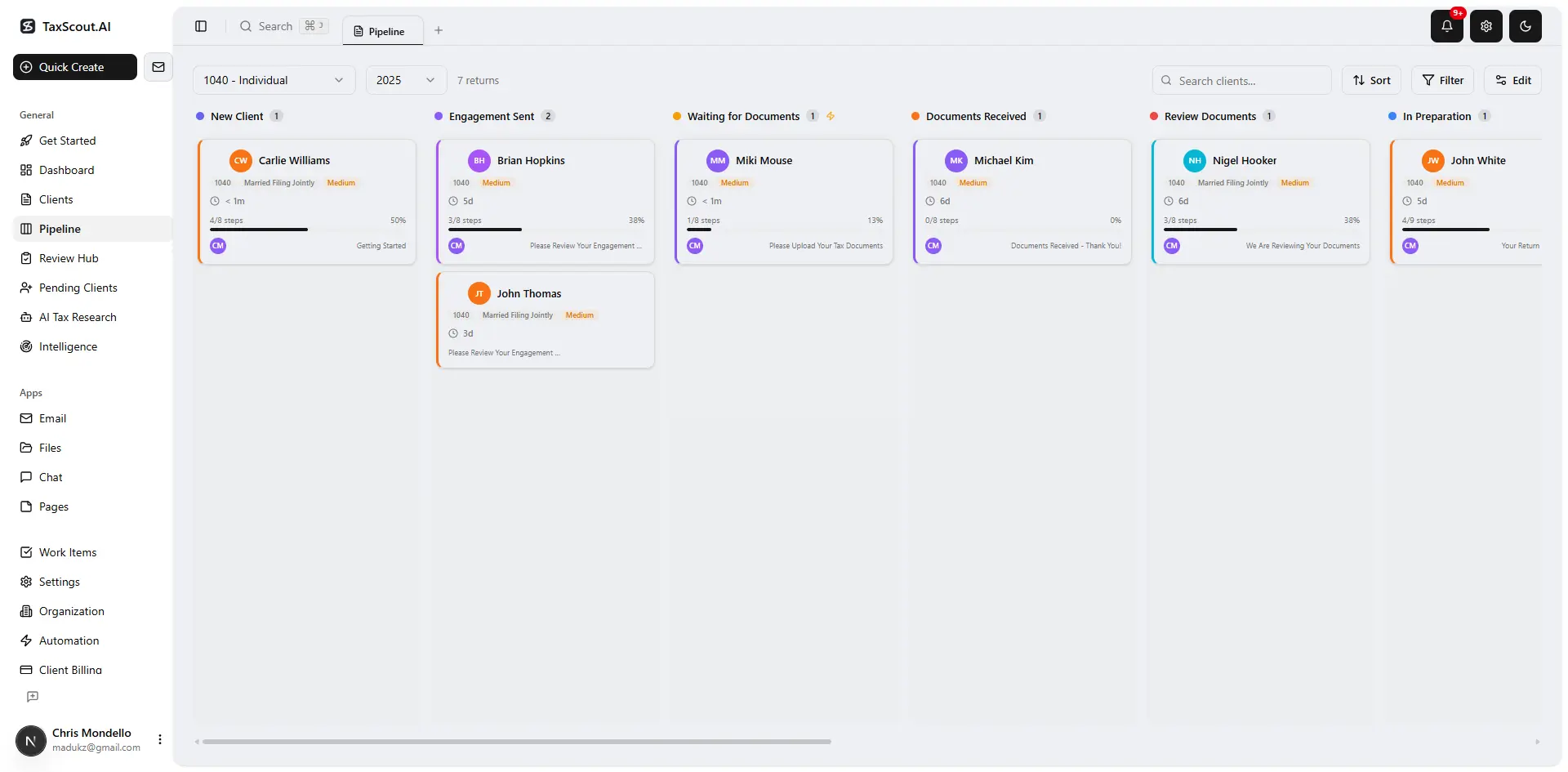
Track every return from intake to filed with drag-and-drop pipeline management
Reseller Exceptions and the de Minimis Production Rule
Not every taxpayer that touches a product is a producer for Section 263A purposes. Treasury Regulation 1.263A-2(a)(1)(ii) provides that a taxpayer is treated as a producer only if it produces property within the meaning of the statute — which generally excludes packaging, labeling, and minor assembly that does not materially transform the product. A wholesaler that relabels products and ships them is almost certainly a reseller, not a producer, and the simplified resale method (not the simplified production method) applies.
The de minimis production rule under Treasury Regulation 1.263A-3(a)(2) provides additional relief: a reseller whose production activities are de minimis — meaning the additional production costs allocable to property produced are less than certain thresholds relative to total production costs — may elect to treat all of its activities as resale for Section 263A purposes. This election simplifies the computation for distribution companies that do incidental light assembly or kitting, avoiding the need to maintain separate production and resale cost pools.
CPAs with wholesale distribution clients should evaluate this election explicitly. The default assumption that a company doing 'a little manufacturing' must use the production method leads to unnecessary complexity and sometimes a higher capitalization amount than the resale method would produce. The election must be made consistently and documented in the workpaper, but it is available — and underused. For firms managing multiple wholesale and distribution clients, the pipeline management features in TaxScout.ai allow you to tag each client with their active Section 263A method election so the review step is built into your workflow rather than reconstructed each year.
Section 263A Method Election Summary for CPAs
| Client Type | Applicable Method | Absorption Ratio Denominator | Key Election Document |
|---|---|---|---|
| Pure manufacturer | Simplified Production Method | Total production costs incurred | Consistent application on return; Form 3115 to change |
| Pure reseller | Simplified Resale Method | Total inventory costs incurred | Consistent application on return; Form 3115 to change |
| Mixed producer-reseller | Simplified Production Method (all) or bifurcated | Production costs (production portion) | Bifurcation election documented in workpaper |
| Reseller with de minimis production | Simplified Resale Method (elective) | Total inventory costs (production treated as resale) | De minimis election documented in workpaper |
| Self-constructed asset producer | Cost accumulation (not simplified method) | Actual direct and indirect costs by asset | Section 263A cost allocation schedule by asset |
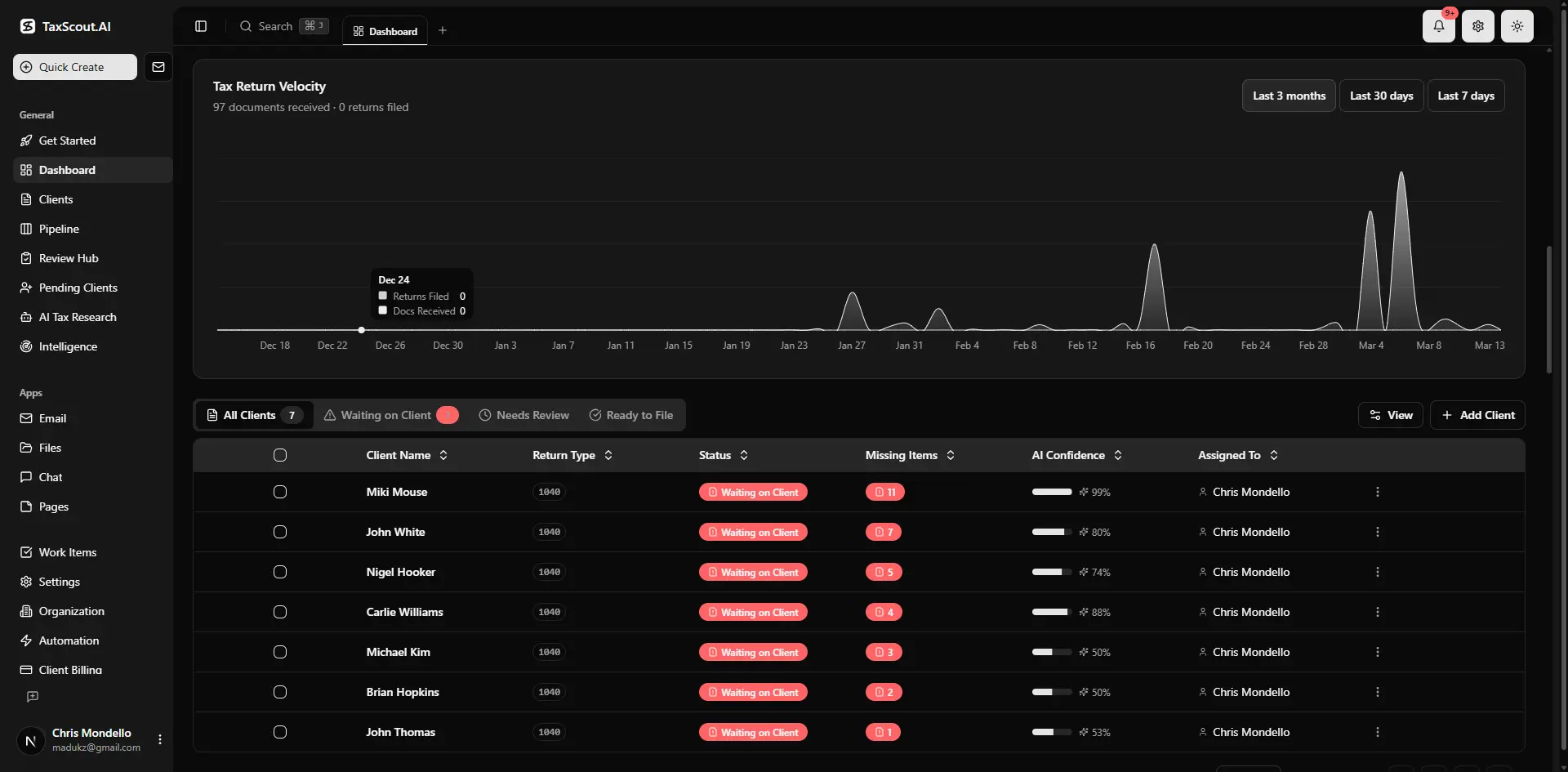
Real-time dashboard showing returns in progress, revenue, and upcoming deadlines

Smart intake auto-fills from uploaded documents and prior-year data
Documentation That Survives an IRS Examination
The IRS Large Business and International division has published examination guidance making Section 263A computations an active audit focus for manufacturers and resellers with inventory above $1 million. The IRS Audit Technique Guide for the Retail Industry and companion manufacturing guides identify the absorption ratio as a primary adjustment target because errors in cost categorization compound across years through the beginning-inventory rollover mechanism.
Examination-quality documentation has three components. First, a cost categorization schedule that maps every general ledger account to one of three categories: already capitalized, additional Section 263A cost, or excluded cost. This schedule must be prepared from the actual chart of accounts, not from a prior-year template that may no longer match the client's cost structure. Second, the absorption ratio computation showing the numerator and denominator with ties to the trial balance. Third, an ending inventory tie-out showing that the Section 263A amount per the workpaper matches the amount reported on the return and on the balance sheet.
Examiners also look for method consistency. If a client switched from the simplified production method to the simplified resale method without filing Form 3115, that is a non-consensual change that the IRS can reverse — restating every year in the statute of limitations period. CPAs should verify on intake for new clients that the method currently being used matches whatever election was made (or defaulted to) in the first year the client was subject to Section 263A. Firms that treat the uniform capitalization rules as a living compliance obligation — not a one-time setup task — are far better positioned when an examiner asks for the historical election documentation.
For clients represented by the CPA in examination, the AI research agents in TaxScout.ai can pull the current version of the relevant Treasury regulations, any active IRS notices affecting Section 263A, and relevant Tax Court cases on the cost-categorization question in real time — so the position paper is built on current law rather than a regulation printout from three years ago. This is especially valuable given that the IRS periodically updates examination priority guidance that affects how agents approach UNICAP reviews.
Managing UNICAP computations across 20 manufacturing clients in one busy season?
TaxScout.ai gives your firm unlimited team members, AI-powered document extraction, and client-context memory — so every Section 263A workpaper is built on the right prior-year data from day one.
Frequently Asked Questions
For tax years beginning in 2024, taxpayers with average annual gross receipts of $30 million or less (indexed for inflation from the TCJA base of $29 million) are exempt from the uniform capitalization rules under Section 263A. The threshold is measured over the three preceding taxable years, and the exemption is not available to tax shelters regardless of gross receipts. CPAs should retest the threshold annually because crossing it mid-growth triggers a mandatory Form 3115 accounting method change.
Keep reading
Non-Applicability of Section 357(c) to Consolidated Groups: What CPA Firms Must Do Now
Oct 17, 2026 · 1 min read
Reasonable Basis Defense: How CPAs Shield Clients From Accuracy-Related Penalties
Oct 17, 2026 · 1 min read
Tangible Property Regulations: How CPAs Apply Capitalization vs Expensing Rules
Oct 15, 2026 · 1 min read
Stay up to date
Get the latest tax tech insights delivered to your inbox.