Accounting Firm Marketing: 7 Strategies That Actually Win Clients in 2026
Most CPA firm owners treat marketing as a someday project — and lose ideal clients to competitors in the meantime. Accounting firm marketing in 2026 is less about campaigns and more about how professional your systems look to a prospect comparing three firms on a Tuesday afternoon. This guide…
Most CPA firm owners approach accounting firm marketing the wrong way. They picture a separate budget line, a website refresh, maybe a LinkedIn post — tasks that belong to "someday when things slow down." But things never slow down. And while you're waiting for a slow season to build a marketing plan, your next ten ideal clients are signing engagement letters with the firm down the street.
Accounting firm marketing in 2026 doesn't have to be a separate discipline. The most effective growth strategies for CPA firms aren't happening in marketing meetings — they're embedded in operations: how you onboard clients, how you communicate, how you follow up, and how professional your systems look to a prospective client evaluating three firms on a Tuesday afternoon.
This guide covers seven strategies that work specifically for CPA firms, bookkeepers, and solo practitioners in 2026 — with an emphasis on building systems that generate clients without requiring you to become a part-time marketer. Think of it as accounting firm marketing designed around your constraints — not a Fortune 500 playbook scaled down.
Why Traditional Accounting Firm Marketing Advice Fails CPAs
Most marketing advice for accountants is borrowed from generic small business playbooks: "build a website," "post on social media," "ask for referrals." That advice isn't wrong — it's just incomplete, and it ignores the specific dynamics of the tax and accounting profession. Effective accounting firm marketing has to account for long sales cycles, seasonal demand peaks, and the reality that most clients come from a 20-mile radius.
CPA firms face three marketing challenges that general advice misses:
Trust is the primary buying criterion. Clients aren't choosing based on price or even expertise — they're choosing based on how safe they feel handing over their SSN and financial history. Every marketing touchpoint either builds or erodes that trust. That's why the most effective accounting firm marketing doesn't lead with features or fees — it leads with credibility signals that make the decision feel low-risk.
Buying cycles are long and seasonal. A business owner researching CPAs in September isn't hiring until January. Most marketing systems aren't built for 90-day nurture cycles with a hard deadline.
Referrals are dominant but fragile. The AICPA consistently finds that referrals are the #1 source of new clients for small CPA firms — but referral volume is uncontrollable and unpredictable. Firms that depend entirely on referrals plateau.
The firms growing fastest in 2026 aren't spending more on accounting firm marketing. They're building operational systems that generate marketing outcomes automatically — and they're winning niches their generalist competitors can't compete in.
Strategy 1: Pick a Niche — It's the Highest-ROI Marketing Decision You'll Make
Tired of manual workflows slowing your firm down? See how TaxScout handles this with AI-powered automation. → Book a 15-Min Demo
The single most powerful thing a small CPA firm can do for accounting firm marketing is specialize. Not because it sounds sophisticated, but because it changes your economics entirely.
A generalist firm competing for "small business tax clients" is fighting every CPA in their metro area. A firm that specializes in e-commerce sellers, real estate investors, medical practices, or restaurant groups competes in a much smaller pool — and commands higher fees because of it.
Niche positioning works in accounting firm marketing for a specific reason: clients in every vertical talk to each other. One real estate investor client who gets excellent cost segregation analysis refers three others. One restaurant group that gets clean sales tax nexus work sends you their franchisor contact. This is referral velocity — the same referral mechanism, but turbocharged because your clients run in the same circles.
Practical niche selection criteria for 2026:
- Do you have 3+ existing clients in this vertical already?
- Is there an association, forum, or conference where these clients gather?
- Do the compliance needs in this vertical recur annually (creating long-term relationships)?
- Are there specific tax issues in this niche (QBI, cost segregation, R&D credits, multi-state nexus) that create differentiated value?
Choose one niche. Build your website, content, and LinkedIn around it. The fear that you'll turn away clients is almost always unfounded — generalist clients still hire specialists.

Your clients see your brand — OTP login, document upload, and real-time status
Strategy 2: Your Website Has One Job — Convert Skeptical Professionals
Most CPA firm websites were built to look credible, not to convert. They list services, show team photos, and end with a contact form nobody fills out.
A website that converts for accounting firm marketing does three things differently:
It speaks to a specific client type. "We help e-commerce businesses navigate multi-state sales tax nexus and annual bookkeeping" converts better than "Full-service accounting for businesses of all sizes."
It shows social proof in context. Not just generic testimonials — testimonials from recognizable client types. "As a real estate investor with 12 properties, I needed a CPA who understood depreciation recapture" tells the next real estate investor prospect exactly what they need to hear.
It lowers the barrier to the first step. Don't make the first CTA "Schedule a consultation." Offer something lower-commitment: a free tax strategy checklist for your niche, a short video explaining their most common tax issue, or a transparent pricing page. Transparency about pricing is rare in accounting — and it builds immediate trust.
If your website doesn't have a clear niche statement above the fold, a specific CTA beyond a contact form, and at least one piece of useful content (not a generic FAQ), it's costing you clients every week.
Strategy 3: Content Marketing for CPA Firms — The Long Game That Pays Off
Content marketing generates the highest long-term ROI of any digital channel for accounting firm marketing — and almost no small accounting firms are doing it consistently.
The reason is simple math: someone searching "do I need a CPA for my Airbnb income" or "S corp election deadline for LLC" is already in buying intent. If you've written a clear, useful article on that topic, you get the click, you demonstrate expertise, and you're in the conversation before they've talked to any competitor.
The IRS's own published guidance generates millions of visits because small business owners are actively searching for answers to tax questions. A CPA firm investing in accounting firm marketing through content can own the informational layer directly above those searches.
Effective content marketing for a CPA firm doesn't require publishing daily. It requires publishing strategically:
- One foundational guide per niche topic per quarter (e.g., "S Corp Election: When and How to File" — we've covered this in detail in our S Corp election guide)
- Deadline-driven posts that get annual search traffic (e.g., "Texas Franchise Tax 2026 Filing Guide" — see our Texas Franchise Tax CPA guide for a format template)
- FAQ-style posts that answer specific niche questions your clients ask regularly
Six high-quality, well-optimized posts per year outperform 52 generic weekly posts. Focus on depth and specificity over frequency.
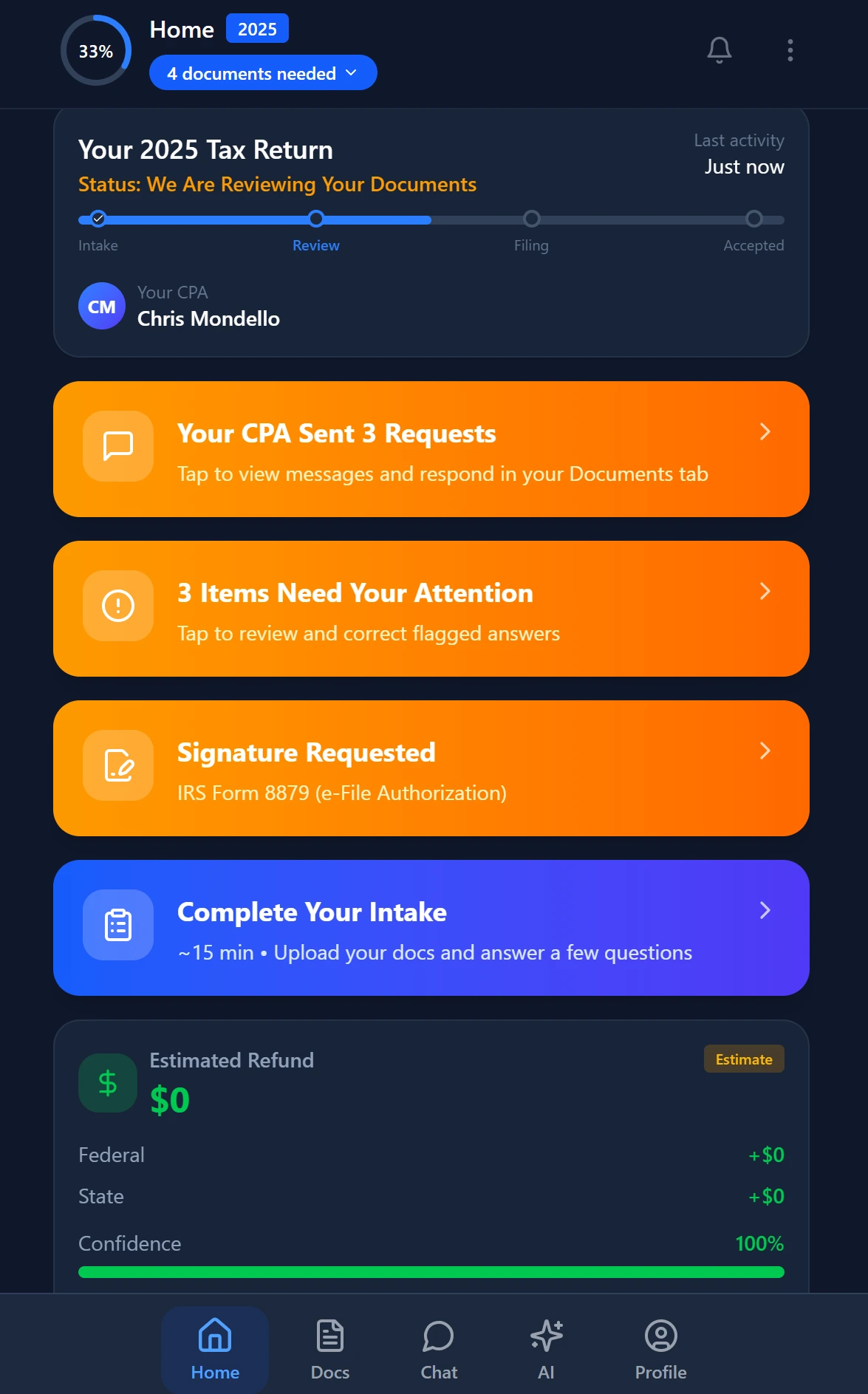
Smart intake auto-fills from uploaded documents and prior-year data
Strategy 4: AI-Assisted Outreach — Personalized at Scale
Cold outreach for CPA firms has historically been low-ROI because it's either generic (mass email) or unsustainably manual (individualized LinkedIn messages). AI changes this equation.
In 2026, accounting firm marketing strategies include AI-assisted outreach that falls somewhere between generic and fully manual. The model works like this:
- Build a targeted list. Use LinkedIn Sales Navigator, local business databases, or niche directories (e.g., Airbnb host communities, e-commerce seller forums, local restaurant association members) to identify 50-100 ideal prospects.
- Research each prospect using AI. Tools like ChatGPT can analyze a company's public LinkedIn, website, or press releases to identify specific pain points — recent growth, new state operations, change in entity structure — and draft a personalized first line.
- Send a sequenced, value-first email. Not a pitch. Something like: "I noticed [Company] expanded to Texas last year — wanted to share a quick note about the franchise tax margin calculation that catches most new entrants off guard." Include one useful piece of content. No ask.
- Follow up twice, then stop. Most conversions happen on the second touchpoint. Three-email sequences with a genuine offer of value have 40-60% open rates in B2B professional services.
The goal isn't volume. It's a handful of highly targeted outreach sequences per quarter that land in the exact right inbox at the right time.
Finding document chaos is slowing down client acquisition too? See how TaxScout handles automated intake, client communication, and onboarding in one system. → Book a 15-Min Demo — See It Live
Strategy 5: Your Client Portal Is a Marketing Asset — Treat It That Way
Here's the accounting firm marketing insight nobody talks about: your client portal isn't just an operational tool. For a prospective client evaluating two firms, it's one of the most powerful trust signals you can show.
Imagine you're a business owner who just had a frustrating experience with your current CPA — documents exchanged via email, invoices showing up inconsistently, no clear view of where things stand. You're evaluating two new firms. One sends a PDF engagement letter. The other invites you into a branded client portal with your firm's logo, a clear intake form, OTP login (no account creation required), and a visible document checklist.
The second firm won before they said a word about their qualifications.
TaxScout's client portal is built specifically for this conversion dynamic. It's branded with your firm's identity, accessible with a simple one-time code via email — no passwords, no app install — and it guides clients through document submission with smart intake that auto-fills from prior-year data and uploaded documents. As we explored in Client Portal Accounting Clients Will Actually Use, the design choices that drive adoption are the same ones that make a strong first impression on prospects.
For accounting firm marketing, the rule is: every client-facing touchpoint is a marketing moment. Make them professional.
Strategy 6: Onboarding as Retention Marketing — The System That Keeps Clients
Acquisition is expensive. Retention is cheap. Most CPA firms focus almost entirely on acquisition marketing and underinvest in the operational systems that keep clients renewing year after year.
The first 90 days of a client relationship are the highest-churn risk window. Clients who have a confusing or frustrating onboarding experience — unclear expectations, document requests scattered across email threads, invoices that appear before the work feels done — leave after year one at a much higher rate.
A structured onboarding system is retention marketing, and it's one of the most overlooked elements of accounting firm marketing. Here's how it works operationally:
Week 1: Frictionless document collection. Smart intake that pre-populates from prior-year data means clients don't answer the same questions they answered last year. TaxScout's intake engine, modeled on IRS Form 13614-C, uses a 4-layer prefill system — document-first, prior-year, profile, and AI gap analysis — so clients experience a system that already knows them.
Week 2: Transparent status visibility. Clients who can see where their return is in your pipeline don't call to ask. The 12-stage pipeline in TaxScout auto-advances when conditions are met, so clients get status updates without your staff manually communicating them.
Week 3+: Clean billing with no surprises. Invoices delivered through the portal with Stripe-powered payment (credit card and ACH), automated reminders, and clear fee breakdowns remove the friction that causes clients to question the relationship.
As we detailed in Client Onboarding Accounting Firm Checklist Guide, firms that systematize onboarding see materially higher year-2 retention — and retention directly reduces the marketing spend required to maintain revenue.
Strategy 7: Referral Systems — Making Word-of-Mouth Mechanical
Referrals are already your #1 client source. The question is whether you're leaving referral volume on the table by treating it as passive. A deliberate referral program is one of the highest-leverage investments in accounting firm marketing you can make.
A structured referral program for a CPA firm has three components:
1. Timing. Ask for referrals at peak satisfaction moments — right after delivering a clean return, right after saving a client money on a tax strategy, right after resolving a complicated issue. Not annually in a mass email.
2. Specificity. "If you know anyone who needs a CPA" generates less than "Do you know any other real estate investors who have LLCs in multiple states? That's exactly the situation we help." Specificity triggers specific people in the referrer's network.
3. Reciprocity. For professional referral partners (attorneys, financial advisors, mortgage brokers), give before you ask. Send one useful piece of content per quarter. Make one introduction. Referral relationships that are one-directional atrophy quickly.
For a full framework on building a referral program that runs on its own, see our detailed accounting firm referral program guide.
The Operational Stack That Makes All Seven Strategies Work
Every strategy in this article is more effective with a practice management platform that reduces friction for both your team and your clients. Here's how TaxScout pricing compares to running disparate tools:
| Marketing Function | Without TaxScout | With TaxScout |
|---|---|---|
| Client first impression | Email thread + PDF forms | Branded portal with OTP login |
| Intake experience | Manual questionnaires | Smart intake with 4-layer prefill |
| Document collection | Email + Dropbox | Secure portal with AI extraction |
| Status communication | Manual emails | Auto-advancing 12-stage pipeline |
| E-signatures | Separate DocuSign account | Built-in via Documenso |
| Billing | Separate invoicing tool | Stripe-integrated portal billing |
| Referral timing signals | Gut instinct | Pipeline stage visibility |
TaxScout Prep Starter starts at $49/month flat — not per user. A 5-person team using TaxDome pays approximately $500/month. That $450/month difference funds your accounting firm marketing, outreach tools, and niche positioning work.
How to Attract Accounting Clients in 2026: A Realistic 90-Day Plan
Days 1-30: Pick your niche, update your website's headline to reflect it, and identify 50 prospects in that niche using LinkedIn.
Days 31-60: Write one foundational piece of content for your niche (deadline-driven, specific, 1,500+ words). Set up your client portal so the first impression of your firm is professional and frictionless.
Days 61-90: Launch a 3-email outreach sequence to your 50 prospects using AI-assisted personalization. Ask 5 current clients for referrals using niche-specific language. Measure which strategy generated the first conversation.
None of these steps require a marketing hire. They require a half-day each, a clear niche, and operational systems that don't embarrass you when a prospect looks under the hood.
Ready to Turn Your Operations Into a Marketing Engine?
TaxScout gives your firm a branded client portal, automated intake, pipeline visibility, and billing in one platform — for $49/month flat, no per-user fees. → Book a 15-Min Demo
Frequently Asked Questions
Solo practitioners see the strongest results from systems-based marketing rather than active outreach campaigns. Specifically, automating client onboarding communications, requesting reviews at the right moment in the client journey, and ensuring your proposal and engagement letter process looks professional. TaxScout's client portal and automated follow-up workflows help solo CPAs present like a larger firm, which research shows increases close rates on initial consultations by reducing the 'will they be reliable?' hesitation prospective clients have when evaluating a one-person shop.
Keep reading
CPA Firm Website That Wins Clients: What to Build Before You Hand Out Business Cards
Sep 18, 2026 · 1 min read
AEO for CPA Firms: How to Get AI Search to Recommend Your Practice
Sep 9, 2026 · 1 min read
Big 4 to Small Firm Transition: How CPAs Rebuild Their Practice Identity and Client Base
Jul 22, 2026 · 1 min read
Stay up to date
Get the latest tax tech insights delivered to your inbox.