S Corp Election Guide: When and How to File
Your clients on Schedule C may be overpaying self-employment tax by thousands each year — and a timely S-corp election can change that. This guide gives CPAs a clear decision-making framework for when to recommend the election, how to file it correctly, and how to build it into a scalable advisory…
Your client's Schedule C shows $180,000 in net profit. They're paying self-employment tax on every dollar. You file the return, collect your fee, and move on — but you just left $8,000 to $12,000 in annual tax savings on the table. Multiply that across 40 similar clients in your book of business, and you've walked past half a million dollars in client value without a single advisory conversation. The s corp election guide most CPAs need isn't a consumer explainer — it's a decision-making framework for when to recommend it, how to file it, and how to build it into a repeatable advisory service.
Why the S-Corp Election Conversation Belongs in Every CPA's Advisory Toolkit
The S-corporation election under IRC Section 1362 is one of the most powerful tax-reduction tools available to small business owners — and one of the most consistently under-recommended by CPA firms that are buried in compliance work. The mechanics are well-known: an S-corp pays the shareholder-employee a reasonable salary subject to FICA, while distributing remaining profits free of self-employment tax. At the right income level, the savings are material. Any reliable s corp election guide starts by acknowledging this gap between the election's potential and how rarely it gets proactively surfaced.
What's less well-documented is the decision framework CPAs should use to identify candidates, quantify the benefit, handle the Form 2553 mechanics, and convert the recommendation into a recurring advisory engagement. That's what this guide covers. Think of what follows as a practical s corp election guide built specifically for advisors who need a repeatable process, not just a conceptual overview.
The Income Threshold Analysis: When to Elect S-Corp Status
The S-corp election produces savings by converting net business profit from self-employment income (15.3% SE tax on the first $176,100 in 2025, 2.9% above that) into distributions not subject to FICA. But the election carries real costs: payroll administration, state minimum taxes or franchise fees, additional compliance filings, and the reasonable compensation requirement. The net benefit has to exceed those costs. A well-structured s corp election guide has to weigh both sides of that ledger before a recommendation reaches the client.
The general threshold framework CPAs use:
| Net Profit Range | SE Tax Exposure | Typical Annual Savings | Election Recommended? |
|---|---|---|---|
| Under $40,000 | ~$5,600 | Minimal after costs | Rarely |
| $40,000–$60,000 | $5,600–$8,500 | Marginal | Situational |
| $60,000–$80,000 | $8,500–$11,300 | $3,000–$6,000 net | Often yes |
| $80,000–$150,000 | $11,300–$21,000 | $6,000–$14,000 net | Strong candidate |
| $150,000+ | $21,000+ | $12,000–$20,000+ net | High priority |
These numbers shift based on state. In Texas, there's no state income tax, so the federal SE tax savings are unencumbered. In California, however, S-corps pay a 1.5% franchise tax (minimum $800), and the California Franchise Tax Board imposes specific filing requirements that can reduce net benefit for lower-income clients. (For a deeper look at how California's rules affect advisory recommendations, see California Tax Changes 2026 CPAs Must Know.)
Beyond the number: qualifying factors
Income threshold is a starting filter, not the whole analysis. Before recommending an S-corp election, also evaluate:
- Profit stability: Volatile income makes reasonable compensation calculations difficult and increases audit risk
- State nexus and filing obligations: Multi-state businesses add complexity that may outweigh savings
- Owner's basis in current entity: LLC members converting to S-corp need basis analysis
- Existing payroll infrastructure: A client already running payroll absorbs less incremental cost
- Health insurance treatment: Shareholder-employee health insurance has specific deductibility rules under IRC Section 162(l) that affect the true savings calculation
- Exit planning horizon: If the client plans to sell in 2–3 years, the entity structure has M&A implications
Tired of manually identifying which clients qualify for an S-corp election every tax season? See how TaxScout's AI research agents can surface advisory opportunities across your entire client base automatically. → Book a 15-Min Demo — See It Live
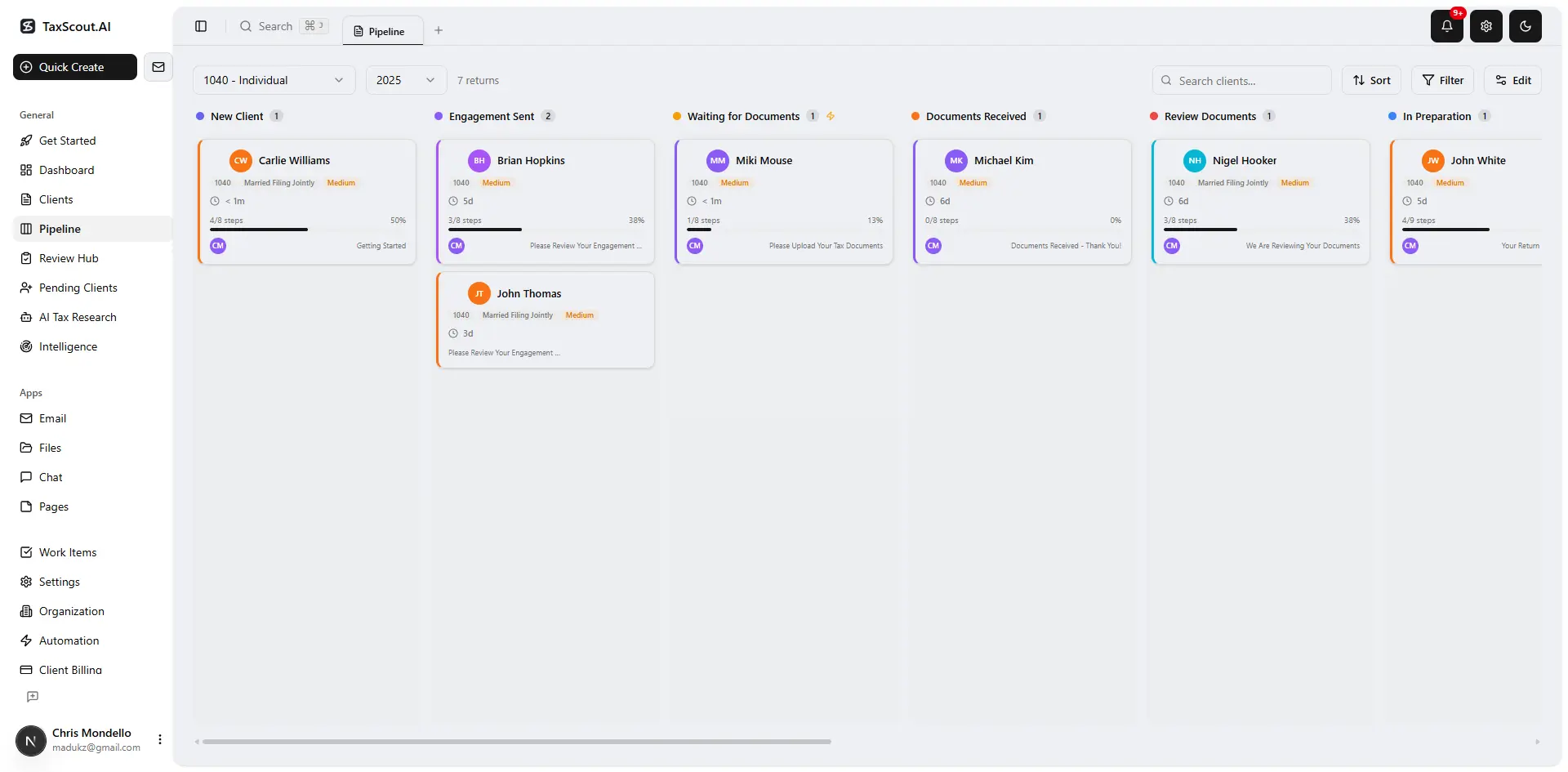
Track every return from intake to filed with drag-and-drop pipeline management
Reasonable Compensation: The Number That Makes or Breaks the Election
The IRS requires S-corp shareholder-employees to pay themselves a "reasonable salary" before taking distributions. Getting this wrong is the #1 audit trigger for S-corps. Too low, and the IRS reclassifies distributions as wages, assessing back taxes, penalties, and interest. Too high, and you've eliminated the tax advantage. Every s corp election guide worth following emphasizes that reasonable compensation documentation is not optional — it's the foundation of a defensible election.
The compensation determination methods CPAs rely on:
- IRS position: Wages comparable to what the corporation would pay a non-shareholder employee performing the same services
- Industry data: BLS Occupational Employment Statistics, industry salary surveys, Robert Half salary guides
- Revenue-based heuristics: Many practitioners use 40–60% of net profit as salary when no better industry benchmark exists, but this is a starting point, not a safe harbor
- Functional analysis: Document the actual hours worked, skills required, and market rates — this documentation file protects the client in an examination
Documentation standard: Your workpapers should include the data source used, the comparable range identified, the final salary selected, and the rationale for any variance from the midpoint. This isn't just compliance practice — it's the file that keeps your client out of trouble three years from now.
Form 2553 Filing Mechanics and Deadlines
The IRS Form 2553 (Election by a Small Business Corporation) is the election document, and the filing mechanics have more nuance than practitioners expect. Referring to a detailed s corp election guide during this stage helps ensure nothing falls through the cracks — especially for LLC-to-S-corp conversions, which involve a two-step filing process.
The S-corp election deadline: two scenarios
Existing corporation (already formed) To be effective for the current tax year, Form 2553 must be filed by the 15th day of the third month of that tax year. For a calendar-year entity, that's March 15. Filing after March 15 applies the election to the following tax year — unless the taxpayer qualifies for late election relief.
New corporation (formed during the year) The election must be filed within 2 months and 15 days of the date the corporation first had shareholders, acquired assets, or began doing business — whichever is earliest. This is often the gotcha moment: clients who form an LLC and immediately begin operating without notifying their CPA have a shrinking window.
The 2026 S-corp election deadline for calendar-year entities: March 16, 2026 (March 15 falls on a Sunday).
LLC to S-corp election: the two-step process
An LLC electing S-corp status must file both:
- Form 8832 (Entity Classification Election) — to elect corporate tax treatment (unless the state treats the LLC as a corporation by default)
- Form 2553 — to elect S-corporation status within the corporate classification
In practice, Rev. Proc. 2013-30 allows taxpayers to file only Form 2553 when making a simultaneous check-the-box election, but the mechanics require careful attention. Many state-level filings also have separate requirements — the election with the IRS doesn't automatically update state tax classification in every jurisdiction.
Late election relief
Rev. Proc. 2013-30 provides a streamlined process for late S-corp elections when:
- The entity has reasonable cause for the late filing
- The corporation has been filing as an S-corp (or intended to)
- All shareholders consent
Late election requests go on Form 2553 itself with an explanation statement attached. This is frequently available and worth pursuing when a client missed the window — don't assume a missed deadline means a lost year of savings.
Key Form 2553 mechanics checklist:
| Item | Requirement |
|---|---|
| Part I — Corporation Information | Legal name, EIN, incorporation date, fiscal year |
| Part I — Election Date | Requested effective date of election |
| Shareholder Consent | ALL shareholders must sign — unanimous consent required |
| Eligible Shareholders | No more than 100, all must be US citizens/residents or qualifying trusts, no non-resident aliens, no corporations |
| One Class of Stock | S-corps can only have one class of stock (voting rights can vary) |
| Filing Method | Mail to IRS service center based on entity's state |
| Filing Confirmation | No automatic IRS acknowledgment — follow up with a CP261 notice |
Always confirm receipt. The IRS does not send automatic confirmations for Form 2553 — CPAs routinely follow up by calling or requesting a copy of the CP261 notice. A missing election is a multi-year problem if discovered at audit.
Make sure you've reviewed the IRS Deadlines Every CPA Must Know in 2026: The Complete Professional Compliance Guide to ensure you're tracking Form 2553 filing windows alongside your other March compliance obligations.
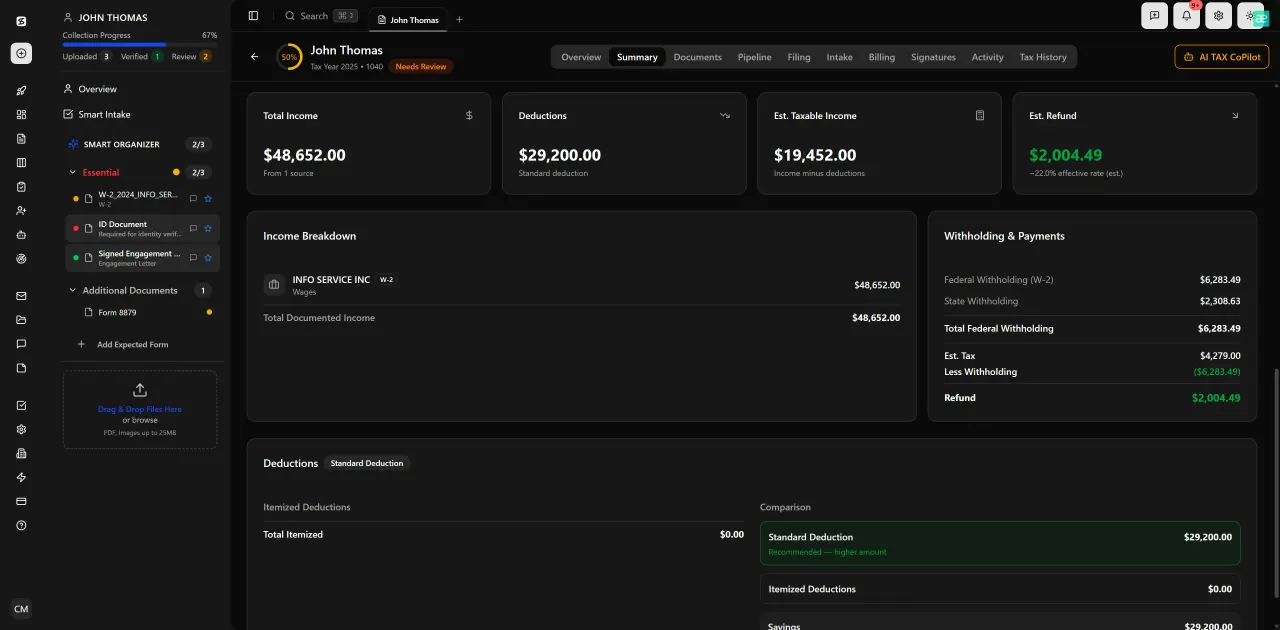
Review with AI assist — 9 agents answer questions with full client context
Estimated Quarterly Tax Payments After the S-Corp Election
Once the election is effective, the shareholder-employee's tax picture changes in ways that require recalibration of estimated quarterly tax payments. The W-2 wages will have FICA and income tax withholding, but the distribution income will not. CPAs frequently see underpayment penalties in Year 1 of an S-corp election because neither the client nor the preparer adjusted estimated payments to account for the new structure. A good s corp election guide treats this post-election recalibration as a required step, not an afterthought.
The recalibration checklist:
- Calculate expected distributions for the year
- Ensure W-2 withholding covers FICA obligations
- Model federal income tax on distributions (no withholding mechanism for S-corp distributions)
- Set Q1–Q4 Form 1040-ES payment schedule based on expected distribution income
- Confirm state estimated payment requirements — most states follow federal quarterly due dates but some have state-specific schedules
This recalibration conversation is a natural touch point for a mid-year advisory check-in — the kind of billable interaction that justifies a retainer model.
How AI-Assisted Advisory Tools Help CPAs Identify S-Corp Candidates at Scale
Here's the operational problem: the income threshold analysis described above takes 10–15 minutes per client when done manually. With 200+ clients in a typical firm, applying this filter during tax season is unrealistic. Most CPAs default to catching it opportunistically — when they happen to notice a high Schedule C while preparing the return.
TaxScout's AI research agents change this by applying advisory screening logic across your entire client base systematically, not opportunistically.
The platform's Document Intelligence and Gap Detection agents, working from extracted return data, can surface clients who:
- Have Schedule C or Schedule E (partnership/S-corp K-1) income above a defined threshold
- Are currently filing as a sole proprietor or single-member LLC with no payroll
- Have consistent multi-year profit history (using prior-year return data from client memory)
- Have not previously elected S-corp status
TaxScout's AI document extraction processes 180+ tax form types — including prior-year 1040s with all schedules — giving the system the data it needs to run this analysis without manual review. The client-context AI memory retains each client's entity structures, filing history, and prior-year data across sessions, so the advisory screening logic has longitudinal context, not just a single year's snapshot.
The result: instead of catching one S-corp candidate during return prep, you surface 15 candidates in a single advisory screening run — before the returns are filed, when the recommendation can still affect the current year. This is exactly the kind of systematic approach a well-designed s corp election guide should enable at the firm level.
Turning S-Corp Elections Into a Repeatable Advisory Service
This is where the Canopy advisory model discussed in their tax season strategy content identifies the opportunity but stops short of operationalizing it. The insight — that business-owner clients are your highest-value segment — is correct. The missing piece is the systematic process for identifying and converting them. Using this s corp election guide as the backbone of that process gives your firm a replicable framework rather than a one-off win.
A repeatable S-corp advisory service looks like this:
Step 1: Screening (January–February) Run AI-assisted screening across the client base during document collection. Flag candidates with net profit above $60,000, currently structured as sole proprietors or single-member LLCs.
Step 2: Benefit calculation (February–March) Prepare a one-page S-corp tax savings analysis for each flagged client. TaxScout's Tax Calculation agent can draft the analysis; you review and approve. This is the deliverable that opens the advisory conversation.
Step 3: Advisory conversation (February–March) Present the analysis at the return delivery meeting or via a separate strategy session. The conversation covers: estimated annual savings, election mechanics, reasonable compensation determination, payroll setup costs, and ongoing compliance obligations.
Step 4: Engagement and election filing (March) For clients who elect to proceed, file Form 2553 before the March 15/16 deadline. Bill for the advisory session and the election filing separately from the annual return.
Step 5: Ongoing retainer The S-corp creates ongoing advisory needs: quarterly payroll review, reasonable compensation annual recertification, estimated payment calibration, and annual S-corp return (Form 1120-S). Package these into a monthly retainer — the election recommendation just created a year-round client relationship.
For more on structuring this model profitably, see CPA Advisory Services Pricing: A Practical Guide and Boost CPA Firm Revenue Growth Without Adding Headcount.
From a practice management perspective, TaxScout's pipeline management — with 12 customizable stages from New Client to Filed — can include a dedicated S-corp advisory workflow stage, ensuring no candidate identified during screening falls through the cracks before March 15.
The billing math: If 15 clients proceed with S-corp elections, each at a $500 advisory fee plus $300 election filing, that's $12,000 in incremental revenue before accounting for the ongoing retainer work. At a $200/month retainer for quarterly compliance and annual recertification, those 15 clients add $36,000 in annual recurring revenue. The AI screening that surfaced them costs a fraction of that.
Ready to Build an S-Corp Advisory Practice?
TaxScout gives your firm AI-assisted client screening, research agents, and practice management infrastructure to identify S-corp candidates at scale and deliver the advisory conversations — for $49/mo flat. → Book a 15-Min Demo
Frequently Asked Questions
Most CPAs use $80,000–$100,000 in net profit as the minimum threshold for recommending an S-corp election. Below that level, the administrative costs of payroll, a separate business return (Form 1120-S), and state fees often erode the self-employment tax savings. At $180,000 in net profit, the annual SE tax savings typically range from $8,000 to $12,000, making the election highly beneficial. TaxScout's S-corp suitability analyzer runs this breakeven calculation automatically, factoring in the client's state, reasonable compensation benchmarks, and estimated compliance costs, so CPAs can present a documented recommendation in minutes rather than building the model manually.
Keep reading
Backdoor Roth IRA: How CPAs Execute the Strategy Without Triggering Pro-Rata Tax
Oct 12, 2026 · 1 min read
Transparency in Coverage Final Rules: What CPA Firms Must Do Now
Oct 12, 2026 · 1 min read
Late Filing Penalty Relief: How CPAs Reduce or Eliminate IRS Failure-to-File Charges
Oct 12, 2026 · 1 min read
Stay up to date
Get the latest tax tech insights delivered to your inbox.