Accounting Firm Proposals: How to Win Clients Before the First Meeting
Most CPA firms lose engagements not on price — but because their proposals fail to convert. This guide breaks down exactly how to structure, price, and follow up on accounting firm proposals that win clients before the first invoice is sent. Discover how AI-native practice management is closing…
A prospect emails your firm on a Tuesday afternoon asking about tax preparation services. You respond within the hour, hop on a discovery call Friday, and then spend Sunday night assembling a Word document with your fees, scope, and a few bullet points about your credentials. You email it Monday morning. You hear nothing back. By Thursday you follow up. They politely tell you they went with another firm. What you're describing is the reality most accounting firm proposals face: a rushed, reactive process that undersells your expertise before the conversation even begins.
The work you lost wasn't lost on price. It was lost because accounting firm proposals are a conversion asset — and most CPA firms treat them like an afterthought.
This guide walks through exactly how to structure, price, and follow up on proposals that win engagements before the first invoice is ever sent — and how AI-native practice management is collapsing the gap between "I'm interested" and "I'm a client." Whether you're sending five or fifty accounting firm proposals a month, the principles here apply regardless of your firm's size or specialty.
Why Accounting Firm Proposals Lose More Business Than CPAs Realize
The Bureau of Labor Statistics Occupational Outlook for Accountants and Auditors projects continued demand for accounting services — which means competition for the ideal client is intensifying, not easing. Prospects who contact your firm almost certainly contact two or three others at the same time. For firms evaluating their accounting firm proposals approach, this trade-off compounds over time.
In that environment, your accounting firm proposals aren't just a price list. They are the first real deliverable you produce for a prospective client. They signal your responsiveness, your organization, your fee philosophy, and your ability to explain complex services in plain terms.
The data inside most CPA firms tells a bleak story: informal proposals sent as plain email, no consistent template, pricing presented as a single number with no context, no documented follow-up sequence, and zero connection between the proposal and the engagement letter. The result is a win rate that hovers somewhere between 30% and 50% for qualified prospects — when it could easily be 65% to 80% with the right structure and timing. Each of these factors directly shapes how accounting firm proposals plays out in practice.
Three specific failure modes account for most lost proposals:
Delay. Research published by the Harvard Business Review found that leads contacted within an hour are 7 times more likely to qualify. CPA firms that take two to four days to send a proposal are competing with firms that sent one same-day. Understanding accounting firm proposals in this context is what separates firms that scale from those that stall.
Ambiguity on scope. When a prospect doesn't understand what they're buying, price becomes the only decision variable. Proposals that define scope clearly — what's included, what's excluded, what triggers a change order — convert at significantly higher rates. This is precisely where a deliberate accounting firm proposals strategy pays off.
No follow-up cadence. Most CPA firm proposals get one follow-up email, sent too late. After that, silence. The prospect reads this as indifference. Accounting firm proposals sits at the center of this decision — get it wrong and the rest unravels.
Tired of assembling proposals manually every time a new prospect reaches out? See how TaxScout auto-generates proposals from intake data and moves accepted engagements directly into your onboarding workflow. → Book a 15-Min Demo — See It Live
The CPA Proposal Template That Converts
A winning engagement proposal for a CPA firm has seven sections. Each one does specific conversion work. When firms revisit their accounting firm proposals priorities, the gaps usually surface here.
Section 1: The Situation Summary
Open with what you learned about the prospect — their entity type, filing complexity, current pain points, and goals. This section exists entirely to prove you listened. It takes thirty seconds to read and it's the section that separates you from the firm that sent a generic scope sheet.
Example: "Based on our conversation, you're operating as a two-member LLC taxed as an S corporation, currently filing in three states, and looking to move away from your previous preparer after a missed deadline last April."
Section 2: Proposed Scope of Services
Break your scope into explicit line items. For a 1040 client: federal return, state returns (by state name), Schedule C, SE optimization analysis, quarterly estimate calculations, and year-end planning call. For a business entity: the return type, associated owner returns, payroll tax review, and any K-1 preparation.
List exclusions explicitly. "This engagement does not include audit representation, FBAR preparation, or amended returns for prior periods." Exclusions prevent scope creep and demonstrate professionalism. Well-structured accounting firm proposals make this kind of clarity the norm rather than the exception.
Section 3: Your Investment
Present pricing as a range tied to complexity, not a single number. A range like "$1,800–$2,400 depending on final document volume" is more persuasive than "$2,100" because it signals flexibility without appearing arbitrary.
If you use tiered service packages — an area covered in depth in our guide to accounting firm service packaging — present the tiers side by side with a recommended tier called out. Most prospects choose the middle tier. Most prospects who see only one tier wonder what they're missing.
Section 4: Why This Firm
Keep this brief — three bullet points maximum. Lead with specific credentials relevant to the prospect's situation (S corporation experience, real estate investors, multi-state filers), not generic claims like "20 years of experience." One client result or before/after story outperforms any credential list.
Section 5: Process Overview
A four-step visual flow (Intake → Preparation → Review → Filing) reduces anxiety about what happens after they say yes. CPAs underestimate how much prospect anxiety is about process uncertainty, not price. Showing the road ahead closes that gap.
Section 6: Terms and Validity Window
Include your payment terms, retainer requirement if any, and a clear proposal expiration date. "This proposal is valid through [date + 7 days]" creates urgency without pressure tactics. It also gives you a clean reason to follow up.
Section 7: Clear Next Step
One call to action: "Click here to accept and begin onboarding" or "Reply to this email to confirm and I'll send your engagement letter within 24 hours." Proposals that end with "please let me know if you have questions" convert at roughly half the rate of proposals with a single next-step instruction.

Your clients see your brand — OTP login, document upload, and real-time status
Pricing Presentation: How to Anchor, Bundle, and Protect Your Margins
The most common pricing mistake in CPA proposals is presenting your fee without context. Anchoring is a well-documented behavioral phenomenon — the Journal of Accountancy has covered value pricing for professional services extensively — and it works in proposals.
Before naming your fee, describe the problem it solves. "Multi-state S corporation returns require tracking apportionment across three jurisdictions, reconciling payroll tax obligations, and coordinating K-1 distributions to two owners. Our fee for this scope is $3,200." That framing makes $3,200 feel proportionate to the complexity you just described. Firms that build this context into their accounting firm proposals consistently protect margins better than those that lead with a number alone.
Three anchoring techniques that work in CPA proposals:
Complexity ladder. Show your fee alongside a simplified description of the work involved. Each line item on your scope list implicitly justifies a portion of the fee.
Comparison anchor. Reference the cost of the problem you're solving. "A missed state filing triggers penalties averaging $200–$500 per month. Our engagement includes proactive state deadline tracking as a standard service."
Value-per-hour reframe. If a client pushes back on a $2,400 annual fee, point out that it represents $46/week for year-round access to a licensed CPA. This reframe is especially effective for clients coming from DIY software.
This connects directly to a broader conversation about pricing models that move CPAs off hourly billing — proposals are where that transition becomes concrete and client-facing.
The Follow-Up Sequence That Wins the Engagement
Most CPA firms send one follow-up. High-converting firms run a four-touch sequence.
Day 0: Proposal delivered. Short email: "I've sent over the proposal — let me know if you'd like to walk through it together. Happy to do a 20-minute call."
Day 2: Value touchpoint. Send one relevant resource — an article about a tax issue specific to their entity type, a brief note about a recent regulatory change that affects them. This demonstrates that you were already thinking about their situation without being pushy.
Day 5: Friction-clearing check-in. "Just wanted to make sure the proposal covered everything you were looking for. If scope or pricing need adjustment, I'm happy to talk through it." This opens the door for objections to surface instead of silently killing the deal. Firms that build this step into their accounting firm proposals process recover a meaningful share of engagements that would otherwise go quiet.
Day 9 (proposal expiration day): Final touchpoint. "The proposal I sent on [date] expires today. If you'd like to move forward, I can have your engagement letter ready within 24 hours. If the timing isn't right, I completely understand and would be glad to reconnect whenever it makes sense."
This sequence converts 15–25% more proposals than a single follow-up, and it does so without being aggressive. The key is personalizing each touchpoint to something specific you know about the prospect — which is only possible if you captured that information in your initial discovery.
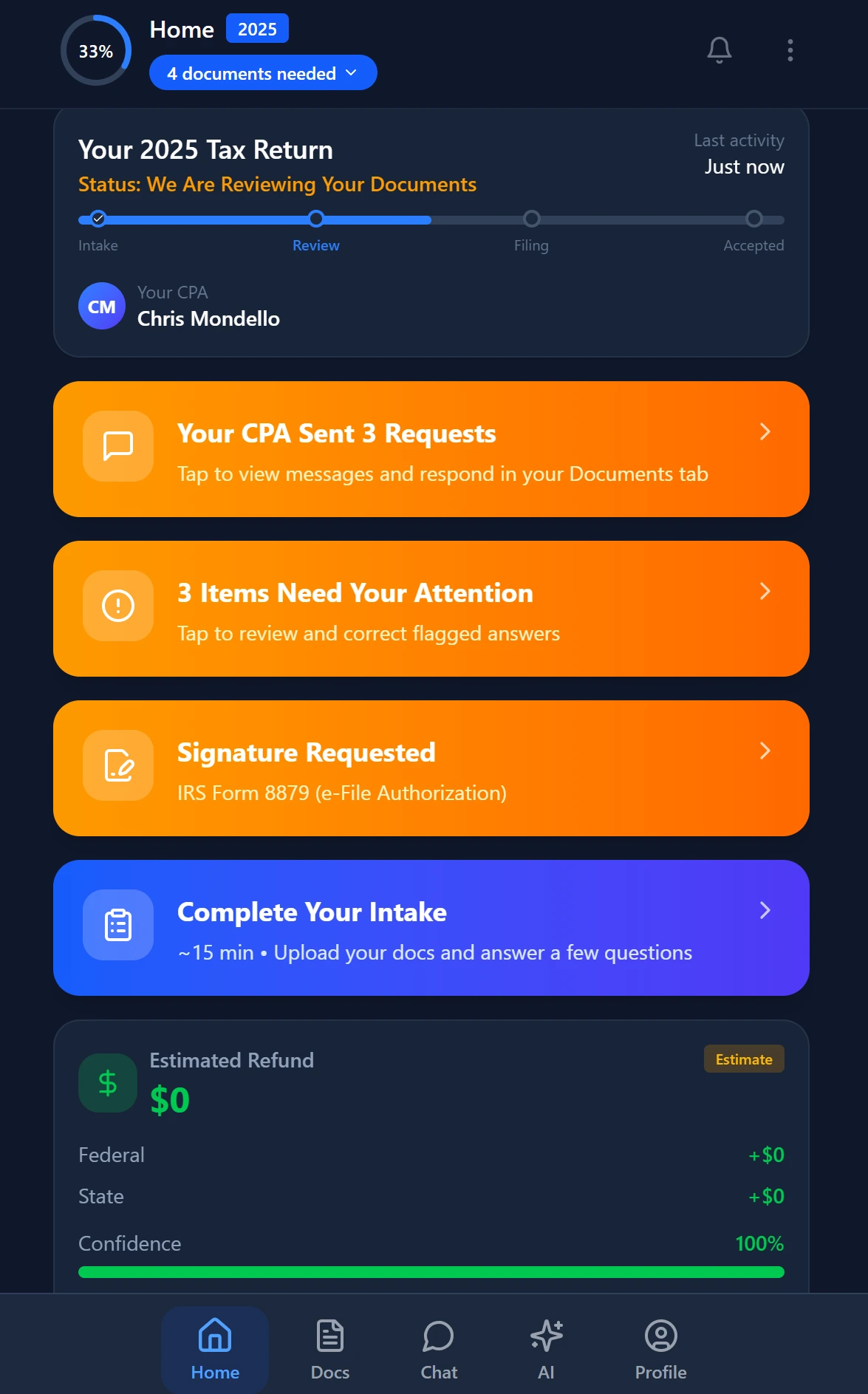
Smart intake auto-fills from uploaded documents and prior-year data
How AI Turns Intake Data Into a CPA Proposal in Minutes
The gap between "prospect expresses interest" and "proposal in their inbox" is where most firms lose deals. Manual proposal assembly — pulling together scope from notes, looking up prior-year fees, formatting a Word doc — takes 45 to 90 minutes per prospect. Across a busy season, that's a significant cost before a single client says yes. When accounting firm proposals are assembled this way, the delay itself becomes a competitive liability.
TaxScout's revenue engine and smart intake pipeline closes this gap with a direct data flow from prospect intake to proposal generation.
Here's how the workflow runs:
A prospect submits their information through your branded client portal — entity type, filing history, states, number of owners, prior-year return if available. TaxScout's AI document extraction can read their prior-year 1040 or business return, pulling entity structure, income sources, and state filing activity across 180+ tax form types. That data populates a proposal template automatically: entity type confirmed, relevant schedules identified, state returns pre-listed, prior-year preparer fee visible for benchmarking.
The proposal goes out the same day the prospect reaches out. Your team reviews and sends it — the AI does the assembly work.
Once the prospect accepts, TaxScout moves the engagement directly into pipeline management, where a 12-stage workflow advances the client from New Prospect to Active Client. The acceptance triggers your engagement letter queue through e-signatures — Form 8879 authorization, the engagement letter itself, and a W-9 if needed — all with signing order dependencies already set.
The intake data captured in the proposal phase pre-populates the tax organizer, so the client doesn't re-enter what they already told you. TaxScout's 4-layer prefill logic (document-first, prior-year data, profile data, and AI gap analysis) means your first client interaction after proposal acceptance is substantive, not administrative.
Comparison: Manual Proposals vs. AI-Assisted Proposals With TaxScout
| Capability | Manual / Word Doc Approach | TaxScout AI-Assisted Proposals |
|---|---|---|
| Proposal assembly time | 45–90 min per prospect | Under 10 min with intake prefill |
| Scope accuracy | Relies on memory / notes | Auto-populated from intake + prior return |
| Pricing consistency | Varies by who prepares it | Template-driven with complexity triggers |
| Follow-up tracking | Ad hoc or not tracked | Pipeline stage with auto-advance |
| Proposal → engagement letter | Manual handoff, 1–3 days | Same-day, triggered on acceptance |
| E-signature routing | Separate DocuSign/Adobe workflow | Native, with signing order dependencies |
| Pricing per firm | Cost of Word + DocuSign + CRM | $49/mo flat, unlimited clients |
At $49/month on the Prep Starter plan — or $149/month for Prep Pro with full automation — TaxScout replaces the patchwork of Word, email follow-up tracking, and disconnected e-signature tools that most small CPA firms currently cobble together. For context, TaxDome runs approximately $100 per user per month (~$500/month for a 5-person team) and doesn't include AI proposal generation or automated intake-to-proposal data flow.
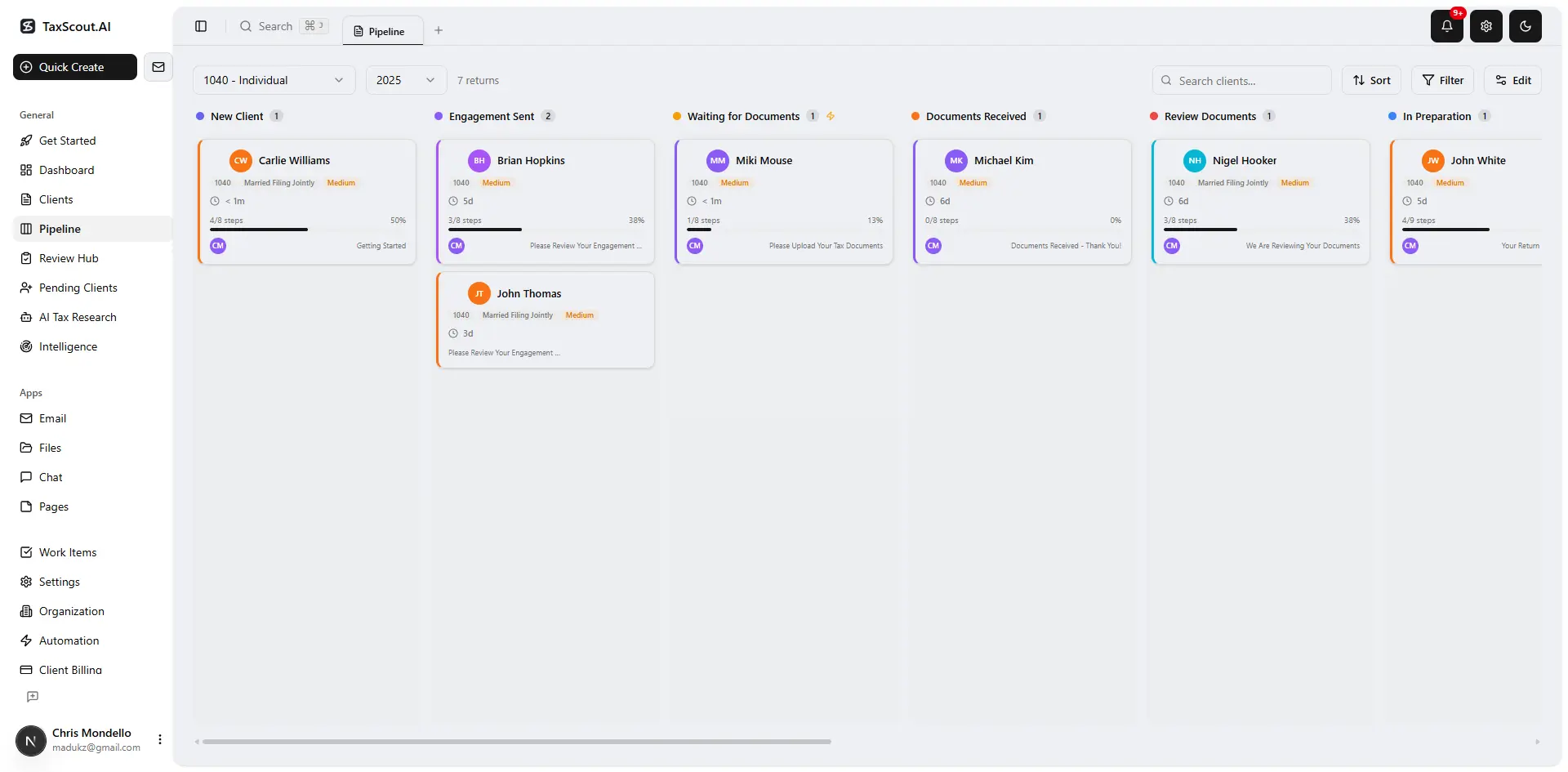
Track every return from intake to filed with drag-and-drop pipeline management
Real-World Workflow: From First Contact to Signed Engagement Letter in 48 Hours
A five-person CPA firm in Texas receives an inquiry from a real estate investor on a Monday morning. The prospect has two LLCs, files in Texas and California, has rental properties on Schedule E, and is currently using a national chain preparer.
By Monday at noon: The prospect fills out the intake form through the firm's branded client portal. They upload their prior-year 1040. TaxScout extracts the return — Schedule E rental activity, two state returns, no foreign activity — and flags that the client has rental income from 12 properties, which triggers the firm's complex-return pricing tier.
By Monday at 2 PM: The firm's lead preparer reviews the auto-generated proposal draft — scope pre-populated with federal 1040, Schedule E (12 properties), Texas franchise tax, California 540NR, and quarterly estimates. Fee range pre-filled at $3,200–$3,800 based on the firm's complexity matrix. The preparer adds a one-paragraph situation summary and sends. This is exactly the kind of efficiency that well-designed accounting firm proposals make possible at scale.
By Tuesday morning: The prospect accepts the proposal. TaxScout advances the client to the "Engagement Letter" pipeline stage. The engagement letter and Form 8879 are routed for e-signature. The prospect signs by Tuesday afternoon.
By Wednesday: The tax organizer is pre-populated from the prior-year data. The client receives a request for only the documents that are missing — not a 12-page PDF organizer asking them to restate what you already know. The client onboarding playbook picks up from here.
That's 48 hours from first contact to signed engagement. Without AI-assisted proposals, that same workflow takes five to seven business days in most firms — enough time for the prospect to sign with someone else.
You can also explore how accounting firm client acquisition strategies feed the top of this funnel. Proposal conversion is the leverage point that makes acquisition spend worth it — you can drive all the referrals and marketing you want, but if accounting firm proposals convert at 35% instead of 70%, you're leaving half your acquisition cost on the table.
Regulatory Considerations for CPA Firm Proposals
A proposal that commits to specific tax outcomes ("we will save you $X") creates liability. Keep proposal language scoped to services, not results. The IRS Circular 230 governs tax practitioner conduct, and state CPA boards add their own overlay — California's Board of Accountancy requirements and New York's Office of the Professions rules both speak to client communication standards.
Cornell Law's coverage of IRC Section 7525 on federally authorized tax practitioner privilege is also relevant context when framing advisory scope in proposals — particularly for clients with IRS exposure.
Your engagement letter, which flows from the accepted proposal, should be the document that creates the formal legal relationship. TaxScout's e-signature integration covers engagement letters, Form 8879, FBAR (FinCEN 114), W-9, and state forms — all from a single workflow, with audit-logged signing events.
Ready to send proposals that convert in 48 hours instead of 48 days? TaxScout auto-generates engagement proposals from intake data and routes accepted engagements to e-signature — all for $49/mo flat. → Book a 15-Min Demo
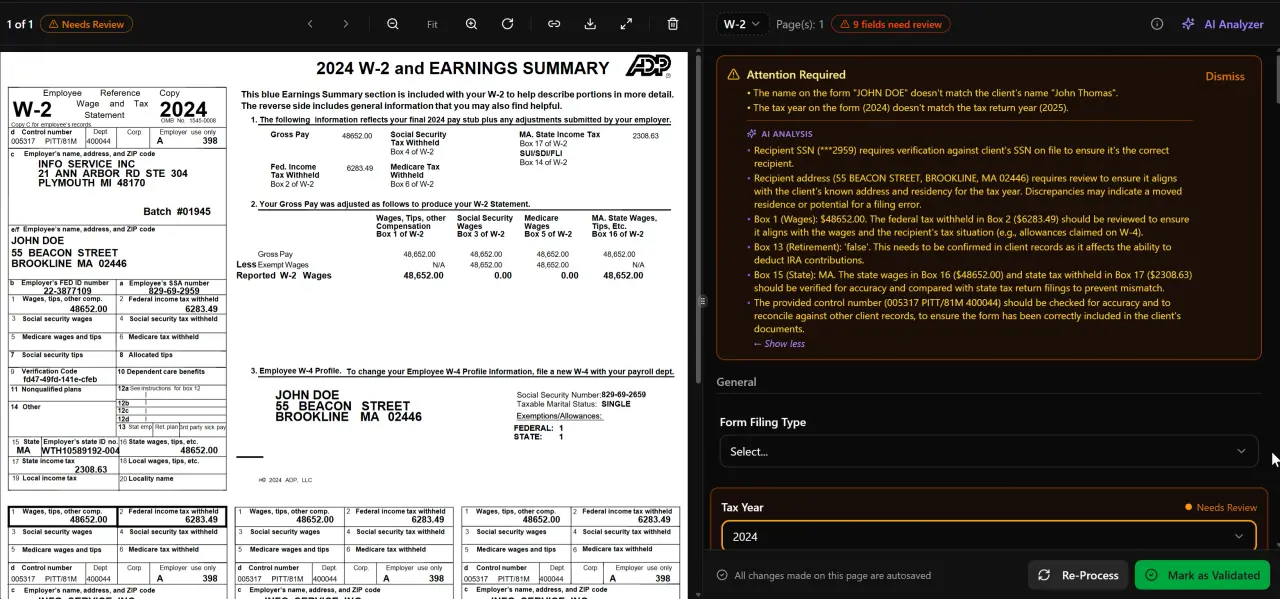
AI classifies, extracts, and validates every document automatically
Frequently Asked Questions
Prospects evaluate multiple firms simultaneously, and research suggests conversion rates drop sharply after 24 hours. TaxScout.ai auto-generates a structured proposal draft immediately after a discovery call using intake data, reducing average proposal delivery time from 2–3 days to under 2 hours. The platform pulls scope, pricing tiers, and credential highlights so CPAs review and send rather than build from scratch.
Keep reading
CPA Firm Website That Wins Clients: What to Build Before You Hand Out Business Cards
Sep 18, 2026 · 1 min read
AEO for CPA Firms: How to Get AI Search to Recommend Your Practice
Sep 9, 2026 · 1 min read
Big 4 to Small Firm Transition: How CPAs Rebuild Their Practice Identity and Client Base
Jul 22, 2026 · 1 min read
Stay up to date
Get the latest tax tech insights delivered to your inbox.