CPA Firm Niche Specialization: How to Dominate a Vertical and Charge Premium Fees
The fastest path to premium fees isn't working harder — it's becoming the undisputed CPA expert in a specific vertical. Niche specialization transforms your firm from a commodity into a sought-after authority that clients pay more to access. Discover how to choose your vertical, build deep…
Your best client — the one who never haggles on fees, refers three friends every year, and actually responds to your emails — isn't loyal to you because you're a good accountant. They're loyal because you understand their world better than anyone else. CPA firm niche specialization is the strategy that turns that dynamic from an accident into a repeatable system, and it's the fastest path to premium pricing that most generalist firms never pursue.
This isn't about turning away clients. It's about deliberately becoming the most valuable CPA in a specific vertical — real estate investors, e-commerce operators, medical practices, cannabis businesses, law firms — and charging accordingly. CPA firm niche specialization is the strategy that lets you become the most valuable CPA in a specific vertical — real estate investors, e-commerce operators, medical practices, cannabis businesses, law firms — and charge accordingly.
Why Generalist CPA Firms Leave Money on the Table
The accounting profession's default growth playbook hasn't changed in decades: hire another preparer, run some Google ads, ask for referrals. It works, slowly, until a better-positioned competitor enters your market. CPA firm niche specialization offers a more deliberate path than the accounting profession's default growth playbook, which hasn't changed in decades: hire another preparer, run some Google ads, ask for referrals — it works, slowly, until a better-positioned competitor enters your market.
Generalist firms compete on price by default. When a prospect can't distinguish your capabilities from the next firm on a Google search, the only differentiator is hourly rate or flat-fee quote. That's a race to the bottom that erodes margins every year. Without CPA firm niche specialization, generalist firms compete on price by default, because when a prospect can't distinguish your capabilities from the next firm on a Google search, the only differentiator is hourly rate or flat-fee quote — a race to the bottom that erodes margins every year.
The numbers tell the story. According to the Bureau of Labor Statistics, the median annual wage for accountants and auditors is around $79,880 — but the top 25% earn over $104,000. The gap between median and top-quartile practitioners isn't explained by working more hours. It's explained by positioning. Specialized CPAs command a 40–80% fee premium over generalists serving the same income level, because they deliver context-specific value that a generalist physically cannot replicate without hours of research. For firms evaluating their CPA firm niche specialization approach, this trade-off compounds over time.
A real estate investor doesn't want a CPA who knows the 1040. They want someone who understands cost segregation studies, the short-term rental loophole under IRC § 469, passive activity loss rules, and 1031 exchange mechanics cold — someone who can spot a depreciation recapture issue without being asked. That expertise is genuinely scarce, and scarcity commands a premium. Each of these factors directly shapes how CPA firm niche specialization plays out in practice.
The Journal of Accountancy has documented repeatedly that advisory-focused, specialized firms generate higher revenue per client and experience lower annual churn than general compliance practices. Clients who believe their CPA understands their industry switch firms far less often than clients who see their accountant as a commodity vendor. Understanding CPA firm niche specialization in this context is what separates firms that scale from those that stall.
Most CPA firms are sitting on a niche they already own — they just haven't claimed it yet. This is precisely where a deliberate CPA firm niche specialization strategy pays off.
Tired of competing on price against generalist firms who underbid every proposal? See how TaxScout equips specialized CPA firms to deliver vertical-specific expertise at scale. → Book a 15-Min Demo — See It Live CPA firm niche specialization sits at the center of this decision — get it wrong and the rest unravels.
How to Identify Your Niche Using Existing Client Data
The fastest way to find your firm's natural specialization isn't market research — it's looking at who's already paying you the most. When firms revisit their CPA firm niche specialization priorities, the gaps usually surface here.
Pull your client list, filter by revenue per engagement, and ask three questions:
1. Which industry shows up most frequently among your top 20% of clients by revenue? Clustering matters. If you have eight real estate investors, two med-spa owners, and a handful of e-commerce founders in your top tier, the real estate cluster is already a niche you're operating in. You just haven't positioned around it. Committing to CPA firm niche specialization means turning that accident into an intentional practice.
2. Where do you solve problems your peers can't? Think about the last five clients who called you with a genuinely complex issue. What was the common thread? Passive activity losses? Qualified Business Income deductions for professional service firms? Multi-state nexus for online sellers? That's where your tacit expertise already lives — and it's the seed of a fully realized CPA firm niche specialization strategy.
3. Which clients refer others who look like them? If your dentist client has sent you three other dental practice owners, that's a market signal. Referral patterns within an industry are self-reinforcing — once you're known inside a vertical's professional network, inbound leads compound without paid marketing. Our accounting firm referral program guide explores this compounding effect in detail.
Once you've identified the pattern, validate it with one external data point: search volume. Use Google Keyword Planner or Semrush to confirm that "CPA for real estate investors [your city]" or "accounting firm for medical practices [your city]" has meaningful search volume. Verticals with documented Google demand have room for a positioning play that generates inbound leads organically.

Click any extracted field to see its source highlighted on the original PDF
Building an Accounting Firm Positioning Strategy Around One Vertical
Choosing a niche is the easy part. Repositioning your firm's messaging is where most CPAs hesitate, because it feels like exclusion rather than focus. It isn't.
Vertical specialization doesn't mean turning away a dentist if you're a real estate CPA. It means your website, your service packages, your intake process, and your sales conversations are optimized for one audience. Everyone else who hires you gets the same quality work — they just arrived through a different door. Done well, CPA firm niche specialization sharpens every client-facing touchpoint without narrowing your actual capabilities.
Your positioning statement should name the industry explicitly. Compare these two homepage headlines:
- "Full-service CPA firm serving individuals and businesses in Austin, TX"
- "Tax and advisory services for Austin-area real estate investors — from first rental property to commercial portfolio"
The second version will convert at a dramatically higher rate among real estate investors searching Google, generate zero additional cost to attract other clients who find you through referrals, and immediately position you as a specialist rather than a commodity.
Your service packages should be vertical-specific. A real estate investor package might include:
- Annual tax preparation (1040 + Schedule E + depreciation schedules)
- Cost segregation study coordination
- 1031 exchange tax planning
- Entity structure review (LP vs. LLC vs. S-Corp for rental portfolios)
- Quarterly tax estimates with cash flow modeling
That's a defined scope that justifies a fixed annual fee of $3,500–$8,000 per client depending on portfolio complexity — far above what a generalist charges for the same client's 1040. Value-based pricing for CPA firms becomes achievable when you can articulate exactly what expertise you're delivering, and CPA firm niche specialization is the foundation that makes that articulation credible. Our CPA firm pricing models guide lays out the transition from hourly billing to fixed-fee value pricing in detail.
!TaxScout pipeline kanban view showing specialized vertical workflow stages for a real estate investor CPA niche practice
How AI-Native Practice Management Lets a Small Firm Compete in a Specialized Vertical
Here's where the growth math changes for small firms. A 2–3 person generalist CPA practice simply cannot compete with a 15-person regional firm on volume. But a 2–3 person specialist CPA firm absolutely can out-compete a 15-person generalist firm on quality within a single vertical — if they have the right technology infrastructure.
This is the gap most competitor articles miss entirely. They treat niche specialization as a marketing strategy, not an operational one. The firms that successfully dominate a vertical do it by building workflows that deliver consistent, high-quality service to every client in that niche without adding headcount. Effective CPA firm niche specialization depends as much on this operational foundation as it does on positioning.
AI document extraction is the foundation. TaxScout extracts data from 180+ tax form types — every W-2 variant, all 1099 forms (A through SA), K-1s for partnerships, S-Corps, and trusts, the complete 1098 series, 1095s, and 30+ supporting categories — with a 5-layer validation pipeline that catches errors before they reach a preparer's desk. For a real estate-focused firm, that means every Schedule E, depreciation schedule, K-1 from a partnership interest, and cost basis document is extracted and validated automatically, not manually keyed.
The pipeline management engine lets you build a workflow that mirrors your vertical's specific compliance calendar. A medical practice CPA has different milestones than a real estate investor CPA — different entity structures (professional corporations, MSOs, sole proprietorships), different payroll complexity, different deduction profiles. TaxScout's 12 customizable stages let you build a pipeline specific to your niche, with auto-advance triggers and loopback transitions that keep work moving without a senior CPA manually supervising every handoff.
The AI research agents are what separate a specialist from a generalist at the question-answering level. When a real estate investor client asks whether their Airbnb activity qualifies for the short-term rental exception under IRC § 469, TaxScout's 9 specialized AI research agents — including the Tax Calculation agent, Risk Assessment agent, and Filing Specialist — pull live information from IRS.gov, treasury.gov, and law.cornell.edu, not from a static database that may be 18 months stale. That's the research depth that justifies a specialist's fee premium. And because TaxScout maintains client-context AI memory across all sessions, the agents already know each client's entity structure, filing history, and prior-year returns when you ask the question.
A 3-person firm using TaxScout can realistically manage 150–300 clients within a single vertical at the Prep Starter or Prep Pro tier — $49/month or $149/month flat, with no per-user fees. Compare that to TaxDome at roughly $100/user/month (approximately $300/month for three users) or Canopy at approximately $45/user/month per module, where Smart Intake alone costs $11 per client extra. The cost differential compounds — TaxScout's flat pricing model means adding a fourth team member costs nothing extra, while every competitor's bill climbs proportionally.
!TaxScout AI research agent interface showing real-time IRS regulatory search for specialized CPA firm vertical client advisory
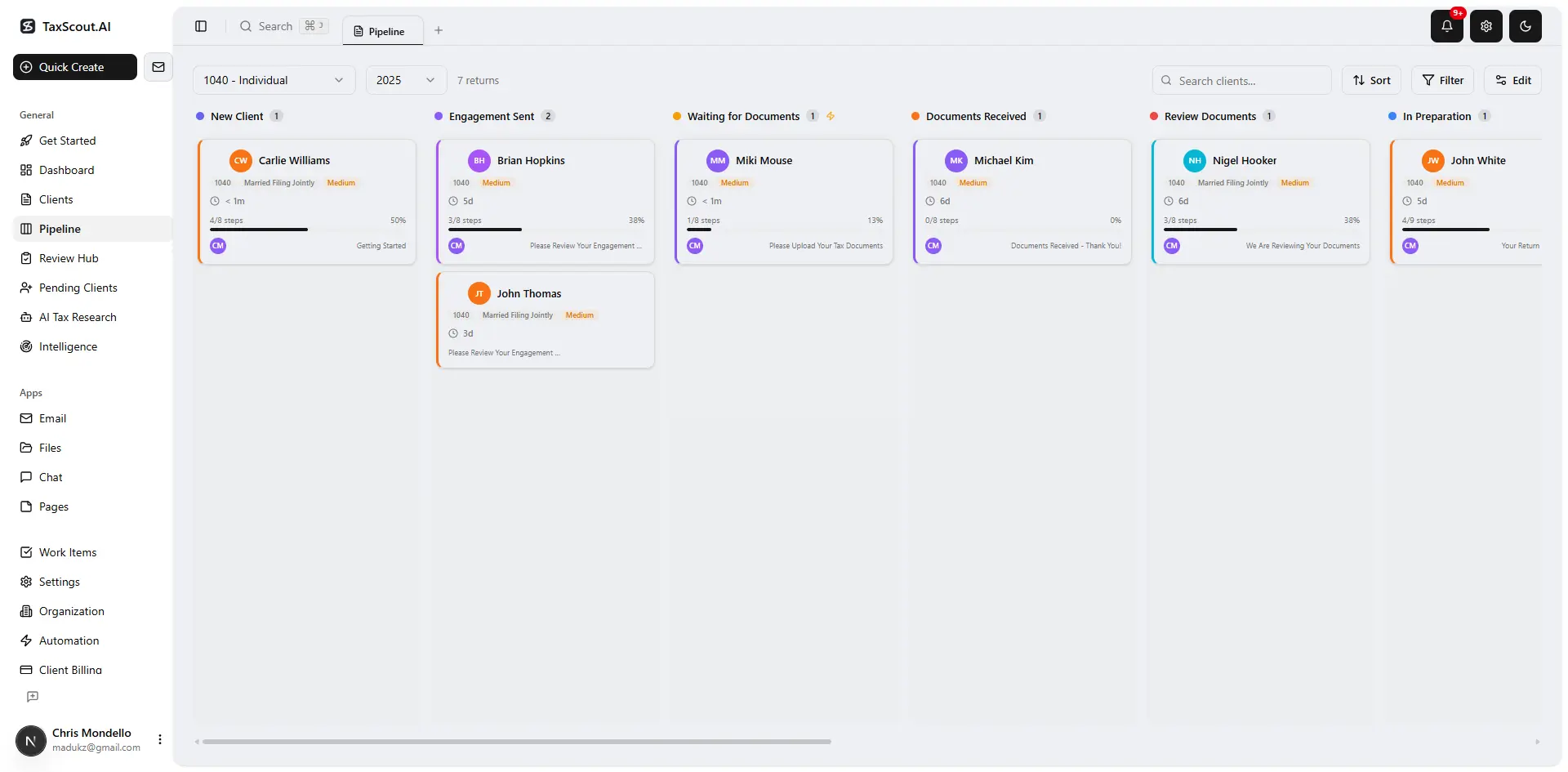
Track every return from intake to filed with drag-and-drop pipeline management
A Real-World Workflow: The E-Commerce CPA Niche
Consider a 3-person CPA firm that specializes in e-commerce brands doing $500K–$5M in annual revenue. Their typical client has multi-state sales tax nexus from marketplace facilitator sales, inventory cost accounting, deferred revenue recognition issues, and owner-operator compensation structures that mix W-2 and pass-through income. This level of vertical depth is exactly what CPA firm niche specialization looks like when it's fully operational.
Here's how TaxScout supports their specialized vertical at scale:
Intake: The smart intake engine pre-populates from prior-year return data and any uploaded documents. An e-commerce client uploads their Shopify/QuickBooks reports, 1099-K from Amazon, and business bank statements. The AI gap analysis detects that multi-state nexus is flagged based on a prior-year 1099-K showing sales in 12 states and surfaces a prioritized question about whether they've registered for sales tax in each.
Document processing: TaxScout's AI document extraction handles the 1099-K, all 1099s, W-2s for any employees, and K-1s from any partnership interests with per-field confidence scoring (0.0–1.0) and OCR cross-verification. The split-screen PDF viewer lets any team member click a field and instantly see the source document highlighted with pixel-precise coordinates — a critical workflow for e-commerce returns with 20+ documents.
Research: A client asks whether their inventory write-down qualifies under the lower of cost or market method after a product line discontinuation. The AI Tax Research agent pulls the current IRS guidance and relevant Treasury regulations on inventory accounting in real time, surfacing a cited answer in seconds rather than the 45-minute research session a junior preparer would need.
Billing: The firm charges a fixed annual fee of $4,200 for their e-commerce package. TaxScout's invoicing via Stripe Connect Express generates a branded invoice, sends an automated payment link to the client portal, and logs payment automatically — no chasing, no manual reconciliation.
The entire workflow — intake through filing-ready package — runs without the firm adding staff, because each stage is automated or AI-assisted. A 3-person e-commerce CPA firm can comfortably serve 80–120 specialized clients at $3,500–$6,000 average annual fee, generating $280,000–$720,000 in firm revenue without the overhead of a larger generalist practice.
Transitioning From Generalist to Specialist Without Losing Current Clients
The most common objection to CPA firm niche specialization is the fear of revenue disruption during the transition. Here's a practical phased approach:
Phase 1 (Months 1–3): Identify and codify your niche. Analyze existing client data using the framework above. Choose one vertical. Build a specialized service package with fixed-fee pricing. Update your website's homepage headline and services page to lead with the vertical. Do not turn away any existing clients.
Phase 2 (Months 4–6): Generate vertical-specific content. Write two to three educational pieces targeting your niche's specific pain points — for a real estate CPA, that might include cost segregation timing, the short-term rental exception, and entity structure for new investors. These articles rank for long-tail searches your generalist competitors aren't targeting. Review your accounting firm marketing strategy to build out a content distribution plan alongside your repositioning.
Phase 3 (Months 7–12): Price new vertical clients at specialist rates. All new clients who fit your chosen niche get quoted at the new fixed-fee specialist pricing. Existing clients retain their current pricing until renewal, at which point you re-present your specialized service package and its value. Most clients accept the increase when the rationale is expertise-based rather than cost-of-living based. This is where CPA firm niche specialization directly translates into measurable revenue growth.
Phase 4 (Year 2+): Let the niche compound. Referrals from within the vertical accumulate. Your content begins ranking. You get invited to speak at industry events (a real estate investment club, a dental practice management conference, an e-commerce founders group). At that point, the niche effectively markets itself and inbound leads arrive without paid advertising.

Your clients see your brand — OTP login, document upload, and real-time status
Feature Comparison: TaxScout vs. Competitors for Specialized CPA Firms
| Feature | TaxScout | TaxDome | Canopy |
|---|---|---|---|
| AI document extraction (180+ forms) | ✓ | ✗ | Partial (basic rename) |
| 5-layer validation pipeline | ✓ | ✗ | ✗ |
| AI research agents (9 specialized) | ✓ | ✗ | ✗ |
| Real-time IRS/Treasury research | ✓ | ✗ | ✗ |
| Client-context AI memory | ✓ | ✗ | ✗ |
| Pipeline (12 customizable stages) | ✓ | ✓ | ✓ |
| Flat team pricing (no per-user fees) | ✓ | ✗ | ✗ |
| Cost for 3-person team | $49–$149/mo | ~$300/mo | ~$198–$660/mo |
| Smart intake with AI gap analysis | ✓ | Partial | $11/client extra |
| Split-screen PDF source viewer | ✓ | ✗ | ✗ |
Ready to build a specialized CPA practice that commands premium fees? TaxScout gives a 2–3 person firm the AI infrastructure to dominate a vertical for $49/mo flat — no per-user fees, no module add-ons. → Book a 15-Min Demo
The Long-Term Compounding Effect of CPA Industry Specialization
Generalist firms grow linearly — more clients require proportionally more staff. Specialist firms grow exponentially in the early years because expertise compounds faster than headcount. The tenth real estate investor client makes you marginally better at serving the eleventh. The tenth generic individual client teaches you nothing about the eleventh generic individual client.
CPA firm niche specialization also changes your referral economics. A generalist's referral network is diffuse — anyone might send anyone. A specialist's referral network is targeted — every satisfied real estate investor client knows 10 more. When those referrals arrive already pre-sold on your expertise, your close rate climbs and your average engagement value climbs with it.
The SBA's data on professional service firms consistently shows that firms with a defined service and client focus outperform generalists on revenue per employee — the single most important metric for a small CPA practice where adding staff has real cost and management overhead.
The firms dominating their verticals right now didn't get there by working more hours or spending more on ads. They got there by going deep instead of wide — and by building the technology infrastructure that lets a small team deliver specialist-grade service at scale. That's exactly the combination that CPA firm niche specialization, paired with the right AI-native practice management platform, makes achievable for firms of any size.
Ready to see the difference? TaxScout gives your firm AI extraction, 5-layer validation, and complete practice management — for $49/mo flat. → Book a 15-Min Demo — See It Live

Smart intake auto-fills from uploaded documents and prior-year data
Frequently Asked Questions
Most CPA firms that commit to niche specialization begin seeing measurable fee increases within 6–12 months of focusing on a single vertical. TaxScout's niche positioning tools help accelerate this by automatically identifying which client industries already represent your highest-margin work, so you're not starting from scratch. Firms using TaxScout report repositioning their service mix and raising average engagement fees by 30–40% within the first year by targeting verticals like real estate investors, e-commerce operators, or medical practices where specialized tax knowledge commands a premium.
Keep reading
Business Valuation for CPAs: How to Price a Client Company Without Hiring an Appraiser
Sep 18, 2026 · 1 min read
Equity Partner Compensation: How CPA Firms Structure Pay for Owners
Sep 18, 2026 · 1 min read
Accountant Shortage Solutions: How CPA Firms Survive the Talent Crisis Without Overpaying
Sep 18, 2026 · 1 min read
Stay up to date
Get the latest tax tech insights delivered to your inbox.