CPA Firm Hiring: How to Find and Keep Top Accounting Talent
CPA firm hiring has reached a breaking point — the U.S. accounting workforce shrank by 17% between 2019 and 2023, making every open role harder to fill. This guide goes beyond generic retention tips to show you how to source senior staff, craft compelling job postings, and compete without simply…
CPA firm hiring has never been harder to get right — and most of the advice out there misses the point entirely. Retention guides tell you to offer flexibility. Job boards tell you to post and pray. But the real problem starts earlier: firms don't know how to source qualified candidates, write job postings that attract senior staff, or compete against Big 4 compensation packages without simply matching them dollar for dollar. Meanwhile, the accounting profession is contracting. According to the Bureau of Labor Statistics, the number of accountants and auditors in the U.S. declined by roughly 17% between 2019 and 2023 — a supply-side crisis that makes every open role harder to fill.
This guide covers the full CPA firm hiring funnel: where to find qualified candidates, how to write job postings that land on the right desks, how to compete with Big 4 packages using non-comp advantages, how to run efficient interviews, and how AI-assisted onboarding reduces the 90-day ramp time that causes so many new hires to disengage before they ever contribute.
Why Accounting Firm Hiring Has Become a Structural Problem
The pipeline problem isn't cyclical — it's structural. NASBA's pipeline advisory report flagged a 33% decline in CPA exam candidates over the last decade. Fewer accounting graduates are sitting for the exam. Of those who pass, a disproportionate share goes directly to Big 4 or large regional firms where brand prestige and starting salaries ($70,000–$95,000 at major metros) set a floor that smaller practices struggle to meet. These structural shifts have made CPA firm hiring significantly more competitive, particularly for regional and independent practices that can't match Big 4 compensation packages.
The consequences for mid-size and small firms compound quickly. When a senior CPA leaves, they take institutional knowledge, client relationships, and three to four years of ramp investment with them. The cost to replace a mid-level accountant — recruiting fees, lost productivity, training time — typically runs 50–150% of annual salary, according to workforce research compiled by the Society for Human Resource Management. For a $90,000/year staff accountant, that replacement cost can easily reach $135,000. This turnover math is why CPA firm hiring strategy has become as operationally critical as client acquisition for practices looking to sustain long-term growth.
Seasonal staffing adds another layer. Most CPA firms need 20–40% more capacity between January and April. Hiring contractors or temporary staff for that window, then managing their onboarding and offboarding, is operationally expensive and rarely systematized. Building a repeatable seasonal workforce pipeline is one of the most overlooked yet high-impact improvements a firm can make to its overall CPA firm hiring process.
The good news: accounting firm hiring is a solvable problem if you address it systematically — sourcing, job posting quality, offer strategy, and onboarding automation all pull in the same direction. For firms evaluating their CPA firm hiring approach, this trade-off compounds over time.
Tired of losing qualified candidates to larger firms with bigger budgets? See how TaxScout's modern tooling becomes a recruiting differentiator with tech-forward CPAs. → Book a 15-Min Demo — See It Live Each of these factors directly shapes how CPA firm hiring plays out in practice.
Where to Source Qualified CPA Candidates in 2026
Most firms default to Indeed or LinkedIn and wonder why they get 80 applications from unqualified candidates and zero from the senior staff accountant they actually need. CPA firm hiring requires a more deliberate channel mix.
State CPA Society Job Boards Every state CPA society operates a job board — NYSSCPA, CalCPA, TXCPA, and so on. These boards attract candidates who are actively engaged in the profession, already licensed or pursuing licensure, and not just browsing general job sites. Post here first. Understanding CPA firm hiring in this context is what separates firms that scale from those that stall.
University Accounting Programs Direct relationships with accounting department chairs at regional universities give you access to candidates before they enter the open market. Most programs hold fall and spring career fairs. Firms that show up with a clear story — interesting work, modern tools, partner-track clarity — win disproportionately because the Big 4 crowd-out effect is less severe at regional schools. This is precisely where a deliberate CPA firm hiring strategy pays off.
Professional Networks and Referrals The Journal of Accountancy frequently reports that referrals remain the highest-quality hiring channel for CPA firms. Your existing staff's professional networks are an underused asset. A formal referral bonus ($1,000–$3,000 for a placed hire) pays for itself quickly relative to agency fees. Our accounting firm referral program guide covers how to structure incentive programs that actually produce results. CPA firm hiring sits at the center of this decision — get it wrong and the rest unravels.
LinkedIn Recruiter and Passive Candidate Outreach For senior roles — managers, supervisors, practice leads — passive candidate outreach on LinkedIn often outperforms active job posting. A personalized message that addresses a candidate's specific background, mentions the type of work they'd own, and leads with non-comp differentiators (more on that below) gets response rates well above generic InMail. When firms revisit their CPA firm hiring priorities, the gaps usually surface here.
Seasonal and Contract Staff Channels For tax season staffing, consider platforms like Accountingfly, which specializes in remote accounting talent, or work with a specialized accounting recruiter who maintains a pool of seasonal contractors. These candidates have often worked multiple tax seasons at different firms and can ramp in a week rather than six.

Click any extracted field to see its source highlighted on the original PDF
How to Write CPA Job Postings That Attract Senior Staff
Most accounting job postings are interchangeable. "We're a growing CPA firm looking for a detail-oriented accountant with 3–5 years of experience in public accounting and a CPA license or candidate status." That describes every job at every firm.
Senior candidates — the ones with 5+ years, a full client book, and options — read a job posting in 45 seconds and decide whether to continue. Here is what moves that needle:
Lead with what makes your firm unusual. If you specialize in a specific industry (real estate, medical practices, restaurants), say that in the first sentence. Specialization signals interesting work. "Our firm handles tax and advisory for 200+ Texas-based restaurant groups" is more compelling than "growing regional CPA firm."
Describe the actual work, not just the requirements. "You'll manage a portfolio of 60–80 clients, with responsibility for review and a direct path to client relationship ownership within 18 months" is a concrete offer. Requirements-heavy postings tell candidates what you need. Work descriptions tell candidates what they get.
Address compensation directly. Burying "competitive salary" in a job posting in 2026 is a red flag to experienced candidates. Post a range. The IRS Wage and Income transcripts may not tell you what your competitors pay, but the BLS Occupational Employment Statistics will. Median annual pay for accountants and auditors at the senior staff level in major metros runs $85,000–$110,000. Know the number and post it.
Highlight your technology stack. This is where smaller firms increasingly win with younger CPAs. If your firm uses AI-native tools for document extraction, automated intake, and pipeline management — say so. Tech-forward candidates, particularly those under 35, are actively choosing firms where they won't spend their days on manual data entry. A sentence like "Our practice runs on AI-assisted workflows — no manual data entry, no chasing clients for documents" is a genuine differentiator.
Include growth specifics. Vague "growth opportunities" language is noise. "All managers are eligible for profit-sharing after 24 months" or "we promote 80% of our senior staff to manager internally" is signal.
Competing With Big 4 Salaries Without Matching Them
The compensation gap between small CPA firms and Big 4 is real — but it is not the only variable that drives candidate decisions. Research consistently shows that work-life balance, autonomy, and professional development rank alongside compensation for experienced accountants who've already seen what the Big 4 grind looks like from the inside.
Autonomy and ownership. At a Big 4 firm, a senior associate works on one piece of a large engagement for months. At a small firm, they own a client relationship end-to-end in year one. That ownership is genuinely valuable to a candidate who wants to become a well-rounded practitioner rather than a narrow specialist.
Schedule flexibility. Full remote or hybrid arrangements are now standard expectations, not perks. Firms that have invested in pipeline management and cloud-based practice management can offer genuine location flexibility, which is worth real dollars to candidates with families, geographic preferences, or long commutes.
Technology quality. This is underappreciated as a recruiting lever. Experienced CPAs who have suffered through paper-heavy workflows, outdated scan-and-populate software, or firms where every client interaction requires 15 manual steps know exactly what bad tooling costs them — in time, in frustration, in the feeling that their skills are being wasted on clerical work. A firm running modern AI document extraction that handles 180+ form types with per-field confidence scoring is a genuinely different work environment.
Non-comp compensation. Continuing education allowances ($2,000–$5,000/year for CPE, certifications, conferences), firm-paid professional memberships, and retirement matching often carry higher perceived value than their dollar amount suggests, particularly for newer CPAs building their credentials.
Transparent path to partner. Mid-career CPAs at Big 4 firms know the partner selection process is opaque and intensely competitive. Firms that offer a clear, documented path — "two years as manager, profitable client portfolio above $X, then we talk equity" — differentiate on predictability.

Your clients see your brand — OTP login, document upload, and real-time status
Running an Efficient CPA Interview Process
A slow hiring process loses candidates. In a tight labor market, a two-week delay between resume submission and first interview is enough for a well-qualified candidate to accept an offer elsewhere.
A functional CPA firm hiring process looks like this:
Stage 1: Application review (24–48 hours). Assign one person to review applications daily during an open search. If you're receiving high volume, a simple scoring rubric (license status, years in public accounting, software familiarity) keeps review consistent.
Stage 2: 20-minute phone screen. Confirm salary expectations, timeline, and remote/hybrid requirements before investing time in a full interview. Surface any hard mismatches early.
Stage 3: Technical interview (60–90 minutes). Use a consistent question set that tests real work knowledge — a specific K-1 allocation question, a depreciation recapture scenario, a client communication situation. Avoid generic behavioral questions that test interview skill rather than accounting competence.
Stage 4: Working interview or case review (optional but powerful). For senior roles, a 2-hour paid working interview — reviewing an anonymized return, identifying issues, explaining their reasoning — reveals more than three rounds of behavioral questions.
Stage 5: Offer within 48 hours of final interview. Speed signals organizational competence. Candidates who receive an offer the same week as their final interview close at higher rates.
Onboarding New Accountants: The 90-Day Window That Determines Retention
Hiring is only half the problem. According to SHRM onboarding research, organizations that invest in structured onboarding improve new hire retention by 82% and productivity by over 70%. Most CPA firms do the opposite — new hires get a stack of logins and a list of clients and are expected to figure it out.
The 90-day ramp problem is acute in accounting because client relationships, software workflows, and regulatory judgment all need to transfer simultaneously. Structured onboarding that addresses all three dramatically reduces the frustration that causes new hires to disengage.
Week 1–2: Systems and access. New hires should have complete platform access, documented workflows, and a named mentor before they touch a client file. The client onboarding checklist used for new clients mirrors the kind of structured orientation that should exist for new staff.
Week 3–4: Shadowed client work. New hires observe client intake, document review, and return preparation before taking independent responsibility. This is where modern tooling pays recruiting dividends — watching AI extraction process a W-2 or K-1 packet in seconds, with every field highlighted in the split-screen PDF viewer, demonstrates immediately that this firm is different from where they came from.
Month 2: Supervised independent work. New hires carry their own workload under a supervisor's review. Automated pipeline management with 12 customizable stages means the review workflow is embedded in the system — supervisors see exactly where each return is, without status check emails.
Month 3: Full ownership with review. By day 90, a well-onboarded CPA should be able to manage their full assigned portfolio with periodic review, not daily supervision.
The operational infrastructure matters here. Firms running manual workflows — email chains, shared drives, disconnected intake forms — impose unnecessary friction on new hires and experienced staff alike. Our CPA burnout post covers how this friction accumulates into attrition risk, particularly during tax season when ramp-up speed matters most.
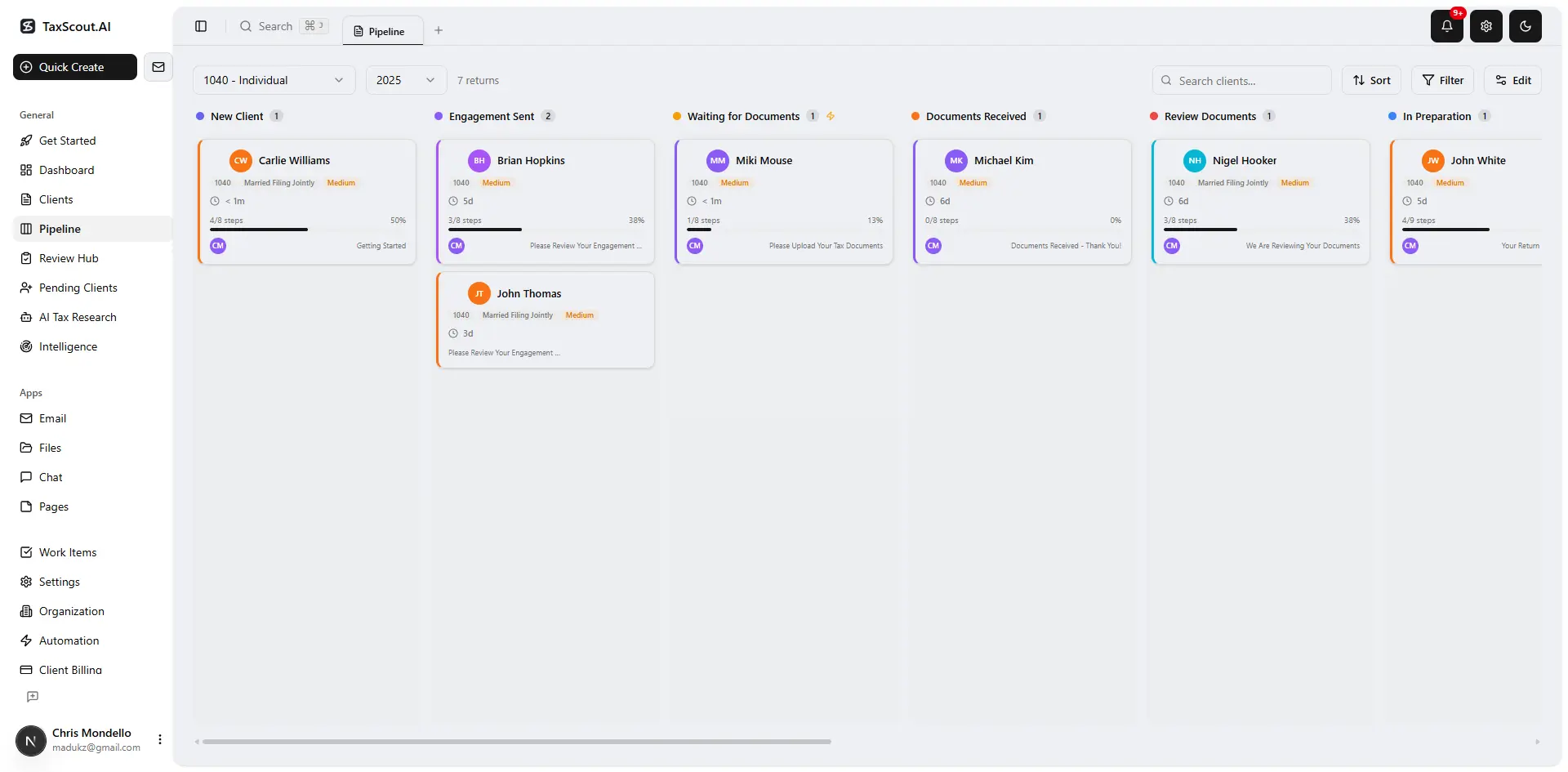
Track every return from intake to filed with drag-and-drop pipeline management
How Modern Practice Management Becomes a Recruiting Differentiator
The technology argument for hiring is concrete, not aspirational. When a candidate asks "what does a typical client onboarding look like?", a firm running TaxScout can answer: clients get a branded portal with one-time code login (no account creation), documents are processed through a 5-layer AI validation pipeline covering 180+ form types, the intake form prefills from prior-year data and uploaded documents, and the pipeline automatically advances when conditions are met. That answer communicates organizational maturity.
For candidates evaluating multiple offers, that organizational maturity is a proxy for how much of their time will be spent on valuable work versus administrative friction. A senior CPA who has spent five years manually transcribing numbers from PDFs into spreadsheets at a competitor firm will recognize immediately what a differentiated environment looks like.
!TaxScout pipeline kanban demonstrates standardized workflows that reduce onboarding friction and ramp time for new CPA hires
TaxScout's flat pricing model also has internal implications for hiring. At $149/month total for Prep Pro — versus TaxDome's ~$100/user/month (roughly $500/month for a 5-person team) — the savings free up budget that can be redirected toward compensation, continuing education, or signing bonuses. That reallocation math is worth making explicit when building your offer strategy.
Explore the full TaxScout pricing breakdown to see how the flat-fee model scales as your team grows — without per-user charges that penalize headcount.
Building an Accounting Firm Culture That Retains Who You Hire
CPA firm hiring doesn't end at the offer letter. Retention starts at offer acceptance and is determined by the first 6 months of actual experience. The firm culture signals that matter most to accounting staff are: predictability (does the firm run on documented processes or tribal knowledge?), recognition (is excellent work noticed?), and development (am I getting better here?).
Firms that invest in accounting firm capacity planning — tracking utilization, distributing workload intentionally, and building in buffer for the unexpected — signal to staff that leadership thinks about sustainable operations, not just revenue targets. That signal is retention infrastructure.
Documenting processes in a knowledge base removes one of the most common sources of new-hire frustration: discovering that the answer to a question exists in someone's head and not in any system. When institutional knowledge is accessible to anyone on the team, new hires ramp faster and experienced staff spend less time answering the same questions.
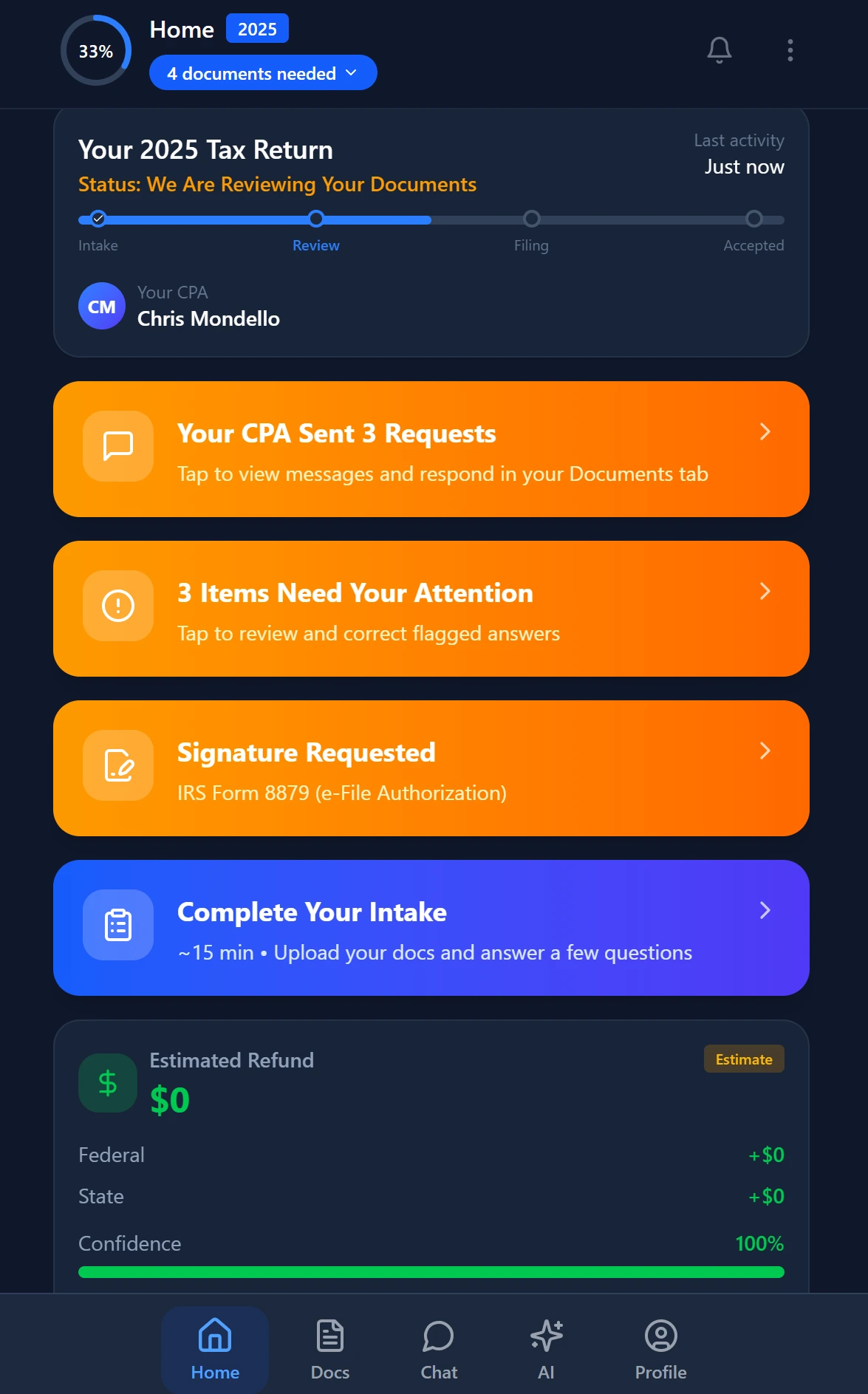
Smart intake auto-fills from uploaded documents and prior-year data
The Hiring and Retention Equation
The firms winning at CPA firm hiring in 2026 are doing four things differently: they source proactively instead of posting and waiting, they write job postings that describe work rather than list requirements, they compete on autonomy and tooling rather than trying to win a compensation war with Big 4, and they systematize onboarding so that new hires become productive contributors in 90 days rather than 180.
The technology layer ties all of this together. A firm running AI-native practice management isn't just more efficient — it's more attractive to the candidates you most want to hire, faster at onboarding the candidates you do hire, and operationally resilient when staff turnover inevitably happens.
Ready to make your firm the kind of place top CPAs actually want to work? TaxScout gives your firm AI-native practice management for $49/mo flat — modern tooling that attracts tech-forward candidates and eliminates the manual friction that drives new-hire frustration. → Book a 15-Min Demo
Frequently Asked Questions
Small CPA firms can compete with Big 4 offers by emphasizing non-comp advantages: faster partnership tracks, work-life balance, client variety, and technology investment. Firms using TaxScout.ai report that showcasing AI-assisted workflows during interviews is a differentiator — candidates see they won't be doing manual data entry. Rather than matching Big 4 dollar-for-dollar, the pitch becomes a better quality-of-work proposition backed by modern tooling.
Keep reading
Amended FBAR Procedures: How CPAs Correct Foreign Account Errors Without Triggering Penalties
Oct 12, 2026 · 1 min read
Transparency in Coverage Final Rules: What CPA Firms Must Do Now
Oct 12, 2026 · 1 min read
Backdoor Roth IRA: How CPAs Execute the Strategy for High-Income Clients
Oct 12, 2026 · 1 min read
Stay up to date
Get the latest tax tech insights delivered to your inbox.