Accounting Busy Season: What AI-Ready Firms Do Differently
The accounting busy season breaks firms that weren't ready in January — and the data shows why. With the majority of the 69,089 preparers in the TaxScout directory operating as solo practitioners, most firms face peak volume with zero bench depth. This guide goes beyond generic survival tips to…
Every year, the accounting busy season lands the same way: W-2s release on February 1, client emails spike, and suddenly every hour of capacity you thought you had is gone. Generic advice — set boundaries, use a project management app, batch your tasks — sounds reasonable until you're staring down 300 open returns in March. The firms that actually control their season aren't just more disciplined. They're structurally different before the first document arrives.
Here is the data point that reframes the problem: according to the TaxScout directory of 69,089 US tax preparers, matched against the IRS federal preparer directory, the vast majority of listed firms are solo or micro practices. Of those preparers, 32,239 are CPAs and 11,112 are enrolled agents. That means most firms absorb peak volume with no bench depth — one preparer out sick, one difficult client demanding callbacks, and the entire pipeline stalls. Capacity planning isn't a luxury; it's a survival mechanism. Understanding who actually bears the brunt of accounting busy season matters, because the capacity problem looks very different depending on firm size.
This guide covers everything the competitors cover — expectations management, tech stack setup, workflow design, automation, AI, delegation, and burnout prevention — and then goes further. You'll find a pre-season client triage framework using AI-flagged complexity scoring, a decision model for when to refer overflow to another credentialed preparer, and IRS PTIN data on preparer churn that underscores why waiting until February to get organized is a losing strategy. If you want other guide resources on running a modern CPA firm, the broader cluster covers everything from client onboarding to advisory services. Whether you're preparing for your first accounting busy season with AI tools or looking to refine a system that already exists, the frameworks here are designed to be immediately actionable.
Why the Accounting Busy Season Breaks Most Firms
The IRS processes roughly 150 million individual returns each year, and the overwhelming share arrive between February 1 and April 15. That ten-week window compresses an entire year's worth of individual tax work into roughly 70 business days — and IRS data on preparer PTIN registrations shows meaningful churn between seasons, meaning the workforce handling that volume is not stable year to year. For firms evaluating their accounting busy season approach, this trade-off compounds over time.
For multi-preparer firms, the math is painful but manageable. For solo practitioners — which represent a disproportionate share of the 69,089 preparers listed in the TaxScout directory — there is no overflow valve. A single complex return (K-1 passthrough, rental portfolio, stock options) can consume a full day that was earmarked for five standard 1040s. That unpredictability is the actual root cause of busy season chaos, and it's rarely addressed in productivity listicles. Each of these factors directly shapes how accounting busy season plays out in practice.
The Bureau of Labor Statistics Occupational Outlook for accountants and auditors projects continued demand growth for accounting services, which means the capacity gap won't self-correct. Firms that don't build structural buffers before the season starts will face the same crunch — only with more clients expecting faster turnaround. Understanding accounting busy season in this context is what separates firms that scale from those that stall.
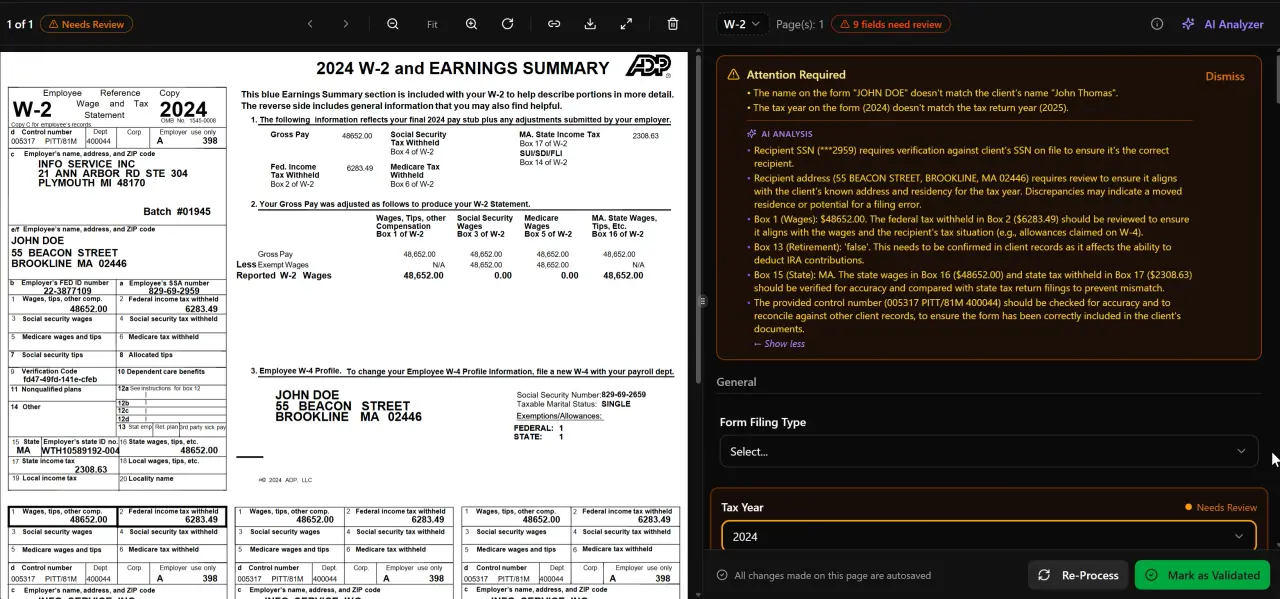
AI classifies, extracts, and validates every document automatically
Pre-Season Client Triage Using AI Complexity Scoring
The single highest-leverage action a CPA firm can take before February 1 is segmenting its client roster by expected complexity — not by fee, not by relationship length, but by the number of document types and schedules each return is likely to require. A client with a W-2, a 1098, and a standard deduction is a 20-minute engagement. A client with a Schedule C, a K-1 from a passthrough, RSU vesting, a rental property, and a foreign account disclosure is a two-day project. Treating them identically in your pipeline is how firms fall behind by February 10. This is precisely where a deliberate accounting busy season strategy pays off.
TaxScout's AI document extraction processes recognized document classes — W-2s, the full 1099 series, K-1s, 1098s, 1095s, 1040 schedules, and supporting records — through a 5-layer validation pipeline that includes confidence scoring at the extraction stage. When documents arrive, the system isn't just reading fields; it's flagging documents that require human review, which is a proxy for return complexity. Firms that connect their document intake to this pipeline in December and January can generate a rough complexity distribution across their client base before work begins. Accounting busy season sits at the center of this decision — get it wrong and the rest unravels.
Use that distribution to tier your January scheduling. High-complexity returns should be scheduled early, assigned to your most experienced preparer, and given explicit buffer time. Standard returns can be batched and processed in sequence. This isn't a new concept — it's how audit firms have scheduled engagements for decades — but most tax practices never apply it because they lack the data infrastructure to generate the complexity signal automatically. AI-driven smart intake, modeled on IRS Form 13614-C with four-layer prefill (document-first, prior-year, profile, and AI gap analysis), surfaces that signal at the moment a client begins submitting documents. When firms revisit their accounting busy season priorities, the gaps usually surface here.
Tired of discovering your hardest returns in the third week of March?
TaxScout's AI intake and document extraction flag complexity before work begins — so you schedule smarter, not harder.
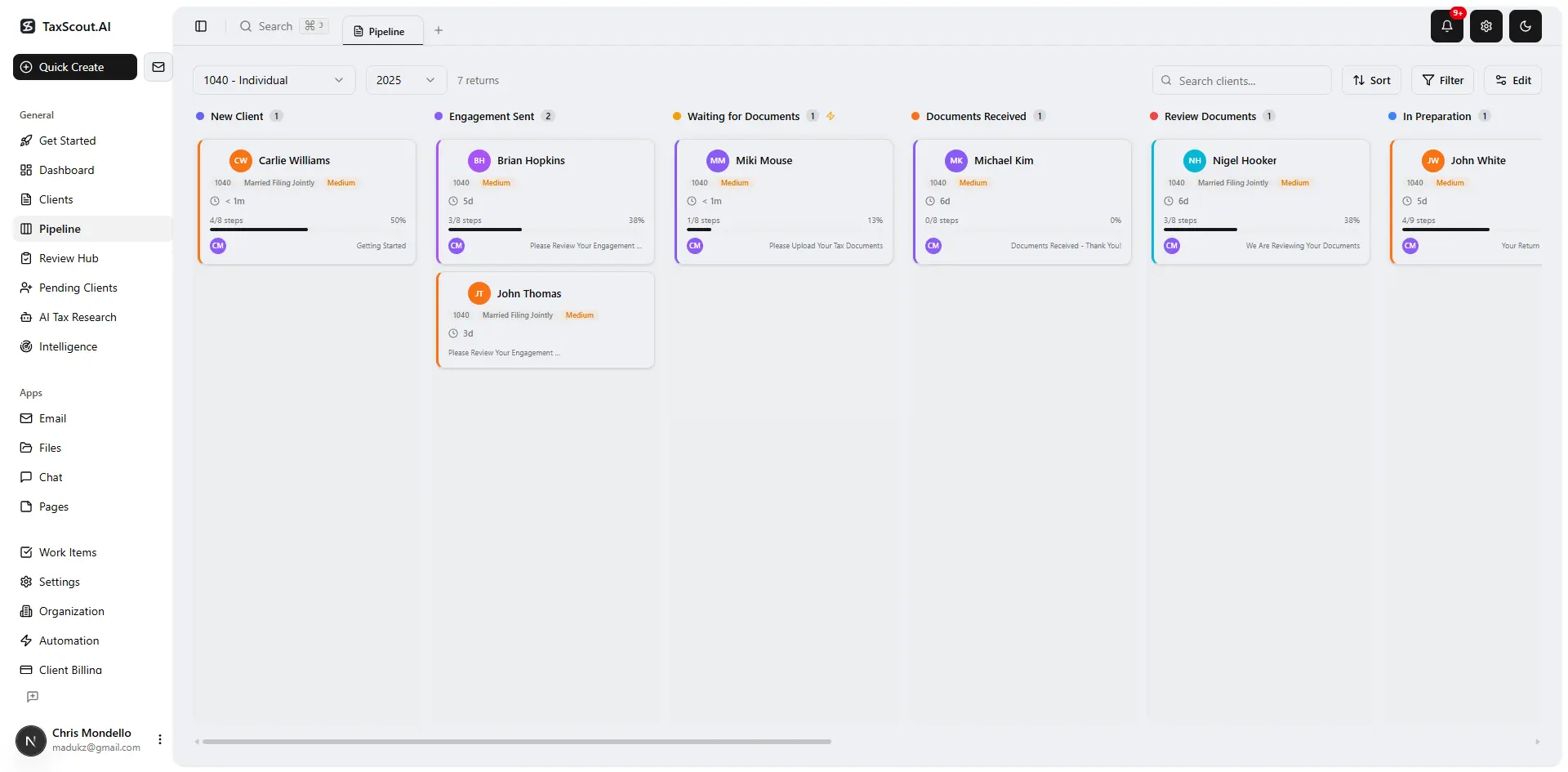
Track every return from intake to filed with drag-and-drop pipeline management

Click any extracted field to see its source highlighted on the original PDF
The Operational Playbook: What AI-Ready Firms Actually Do
Beyond triage, AI-ready firms build a set of repeatable operational practices that generic busy season guides skip entirely. The following subsections cover the full playbook — including the standard advice from competitors, elevated with the structural changes that actually move the needle.
Set Client Expectations Before the Season Starts
Every competitor guide mentions expectation-setting, and they're right. What they miss is the mechanism. Sending a January newsletter asking clients to upload documents early is not expectation management — it's a suggestion. Expectation management requires a branded client portal with OTP login (no passwords), a checklist tied to last year's document set, and automated reminders that escalate if the client hasn't acted by a specific date. When clients log into a portal that already shows their prior-year prefill and a list of exactly what's missing, submission rates improve and the back-and-forth email that eats preparer time disappears.
Design Your Capacity Plan Around Actual Bench Depth
Capacity planning in a solo or two-person firm is not about adding staff in February — it's about knowing in December exactly how many returns you can responsibly accept given your document collection timeline, your review process, and your extension policy. TaxScout's pipeline management gives firms 12 customizable stages with a drag-and-drop kanban board. When every return has a stage, you can see at a glance whether your in-progress queue is approaching the point where new intake must pause or be referred. That visibility is the entire difference between a controlled season and a chaotic one.
Automate Every Repeatable Step
The tasks that consume the most aggregate preparer time during busy season are almost never the complex tax judgments. They're the status updates, the document chasers, the engagement letter follow-ups, the invoice reminders. Tax season workflow automation handles all of these deterministically — trigger a document reminder when a client's intake is incomplete after five days, send an e-signature request the moment Form 8879 is ready, issue an invoice via Stripe Connect Express when the return is marked complete. Each automated handoff returns 10 to 20 minutes to your preparer's day, and that compounds across hundreds of returns.
Use AI Research Agents for Complex Issues
When a preparer hits an unfamiliar issue — a client with Section 1231 gain on a business asset sale, a passthrough with a 754 step-up basis complication, or a 1040 extension strategy decision under time pressure — the standard approach is to either guess, over-research manually, or escalate to a senior who is also buried. TaxScout's nine specialized AI research agents run real-time searches across IRS, Treasury, Cornell Law, SSA, and Congress to surface the authoritative answer in minutes. That means complex issues get resolved at the point of preparation, not parked in a review queue for days.
Centralize Documentation and Kill Email Attachment Chains
Document management is where most small firms leak the most time. A client emails a PDF, a team member downloads it, renames it, uploads it to a shared drive, emails back a confirmation, and then the preparer searches for it three days later. TaxScout's file management and PDF tools — including OCR, merge, split, Bates numbering, and PII masking across 14+ tools — eliminate that chain entirely. Documents received through the client portal land directly in the client record, pre-processed and ready for extraction.
Delegate Evenly and Track Utilization
Uneven delegation is one of the most common causes of busy season burnout among accountants. The senior preparer handles 80% of the complexity while junior staff sit underutilized — or the opposite, where junior staff get in over their heads because oversight is thin during peak volume. Practice management integrations with pipeline visibility make staff utilization visible in real time, so workload reallocation can happen dynamically rather than reactively.
Refer Overflow to Credentialed Preparers — With a Process
Every firm has a threshold beyond which accepting new work is a liability, not a revenue opportunity. The question is whether you have a referral process ready when you hit that threshold, or whether you're improvising. The TaxScout directory at /cpa lists 69,089 preparers matched against the IRS federal directory — including 32,239 CPAs and 11,112 enrolled agents — which makes it a live tool for identifying credentialed referral partners by geography and credential type before the season starts. Establishing two or three referral relationships in January means that when February volume exceeds capacity, you have a dignified answer for the client instead of a stress-induced yes.
Pricing and Client List Strategy Before February 1
Strategic pricing is not just about revenue — it's a capacity-management tool. Raising fees on complexity tiers (Schedule C with home office, multi-state returns, clients with crypto) naturally reduces volume on the engagements that consume disproportionate preparer time. If your pricing is flat across complexity tiers, you're subsidizing your hardest clients with margin from your easiest ones — and creating the conditions for burnout in the process.
Trimming the client list is real advice, but it requires a framework. Use your AI complexity scores from the previous section alongside your profitability data: clients who are low-fee, high-complexity, and chronically late submitting documents are the right candidates for non-renewal. This isn't about being selective for its own sake — it's about protecting the capacity that lets you serve your best clients well. Value-based pricing resources in the TaxScout knowledge base provide the framework for communicating fee changes without losing relationships.
On the invoicing side, Stripe Connect Express integration allows you to collect payment at engagement letter signing or at the time of submission — not after the return is filed. Getting paid before you do the work is the standard in most professional service firms, and it's one of the cleanest ways to reduce collection friction during the season's most compressed weeks.

Your clients see your brand — OTP login, document upload, and real-time status
AI-Ready Firm vs. Reactive Firm: Key Operational Differences During Accounting Busy Season
| Practice Area | Reactive Firm | AI-Ready Firm |
|---|---|---|
| Client triage | All returns treated equally until a bottleneck appears | AI complexity scoring segments returns in December; high-complexity scheduled first |
| Document collection | Email attachments, manual downloads, missed documents discovered at review | Client portal with auto-prefill; AI extraction with 5-layer validation on receipt |
| Capacity visibility | Partner estimates workload informally | 12-stage pipeline kanban shows in-progress queue in real time |
| Complex issue resolution | Senior preparer researches manually; return parked for days | 9 AI research agents surface authoritative answer at point of preparation |
| Overflow management | Ad hoc decisions under pressure; some clients get a rushed return | Referral partners identified in January using credentialed preparer directory |
| Burnout risk | High — uneven delegation, no early-warning system | Lower — utilization visible, automation handles repeatable tasks |
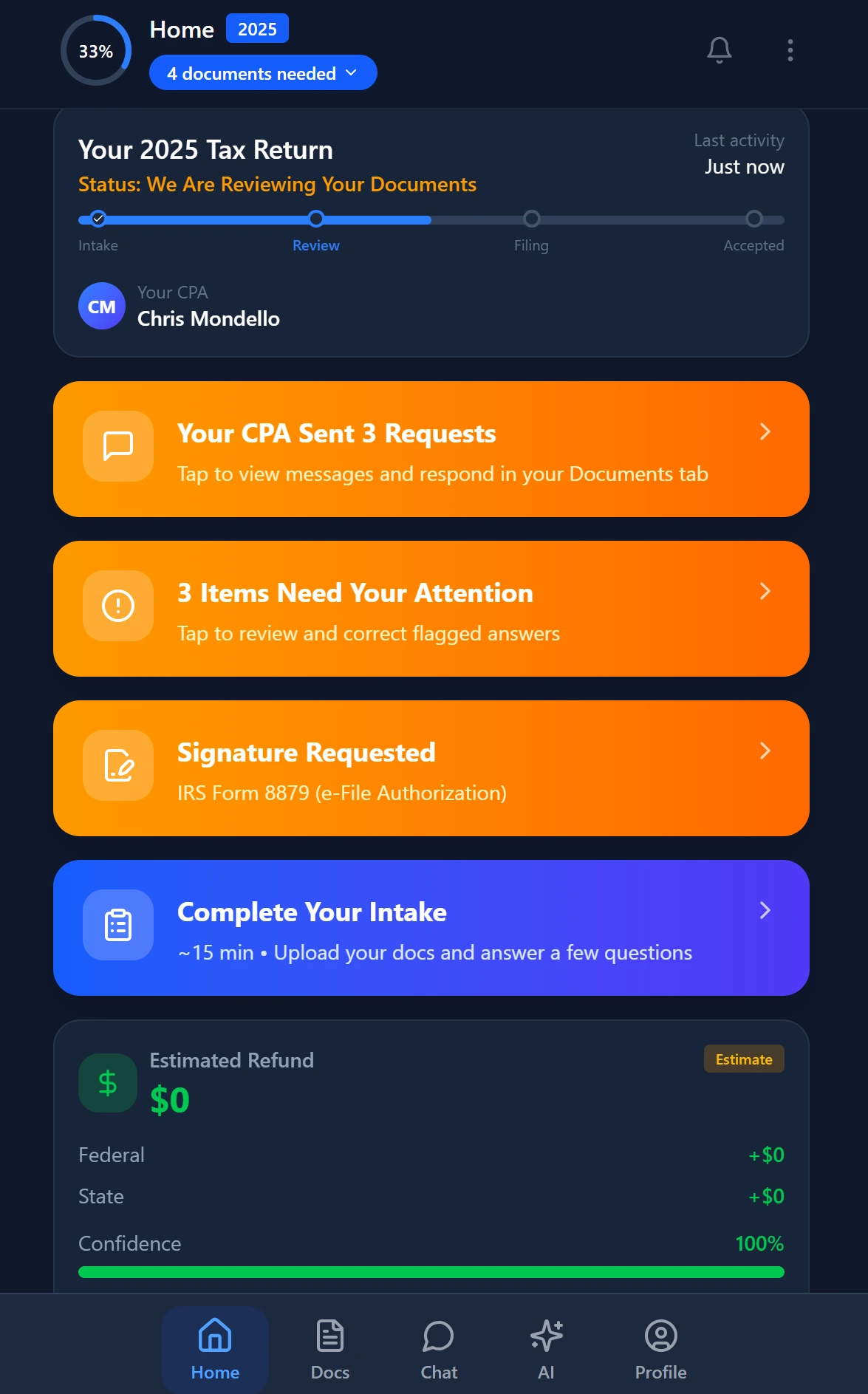
Smart intake auto-fills from uploaded documents and prior-year data
Morale, Communication, and Sustainable Pace
The operational scaffolding above reduces the mechanical friction of busy season. But even a well-automated firm needs to manage the human dimension. Busy season burnout among accountants is well-documented: research published by the Journal of Accountancy has repeatedly linked peak-season overload to attrition, which compounds the capacity problem in future years as trained staff leave the profession. Firms that treat burnout prevention as a structural issue — not just a morale initiative — retain staff and keep institutional knowledge inside the firm.
Practical measures include: scheduling explicit catch-up days mid-season where no new intake is accepted; reducing internal meetings to async updates via team chat during peak weeks; rotating the heaviest client loads so no single preparer carries complex work continuously for ten weeks; and building in a formal post-season debrief that feeds directly into the next January's capacity plan. The debrief is the step most firms skip — and it's the one that determines whether next year is better or identical.
For firms with remote or hybrid staff, AI notetaker captures decision context from client calls so preparers aren't transcribing notes manually between conversations. That 10 minutes per call adds up across 200+ client interactions in a compressed season.
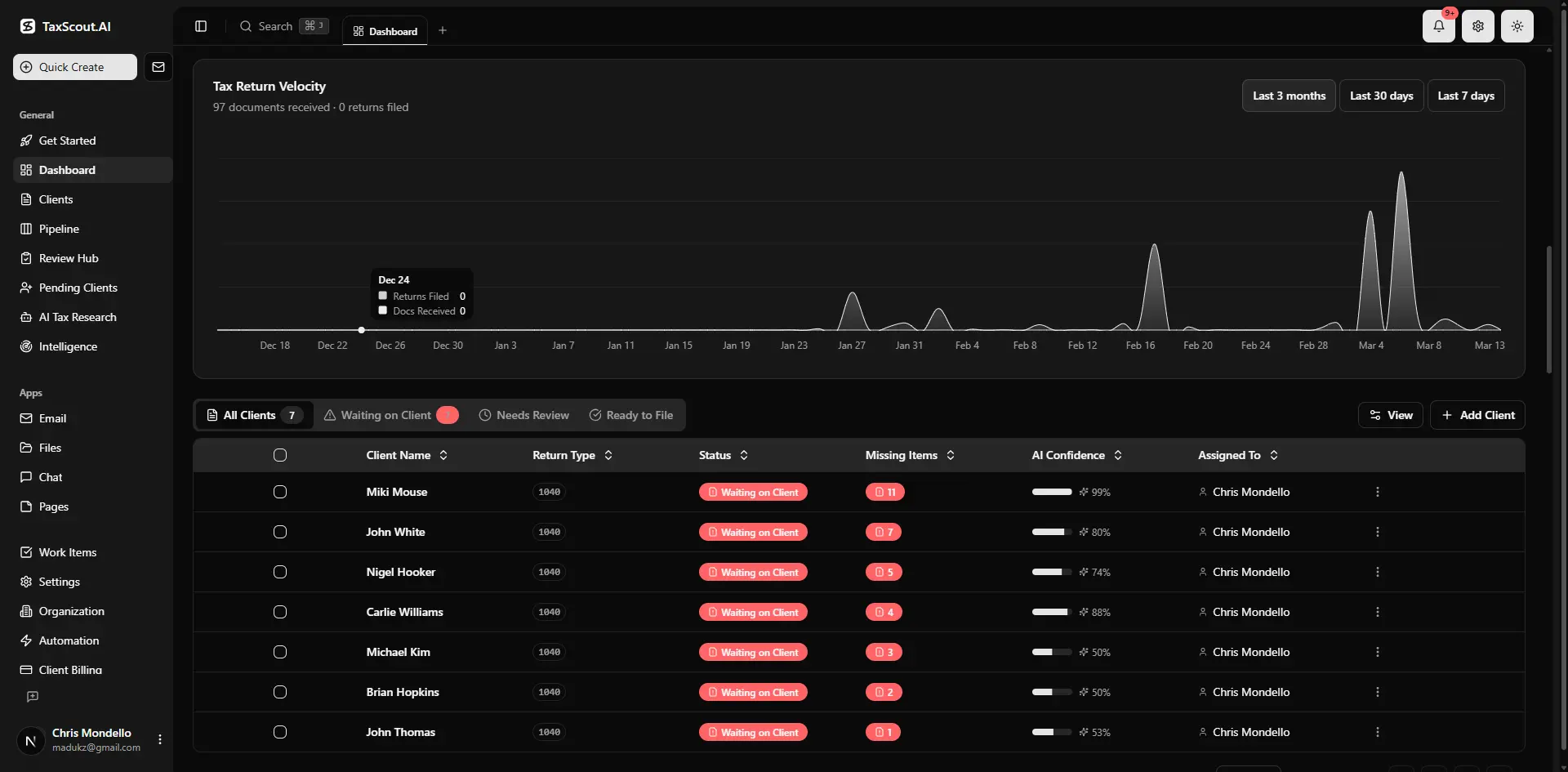
Real-time dashboard showing returns in progress, revenue, and upcoming deadlines
IRS PTIN Data and Preparer Churn: Why Urgency Is Real
The IRS PTIN statistics page publishes annual data on the number of active preparer tax identification numbers. The figures consistently show that the registered preparer population fluctuates between seasons — practitioners who were active the prior year do not always renew, and new registrants don't fully offset departures. That churn has two implications for capacity planning.
First, referral partners you identified last season may not be active this season. Building your referral directory from a live, IRS-matched source — like the TaxScout preparer directory — rather than from memory or a stale list reduces the risk of sending a client to a preparer who is no longer taking work. Second, the churn data confirms that the pool of credentialed preparers is not growing fast enough to meet rising demand. SSA wage data and demographic trends point in the same direction: the pipeline of new accounting graduates is not replacing retiring preparers at a one-to-one rate.
The implication for AI adoption is direct: firms that automate the mechanical portions of tax preparation — document extraction, math validation, status communications, research lookups — are effectively multiplying their existing preparer capacity rather than waiting for a labor market that isn't going to supply the headcount. For a deeper look at what the full preparer data reveals about where AI fits, see Will AI Replace Accountants? What 70,000+ Tax Preparer Profiles Reveal.
The Accounting Busy Season Checklist: What to Complete Before February 1
The following items represent the minimum viable preparation for a firm that wants to control its season rather than react to it. These are not aspirational — each one is achievable in December or early January with the right tools in place.
Segment your client roster by expected complexity using last year's return data and document history. Assign complexity tiers to each client and block your calendar accordingly. Set up your client portal with prior-year prefill so clients who log in see exactly what they submitted last year and what appears to be missing. Confirm that your e-signature workflow is live for Form 8879, engagement letters, and 4868s before the first return is ready. Establish at least two referral relationships with credentialed preparers (verify credentials in the TaxScout directory) for overflow scenarios. Configure your pipeline stages to match your actual review process so workload is visible to everyone on the team at all times. Run one complete test of your AI document extraction workflow on a prior-year document set so you understand the confidence scoring output before live returns arrive.
Firms that complete this checklist before February 1 enter the season with structural advantages that no amount of mid-season hustle can replicate. For comparison, see how TaxScout stacks up against TaxDome if you're currently evaluating platforms before the season starts. Pricing is straightforward: TaxScout Solo starts at $49/month with no per-user fees and 150 return credits per term; TaxScout Firm is $149/month with 500 return credits and all nine AI research agents. Full details are at /pricing.
Is your firm still building its busy season infrastructure in February?
TaxScout gives CPA firms AI document extraction, smart intake, pipeline management, and nine AI research agents — all in one platform, with no per-user fees.
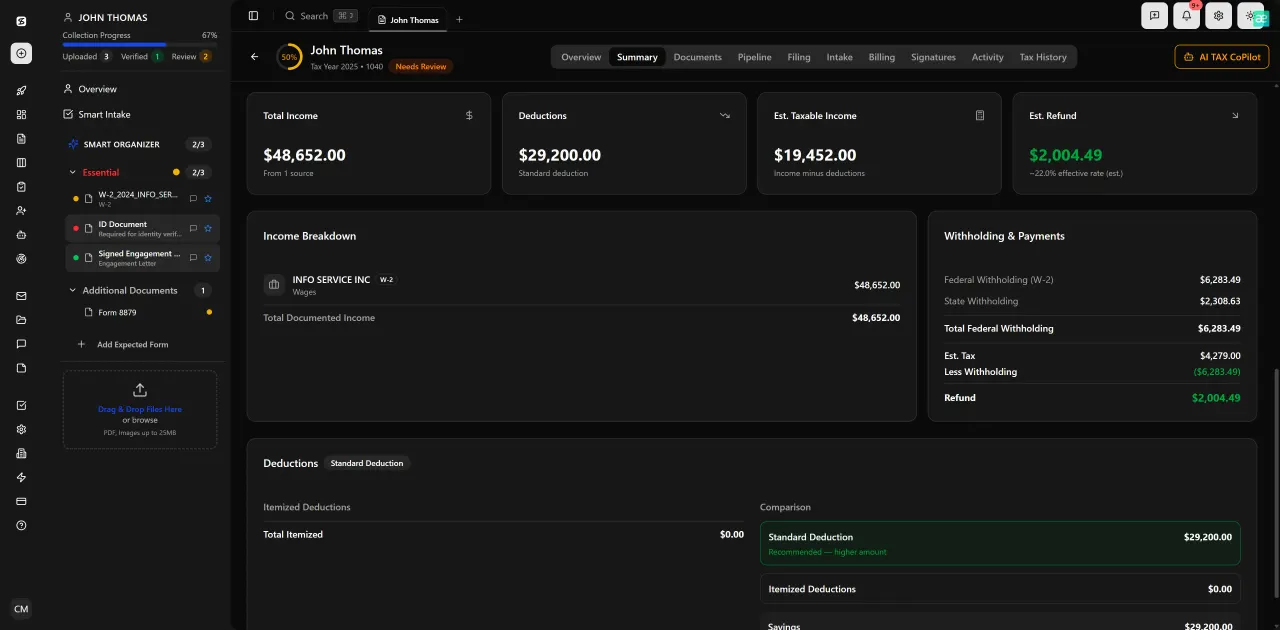
Review with AI assist — 9 agents answer questions with full client context
Frequently Asked Questions
For most CPA firms handling individual returns, accounting busy season runs from February 1 — when employers must issue W-2s — through April 15, the standard individual filing deadline. Firms with extension-heavy practices face a second surge in September and October. The IRS processes roughly 150 million individual returns per year, with the majority concentrated in that ten-week February-to-April window.
Keep reading
Agentic AI for Accounting Firms: What It Means When AI Acts, Not Just Assists
May 14, 2026 · 1 min read
Tax Software Updates Mid-Season: How CPA Firms Stay Productive Without Downtime
May 26, 2026 · 1 min read
Will AI Replace Accountants? What 70,000+ Tax Preparer Profiles Reveal
Nov 9, 2026 · 1 min read
Stay up to date
Get the latest tax tech insights delivered to your inbox.