Tax Preparation Fees in 2026: What CPAs Charge and How to Price Competitively
Most articles about tax preparation fees are written for clients wondering what they'll pay — this one is written for CPAs deciding what to charge. Discover 2026 benchmarks by return type, how to structure service tiers, and why AI efficiency is the strongest argument for raising your rates…
Debates over tax preparation fees 2026 CPAs should charge have become a surprisingly divisive topic inside firms. Inflation has pushed operating costs up, compliance complexity has increased thanks to TCJA-related changes and expanded state filing obligations, and clients — armed with TurboTax pricing pages — push back harder than ever on invoice surprises. Meanwhile, the actual benchmarks CPAs should be using to set prices are scattered across NSA surveys, regional peer groups, and anecdotal Slack threads.
This guide flips the usual framing. Instead of telling clients what they should expect to pay, it gives CPAs the market data, tier architecture, and narrative toolkit to set fees confidently, raise them strategically, and defend every dollar when a client asks why your 1040 costs more than the firm down the street. Understanding tax preparation fees 2026 requires more than a quick Google search — it demands real market data and a defensible pricing structure.
Whether you're a solo practitioner reviewing your fee schedule for the first time in three years or a managing partner benchmarking your firm's pricing against regional competitors, the numbers and frameworks here are meant to be actionable — not just informational. Tax preparation fees 2026 benchmarks are especially relevant if your last fee review happened before inflation, staffing costs, and software subscriptions reshaped your overhead.
2026 Market Benchmarks for Tax Preparation Fees by Return Type
The National Society of Accountants conducts its biennial income and fees survey, and the most recent data shows that average CPA fees for tax returns have continued to rise. For a standard Form 1040 with a Schedule A, the national average sits in the $350–$500 range, though regional variation is significant. Coastal urban markets (New York, Los Angeles, San Francisco, Boston) routinely command 40–60% premiums over the national average, while rural Midwest and Southeast markets often sit 20–30% below it. This data forms the backbone of any honest conversation about tax preparation fees 2026, giving practitioners a credible starting point for positioning their rates.
Business returns tell a different story. An S corporation return (Form 1120-S) averages $1,200–$2,500 nationally depending on the number of shareholders, states involved, and complexity of the income statement. Partnership returns (Form 1065) follow a similar range, with multi-state partnerships and those carrying K-1 complexity frequently billing $2,500–$5,000 or more. C corporation returns (Form 1120) without significant consolidation start around $1,500 and scale steeply. For firms evaluating their tax preparation fees 2026 approach, this trade-off compounds over time.
These figures represent averages — not ceilings. Firms that have invested in niche specialization consistently bill above market. A CPA serving real estate investors with cost segregation activity, for example, routinely charges $3,000–$6,000 for what would otherwise be a mid-complexity 1065. For deeper context on niche-based pricing premiums, see Niche Pricing Strategy: How CPAs Command Premium Rates in Specialized Markets. Each of these factors directly shapes how tax preparation fees 2026 plays out in practice.
The key takeaway from the benchmarks: most solo practitioners and small firms are underpriced relative to their metropolitan market. A $295 1040 in a major metro is not competitive — it's a margin drain. Understanding tax preparation fees 2026 in this context is what separates firms that scale from those that stall.
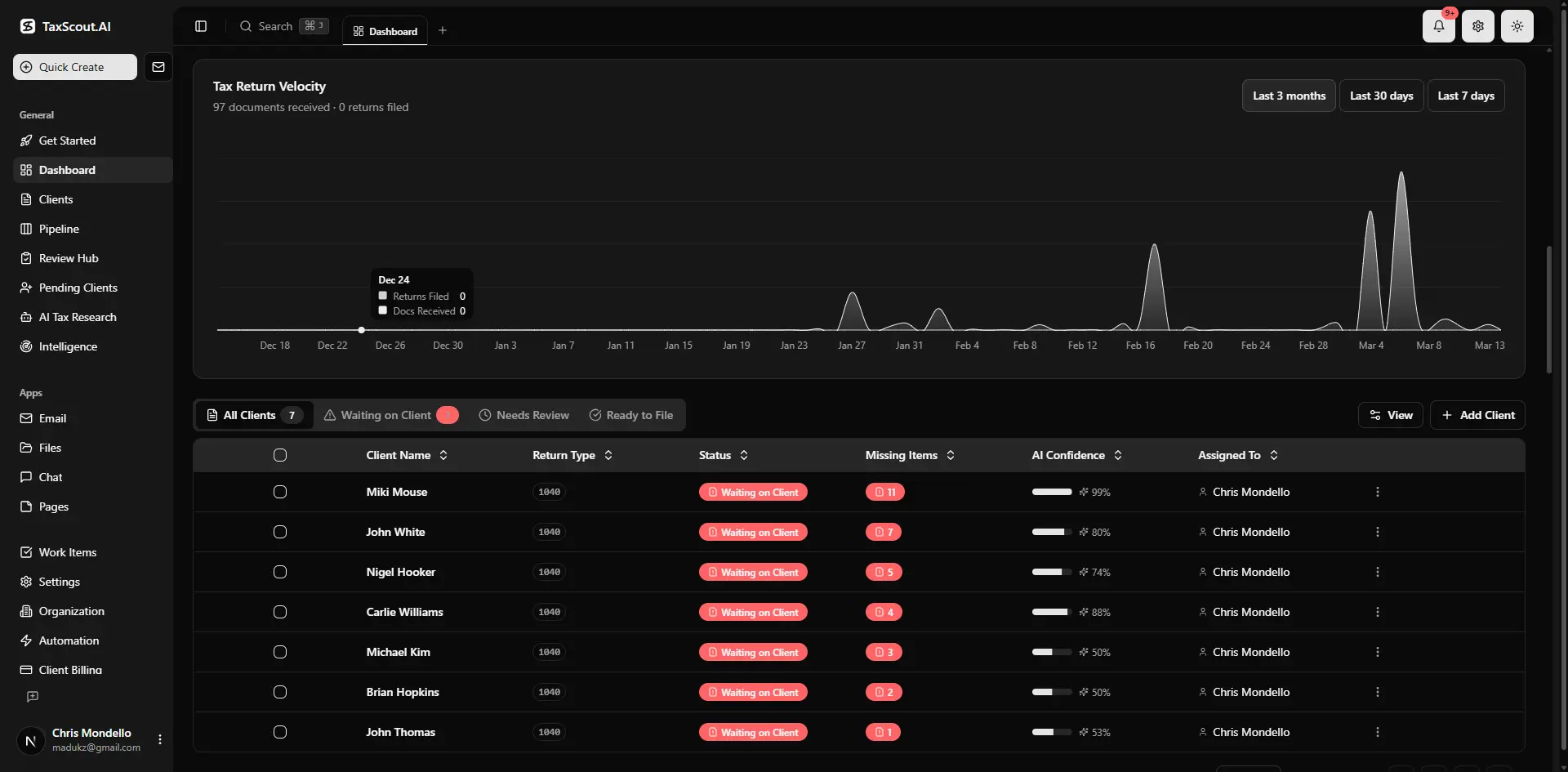
Real-time dashboard showing returns in progress, revenue, and upcoming deadlines
Why Accounting Firm Pricing Has Lagged Inflation
According to the Bureau of Labor Statistics CPI data, professional services fees have grown roughly 3.5–4% annually since 2020, but many CPA firms haven't adjusted their standard fee schedules to match. The reasons are familiar: client retention anxiety, the perception that tax prep is a commodity, reluctance to trigger a comparison with online DIY software, and the sheer administrative friction of updating fees across hundreds of existing engagement letters. This is precisely where a deliberate tax preparation fees 2026 strategy pays off.
There's also a structural problem. Many firms still price on a cost-plus model — estimating hours, applying a blended rate, and hoping the client doesn't balk. This approach anchors clients to hours rather than outcomes, and it creates a perverse incentive: the more efficient your team becomes (through training, software, or AI), the less revenue you generate on the same return. That's a model that punishes improvement. Tax preparation fees 2026 sits at the center of this decision — get it wrong and the rest unravels.
The IRS Taxpayer Advocate's annual report consistently documents increases in tax code complexity year over year. As compliance burden grows, the value a competent CPA delivers grows with it — yet fees often don't move in parallel. That gap is the opportunity 2026 pricing discussions need to address directly. When firms revisit their tax preparation fees 2026 priorities, the gaps usually surface here.
For additional context on transitioning away from hourly models, Flat Fee Billing for CPAs: Ditch Hourly and Earn More lays out a practical migration path for firms ready to restructure.
Tired of undercharging for returns that take your team hours to process?
TaxScout.ai automates document extraction, intake, and workflow so your team spends time on judgment — not data entry — making every price increase easier to justify.

Click any extracted field to see its source highlighted on the original PDF
Service Tier Architecture: Structuring 1040 vs S Corp vs Partnership Pricing
One of the most effective pricing levers available to CPA firms is a clearly defined service tier structure. Rather than quoting each engagement from scratch, a tier model sets predictable starting points by return complexity and layers optional add-ons for scope increases. This reduces scope creep, simplifies sales conversations, and positions the firm as organized and professional rather than reactive.
A practical three-tier architecture for individual returns might look like this: a Base tier covers a straightforward 1040 with W-2 income, standard deduction, and no investments — priced at $300–$450 in mid-market areas. A Standard tier adds Schedule A, Schedule B, and one or two state returns — priced at $500–$750. A Premium tier handles Schedule C with depreciation, Schedule E with rental or pass-through activity, multi-state filings, and equity compensation — priced at $900–$1,500 or more. Firms that anchor their tax preparation fees 2026 structure around these tiers typically find it easier to communicate scope and resist client pressure to discount.
For business returns, the tier structure shifts to entity type rather than schedule count. A single-state S corporation with fewer than five shareholders and clean QuickBooks data is a logical entry point at $1,200–$1,800. Add a multi-state footprint, shareholder loans, or significant depreciation recapture and the fee should move to $2,500–$4,000. Firms that also prepare the related individual returns for all shareholders should price those as a bundle — the discount creates loyalty while the aggregate revenue per client relationship increases significantly.
Partnership returns with K-1s often benefit from a per-partner pricing component layered on top of a base entity fee. A $1,500 base for the 1065 plus $75–$150 per K-1 issued is transparent, scalable, and easy for clients to understand. It also automatically captures the higher effort involved in large partnerships without requiring a separate negotiation each year.
The glossary entry on three-tier pricing architecture provides additional framework context for firms formalizing their tier model for the first time.
Add-On Services That Increase Revenue Per Return
Beyond base return preparation, add-on services represent the fastest path to average revenue per client growth without adding new clients. Common add-ons that price well: extension preparation ($75–$150), estimated quarterly tax calculation and voucher preparation ($150–$300/year as an annual add-on), FBAR and foreign account disclosure ($250–$750 depending on complexity), prior-year amended returns ($200–$400 per year), and virtual CFO advisory sessions ($200–$400/hour or bundled into an advisory retainer).
Offering these as named line items in your engagement letter — rather than absorbing them into the base fee — trains clients to see scope clearly and eliminates the conversation where a client assumes extensions are included because they've always been handled without a separate invoice. For firms using e-signatures on their engagement letters, the digital format makes it easy to present tiered scope menus that clients can review and sign before work begins.
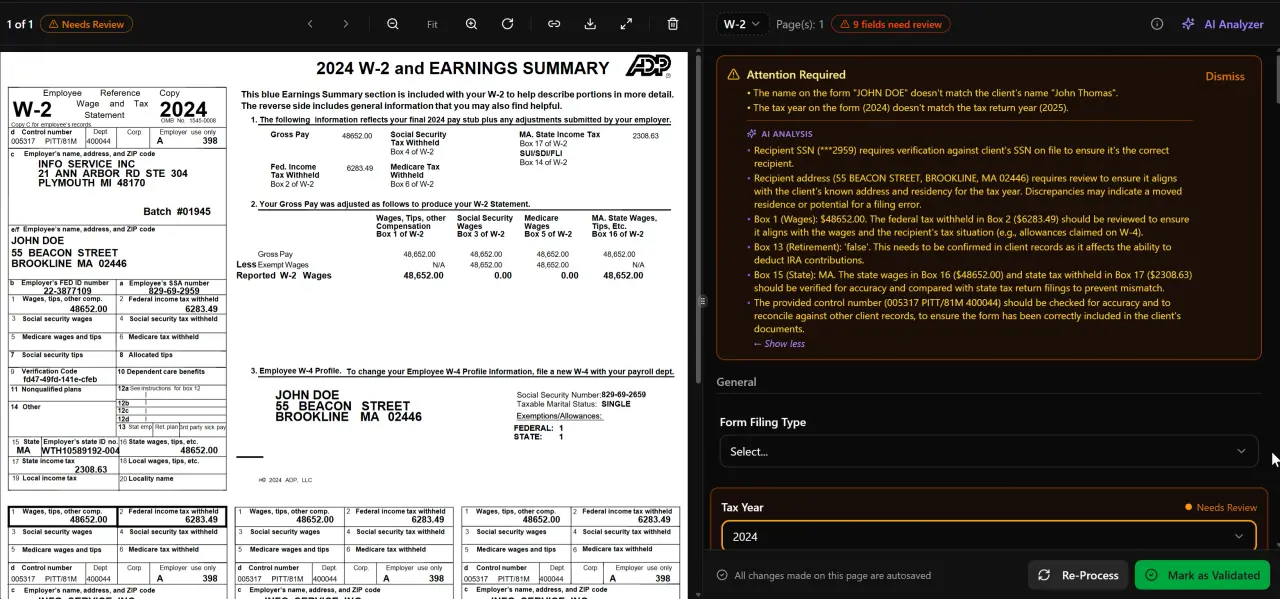
AI classifies, extracts, and validates every document automatically
AI Efficiency as a CPA Tax Prep Pricing Lever in 2026
The most important pricing conversation in 2026 is not whether to raise rates — it's how to justify raises to clients who assume that AI should be making their returns cheaper. The argument runs like this: if software is doing more of the work, shouldn't the CPA charge less? The correct answer is no, and here's why.
AI in a well-built tax workflow eliminates data entry and document chasing — the lowest-value parts of the process. What remains is the judgment work: identifying the missed deduction, flagging the cost basis discrepancy, recommending the S election, catching the state nexus issue. That judgment work has always been what clients are actually paying for; it just used to be bundled with 40 minutes of transcribing W-2 boxes. When AI handles the transcription, the CPA delivers more judgment per engagement — not less. That's a value increase, not a cost decrease, and it's central to how leading firms are framing their tax preparation fees 2026 conversations with clients.
Platforms like TaxScout.ai make this concrete. The AI document extraction engine processes W-2s, 1099s, K-1s, and 1095s through a 5-layer validation pipeline that includes confidence scoring, OCR cross-verification, and 18 post-extraction rules — so your staff reviews exceptions rather than re-keying every field. The time recovered is real and measurable. Firms using AI-assisted extraction consistently report 30–50% reductions in document processing time per return.
That time recovery translates directly into capacity. A firm that previously completed 300 returns in a season can handle 400–450 with the same team when document processing is automated. Rather than passing those savings to clients as discounts, the correct move is to raise the base fee modestly — say 8–12% — while absorbing a larger client volume. Revenue per staff member increases. Margins improve. And the quality of the work delivered actually goes up because your team isn't exhausted from manual data entry.
For a deeper look at how AI changes the productivity math inside CPA firms, Boost AI Accounting Productivity Without the Overwhelm provides a practical operational framework.

Your clients see your brand — OTP login, document upload, and real-time status
How to Justify Higher Tax Return Preparation Fees to Clients
The client conversation about fee increases is never purely about numbers — it's about perceived value. A client who feels the process is organized, fast, and communicative will accept a higher invoice without complaint. A client who spent three weeks chasing you for their return status will push back on even a modest increase.
The mechanics of value communication matter. First, document your process explicitly. A one-page 'what to expect' document that describes your intake process, review stages, and communication cadence signals professionalism and scope. Second, use your client portal to show rather than tell. When a client logs into a branded portal, sees their documents processed and organized, and receives a proactive update at each milestone, the fee looks different than when the experience is a series of unacknowledged emails and a PDF that arrives without warning. TaxScout's client portal provides exactly this kind of branded, transparent client-facing workflow.
Third, price anchoring matters. Always present your fee in context. 'A 1040 with Schedule E and two state returns is $875' lands differently than just '$875.' Naming the complexity you're handling reminds the client that you're managing something they couldn't do themselves — and that the comparison to TurboTax is not apples to apples. Clients who understand what drives tax preparation fees 2026 upward are far less likely to push back when you can point to specific complexity factors in their own return.
For firms filing in states with significant legislative activity this year, pointing to specific 2026 changes adds tangible justification for rate increases. In California, for example, California Tax Changes 2026 CPAs Must Know outlines several new compliance requirements that materially increase preparation time for affected clients. Referencing these changes in your fee-increase communication turns a generic price hike into a documented, reasonable response to complexity.
According to law.cornell.edu's overview of IRC Section 7216, CPAs have significant confidentiality obligations around client tax information. Reminding clients that your firm invests in security infrastructure — including encryption, MFA, and data-subject deletion support — is another legitimate value differentiator that DIY software genuinely cannot match.
2026 Tax Preparation Fee Benchmarks by Return Type and Market
| Return Type | National Average | Major Metro Premium | Niche/Specialist Range |
|---|---|---|---|
| Form 1040 (simple, standard deduction) | $250–$350 | $400–$550 | N/A |
| Form 1040 with Schedules A/B/D | $400–$600 | $600–$900 | N/A |
| Form 1040 with Schedule C/E (complex) | $700–$1,200 | $1,100–$1,800 | $1,500–$2,500 |
| Form 1120-S (S Corporation) | $1,200–$2,000 | $1,800–$3,000 | $2,500–$5,000 |
| Form 1065 (Partnership) | $1,200–$2,500 | $2,000–$3,500 | $3,000–$6,000 |
| Form 1120 (C Corporation) | $1,500–$3,000 | $2,500–$4,500 | $4,000–$8,000+ |
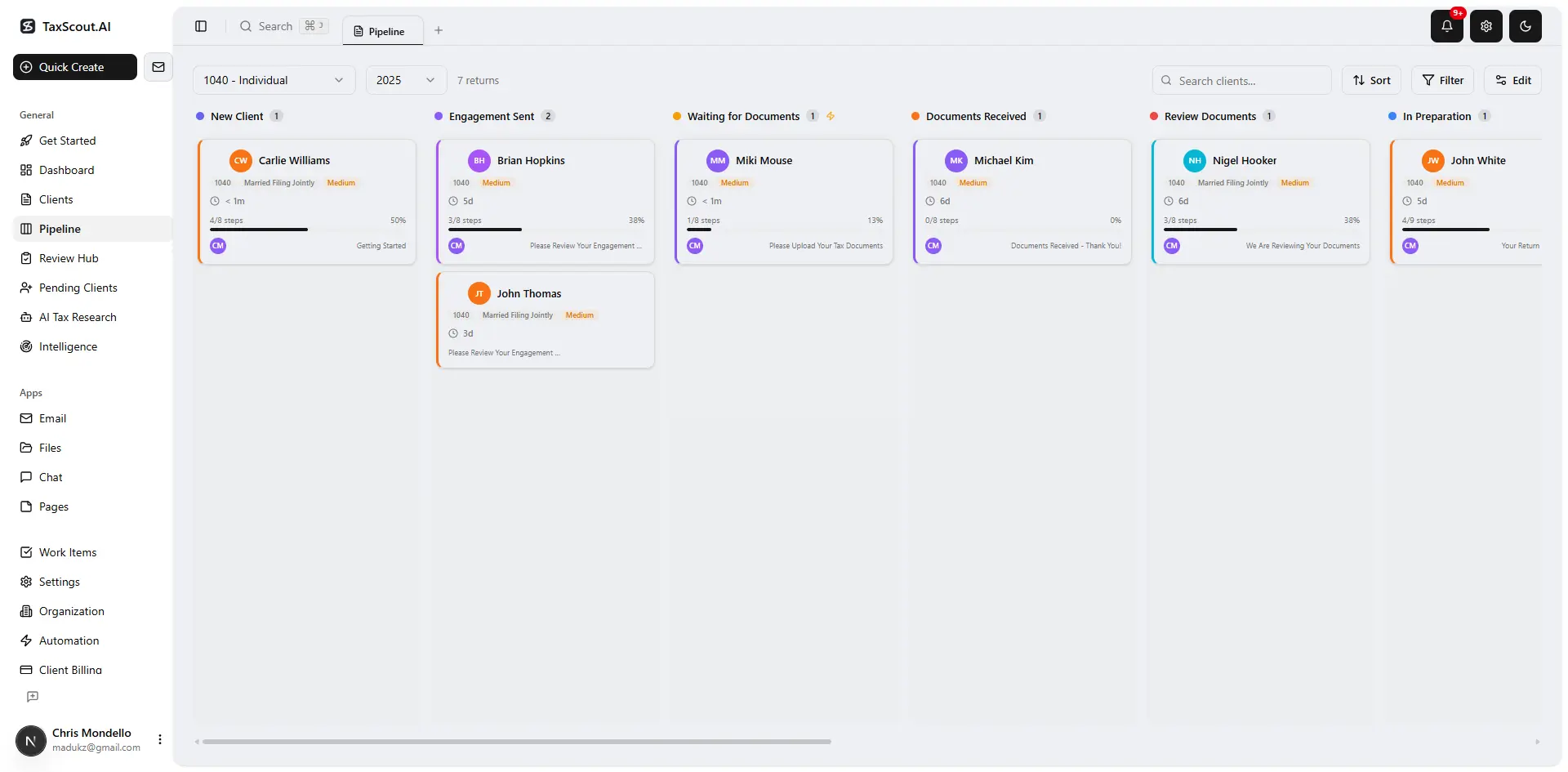
Track every return from intake to filed with drag-and-drop pipeline management
Regional and Niche Factors That Shift Tax Prep Pricing
National averages are a starting point, not a destination. CPA tax prep pricing is substantially influenced by three variables that national surveys can only partially capture: metropolitan market density, industry niche, and the complexity concentration of your client base.
Metropolitan density affects both what the market will bear and what your costs require. Office rent, staff salaries, and professional liability insurance premiums all vary dramatically by region. A New York City firm paying $85 per square foot and $120,000 for a mid-level staff accountant has legitimate cost justification for fees that would seem steep in Omaha. The Small Business Administration's regional economic data provides useful context for understanding local market dynamics. Firms in high-cost metros should ensure their tax preparation fees 2026 schedules fully reflect those overhead realities rather than anchoring to national survey averages.
Industry niche is the single strongest pricing lever available to established firms. A CPA who serves exclusively medical practices, cannabis operators, real estate syndicators, or tech startups can charge 25–60% above general-practice peers for nominally similar return types — because the specialization reduces client risk in ways that a generalist cannot. A real estate operator with complex depreciation schedules, cost segregation studies, and opportunity zone elections is not simply buying a 1065; they're buying insurance against an IRS exam from a preparer who understands their industry. That's worth a significant premium.
Complexity concentration also matters. A firm with 60% of its revenue from Schedule C and Schedule E filers is operating at a different complexity level than one that handles mostly W-2 households. Audit risk, research time, and professional liability exposure scale with complexity. Pricing should reflect that. Explore other blog resources from TaxScout.ai for more on structuring your firm's service mix.
Firms operating across multiple states also face compounding complexity. Multi-state individual returns require an understanding of each state's conformity position with federal law, residency allocation rules, and credit-for-taxes-paid mechanics. The IRS's Publication 17 covers federal basics, but state-specific complexity is where the real billing justification lives. Our dedicated state tax deadlines resource tracks current filing requirements across all 50 states.
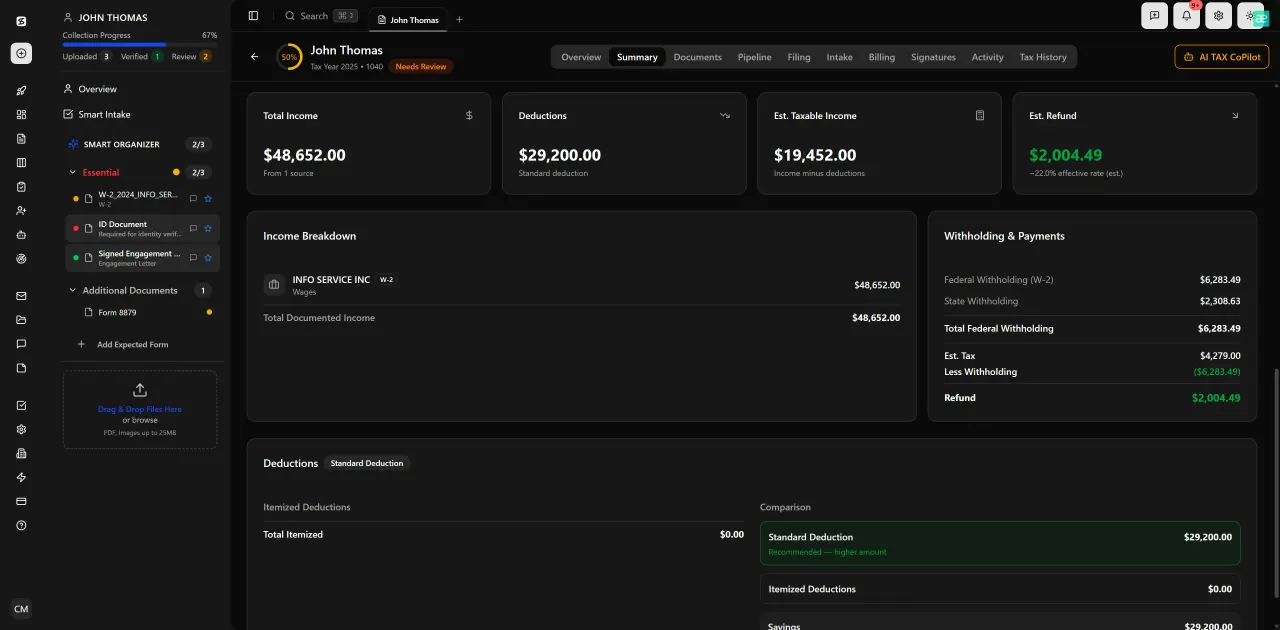
Review with AI assist — 9 agents answer questions with full client context
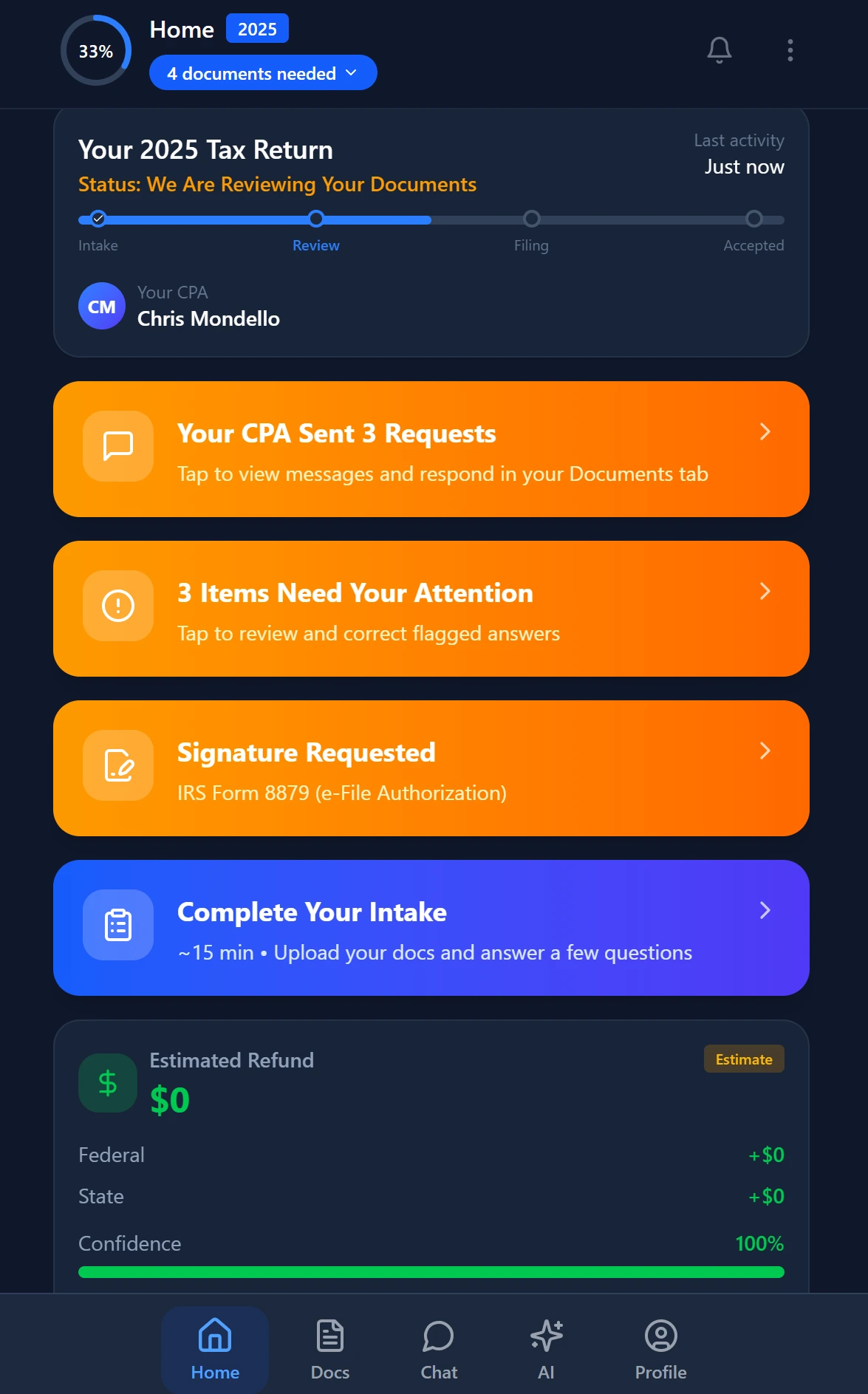
Smart intake auto-fills from uploaded documents and prior-year data
Operationalizing Value-Based Pricing With Practice Management Technology
The gap between knowing what you should charge and actually capturing it consistently is usually operational. Firms with ad hoc intake processes, inconsistent engagement letter practices, and no systematic way to track return complexity end up discounting by accident — because the engagement was already half-complete before scope was defined.
A structured intake process is the foundation. TaxScout's smart intake engine models the IRS Form 13614-C and uses four-layer prefill — pulling from documents, prior-year data, client profile, and AI gap analysis — to surface complexity indicators before the return is even opened. When your intake workflow identifies that a client has acquired a rental property this year, your team can update the engagement letter scope before the client assumes the old price applies. This kind of proactive scope management is what keeps tax preparation fees 2026 aligned with actual work delivered rather than what was billed the prior year.
Pipeline visibility is equally important. With pipeline management that tracks returns across 12 customizable stages, your team always knows which returns are in review, which are awaiting client signatures, and which are bottlenecked on document delivery. This operational clarity translates directly into pricing confidence: when you can show clients a structured, visible process, the price feels commensurate with the service.
Invoicing should be integrated with workflow completion milestones, not an afterthought. TaxScout's invoicing via Stripe Connect allows firms to issue invoices at engagement completion, tied directly to the work product delivered. Paired with automated recurring billing for retainer clients, this eliminates the awkward lag between work completed and revenue collected — which, in practice, often results in write-downs that erode effective rates.
The glossary entry on value-based pricing provides a useful definitional framework for firms transitioning away from hourly billing and looking to anchor fee conversations in client outcomes rather than time inputs.
Ready to stop leaving revenue on the table every tax season?
TaxScout.ai gives your firm AI document processing, smart intake, pipeline visibility, and integrated invoicing — the operational foundation that makes premium pricing defensible.
Frequently Asked Questions
The national average for a Form 1040 with basic schedules ranges from $350 to $600, depending on complexity and region. Major metropolitan markets typically charge 40–60% above the national average, while rural markets may be 20–30% below it. Returns with Schedule C, rental income, or multi-state filings routinely exceed $900–$1,500 even in mid-market areas.
Keep reading
Late Filing Penalty Relief: How CPAs Reduce or Eliminate IRS Failure-to-File Charges
Oct 12, 2026 · 1 min read
Business Valuation for CPAs: How to Price a Client Company Without Hiring an Appraiser
Sep 18, 2026 · 1 min read
Equity Partner Compensation: How CPA Firms Structure Pay for Owners
Sep 18, 2026 · 1 min read
Stay up to date
Get the latest tax tech insights delivered to your inbox.