Selling Advisory Services to Existing Tax Clients: A Conversion Playbook for CPAs
The highest-ROI growth move most CPA firms ignore is sitting right on their existing client roster. This playbook walks through the life-event triggers, repeatable conversation frameworks, and AI-generated client summaries that turn compliance clients into ongoing advisory engagements — without…
Selling advisory services is the topic of nearly every CPA conference breakout session, every accounting firm newsletter, and half the trade press in our industry. Yet almost all of that content focuses on two things: how to price advisory engagements and how to attract brand-new clients who already want advisory help. The highest-leverage opportunity — converting the compliance clients already on your roster — gets almost no serious treatment. For firms evaluating their selling advisory services approach, this trade-off compounds over time.
That gap is a real business problem. The average firm has dozens or hundreds of clients who file returns every year, pay a flat fee established years ago, and have never been asked whether they want more. Those clients already trust you. They already share their financial lives with you. The cost of acquiring their next dollar of revenue is a fraction of what it costs to win a new client. But the conversion conversation is awkward, and without a system for identifying who is ready and what to say, most CPAs never have it. Selling advisory services to clients who already trust you is fundamentally different from acquiring new ones, yet most firms treat both challenges the same way.
This guide gives you that system. You will learn which life events signal genuine advisory readiness, how to walk into a conversion conversation prepared instead of improvised, and how AI-generated client summaries can do the research legwork so you show up knowing exactly what to recommend — and why. When it comes to selling advisory services, preparation and timing matter far more than any sales script or pricing strategy.
Why Compliance Clients Resist Advisory Fees
Before mapping out trigger events or conversation scripts, it is worth understanding the psychology working against you. A client who has paid you $600 a year for a 1040 for seven years has a mental anchor: you are the person who handles their taxes, and $600 is what that costs. When you introduce a $400-per-month advisory retainer, they are not evaluating it on its own merits — they are comparing it to $600 a year and asking themselves why the price went up 800 percent. Each of these factors directly shapes how selling advisory services plays out in practice.
This is called anchoring bias, and it is the primary reason advisory conversion stalls even when clients genuinely need the service. The solution is not to justify your price more persuasively. It is to detach the new engagement from the existing one. Advisory is a different product that solves a different problem. It is not an upgrade to tax prep; it is a separate relationship with a separate scope. Understanding selling advisory services in this context is what separates firms that scale from those that stall.
The second barrier is perceived self-sufficiency. Many small business owners and high-income individuals believe they are managing their finances well enough. They are not asking for help because they do not recognize the gaps. Your job in the conversion conversation is not to sell — it is to surface the specific, dollar-denominated cost of those gaps. That requires preparation, which is where AI-powered client summaries become a genuine sales tool rather than just a workflow efficiency feature. You can read more about the mechanics of AI-powered client management and how it surfaces those gaps automatically. This is precisely where a deliberate selling advisory services strategy pays off.
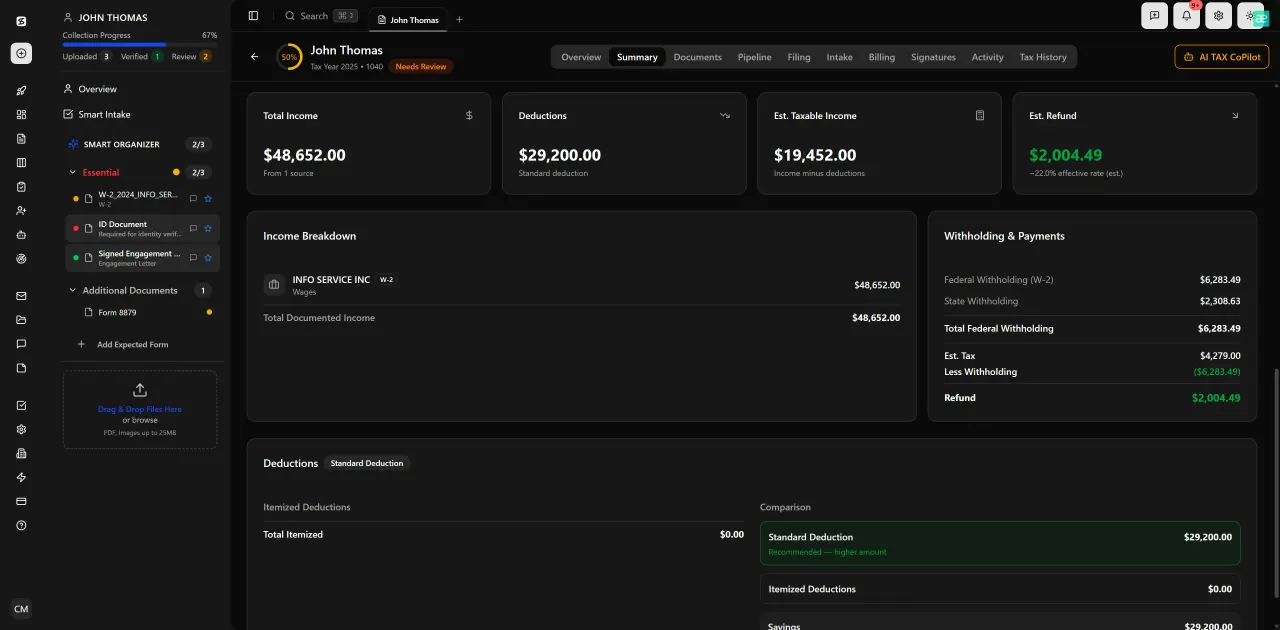
Review with AI assist — 9 agents answer questions with full client context
Life Events and Trigger Signals That Indicate Advisory Readiness
The most effective way to identify advisory candidates is not to look at revenue or business size — it is to watch for life events that create new financial complexity. These events reliably generate questions a compliance engagement cannot answer, which means the client will either pay for advice elsewhere, make uninformed decisions, or go underserved. Any of those outcomes is a missed opportunity. Selling advisory services sits at the center of this decision — get it wrong and the rest unravels.
The IRS publication library documents dozens of situations that carry significant tax elections and planning windows — entity changes, retirement contributions, real estate transactions, and more. Most of those situations arrive as life events before they appear as tax-year data. Here are the highest-signal triggers to monitor: When firms revisit their selling advisory services priorities, the gaps usually surface here.
Business Formation and Entity Elections
A client who forms an LLC or S corporation has just entered a multi-year window of planning opportunity. Section 1202 stock exclusions, S election timing, reasonable compensation analysis, and retirement plan setup are all decisions that carry irreversible consequences if handled wrong. When a new entity shows up in a client's tax documents or intake questionnaire, that is a direct invitation to open a planning conversation — and a natural entry point for selling advisory services to a client who is already primed to need guidance.
In TaxScout's smart intake engine, entity structures flow into the client's persistent memory profile. When a new entity appears, the system flags it. You do not have to remember to look — the platform surfaces it in your pipeline view so the advisory conversation can happen at the moment of maximum relevance, not twelve months later at the next annual filing.
Liquidity Events and Funding Rounds
A business sale, equity buyout, or funding round creates an immediate planning window that closes quickly. Capital gains deferral strategies including Qualified Opportunity Zone investments under IRS guidance on IRC 1400Z-2 must be initiated within 180 days of the sale. Clients who receive a term sheet or close a transaction without proactive planning from their CPA leave real money on the table. Selling advisory services at this moment — when the stakes are highest and the planning window is shortest — is where a well-timed conversation delivers the most measurable value.
If a client mentions a pending transaction in an email, on an intake form, or in a prior-year return with a large Schedule D gain, that is a high-priority advisory trigger. The problem is that most CPAs only see this information passively, buried in documents. AI extraction that surfaces large capital gains automatically — and routes those clients into a dedicated workflow stage — turns passive data into proactive outreach.
Divorce, Inheritance, and Major Life Transitions
Divorce creates immediate tax consequences around filing status, dependent allocation, alimony treatment under post-TCJA rules, and retirement account division via QDRO. Inheritance triggers basis step-up analysis, inherited IRA distribution planning under the SECURE 2.0 10-year rule, and potential estate tax exposure. Both events are emotionally charged and financially complex — exactly the conditions where clients most want a trusted advisor rather than a transactional preparer. For CPAs actively selling advisory services, these transitions represent some of the highest-conversion opportunities in the existing client base.
Clients going through these transitions rarely announce them proactively. They show up in the documents: a new filing status change, a Form 1099-R with a code 4 distribution, a stepped-up basis disclosure on a Schedule D. AI document extraction that flags these patterns across your client base means you see the advisory opportunity the moment the documents arrive — not after the planning window has already closed.
Tired of finding out about client life events after the planning window has already closed?
TaxScout's AI-powered client summaries surface advisory triggers the moment documents arrive — so you walk into every conversation prepared.
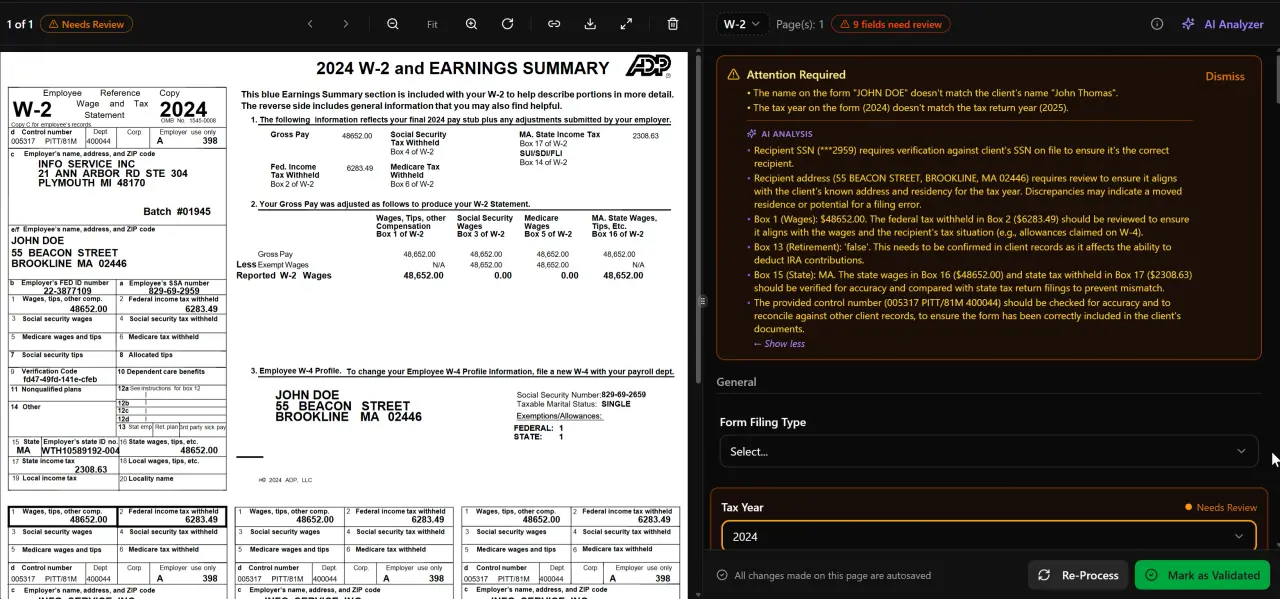
AI classifies, extracts, and validates every document automatically

Track firm performance with real-time analytics and client activity monitoring
How to Use AI Client Summaries as a Pre-Meeting Sales Tool
Most discussions of AI in accounting focus on efficiency: faster extraction, fewer keystrokes, reduced data entry errors. That framing undersells the most commercially valuable use case. A well-structured AI client summary is the best sales prep tool a CPA can have going into a conversion conversation — because it surfaces specific, dollar-denominated planning gaps that the client does not know they have. This is the preparation work that makes selling advisory services feel like a natural next step rather than an unsolicited pitch.
Before an advisory conversion meeting, a TaxScout summary can surface: the client's effective tax rate versus the rate achievable with reasonable compensation optimization; retirement contribution headroom they have not used; estimated self-employment tax exposure compared to what an S election would produce; or unrealized loss positions that could offset an upcoming gain. These are not generic recommendations — they are specific findings derived from that client's actual return history and document data.
The psychological effect is significant. When you walk into a meeting and say 'Based on your last two returns, I estimate you are overpaying approximately $8,400 per year in self-employment taxes that a properly structured S election would eliminate' — that is not a sales pitch. It is a diagnosis. The client's next question is almost always 'How do we fix it?' which is the natural opening for the advisory engagement discussion. Compare that to walking in and saying 'We offer advisory services starting at $X per month' and you can see why most advisory conversion attempts fail: they lead with price before they have established value.
TaxScout's AI research agents can support this preparation further by surfacing relevant IRS guidance, recent regulatory changes, or planning strategies applicable to a client's specific situation. For example, if a client has a rental property, the agents can pull current passive activity loss rules from Cornell Law's LII and flag whether the client qualifies for real estate professional status — before you even sit down with them.
A Repeatable Framework for the Advisory Conversion Conversation
The most effective advisory conversion conversations follow a four-part structure: surface, quantify, scope, and close. This framework works because it keeps the conversation anchored to the client's situation rather than your service menu. It also gives every team member a consistent method for selling advisory services without relying on individual salesmanship or improvised pitches.
Surface means presenting a specific finding from your pre-meeting review. 'I was reviewing your documents ahead of today's call and noticed something I want to walk you through.' This signals preparation and expertise before you have said anything about advisory services.
Quantify means attaching a dollar figure to the gap. Vague observations ('you might have some tax planning opportunities') create no urgency. Specific estimates ('based on your Schedule C net income of $180,000, a properly structured S election could save you roughly $7,200 to $9,000 per year in self-employment taxes, depending on how we set reasonable compensation') create urgency and justify a fee.
Scope means describing what ongoing advisory engagement would cover — not in terms of deliverables, but in terms of decisions. 'What we would do together is review your entity structure, set up a compensation strategy, establish a retirement plan, and then do quarterly check-ins so we catch planning opportunities before they expire rather than after the year closes.' This makes the service feel concrete rather than abstract.
Close means asking a direct question rather than making a pitch. 'Does it make sense to put a formal engagement together for this?' is easier for a client to say yes to than 'Would you like to purchase our advisory package?' The first question frames advisory as the logical next step in a conversation that has already established value. For billing structure guidance, our post on flat-fee billing for CPAs covers how to package advisory retainers so the price conversation is simpler.
You can find additional frameworks and resources across our complete advisory and firm growth blog, where we cover revenue strategy, pricing, and client management in depth.
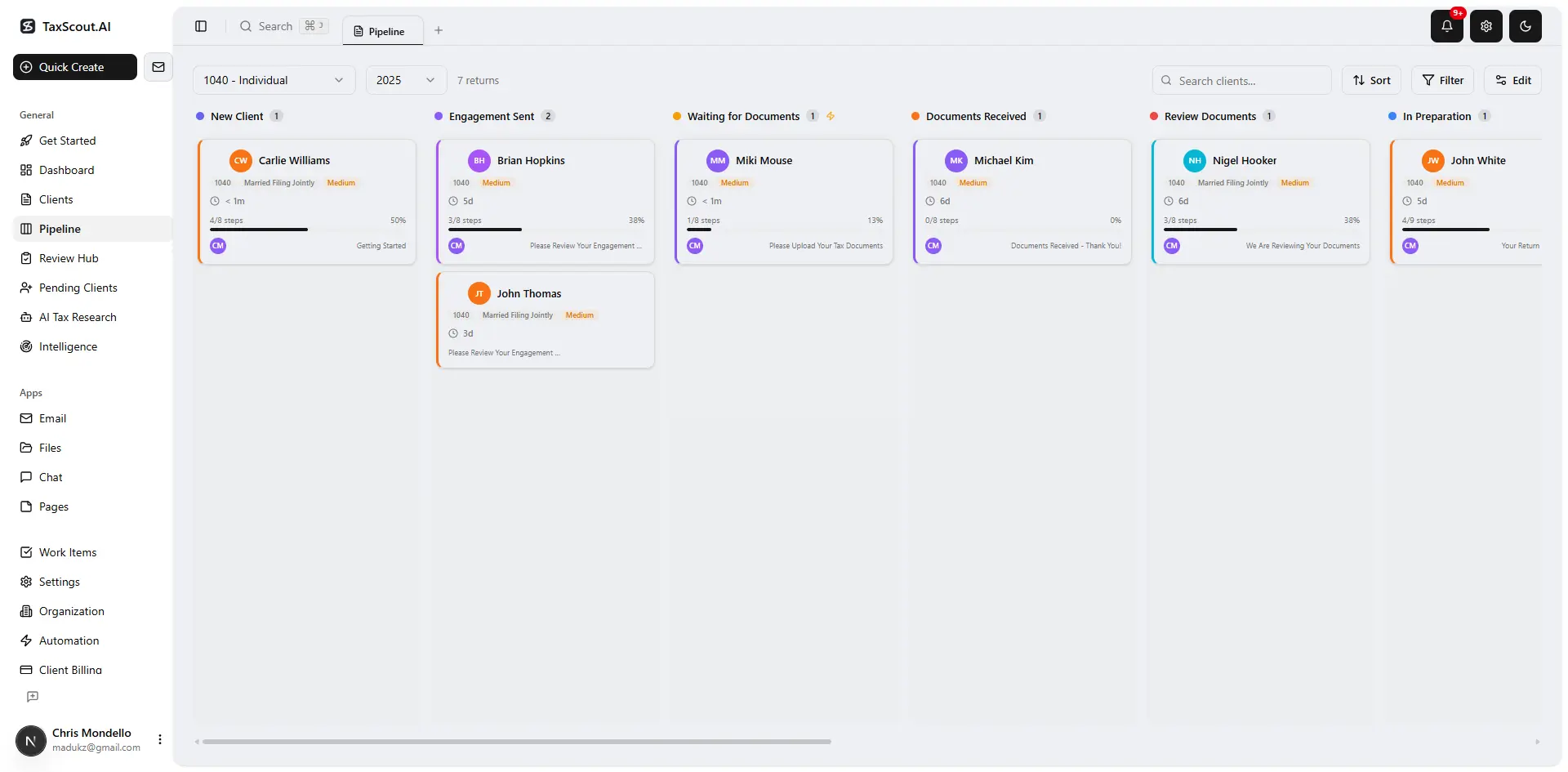
Track every return from intake to filed with drag-and-drop pipeline management
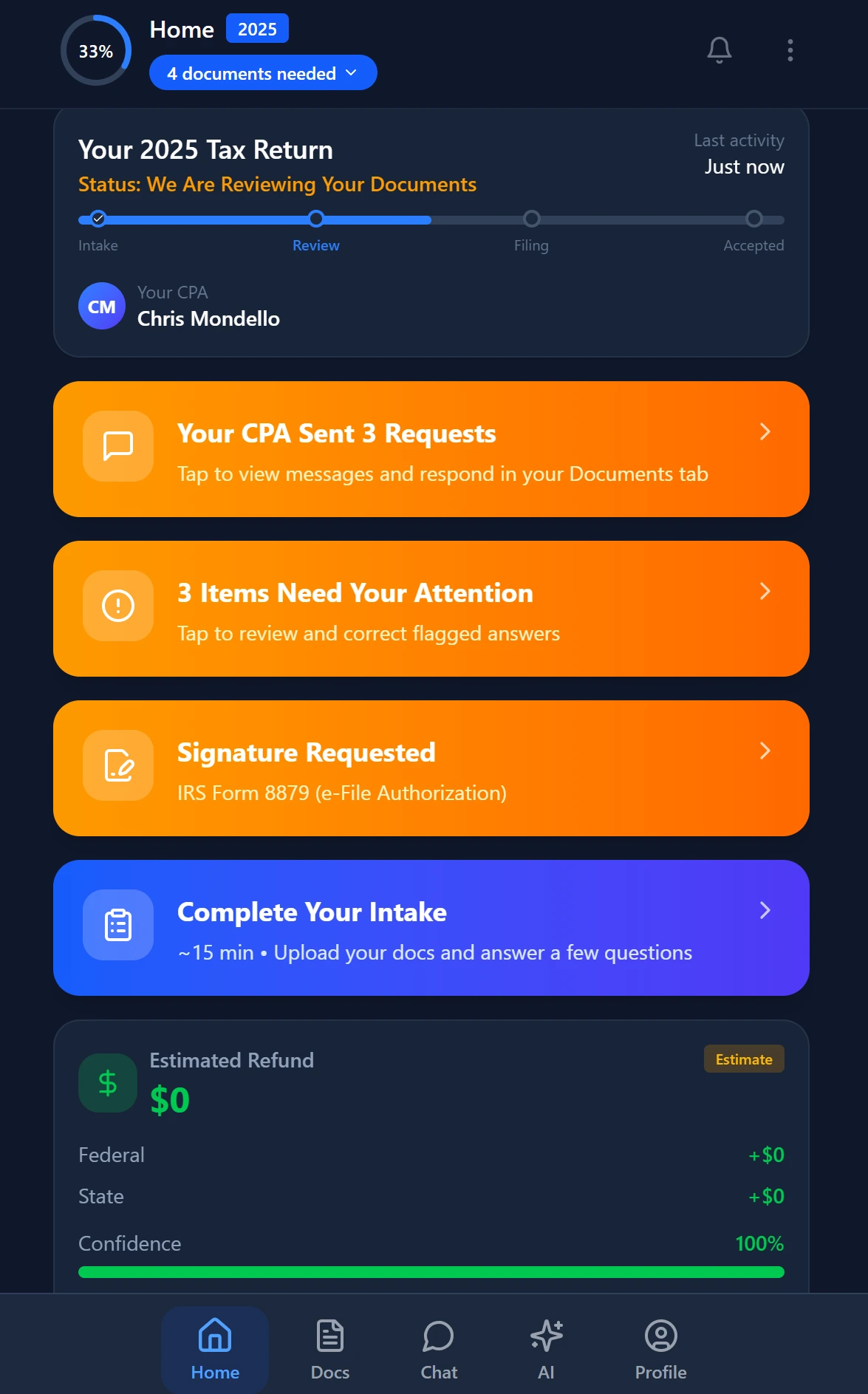
Smart intake auto-fills from uploaded documents and prior-year data
Building a Systematic Advisory Pipeline from Your Existing Client Base
Individual conversion conversations are valuable, but the real leverage comes from systematizing the process across your entire client roster. That means building a pipeline that continuously identifies advisory candidates, routes them to the right conversation at the right time, and tracks conversion progress without manual triage. Firms that treat selling advisory services as a repeatable process rather than a series of one-off conversations consistently outperform those that rely on opportunistic outreach.
In TaxScout's pipeline management module, you can create a dedicated advisory pipeline stage — separate from your compliance workflow — that captures clients flagged by trigger events. When AI extraction surfaces a new entity, a large capital gain, a filing status change, or a retirement distribution, those clients can be automatically routed into the advisory prospect stage with the relevant finding noted in the client record.
From there, the workflow is straightforward: a team member reviews the flagged clients weekly, schedules a brief advisory discovery call, runs a pre-meeting summary using the AI research tools, and enters the conversation prepared. Firms that build this process report that advisory conversion rates from existing clients are significantly higher than outreach to new prospects — because trust is already established and the data to support the conversation already exists in the client file.
The Bureau of Labor Statistics Occupational Outlook for Accountants and Auditors notes that advisory and management consulting services are among the fastest-growing revenue sources for CPA firms. The firms capturing that growth are not necessarily acquiring new clients at a faster rate — they are converting existing relationships more effectively.
To support consistent outreach, TaxScout's communication hub lets you track advisory outreach emails alongside existing client communication threads, so nothing falls through the cracks when a team member is managing multiple pipelines simultaneously.
Addressing the Pricing Conversation Without Losing the Relationship
Even with a well-executed conversion conversation, the pricing discussion can stall a deal that should close. Here is the dynamic to watch for: a client who has paid $800 per year for their return does not resist $500 per month because it is expensive — they resist it because the anchoring effect makes the jump feel disproportionate, regardless of value.
Two tactics reduce this friction. First, decouple the advisory engagement announcement from the annual compliance billing cycle. If you announce a new advisory offering at the same time you send a renewal invoice or a rate increase notice, the client conflates the two and perceives them both as price increases. Announce advisory separately, ideally during a proactive call or meeting that is not tied to any billing event.
Second, offer a defined-scope starter engagement rather than an open-ended retainer. A 'Q1 planning session and entity review' priced at $1,200 is psychologically easier to approve than a '$400 per month advisory retainer with no defined end date.' Once a client has experienced the value of a planning engagement, converting them to an ongoing retainer is a much shorter conversation. You can learn more about structuring tiered engagements in our guide to niche pricing strategy for CPAs.
For the ongoing retainer conversation, value-based pricing principles are directly applicable: the fee should be anchored to the value delivered, not to the time spent. A client saving $9,000 per year in taxes should perceive a $4,800 annual advisory fee as a straightforward investment, not an expense. The job of the conversion conversation is to make that math visible before the price is named. This is why selling advisory services on the basis of quantified client outcomes consistently produces higher close rates than leading with service tiers or monthly fee schedules.
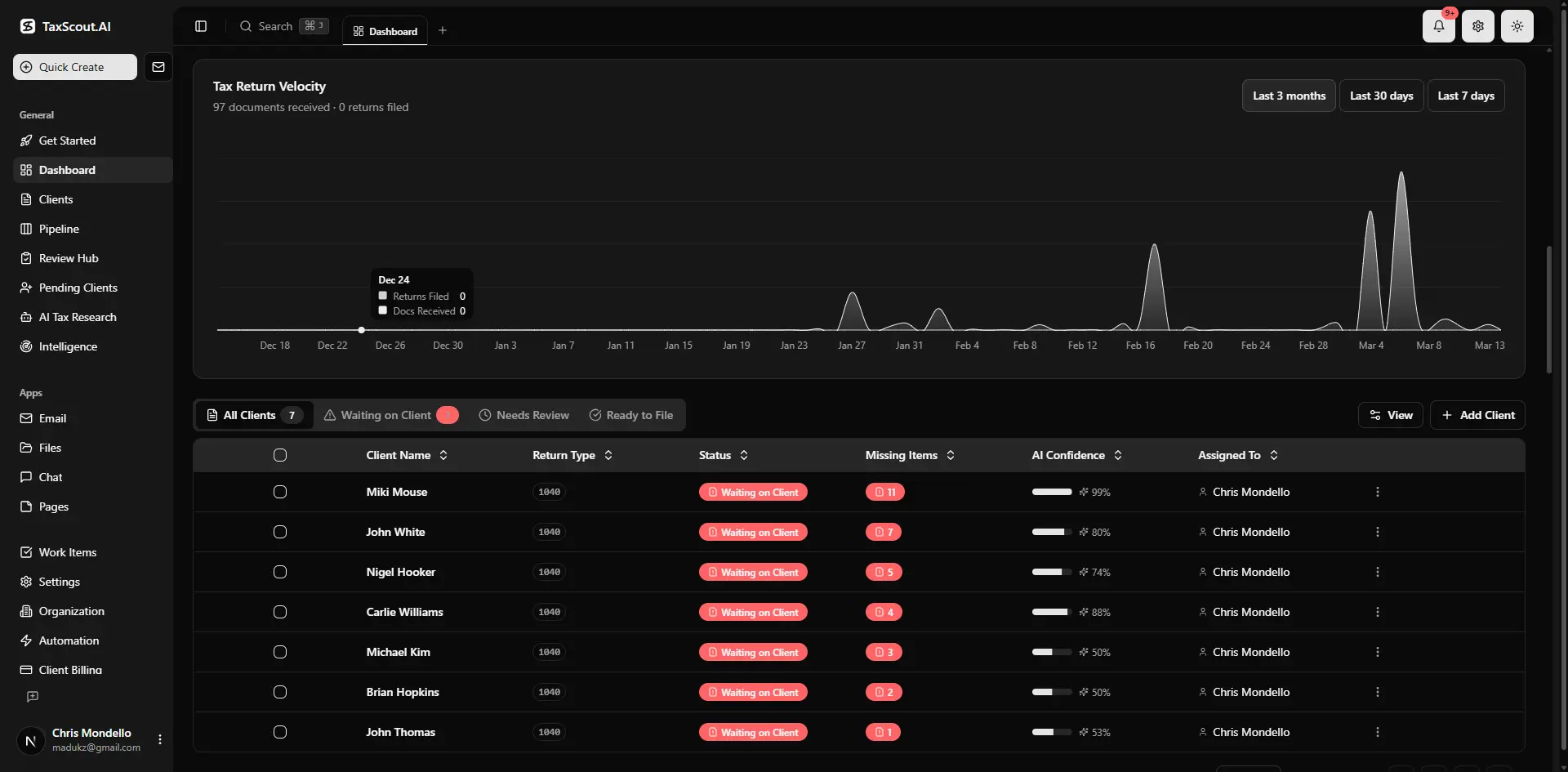
Real-time dashboard showing returns in progress, revenue, and upcoming deadlines

Click any extracted field to see its source highlighted on the original PDF
Measuring Advisory Conversion Performance Over Time
You cannot improve what you do not measure. For advisory conversion, the three metrics that matter most are: advisory pipeline entry rate (what percentage of your compliance clients enter the advisory prospect stage each quarter), advisory conversion rate (what percentage of those conversations result in a signed engagement), and revenue per client (how the average engagement value changes as advisory clients accumulate).
Tracking these metrics in your practice management system lets you identify which trigger events convert most reliably, which team members are most effective at the conversion conversation, and where in the pipeline clients are dropping out. The accounting firm KPI dashboard guide covers how to build and track these metrics systematically inside a practice management workflow.
For firms early in the advisory conversion process, a realistic first-year target is converting 10 to 15 percent of your top compliance clients into some form of advisory engagement. Even at modest retainer values, that conversion rate typically produces a 20 to 35 percent increase in revenue per client — without adding a single new name to the roster. The Small Business Administration publishes financial management guidance that underscores the growing demand for professional advisory services among small business owners — your existing clients are already in that market, and selling advisory services to them is the most efficient path to capturing it.
Want to start converting compliance clients without adding research hours to your week?
TaxScout gives you AI-generated client summaries, a dedicated advisory pipeline, and 9 specialized research agents — all on a flat monthly fee with no per-user charges.
Frequently Asked Questions
The most effective starting point is identifying clients who have recently experienced a life event — business formation, a liquidity event, a major inheritance, or a life transition like divorce. These events create immediate planning complexity that a compliance engagement cannot address. Use AI-generated client summaries to surface dollar-denominated gaps before your conversation so you lead with specific value rather than a generic pitch.
Keep reading
Backdoor Roth IRA: How CPAs Execute the Strategy Without Triggering Pro-Rata Tax
Oct 12, 2026 · 1 min read
Amended FBAR Procedures: How CPAs Correct Foreign Account Errors Without Triggering Penalties
Oct 12, 2026 · 1 min read
Transparency in Coverage Final Rules: What CPA Firms Must Do Now
Oct 12, 2026 · 1 min read
Stay up to date
Get the latest tax tech insights delivered to your inbox.