NACHA Phase 2 Compliance: What CPA Firms Managing ACH Payments Must Do Now
NACHA Phase 2 compliance is not optional for CPA firms collecting ACH payments from clients. This action guide walks through exactly what must change in your engagement letters, payment processor configuration, and account validation workflows — before the deadline catches you unprepared.
NACHA phase 2 compliance is not a future concern — it is an immediate operational requirement for any CPA firm collecting retainers, recurring fees, or one-time payments via ACH. The updated WEB Debit Rule mandates that all originators of WEB debit entries must use a commercially reasonable fraud detection system, and the Phase 2 expansion broadens which transactions and validation methods fall under that standard. If your firm processes ACH payments through Stripe, CPACharge, a bank portal, or any embedded billing tool in your practice management platform, you are an originator subject to these rules.
The compliance gap among CPA firms is real. Most regulatory coverage of NACHA's WEB Debit Rule focuses on banks and payment processors — not on the accounting firms that initiate the transactions. That means your engagement letters may contain outdated ACH authorization language, your payment processor may not have account validation enabled, and your intake workflow may not be capturing the authorization data NACHA now requires you to retain. Understanding NACHA phase 2 compliance is especially critical for CPA firms, since most regulatory guidance has been directed at banks rather than the accounting professionals who initiate these transactions.
This guide is not a regulatory overview. It is a step-by-step action checklist for practice managers and firm owners who need to verify — right now — that their ACH payment workflows are compliant. We also explain how an AI-native practice management platform can make these compliance requirements easier to meet without adding manual overhead to your team. Whether you are just beginning to assess your exposure or are deep into remediation, this checklist will help you confirm that your firm meets NACHA phase 2 compliance requirements before your next audit cycle.
What NACHA Phase 2 Actually Requires from Payment Originators
The NACHA Operating Rules govern all ACH transactions processed through the U.S. banking system. The WEB Debit Rule — which applies to any ACH debit entry where authorization is obtained via the internet or a mobile device — has been expanded in phases. Phase 1 required account validation at first use. Phase 2 extends the standard to require that originators use a commercially reasonable external validation method, not just internal checks, before initiating a debit against a consumer or business bank account. NACHA phase 2 compliance built on that foundation by introducing stricter account validation requirements, meaning firms must now verify that routing and account numbers are legitimate before initiating a WEB debit entry.
Under NACHA's published guidance, acceptable validation methods include micro-deposit verification, real-time bank account verification via a third-party data provider (such as Plaid or Finicity), and instant bank verification through open banking APIs. Simply asking a client to enter their routing and account number on a PDF is no longer sufficient authorization documentation for ongoing WEB debits. For firms evaluating their NACHA phase 2 compliance approach, this trade-off compounds over time.
CPA firms are considered Third-Party Senders or Originators depending on how they initiate payments. If your firm uses Stripe Connect, CPACharge, or a built-in invoicing module to pull ACH payments from client bank accounts, the Federal Reserve's ACH operator guidelines and NACHA rules apply to you directly. Non-compliance can result in your ODFI (Originating Depository Financial Institution) suspending your ACH origination privileges — which means no more direct billing until the issue is resolved. Each of these factors directly shapes how NACHA phase 2 compliance plays out in practice.
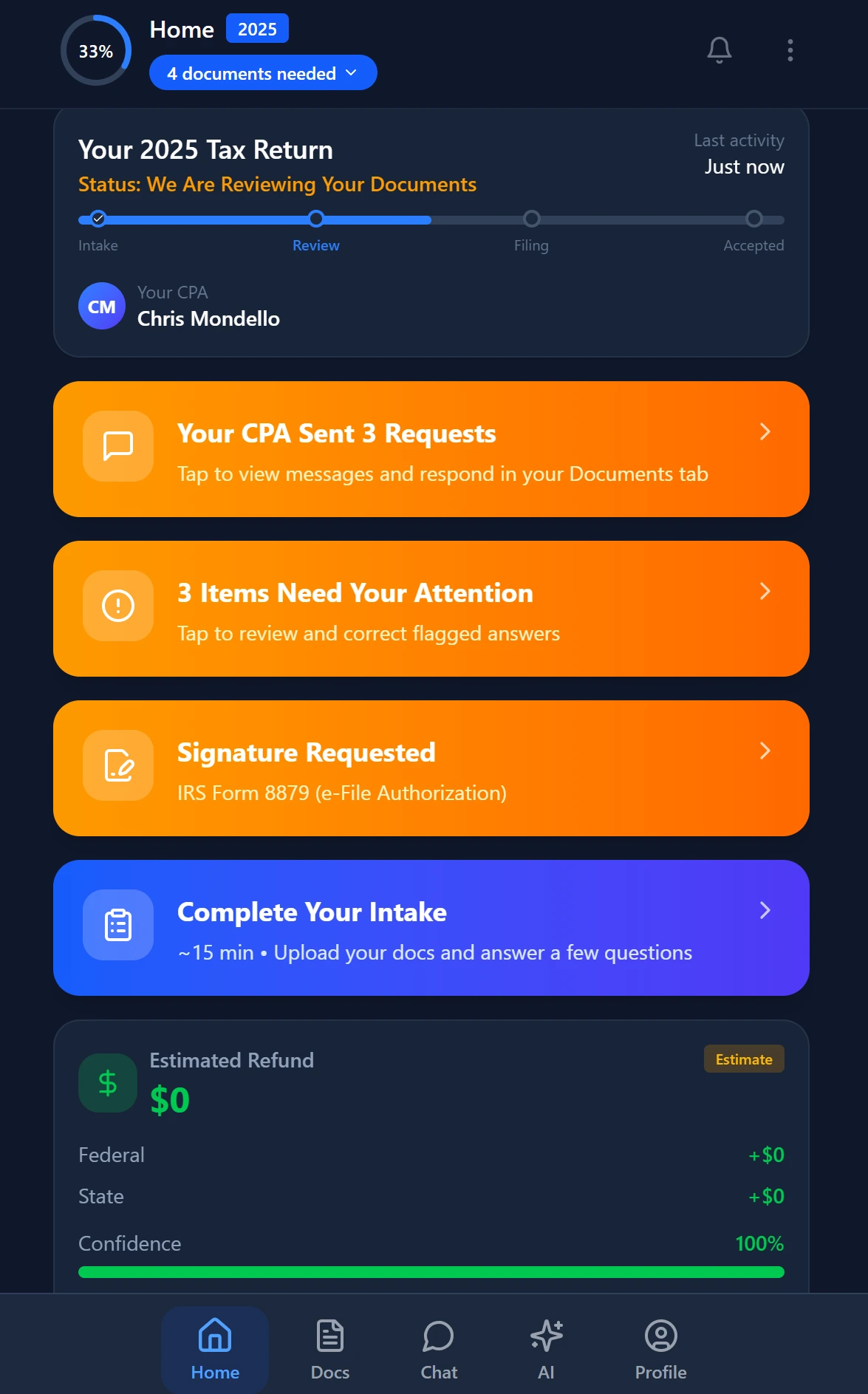
Smart intake auto-fills from uploaded documents and prior-year data
Step 1: Audit Your Engagement Letter ACH Authorization Language
The single most overlooked gap in CPA firm NACHA compliance is the engagement letter. Most firms copied ACH authorization language from a template years ago and have not revisited it since. NACHA Phase 2 compliance requires that your authorization language specifically discloses the validation method you use, the frequency and timing of debits, the amount (or method for calculating a variable amount), and the client's right to revoke authorization.
Conduct a line-by-line review of every engagement letter template your firm uses that includes ACH payment terms. At minimum, verify that the language covers: (1) the account owner's explicit consent to electronic debit, (2) the validation method used to confirm account ownership, (3) the debit schedule and whether amounts are fixed or variable, and (4) the cancellation and dispute process. Vague language like 'client authorizes electronic payment' does not meet the specificity standard. Understanding NACHA phase 2 compliance in this context is what separates firms that scale from those that stall.
If you use TaxScout's e-signature features for engagement letters, you already have a timestamped, audit-trail-backed record of when authorization was obtained. What you need to add is updated ACH authorization language in the template itself before the next round of engagement letters goes out. This is also a good time to revisit your electronic signatures compliance practices more broadly, since NACHA, ESIGN, and state-level eCommerce laws all interact with how digital authorizations are captured and retained. This is precisely where a deliberate NACHA phase 2 compliance strategy pays off.
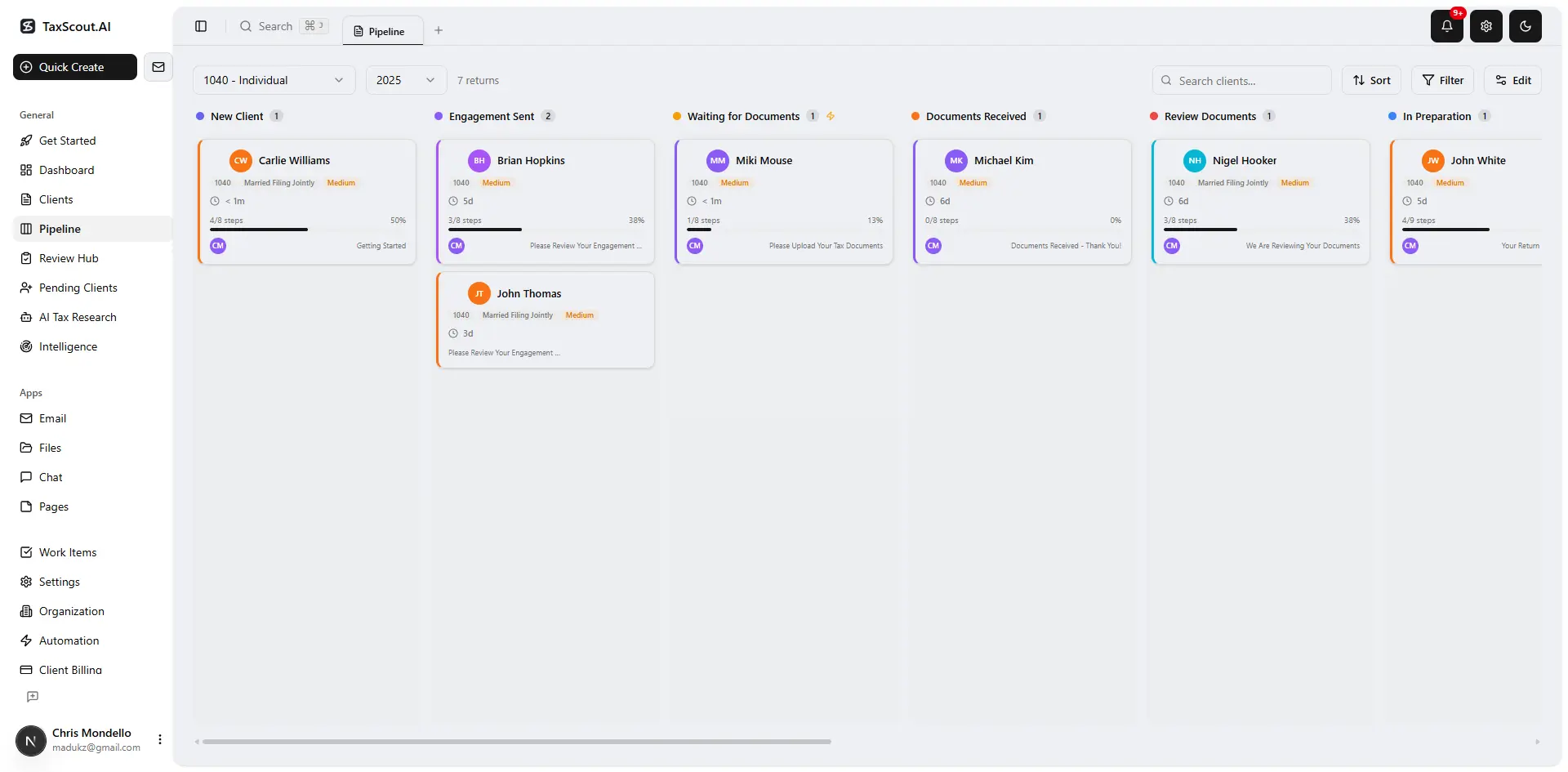
Track every return from intake to filed with drag-and-drop pipeline management
Step 2: Verify Account Validation Is Active in Your Payment Processor
Knowing that account validation is required is not the same as knowing it is actually enabled in your payment stack. Many firms assume their processor handles this automatically — and some do, but with optional features that may not be turned on by default. NACHA phase 2 compliance sits at the center of this decision — get it wrong and the rest unravels.
If your firm uses Stripe: Navigate to your Stripe Dashboard, open 'Payment methods,' and verify that ACH Direct Debit with bank account verification is configured. Stripe supports instant verification via Financial Connections (Plaid-backed) and micro-deposits. Instant verification is the stronger option for NACHA compliance because it confirms account ownership in real time rather than waiting 1-3 business days for micro-deposit confirmation. Review Stripe's ACH Direct Debit documentation to confirm your integration uses the verification flow — not just account number capture. When firms revisit their NACHA phase 2 compliance priorities, the gaps usually surface here.
If your firm uses CPACharge: Log in to your merchant portal and confirm that eCheck authorization forms are using the current CPACharge-hosted payment page, not a legacy PDF form. CPACharge's hosted payment pages include bank account validation through their processor network. If you are embedding payment links manually, consult their support documentation to ensure validation is not being bypassed.
Regardless of processor, document which validation method is active and when it was last audited. NACHA compliance is not a one-time checkbox — it requires ongoing monitoring. Store this documentation in your firm's written information security plan or compliance records folder so it is accessible during any bank or regulatory review.
Tired of patching together compliance workflows across five different tools?
TaxScout's AI-native platform centralizes invoicing, e-signatures, client intake, and document management — so your ACH compliance workflow lives in one auditable place.

Every client gets organized documents, status tracking, and a complete history
Step 3: Update Your Client Intake Workflow to Capture Required Authorization Data
NACHA requires that you retain proof of authorization for each WEB debit — including the date authorization was obtained, the account details provided, and the validation method used. Most CPA firm intake workflows were not designed with this requirement in mind. The typical onboarding form collects a routing number and account number, but does not timestamp the authorization or link it to the validation event.
Your intake workflow needs to capture: the date and time the client submitted banking information, the validation method used (e.g., instant verification via Plaid, micro-deposit confirmation, or manual VOID check), the IP address or session metadata if authorization was obtained online, and the specific debit schedule authorized. This data must be stored in a retrievable format for a minimum of two years after the authorization is terminated — the standard retention window cited in NACHA's operating rules.
TaxScout's AI intake engine is modeled on IRS Form 13614-C and includes a 4-layer prefill system that captures structured client data at onboarding. For ACH compliance, the intake flow can be configured to collect and timestamp payment authorization data, link it to the signed engagement letter, and store it in the client record — creating a single, auditable authorization file. This is meaningfully different from storing a scanned PDF of a payment form in a generic folder, which is still how many firms manage this.
For firms managing recurring billing, also review our guide on automating recurring client invoicing, which covers how to structure billing cycles so that each debit is authorized, predictable, and properly documented without requiring manual intervention each billing period.

Your clients see your brand — OTP login, document upload, and real-time status
Step 4: Implement Ongoing ACH Fraud Detection Monitoring
Phase 2 of NACHA's WEB Debit Rule specifically requires that fraud detection be commercially reasonable — meaning it must be an ongoing operational practice, not a one-time check at account setup. For CPA firms, this translates to three concrete actions: monitoring for returned ACH transactions and investigating patterns, flagging anomalous payment behavior such as sudden account changes or authorization revocations, and using your processor's fraud reporting tools to document your detection activity.
Stripe, CPACharge, and most ACH processors provide return code reporting. ACH return codes published by NACHA differentiate between administrative returns (wrong account number) and unauthorized returns (R10, R29 — indicating the account holder is disputing the debit). A commercially reasonable fraud detection program requires that you review these returns, investigate unauthorized return codes, and take corrective action — which may include suspending the payment method and re-verifying authorization.
Document your fraud monitoring process in a written policy. This does not need to be lengthy, but it does need to exist. The SSA's guidance on financial record retention and the Treasury Department's financial integrity resources both underscore the importance of written procedures for firms handling recurring electronic payments. If your firm does not have a written ACH fraud monitoring policy, drafting one this quarter should be a compliance priority.
NACHA Phase 2 Compliance Checklist for CPA Firms Collecting ACH Payments
| Compliance Action | Requirement Source | Responsible Party | Status Check |
|---|---|---|---|
| Update engagement letter ACH authorization language | NACHA WEB Debit Rule, ESIGN Act | Firm owner / operations manager | Review all active templates |
| Enable account validation in payment processor | NACHA Phase 2 — external validation required | Firm owner / IT / processor admin | Verify in processor dashboard |
| Capture and store authorization data at intake | NACHA retention standard (2 years post-termination) | Intake workflow owner | Audit intake form fields |
| Implement ongoing ACH fraud detection monitoring | NACHA 'commercially reasonable' standard | Billing / operations | Create written monitoring policy |
| Train staff on ACH return code review | NACHA Operating Rules | Practice manager | Schedule quarterly review cadence |
| Link payment authorization to signed engagement letter | Best practice / audit readiness | Platform admin | Configure in practice management system |
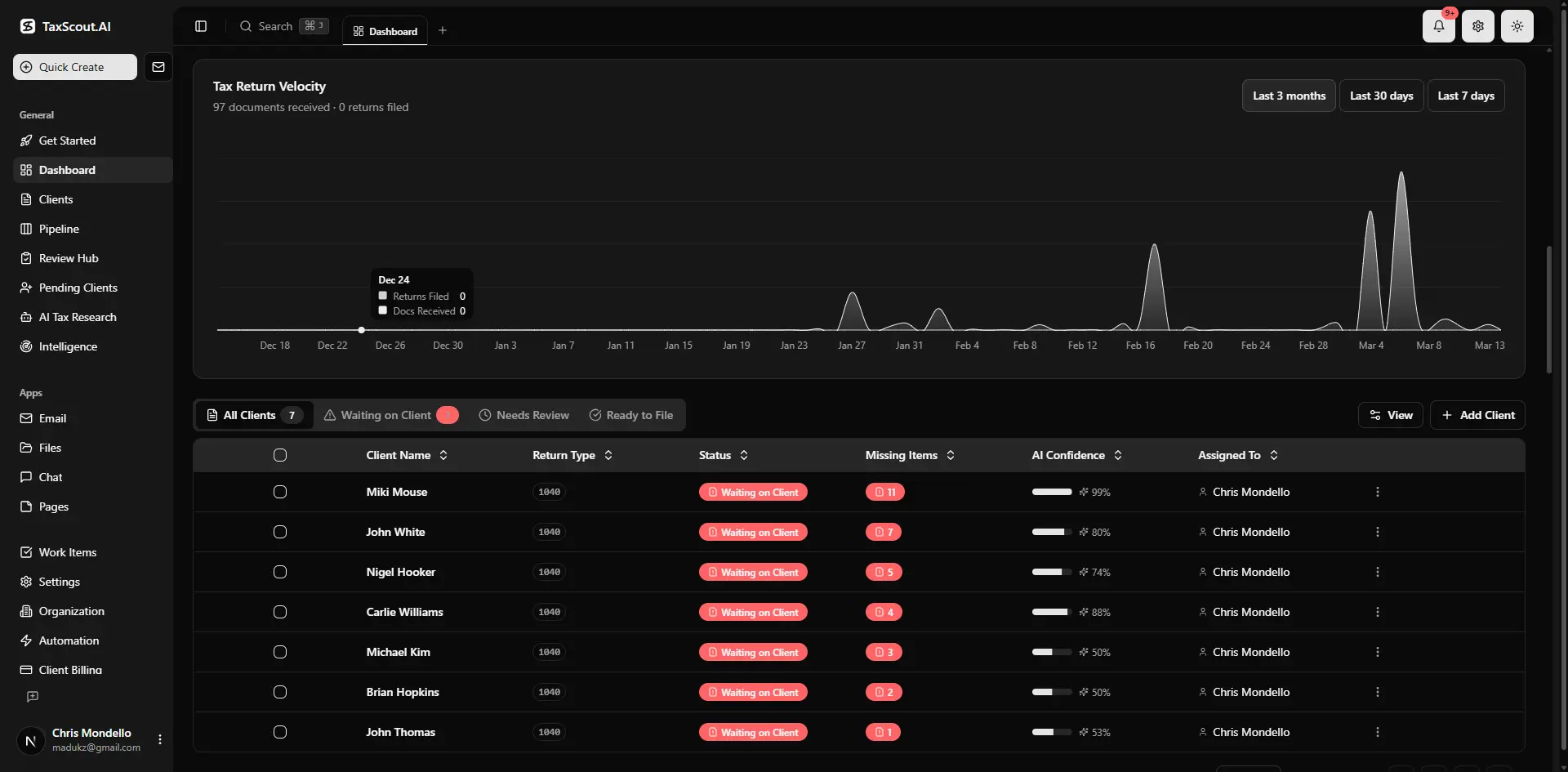
Real-time dashboard showing returns in progress, revenue, and upcoming deadlines
How an AI-Native Practice Management Platform Handles ACH Compliance Transparently
The challenge for CPA firms is not understanding NACHA phase 2 compliance requirements — it is operationalizing them without adding significant manual work to an already stretched team. Most practice management platforms were built around workflow and document management, with payment features bolted on afterward. That architecture creates compliance gaps: authorization data lives in the payment processor, engagement letters live in a document folder, and intake data lives in a form tool — none of it linked.
TaxScout approaches this differently. The invoicing module is built on Stripe Connect Express and surfaces ACH payment options natively within the client portal. Authorization data captured at payment setup is timestamped and tied to the client record. The client portal uses OTP login (no passwords) so access events are logged, creating an additional layer of session-level audit trail for any authorization obtained through the portal.
The e-signature workflow supports Form 8879, engagement letters, and custom documents — meaning the ACH authorization addendum you add to your engagement letter template will be signed, timestamped, and stored in the same client file as the intake form and payment history. This is the kind of unified authorization record that makes a NACHA compliance audit straightforward rather than a scramble across three systems.
For firms that want to explore this architecture before committing, our pricing page shows that TaxScout Prep Pro at $149/month serves unlimited clients with no per-user fees — making it cost-effective to bring the entire billing and compliance workflow onto one platform rather than paying per-seat fees to a patchwork of tools. You can also explore how TaxScout compares to TaxDome on compliance and billing features specifically.

Click any extracted field to see its source highlighted on the original PDF
What Happens If Your Firm Is Not Compliant
The enforcement mechanism for NACHA compliance runs through your ODFI — the bank or credit union that originates your ACH transactions. If your return rate on WEB debits exceeds NACHA's thresholds (currently 0.5% for unauthorized returns and 3% for administrative returns), your ODFI is required to investigate and may suspend your origination privileges. For a CPA firm that bills clients electronically, this is an operational emergency — not just a compliance fine.
Beyond ODFI enforcement, NACHA can directly sanction originators and their processors for rule violations. These sanctions are published and searchable, which creates reputational risk in addition to operational disruption. The Cornell Law School Legal Information Institute's overview of the Electronic Fund Transfer Act covers the consumer protection framework that underlies NACHA's rules and explains the liability exposure for unauthorized electronic transfers — exposure that can attach to your firm if your authorization documentation is inadequate.
The good news is that getting compliant is a finite project. The checklist in this article covers the core requirements. Completing it before the next billing cycle — not before a theoretical future deadline — is the right timeline. For additional context on how compliance requirements interact with your broader firm operations, browse other blog resources covering practice management, billing, and regulatory updates for CPA firms.
Ready to stop managing ACH compliance across disconnected tools?
TaxScout unifies client intake, e-signatures, invoicing, and document storage into one compliant, AI-native platform — purpose-built for CPA firms.
Frequently Asked Questions
Yes. Any firm that initiates ACH WEB debit entries — meaning the authorization was obtained via the internet or a mobile device — is subject to NACHA's WEB Debit Rule. CPA firms using Stripe, CPACharge, or any platform with embedded ACH billing are considered originators and must ensure they are using a commercially reasonable external account validation method and maintaining proper authorization records.
Keep reading
Regulations Regarding Payment of Tax by Commercially Acceptable Means: What CPA Firms Must Do Now
Oct 21, 2026 · 1 min read
Estate Tax Closing Letter User Fee Update: What CPA Firms Must Do Now
Sep 28, 2026 · 1 min read
Qualified Plan Audit Requirements: How CPAs Prepare Employee Benefit Plans for DOL Review
Sep 24, 2026 · 1 min read
Stay up to date
Get the latest tax tech insights delivered to your inbox.