IRS Releases Tax Inflation Adjustments for Tax Year 2027: What CPA Firms Must Do Now
The IRS released nearly 70 inflation-adjusted tax provisions for tax year 2027 through IR-2026-133 and Revenue Procedure 2026-35, published November 5, 2026. CPA firm owners need to update planning templates, adjust withholding projections, and brief clients on bracket shifts before year-end closes.
On November 5, 2026, the IRS releases tax inflation adjustments for tax year 2027 — nearly 70 provisions covering rate schedules, the standard deduction, AMT exemptions, retirement contribution limits, and more. The official announcement, IR-2026-133, is effective for returns filed in 2028 for the 2027 tax year. The technical details live in Revenue Procedure 2026-35.
For CPA firm owners, this is not a background-reading announcement — it is an operational trigger. Withholding projections for business clients, year-end planning conversations with high-income individuals, and retirement plan contribution advice all hinge on these numbers. Firms that move quickly to update their templates and communicate changes to clients will differentiate themselves during the winter advisory window. Now that the IRS releases tax inflation adjustments for tax year 2027, CPA firm owners must treat this as an operational trigger rather than background reading.
This brief extracts the key numbers, identifies which client segments are most affected, and gives your team a concrete action list for this week. It does not rehash the press release verbatim — the IRS Newsroom page does that fine. The goal here is practice management clarity. Each year the IRS releases tax inflation adjustments for tax year 2027 and beyond, the practical challenge for firms is translating raw numbers into client-ready guidance before competitors do.
What Changed for Tax Year 2027
Revenue Procedure 2026-35 covers adjustments to the tax brackets, standard deduction, alternative minimum tax exemptions, earned income tax credit thresholds, annual gift tax exclusion, adoption credit, and foreign earned income exclusion, among others. Because most individual provisions were made permanent by P.L. 119-21 (signed July 4, 2025), these adjustments are purely inflationary — the structure of the rates and the Working Families Tax Cuts remain intact. Revenue Procedure 2026-35 is the formal mechanism by which the IRS releases tax inflation adjustments for tax year 2027, touching everything from bracket thresholds to the standard deduction and gift tax exclusion.
The seven individual rate brackets (10%, 12%, 22%, 24%, 32%, 35%, 37%) continue under permanent law. What changes for 2027 is where the bracket thresholds fall after the annual inflation adjustment. Firms should pull the full table from Revenue Procedure 2026-35 on IRS.gov and plug the new thresholds into any planning models that currently reference 2026 figures. For firms evaluating their IRS releases tax inflation adjustments for tax year 2027 approach, this trade-off compounds over time.
For context, the 2026 standard deduction stood at $16,100 for single filers and $32,200 for married filing jointly under IRS Rev. Proc. 2025-32. The 2027 figures from Rev. Proc. 2026-35 will be modestly higher. If you need the exact 2027 dollar amounts before updating your systems, verify them directly in Revenue Procedure 2026-35 — do not rely on memory or secondary sources for specific figures. Each of these factors directly shapes how IRS releases tax inflation adjustments for tax year 2027 plays out in practice.
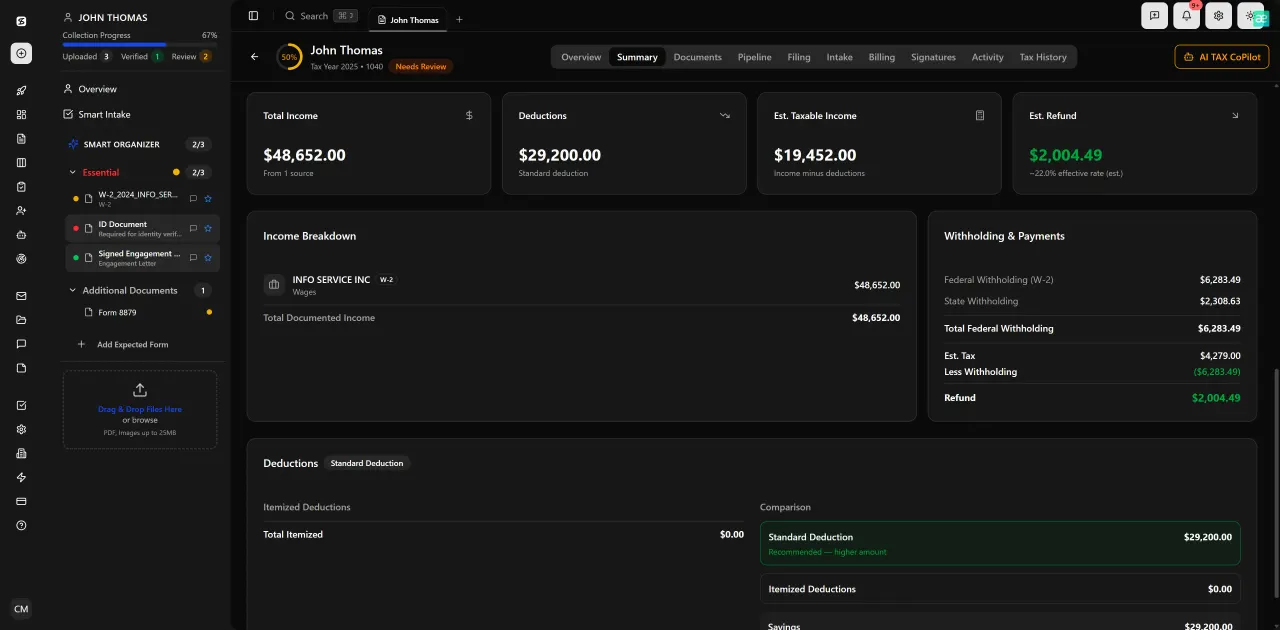
Review with AI assist — 9 agents answer questions with full client context
Which Client Segments Are Most Affected
Tired of manual workflows slowing your firm down? See how TaxScout handles this with AI-powered automation. → Book a 15-Min Demo Understanding IRS releases tax inflation adjustments for tax year 2027 in this context is what separates firms that scale from those that stall.
Individual filers (Form 1040) feel the broadest impact. Bracket threshold shifts affect estimated tax payments, withholding elections, and Roth conversion sizing for clients in the 22%–32% range. Clients who are salaried W-2 employees may need a revised Form W-4 if their income is near a bracket boundary. See the IRS withholding estimator guidance for reference. This is precisely where a deliberate IRS releases tax inflation adjustments for tax year 2027 strategy pays off.
S-corp owners and sole proprietors are affected through the Section 199A qualified business income deduction, whose phase-in range adjusted for 2026 to $75,000 single / $150,000 joint, and will adjust again for 2027. The QBI deduction interaction with the standard deduction and bracket position makes year-end salary vs. distribution planning particularly sensitive to the new thresholds. For more on S-corp basis complexity, see our basis tracking for S-corp shareholders guide. IRS releases tax inflation adjustments for tax year 2027 sits at the center of this decision — get it wrong and the rest unravels.
Partnership and LLC clients face similar bracket-driven planning considerations at the partner level. Where guaranteed payments are involved, the self-employment tax base and income tax bracket overlay both shift — review open engagements for clients near threshold boundaries. Our partnership guaranteed payments guide covers the SE tax mechanics in detail.
High-net-worth and estate planning clients should note that the estate and lifetime gift tax exemption for 2026 is $15,000,000 per person with indexing continuing forward. The 2027 indexed figure will appear in Rev. Proc. 2026-35. Clients who deferred large gift transactions pending the 2027 numbers now have clarity to act.
Tax-exempt organizations are indirectly affected through UBTI bracket rates and unrelated business taxable income calculations. While the nonprofit itself does not file a 1040, the unrelated business taxable income rate table follows the trust/estate schedule, which is also adjusted annually.
Tired of manually updating planning templates every time the IRS drops a new Revenue Procedure?
TaxScout.ai's AI research agents pull IRS, Treasury, and law.cornell.edu sources in real time — so your team always works from current numbers, not last year's defaults.
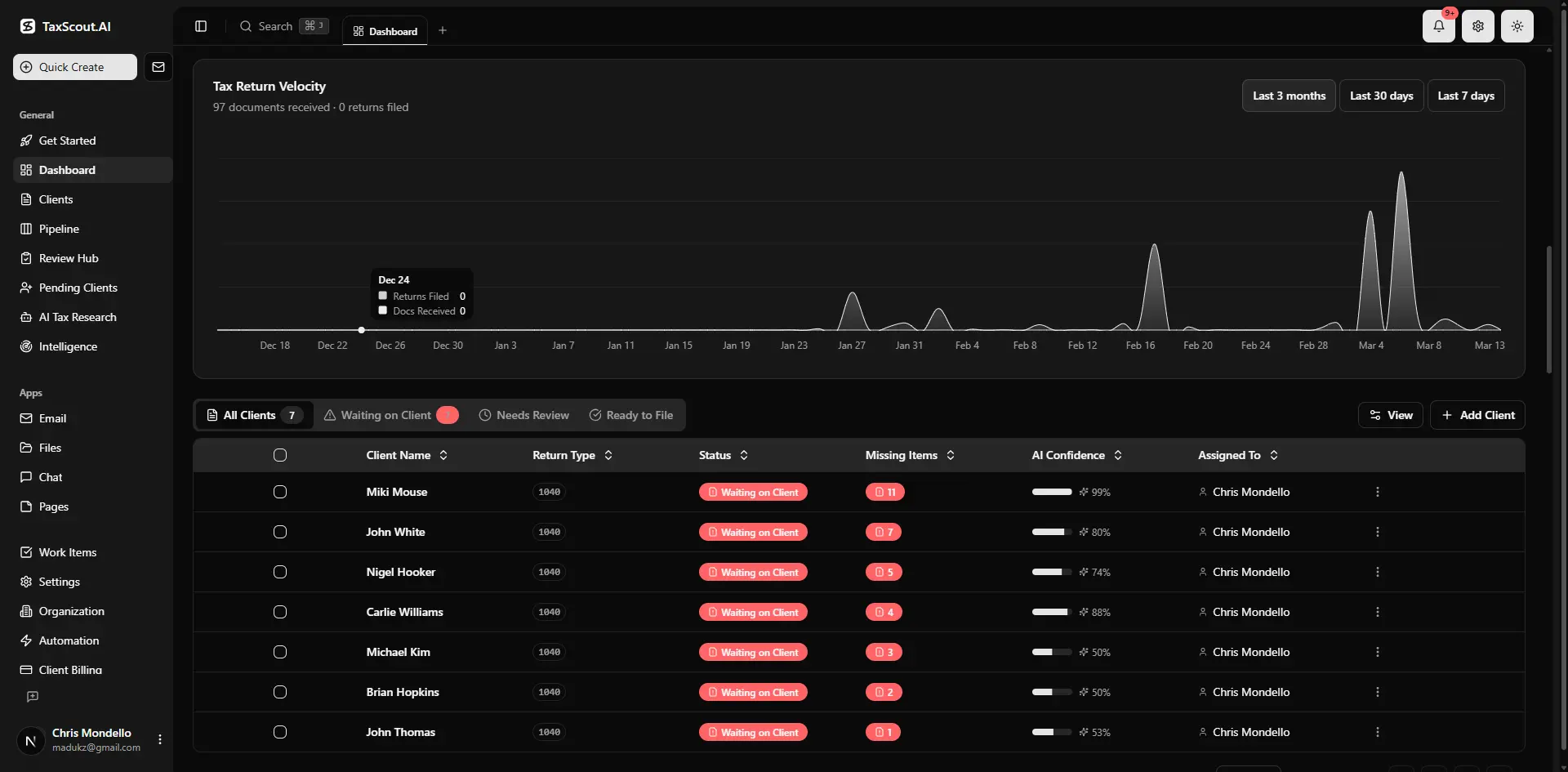
Real-time dashboard showing returns in progress, revenue, and upcoming deadlines
What to Do This Week: A Firm Action List
The following steps are sequenced by urgency. Teams with dedicated tax staff can divide these across associates; solo practitioners should prioritize the first three before anything else.
- Download Revenue Procedure 2026-35. Pull the full document from IRS.gov and extract the bracket tables, standard deduction amounts, AMT exemptions, and retirement plan limits into a shared reference document. This becomes your 2027 planning baseline.
- Update your tax projection templates. Any Excel or software-based projection tool that hardcodes 2026 thresholds needs a 2027 version. For firms using the TaxScout Excel 1040 calculator (66 sheets, ~36,000 formulas), confirm whether the forthcoming update cycle includes Rev. Proc. 2026-35 values.
- Flag clients near bracket boundaries. Run a quick pass of your 2026 clients whose projected 2027 income falls within $20,000 of a bracket threshold. These clients benefit most from a year-end conversation about timing income, accelerating deductions, or adjusting withholding.
- Revisit W-4 and estimated tax recommendations. For W-2 clients, a bracket shift — even a modest one — can mean under-withholding if they set their W-4 based on 2026 tables. Use the IRS Tax Withholding Estimator as the reference tool and document your recommendation in the client file.
- Update retirement contribution talking points. Retirement plan contribution limits (401(k), IRA, HSA) are adjusted separately but often released alongside the main inflation adjustment announcement. Confirm the 2027 limits from Rev. Proc. 2026-35 and push updated figures to your advisory team. The IRS retirement plans page is the authoritative source.
- Queue client communications. A brief client-facing summary of the 2027 standard deduction and bracket changes positions your firm as proactive. If your practice uses a client portal, drafting a short bulletin now — before the December holiday slowdown — sets a professional tone for the new year. TaxScout's client portal supports broadcast communications to segmented client groups.
- Brief your team. Add a standing agenda item to your next staff meeting to walk through the key 2027 numbers. Staff who handle intake and tax organizer reviews need to know when a client's circumstances have shifted enough to warrant a planning call rather than a straight return preparation.
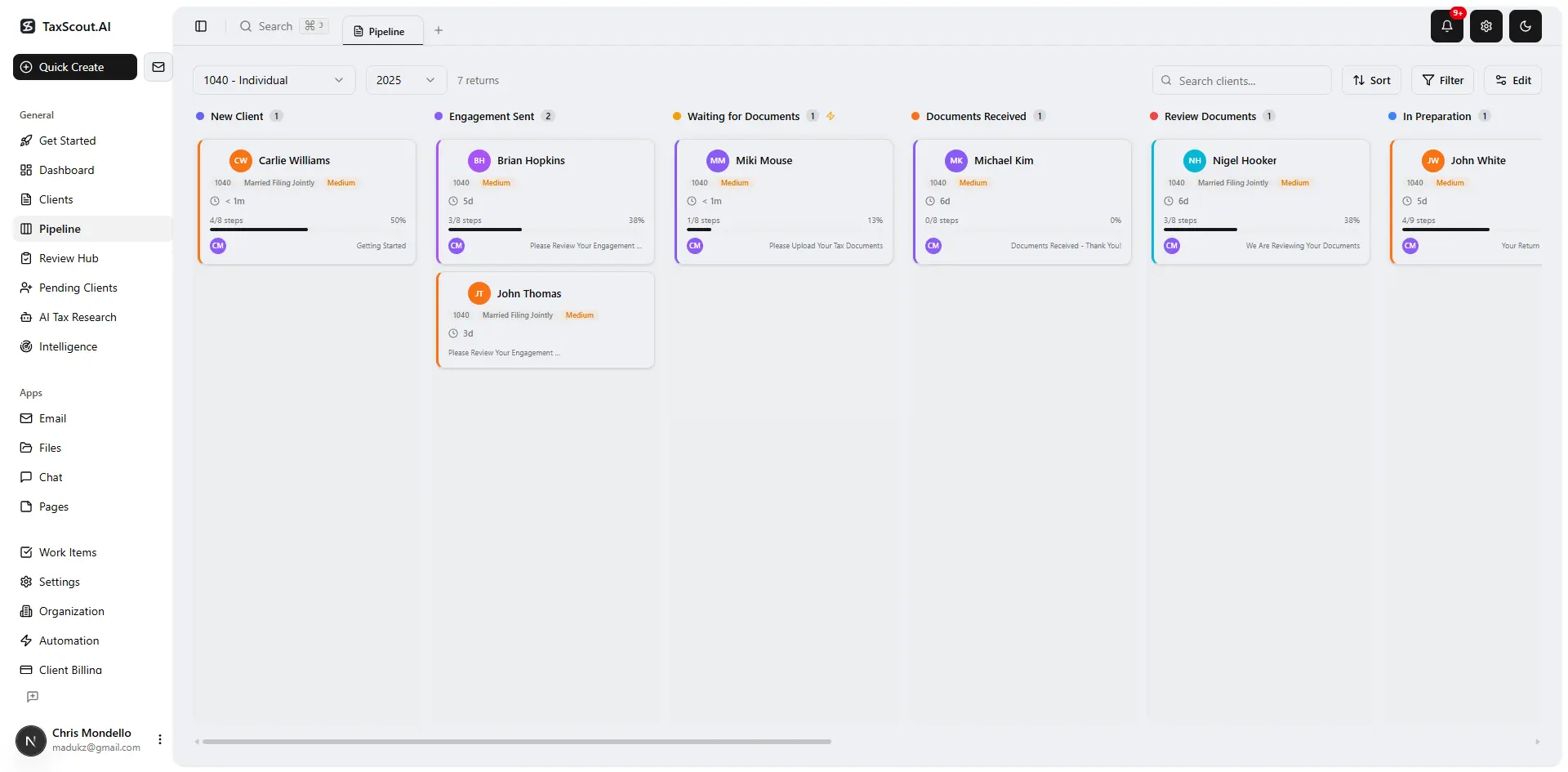
Track every return from intake to filed with drag-and-drop pipeline management

Every client gets organized documents, status tracking, and a complete history
Operational Notes for Firm Technology
If your firm uses Drake, CCH Axcess, UltraTax CS, Lacerte, ProConnect, or ProSeries, watch for the vendor's corresponding update release that incorporates Rev. Proc. 2026-35 tables. Those updates typically ship within two to four weeks of IRS publication but do not always auto-deploy — confirm your version is current before beginning 2027 year-end projections.
AI-assisted practice management platforms can accelerate the update cycle. TaxScout's AI document extraction and 9 specialized research agents cross-reference IRS, Treasury, and law.cornell.edu sources to surface relevant code sections in real time, reducing the manual effort of verifying whether a planning assumption still holds after a Rev. Proc. update. The pipeline integrates with your existing tax preparation software rather than replacing it.
For firms tracking tax season capacity and workflow, now is also the right moment to pressure-test your pipeline management setup for the 2027 filing season. Bracket and deduction changes tend to increase the volume of advisory conversations firms handle in Q4 and Q1, which translates directly into more tasks, more client touchpoints, and more documents moving through your system. For best practices on managing that surge, review our accounting busy season guide.
You can also browse other news resources on the TaxScout blog for coverage of IRS announcements, regulatory updates, and practice management guidance as they are published.
Primary Source and Further Reading
The authoritative source for all 2027 figures is IRS releases tax inflation adjustments for tax year 2027; taxpayers continue to benefit from the Working Families Tax Cuts, published November 5, 2026 as IR-2026-133. The technical detail document is Revenue Procedure 2026-35, available through the IRS website.
For prior-year context, the 2026 standard deduction and bracket thresholds are in IRS Rev. Proc. 2025-32. The SSA cost-of-living adjustment announcement for 2027 (released separately) is relevant for clients receiving Social Security benefits who may cross provisional income thresholds as a result of COLA increases.
If your firm has questions about how the new inflation adjustments interact with the SALT cap — which for 2026 sits at $40,400 for most filers with a phase-down above certain MAGI thresholds — confirm the 2027 figure directly from Rev. Proc. 2026-35. The cap and threshold rise at approximately 1% per year through 2029 under current law, then revert to a flat $10,000 from 2030 under IRC §164(b)(7) as added by P.L. 119-21.
Does your current practice management stack make it easy to act on IRS announcements the same week they drop?
TaxScout.ai gives CPA firms AI research agents, smart client intake, and a full pipeline — flat-rate, unlimited team members, no per-user fees.
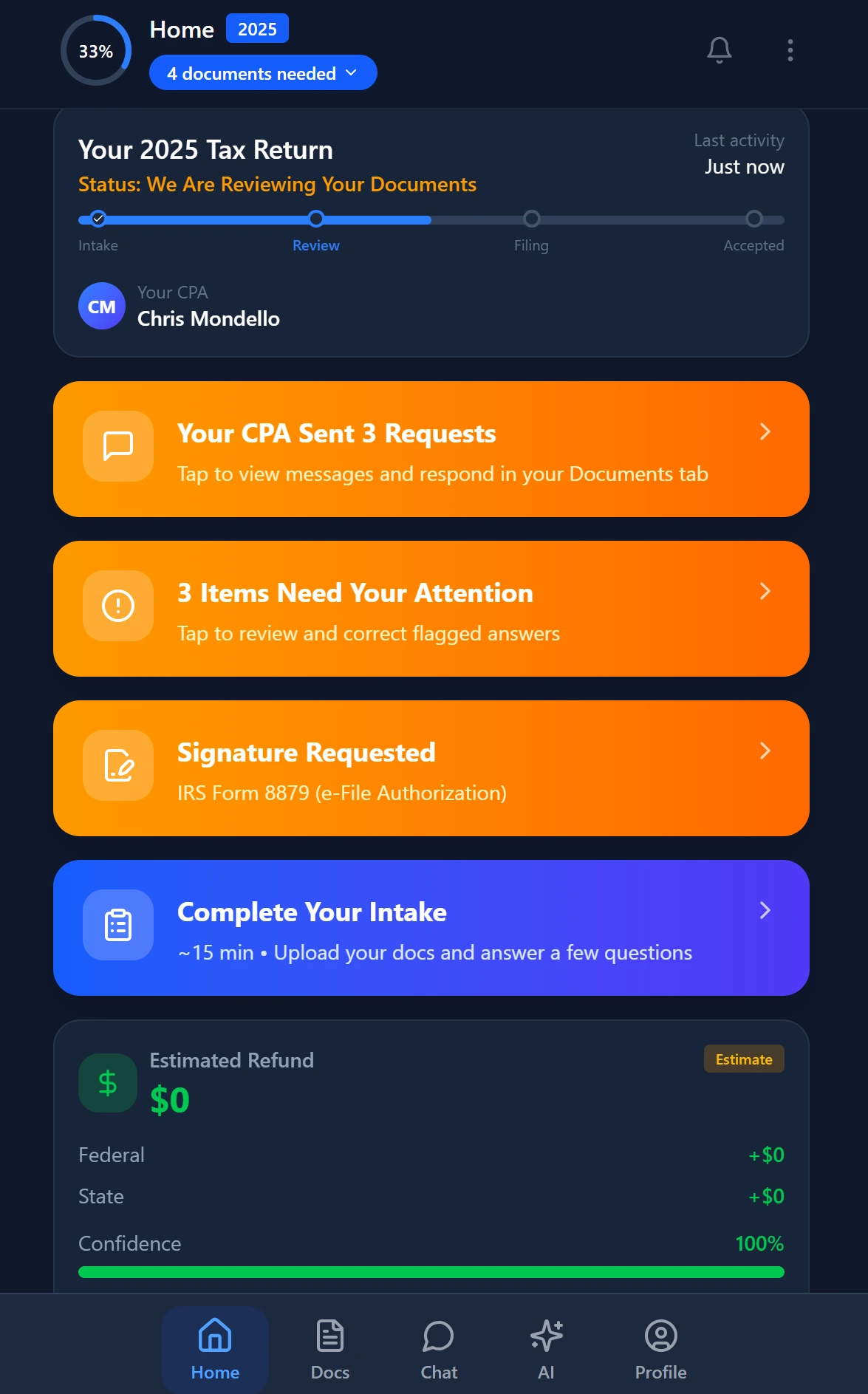
Smart intake auto-fills from uploaded documents and prior-year data
Frequently Asked Questions
The adjustments announced in IR-2026-133 and Revenue Procedure 2026-35 apply to the 2027 tax year — meaning returns filed in 2028. Clients do not use these figures on their 2026 returns, but year-end 2026 planning (withholding, estimated taxes, Roth conversions) should account for where 2027 brackets and thresholds will land.
Stay up to date
Get the latest tax tech insights delivered to your inbox.