IRS Income Taxes Rule Published August 21 2026: What CPA Firms Must Do Now
The IRS published a new income taxes document in the Federal Register on August 21, 2026 (Document No. 2026-17154). This brief cuts through the agency language to tell CPA firm owners exactly which client segments are affected and what steps to take before the week is out.
On August 21, 2026, the IRS published a new income taxes ruling in the Federal Register — Document No. 2026-17154. The Income Taxes notice (2026-17154) is live now, and its effective date means CPA firms cannot wait for the next newsletter cycle to act. Most coverage has simply republished the agency summary. This brief extracts the operational impact for small and mid-size CPA practices.
Federal Register income taxes publications carry immediate weight for any firm preparing individual and business returns. The document touches rules that flow through Form 1040 preparation, S-corporation and partnership pass-through calculations, and in some provisions, nonprofit reporting obligations under the IRC as codified at Cornell Law School's Legal Information Institute. Understanding the change at the entity level — not just the statutory level — is what separates proactive firms from reactive ones.
Below you will find a plain-language breakdown of what changed, a client-segment impact map, and a concrete action checklist designed for a firm principal who has limited time this week.
What the Federal Register Income Taxes Document Actually Changed
The IRS filing at federalregister.gov/documents/2026/08/21/2026-17154/income-taxes represents a formal regulatory action under Title 26. While the document number and publication date are confirmed, the specific technical amendments it contains require direct review from the primary source, because the IRS does not always syndicate granular rule-text through secondary channels before official publication.
In the context of income taxes rulings published by the IRS in mid-2026, the areas most commonly addressed include TCJA sunset provisions that remain in flux, taxable income calculation adjustments, and updated withholding guidance. CPA firms should open the primary source document directly and note the regulation section numbers cited so affected return types can be flagged in their workflow.
For compliance context, IRS guidance on income tax regulations explains the hierarchy of Treasury Decisions, Revenue Rulings, and Notices, which determines how quickly a published document binds taxpayers versus how long a comment period or applicability date provides a runway. Document 2026-17154 should be read against that hierarchy.
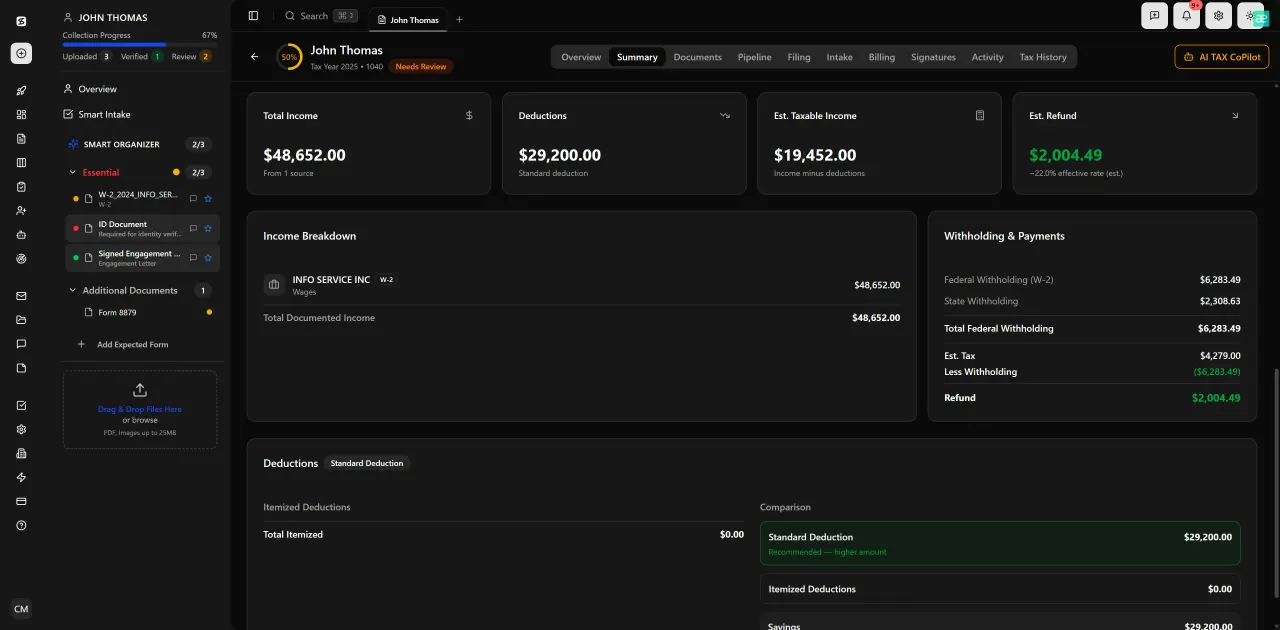
Review with AI assist — 9 agents answer questions with full client context
Which Client Segments Are Affected
Tired of manual workflows slowing your firm down? See how TaxScout handles this with AI-powered automation. → Book a 15-Min Demo
Most income taxes regulatory changes from the IRS have a tiered impact across entity types. Based on the scope typical of late-August Federal Register publications and the IRS's 2026 regulatory agenda published by the U.S. Treasury, the following client segments are most likely to be in scope:
Individual filers (Form 1040): Any change to income computation rules, above-the-line deductions, or tax brackets flows directly into 1040 preparation. Clients with wage income, self-employment income, or retirement distributions should be flagged for review against the updated rule text.
S-corporations and partnerships: Pass-through income rules sit at the intersection of entity-level elections and individual taxable income. If Document 2026-17154 touches Subchapter S or Subchapter K provisions, every S-corp K-1 and partnership Schedule K-1 in your pipeline is potentially affected. See the IRS S-corporation guidance page for the regulatory cross-references.
Nonprofits: Organizations filing Form 990 or 990-T that carry unrelated business income (UBIT) are subject to Subchapter F income tax rules. If the ruling touches UBIT calculations or uniform guidance cost allocations, nonprofit clients need separate flagging. Our earlier guide on nonprofit audit preparation covers the broader compliance picture for this segment.
Employers with benefit plans: Trump Account employer contribution rules published earlier in 2026 (see our coverage of employer contributions and nondiscrimination rules) interact with income tax treatment of contributions. Any employer client offering ABLE-adjacent or new account structures should be reviewed.
Tired of routing regulatory updates through a shared inbox where they get buried?
TaxScout's AI research agents surface IRS and Federal Register changes and tie them to the specific clients in your pipeline — no manual triage required.
What to Do This Week: Firm Action Checklist
The following steps are designed for a firm principal or senior manager to complete or delegate within five business days of publication. Regulatory latency is one of the most common sources of malpractice exposure for small CPA firms, and income taxes rule changes published in the Federal Register carry a date-certain compliance clock.
Step 1: Read the primary source. Open Income Taxes Document 2026-17154 in full. Note the effective date, the CFR sections amended, and whether there is a delayed applicability date or a retroactive provision. Print or save a PDF to your firm's document archive.
Step 2: Identify the CFR sections changed. Cross-reference the amended regulation citations against your current-year return checklists. Most tax software vendors (Drake, CCH Axcess, UltraTax CS, Lacerte, ProConnect, ProSeries) publish mid-season patch notes when a Federal Register change triggers a form update. Check your software vendor's bulletin board or support portal.
Step 3: Flag affected client files. Pull a list of open returns that involve the entity types identified above. For 1040 clients with pass-through K-1s, S-corp returns in progress, and any partnership returns awaiting final K-1s, add a review task before final sign-off. Use your pipeline management system to tag these files so nothing exits the pipeline without clearance.
Step 4: Update your engagement letter language if warranted. If the rule change creates a new disclosure obligation or alters the scope of services for open engagements, send an addendum. TaxScout's e-signatures workflow supports rapid addendum delivery through Form 8879-style flows, which shortens the turnaround compared to chasing wet signatures.
Step 5: Document your firm's review. Create a dated internal memo noting that the firm reviewed Document 2026-17154, identified affected return types, and implemented the steps above. This is your professional liability paper trail. Store it in the same folder as the primary source PDF. For more on keeping your firm's records airtight, see our guide to IRS deadlines and compliance.
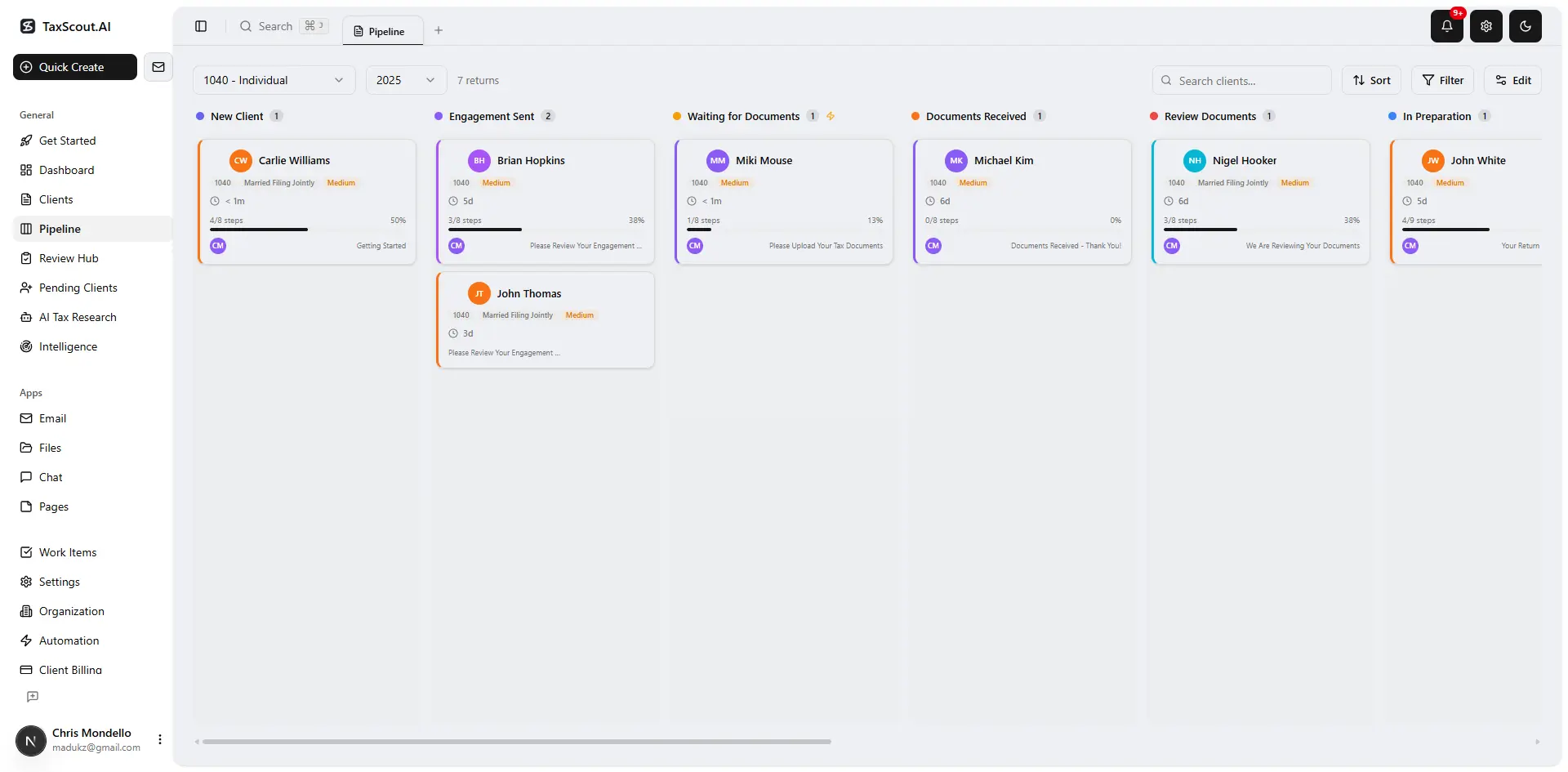
Track every return from intake to filed with drag-and-drop pipeline management
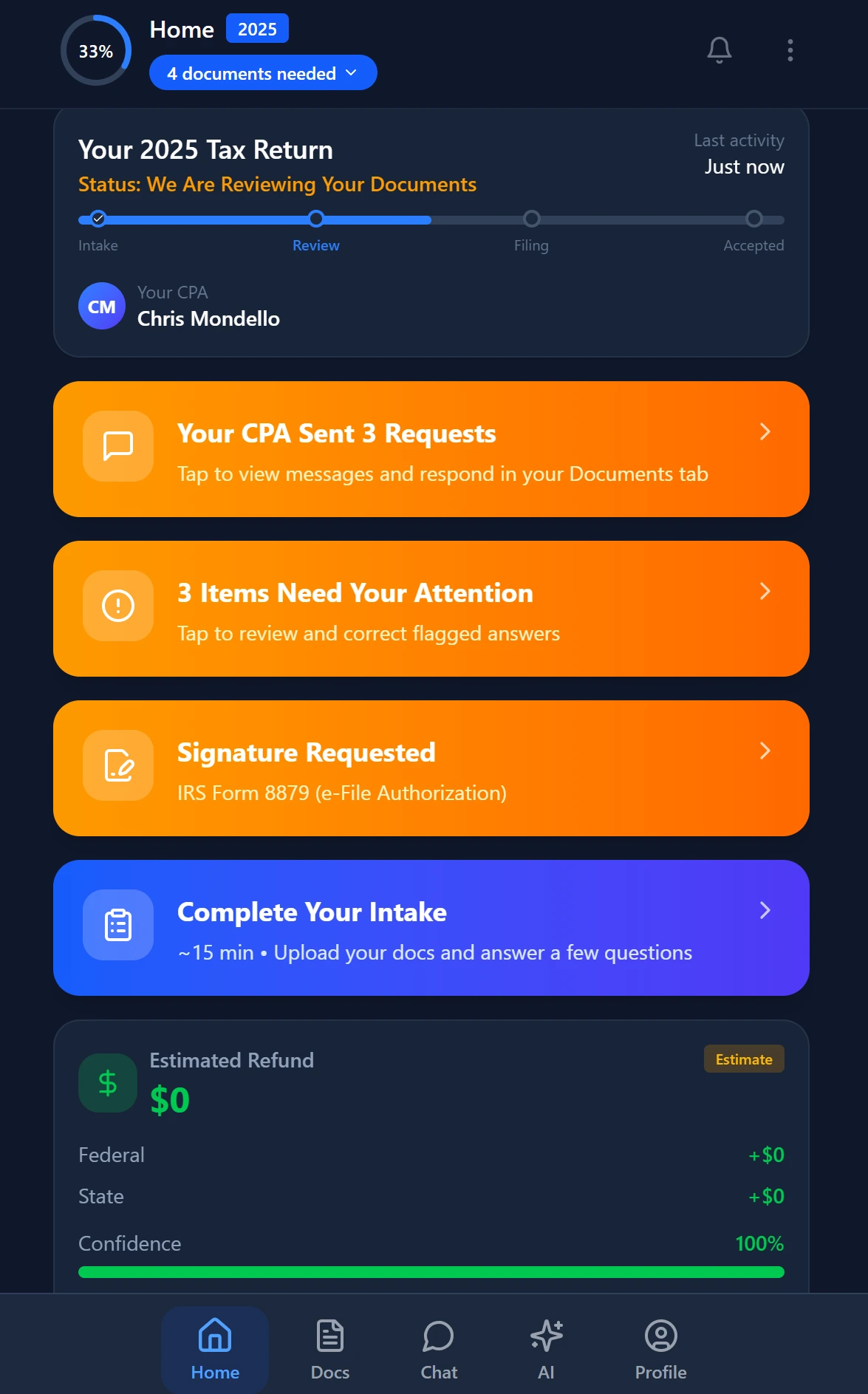
Smart intake auto-fills from uploaded documents and prior-year data
How This Fits Into the Broader 2026 Regulatory Picture
Document 2026-17154 is not an isolated change. The 2026 regulatory calendar has already delivered several high-priority updates affecting CPA firm workflows. Earlier this year we covered the proposed increase in 1099 reporting thresholds and the related information reporting implications. The BLS Occupational Outlook for accountants and auditors notes that regulatory complexity is among the primary drivers of demand for CPA services — a trend that 2026 is accelerating.
Firms that have invested in structured regulatory monitoring — rather than relying on informal news scanning — are processing these changes faster and with fewer errors. The TaxScout AI research agents are purpose-built for this: each agent queries IRS, Treasury, Cornell's Legal Information Institute, SSA, and Congress in real time, tied to the specific client context in your pipeline. That means when a Federal Register income taxes document publishes, the relevant client files surface immediately rather than after a manual search.
You can track all recent tax regulatory updates and CPA practice news through our complete tax news coverage, which is updated continuously as new Federal Register items publish. This gives your firm a single reference point rather than monitoring multiple government feeds manually.
Income Taxes Compliance and Your Practice Management Stack
One structural challenge this type of regulatory update reveals: most CPA firms lack a direct link between their regulatory monitoring and their client file system. A Federal Register alert lives in an email or a bookmarked tab, while the affected client returns live in a completely separate workflow. That gap creates the conditions for missed updates.
TaxScout's regulatory intelligence features are designed to close that gap. When a rule change affects income taxes computation, the platform ties the update to open client files by entity type and filing status — so your review task list builds itself rather than requiring manual cross-referencing. Pair that with AI document extraction that already understands the affected form types, and the time between 'rule published' and 'returns reviewed' compresses significantly.
For a deeper look at how AI extraction handles the 1040 schedules and K-1 documents most likely affected by income taxes regulatory changes, see our technical guide to AI document extraction for CPAs. The underpayment penalty and statute of limitations implications of missing a rule change also make the investment in a connected workflow straightforward to justify.
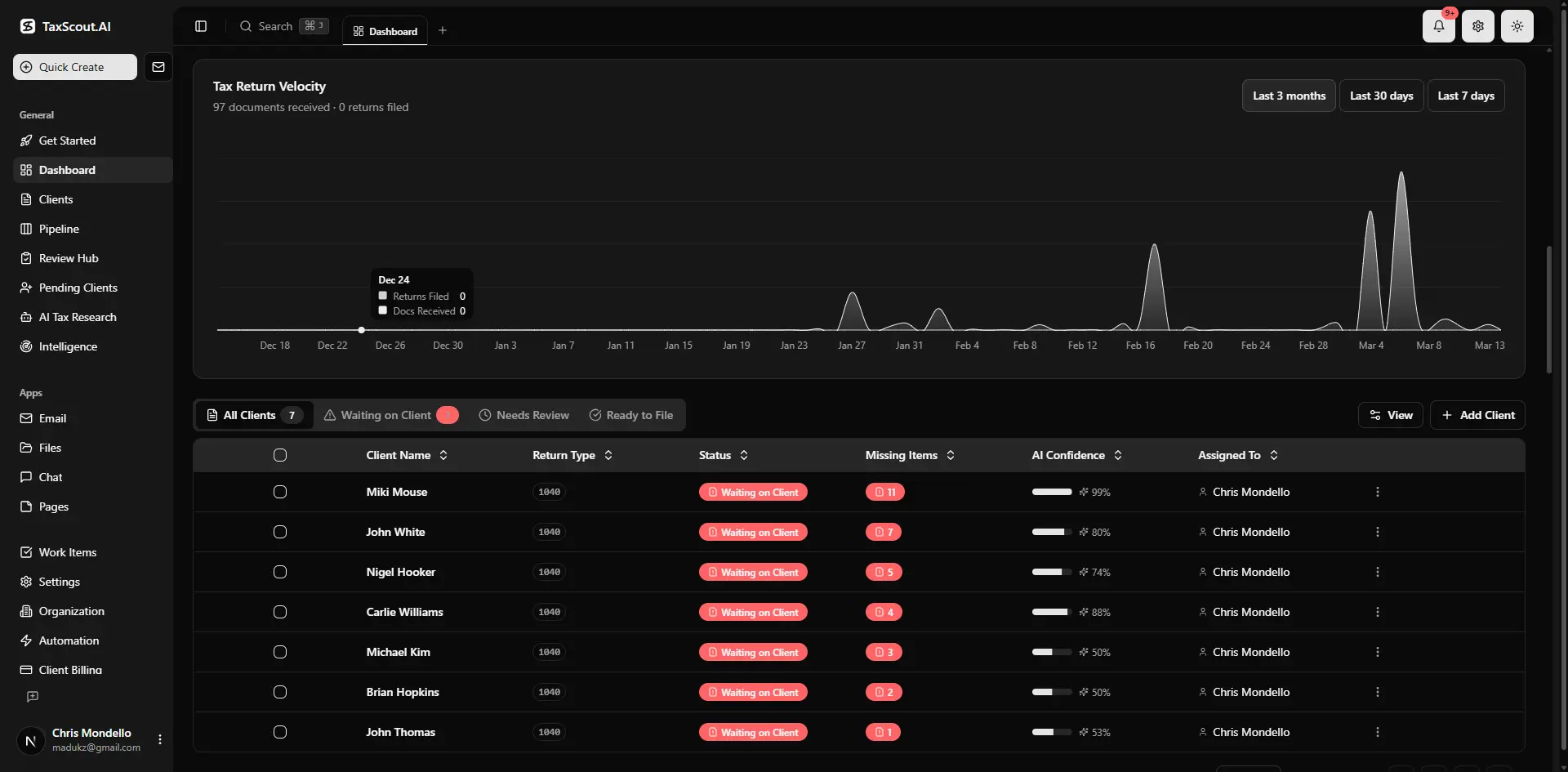
Real-time dashboard showing returns in progress, revenue, and upcoming deadlines
Entity Type Impact Matrix for Income Taxes Rule Changes
| Entity / Filing Type | Likely Impact Area | Immediate Firm Action |
|---|---|---|
| Individual (Form 1040) | Income computation, deductions, brackets | Flag open 1040s; check software patch notes |
| S-Corporation (Form 1120-S) | Pass-through income rules, shareholder basis | Review K-1 calculations; check Subchapter S citations |
| Partnership (Form 1065) | Subchapter K allocations, guaranteed payments | Review Schedule K-1s before final distribution |
| Nonprofit (Form 990-T) | UBIT income tax computation | Flag any 990-T with unrelated business activity |
| Employer benefit plans | Account contribution income tax treatment | Cross-reference with Trump Account guidance published 2026 |
Primary Source and Where to Go Next
The authoritative text of this change is at Income Taxes — Federal Register Document 2026-17154, published August 21, 2026. That URL is your primary citation for any client communication, internal memo, or professional liability file you create in response to this update.
For the regulatory hierarchy context, the IRS official guidance page explains how Treasury Decisions and Final Regulations differ from proposed rules and notices — a distinction that determines whether your firm must act now or has a comment or applicability window. The law.cornell.edu Title 26 index is the fastest way to look up the specific IRC sections referenced in the document.
If your firm is still managing regulatory updates through a shared inbox or a static checklist spreadsheet, this week is a good time to evaluate a more connected approach. Book a demo to see how TaxScout surfaces changes like this one directly inside your client workflow — or review the TaxScout pricing page to understand what a full-featured AI-native practice stack costs compared to the per-user fees at legacy competitors.
Still manually tracking Federal Register income taxes updates and hoping nothing slips through?
TaxScout connects IRS regulatory changes to your open client files automatically, so your firm acts faster and documents compliance without the manual hunt.

Click any extracted field to see its source highlighted on the original PDF
Frequently Asked Questions
It is an IRS income taxes regulatory document published in the Federal Register on August 21, 2026. The full text is available at federalregister.gov/documents/2026/08/21/2026-17154/income-taxes. CPA firms should read the primary source to identify which IRC sections are amended and whether any provisions affect returns currently in progress.
Keep reading
Backdoor Roth IRA: How CPAs Execute the Strategy Without Triggering Pro-Rata Tax
Oct 12, 2026 · 1 min read
Amended FBAR Procedures: How CPAs Correct Foreign Account Errors Without Triggering Penalties
Oct 12, 2026 · 1 min read
Transparency in Coverage Final Rules: What CPA Firms Must Do Now
Oct 12, 2026 · 1 min read
Stay up to date
Get the latest tax tech insights delivered to your inbox.