IRS Installment Agreement CPAs: How to Negotiate Payment Plans for Clients
When clients owe back taxes they cannot pay in full, a properly negotiated IRS installment agreement is often the fastest path to resolution. This guide walks CPAs through eligibility thresholds, Form 9465, streamlined versus non-streamlined agreements, Direct Debit advantages, and how AI-powered…
IRS installment agreement CPAs navigate every tax season are among the most time-sensitive engagements a firm can handle. When a client receives a CP2000 notice or a balance-due letter after filing, the clock starts immediately — interest compounds daily and the IRS's failure-to-pay penalty accrues at 0.5% per month on the unpaid balance. Knowing exactly which agreement type to pursue, which forms to file, and what financial documentation to prepare can mean the difference between a smooth resolution and a lien filing.
Most published guides treat installment agreements as a simple checkbox: file Form 9465 and wait. That misses the strategic layer that separates a competent CPA from a great one. Choosing between a streamlined agreement and a non-streamlined arrangement, deciding whether to recommend a Direct Debit Installment Agreement, and knowing when to pivot to Currently Not Collectible status or a Partial Pay Installment Agreement — these are judgment calls with real financial consequences for clients. IRS installment agreement CPAs who master this strategic layer consistently achieve better outcomes and stronger client retention than those who treat the process as purely administrative.
This guide covers the full workflow: eligibility rules, form mechanics, negotiation tactics, and how modern AI-powered practice management keeps every active installment agreement visible so nothing expires unnoticed. For additional tax resolution resources, see other blog resources published by TaxScout. Whether you are new to tax resolution or an experienced practitioner, this resource is designed to sharpen the skills that define effective IRS installment agreement CPAs.
IRS Installment Agreement Eligibility: The Thresholds CPAs Must Know
The IRS divides installment agreement pathways primarily by the total balance owed across all tax periods. Understanding these tiers before you file anything saves significant time and sets client expectations accurately. For IRS installment agreement CPAs, knowing exactly which tier applies before submitting any paperwork is one of the most valuable services you can provide to a client facing a tax balance.
For individuals, the streamlined installment agreement covers balances of $50,000 or less (including tax, penalties, and interest) and requires repayment within 72 months. At this threshold, the IRS does not require a Collection Information Statement — meaning no Form 433-A and no invasive review of assets, expenses, or bank accounts. The IRS processes streamlined agreements with minimal scrutiny, and most are approved within days via the IRS Online Payment Agreement tool or through a single call to the Automated Collection System (ACS). For firms evaluating their IRS installment agreement CPAs approach, this trade-off compounds over time.
Balances above $50,000 but at or below $100,000 may qualify for an Expanded Streamlined Agreement introduced in 2023 under IRS guidance, also requiring 84-month repayment. Anything above $100,000 — or any case involving trust fund recovery penalties, open audits, or unfiled returns — moves into non-streamlined territory where full financial disclosure is mandatory. Each of these factors directly shapes how IRS installment agreement CPAs plays out in practice.
For businesses, the threshold for a streamlined in-business agreement is $25,000, with a 24-month payoff window. Sole proprietors with individual liability can sometimes use the individual thresholds, but entities with payroll tax debt face a narrower path and should be escalated to a revenue officer negotiation. Understanding IRS installment agreement CPAs in this context is what separates firms that scale from those that stall.
Before recommending any installment agreement, verify that all required returns are filed. The IRS will reject an installment agreement application — even a streamlined one — if any tax years remain unfiled. Review IRS Tax Deadlines 2026 to confirm all periods are current before you begin the resolution process. This is precisely where a deliberate IRS installment agreement CPAs strategy pays off.
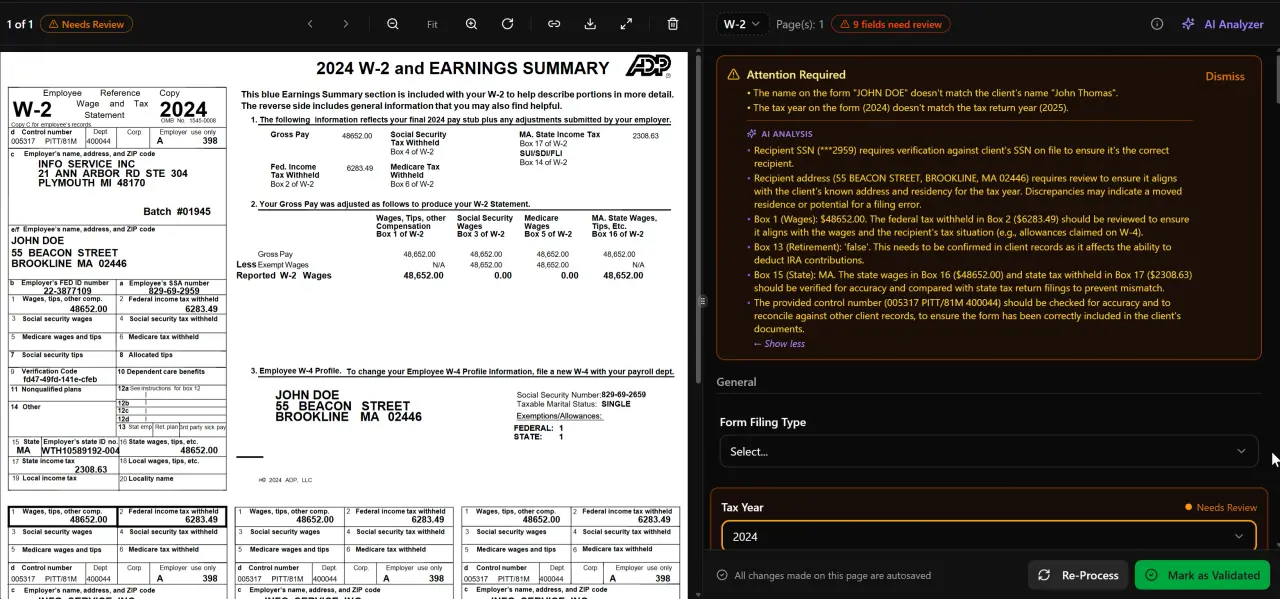
AI classifies, extracts, and validates every document automatically
Form 9465 and 433-A: Filing the Right Paperwork
Form 9465, the Installment Agreement Request, is the primary document for clients who cannot use the IRS Online Payment Agreement portal or prefer a paper-filed request attached directly to a balance-due return. For streamlined agreements, Form 9465 alone is sufficient — you specify the proposed monthly payment amount and the requested payment date, and the IRS responds by mail within 30 days. IRS installment agreement CPAs sits at the center of this decision — get it wrong and the rest unravels.
For non-streamlined agreements, Form 9465 must be accompanied by either Form 433-A (Collection Information Statement for Wage Earners and Self-Employed Individuals) or Form 433-B (for businesses). These forms are detailed financial disclosures covering income, expenses, assets, and equity. The IRS uses them to calculate a client's "reasonable collection potential" — the figure that anchors their counteroffer if your proposed payment is too low. When firms revisit their IRS installment agreement CPAs priorities, the gaps usually surface here.
When completing Form 433-A, apply the IRS Collection Financial Standards as a floor. The IRS allows standardized allowances for food, clothing, housing, transportation, and healthcare based on the client's geographic location and family size. Expenses below those standards are accepted without documentation; expenses above them require proof. Knowing these standards lets you optimize the allowable expense total and minimize the calculated monthly payment.
A common CPA mistake is including voluntary retirement contributions, above-market car payments on leased vehicles, or private school tuition in the expense section without a defensible argument. Revenue officers will disallow those items, triggering a revised demand. Build the 433-A conservatively, document everything you include, and anticipate pushback on discretionary expenses. TaxScout's AI document extraction can process the bank statements, pay stubs, and mortgage statements needed to populate the 433-A quickly and accurately.
Tired of tracking active installment agreements on a spreadsheet that no one updates?
TaxScout's pipeline management gives every IRS debt resolution case its own stage, deadline tracker, and automated client follow-up — so payment plan compliance never slips.

Your clients see your brand — OTP login, document upload, and real-time status
Streamlined vs. Non-Streamlined Agreements: CPA Action Steps
The tactical difference between these two pathways matters more than most CPAs realize. Below is a side-by-side comparison of the key decision points.
For streamlined agreements under $50,000: use the IRS Online Payment Agreement tool with an IRS account or file Form 9465 with the balance-due return. No financial disclosure. No negotiation. The IRS accepts the agreement as long as the proposed payment pays off the full balance within 72 months. Calculate the minimum payment by dividing (tax + current interest estimate + projected penalties) by 72 and round up to the nearest $25. Set up automatic payment at the time of application to reduce the setup fee.
For non-streamlined agreements above $50,000: prepare Form 433-A or 433-B in advance. Request the client's IRS account transcript (using Form 4506-T or the IRS Transcript Delivery System) to confirm the exact balance, any existing liens, and whether a Notice of Federal Tax Lien has already been filed. If a lien exists, negotiate lien subordination or withdrawal as part of the agreement terms — this matters enormously for clients who need mortgage access or business credit.
In non-streamlined negotiations, the IRS's position starts from the client's "ability to pay" calculation based on the 433-A. Your job is to maximize allowable expenses, document every claim, and propose a payment amount consistent with what the financial statement supports. Pushing for a lower payment than the financial statement justifies invites rejection and can trigger escalation to a revenue officer. Propose what the math supports, and use remaining strategies — like requesting penalty abatement under first-time abatement — to reduce the total balance before setting the payment.
The /features/ai-research-agents inside TaxScout can pull current IRS Collection Financial Standards, verify penalty abatement eligibility criteria, and surface relevant Tax Court decisions — all in real time during client consultations.
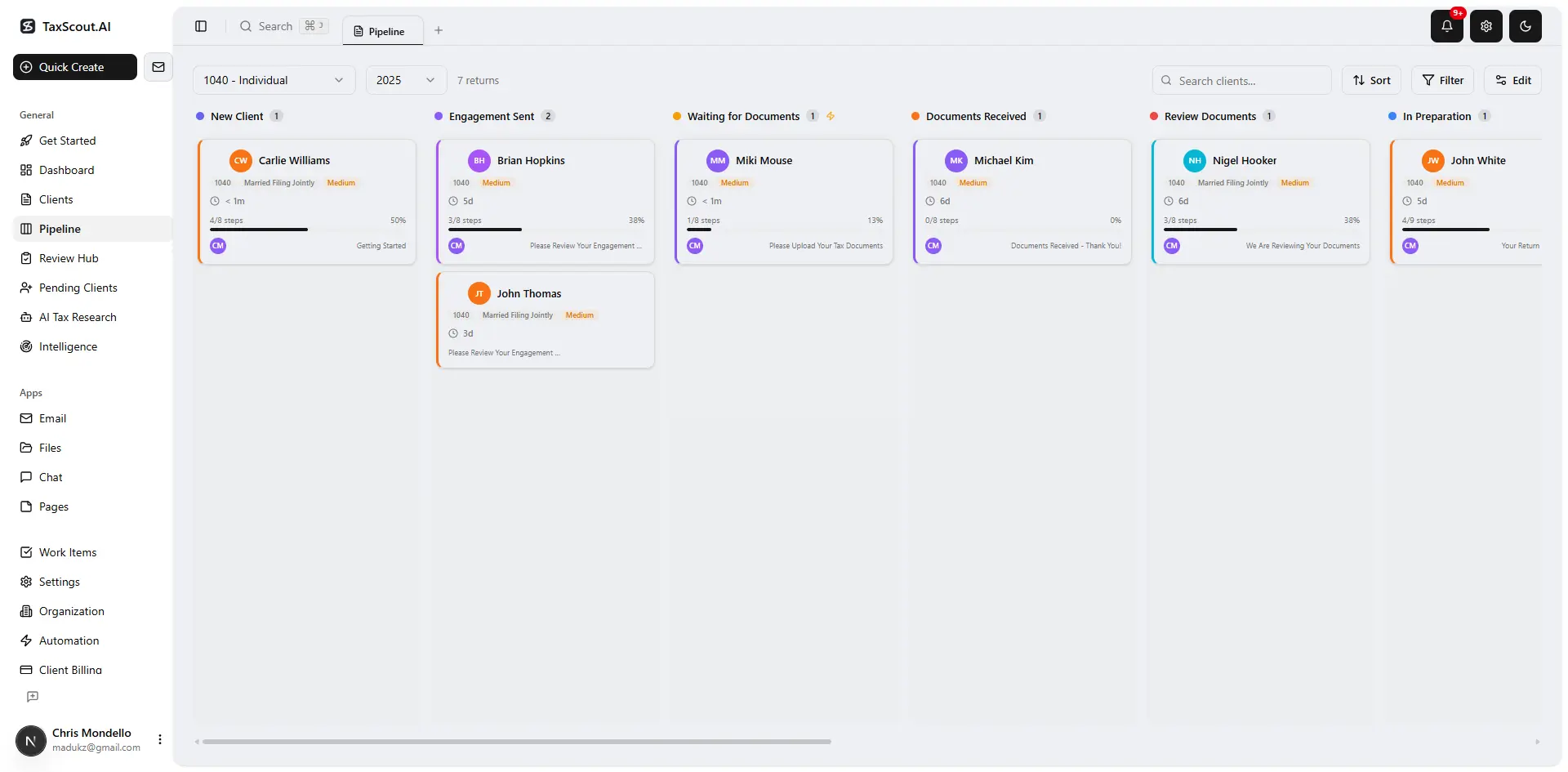
Track every return from intake to filed with drag-and-drop pipeline management
Streamlined vs. Non-Streamlined IRS Installment Agreement: Key Differences
| Factor | Streamlined (under $50k) | Non-Streamlined (over $50k) |
|---|---|---|
| Form required | Form 9465 only | Form 9465 + 433-A or 433-B |
| Financial disclosure | Not required | Required — assets, income, expenses |
| IRS Collection Financial Standards | Not applied | Applied to calculate ability to pay |
| Maximum repayment term | 72 months (84 under expanded) | Negotiated, typically up to 72 months |
| Processing speed | Days (online) or ~30 days (paper) | Weeks to months; may involve revenue officer |
| Lien filing risk | Lien filed if balance over $10k | High — lien likely; withdrawal negotiable |
| User fee (direct debit) | $31 | $31 |
| User fee (standard) | $130 | $130 |
Direct Debit vs. Standard Installment Agreements: Fee and Compliance Implications
One detail that separates experienced IRS debt resolution CPAs from less seasoned practitioners is the Direct Debit Installment Agreement (DDIA). Clients who authorize the IRS to pull payments directly from a bank account pay a $31 setup fee versus $130 for a standard agreement (or $107 for standard agreements modified online). For clients who qualify for the low-income waiver, the fee is reduced to $43 for non-direct-debit and waived entirely for direct debit.
Beyond the fee savings, DDIAs have a structural compliance advantage: clients cannot miss a payment due to forgetfulness, a mailed check getting lost, or an online banking session that slips the mind. Given that a single missed payment can throw a client into default and trigger a Notice of Intent to Levy, automating the payment is a genuine risk-management step — not just a convenience. IRS installment agreement CPAs who routinely steer eligible clients toward DDIAs demonstrate exactly this kind of proactive, compliance-focused advising.
The tradeoff is cash flow visibility. Clients on tight budgets need to know the IRS will pull payment on a specific date, or an unexpected draft can trigger an overdraft. Your intake and onboarding workflow should capture the client's preferred payment date (the IRS allows you to specify a date between the 1st and 28th of each month) and confirm the bank account has sufficient cushion. Use your firm's client portal to send a reminder five days before each scheduled draft — a small touch that prevents cascading defaults.
For clients who genuinely cannot make a regular monthly payment, consider whether the case qualifies for Currently Not Collectible (CNC) status instead. CNC is not an installment agreement — it is a formal determination by the IRS that collection activity would create economic hardship. The IRS pauses collection, but interest and penalties continue accruing, and the IRS reviews CNC status annually. CNC is a holding pattern, not a resolution, and should be positioned to clients accordingly. For more on advising clients on estimated tax payments and cash flow planning, see our related guide.

Click any extracted field to see its source highlighted on the original PDF
Partial Pay Installment Agreements and When to Use Them
A Partial Pay Installment Agreement (PPIA) is appropriate when a client's financial statement shows they cannot pay the full balance before the Collection Statute Expiration Date (CSED) — the 10-year window the IRS has to collect a tax debt. The IRS will accept payments based on demonstrated ability to pay, even if those payments will not cover the full liability, as long as the client cooperates with financial disclosure. IRS installment agreement CPAs who understand the PPIA pathway can deliver meaningful long-term savings for clients whose balances would otherwise outlast their ability to pay.
PPIAs require the same Form 433-A documentation as non-streamlined agreements, but they are more rigorously scrutinized. The IRS will review asset equity carefully — if a client has a home with substantial equity, the IRS may expect them to refinance and pay down the liability before accepting a reduced payment. CPAs negotiating a PPIA should prepare a strong equity analysis showing that liquidation is impractical or that encumbering the asset would cause undue hardship.
PPIAs are reviewed every two years. If the client's financial situation improves, the IRS can increase the required payment. This makes ongoing compliance monitoring critical — and it is an area where most practice management tools fall short. TaxScout's pipeline management lets you create a dedicated installment agreement stage with automated review reminders at 12-month intervals, ensuring nothing falls off the calendar as years pass.
An important strategic note: the PPIA and Offer in Compromise (OIC) often serve overlapping client profiles, but they are not interchangeable. An OIC resolves the debt permanently for a lump-sum or short-term payment; a PPIA keeps the clock running. If the CSED is two or three years away and the client's financial situation is unlikely to improve, a PPIA can be better than an OIC from a total-payment standpoint. But if the CSED is seven years out, an OIC may be the stronger option. Model both scenarios in writing before recommending a path.
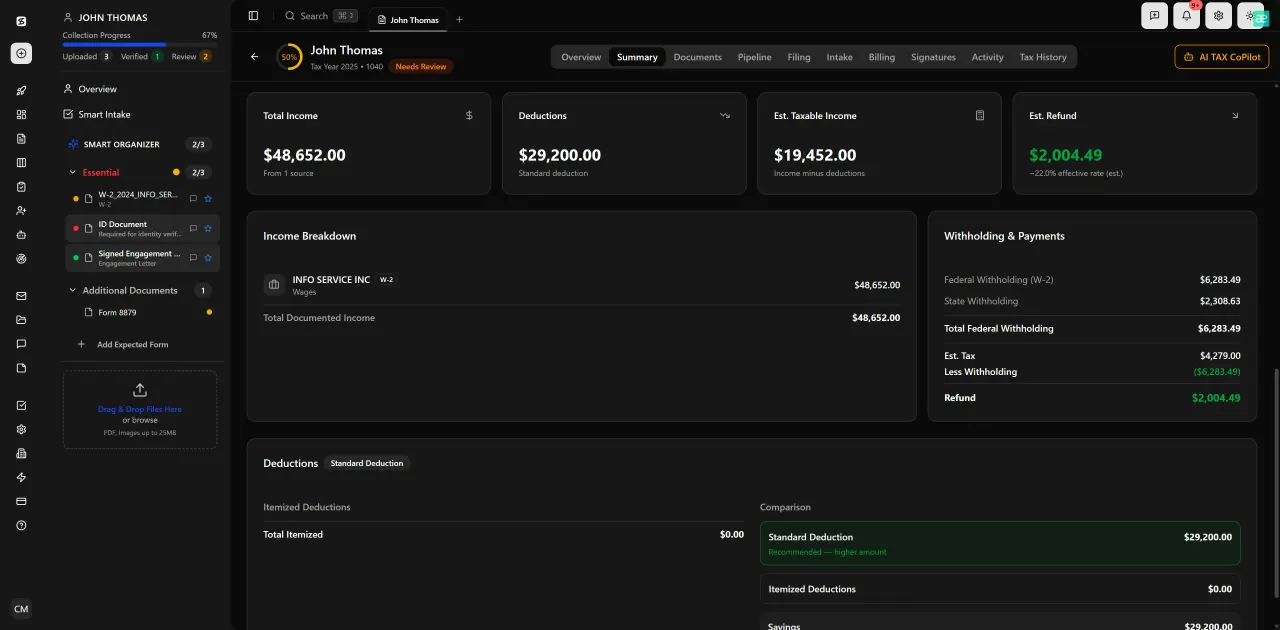
Review with AI assist — 9 agents answer questions with full client context
IRS Installment Agreement CPAs: Negotiation Tactics That Work
The IRS is not a monolith. How you negotiate depends on whether you are dealing with the Automated Collection System (ACS), a revenue officer, or the Centralized Authorization File (CAF) unit. For streamlined cases, ACS phone negotiation is usually sufficient. For complex non-streamlined cases, requesting assignment to a specific revenue officer and establishing a direct working relationship is worth the extra time.
Key negotiation principles for IRS debt resolution CPAs: First, always request the full account transcript before negotiating. Confirm every period's balance, the CSED for each year, any existing liens, and whether there are trust fund recovery penalty assessments lurking. Missing a TFRP assessment in a business case can derail an otherwise clean agreement. Second, file Form 2848 (Power of Attorney) in advance so you can speak freely on the client's behalf and receive all notices directly. This is non-negotiable — negotiating without POA puts your client at risk of direct IRS contact during the process.
Third, propose the payment amount that the financial statement supports — not an arbitrary round number. Revenue officers are trained to spot income-to-expense summaries that seem inflated, and a proposal that does not match the 433-A will trigger scrutiny. Fourth, request penalty abatement simultaneously. First-time abatement is available for clients with a clean compliance history for the prior three years, and it can reduce the total balance by thousands of dollars, making the installment terms more manageable.
Finally, get the agreement terms in writing before the client makes any payments. The IRS issues a formal acceptance letter specifying the monthly amount, payment date, and agreement number. File that letter in the client's permanent record and flag the CSED for each tax year in your practice management system. For firms managing high volumes of tax resolution work, AI document extraction can automate the extraction of key terms from IRS acceptance letters, reducing manual data entry and indexing errors. IRS installment agreement CPAs who build this kind of systematic documentation habit protect both their clients and their firms from costly oversights down the line.

Every client gets organized documents, status tracking, and a complete history
Tracking Active Installment Agreements With Practice Management Software
Once an installment agreement is in place, the CPA's responsibility does not end — it shifts to compliance monitoring. A client who misses two payments in a 12-month period defaults on the agreement automatically. The IRS then sends a CP523 notice giving 30 days to reinstate, after which collection action — including levy — can resume. For clients who have been on a PPIA or non-streamlined agreement for years, that default can undo years of careful negotiation.
Most general-purpose practice management tools treat each engagement as a one-time task. Installment agreements are ongoing relationships that span months or years, with specific review dates, annual financial statement updates for PPIAs, and payment-date reminders that must fire every single month. TaxScout's pipeline management supports 12 customizable stages, making it straightforward to build a dedicated IRS resolution workflow with stages like "Agreement Pending," "Active — Monitoring," "PPIA Review Due," and "CSED Approaching."
The AI-powered client intake and communication hub log every client interaction automatically, so if a client calls to say they cannot make next month's payment, that conversation is captured and a workflow can trigger to draft a modification request. For firms with 10 or more active installment agreement clients, this kind of systematic tracking is the difference between a clean compliance record and a malpractice exposure. Pair it with the client portal so clients can see their next payment date, upload updated financial documents, and e-sign any required forms without playing phone tag.
For firms evaluating practice management platforms, it is worth noting that general workflow tools like TaxDome or Karbon lack dedicated IRS resolution tracking and AI-powered document extraction. TaxScout's flat-fee pricing at $149/month for up to 10 seats — versus TaxDome at roughly $500/month or Karbon at roughly $590/month for the same team — makes it a compelling platform for firms growing their tax resolution practice. See TaxScout's full pricing for the current plan details.
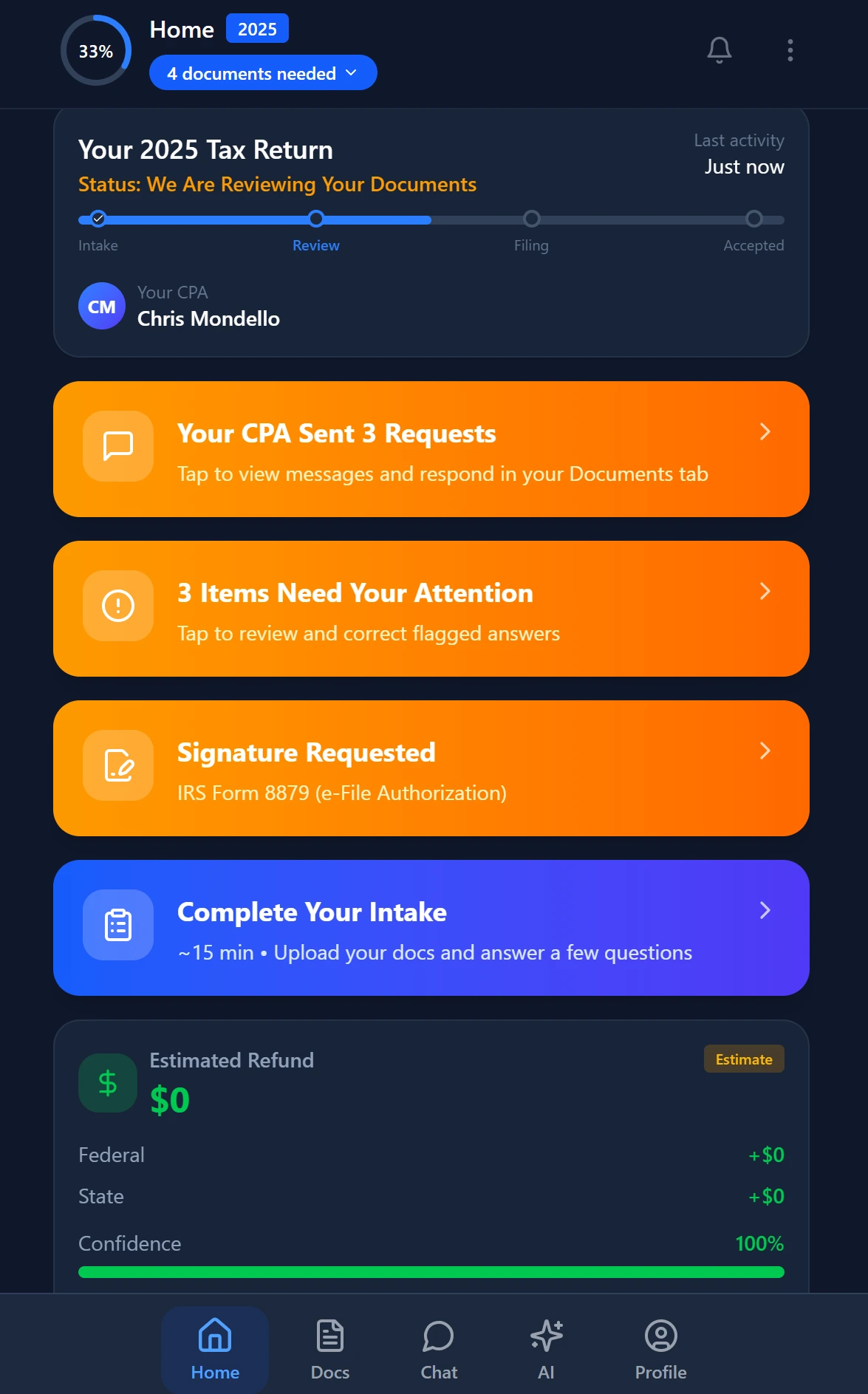
Smart intake auto-fills from uploaded documents and prior-year data
Communicating Installment Agreement Terms to Clients
The client relationship does not improve automatically because you secured a favorable agreement. Clients who do not understand the terms — the penalty and interest accrual during repayment, the two-year review cycle for PPIAs, the CSED implications — are more likely to make unilateral decisions (like skipping a payment to cover a business expense) that put the agreement at risk.
Build a short client education memo into your engagement workflow. Cover: (1) the monthly payment amount and due date, (2) what happens if they miss a payment, (3) that interest and penalties continue to accrue on the remaining balance during the agreement, (4) when you will review the financial situation again, and (5) what triggers a modification request. Deliver this via the secure client portal where the client can sign an acknowledgment, preserving a record that the terms were communicated.
From a billing standpoint, IRS resolution engagements are well-suited to flat-fee pricing. The work has defined phases — analysis, form preparation, negotiation, agreement monitoring — and hourly billing creates client anxiety that discourages them from calling you when something changes. For a deeper look at structuring resolution fees, see our guide to flat fee billing for CPAs. Use TaxScout's invoicing via Stripe Connect to collect setup fees and monthly monitoring retainers automatically, keeping the revenue relationship as smooth as the agreement itself.
Firms that systematize IRS installment agreement CPAs workflows — from intake through multi-year monitoring — consistently generate more referral revenue from this service line than firms that treat each case as a one-off. Satisfied clients facing tax debt are highly motivated referrers, and a documented resolution process is a differentiator worth marketing. The SSA's overview of taxpayer rights and Treasury's taxpayer resources provide client-facing language you can incorporate into your onboarding materials.
Managing IRS installment agreements for multiple clients and worried about missing a review date?
TaxScout gives your firm a dedicated IRS resolution pipeline, AI research agents for real-time IRS guidance, and automated client follow-up — all at a flat monthly rate with no per-user fees.
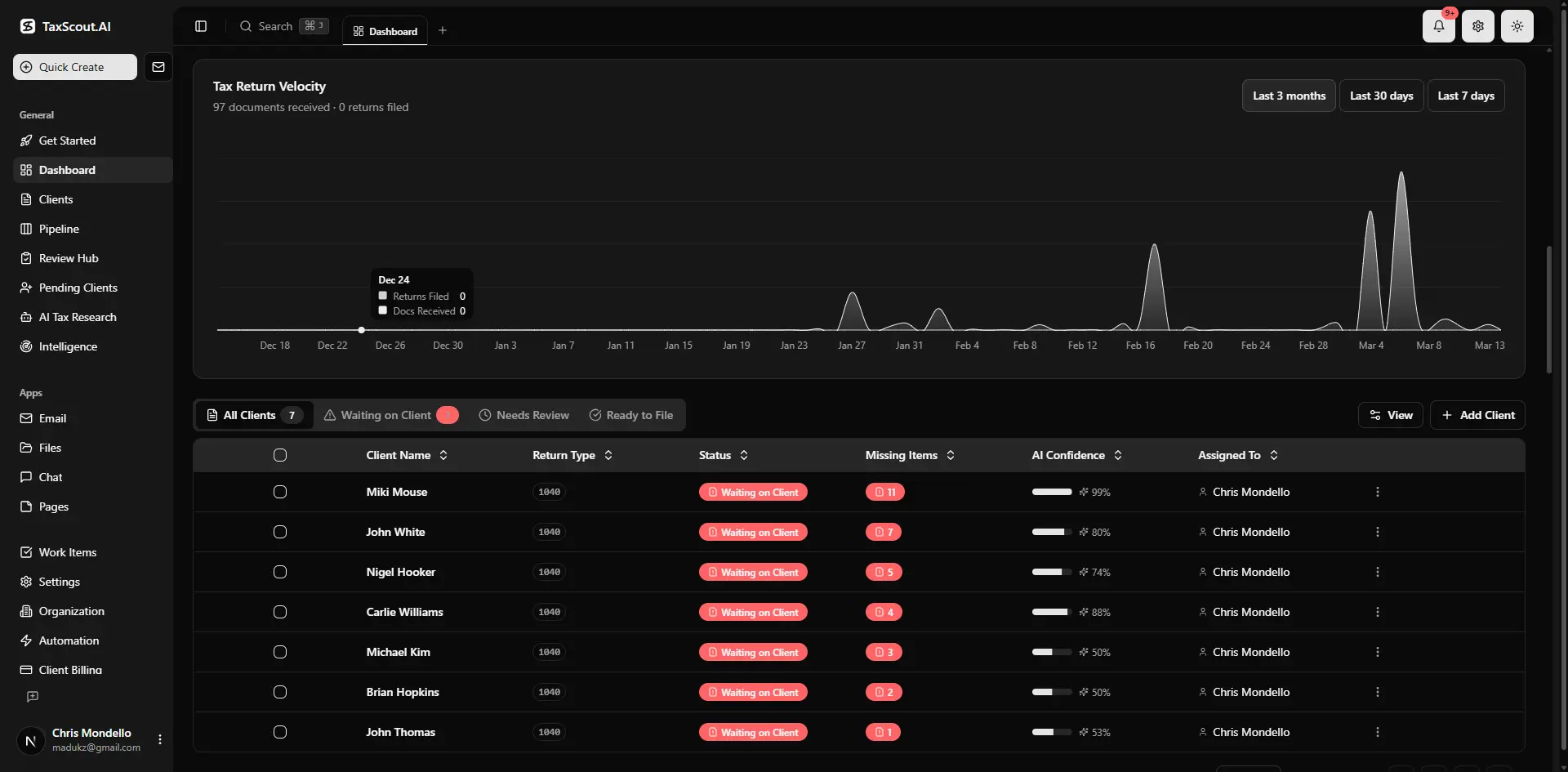
Real-time dashboard showing returns in progress, revenue, and upcoming deadlines
Frequently Asked Questions
For individuals, a streamlined installment agreement covers balances of $50,000 or less (tax, penalties, and interest combined) and requires full repayment within 72 months. An expanded streamlined option covers balances up to $100,000 with an 84-month repayment window. No Collection Information Statement (Form 433-A) is required at either threshold. For businesses, the streamlined limit is $25,000 with a 24-month window.
Keep reading
Uniform Capitalization Rules: How CPAs Apply UNICAP to Inventory and Self-Constructed Assets
Oct 17, 2026 · 1 min read
Non-Applicability of Section 357(c) to Consolidated Groups: What CPA Firms Must Do Now
Oct 17, 2026 · 1 min read
Reasonable Basis Defense: How CPAs Shield Clients From Accuracy-Related Penalties
Oct 17, 2026 · 1 min read
Stay up to date
Get the latest tax tech insights delivered to your inbox.