Inherited IRA Distribution Rules: What CPAs Must Tell Clients Now
The SECURE 2.0 Act and the IRS's 2024 final regulations reshaped inherited IRA distribution rules in ways that still catch clients — and some CPAs — off guard. This guide breaks down the 10-year rule, beneficiary categories, annual RMD requirements, and, critically, how to systematize inherited…
Inherited IRA distribution rules have become one of the most consequential — and most misunderstood — planning areas in personal tax advisory. Since the SECURE Act of 2019 eliminated the stretch IRA for most non-spouse beneficiaries, and SECURE 2.0 layered on additional modifications, CPAs face a real professional liability risk any time a client inherits a retirement account and doesn't receive clear, timely guidance.
The risk intensified in 2024 when the IRS released final regulations under T.D. 10001, confirming that non-eligible designated beneficiaries who inherit from an owner who had already started required minimum distributions must take annual RMDs throughout the 10-year window — not simply wait until year ten to withdraw everything. Many clients who followed the 'just wait' shortcut from 2020 through 2023 now face a complicated catch-up situation. CPAs who stay current on inherited IRA distribution rules will be far better positioned to help clients avoid costly penalties under these final regulations.
Beyond the compliance urgency, there is a practice development angle here that most firms overlook. Inherited IRA conversations are not a one-time engagement — they are a recurring annual advisory touchpoint that can be packaged, priced, and systematically delivered. This guide gives you the technical framework and the workflow playbook to do exactly that. Firms that develop a structured process for reviewing inherited IRA distribution rules with clients annually can turn a complex compliance obligation into a high-value, repeatable service offering.
How the SECURE Act and SECURE 2.0 Changed Inherited IRA Rules
Before the Setting Every Community Up for Retirement Enhancement (SECURE) Act took effect on January 1, 2020, most non-spouse beneficiaries could 'stretch' inherited IRA distributions over their own life expectancy — a technique that deferred taxes for decades and made inherited IRAs powerful estate planning tools. The SECURE Act eliminated the stretch IRA for the vast majority of beneficiaries, replacing it with a mandatory 10-year rule. Understanding how dramatically the inherited IRA distribution rules have shifted since then is essential context for any CPA advising beneficiaries today.
SECURE 2.0, enacted in December 2022, did not reverse the 10-year rule, but it did adjust RMD ages for account owners (now 73, rising to 75 in 2033), modified penalty provisions, and expanded Roth conversion opportunities — all of which interact with inherited IRA planning in ways that require CPA attention on an annual basis. You can find the official IRS summary of SECURE 2.0 provisions on irs.gov. For firms evaluating their inherited IRA distribution rules approach, this trade-off compounds over time.
The critical 2024 development was the IRS releasing final regulations that resolved years of practitioner uncertainty about annual RMDs inside the 10-year window. Under these final rules, if the original IRA owner died on or after their required beginning date — meaning they had already started RMDs — the beneficiary must take annual distributions during years one through nine AND fully deplete the account by December 31 of year ten. If the owner died before their required beginning date, the beneficiary has more flexibility and is not required to take annual distributions, though the account must still be fully distributed by year ten. See our other blog resources for additional CPA advisory topics covering recent regulatory changes. Each of these factors directly shapes how inherited IRA distribution rules plays out in practice.
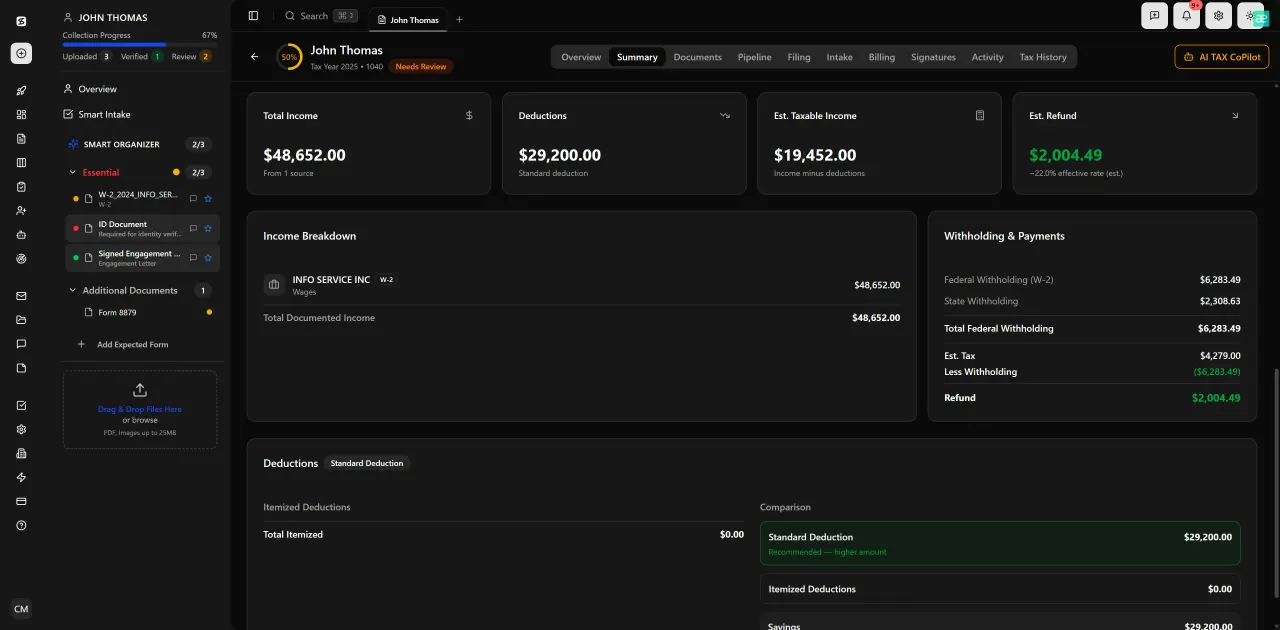
Review with AI assist — 9 agents answer questions with full client context
Beneficiary Categories Under Current Law
The inherited IRA distribution rules you must apply depend entirely on which beneficiary category a client falls into. The IRS uses two broad classifications: eligible designated beneficiaries (EDBs) and non-eligible designated beneficiaries (NEDBs).
Eligible designated beneficiaries are a narrow group defined in IRC Section 401(a)(9)(E)(ii) and include: surviving spouses, minor children of the deceased owner (until they reach the age of majority), disabled individuals meeting IRS definitions, chronically ill individuals, and any beneficiary who is not more than ten years younger than the deceased owner. EDBs retain the ability to use the life-expectancy stretch method — a significantly more tax-efficient option. Understanding inherited IRA distribution rules in this context is what separates firms that scale from those that stall.
Non-eligible designated beneficiaries — typically adult children, grandchildren, siblings, and most trusts — are subject to the 10-year rule with no stretch option. Non-designated beneficiaries, such as estates or charities, face a five-year rule if the owner died before their required beginning date, or must use the owner's remaining life expectancy if the owner had already begun RMDs. This is precisely where a deliberate inherited IRA distribution rules strategy pays off.
Spousal beneficiaries retain unique options beyond the EDB stretch: they can roll the inherited IRA into their own IRA, treat it as their own, or remain as a beneficiary of the inherited account — each approach carries different RMD timing implications that CPAs should model for clients before they make an irrevocable election.
Minor Children: A Frequently Missed Transition
Minor children of the deceased owner qualify as EDBs and may use the life-expectancy method — but only until they reach the age of majority (typically 21 under IRS rules, though state law variations apply). Once the child reaches majority, the 10-year rule kicks in, meaning the entire account must be distributed within ten years from the date the child reached majority. CPAs advising clients with minor child beneficiaries must calendar this transition and proactively model the distribution schedule years in advance.
Disabled and Chronically Ill Beneficiaries
Qualifying disabled or chronically ill beneficiaries under IRC Section 72(m)(7) retain the life-expectancy stretch, which can be an important planning tool when significant IRA balances are involved. Documentation of the disability or chronic illness at the time of inheritance is essential for substantiating this status in an IRS examination. CPAs should capture and retain this documentation as part of the client's permanent tax file.
Tired of discovering inherited IRA situations at year-end when the planning window has already closed?
TaxScout's AI intake engine and client management tools let you flag inherited IRA scenarios during onboarding, so you deliver proactive advisory — not reactive compliance.
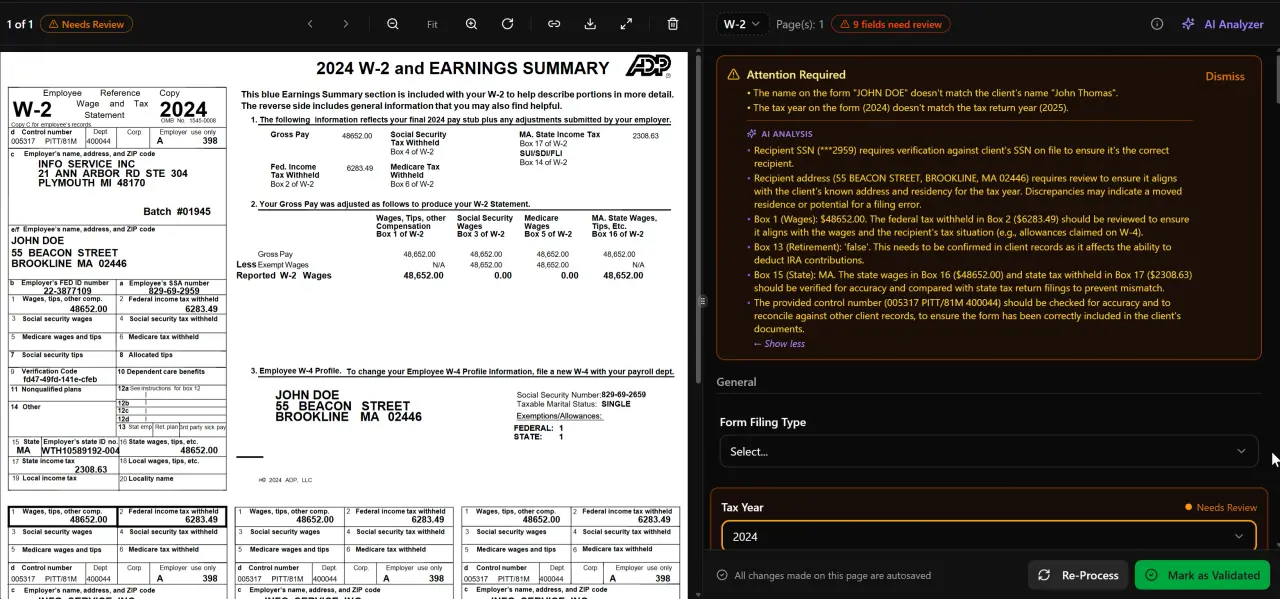
AI classifies, extracts, and validates every document automatically

Track firm performance with real-time analytics and client activity monitoring
Annual RMD Requirements Inside the 10-Year Window
The most consequential and widely misunderstood aspect of inherited IRA distribution rules post-2024 is the annual RMD requirement for NEDBs when the original owner died on or after their required beginning date. Many clients were told — or simply assumed — that the 10-year rule meant they had a decade-long lump sum deadline with no annual obligation. The IRS's 2024 final regulations corrected that interpretation definitively.
For NEDBs subject to annual RMDs, the annual distribution amount is calculated using the single life expectancy table (Table I in IRS Publication 590-B) based on the beneficiary's age in the year following the owner's death, reduced by one for each subsequent year. In year ten, the entire remaining balance must be distributed regardless of the calculated amount.
CPAs should be aware that the IRS waived the 10% early withdrawal penalty on missed RMDs from inherited IRAs for tax years 2021 through 2024 under a series of transition relief notices, but that relief has expired. Beginning with the 2025 tax year, the penalty for missed inherited IRA RMDs applies at the standard 25% rate (reduced to 10% if corrected within the correction window under SECURE 2.0's reforms to IRC Section 4974). The IRS penalty correction procedures are worth reviewing with any client who missed distributions during the waiver years.
Inherited IRA Distribution Rules as a Recurring Advisory Service
Most CPA firms treat inherited IRA guidance as a one-time conversation that happens when a client mentions they inherited an account. This reactive posture leaves significant advisory revenue on the table and exposes the firm to liability when clients make uninformed distribution decisions between annual appointments.
A better model is to treat inherited IRA distribution rules as an annual advisory service with a defined scope, a fixed fee, and a documented deliverable. The service scope typically includes: reviewing the prior year's distributions against the calculated RMD, projecting the remaining 10-year (or life-expectancy) schedule, modeling the tax impact of accelerating or deferring distributions, and documenting the beneficiary category and basis for the applicable rule. For firms already offering advisory packages, this is a natural add-on. For others, it represents a concrete starting point for building advisory capacity. See our post on flat fee billing for CPAs for a framework on packaging this type of service.
Pricing this service is straightforward. A single inherited IRA annual review typically justifies $300–$800 depending on complexity — substantially more when the client holds multiple inherited accounts, has a trust beneficiary structure, or faces a minor-child-to-adult transition within the planning window. Multiply that by even twenty clients with inherited IRAs and you have a meaningful recurring revenue line item. Review our niche pricing strategy guide for how specialty advisory services command premium rates when you demonstrate documented, repeatable expertise.
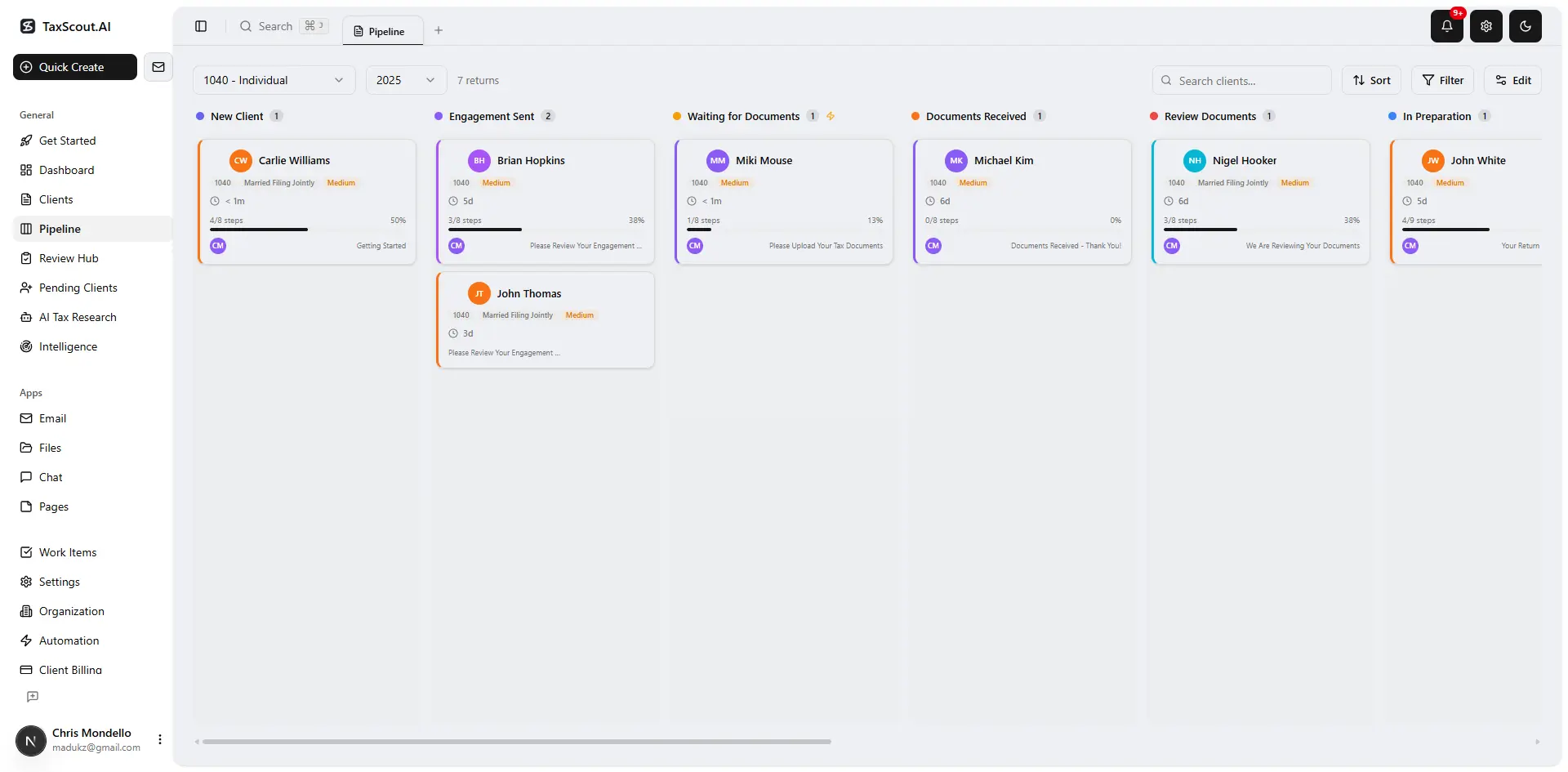
Track every return from intake to filed with drag-and-drop pipeline management
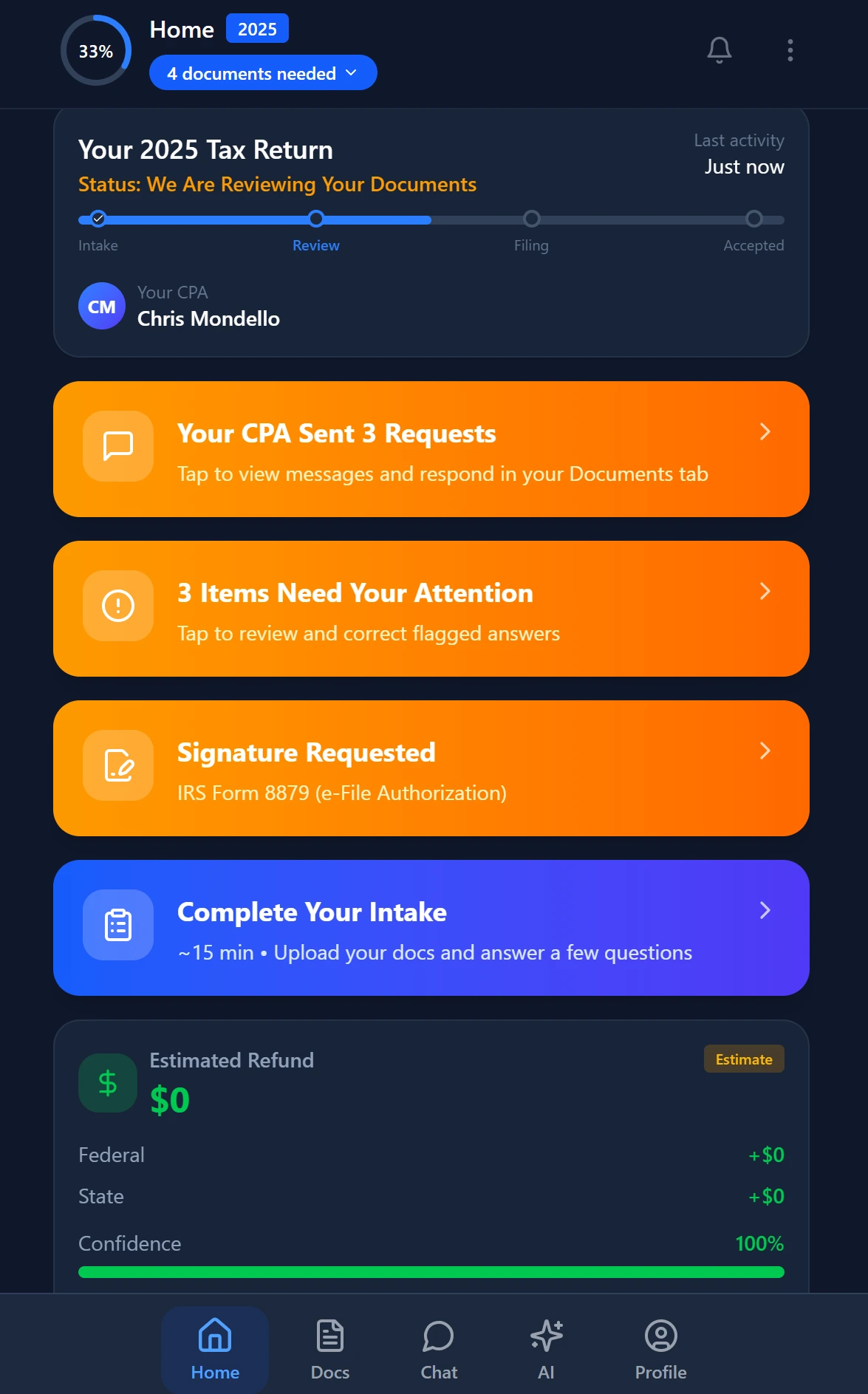
Smart intake auto-fills from uploaded documents and prior-year data
Systematically Identifying Clients with Inherited IRAs
The biggest workflow gap in most CPA firms is the absence of a systematic method for identifying which clients currently hold inherited IRAs and which clients are likely to inherit one in the near future. This information exists in your files — in prior-year returns with Form 8606 or Schedule 1 distributions, in 1099-R forms showing distribution codes 4 (death) or Q, and in intake questionnaires — but without a structured workflow, it is rarely surfaced proactively.
TaxScout's AI document extraction automatically identifies 1099-R forms across your client base, including distribution code 4 indicators, and flags them within the client record. When paired with the pipeline management system's 12 customizable stages, you can create a dedicated inherited IRA review stage that automatically populates when the system detects a relevant document — turning passive data into an active advisory trigger.
The AI intake engine also plays a role here. The smart intake questionnaire modeled on IRS Form 13614-C includes prompts that surface new inheritances and beneficiary changes, and the 4-layer prefill system ensures returning clients are not re-asked questions already answered in prior years. Combined, these tools allow you to build a living list of inherited IRA clients without relying on staff memory or ad hoc scanning of returns.
For firms managing high volumes of clients, the campaign engine can be configured to send a targeted outreach message to every client flagged with a 1099-R distribution code 4 each October — ahead of the December 31 RMD deadline — offering an inherited IRA review appointment. This is proactive advisory at scale, delivered through a system rather than relying on individual staff initiative. Pairing this with client management tags for beneficiary type allows you to segment campaigns precisely and avoid sending irrelevant messages.
Inherited IRA Distribution Rule Summary by Beneficiary Type
| Beneficiary Type | Distribution Method | Annual RMD Required? | Key Planning Note |
|---|---|---|---|
| Surviving Spouse (EDB) | Life expectancy stretch or own-IRA rollover | Yes, if treated as beneficiary | Spousal rollover defers RMDs to spouse's age 73 |
| Minor Child of Owner (EDB) | Life expectancy until majority, then 10-year rule | Yes, during EDB period | Calendar the majority-age transition proactively |
| Disabled / Chronically Ill (EDB) | Life expectancy stretch | Yes | Retain disability documentation in permanent file |
| Not-more-than-10-years-younger (EDB) | Life expectancy stretch | Yes | Age verification required at time of inheritance |
| Adult Child / Other NEDB — Owner died before RBD | 10-year rule, flexible timing | No annual RMD required | Full depletion by Dec 31 of year 10 |
| Adult Child / Other NEDB — Owner died on/after RBD | 10-year rule with annual RMDs | Yes, years 1-9; full depletion year 10 | 2024 final regs confirmed annual obligation — model each year |
| Non-Designated Beneficiary (estate, charity) | 5-year rule (pre-RBD) or owner life expectancy (post-RBD) | Varies | Trust structures require separate analysis |
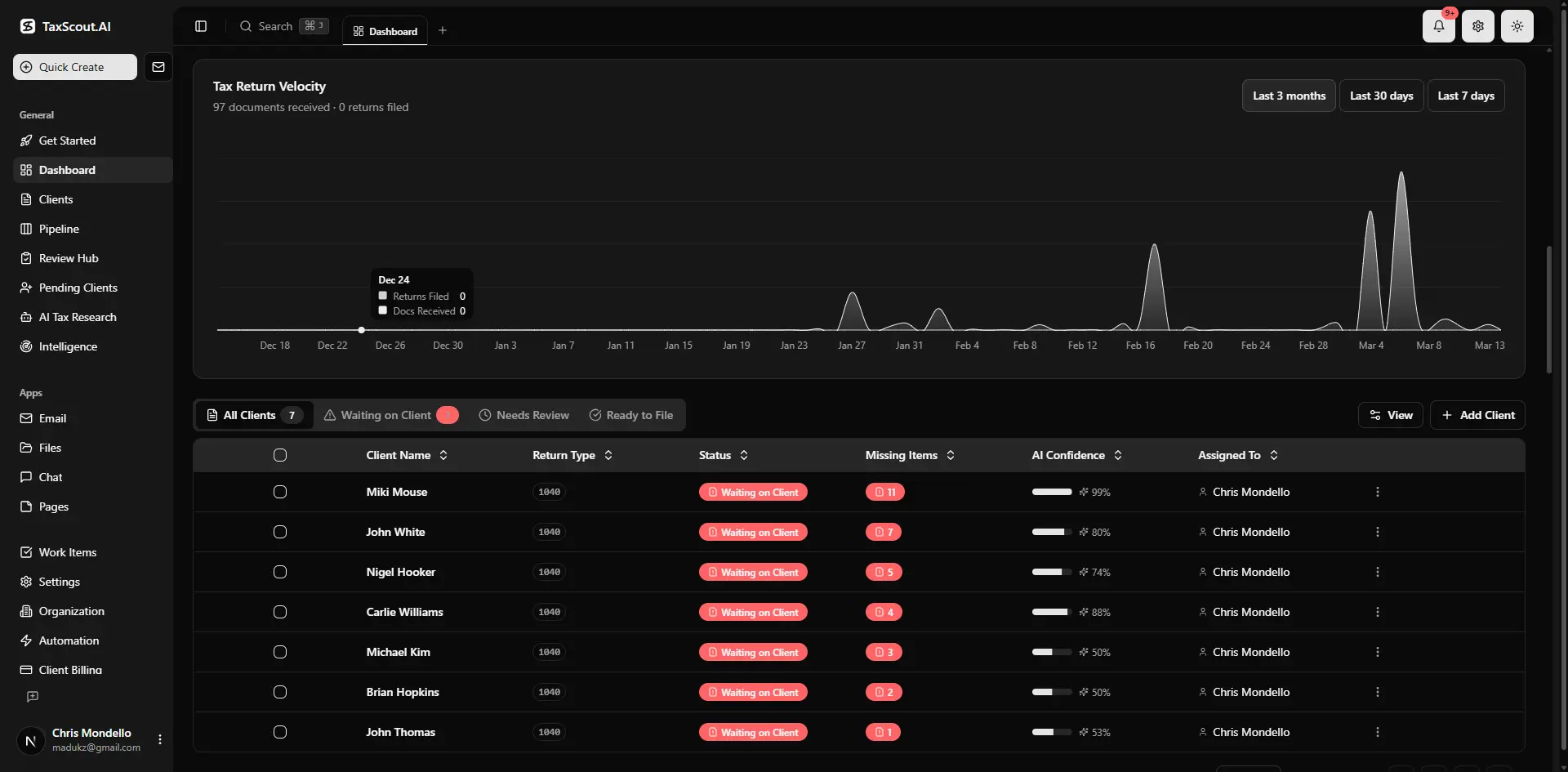
Real-time dashboard showing returns in progress, revenue, and upcoming deadlines
Documentation and Professional Liability Best Practices
Given the complexity of inherited IRA distribution rules and the financial magnitude of errors — missed RMDs carry a 25% penalty, and incorrect beneficiary category determinations can result in years of under-distribution — documentation practices for inherited IRA advisory should meet a higher standard than routine compliance work.
At a minimum, CPAs should document: the date of the original owner's death, whether the owner had reached their required beginning date, the beneficiary category determination and the supporting facts (e.g., disability certification, age verification), the annual RMD calculation method and result, and any client instruction to deviate from the recommended distribution amount. This documentation belongs in the client's permanent file, not just in the current-year workpapers.
TaxScout's file management system supports organized permanent file structures with version control and AES-256-GCM encrypted document storage, ensuring sensitive beneficiary documents remain accessible and secure across tax years. The AI research agents feature — which includes nine specialized agents with real-time search across IRS, Treasury, Cornell Law, and other authoritative sources — is particularly useful when inherited IRA situations involve unusual trust structures, international beneficiaries, or state-law wrinkles that intersect with the federal rules. You can find additional context on how to build a paperless document workflow that supports this kind of long-term record organization.
From a professional liability standpoint, firms should also consider whether their engagement letters explicitly address inherited IRA advisory — or explicitly carve it out of scope if the firm does not offer this service. Scope clarity protects both the client and the firm. See our guide on electronic signatures for accountants for best practices on engagement letter execution and retention.

Click any extracted field to see its source highlighted on the original PDF
Using AI Research Agents to Stay Current on Inherited IRA Regulations
Inherited IRA distribution rules have changed materially every few years since 2019, and the regulatory environment shows no sign of stabilizing. The IRS's ongoing regulatory activity around retirement distributions — including potential additional guidance on trust beneficiaries and the interaction between the 10-year rule and qualified charitable distributions — means CPAs need a reliable way to monitor developments without manually scanning IRS notices.
TaxScout's AI research agents provide nine specialized agents with real-time search capability across IRS.gov, Treasury.gov, Cornell Law's USC Title 26, and SSA.gov. When a client scenario involves an inherited IRA question — such as whether a special needs trust qualifies for the EDB disabled-beneficiary treatment, or how state community property law affects a spousal rollover — the research agent can surface relevant IRS rulings, proposed regulations, and statutory language in seconds, with citations you can include in client-facing documentation.
This capability is especially valuable for smaller firms that cannot justify a dedicated retirement planning specialist but still want to deliver authoritative guidance. The regulatory intelligence feature complements this by flagging new IRS guidance relevant to your client base as it is published, so you are never learning about a rule change from a client who read about it online.
Ready to stop missing inherited IRA advisory opportunities across your client base?
TaxScout gives CPA firms the document intelligence, workflow automation, and AI research tools to make inherited IRA planning a systematic, billable annual service — starting at $49/month with no per-user fees.
Frequently Asked Questions
It depends on whether the original IRA owner died before or after their required beginning date (RBD). Under the IRS's 2024 final regulations, if the owner died on or after their RBD — meaning they had already started required minimum distributions — non-eligible designated beneficiaries must take annual RMDs in years one through nine and fully deplete the account by December 31 of year ten. If the owner died before their RBD, the beneficiary has no annual RMD obligation but must still empty the account by the end of year ten.
Keep reading
Backdoor Roth IRA: How CPAs Execute the Strategy Without Triggering Pro-Rata Tax
Oct 12, 2026 · 1 min read
Amended FBAR Procedures: How CPAs Correct Foreign Account Errors Without Triggering Penalties
Oct 12, 2026 · 1 min read
Transparency in Coverage Final Rules: What CPA Firms Must Do Now
Oct 12, 2026 · 1 min read
Stay up to date
Get the latest tax tech insights delivered to your inbox.