FBAR Penalty Negotiation: How CPAs Reduce Willful Violations to Non-Willful
When a client's foreign account disclosure fails and the IRS flags a willful FBAR violation, the filing phase is over — the negotiation phase begins. This guide walks CPAs through the practitioner strategies used to recharacterize willful penalties, apply Bittner v. United States, and structure…
FBAR penalty negotiation is among the most high-stakes engagements a CPA can accept. Once the IRS or FinCEN has flagged a potential willful violation of the Bank Secrecy Act's foreign account reporting requirement, the conversation shifts from compliance to defense — and the dollar amounts at stake can be staggering. A single willful FBAR violation historically carried a civil penalty up to the greater of $100,000 or 50% of the account balance per violation per year, with the IRS interpreting each unreported account as a separate violation.
Most published guidance focuses on how to file or amend FinCEN Form 114 before any IRS contact. That compliance-filing advice is useful, but it leaves CPAs without a roadmap once enforcement begins. This article addresses the practitioner strategies that come into play after the flag: how to build a fact record that supports recharacterization from willful to non-willful, how the Supreme Court's 2023 ruling in Bittner v. United States reshapes the penalty math, and how to decide between available disclosure pathways when your client is already in the pipeline. What that guidance omits, however, is the practical framework for FBAR penalty negotiation once the IRS has already initiated contact.
If you are advising a high-net-worth client who received an FBAR-related summons, a Letter 3800, or a referral notice, the strategies below are where your analysis should begin. For clients still in the pre-enforcement window, see our earlier resource on Amended FBAR Procedures before proceeding. Each of those enforcement triggers demands a different opening posture in FBAR penalty negotiation, and confusing them can cost your client significantly.
Willful vs Non-Willful: Why the Distinction Defines the Penalty Universe
The Bank Secrecy Act, codified at 31 U.S.C. § 5314, requires U.S. persons to report financial interest in or signatory authority over foreign financial accounts exceeding $10,000 at any point during the calendar year. Failure to file FinCEN 114 triggers two distinct penalty regimes depending on whether the violation was willful. Understanding exactly which statutory threshold your client crossed is the foundation of any credible FBAR penalty negotiation strategy, since willful and non-willful violations carry penalties that differ by an order of magnitude.
A non-willful FBAR violation — one the IRS characterizes as resulting from negligence, inadvertence, or mistake — carries a maximum civil penalty of $10,000 per violation. A willful violation, by contrast, carries a penalty of up to the greater of $100,000 or 50% of the account balance at the time of the violation. For a client with five accounts over three years, the theoretical maximum willful exposure can reach seven figures before any FBAR penalty negotiation begins. For firms evaluating their FBAR penalty negotiation approach, this trade-off compounds over time.
The FBAR willful vs non-willful penalty distinction therefore determines the entire negotiation landscape. The IRS does not need to prove criminal intent to establish civil willfulness; courts have upheld willfulness findings based on 'reckless disregard' of a known legal obligation. Critically, checking 'No' on Schedule B, Part III of Form 1040 — which asks whether the taxpayer has a financial interest in or signature authority over a foreign financial account — has been treated by courts as strong evidence of willful conduct even when the taxpayer claims ignorance. For the defending practitioner, this is the fact pattern you must attack first. Each of these factors directly shapes how FBAR penalty negotiation plays out in practice.
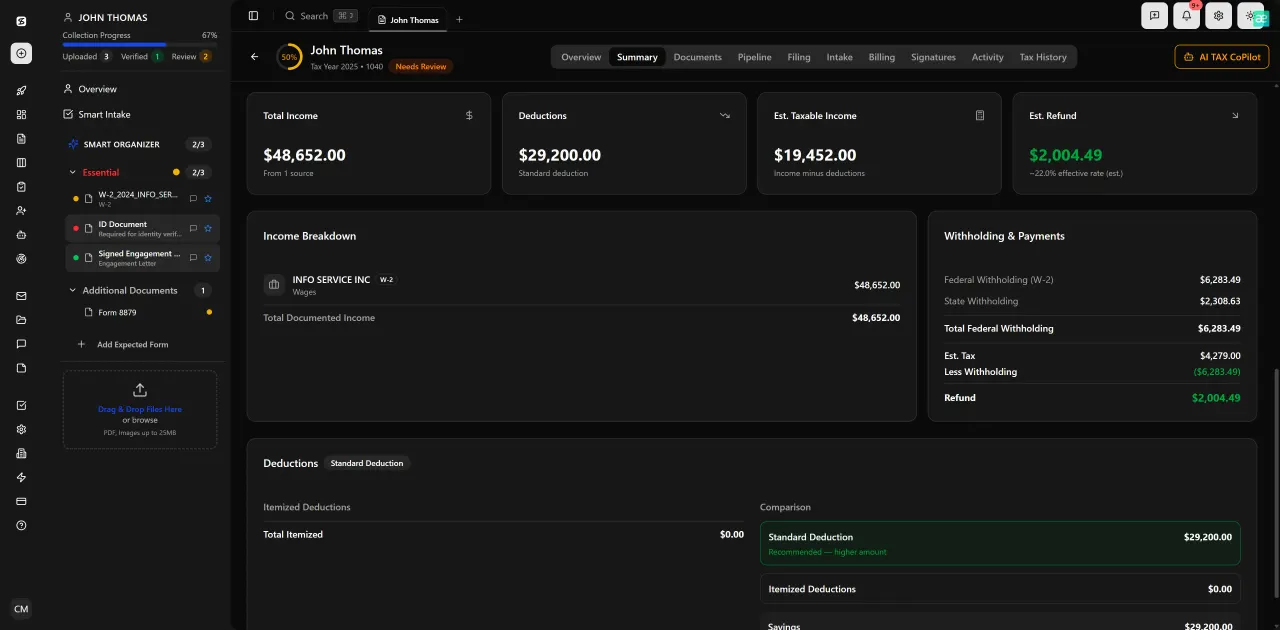
Review with AI assist — 9 agents answer questions with full client context
Bittner v. United States and the Per-Form Penalty Calculation
Tired of manual workflows slowing your firm down? See how TaxScout handles this with AI-powered automation. → Book a 15-Min Demo Understanding FBAR penalty negotiation in this context is what separates firms that scale from those that stall.
The Supreme Court's February 2023 decision in Bittner v. United States, 598 U.S. 85 (2023) fundamentally restructured how non-willful FBAR penalties are calculated. Alexandru Bittner, a Romanian-American businessman, failed to file FBARs for five years covering approximately 272 foreign accounts. The IRS assessed penalties on a per-account basis — one $10,000 penalty for each account for each year — producing a $2.72 million assessment. The Supreme Court held, in a 5-4 decision, that the $10,000 non-willful penalty accrues per form (i.e., per annual FBAR filing), not per account. This is precisely where a deliberate FBAR penalty negotiation strategy pays off.
The practical result is dramatic: a client with 50 foreign accounts who failed to file FBARs for three years faces a maximum non-willful penalty of $30,000 under Bittner (3 forms × $10,000), rather than $1.5 million (50 accounts × 3 years × $10,000). This makes the recharacterization argument — pushing a case from willful to non-willful — even more valuable than it was before the decision. Every basis point of negotiating leverage you create on the willfulness question now translates into a per-form penalty cap that can be orders of magnitude lower than the willful exposure. FBAR penalty negotiation sits at the center of this decision — get it wrong and the rest unravels.
Note that Bittner applied explicitly to non-willful violations only. The per-account calculation for willful penalties was not at issue, and the IRS has continued to assert per-account willful penalties in subsequent cases. This asymmetry reinforces why FBAR violation defense strategy must focus on the willfulness characterization before addressing the arithmetic. When firms revisit their FBAR penalty negotiation priorities, the gaps usually surface here.
Managing a high-stakes FBAR engagement while juggling a full tax season?
TaxScout's AI research agents search IRS, Treasury, and Cornell Law in real time — so you can build a penalty-reduction argument without leaving your workflow.
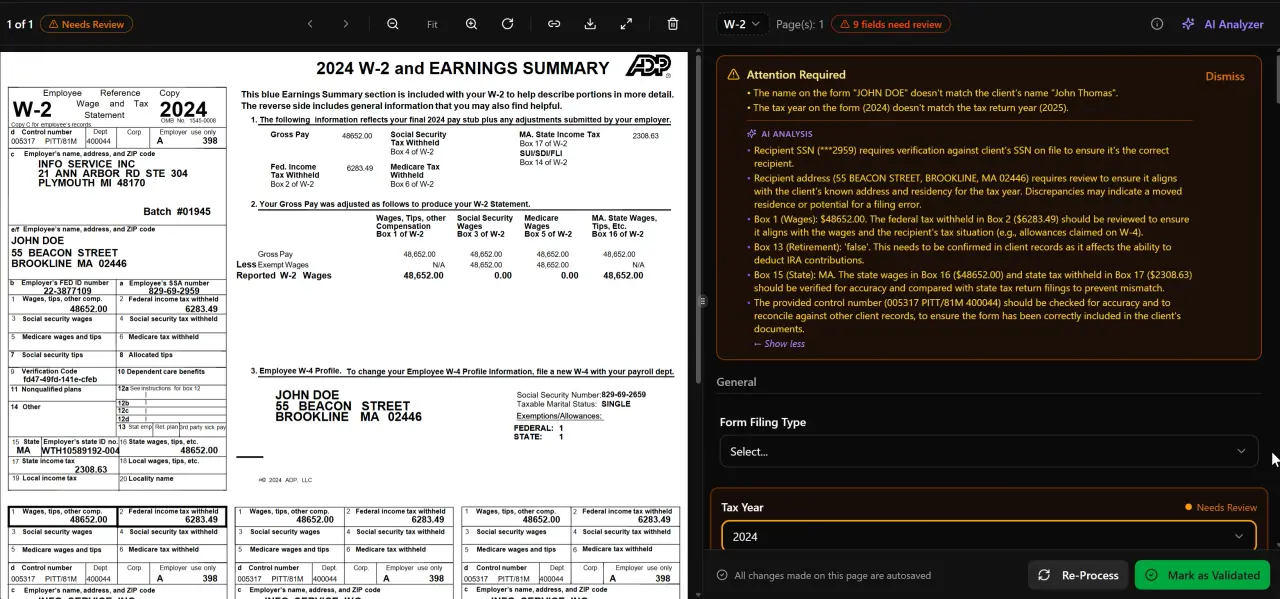
AI classifies, extracts, and validates every document automatically
Practitioner Strategies to Recharacterize Willful to Non-Willful
Recharacterization is not an admission — it is an affirmative factual and legal argument that the government cannot meet its burden of proving willfulness by a preponderance of the evidence. The IRS Internal Revenue Manual IRM 4.26.16 sets out the factors revenue agents are instructed to examine. Your strategy is to systematically build a record that cuts against each factor.
The most powerful affirmative arguments in FBAR penalty negotiation typically include: (1) demonstrating the client received no affirmative advice that foreign accounts must be reported, or received incorrect advice from a prior preparer; (2) showing the client's educational background and financial sophistication do not support constructive knowledge of reporting obligations; (3) establishing that Schedule B was checked incorrectly due to a preparer error, not the client's own omission; and (4) introducing foreign country-specific banking context — for example, clients who inherited accounts in jurisdictions where such accounts are culturally normalized rarely exhibit the hallmarks of concealment intent.
Attorney-CPA coordination is essential at this stage. A CPA alone should not be the sole professional communicating with IRS examiners about willfulness because those communications can become evidence. Engage tax counsel early, ideally before any substantive response to the examiner, and ensure your role is structured around the facts and financial documentation rather than legal characterization. For similar coordination strategies in other penalty contexts, our Reasonable Basis Defense guide outlines how CPAs and counsel divide responsibilities effectively.
Structuring the Facts Record
Build a chronological narrative that documents when and how the client learned about FBAR obligations. Gather evidence of: prior-year returns prepared by other firms (showing the error is systemic, not deliberate); correspondence with foreign banks that uses language suggesting the client did not understand U.S. reporting obligations; and any tax professional advice — however informal — that did not raise FBAR requirements. An affidavit or detailed declaration from your client explaining their understanding of the foreign accounts should be prepared by counsel but informed by the financial records you reconstruct. A well-documented facts record is often the difference between a favorable FBAR penalty negotiation outcome and a full statutory assessment.
Particular attention should go to the client's return-filing history. A client who consistently filed U.S. tax returns and reported foreign income (even without filing FBARs) presents a much weaker willfulness narrative for the IRS than one who also underreported income from the same accounts. The combination of foreign income underreporting and FBAR non-filing is the fact pattern most likely to survive a willfulness argument intact.
Responding to the Revenue Agent's Information Document Requests
Information Document Requests (IDRs) during an FBAR examination are not routine. Each IDR is an opportunity for the agent to establish facts that support willfulness. Respond completely but strategically: provide what is requested, include context that supports a non-willful narrative, and avoid volunteering information that could elevate the characterization. If the IDR requests communications with foreign financial institutions, review them carefully with counsel before production — some contain language about tax confidentiality that agents interpret as concealment intent.
Document your own work product in this phase carefully. A platform with robust file management capabilities allows you to maintain a complete, date-stamped record of every document produced and received — a discipline that protects both the client and your firm if the matter escalates.
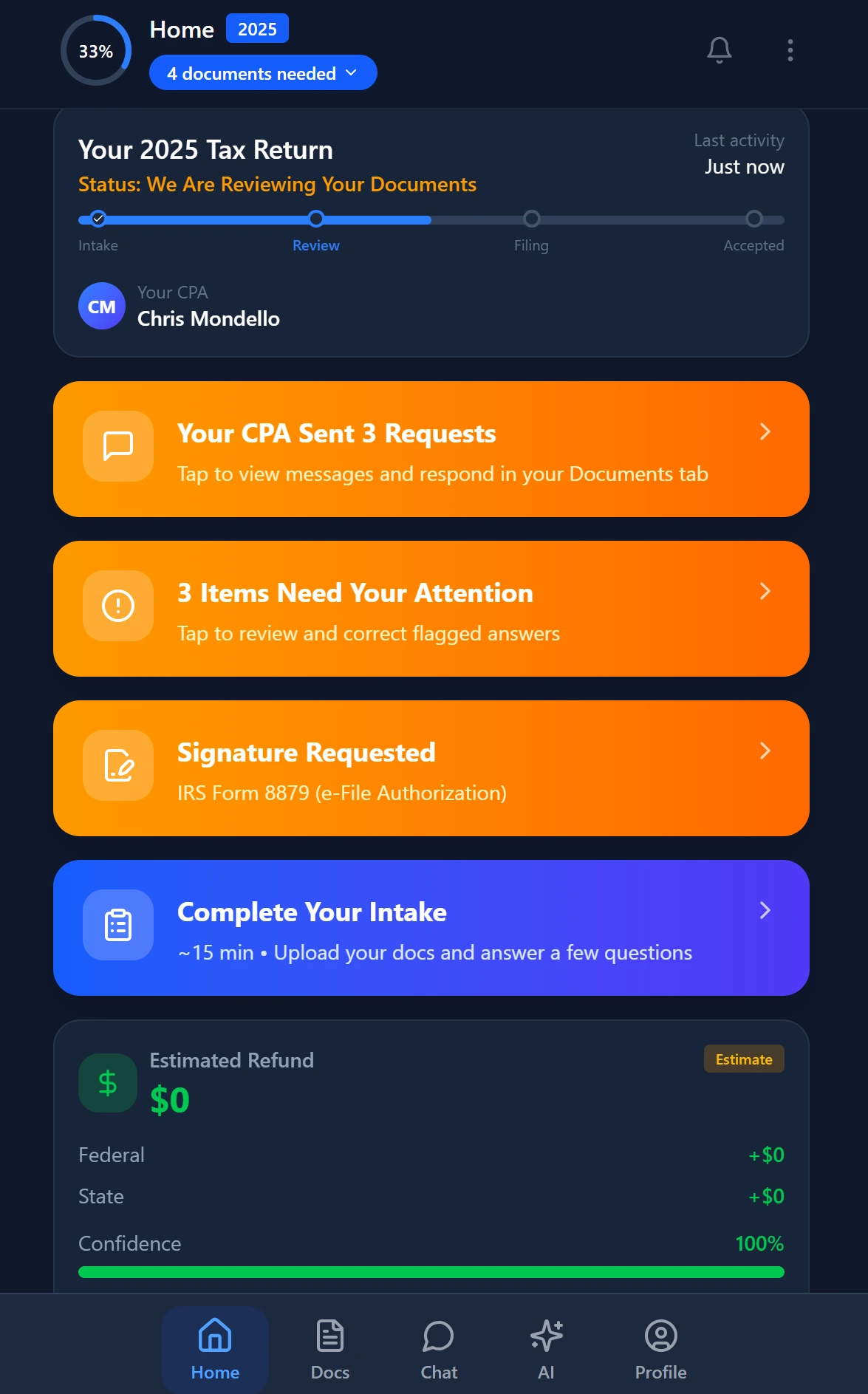
Smart intake auto-fills from uploaded documents and prior-year data
Streamlined Filing Compliance Procedures vs Delinquent FBAR Submission Procedures
Two IRS-administered relief programs exist for clients who come forward before a formal willful determination, and choosing the wrong one can be costly. The Streamlined Domestic Offshore Procedures (SDOP) and the Streamlined Foreign Offshore Procedures (SFOP) both require the taxpayer to certify that the failure to report was non-willful. The SDOP imposes a 5% miscellaneous offshore penalty on the highest aggregate balance of unreported assets; the SFOP imposes no penalty for qualifying foreign residents. Neither program is available once the IRS has initiated a civil examination or a criminal investigation of the taxpayer. Selecting the right pathway before IRS contact is itself a critical step in effective FBAR penalty negotiation.
The Delinquent FBAR Submission Procedures (DFSP) apply when the taxpayer has not filed required FBARs but has reported all foreign income properly. Under the DFSP, the IRS will not impose penalties if the taxpayer files the delinquent FBARs and includes a statement of reasonable cause. This is the lowest-risk pathway for clients whose only failure was the FBAR filing itself — not an underlying income reporting failure.
The decision between these pathways hinges on two questions: (1) Is the client's conduct truly non-willful, and can you document it? (2) Has IRS contact already been initiated? If the IRS has already sent a notice or opened an examination, streamlined procedures are off the table, and the FBAR violation defense strategy pivots entirely to examination-level negotiation and, if necessary, the IRS Independent Office of Appeals. For a broader look at late-filing penalty relief options across return types, see our Late Filing Penalty Relief guide.
Voluntary Disclosure Arguments That Reduce Six-Figure Penalties
When streamlined procedures are unavailable because IRS contact has already occurred, the primary tool for IRS offshore penalty abatement at the examination stage is a penalty abatement or mitigation argument under the IRS FBAR penalty mitigation guidelines. The IRS FBAR Penalty Mitigation Guidelines, found at IRM 4.26.16.4, allow examiners to reduce penalties below the statutory maximum based on a balancing of factors including the amount of the violation, the level of cooperation, the taxpayer's compliance history, and the presence of a voluntary disclosure. Practitioners who understand FBAR penalty negotiation at this level consistently achieve better outcomes than those who treat it as a straightforward abatement request.
A formal voluntary disclosure under the IRS Criminal Investigation Voluntary Disclosure Practice — accessible at IRS Criminal Investigation — can still be valuable even after initial IRS contact in certain circumstances, particularly if the client faces criminal exposure rather than purely civil penalties. The voluntary disclosure practice requires the disclosure to be timely, complete, and truthful; in exchange, CI typically recommends against criminal prosecution. CPAs should not structure or submit a voluntary disclosure without coordinating with criminal tax counsel — the stakes of an incorrectly submitted or incomplete disclosure are severe.
When negotiating penalty amounts at the examination stage, cite the Bittner decision proactively even for cases where willfulness is still in dispute. Argue in the alternative: if the examiner maintains willfulness, preserve the argument for Appeals; simultaneously argue that even if willful, the per-form calculation logic from Bittner's underlying reasoning applies to the factual record in your client's case. Courts have not uniformly extended Bittner to willful penalties, but the argument creates negotiating surface area and signals to the examiner that you will contest the assessment through all available channels. CPAs managing complex IRS research tasks across multiple clients can use TaxScout's AI research agents to surface the latest court decisions and IRS guidance on offshore penalty abatement without manual research queues.
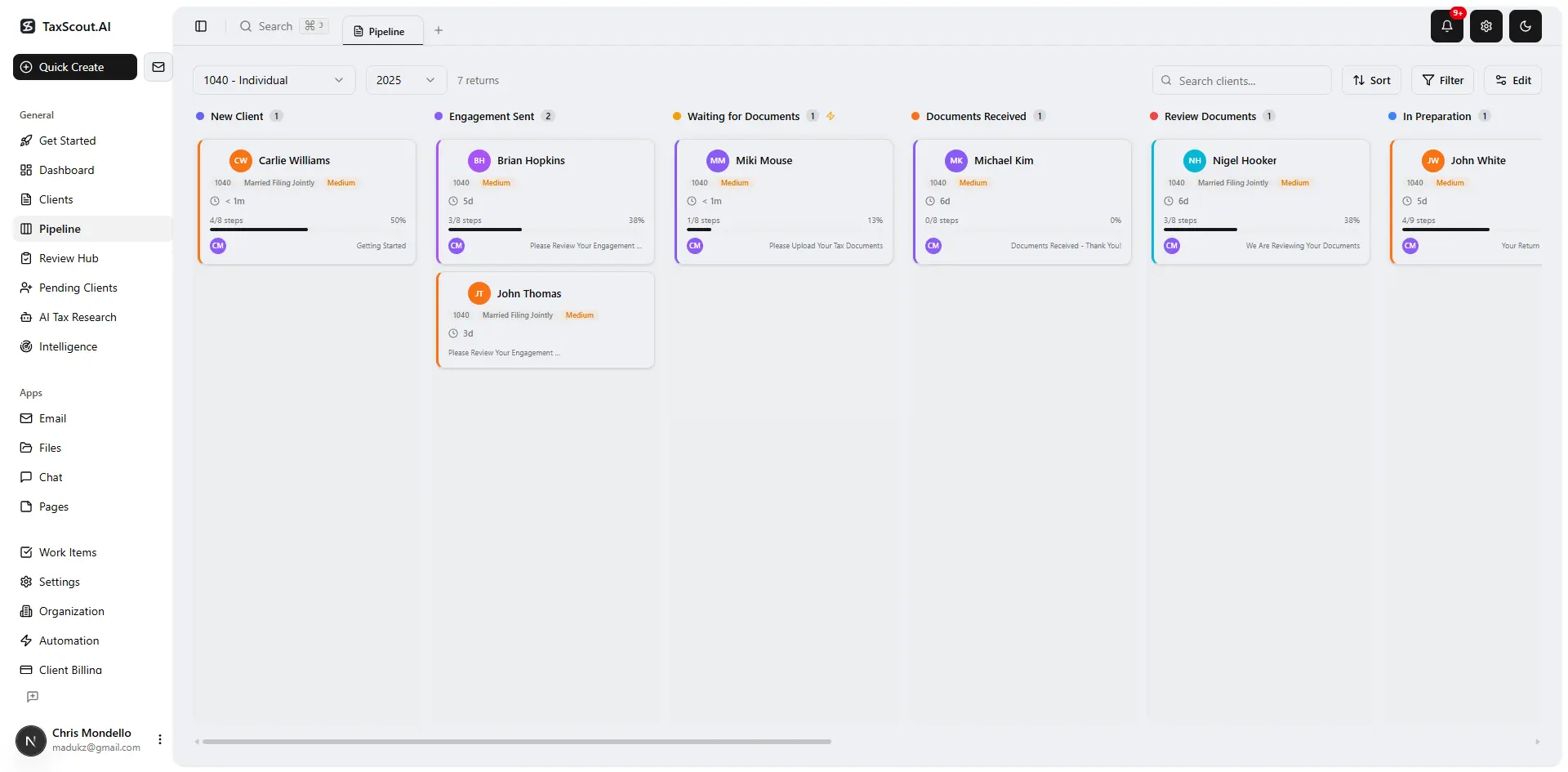
Track every return from intake to filed with drag-and-drop pipeline management
FBAR Relief Pathway Decision Matrix for CPAs
| Pathway | Eligibility Requirement | Penalty Exposure | Best Fit Scenario |
|---|---|---|---|
| Streamlined Domestic Offshore (SDOP) | No prior IRS contact; non-willful certification | 5% miscellaneous offshore penalty on highest aggregate balance | U.S. resident with unreported foreign income and accounts, no examination opened |
| Streamlined Foreign Offshore (SFOP) | No prior IRS contact; non-willful; foreign residency | No FBAR penalty | Foreign resident with non-willful failure; foreign income underreported |
| Delinquent FBAR Submission Procedures (DFSP) | No prior IRS contact; all foreign income reported on returns | No penalty if reasonable cause shown | Client filed returns correctly but never filed FBARs |
| Examination-Level Penalty Mitigation (IRM 4.26.16) | Examination already opened | Reduced below statutory maximum; per-form logic after Bittner | IRS contact received; streamlined programs unavailable |
| IRS CI Voluntary Disclosure Practice | Not yet under criminal investigation | Civil resolution; no criminal prosecution recommended | Client faces criminal exposure; unreported income significant |

Every client gets organized documents, status tracking, and a complete history
CPA Role When a Willful Referral Reaches the Department of Justice
A small but growing number of willful FBAR cases are referred by IRS Criminal Investigation to the Department of Justice Tax Division for prosecution or civil enforcement. Once a DOJ referral occurs, the CPA's role shifts fundamentally: you are no longer the primary advocate and must step back from any function that could make you a witness. Tax counsel — specifically a criminal defense attorney with offshore tax experience — must lead.
That said, the CPA's value in a DOJ-referred case remains substantial. You hold the financial reconstruction — the account records, prior returns, foreign income flows, and entity structures — that counsel needs to build a defense narrative. Your ability to present a clear, timeline-based financial history of how the foreign accounts arose, how they were reported or not reported on prior returns, and what advice the client received is often the difference between a negotiated civil resolution and an indictment. Organizing that documentation quickly and completely, using tools like AI document extraction to reconstruct historical K-1s, 1099s, and foreign account statements, can materially accelerate the defense timeline and strengthen the overall FBAR penalty negotiation position with DOJ counsel.
Maintain strict privilege boundaries. Communications between you and the client that predated the engagement of counsel are not covered by attorney-client privilege — only attorney work product and communications with the attorney are. Document your own work in a format that supports privilege claims: route substantive analysis through counsel's requests, and flag any communications that touch on the willfulness question for counsel's review before sending. You can find additional resources on complex IRS enforcement engagements across other blog resources covering related penalty and compliance topics.
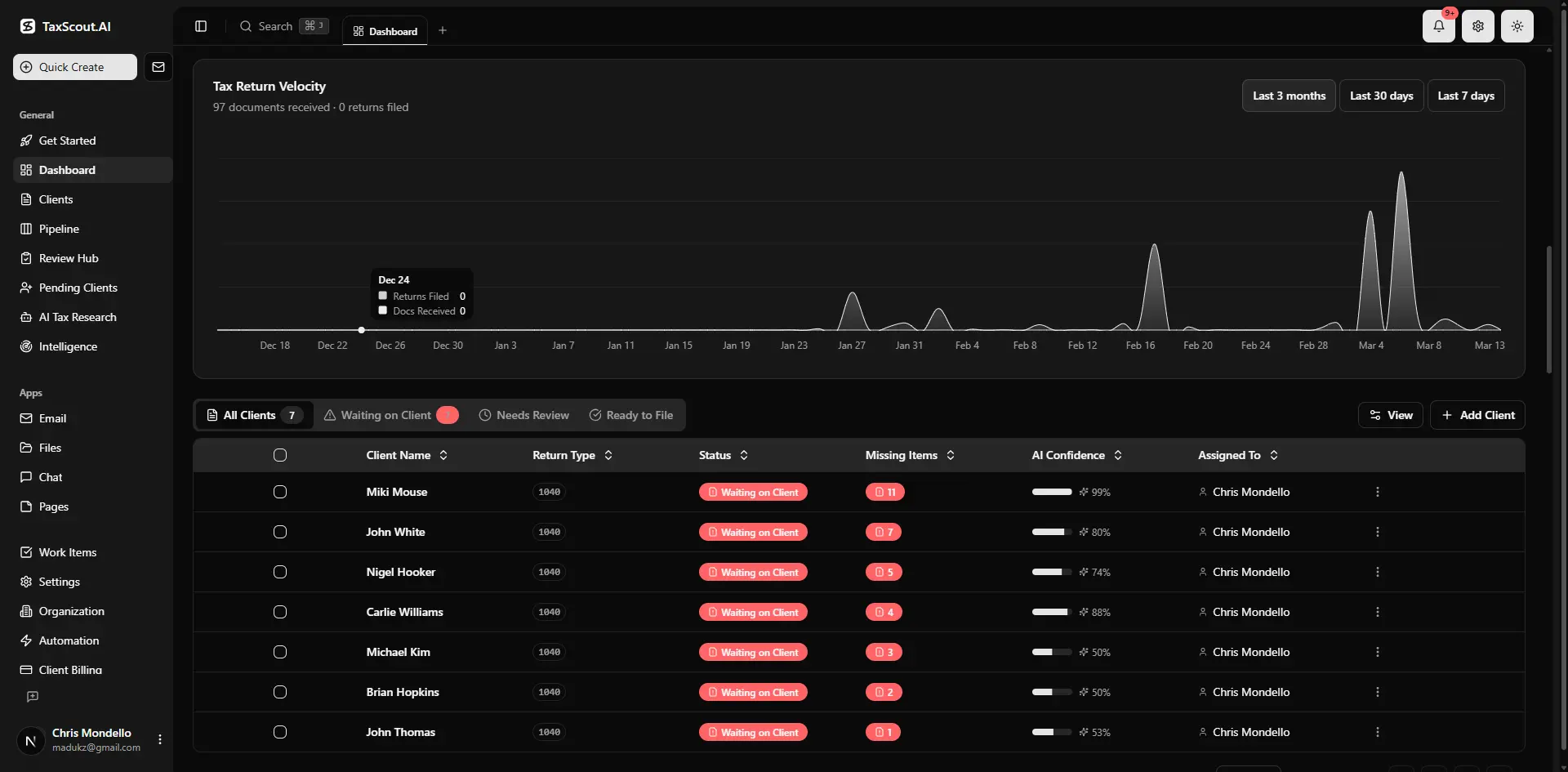
Real-time dashboard showing returns in progress, revenue, and upcoming deadlines
Building Recurring FBAR Oversight Into Your Practice
For CPAs who serve high-net-worth clients, executives with international assignments, or business owners with foreign operations, FBAR compliance should be embedded in the annual engagement rather than treated as a one-off issue. The IRS Foreign Account Tax Compliance Act (FATCA) information exchange program means the IRS now receives automatic account reports from foreign financial institutions in over 100 jurisdictions — making future non-compliance far more detectable than it was a decade ago. Proactive annual oversight is the most effective way to keep clients out of FBAR penalty negotiation entirely.
Build a standing foreign account questionnaire into your intake process. Use it every year, not just in the year a client discloses a new account. Flag any Schedule B Part III 'Yes' answers for FBAR cross-check before the return is filed. The Social Security Administration's wage data and Treasury's FBAR e-filing portal both offer resources for practitioners building systematic processes.
Practice management platforms that support AI-powered intake can prefill foreign account disclosures from prior-year data and prompt for updates — reducing the annual oversight burden significantly. Pair that with a pipeline management system that flags FBAR-related deadlines (the April 15 due date with automatic extension to October 15) alongside Form 1040 due dates, and you have a systematic defense against the inadvertent omissions that create non-willful cases — and the willful exposure that follows if those omissions persist across multiple years.
Managing offshore disclosure cases alongside a full client roster?
TaxScout gives your firm AI research agents, document extraction, and pipeline management on one flat-rate platform — unlimited team members, no per-seat fees.

Your clients see your brand — OTP login, document upload, and real-time status
Frequently Asked Questions
A non-willful FBAR penalty is capped at $10,000 per violation (and after Bittner v. United States, 'per violation' means per annual form, not per account). A willful penalty can reach the greater of $100,000 or 50% of the account balance per violation per year. Willfulness includes both actual knowledge of the reporting obligation and reckless disregard of it — checking 'No' on Schedule B when foreign accounts exist is frequently cited as evidence of willfulness.
Stay up to date
Get the latest tax tech insights delivered to your inbox.