Client Trust in the AI Era: How CPA Firms Build Relationships That Survive Automation
Karbon's 2026 survey of 350 business owners confirms that trust — not price — is the primary reason clients stay with or leave their accounting firm. But trust is not a soft skill; it is a workflow problem. This guide breaks down three operational drivers of client trust and shows how AI-native…
Karbon's 2026 Future of Client Trust report surveyed 350 U.S. business owners and found a striking result: client trust CPA firms build — or fail to build — is the single greatest competitive differentiator in accounting today. Not price. Not credentials. Not specialization. Trust. Clients who trust their accountant stay, refer, and expand their engagement. Clients who don't churn quietly, often without ever explaining why.
The report is valuable as a diagnostic tool. It confirms what most firm owners feel intuitively: slow response times, lost documents, and radio silence during tax season are the friction points that erode relationships faster than any fee increase. What the report does not provide is a workflow-level prescription — a concrete answer to the question, 'What exactly should we change inside the practice to produce trustworthy client experiences at scale?' Understanding these friction points is essential for client trust CPA firms depend on to retain clients through economic uncertainty and fee adjustments alike.
That is the gap this article fills. Trust is not primarily a people problem or a culture problem. It is an operations problem — and modern AI-native practice management software is built to solve it. Below, we walk through the three operational drivers of client trust that software can directly improve, and how firms are using platforms like TaxScout.ai to transform each one from a recurring weakness into a durable competitive advantage. Ultimately, the client trust CPA firms struggle to build and maintain comes down to whether their internal operations are designed to deliver consistency at every touchpoint.
What Karbon's Research Actually Tells Us About How Clients Choose Accountants
Karbon's report draws on survey responses from 350 U.S. business owners and executives, making it one of the more substantive data sets on accounting firm client relationships published in recent years. The headline finding is that trust outranks price, industry expertise, and technology capabilities when clients evaluate whether to stay with or switch firms. That finding aligns with earlier IRS Taxpayer Experience research showing that responsiveness and transparency are the top two service dimensions taxpayers associate with competence. This finding reinforces a broader truth about client trust CPA firms have long suspected but rarely had hard data to confirm: clients stay for the relationship, not the rate.
Dig deeper into Karbon's data and three sub-findings stand out. First, clients increasingly expect their firms to use AI — but they are simultaneously worried that AI will depersonalize the relationship. Second, the behaviors that erode trust are operational, not interpersonal: missed deadlines, slow replies, unclear document status, and unexpected bills. Third, clients who describe their firm as 'proactive' are significantly more likely to both stay and refer. The CPA firm value proposition, in client minds, is not just technical accuracy — it is the feeling of being looked after. For firms evaluating their client trust CPA firms approach, this trade-off compounds over time.
The problem is that Karbon frames these findings as evidence that trust is a competitive advantage to be cultivated through mindset and culture. That framing undersells the urgency. When the specific behaviors that destroy trust — slow response, document opacity, passive communication — are driven by workflow failures and tooling gaps, the fastest path to better client relationships runs directly through better software. For a deeper exploration of how AI-native tools fit into this picture, other blog resources on practice modernization are worth reviewing alongside this one. Each of these factors directly shapes how client trust CPA firms plays out in practice.

Your clients see your brand — OTP login, document upload, and real-time status
The Three Operational Drivers of Client Trust That AI Can Fix
Every trust-eroding behavior Karbon identified maps to one of three operational categories: response time, document transparency, and proactive communication. Each one has a root cause that is structural — embedded in how most firms currently manage work — and each one has a direct software-level remedy. Understanding client trust CPA firms in this context is what separates firms that scale from those that stall.
Response time failures happen when client messages are routed to individual inboxes, buried under internal thread volume, or simply missed during peak season. Document transparency failures happen when clients have no visibility into what they submitted, what is still needed, or where their return stands. Proactive communication failures happen when the only trigger for outreach is an inbound question — meaning the firm is always reactive, never leading. This is precisely where a deliberate client trust CPA firms strategy pays off.
Understanding these as distinct operational categories matters because each requires a different workflow intervention. Lumping them together under 'client service culture' makes them feel vague and hard to fix. Breaking them apart makes them tractable — and measurable. The accounting firm KPI dashboard guide covers how to instrument these metrics once the workflows are in place. Client trust CPA firms sits at the center of this decision — get it wrong and the rest unravels.
Tired of client trust eroding because your workflows weren't designed to prevent it? When firms revisit their client trust CPA firms priorities, the gaps usually surface here.
TaxScout.ai gives CPA firms the AI-native infrastructure to deliver faster responses, full document transparency, and proactive communication — all from one platform, starting at $49/month.
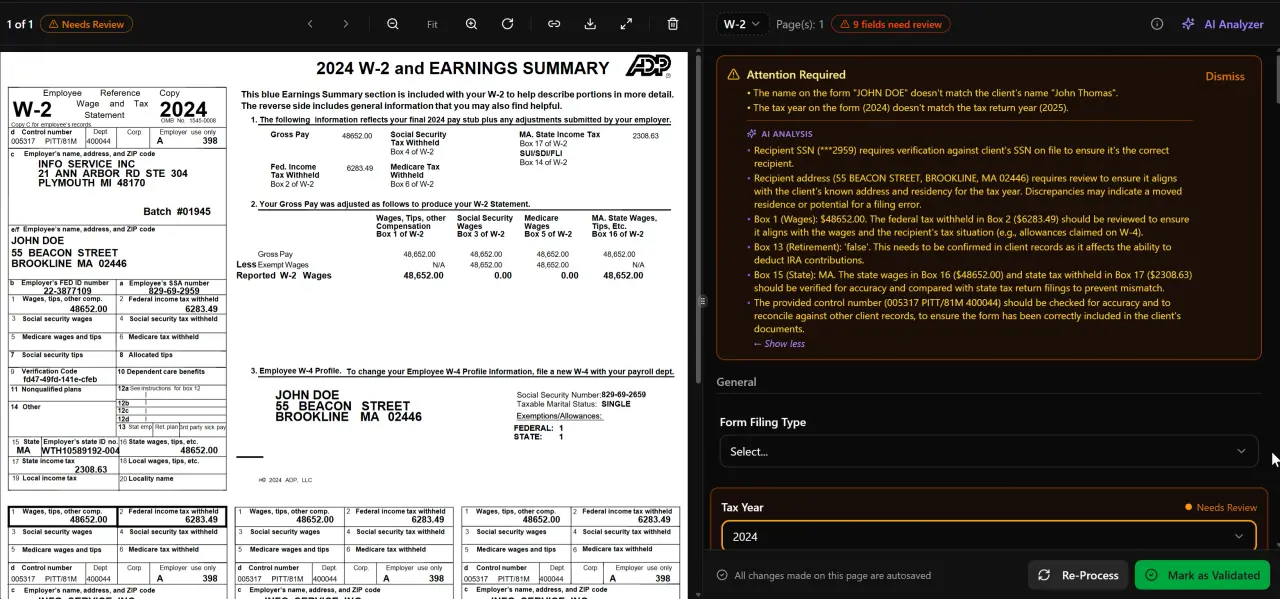
AI classifies, extracts, and validates every document automatically

Click any extracted field to see its source highlighted on the original PDF
Driver 1: Response Time and the AI Communication Hub
According to Bureau of Labor Statistics occupational survey data, CPA firms experience a 3-to-1 surge in client inquiry volume during January through April. Most firms handle this surge with the same infrastructure they use in July: individual email inboxes and manual triage. The result is that messages routinely sit for 24 to 72 hours during the period when clients are most anxious and most likely to form negative judgments about their firm.
The structural fix is a unified communication hub that aggregates Gmail, Outlook, and IMAP/POP3 accounts into a single queue with AI-powered classification. When every message is visible to the whole team, triaged by urgency, and assigned to the right person without a forwarding chain, average first-response time drops from days to hours. The shared inbox guide covers the implementation details, but the key mechanism is removing the single-inbox bottleneck that makes fast response structurally impossible during peak season.
AI classification adds a second layer: it distinguishes between a client asking a quick status question (which a team member can answer in two minutes) and a client raising a scope-change issue (which needs partner review). Routing these differently means the easy responses happen immediately while the complex ones get appropriate attention — rather than both sitting in the same pile and neither being answered fast enough.
Driver 2: Document Transparency and the Client Portal
The second trust-eroding pattern Karbon identified is document opacity. Clients send in their W-2s and 1099s and then have no idea whether the documents arrived safely, whether anything is missing, or what happens next. This uncertainty creates anxiety that clients often interpret as disorganization — even when the firm is perfectly on top of the engagement internally.
A branded client portal with OTP login eliminates this uncertainty by giving clients a real-time window into their own engagement. They can see which documents have been received and processed, what is still outstanding, and where their return stands in the pipeline — without calling or emailing to ask. The portal uses one-time passcodes instead of passwords, which removes the friction that kills adoption on legacy portal products.
On the firm side, AI document extraction processes 180+ tax form types — W-2s, all 1099 variants, K-1s, 1098 series, 1095 series, and the full 1040 with schedules — through a 5-layer validation pipeline that includes OCR cross-verification, confidence scoring, and 15 deterministic math rules. The split-screen PDF viewer with click-to-source field highlighting means preparers can verify extraction results against original documents in seconds rather than minutes. For a technical deep-dive on what that pipeline actually does, the AI document extraction guide is the most complete reference available.
The trust payoff is bidirectional. Clients gain the visibility they need to feel confident. Firms gain a complete audit trail showing exactly when documents were received and processed — which matters when IRS compliance questions arise about timeliness or completeness.
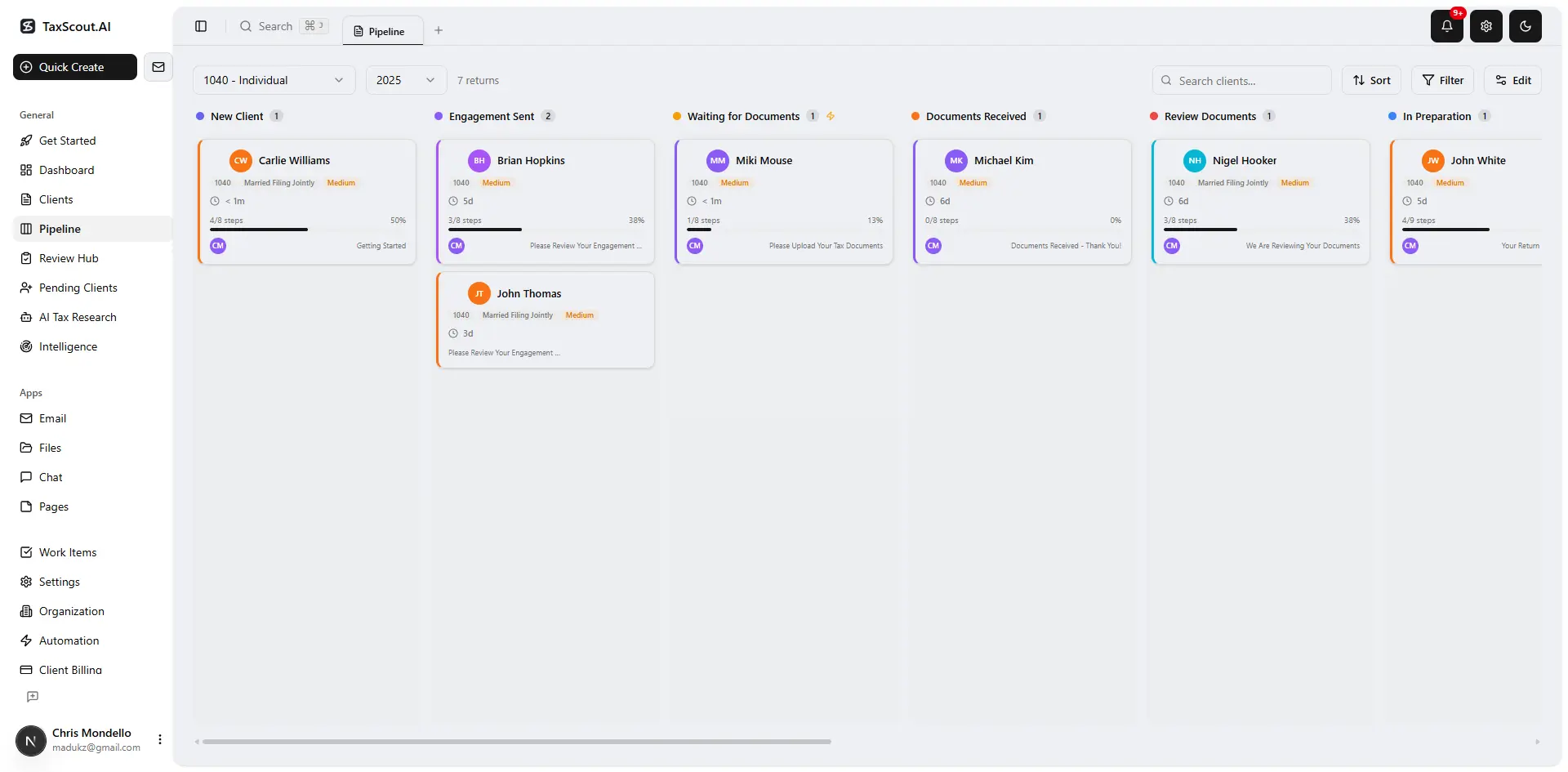
Track every return from intake to filed with drag-and-drop pipeline management
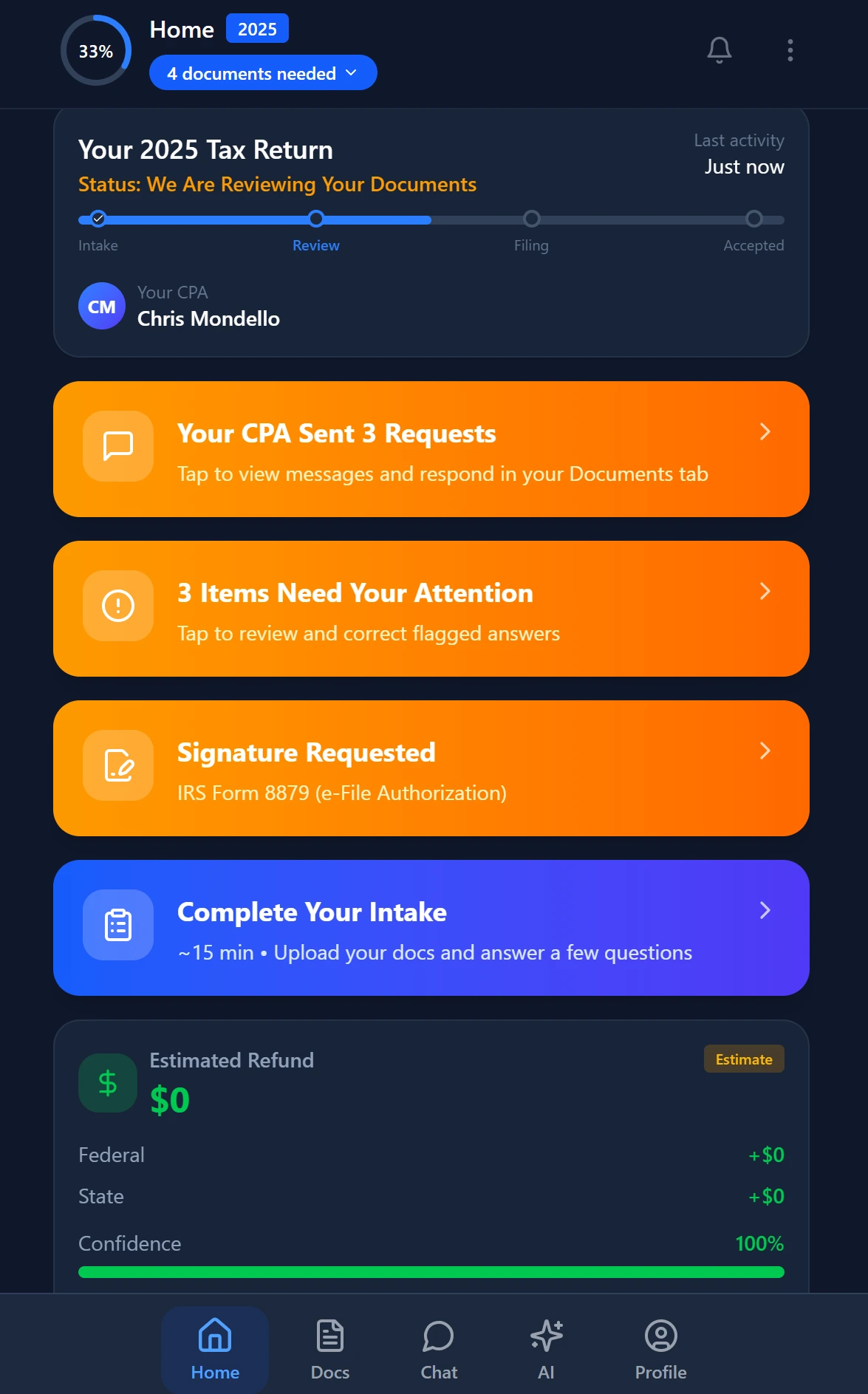
Smart intake auto-fills from uploaded documents and prior-year data
Driver 3: Proactive Communication Through Smart Intake and Pipeline Automation
The firms clients describe as 'proactive' are not staffed with psychic partners. They have systems that trigger outreach before clients think to ask. That distinction matters because proactive communication at scale is not a people problem — it is an automation problem.
The smart intake engine addresses this at the front of the engagement. Modeled on IRS Form 13614-C, it uses a four-layer prefill approach: document-first extraction from prior-year returns, profile data, and an AI gap analysis that identifies what is likely missing based on prior filings and the client's entity structure. When intake is that thorough, the number of mid-engagement document-chase emails drops significantly — which clients experience as the firm having its act together.
Mid-engagement, pipeline management with 12 customizable stages and drag-and-drop kanban gives the team a single view of where every client stands. Automated stage transitions and deadline triggers mean clients get status updates — and firms catch stalled work — without anyone having to manually monitor every open return. The IRS deadlines 2026 guide is a useful companion for configuring deadline triggers that align with actual filing calendar requirements.
The Small Business Administration's research on business owner priorities consistently shows that small business clients rank 'knowing what is happening with my taxes' above almost every other service attribute. Proactive pipeline communication directly addresses that priority — and it is the workflow change most firms could make fastest with the right tooling.
How TaxScout.ai compares to Karbon on the three trust drivers for a 10-person firm
| Trust Driver | Karbon | TaxScout.ai |
|---|---|---|
| Response time / unified inbox | Email-centric shared inbox; no AI classification | AI-classified communication hub (Gmail, Outlook, IMAP) with urgency routing |
| Document transparency / portal | Client portal available; no AI extraction or 5-layer validation | Branded portal with OTP login + AI extraction across 180+ form types |
| Proactive communication / intake | Workflow automation available; no AI intake prefill or gap analysis | Smart intake with 4-layer AI prefill + 12-stage pipeline with deadline triggers |
| AI research for advisory depth | No dedicated AI research agents | 9 specialized AI agents with real-time IRS/Treasury/Cornell/SSA search |
| Monthly cost (10-person firm) | ~$590/month ($59/user) | $149/month flat — no per-user fees |
AI and Client Trust Accounting: Why Clients Accept — and Expect — AI in Their Firm
One of the most actionable findings in Karbon's research is the nuance around AI adoption: clients want their firms to use AI, but they want the relationship to remain human. This is not a contradiction — it is a workflow design brief. The AI should be invisible in the output and visible in the speed and accuracy of the service. When a client gets a detailed, sourced answer to a complex question about law.cornell.edu's IRC Section 179 deduction limits within an hour of asking, they do not need to know that nine specialized AI research agents ran parallel queries against IRS, Treasury, Cornell Legal Information Institute, and SSA sources to produce it. They just need the answer to be right and fast.
The same logic applies to document processing. When a client uploads a K-1 with an unusual line item and the preparer catches it during review because the AI flagged a confidence score anomaly in the 5-layer validation pipeline — that is AI serving the relationship, not replacing it. The preparer still makes the judgment call. The AI just made sure the issue was visible in the first place.
Firms that understand this distinction — AI as infrastructure for human judgment, not a substitute for it — are the ones that will successfully answer the question of how clients choose accountants in the next five years. The AI accounting productivity guide covers how to introduce AI tooling to clients in ways that reinforce rather than undermine the trust narrative.
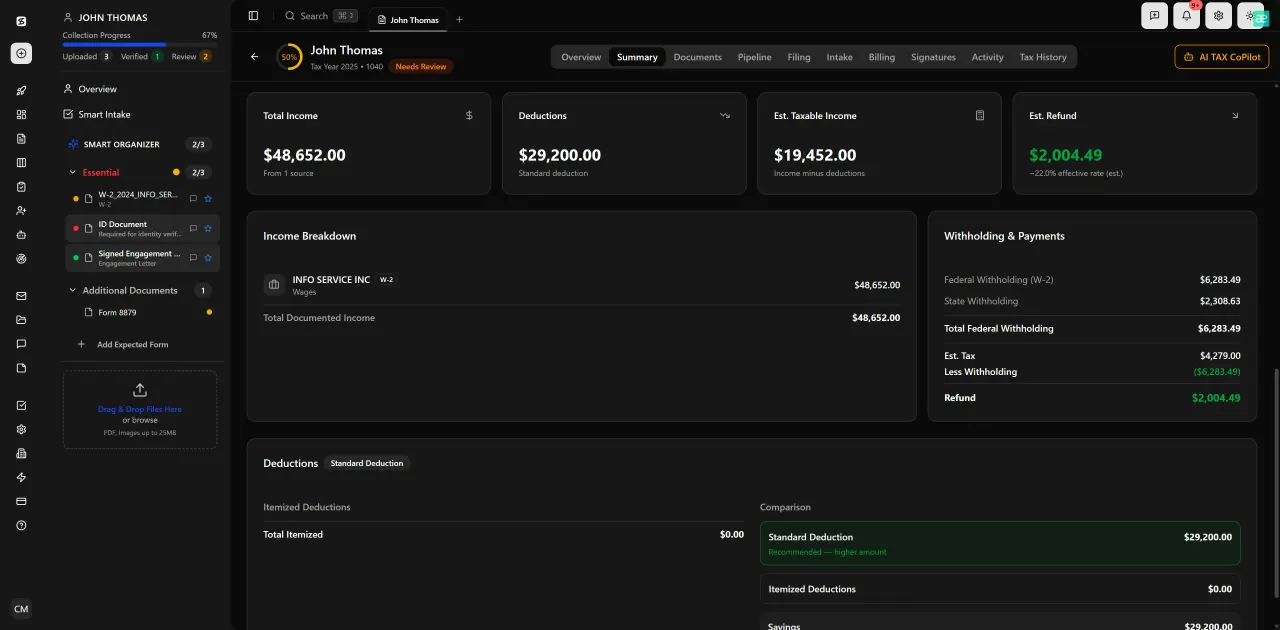
Review with AI assist — 9 agents answer questions with full client context
Building a CPA Firm Competitive Advantage That Compounds Over Time
Karbon's framing of trust as a static competitive advantage misses something important: trust compounds. Each on-time delivery, fast response, and proactive heads-up is a deposit into a relationship account that makes the next renewal conversation shorter, the next referral more likely, and the next fee increase easier to accept. The Journal of Accountancy's practice management research has documented that firms with high client retention rates charge on average 15-20% more than peers with comparable technical capability — not because they are more technically skilled, but because clients trust them and price becomes a secondary consideration.
The compounding effect only works if the underlying workflows are reliable. A firm that delivers a great experience in January but drops the ball in March loses the compound interest it earned. AI-native infrastructure — unified inbox, smart intake, document portal, pipeline automation — is what makes great client experiences consistent rather than heroic. It removes the dependency on individual staff members heroically catching things and replaces it with systematic processes that work the same way every time.
For firms evaluating their current stack, the TaxScout.ai comparison with Karbon shows in detail how the two platforms differ on the specific features that drive the three trust metrics. The pricing page breaks down the flat per-firm cost structure that makes the switch financially straightforward for firms of almost any size — with no per-user fees and unlimited clients on every plan.
The U.S. Treasury's guidance on taxpayer rights and service standards increasingly frames timely and transparent communication as a baseline expectation, not a differentiator. For CPA firms, that external pressure reinforces the internal business case: the firms that operationalize trust through better workflows will not just retain more clients — they will attract the clients that competitors lose.
Ready to turn trust from a soft skill into a systematic workflow advantage?
TaxScout.ai gives your firm AI-native document extraction, a branded client portal, smart intake, and pipeline automation — all at a flat $149/month for up to 10 seats, no per-user fees.

Every client gets organized documents, status tracking, and a complete history
Frequently Asked Questions
Karbon's 2026 survey of 350 U.S. business owners found that trust is the top factor clients use when evaluating whether to stay with or switch accounting firms — outranking price, credentials, and technology. The specific behaviors that erode trust are operational: slow response times, document opacity, missed deadlines, and passive communication.
Keep reading
Divorce Tax Planning for CPAs: How to Split Assets Without Triggering Unexpected Liability
Oct 25, 2026 · 1 min read
Ponzi Scheme Loss Deductions: How CPAs Claim Theft Losses for Defrauded Clients
Oct 24, 2026 · 1 min read
Premium Tax Credit Proposed Regulations: What CPA Firms Must Do Now
Oct 24, 2026 · 1 min read
Stay up to date
Get the latest tax tech insights delivered to your inbox.