AEO for CPA Firms: How to Get AI Search to Recommend Your Practice
AI tools like ChatGPT, Claude, and Google AI Overviews are becoming the first stop for business owners searching for a CPA. This guide gives accounting firms a technical and strategic roadmap — schema markup, FAQ architecture, structured content, and AI-native workflows — to get cited and…
AEO for CPA firms is no longer a forward-looking experiment — it is an immediate competitive reality. When a business owner types 'find me a CPA who handles S-corps in Austin' into ChatGPT or Claude, an AI model reads your website, your reviews, your structured data, and your content depth, then decides whether to cite your firm or a competitor. No click required. No yellow-pages listing. No Google Ads spend can buy that citation.
Traditional search engine optimization built your firm's visibility around keyword rankings and backlink counts. Answer engine optimization is different: AI search systems — including Google's AI Overviews, Bing Copilot, Perplexity, ChatGPT, and Claude — are trained to extract the most authoritative, clearly structured, directly relevant answer to a question. If your firm's digital footprint is not organized to feed those extraction models, you are invisible even when you are technically the best option. AEO for CPA firms addresses this shift by positioning your practice as the trusted source AI systems pull from when answering tax, audit, and advisory questions.
This guide goes beyond brand consistency tips. You will get the technical implementation checklist — schema markup types, FAQ page architecture, structured Q&A content formats — plus an analysis of why the practice management software your firm runs changes your AEO footprint in ways most CPAs have never considered. Mastering AEO for CPA firms requires understanding not just content structure but also how your underlying technology stack signals authority to AI retrieval systems.
What Answer Engine Optimization Means for Accounting Firms
Answer engine optimization is the practice of structuring your firm's web presence so AI retrieval systems can extract, trust, and cite your content when answering user questions. Where SEO optimizes for a ranked list of links, AEO optimizes for a direct spoken or written answer — one in which your firm may be named without the user ever visiting your website. When applied correctly, AEO for CPA firms means your expertise — not a competitor's — appears as the cited answer when a prospective client asks an AI about local tax planning or audit services.
For accounting firms, this shift is consequential. According to research tracked by the U.S. Bureau of Labor Statistics, demand for accountants continues to grow, yet the channel through which prospective clients find a CPA is migrating toward conversational AI. The firms that build AEO infrastructure now will own that channel as it matures. For firms evaluating their AEO for CPA firms approach, this trade-off compounds over time.
The core mechanics of answer engine optimization accounting strategy rest on three pillars: machine-readable structured data (schema markup), content that directly answers specific questions your ideal clients ask, and consistent entity signals across every platform where your firm appears. Each pillar reinforces the others, and all three are measurable. Each of these factors directly shapes how AEO for CPA firms plays out in practice.
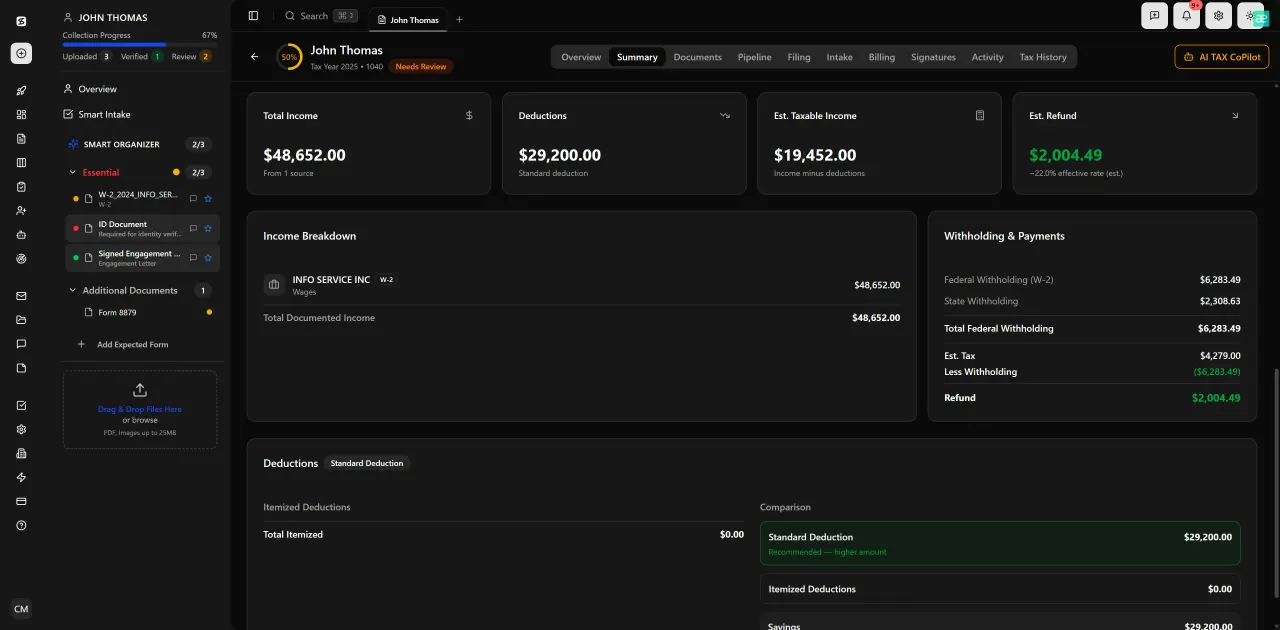
Review with AI assist — 9 agents answer questions with full client context
How AI Search Systems Decide Which CPA Firms to Cite
ChatGPT, Claude, Perplexity, and Google AI Overviews all use large language models trained on indexed web content, supplemented in some cases by live retrieval. When a model answers 'who is the best CPA for real estate investors in Denver,' it is performing a weighted combination of: entity recognition (does your firm clearly identify its niche?), content authority (do you publish deep, accurate answers to questions your niche asks?), structured data signals (does your markup confirm your credentials, location, and service scope?), and trust signals (reviews, citations from authoritative domains, consistent NAP data). Understanding AEO for CPA firms in this context is what separates firms that scale from those that stall.
Google's Search Quality Evaluator Guidelines formalize this as E-E-A-T: Experience, Expertise, Authoritativeness, and Trustworthiness. While written for human raters, these standards directly shape the signals that feed AI Overview selection. A CPA firm that publishes signed articles by licensed CPAs, cites IRS publications and Treasury guidance, and structures its site with proper schema communicates high E-E-A-T to both human evaluators and AI extraction pipelines. This is precisely where a deliberate AEO for CPA firms strategy pays off.
The critical insight is that AI systems prefer content that is already formatted as an answer. A page titled 'Our Tax Services' provides weak AEO signal. A page titled 'What Does a CPA Charge for an S-Corp Tax Return in Texas?' that opens with a direct, specific answer, then elaborates with depth, is precisely the content format that gets cited. This is a structural writing discipline, not a clever hack. AEO for CPA firms sits at the center of this decision — get it wrong and the rest unravels.
Tired of losing prospective clients to firms whose websites are better organized than yours? When firms revisit their AEO for CPA firms priorities, the gaps usually surface here.
TaxScout gives your firm the AI-native infrastructure — branded client portal, structured intake, and research agents — that makes your practice more credible and more citable in AI search.

Your clients see your brand — OTP login, document upload, and real-time status

Click any extracted field to see its source highlighted on the original PDF
Technical AEO Implementation: Schema Markup for CPA Firms
Schema markup is machine-readable code that tells AI crawlers and search engines exactly what your content means — not just what it says. For CPA firms, the highest-value schema types are: LocalBusiness (with accountingService subtype), FAQPage, Person (for credentialed staff pages), Review/AggregateRating, Service, and ProfessionalService. These types are defined in the Schema.org vocabulary and are read natively by Google, Bing, and the crawlers that feed AI training datasets.
Implementing LocalBusiness schema with your firm's verified address, phone, service area, and CPA license information creates an entity record that AI models can anchor citations to. Without it, a model may know your content exists but cannot confidently attribute it to a real, licensed, located firm. Add hasCredential properties pointing to your state CPA society listing — for example, the AICPA member directory or your state board — to create a verifiable trust chain. This foundational step is where many AEO for CPA firms efforts either gain traction or quietly stall.
FAQPage schema is the highest-leverage AEO implementation for accounting firms. Every FAQ you mark up becomes a candidate for direct extraction into AI Overviews and chat responses. Structure each FAQ with a question matching the exact phrasing your ideal clients use in natural language, followed by a complete, self-contained answer of 40–120 words. A firm specializing in real estate investors should have 15–30 FAQs covering questions like 'Can I deduct depreciation on a short-term rental?', 'What is a cost segregation study?', and 'How do I handle a 1031 exchange on my taxes?' See our guide on cost segregation studies for CPAs for the kind of depth that earns AI citations.
Use JSON-LD format (preferred by Google over Microdata) and place schema in the <head> of each page. Validate with Google's Rich Results Test before publishing. Errors in schema are silent — they do not show up as broken pages, but they do nullify your structured data signal entirely.
Priority Schema Types by Page
Homepage: LocalBusiness, ProfessionalService, AggregateRating. This is your entity anchor — it tells AI systems who you are, where you are, and that real clients validate your work. Service pages: Service with provider linking back to your LocalBusiness entity and areaServed set to your geographic scope. Team/bio pages: Person with hasCredential, alumniOf, and memberOf pointing to your CPA license and professional associations. Blog posts and resource pages: Article with author (a credentialed Person), datePublished, and publisher. FAQ pages: FAQPage with mainEntity arrays containing Question/Answer pairs.
Content Architecture That Gets CPA Firms Cited by AI
Beyond schema, the content itself must be structured to match how AI models retrieve answers. AI systems perform best when a page's first paragraph directly answers the question implied by its title. This is called the 'inverted pyramid' structure used by journalists — lead with the answer, follow with evidence and context. Most CPA firm websites do the opposite: they open with brand narrative and bury the substantive answer four paragraphs down. AI crawlers often truncate at a depth limit; content buried below that threshold is not extracted. Firms serious about AEO for CPA firms need to audit every service page with this discipline in mind.
Build a dedicated FAQ hub on your website — a single page or section that aggregates 50–100 questions organized by practice area. Link each FAQ to a deeper resource page that fully develops the answer. This hub structure creates a 'citation magnet' that AI systems return to repeatedly for your niche. For inspiration on what deep, AI-citable content looks like in practice, review our AI accounting productivity guide and the complete technical guide to AI document extraction.
Publish content on law.cornell.edu-cited tax code topics that your niche clients care about. A 1,500-word explainer on Section 199A qualified business income deductions, written by a licensed CPA and properly attributed with schema, outperforms a generic '5 Tax Tips' post in every AI retrieval benchmark. Depth, accuracy, attribution, and structural clarity are the four variables that determine whether an AI model quotes your firm or your competitor.
Consistency of entity signals across Google Business Profile, your website, LinkedIn, state CPA society listings, and any directory profiles matters as much as content quality. AI systems cross-reference these signals to confirm that the firm in the content is the same verified entity as the firm in the directory. Name, address, phone, license number, and service descriptions should be identical across every platform. Any inconsistency introduces uncertainty that reduces citation probability. For firms executing AEO for CPA firms at a high level, entity consistency is non-negotiable. Check out other blog resources on digital strategy for more frameworks you can apply immediately.
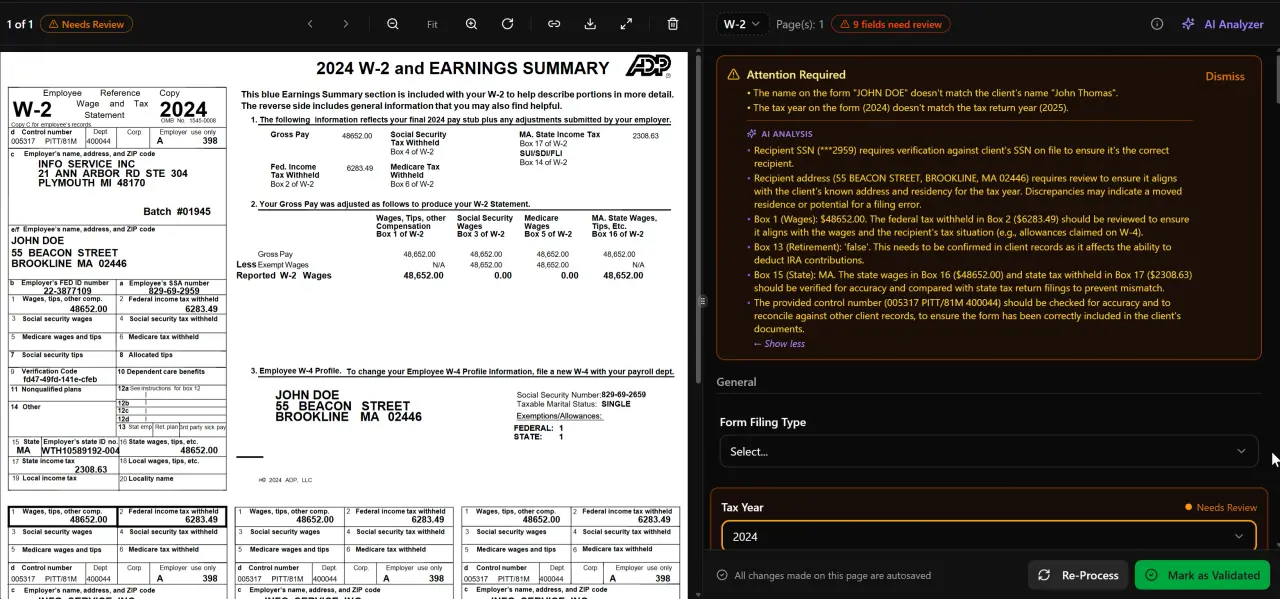
AI classifies, extracts, and validates every document automatically
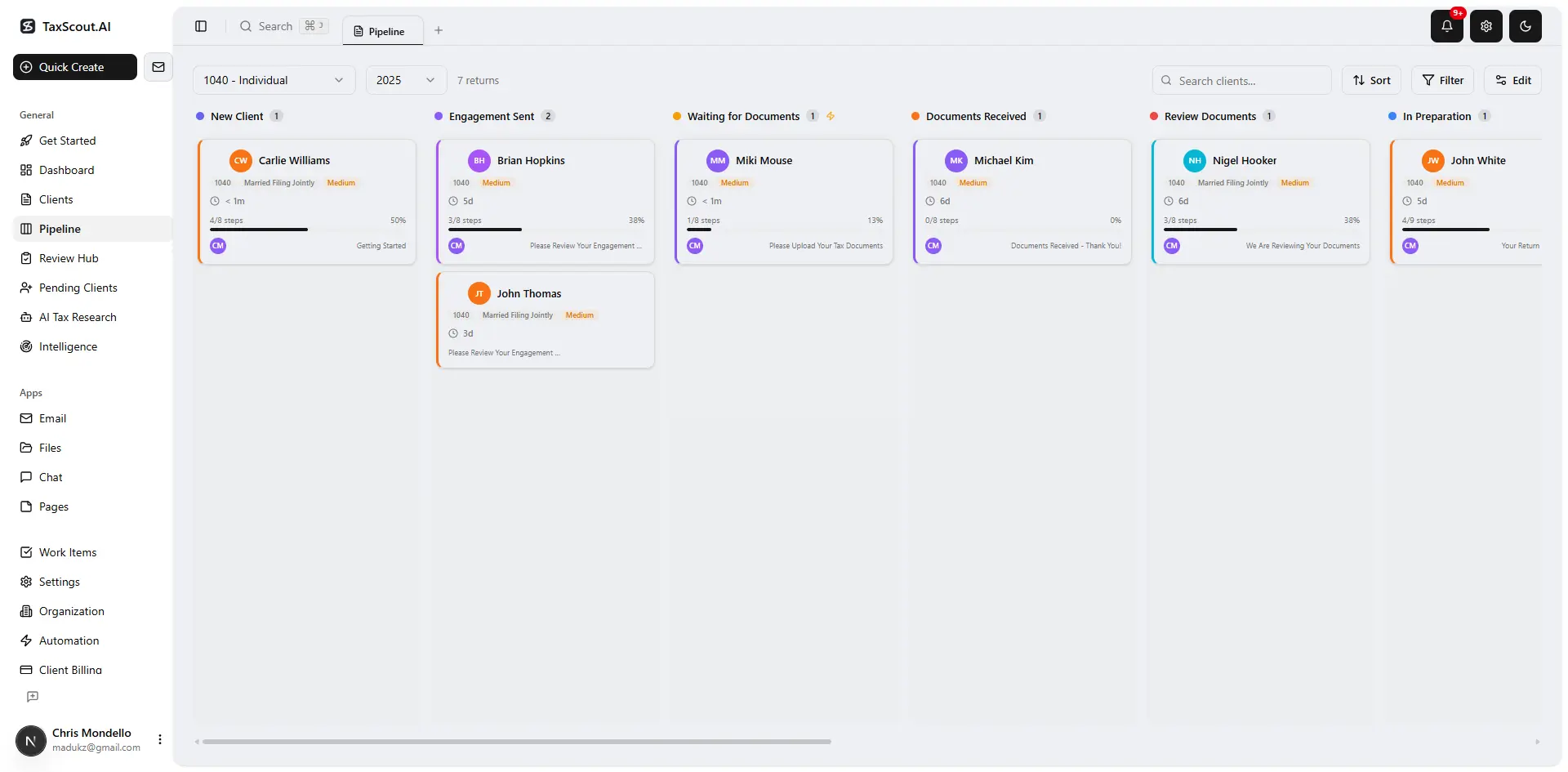
Track every return from intake to filed with drag-and-drop pipeline management
How Practice Management Software Affects Your AEO Footprint
This is the angle that competitors like Canopy do not cover: your choice of practice management software directly affects the digital signals your firm emits — and therefore how AI search systems perceive your firm's credibility and client experience quality.
Legacy practice management tools create fragmented digital touchpoints. A firm using a patchwork of separate portals, email threads, PDF attachments, and manual intake forms generates inconsistent, low-quality signals: no structured intake data, no machine-readable client interaction history, and no unified entity presence that AI crawlers can interpret. When a prospective client asks an AI chatbot to evaluate CPA firms in a city, the AI draws on indexed signals — including the professionalism of a firm's client-facing digital infrastructure. A firm with a branded client portal using OTP login, structured intake flows, and AI-assisted document processing communicates operational maturity in ways that legacy-tool firms simply cannot replicate. This is where the practical gap in AEO for CPA firms becomes most visible.
AI-native platforms like TaxScout create structured, consistent digital signals at every client touchpoint. The AI intake engine modeled on IRS Form 13614-C produces structured intake data rather than unstructured PDFs. The AI research agents that search IRS, Treasury, Cornell Law, and Congress in real time demonstrate the kind of authoritative, source-linked content that AI citation systems favor. When your firm's workflow is built on AI-native infrastructure, the content you produce — client guides, response templates, FAQ answers — is inherently more structured and more citable than content produced by manual, legacy processes.
Compare this to a firm running TaxDome or Canopy: TaxDome charges approximately $100 per user per month and provides no AI extraction, no validation pipeline, and no IRS research agents. Canopy charges approximately $45 per user per month per module, with Smart Intake costing an additional $11 per client. Neither platform produces the kind of AI-native content infrastructure that supports a strong AEO footprint. TaxScout's flat-fee pricing — starting at $49/month for unlimited team members — means your entire firm can operate on AI-native infrastructure without per-seat cost constraints limiting adoption.
Practice Management Platforms and AEO-Relevant Features
| Feature | TaxScout | TaxDome | Canopy |
|---|---|---|---|
| Pricing model | $49–$149/mo flat (unlimited users) | ~$100/user/month | ~$45/user/month per module |
| AI document extraction | Yes — 5-layer validation pipeline | No | No |
| Branded client portal with OTP | Yes | Yes (password-based) | Yes (password-based) |
| Structured AI intake (13614-C model) | Yes | No | $11/client add-on |
| AI research agents (IRS/Treasury/Cornell) | 9 agents, real-time search | No | No |
| FAQ/knowledge base content generation | Yes, AI-assisted | No | No |
| Entity-consistent digital signals | Unified AI-native platform | Fragmented modules | Fragmented modules |
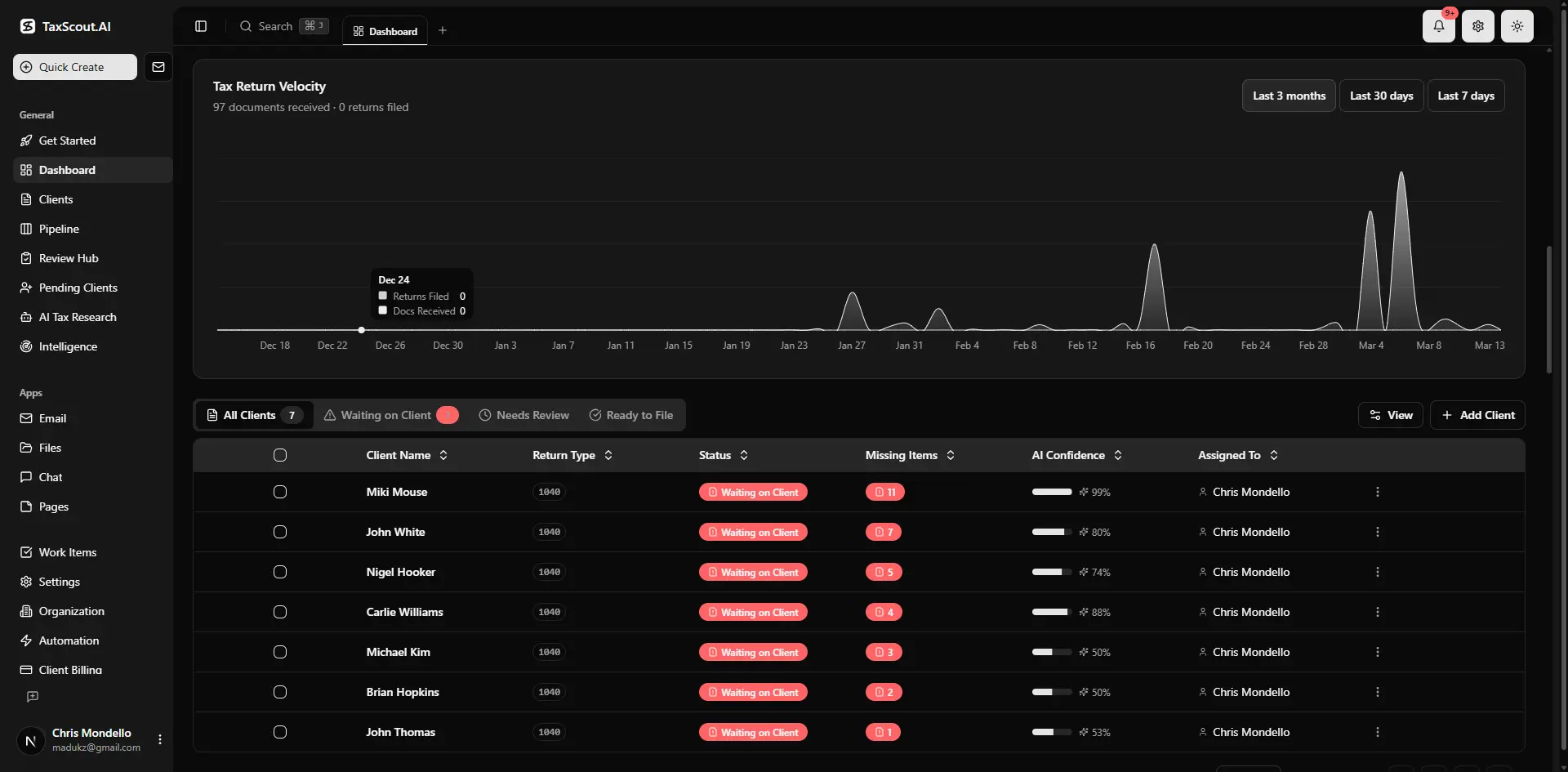
Real-time dashboard showing returns in progress, revenue, and upcoming deadlines
Step-by-Step AEO Checklist for CPA Firms
The following checklist consolidates every implementation step into a prioritized sequence. Work through Phase 1 before Phase 2; schema errors in Phase 1 will undermine Phase 2 content efforts.
Phase 1: Entity and Schema Foundation
- Claim and fully complete your Google Business Profile with accurate NAP, service categories set to 'Accountant' and 'Tax Preparation Service,' and a keyword-rich description naming your niche. 2. Add
LocalBusinessandProfessionalServiceJSON-LD schema to your homepage withhasCredentialpointing to your state board license URL. 3. AddPersonschema withhasCredentialto every credentialed staff bio page. 4. Audit your NAP across all directories (Yelp, Bing Places, state CPA society, LinkedIn Company Page) and correct inconsistencies. 5. Validate all schema with Google's Rich Results Test and resolve any errors before proceeding.
Phase 2: FAQ Architecture and Content Depth
- Identify the 20 most common questions your niche clients ask — interview your team, review your email history, and use tools like AnswerThePublic or Google's 'People Also Ask' boxes for your target keywords. 7. Write a dedicated FAQ page with
FAQPageJSON-LD schema. Each answer must be complete, accurate, and 40–120 words — self-contained enough that an AI can cite it without additional context. 8. Build at least five 'pillar' content pages (1,200–2,000 words each) on core topics your niche cares about. Each pillar should cite at least two authoritative external sources (IRS.gov, Treasury, Cornell LII) and be attributed to a licensed CPA withPersonschema. 9. AddArticleschema to every blog post withauthor,datePublished,dateModified, andpublisherfields populated. 10. Build internal links from FAQ answers to pillar pages and from pillar pages back to service pages — this creates a topical authority cluster that AI retrieval models favor.
Phase 3: Review Signals and Trust Infrastructure
- Implement a systematic review request workflow — every closed engagement should trigger a review request sent within 48 hours. Use
AggregateRatingschema on your homepage and service pages once you have five or more reviews. 12. Earn at least three third-party citations from authoritative domains: a local business journal feature, a state CPA society newsletter mention, or a guest article in a trade publication. These inbound citations from trusted domains are the closest AEO equivalent to traditional backlinks. 13. Publish a cybersecurity and privacy policy page that describes your data protection practices — AI models increasingly weight trust and security disclosures as credibility signals for professional services firms. 14. Set a quarterly review cadence to update FAQ answers, refresh pillar content dates, and add new questions as your niche evolves. AI models penalize stale content; a page last updated in 2022 loses citation priority to one updated last month.
Smart intake auto-fills from uploaded documents and prior-year data
Why AI-Native Workflows Produce Better AEO Content Naturally
The most durable AEO advantage is not a one-time schema implementation — it is a workflow that continuously produces structured, accurate, citable content as a byproduct of serving clients well. AI-native practice management is that workflow. For practices committed to AEO for CPA firms over the long term, this operational foundation is what makes the difference between a one-time ranking lift and sustained citation authority.
When your team uses TaxScout's AI research agents to answer client questions, those responses draw on real-time IRS, Treasury, and Congressional sources. The structured, cited answers your team produces can be cleaned and repurposed as FAQ content, blog posts, and client education resources — all with the source-linked authority that AI citation systems reward. Firms running legacy tools produce answers in email threads that never become citable content. Firms running AI-native tools produce answers that are structurally ready to be published as authoritative web content.
Similarly, the AI document extraction pipeline creates structured data records across W-2s, 1099 series, K-1s, and 1040 schedules — data that informs the niche-specific content your firm can publish. A firm that processes 400 S-corp returns per year has unique, experiential data about the questions those clients ask at intake, the errors that appear most frequently, and the planning opportunities most commonly missed. That experiential data is the raw material for the most AEO-powerful content a firm can publish: real, specific, practitioner-authored answers to real client problems. For more on building this kind of operational depth, see our niche pricing strategy guide.
The accounting firm AEO strategy that wins long-term is the one embedded in daily operations — not bolted on as a marketing project. Choosing AI-native infrastructure is the foundational decision that makes every subsequent AEO effort compound rather than decay.
Ready to build the AI-native foundation that makes your firm citable across every AI search platform?
TaxScout gives your CPA firm AI document processing, branded client portal, and 9 AI research agents — all on a flat monthly fee with unlimited team members.
Frequently Asked Questions
Answer engine optimization (AEO) for CPA firms is the practice of structuring your website content, schema markup, and digital presence so that AI tools like ChatGPT, Claude, and Google AI Overviews can extract and cite your firm when answering prospective clients' questions. It focuses on direct, structured answers rather than traditional keyword rankings.
Keep reading
CPA Firm Website That Wins Clients: What to Build Before You Hand Out Business Cards
Sep 18, 2026 · 1 min read
CPA Firm Referral Network: How to Build Relationships With Financial Advisors That Actually Send Clients
Jul 10, 2026 · 1 min read
How to Get Mid-Market Clients as a CPA: Moving Up From Small Business Work
Jul 8, 2026 · 1 min read
Stay up to date
Get the latest tax tech insights delivered to your inbox.