Beneficial Ownership Reporting: What CPAs Must Do for Clients in 2026
Most articles on FinCEN BOI filing stop at deadline dates. This guide goes deeper — showing CPAs exactly how to identify which clients are affected, build a scalable filing workflow, document advisory liability, and price BOI services as a standalone or bundled engagement in 2026.
Beneficial ownership reporting under the Corporate Transparency Act has quietly become one of the most operationally complex compliance obligations CPA firms have taken on in years. The law requires most LLCs, corporations, and similar entities to file Beneficial Ownership Information (BOI) reports with FinCEN — and to update those reports within 30 days whenever ownership changes. For a firm with 50 or 100 business clients, that isn't a one-time task. It's an ongoing service line that demands a real workflow.
Most content published on FinCEN BOI filing for CPAs focuses on who must file and when. That's useful, but it skips the harder questions: How do you identify every client in your book that qualifies as a reporting company? How do you collect government-issued ID data from beneficial owners without creating a document security nightmare? How do you document your firm's role clearly enough that you're protected when a client fails to notify you of an ownership change? These are practice management questions, not just tax questions. What gets far less attention is the operational reality of managing beneficial ownership reporting across an entire client portfolio.
This guide walks through every layer — from initial client scoping to data collection, engagement documentation, liability protection, and pricing — and shows how an AI-native platform like TaxScout.ai turns a fragmented compliance burden into a systematic, billable service your firm can deliver at scale. Whether you're handling five clients or five hundred, beneficial ownership reporting demands a repeatable process that scales without sacrificing accuracy.
Understanding the Beneficial Ownership Reporting Obligation in 2026
The Corporate Transparency Act (CTA) requires domestic and foreign entities registered to do business in the United States to file BOI reports with the Financial Crimes Enforcement Network (FinCEN). A reporting company must disclose each beneficial owner — defined as any individual who directly or indirectly owns or controls at least 25% of the entity, or who exercises substantial control — along with their legal name, date of birth, address, and a government-issued identification document number. For firms evaluating their beneficial ownership reporting approach, this trade-off compounds over time.
FinCEN published its Small Entity Compliance Guide to help businesses navigate the requirements, and the glossary definition of beneficial ownership information BOI reporting provides a useful CPA-focused primer. Entities formed before January 1, 2024 had a deadline of January 1, 2025. Entities formed in 2024 had 90 days. Entities formed on or after January 1, 2025 have just 30 days from formation to file. Critically, any change to a beneficial owner's information — a new address, an expired passport replaced with a new one, a change in ownership stake — also triggers a 30-day update deadline. Each of these factors directly shapes how beneficial ownership reporting plays out in practice.
The Corporate Transparency Act CPA compliance landscape remains fluid. Courts challenged the law's constitutionality in 2024-2025, with enforcement paused and resumed multiple times. As of 2026, firms should operate under the assumption that reporting requirements are active for most clients and monitor FinCEN's official BOI updates page regularly for enforcement guidance changes. Understanding beneficial ownership reporting in this context is what separates firms that scale from those that stall.
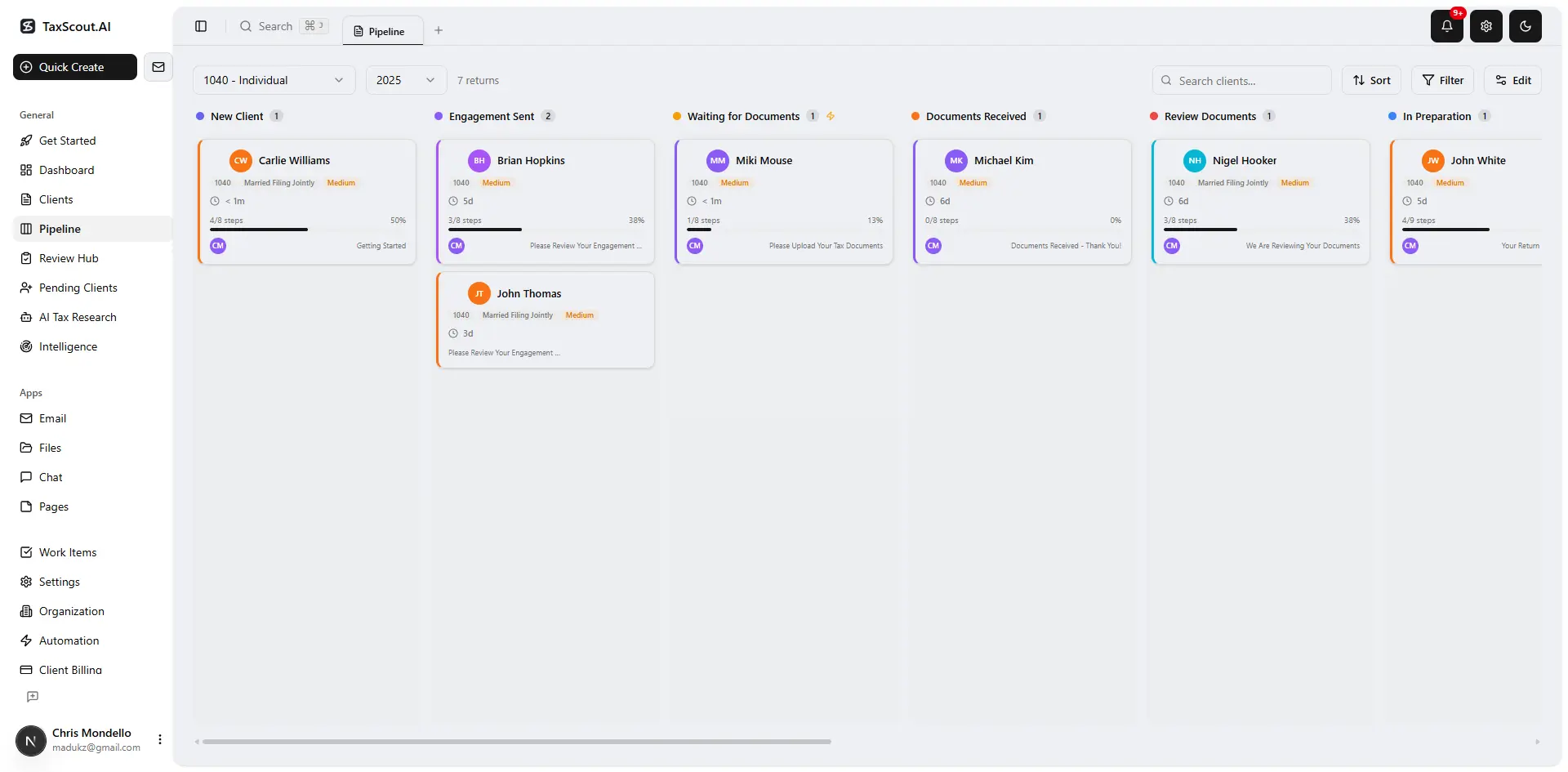
Track every return from intake to filed with drag-and-drop pipeline management
Step 1: Identify Which Clients Are Reporting Companies
The first workflow challenge is scoping. Not every business client owes a BOI report. Exempt categories include large operating companies (more than 20 full-time U.S. employees, a physical U.S. office, and over $5 million in gross receipts), SEC-reporting companies, banks, credit unions, insurance companies, and roughly 23 other defined categories. Sole proprietors operating under their own name with no formal entity registration are also excluded. This is precisely where a deliberate beneficial ownership reporting strategy pays off.
For most CPA firms, the practical universe is: single-member LLCs, multi-member LLCs, S corporations, C corporations, and limited partnerships formed by small business clients. That population is likely the majority of your business book. Start by pulling every entity from your client management system and running a three-question filter: (1) Is it a legal entity registered with a state? (2) Does it fall outside the 23 exemption categories? (3) Has a BOI report been filed and confirmed? Clients who answer yes, yes, no are in scope. Beneficial ownership reporting sits at the center of this decision — get it wrong and the rest unravels.
TaxScout.ai's pipeline management feature lets you create a dedicated BOI Compliance pipeline with custom stages — Scoping Review, Awaiting Owner Data, Filed and Confirmed, Pending Update — so every affected entity has a tracked home. Combined with the AI intake engine, you can send a structured data request directly to each business client through the branded portal, collecting owner information without a single phone call or email chain to manage manually. When firms revisit their beneficial ownership reporting priorities, the gaps usually surface here.

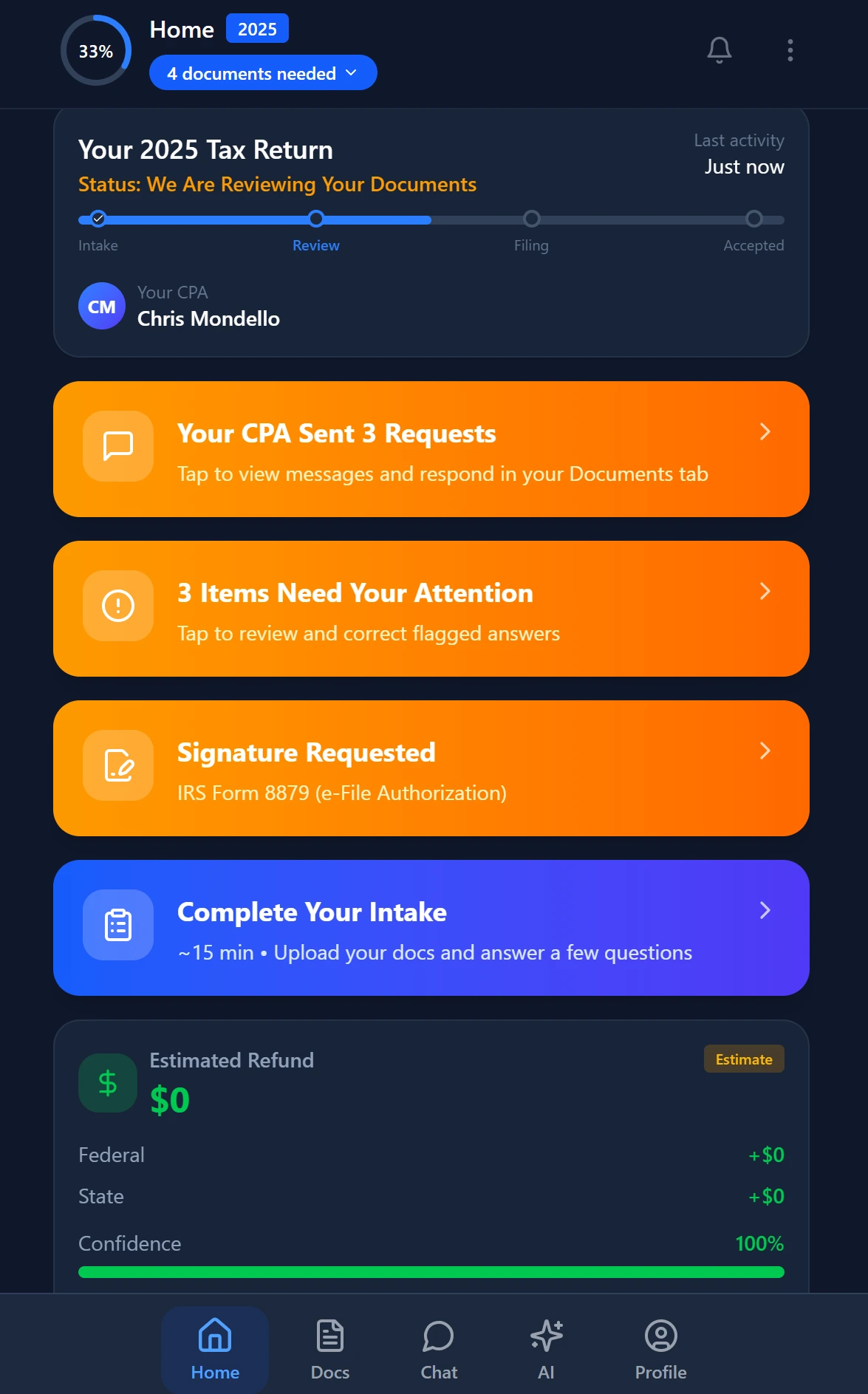
Your clients see your brand — OTP login, document upload, and real-time status
Step 2: Collect Beneficial Owner Data Securely
BOI filings require each beneficial owner's full legal name, date of birth, current residential address, and a unique identifying number from an acceptable document — a U.S. passport, driver's license, or other government-issued ID. Collecting this data via email creates obvious security risks and creates a scattered document trail that is hard to audit. A secure client portal is the correct collection channel.
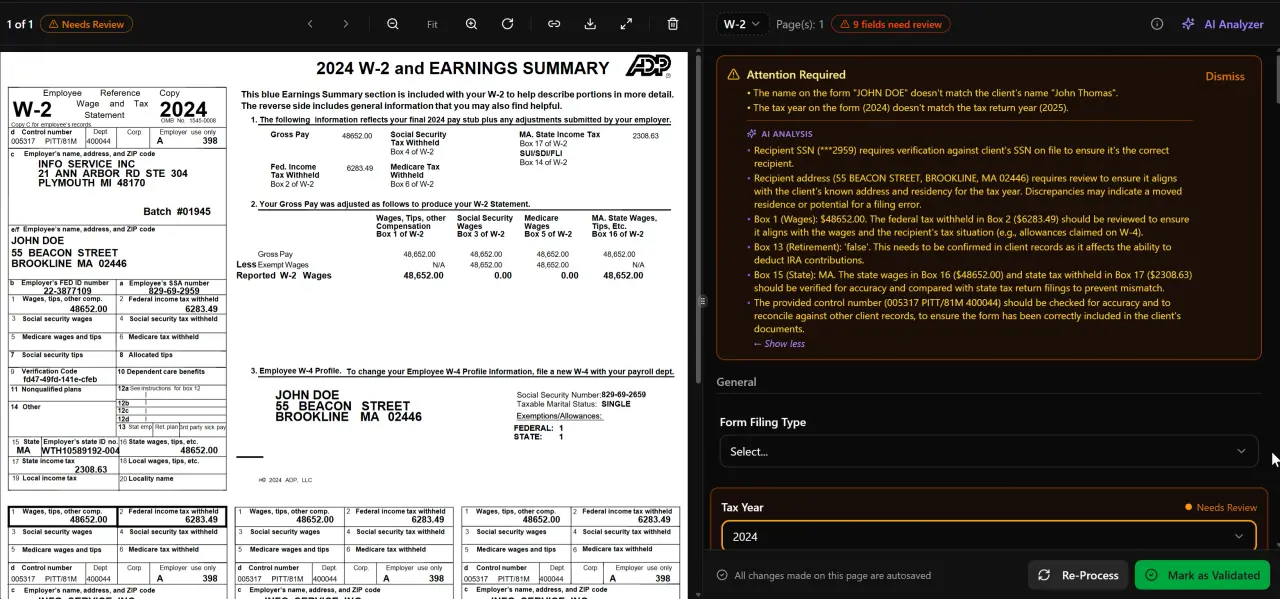
TaxScout.ai's client portal uses OTP login (no passwords to manage or leak) and the AI document extraction engine can process 180+ document types, including government-issued IDs, automatically extracting structured fields with confidence scoring and cross-verification. When a client uploads a driver's license, the platform populates name, address, and ID number into the structured intake form — reducing transcription errors and saving staff time. For more background on how this works technically, see our AI document extraction guide for CPAs.
All collected documents and sensitive fields are stored in TaxScout.ai's AES-256-GCM encrypted vault, with a 13-step DSAR anonymization workflow and 7-role RBAC access controls. From a security posture standpoint, this matters: collecting copies of government-issued IDs from dozens of clients is exactly the kind of data aggregation that makes firms a target. See our cybersecurity resources for additional hardening guidance.
Smart intake auto-fills from uploaded documents and prior-year data
Managing BOI filings for 40 clients across a shared spreadsheet?
TaxScout.ai gives your firm a dedicated BOI pipeline, secure ID collection, and automated update reminders — all under a flat monthly fee with no per-user costs.
Step 3: Document Your Firm's Advisory Role and Limit Liability Exposure
This is the step most articles skip entirely. CPAs who assist clients with BOI filings face a specific liability risk: if a client fails to notify the firm of an ownership change — a new investor, a buyout, a death in the family — the 30-day update window can lapse without the firm knowing. That exposure is real. FinCEN civil penalties for willful violations reach $591 per day, and criminal penalties are possible for knowing non-compliance. While the firm is not typically the "reporting company" itself, advisory relationships can create professional liability claims if a client argues the CPA had constructive knowledge of the change.
The correct protection is a well-scoped engagement letter that explicitly defines the firm's responsibilities. The engagement letter should state: (a) the firm will assist with initial BOI filing based on information provided by the client; (b) the client is solely responsible for notifying the firm within 15 days of any ownership change or change to beneficial owner identifying information; (c) the firm assumes no obligation to proactively monitor ownership structures; and (d) the engagement covers only the entities listed by name in the letter. TaxScout.ai's e-signature workflow via Documenso supports customized engagement letters for BOI engagements alongside standard Form 8879s and standard engagement letters, with full audit trail.
For firms that want to go further, you can explore other blog resources on engagement documentation and professional liability. The electronic signatures compliance guide covers best practices for making sure e-signed engagement letters hold up when disputes arise.

Click any extracted field to see its source highlighted on the original PDF
Step 4: Build a Recurring Update Workflow for Ownership Changes
The initial BOI filing is a one-time task. The update obligation is not. Every time a beneficial owner's name, address, or ID document changes — or when an ownership stake crosses the 25% threshold in either direction — the reporting company has 30 days to file an updated report. For a firm managing 60 business entities, that's an ongoing monitoring challenge that manual systems handle poorly.
TaxScout.ai's automation features allow you to build a trigger-based reminder workflow: when you log an ownership structure change in a client record, the system fires a task to the responsible team member, stages the entity in your BOI Update pipeline, and generates a portal data request to the client for any updated ID documentation. The platform's client-context AI memory retains entity structures and filing history across tax years, so when you're reviewing an S corporation's return and note a K-1 ownership change, that context is immediately available to cross-reference against the BOI filing status.
Annual outreach matters too. A best practice is to send all business clients a short annual ownership certification in Q1 — essentially a confirmation that no ownership changes occurred in the prior year. This creates a documented record that the firm asked, even if the client fails to respond. TaxScout.ai's campaign engine can send templated annual certification requests to a tagged segment of business clients in minutes.
AI classifies, extracts, and validates every document automatically
How to Price BOI Reporting as a Standalone or Bundled Service
BOI filing is genuinely billable work, and most CPA firms have underpriced or given it away as a free courtesy. A standalone initial BOI filing for a simple entity with one or two beneficial owners takes 45-90 minutes including client data collection, document review, filing, and confirmation. At $150-$250 per hour, that's a $112-$375 service per entity. Firms serving 50 business clients have a $5,600-$18,750 revenue opportunity from initial filings alone — before any update work.
Pricing structures that work well in practice include: (1) Flat fee per entity for the initial filing, typically $150-$300 depending on ownership complexity. (2) Annual compliance retainer covering initial filing plus up to two ownership updates per year, priced at $200-$500 per entity. (3) Bundled pricing for clients on a bookkeeping or advisory retainer, where BOI compliance is folded into the annual engagement fee at a slight discount. For firms experimenting with value-based pricing models, see our flat fee billing guide for CPAs — the framing translates directly to BOI service packaging.
One pricing mistake to avoid: charging by the hour for a service where clients can't predict the total cost creates friction and disputes. Use flat-fee or retainer pricing, and build your engagement letter to define exactly what is and isn't included so scope creep doesn't erode margin. TaxScout.ai's invoicing feature via Stripe Connect Express supports one-time and recurring billing, making it straightforward to set up an annual BOI compliance retainer for each affected entity.
BOI Filing Workflow Capabilities: TaxScout.ai vs. General Practice Management Tools
| Capability | TaxScout.ai | TaxDome | Canopy | Karbon |
|---|---|---|---|---|
| Secure ID document collection via client portal | Yes — OTP portal, encrypted vault | Portal available, no AI extraction | Portal available, no AI extraction | No client portal |
| AI extraction of government-issued ID fields | Yes — 180+ document types | No | No | No |
| Customizable BOI compliance pipeline stages | Yes — 12-stage drag-and-drop kanban | Limited pipeline customization | Available | Workflow-based, no kanban |
| Engagement letter e-signature with audit trail | Yes — Documenso integration | Yes | Yes | Yes |
| Automated ownership-change update reminders | Yes — automation triggers | Limited | Limited, $11/client extra for Smart Intake | Limited |
| Flat team pricing (no per-user fees) | Yes — $149/mo for 10 seats | ~$500/mo for 5 users | ~$660/mo for 5 users | ~$590/mo for 5 users |
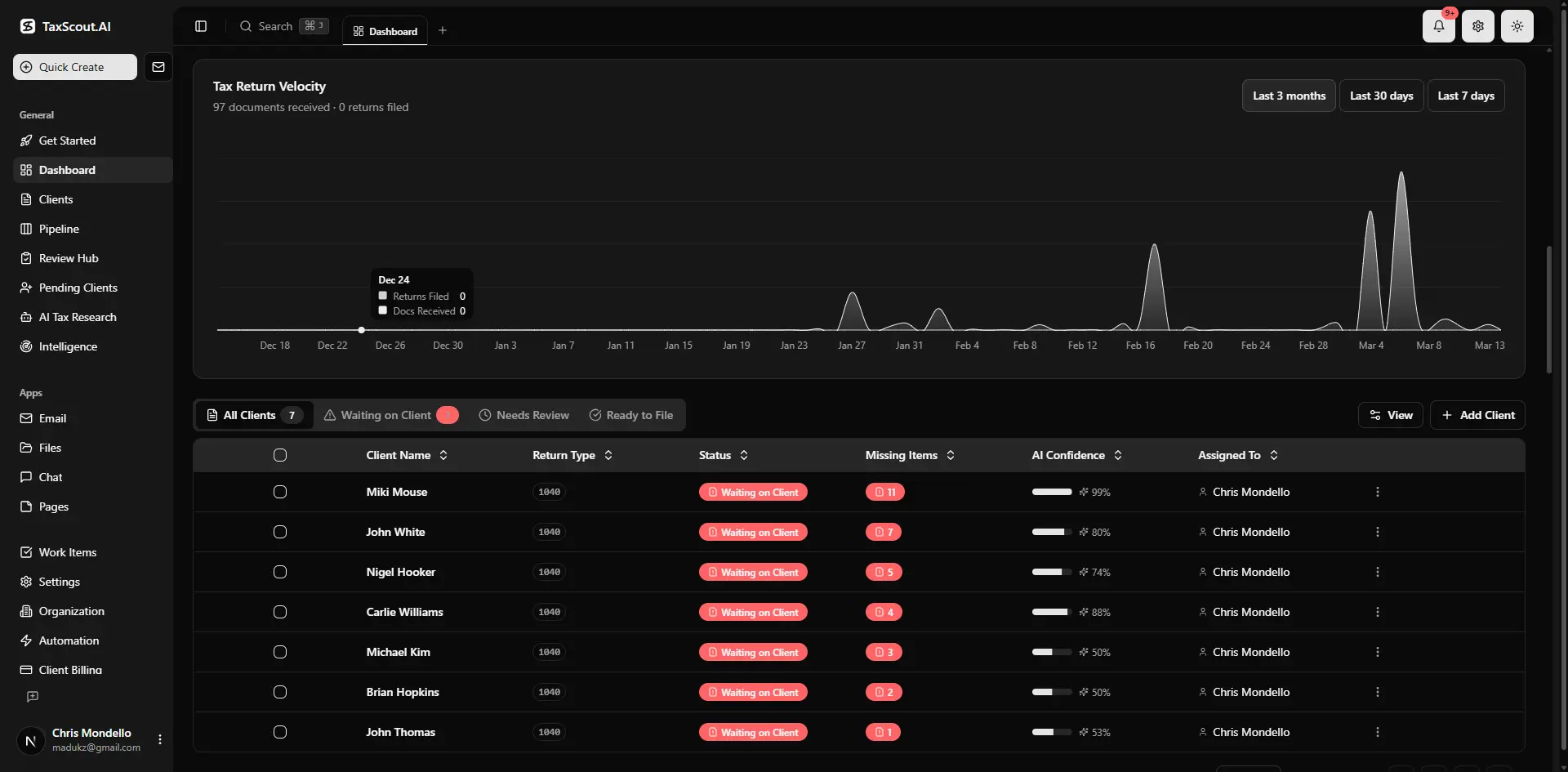
Real-time dashboard showing returns in progress, revenue, and upcoming deadlines

Every client gets organized documents, status tracking, and a complete history
Beneficial Ownership Reporting at Scale: Managing 50 or More Entities
Firms with large business client rosters face an aggregation problem: tracking filing status, pending data requests, update obligations, and engagement letter execution for 50 or 100 entities across multiple staff members creates serious coordination risk. A spreadsheet tracking system breaks down within the first filing cycle when updates start rolling in asynchronously.
The right infrastructure is a purpose-built pipeline where every entity has a card, every card has a status, and every status change triggers the next action. TaxScout.ai's pipeline management supports 12 customizable stages and assigns tasks to specific team members with deadlines, so no entity falls through the cracks during a busy tax season. For firms that want to understand how this connects to broader capacity planning, the accounting firm capacity planning guide covers how to model staff bandwidth against a growing compliance services workload.
The FinCEN BOI filing system is a separate platform from IRS e-filing — CPAs need to register their firm as a third-party filer to submit on behalf of clients. Maintain a centralized log of each entity's FinCEN tracking number, filing date, and confirmation status in TaxScout.ai's client records. That log becomes your documentation if a client is ever audited or disputes the firm's work.
Ready to turn BOI compliance into a systematic, profitable service line?
TaxScout.ai gives your firm the pipeline, portal, automation, and flat-rate pricing to manage beneficial ownership reporting for your entire client book — starting at $149/month for 10 seats, unlimited clients.
Frequently Asked Questions
No — the obligation to file a BOI report belongs to the reporting company itself, not to its CPA. However, CPAs can and do assist clients with preparation and submission as a professional service. If you do assist, a clear engagement letter scoping your firm's role and placing notification responsibility on the client is essential for limiting professional liability.
Keep reading
BOI Reporting Deadline 2026: Prepare Your Firm Now
Mar 27, 2026 · 1 min read
Uniform Capitalization Rules: How CPAs Apply UNICAP to Inventory and Self-Constructed Assets
Oct 17, 2026 · 1 min read
Non-Applicability of Section 357(c) to Consolidated Groups: What CPA Firms Must Do Now
Oct 17, 2026 · 1 min read
Stay up to date
Get the latest tax tech insights delivered to your inbox.