Integrating AI Data Entry Tools with Tax Preparation Software: A CPA Firm Guide
Investing in AI data entry tools means nothing if extracted data ends up being copied manually into Drake or Lacerte. This guide walks CPA firms through the real technical challenges of integrating AI with legacy tax preparation software. Learn the strategies that close the integration gap and…
The Integration Gap: A CPA Firm's Guide to Bridging Legacy Tax Software and AI Data Entry Tools
Picture this: your firm just invested in a promising AI data entry tool after seeing a demo where W-2s and 1099s were extracted in seconds with near-perfect accuracy, convinced that integrating AI data entry tools with tax preparation software would transform your workflow. Three weeks later, your preparers are spending 40 minutes per return manually copying extracted data into Drake or Lacerte because the fields don't map correctly. The AI is doing its job. The integration isn't. Integrating AI data entry tools with tax preparation software sounds straightforward in a polished demo, but the real-world complexity emerges only after you've committed to the technology.
This scenario plays out constantly across CPA practices that adopt AI data entry tools without a structured plan for bridging the gap between modern AI capabilities and the legacy infrastructure those tools must feed. Integrating AI data entry tools with existing tax preparation software isn't just a technology project — it's a workflow redesign challenge that touches security, compliance, staff training, and vendor accountability. This guide gives you a framework to close that gap without losing a tax season. The firms that succeed at integrating AI data entry tools with tax preparation software are the ones who treat it as a workflow redesign project, not just a software installation.
Buried in manual data transfer between your AI tool and tax prep software? See how TaxScout eliminates the handoff problem entirely. → Book a 15-Min Demo — See It Live For firms evaluating their integrating AI data entry tools with tax preparation software approach, this trade-off compounds over time.
Why AI Data Entry Integration With Tax Software Is Harder Than It Looks
The marketing language around AI data entry tools makes integration sound automatic. In practice, the friction is structural. Legacy tax preparation platforms like Drake, CCH Axcess, UltraTax CS, and Lacerte were architected in an era before APIs were a standard feature expectation. Many expose only limited import pathways — typically comma-delimited files or proprietary XML schemas — rather than real-time REST or GraphQL endpoints that modern AI tools expect. Each of these factors directly shapes how integrating AI data entry tools with tax preparation software plays out in practice.
The result is a class of integration problems that the Journal of Accountancy has documented explicitly: firms face significant hurdles around software interoperability, data security, and the ongoing need for human oversight to ensure accuracy. These aren't edge cases. They're the default experience for firms that treat AI integration as a procurement decision rather than an implementation project. Understanding integrating AI data entry tools with tax preparation software in this context is what separates firms that scale from those that stall.
Three structural failure modes account for most of the pain:
Field mapping mismatches. AI tools extract data into their own normalized schema. Tax preparation software stores data in filing-software-specific field structures. Unless someone — the vendor, your IT staff, or you — has explicitly mapped every extracted field to its corresponding tax software destination, preparers manually bridge the gap on every return. For a firm processing 500 returns, this adds up to hundreds of hours of rework that was supposed to disappear. This is precisely where a deliberate integrating AI data entry tools with tax preparation software strategy pays off.
Data silos from disconnected pipelines. As Accounting Today has reported, AI tools frequently create data silos where processed information doesn't flow automatically into the filing workflow. Extracted data sits in the AI platform's dashboard while the return lives in a separate tax preparation environment. Without a deliberate bridge between the two, firms end up running parallel systems that multiply rather than reduce administrative overhead. Integrating AI data entry tools with tax preparation software sits at the center of this decision — get it wrong and the rest unravels.
The black-box verification problem. Tax professionals have a professional obligation to verify the source and accuracy of data reported on returns. When an AI tool provides an extracted value without surfacing the underlying document source, preparers cannot complete that verification efficiently. Regulators and clients expect CPAs to explain where numbers came from. A tool that extracts without traceability shifts verification burden back to the preparer in the worst possible way — not at the extraction stage, where AI is fast, but at the review stage, where a human must hunt through PDFs manually. When firms revisit their integrating AI data entry tools with tax preparation software priorities, the gaps usually surface here.
Security and Compliance Requirements Before Any Integration Goes Live
Data security is not a checklist item to address after integration is working. It is a precondition for integration. Client tax data is among the most sensitive personal information in existence, and the IRS imposes specific requirements on how it must be handled. Before your firm connects any AI data entry tool to its existing software stack, three compliance layers must be confirmed. Firms that have successfully navigated integrating AI data entry tools with tax preparation software consistently cite vendor security vetting as the step they wish they had prioritized earlier.
IRS Publication 4557 and the Safeguards Rule. The IRS requires tax return preparers to maintain a written information security plan (WISP). Any AI tool you integrate becomes part of your security perimeter. If the vendor's infrastructure doesn't meet the same standards your firm maintains — encryption at rest and in transit, access controls, audit logging — your WISP is compromised the moment data flows to their system.
Data residency and subprocessor disclosure. Ask every AI vendor: where is client data stored, and who else touches it? Tools that route data through overseas infrastructure or share processing tasks with undisclosed subprocessors create compliance exposure. The AICPA has emphasized that tax professionals must prioritize data integrity and vendor vetting to maintain compliance with professional standards and regulations.
Encryption standards and SSN handling. Extracted tax documents contain Social Security Numbers throughout. Any integration pipeline — including every touchpoint involved in integrating AI data entry tools with tax preparation software — must maintain encryption across every hop: from document upload through extraction through field mapping through import. Weak links anywhere in this chain create IRS audit exposure and state data breach notification obligations.
When TaxScout handles this security layer, it uses AES-256-GCM encryption for its SSN vault with a dedicated encryption key, rate-limited reveal, and full audit logging. Every client record is isolated at the database level through PostgreSQL row-level security on all business tables — not application-layer logic that can be bypassed. Before evaluating any AI data entry tool, apply this same standard: ask for their encryption specification, their data residency policy, and their access control architecture in writing.

Click any extracted field to see its source highlighted on the original PDF
Vendor Due Diligence: Eight Questions That Expose Integration Reality
The integration gap often exists because CPA firms ask the wrong questions during vendor evaluation. Feature demonstrations show what AI tools do in ideal conditions. Due diligence should surface what happens at the edges. Whether your firm is just beginning the process of integrating AI data entry tools with tax preparation software or revisiting a previous implementation, these questions expose where the real complexity lives.
Ask these eight questions before signing any contract:
- Which tax preparation platforms do you have certified, tested integrations with? Distinguish between "we export CSV files that can be imported into Drake" and "we have a live tested integration with Drake's import schema that maps all 180+ form types."
- How do you handle fields that can't be mapped automatically? Every integration will encounter unmapped fields. The question is whether the tool surfaces those gaps explicitly for human review or silently drops them.
- What is your confidence scoring methodology? Responsible AI data entry tools assign per-field confidence scores so preparers know which extractions require human verification. Tools that present all extracted data with equal apparent certainty are obscuring their own error profile.
- How do you handle validation — and what validation runs before data leaves your system? Extraction accuracy and validation are separate capabilities. A tool can extract text from a document accurately while still producing values that fail basic tax math consistency checks.
- What is your audit trail architecture? Can a preparer click a specific extracted value and see exactly where it came from in the source document? This is the minimum standard for the verification requirement.
- What is your subprocessor list and where is client data stored?
- What is your breach notification SLA and have you had any incidents?
- Do you support API access or webhook notifications so we can trigger downstream workflows in our tax preparation software?
This last question is where most legacy-integration projects fail. Tools that offer only manual export/import cycles force human intervention at every boundary, which eliminates much of the efficiency gain from AI extraction in the first place.
Building a Human-in-the-Loop Verification Workflow
The goal of AI data entry integration is not to remove humans from the process. It is to focus human attention where it delivers the most value — reviewing flagged exceptions, applying professional judgment, and signing off on returns — rather than on manual transcription of clear, high-confidence data. This is the human-in-the-loop model, and building it deliberately is what separates firms that benefit from AI integration from firms that struggle with it.
A well-designed human-in-the-loop workflow has four stages:
Stage 1: AI extraction with confidence stratification. Every extracted field should carry a confidence score. Fields above a defined threshold (say, 0.95) proceed automatically. Fields below the threshold are flagged for preparer review. This tiered approach means a preparer's attention goes where uncertainty actually exists.
Stage 2: Source verification for flagged fields. For any field requiring review, the preparer must be able to see the source document with the relevant section highlighted. Without pixel-precise document linkage, review is not actually faster than manual entry — the preparer must locate the relevant page, find the relevant field, and make the comparison manually. The AI has added a step rather than removing one.
Stage 3: Multi-layer validation before field mapping. Before extracted data moves into your tax preparation software, it should pass through deterministic validation: do the numbers add up correctly within the source document? Are there cross-document consistency issues, like a W-2 employer that doesn't match the name on a prior-year return? Does the 1099-INT value seem implausible given the account balance history? These checks catch errors that high confidence scores miss — and they are one of the most underappreciated benefits of properly integrating AI data entry tools with tax preparation software from the start.
Stage 4: Preparer sign-off before transfer. The actual transfer of extracted data into Drake, Lacerte, or whichever platform your firm uses should require explicit preparer confirmation. This creates an audit record and keeps professional accountability where the profession requires it — with the licensed CPA, not the AI tool.
TaxScout's approach to this workflow is instructive for firms evaluating any integration. The platform's 5-layer validation pipeline — which you can explore in detail on the AI document extraction page — runs document quality routing, per-field confidence scoring with OCR cross-verification, 15 deterministic math rules including phantom 1099-INT hallucination detection, 18 post-extraction validation rules, and cross-document consistency checks. The split-screen PDF viewer lets preparers click any extracted field and see it highlighted in the source document with pixel-precise coordinates. This is what source verification at scale looks like.
Critically, TaxScout is designed to work alongside existing tax preparation software rather than replace it — so firms using Drake, CCH Axcess, UltraTax CS, Lacerte, ProConnect, or ProSeries can add AI-native document processing without abandoning their filing infrastructure. This coexistence model is the right architectural framing for any CPA firm navigating the integration gap. The deeper technical breakdown of this extraction process is worth reviewing in our complete AI document extraction guide for CPAs.
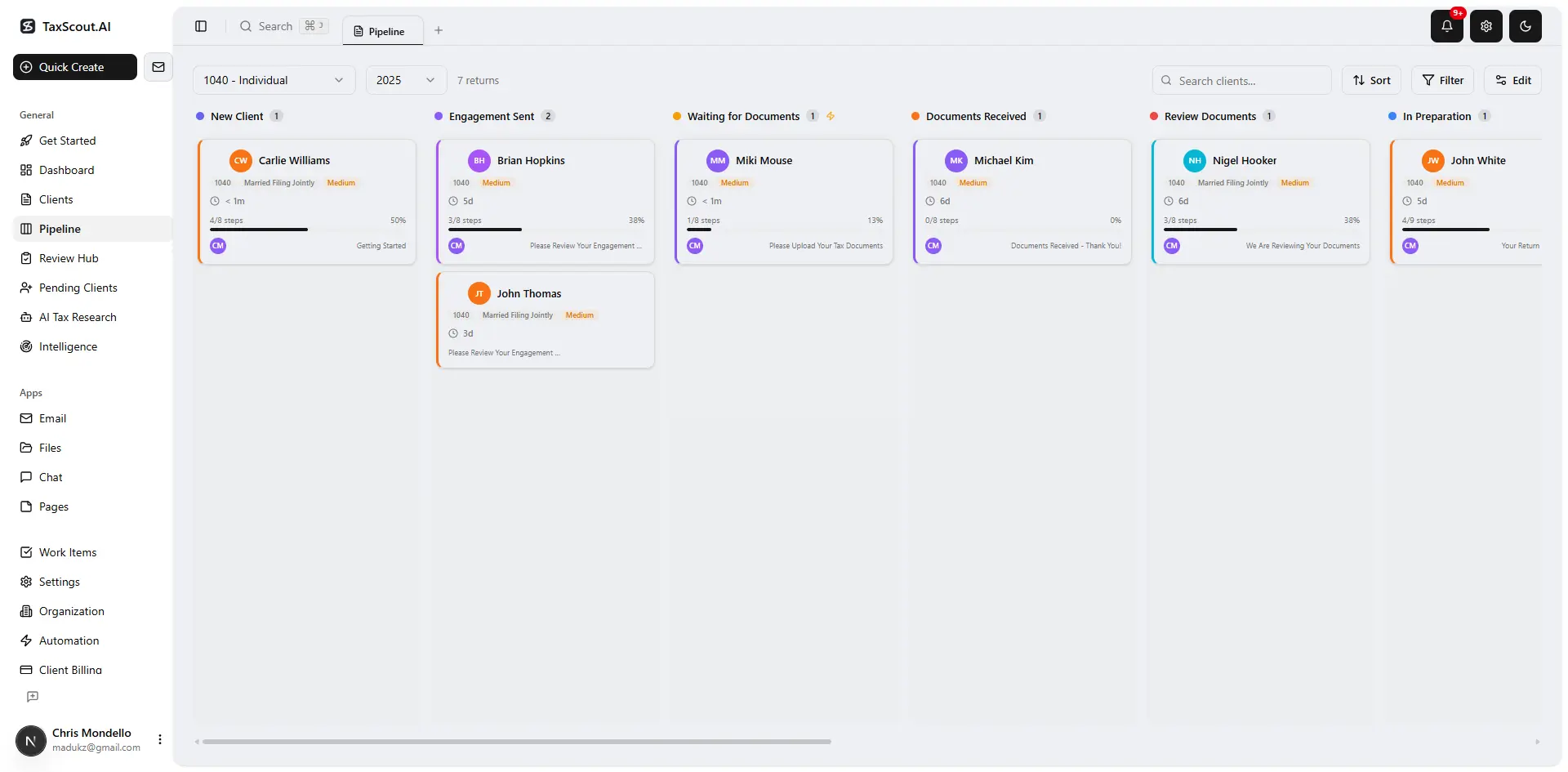
Track every return from intake to filed with drag-and-drop pipeline management
Avoiding the Data Silo Trap in Practice
Data silos are the most common long-term failure mode in AI integration projects. They emerge when an AI tool becomes the system of record for extracted documents while the tax preparation platform remains the system of record for the return — and no live, automated bridge exists between the two.
The practical consequence is a firm running two parallel administrative systems: client documents in the AI platform, return data in Drake. Staff must manually transfer information between environments, updating both when corrections occur. This doubles administrative overhead instead of reducing it — the opposite of what integrating AI data entry tools with tax preparation software is supposed to achieve.
Three design principles prevent silo formation:
Single client record with bidirectional data flow. The AI tool should be capable of receiving return data from the tax preparation platform (for prior-year prefill and comparison) as well as sending extracted data to it. One-directional integrations create half-silos.
Event-driven sync, not batch export. If data transfer requires a manual export/import cycle, preparers will fall behind and the silo will grow. API-driven or webhook-driven sync keeps the two systems aligned without human intervention at every boundary.
Centralized document storage with tax-software metadata. Documents should be tagged with the tax preparation software's client ID so records can be linked without manual matching. Firms that haven't implemented this structure often discover it when auditors request the source document for a specific return line — and the AI platform's document reference doesn't connect to the tax software's client record.
For CPA firms building out their full technology stack, the CPA firm tech stack integration guide covers how to connect practice management, document management, and filing software in a way that minimizes these silos across the full client lifecycle.
What the Integration Gap Costs in Real Numbers
Quantifying the cost of a poorly bridged integration helps firms make the investment case for doing it right. Consider a firm with 10 preparers processing 400 returns per season:
- If each return requires 25 minutes of manual field transfer between the AI tool and tax software (a conservative estimate for mismatched integrations), that's 167 hours of non-billable rework per season.
- At $75/hour for staff time, that's $12,500 in direct labor costs from the integration gap alone.
- Add the error rate from manual transcription — Bureau of Labor Statistics data on repetitive clerical tasks suggests manual data entry error rates typically range from 1-4% — and the downstream cost of catching and correcting those errors adds further exposure.
Per-user pricing compounds this problem on the software side. If your firm is evaluating AI data entry tools bundled with practice management platforms, the pricing model matters as much as the feature set. A platform charging ~$100/user/month means a 10-person firm pays ~$1,000/month — over $12,000/year — before accounting for any integration work. TaxScout's flat pricing of $149/month covers up to 10 team seats with no per-user fees, meaning the cost of integrating AI data entry tools with tax preparation software doesn't compound with headcount the way per-seat models do.

Every client gets organized documents, status tracking, and a complete history
The Right Architecture for 2026 and Beyond
The firms that will extract the most value from AI data entry tools over the next three years are not necessarily the ones that move fastest. They are the ones that design the integration correctly from the start: with a verified security posture, explicit field mapping, multi-layer validation, source-traceable review workflows, and a coexistence model that treats AI as an accelerator for the tax preparation workflow rather than a replacement for the filing infrastructure CPAs already trust.
The integration gap is real, but it is bridgeable. The key is treating integrating AI data entry tools with tax preparation software as the primary implementation challenge — not an afterthought after the AI demo looked impressive — and holding vendors accountable to the same standards your clients hold you.
Ready to eliminate the integration gap in your firm's document workflow? TaxScout works alongside Drake, Lacerte, UltraTax, and CCH Axcess — with 5-layer AI validation and pixel-precise source verification — for $149/mo flat. → Book a 15-Min Demo
Frequently Asked Questions
Demo environments are often pre-configured with clean, controlled data and simplified field mappings that don't reflect real-world tax return complexity. When deployed against actual client documents in Drake or Lacerte, mismatches occur because legacy software uses proprietary field schemas that generic AI extraction tools aren't built to target. TaxScout addresses this by maintaining native, pre-built integrations with major tax preparation platforms, including field-level mapping that accounts for form variants, multi-state returns, and entity-specific data structures — eliminating the 40-minute manual correction cycle firms commonly experience post-demo.
Stay up to date
Get the latest tax tech insights delivered to your inbox.