Trust Administration Software: How CPAs Manage Fiduciary Workflows
Trust and estate engagements are among the most document-intensive, legally sensitive workflows a CPA firm handles — yet most practice management vendors ignore them entirely. This guide shows how an AI-native platform closes every operational gap in Form 1041 prep, beneficiary K-1 distribution…
Trust administration software sits at a frustrating gap in the CPA technology market. Firms that regularly file Form 1041 returns, coordinate with trustees, and issue beneficiary K-1 packages know the workflow is nothing like a standard 1040 season. Yet every major practice management vendor treats fiduciary tax preparation as an afterthought — if they address it at all. The result is that CPAs cobble together shared drives, email threads, and spreadsheet trackers to manage work that carries significant professional liability.
The operational complexity is real. A single irrevocable trust engagement can generate dozens of documents: trust agreements, prior accountings, brokerage 1099 consolidates, estate K-1 passthrough packages, trustee meeting minutes, and distribution records — all before you open the return software. Multiple beneficiaries mean multiple K-1s, multiple addresses to verify, and multiple rounds of signatures. Trustee communication requires an auditable trail that standard email does not provide. Without dedicated trust administration software, managing this document volume often falls to a patchwork of folder systems, spreadsheets, and manual checklists.
This guide examines why generic workflow tools fall short for fiduciary work and how a purpose-built, AI-native practice management platform can close those gaps — from intelligent document extraction on complex trust tax documents to structured pipeline tracking, encrypted client vaults, and e-signature workflows that hold up to scrutiny. Purpose-built trust administration software addresses these gaps in ways that general practice management tools simply were not designed to handle.
Why Fiduciary Engagements Break Generic Practice Management Tools
Most CPA practice management platforms were designed around the volume model of individual 1040 returns: collect documents, prep the return, send for e-signature, collect payment. Trust and estate work does not fit that shape. A Form 1041 engagement typically spans multiple tax years, involves co-trustees with different authorization levels, and requires document retention windows that extend well beyond the standard three-year lookback. IRS Publication 559 outlines the specific obligations survivors, executors, and administrators carry — obligations that flow directly onto the CPA managing the engagement. Trust administration software is built around this multi-year, multi-party engagement model rather than the linear document-to-return workflow that dominates individual tax practices.
Generic project management tools like Karbon focus on email triage and task assignment. They have no document extraction capability, no SSN vault, and no fiduciary-specific intake workflow. TaxDome offers workflow templates but does not provide AI document parsing or any research tooling connected to Treasury regulations governing trust income. When your engagement letter for a complex trust cites Reg. §1.643(a)-3 and the software cannot even recognize a Schedule K-1 (Form 1041), something is fundamentally misaligned. For firms evaluating their trust administration software approach, this trade-off compounds over time.
The deeper problem is data fragmentation. Trustees often provide documents in batches over weeks — a brokerage statement here, an amended trust instrument there. Without a system that classifies, extracts, and cross-references those documents automatically, staff spend hours manually keying data and reconciling figures. That manual burden is exactly where errors and omissions claims originate. See our document management guide for CPA firms for a broader look at how fragmented document handling hurts firm efficiency across all return types. Each of these factors directly shapes how trust administration software plays out in practice.
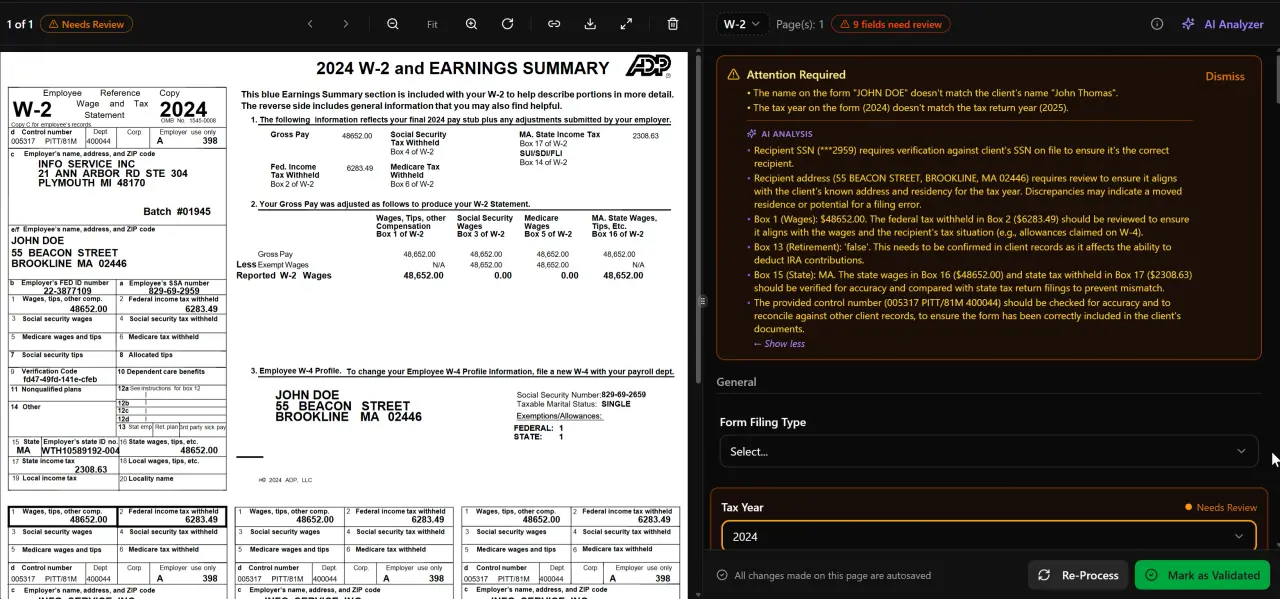
AI classifies, extracts, and validates every document automatically
Form 1041 Workflow CPA Firms Actually Need
A well-structured form 1041 workflow CPA practice follows a consistent sequence: engagement acceptance, trust document review, income document collection, fiduciary accounting reconciliation, return preparation, K-1 package generation, trustee review and approval, e-signature, filing, and post-filing distribution to beneficiaries. Each step has dependencies. Skipping or mishandling any one of them creates downstream risk. Understanding trust administration software in this context is what separates firms that scale from those that stall.
The intake phase is where most firms lose the most time. Trustees frequently submit documents in whatever format is convenient for them — unsearchable scanned PDFs, combined brokerage statements that blend personal and trust accounts, and handwritten distribution ledgers. An AI-native platform with document extraction trained on 180+ tax form types — including all 1099 variants, K-1 passthrough forms, and the 1041 itself with all schedules — can classify and extract those documents automatically. A five-layer validation pipeline that runs OCR cross-verification and 15 deterministic math rules catches errors before they reach the preparer's desk. This is precisely where a deliberate trust administration software strategy pays off.
Pipeline visibility matters just as much as extraction accuracy. A 12-stage customizable kanban pipeline lets fiduciary-focused firms build a trust-specific workflow stage sequence — separate from their 1040 pipeline — so managers can see at a glance which engagements are waiting on trustee approval, which have outstanding K-1 packages, and which are past the IRS April 15 due date for calendar-year trusts. The IRS instructions for Form 1041 specify that fiscal-year trusts have a 3.5-month window from year-end, adding yet another deadline variable that a generic task list cannot track reliably. Trust administration software sits at the center of this decision — get it wrong and the rest unravels.
Tired of managing trust engagements across shared drives, email threads, and sticky notes? When firms revisit their trust administration software priorities, the gaps usually surface here.
TaxScout gives fiduciary-focused CPA firms one AI-native hub for document extraction, pipeline tracking, trustee communication, and e-signatures — at a flat monthly rate with no per-user fees.

Click any extracted field to see its source highlighted on the original PDF

Your clients see your brand — OTP login, document upload, and real-time status
AI Document Extraction for Trust Tax Documents
Trust tax return software lives or dies on how well it handles complex, multi-page source documents. A grantor trust with passthrough rental income might arrive as a 40-page PDF combining the trust agreement, a consolidated 1099, a Schedule K-1 from a partnership interest, and handwritten distribution notes. Manually extracting figures from that package is the kind of work that consumes senior staff hours and introduces transcription risk.
TaxScout's AI document extraction handles this at scale. The platform recognizes all K-1 variants — including Schedule K-1 (Form 1041) for beneficiaries, Schedule K-1 (Form 1065) for partnership interests held in trust, and Schedule K-1 (Form 1120-S) for S-corp holdings — and maps extracted fields to the correct lines on the 1041 and its schedules. The split-screen PDF viewer lets preparers verify every extracted value against the source document with a single click, providing the audit trail that fiduciary work demands. For a deeper dive into how the extraction engine works, see our complete technical guide to AI document extraction.
Cross-document validation is particularly valuable in trust engagements. When a partnership K-1 reports box 1 ordinary income that conflicts with the trust's prior-year carryforward data, the system flags the discrepancy before the preparer ever opens the return in Drake, Lacerte, or CCH Axcess. That kind of automated cross-reference — running 18 post-extraction rules across the entire document set — is simply not available in generic practice management tools.
Trustee Communication and the Audit Trail Problem
Fiduciary accounting software must do more than store documents. Trustees have a legal duty of loyalty and prudence under the Uniform Trust Code as codified at Cornell Law, and the CPA serving the trust has a parallel documentation obligation. When a distribution decision is contested or a beneficiary challenges the accounting, the question is not just whether the numbers are right — it is whether a clear, timestamped record of every communication, instruction, and approval exists.
Standard email fails this test. Messages get deleted, forwarded to personal accounts, or buried in inboxes. A branded client portal with OTP login creates a persistent, access-controlled communication channel for each trust engagement. Every document upload, approval request, and message exchange is logged to the engagement record. Trustees authenticate with a one-time passcode — no password to share or forget — and the portal can be configured with role-based access so a co-trustee sees only the documents and approvals relevant to their authorization level.
For firms managing multiple fiduciary engagements simultaneously, the AI-classified email integration that connects Gmail, Outlook, and IMAP accounts to the platform means trustee emails are automatically routed to the correct engagement record. No manual filing, no missed messages buried in a shared inbox. Our post on shared inbox management for accounting firms covers the broader problem of email volume during peak seasons — trust work adds a year-round dimension to that challenge.
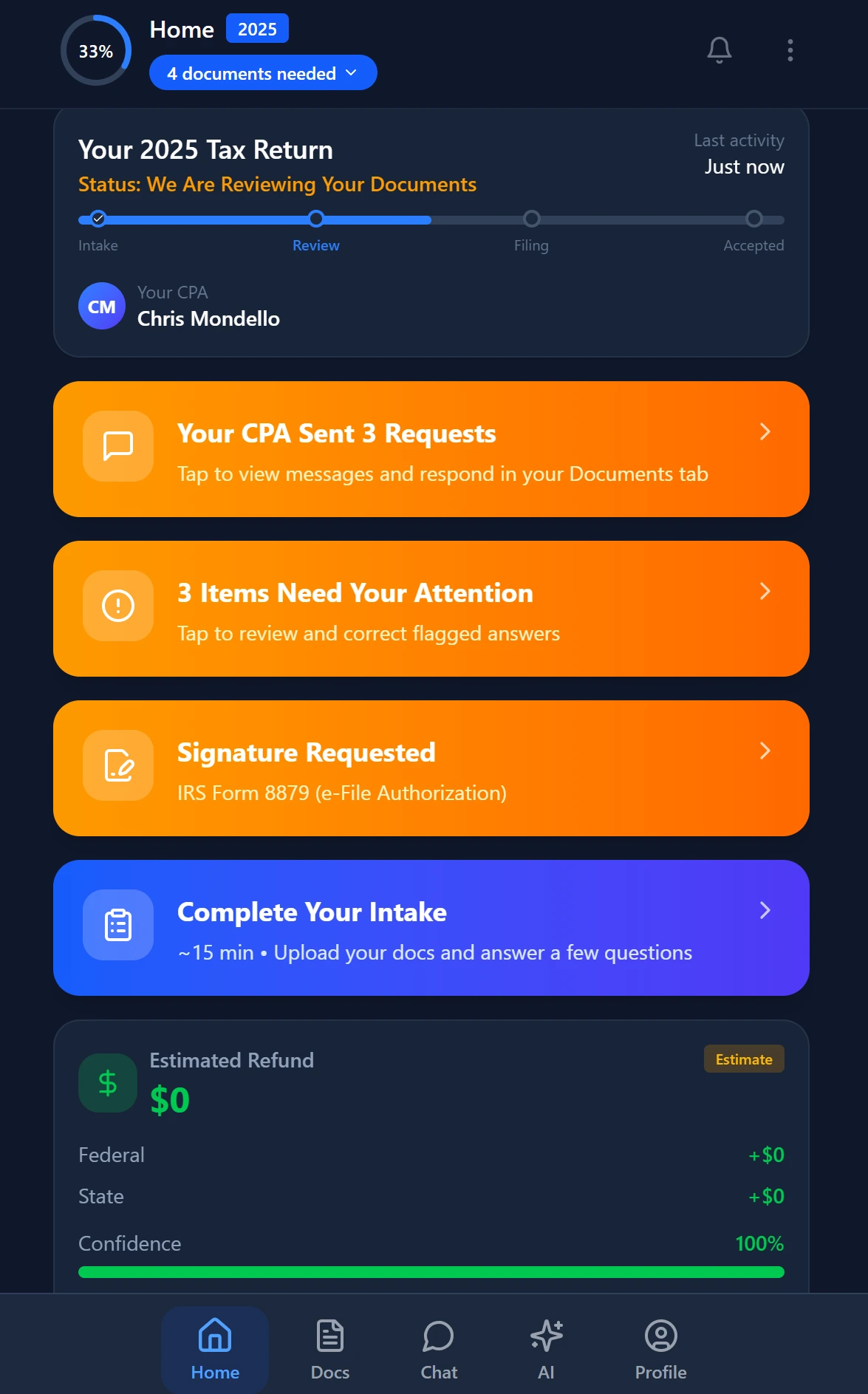
Smart intake auto-fills from uploaded documents and prior-year data
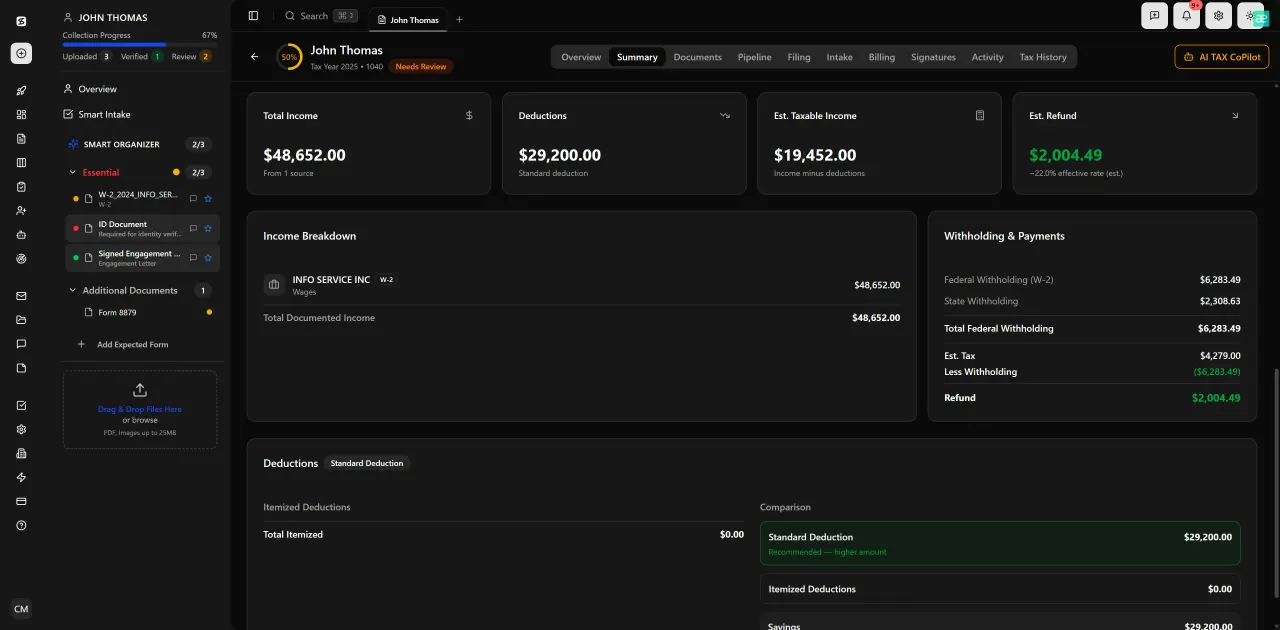
Review with AI assist — 9 agents answer questions with full client context
K-1 Distribution and Beneficiary Management
Generating and distributing Schedule K-1 packages to beneficiaries is one of the most error-prone steps in the fiduciary tax preparation cycle. Each beneficiary receives a K-1 reflecting their distributable net income share, and each K-1 must match the 1041 return exactly. With four, eight, or twelve beneficiaries, the coordination surface for errors multiplies accordingly.
An AI-native platform with client-context memory tracks each beneficiary as a linked contact within the trust engagement. Once the 1041 is prepared in the firm's tax software, K-1 packages can be uploaded to the portal, distributed to individual beneficiaries via their secure portal access, and collected for e-signature through Documenso-backed e-signature workflows. Beneficiaries sign digitally — the same workflow used for Form 8879 individual returns — and every signed document is retained in the encrypted document vault.
Address verification and beneficiary contact management within the platform also prevents the common failure mode of mailing K-1s to stale addresses. The glossary entry on K-1s explains the reporting obligations each beneficiary carries on their individual returns — a detail worth surfacing in the trustee communication so beneficiaries understand what to do with the form they receive.
Document Retention and Security for Fiduciary Engagements
Trust engagements have document retention requirements that exceed the standard 1040 lookback window. Trust instruments, fiduciary accountings, and related tax records may need to be retained for the life of the trust plus several years after termination, particularly when real property or complex assets are involved. The IRS recordkeeping guidance provides a baseline, but the fiduciary's obligations under state law often go further.
TaxScout's AES-256-GCM encrypted SSN vault and 7-role RBAC system provide the security foundation that fiduciary engagements require. SSNs for trustees and beneficiaries never appear in plain text in the workflow layer. The 13-step DSAR anonymization process means that if a beneficiary requests their data under a state privacy statute, the firm can respond without exposing unrelated client records. Post-cancellation, the Retained Archive plan at $99/year provides 7-year read-only access to all engagement records — directly matching the most common professional liability statute of limitations window.
For firms that want to benchmark their current document security posture before migrating fiduciary workflows to a new platform, our resources page includes guidance on what auditors and regulators look for in a CPA firm's document management practices. The cybersecurity essentials guide is also worth reviewing before handling trustee and beneficiary PII in any cloud environment.
AI Research Agents for Complex Fiduciary Tax Questions
Trust and estate tax law generates interpretive questions that generic research tools handle poorly. How does the section 643(b) definition of trust income interact with a state's principal and income act when a trustee exercises discretion over depreciation allocation? What is the current IRS position on grantor trust status after a partial sale of trust assets? These are the kinds of questions that arise mid-engagement and cannot wait for a manual Westlaw search.
TaxScout's 9 specialized AI research agents run real-time searches across IRS.gov, Treasury.gov, Cornell Law, SSA.gov, and the Congressional Research Service. The agents retain client context — entity structure, filing history, prior returns — so a question about the trust's income distribution deduction is answered against that specific trust's facts, not a generic explanation. Research output is citeable, with source links that can be attached to the workpaper file for the engagement.
This capability matters more in fiduciary work than almost any other practice area because the tax consequences of getting a discretionary distribution wrong fall on the trustee — and by extension on the CPA who advised them. Fiduciary tax preparation is not a volume play; it is a judgment-intensive service where authoritative, fact-specific research is part of the deliverable. Browse other blog resources covering advanced CPA practice topics including multi-state filings, advisory services, and AI automation.
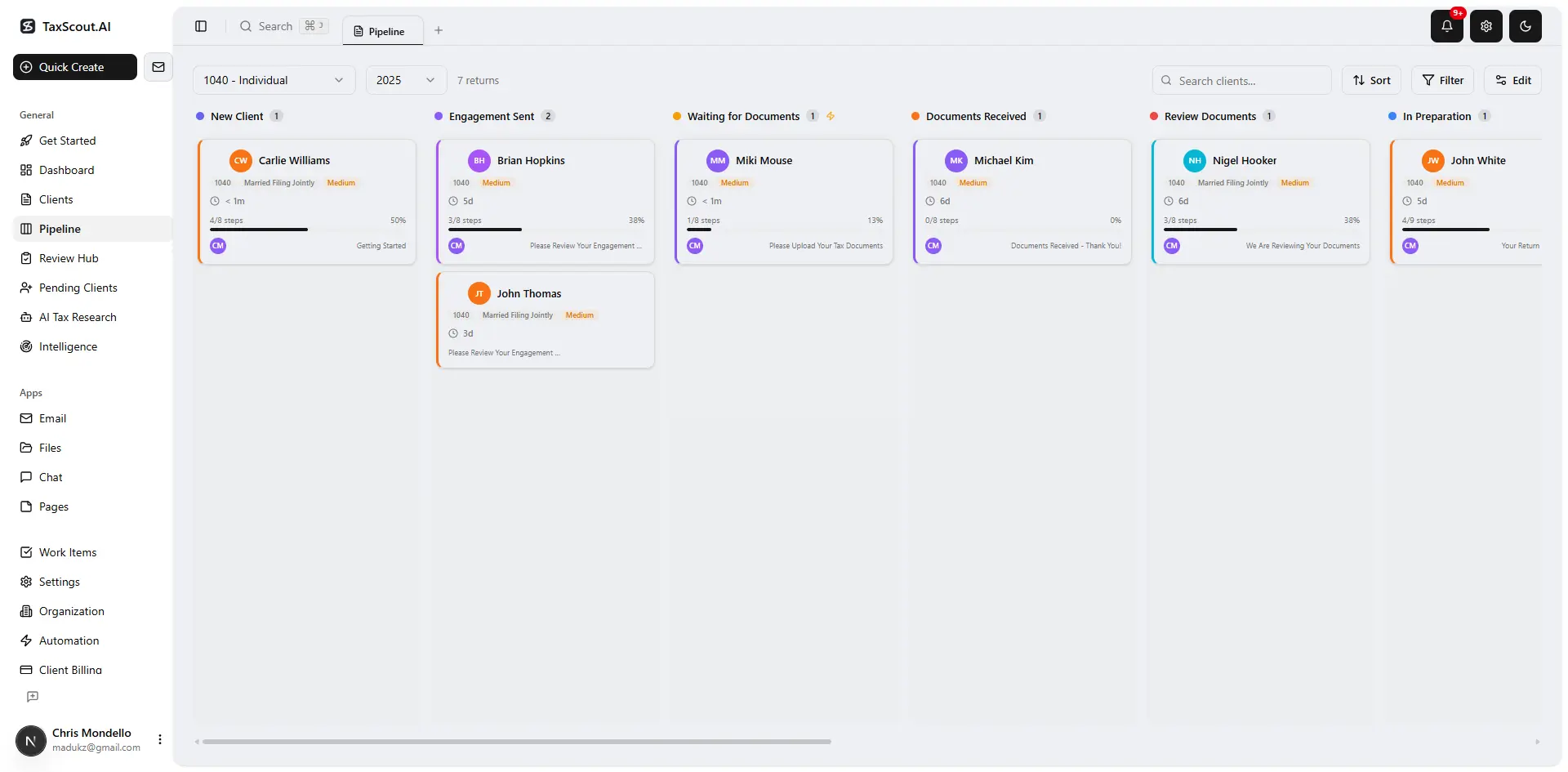
Track every return from intake to filed with drag-and-drop pipeline management
Trust Administration Software: TaxScout vs. Generic Practice Management Platforms
| Capability | TaxScout | TaxDome | Karbon |
|---|---|---|---|
| AI extraction for K-1s and 1041 schedules | Yes — 180+ form types, 5-layer validation | No | No |
| Client-context AI research agents | Yes — 9 agents, real-time IRS/Treasury/Cornell search | No | No |
| Encrypted SSN vault with RBAC | Yes — AES-256-GCM, 7-role RBAC | No | No |
| E-signatures (Form 8879, engagement letters) | Yes — via Documenso | Yes | No |
| Branded portal with OTP login | Yes — no passwords, audit trail per engagement | Yes | No |
| Pipeline customizable for trust workflows | Yes — 12 stages, drag-and-drop kanban | Yes (limited) | Yes (email-centric) |
| Flat pricing (10-person firm) | $149/mo total | ~$500/mo | ~$590/mo |
| Post-cancellation archive | Yes — $99/yr, 7-year read-only | No | No |
Pricing That Makes Sense for Fiduciary-Focused Firms
Estate and trust CPA software should not penalize firms for adding staff or beneficiary contacts. TaxDome charges approximately $100 per user per month. For a 10-person fiduciary practice that adds two seasonal staff during trust accounting season, that pricing model creates a cost spike precisely when capacity is most strained. Karbon is similarly per-user, running approximately $59 per user per month — and it lacks the document management and extraction capabilities that trust work demands.
TaxScout's flat pricing model charges $149 per month for the Prep Pro plan — covering 10 seats, 500 returns per year, all 9 AI Research Agents, the full PDF toolbox, and unlimited clients. There are no per-user fees and no per-client charges for features like smart intake. For a fiduciary practice that onboards a trust engagement with 12 beneficiaries, there is no additional cost for portal access, document storage, or e-signature routing across that beneficiary group.
Firms that are currently using Drake, Lacerte, CCH Axcess, UltraTax CS, or ProConnect do not need to switch tax preparation software to adopt TaxScout. The platform is designed to work alongside existing tax software, handling the practice management layer — document intake, pipeline tracking, client communication, billing — while the firm's existing software handles the return calculation and e-filing. See how that integration works in our Drake Tax Software integration overview.
Ready to stop managing trust engagements in scattered tools that were never built for fiduciary work?
TaxScout is the AI-native practice management platform built for the full complexity of trust administration — from document extraction and K-1 distribution to trustee communication, e-signatures, and 7-year post-filing archiving.

Every client gets organized documents, status tracking, and a complete history
Frequently Asked Questions
Trust administration software for CPAs is a practice management platform that handles the operational workflows specific to fiduciary engagements — including Form 1041 document intake, AI extraction of K-1s and trust tax documents, pipeline tracking across the preparation and filing cycle, beneficiary K-1 distribution, trustee communication with an auditable trail, e-signatures, and long-term document retention. Purpose-built platforms like TaxScout go beyond generic project management tools by including AI document extraction, encrypted SSN vaults, and research agents trained on IRS and Treasury sources.
Keep reading
Amended FBAR Procedures: How CPAs Correct Foreign Account Errors Without Triggering Penalties
Oct 12, 2026 · 1 min read
Transparency in Coverage Final Rules: What CPA Firms Must Do Now
Oct 12, 2026 · 1 min read
Backdoor Roth IRA: How CPAs Execute the Strategy for High-Income Clients
Oct 12, 2026 · 1 min read
Stay up to date
Get the latest tax tech insights delivered to your inbox.