Cryptocurrency Tax Reporting: How CPAs Handle Digital Asset Clients
Cryptocurrency tax reporting is no longer a niche specialty — it's a growing source of complexity that lands in nearly every CPA's inbox. This guide covers how forward-thinking firms build a repeatable crypto client workflow, from reconciling multi-exchange CSV files with AI extraction to pricing…
Cryptocurrency tax reporting has become one of the most demanding challenges in a modern CPA practice. A client who traded on three exchanges, held assets in two hardware wallets, received staking rewards, and minted an NFT in the same tax year is not unusual — and each of those events carries distinct cost basis, holding period, and character implications under current IRS guidance.
Most CPA-focused content treats crypto tax as a standalone explainer: here is what a wash sale means for digital assets, here is how to read a 1099-DA. What that content skips is the operational question that actually matters to a growing firm: how do you handle twenty crypto-heavy clients during filing season without your staff drowning in mismatched rows across eight different exchange CSV formats? The operational realities of cryptocurrency tax reporting at scale are rarely covered in the guides aimed at practitioners.
This guide is about systematizing digital asset tax work — building a repeatable crypto client intake, automating data aggregation, and positioning cryptocurrency tax as a premium service line your firm can price and scale confidently. Done well, cryptocurrency tax reporting becomes a high-value service line rather than a chaotic annual scramble.
The IRS Framework CPAs Must Know Cold
The IRS treats virtual currency as property, not currency, under Notice 2014-21. Every disposal — sale, exchange, payment for goods or services, crypto-to-crypto swap — is a taxable event requiring you to track cost basis, holding period, and gain or loss character. The agency reinforced and expanded this framework through Revenue Ruling 2019-24, which addressed hard forks and airdrops as ordinary income at fair market value on the date of receipt. Understanding this property-based framework is the foundation of accurate cryptocurrency tax reporting for every client engagement.
Staking rewards, mining income, and DeFi yield are generally treated as ordinary income at receipt, then converted to capital gains or capital losses on disposal. NFT sales require character analysis — whether the NFT is a collectible (28% rate) or a capital asset at standard rates depends on the underlying asset and creator relationship. For clients who are NFT creators, proceeds may be self-employment income rather than capital gain. For firms evaluating their cryptocurrency tax reporting approach, this trade-off compounds over time.
The Infrastructure Investment and Jobs Act of 2021 added new reporting requirements for digital asset brokers under IRC §6045, and the Treasury has been issuing proposed regulations since 2023 setting the stage for Form 1099-DA — the new digital asset information return. CPAs who stay current on IRS virtual currency guidance are the ones clients call when the rules shift. Each of these factors directly shapes how cryptocurrency tax reporting plays out in practice.

Click any extracted field to see its source highlighted on the original PDF
Why Multi-Exchange, Multi-Wallet Clients Break Manual Workflows
The average active crypto trader in 2025 used between three and five exchanges and maintained at least one self-custody wallet. Each platform exports transaction data in its own format: Coinbase produces a CSV with one column structure, Kraken uses another, Binance.US a third, and hardware wallets like Ledger export raw blockchain data that requires additional parsing. Before a CPA can even open a tax return, someone on the team must normalize thousands of rows across incompatible formats. Understanding cryptocurrency tax reporting in this context is what separates firms that scale from those that stall.
Manual reconciliation at this scale is where errors compound. Matching a buy on one exchange to a transfer on a second exchange to a sale on a third requires tracking the asset across every movement. Miss a single internal transfer and you manufacture a phantom gain or understate a loss. For clients using DeFi protocols, on-chain transaction logs add yet another layer — gas fees, liquidity pool entries and exits, and wrapped token conversions each need classification.
This is why cryptocurrency tax reporting demands a systematic document ingestion workflow, not just a knowledgeable CPA. Without structured data capture at the front end, every crypto engagement is a custom research project that eats billable hours unpredictably. Read more about how AI is changing this problem in our guide on AI document extraction for CPAs.
Tired of manually reformatting exchange CSVs before you can even open the return?
TaxScout.ai extracts, classifies, and validates crypto transaction documents automatically — so your team starts at reconciliation, not data entry.
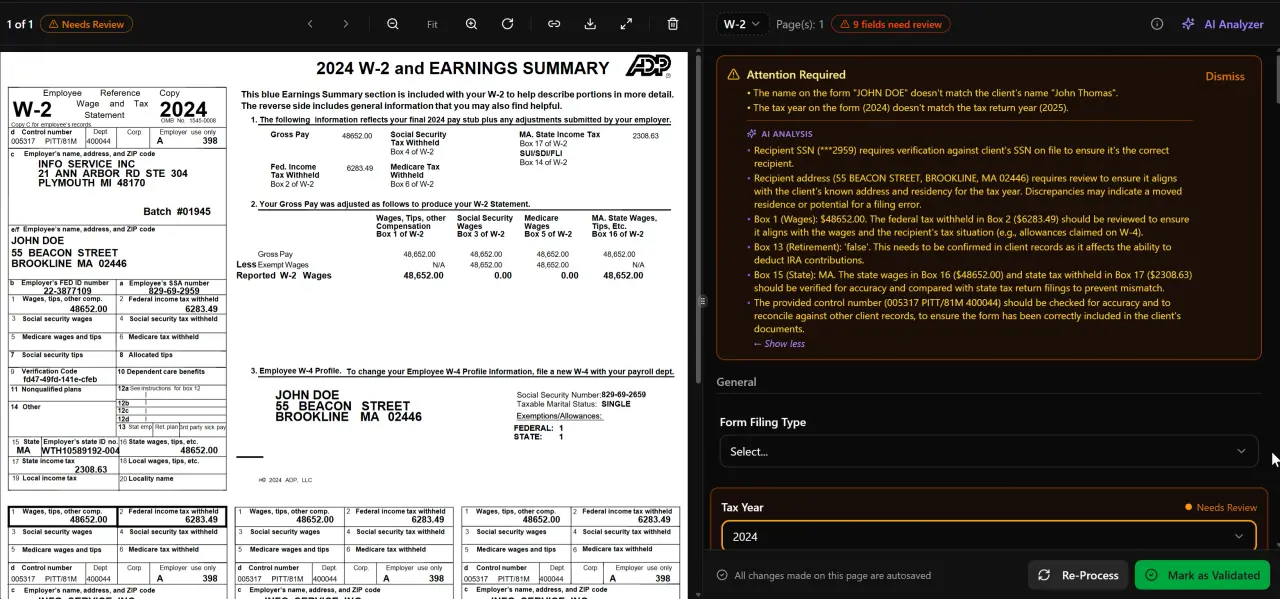
AI classifies, extracts, and validates every document automatically

Your clients see your brand — OTP login, document upload, and real-time status
Cryptocurrency Tax Reporting Workflow: A Step-by-Step Firm Process
Building a repeatable crypto client workflow starts at intake. Your engagement letter should explicitly list every document type the client must provide: exchange CSVs for all platforms used, wallet transaction exports, any third-party crypto tax software reports (Koinly, CoinTracker, TaxBit), staking and mining income summaries, and NFT transaction records. Using a structured intake questionnaire modeled on IRS Form 13614-C that includes crypto-specific questions eliminates the back-and-forth discovery loop. TaxScout.ai's smart intake engine prefills from prior-year data and flags gaps — so if a client listed three exchanges last year but only uploaded two CSVs this year, the system surfaces that discrepancy automatically.
Once documents arrive, the AI document extraction layer handles classification and field-level extraction across 180+ tax form types, including exchange-generated CSVs and third-party aggregator reports. The 5-layer validation pipeline runs document quality routing, AI extraction with confidence scoring, OCR cross-verification, 15 deterministic math rules, and 18 post-extraction rules — catching discrepancies before a human reviewer ever opens the file. The split-screen PDF viewer lets staff click any extracted field and jump directly to the source row in the document, so verification is seconds rather than minutes.
For cost basis tracking, the workflow should establish the client's elected accounting method (FIFO, HIFO, or specific identification) before preparing Form 8949. Specific identification produces the most tax-efficient outcome for most long-term holders but requires per-lot documentation. Your engagement letter should memorialize the elected method each year to defend it in the event of an IRS inquiry.
Form 8949 at Scale
A client with 500 transactions across multiple exchanges needs every disposal on Form 8949 — there is no de minimis threshold. Grouping transactions by holding period (short-term vs. long-term) and by whether a 1099-B or 1099-DA was received (Box A/B/C vs. D/E/F) is mandatory for correct Schedule D roll-up. AI extraction that can ingest aggregator-generated summary reports and validate totals against raw exchange data cuts this multi-hour task to a review step. TaxScout.ai's pipeline management system lets you assign Form 8949 review as a discrete stage so it never gets skipped during a busy filing week.
Wash Sale Rules and Digital Assets
As of the 2025 tax year, the wash sale rule under IRC §1091 does not apply to cryptocurrency — digital assets are property, not securities, so a client who sells Bitcoin at a loss and rebuys within 30 days can still claim the loss. However, Congress has repeatedly proposed legislation to extend wash sale rules to digital assets, and Treasury has signaled support. CPAs should document that the current position is law-dependent and advise clients who aggressively harvest crypto losses that their strategy may be retroactively disallowed if legislation passes mid-year. The IRS virtual currency FAQ is updated periodically and should be your reference point before filing.
How AI Document Extraction Handles Exchange CSVs and Wallet Reports
Most practice management platforms treat document management as file storage — upload a PDF, attach it to a client record, done. Cryptocurrency tax reporting requires something fundamentally different: structured extraction from semi-structured sources like CSV exports, third-party aggregator PDFs, and blockchain transaction logs formatted as spreadsheet exports.
TaxScout.ai's AI document extraction is built around 180+ recognized document types, including the exchange-generated and aggregator formats that crypto clients produce. When a client uploads a Coinbase transaction history CSV or a TaxBit gain/loss summary through the branded client portal, the extraction engine classifies the document, maps column headers to standardized fields, applies confidence scoring, and flags any rows that fail cross-document validation — for example, a transfer-in on one exchange that has no corresponding transfer-out on another.
The result is a structured data set your staff can review in the split-screen viewer rather than manually reformatting. For firms running paperless workflows, this is the critical difference between crypto being a manageable service line and an annual scramble. The PDF tools suite also handles OCR on scanned wallet reports and PII masking for documents that need to be shared with third-party aggregators for cross-verification.
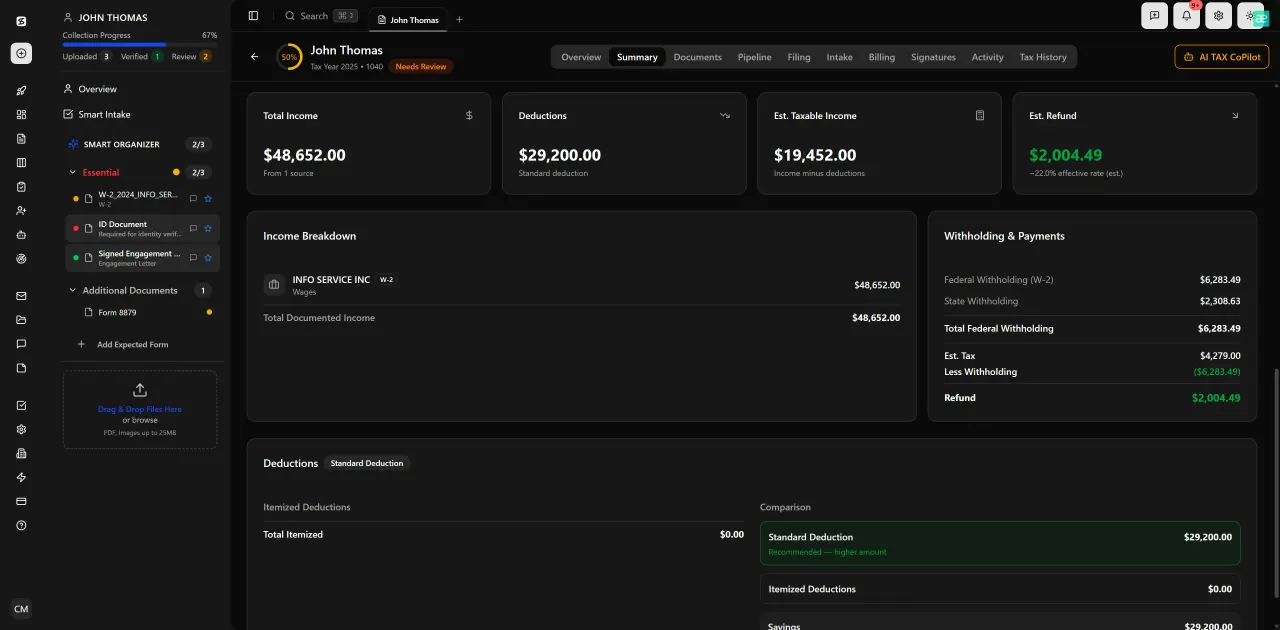
Review with AI assist — 9 agents answer questions with full client context
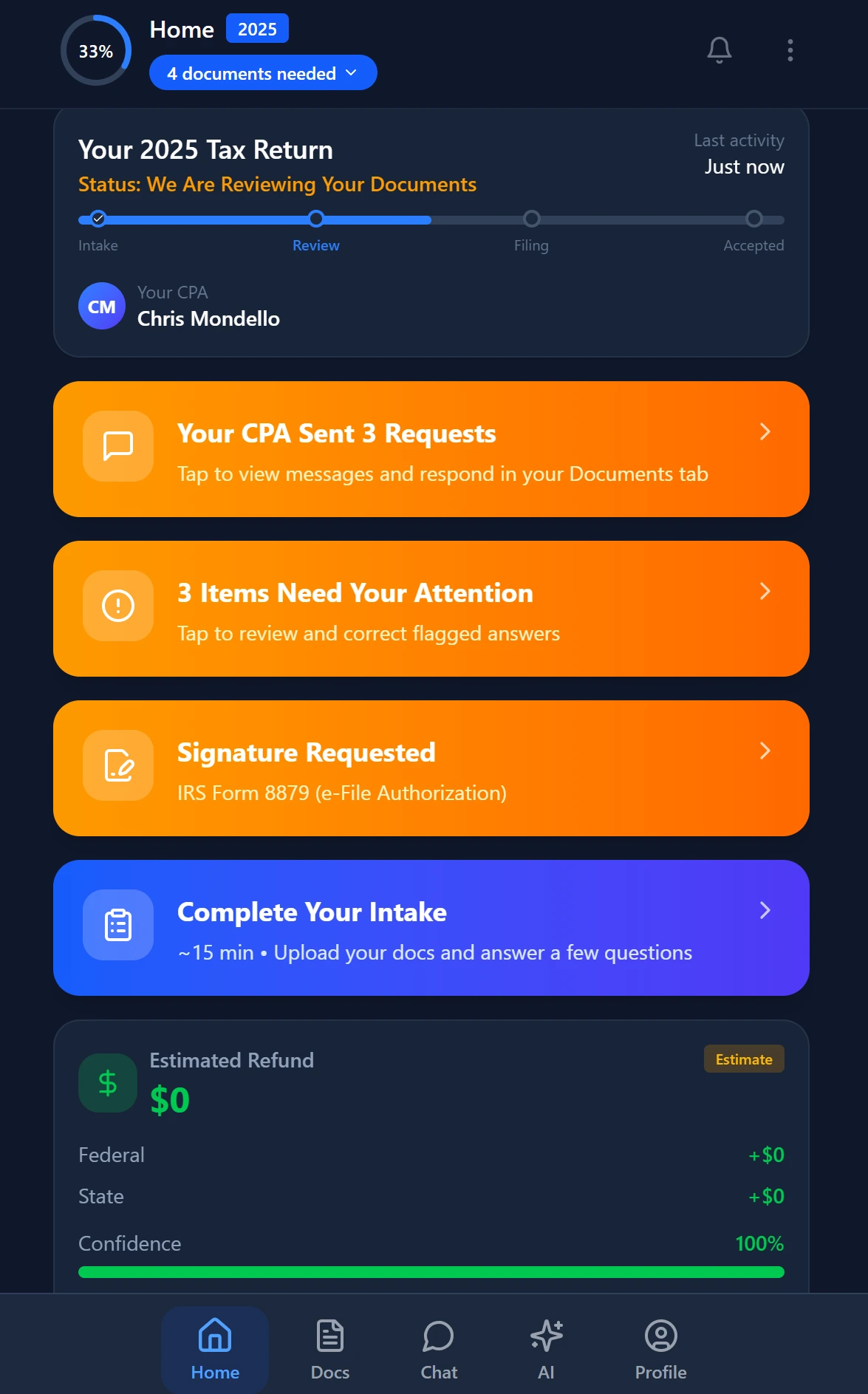
Smart intake auto-fills from uploaded documents and prior-year data
NFT Tax Reporting: What Makes It Different
NFT taxation sits at the intersection of several overlapping rules, and the character analysis is more nuanced than standard cryptocurrency tax reporting. When a client purchases an NFT and later sells it, the gain or loss is generally capital in nature. If the NFT qualifies as a collectible under IRC §408(m), the maximum long-term rate is 28% rather than 20% — a distinction that matters for high-income clients.
Creator royalties received on secondary NFT sales are ordinary income under self-employment rules, subject to self-employment tax. Clients who both create and collect NFTs may have both capital and ordinary income streams from the same digital wallet, which requires careful segregation in the return. The Cornell Law School's Legal Information Institute provides the statutory text on collectibles definitions useful for supporting your position in documentation.
From a workflow standpoint, NFT transaction records from platforms like OpenSea or Blur typically require on-chain lookup to establish cost basis — the platform export may show sale proceeds but not the original mint cost or secondary purchase price. Your intake questionnaire should ask clients to provide both their transaction history export and their wallet address so on-chain verification is possible. TaxScout.ai's AI research agents can assist with real-time IRS and Treasury lookups on NFT-specific guidance as it evolves.
TaxScout.ai vs. Competing Practice Management Platforms for Crypto Client Workflows
| Capability | TaxScout.ai | TaxDome | Canopy |
|---|---|---|---|
| AI document extraction (CSV, PDF, exchange reports) | Yes — 180+ form types, 5-layer validation | No | No |
| Form 8949 data ingestion from aggregators | Yes — structured extraction with confidence scoring | No | No |
| AI research agents (IRS/Treasury real-time search) | Yes — 9 specialized agents | No | No |
| Smart intake with crypto-specific gap analysis | Yes — modeled on Form 13614-C with AI prefill | No | Limited ($11/client add-on) |
| Split-screen PDF viewer with click-to-source | Yes | No | No |
| Pipeline management for multi-stage crypto review | Yes — 12 customizable stages, drag-and-drop kanban | Yes | Yes |
| Pricing (10-person firm) | $149/mo total | ~$500/mo | ~$660/mo |
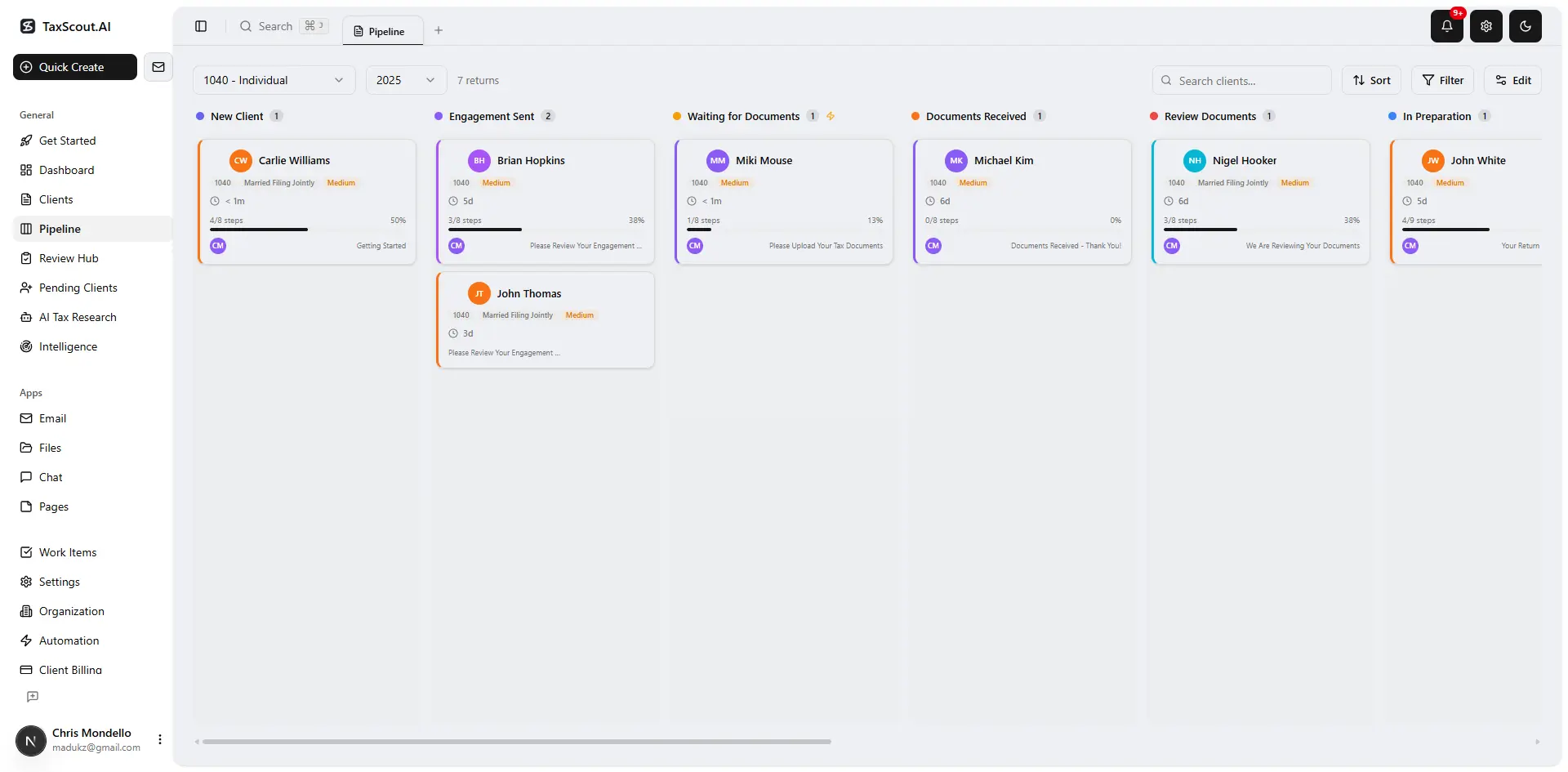
Track every return from intake to filed with drag-and-drop pipeline management
Staffing and Pricing Crypto Engagements as a Premium Service
Cryptocurrency tax reporting should not be priced like a standard Schedule D. The data aggregation burden, the regulatory ambiguity requiring research, and the character analysis for mixed portfolios justify a premium engagement structure. Firms that have successfully built crypto as a service line typically price by complexity tier: a simple single-exchange client with under 100 transactions at one rate, a multi-exchange trader with 100-500 transactions at a second rate, and a DeFi or NFT-heavy client requiring on-chain analysis at a third rate. For guidance on structuring this, our flat fee billing guide covers how to move from hourly to value-based pricing across specialty services.
On the staffing side, designate a crypto lead — a staff member or senior associate who owns the exchange CSV normalization process, stays current on IRS guidance, and handles first-pass reconciliation for all crypto clients. This prevents every team member from independently solving the same format-mapping problems. Pair this person with TaxScout.ai's AI research agents, which can run real-time searches across IRS, Treasury, Cornell LII, and SSA sources, so the crypto lead has authoritative citation support without hours of manual research.
Engagement letters for crypto clients should include explicit scope language covering the number of exchanges, transaction volume threshold, wallet types, and what happens if the client adds a new exchange mid-preparation. The SSA and BLS data on workforce composition shows accountants are increasingly expected to handle technology-adjacent advisory — pricing crypto expertise as advisory rather than compliance is the positioning that protects margins. You can find more cross-practice workflow strategies across other blog resources.

Every client gets organized documents, status tracking, and a complete history
Keeping Crypto Client Data Secure
Digital asset clients often share wallet seed phrases, exchange API keys, and blockchain addresses alongside their tax documents — all of which require heightened data security. TaxScout.ai's security architecture includes AES-256-GCM encrypted SSN vault storage, 13-step DSAR anonymization, and 7-role RBAC so only staff with explicit permissions can access sensitive client records. The branded client portal uses OTP login with no passwords, reducing credential-based exposure for document upload sessions.
For firms concerned about how crypto data intersects with cybersecurity obligations, our guide on cybersecurity for CPA firms covers the technical and procedural safeguards that protect client data year-round. Exchange API keys should never be stored in email threads or shared drives — funneling all document uploads through a structured portal with audit logging is the baseline for defensible data handling.
Ready to stop treating every crypto client as a one-off project?
TaxScout.ai gives your firm the AI extraction, smart intake, and pipeline tools to make cryptocurrency tax reporting a scalable, profitable service line — at $149/month for your entire team.
Frequently Asked Questions
The IRS treats virtual currency as property under Notice 2014-21, meaning every disposal — including crypto-to-crypto swaps, payments for services, and exchange sales — is a taxable event. Gains and losses are capital in nature (short-term or long-term depending on holding period), while staking rewards and mining income are generally ordinary income at the fair market value on the date of receipt.
Stay up to date
Get the latest tax tech insights delivered to your inbox.