Succession Planning for CPA Firms: How to Value, Transition, and Exit on Your Terms
Most CPA firm owners spend decades building a valuable practice, then exit with far less than they deserve because they never built a real succession plan. This guide covers every stage of the CPA firm exit journey — from valuing your practice using the right method to choosing between internal…
Succession planning for CPA firms is one of the most consequential decisions a firm owner will ever make — and one of the most under-prepared for. The AICPA's 2024 PCPS Succession Survey found that fewer than one in four accounting firms has a written succession plan in place, even though the majority of sole proprietors and small firm partners are over 50. The result is a recurring pattern: a founder reaches their late 60s with no buyer identified, no internal candidate groomed, and no documented process — and ends up accepting a fraction of what the practice was worth, or simply shutting the doors.
The content landscape doesn't help. Most articles on CPA firm exits take either the buyer's perspective — how to acquire a practice at a favorable multiple — or focus narrowly on operational risk when a key employee leaves. Almost nothing is written for the person who spent 25 years building the firm and now needs a clear-eyed financial roadmap: how do I value what I've built, who should buy it, how do I structure the deal to maximize what I actually take home, and how do I protect my clients and my reputation along the way? Yet succession planning for CPA firms remains one of the most consequential — and least discussed — challenges facing practice owners today.
This guide addresses all of it. Whether you're five years from retirement or already fielding acquisition inquiries, understanding the full spectrum of succession planning for CPA firms — valuation methods, exit route options, earn-out mechanics, and client transition best practices — will determine whether you exit on your terms or someone else's.
CPA Firm Valuation: Three Methods and When Each Applies
Before you can negotiate a deal, you need to know what your firm is worth — and the answer depends heavily on which valuation method applies to your practice type, client mix, and market conditions. There is no single correct number; there are three primary frameworks, and sophisticated buyers and sellers understand all of them. Effective succession planning for CPA firms starts with an honest, method-driven valuation before any buyer conversations begin.
The most widely cited benchmark in accounting practice sales is the gross revenue multiplier, typically ranging from 0.8x to 1.5x annual gross revenue. The Journal of Accountancy's practice management coverage notes that the 1x rule of thumb has persisted for decades because it's simple and immediately intuitive for both parties. However, it obscures enormous variation: a bookkeeping-heavy practice with low advisory revenue and high client churn deserves closer to 0.8x, while a firm with strong recurring revenue, long client tenure, and an advisory component can command 1.3x–1.5x. Understanding where your firm falls within this range is a foundational step in succession planning for CPA firms, since even a 0.1x difference in multiplier can mean hundreds of thousands of dollars at the closing table.
EBITDA multiples offer a more sophisticated lens. Buyers — especially PE-backed consolidators who have entered the accounting space aggressively since 2021 — evaluate firms at 5x–8x EBITDA, sometimes higher for firms above $2M revenue with strong growth trajectories. According to SBA lending guidelines for professional service acquisitions, this approach aligns closely with how acquisition financing is underwritten, making it the de facto method in larger transactions. For a $1M gross revenue firm with a 25% EBITDA margin, the implied value range under this method is $1.25M–$2M — meaningfully higher than the 1x gross revenue floor. For firms evaluating their succession planning for CPA firms approach, this trade-off compounds over time.
The third method — and the one most relevant to your actual negotiated outcome — is client retention-adjusted pricing. Because CPA practice value is fundamentally a proxy for future cash flows, buyers discount heavily for client concentration risk, client age, and attrition risk at transition. A firm where 40% of revenue comes from three clients, or where the founder is the primary relationship holder for every top-10 account, will see significant haircuts applied during due diligence regardless of the headline multiple. Documenting client tenure, recurring engagement types, multi-year retention history, and the degree to which junior staff or documented systems maintain client relationships is not just good practice management — it is directly value-protective when you go to sell. Each of these factors directly shapes how succession planning for CPA firms plays out in practice.
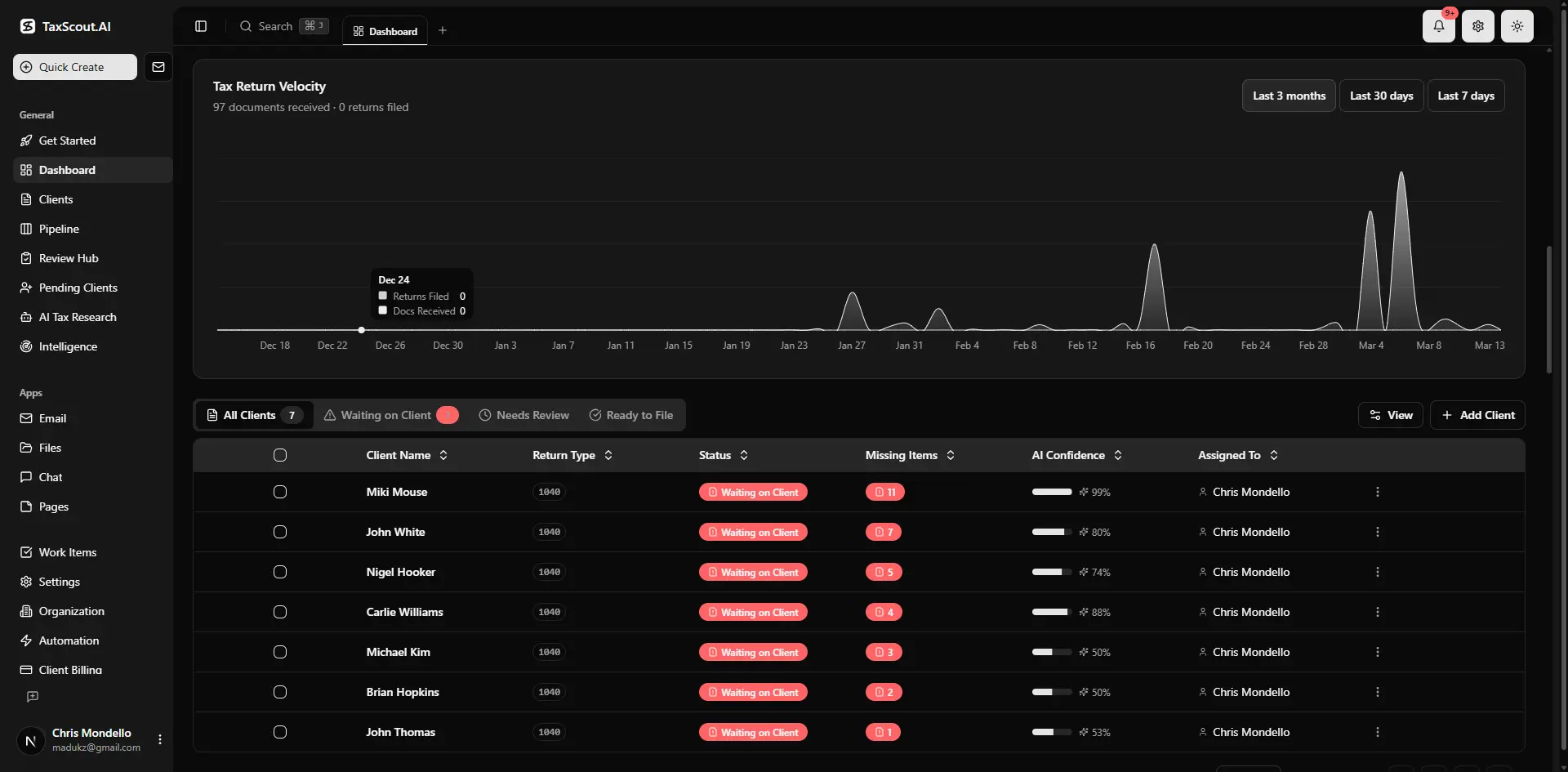
Real-time dashboard showing returns in progress, revenue, and upcoming deadlines
Internal Succession: Junior Partner Buyout and Equity Transfer
Internal succession — selling equity to one or more existing partners, managers, or senior staff — is the most common exit path for sole proprietors and small firms, and often the one that produces the best combined outcome when executed well. It preserves client relationships (the buyer already knows the clients), avoids the disruption of an external sale process, and allows the founder to structure a longer, tax-efficient exit timeline. Understanding succession planning for CPA firms in this context is what separates firms that scale from those that stall.
The mechanics of a CPA partner buyout typically involve the buyer purchasing equity in annual installments funded by the firm's own earnings, a structure sometimes called an internal note or earn-in arrangement. Because most junior partners cannot finance a seven-figure acquisition from personal savings, the firm essentially finances its own sale: the retiring partner takes distributions funded by future profits, often over five to ten years. The IRS's guidance on installment sales under IRC §453 governs the tax treatment of these structured payments, and structuring them correctly — particularly the allocation between goodwill (capital gains) and ordinary income — can meaningfully shift the seller's after-tax proceeds. This is precisely where a deliberate succession planning for CPA firms strategy pays off.
The primary risk in internal succession is candidate readiness. Many founders identify a successor too late, leaving insufficient runway to transfer client relationships gradually, develop the successor's business development skills, and build the institutional credibility needed for major clients to accept the transition. A realistic timeline for grooming an internal successor is three to seven years. If you are within two years of your target exit date and no internal candidate is positioned, an external path is likely more practical. Succession planning for CPA firms sits at the center of this decision — get it wrong and the rest unravels.
Operationally, internal transitions benefit enormously from documented systems. A firm where every engagement workflow, client preference, and filing history lives in the founder's memory is dramatically harder — and cheaper, from the buyer's perspective — to transition than one where pipeline management tracks every active engagement, client records are centralized, and documented procedures govern every recurring service. The more your firm runs like a business rather than a personal practice, the more confident an internal buyer will be and the more they'll be willing to pay. When firms revisit their succession planning for CPA firms priorities, the gaps usually surface here.
Is your firm's value locked in your head instead of your systems?
TaxScout.ai helps CPA firms document workflows, centralize client data, and build the operational infrastructure that commands a premium at exit — starting at $49/month with no per-user fees.

Track every return from intake to filed with drag-and-drop pipeline management

Smart intake auto-fills from uploaded documents and prior-year data
External Sale vs. Merger-as-Exit: Choosing the Right Path
When internal succession isn't viable, firm owners face a choice between a direct external sale to another firm or individual buyer and a merger arrangement that functions as a phased exit. These paths differ substantially in price, control, timeline, and complexity. Succession planning for CPA firms shapes which of these routes is realistic long before a buyer ever enters the picture.
A direct sale — sometimes called an 'upstream merger' when the buyer is a larger firm — typically involves the seller leaving the practice within 12–36 months. The buyer acquires the client list, staff, and goodwill, often paying a negotiated multiple of annual gross fees. This path offers the cleanest break and the highest potential lump-sum or short-term payment, but also the greatest transition risk: client attrition in the 18 months post-close is the most common cause of price adjustments and earn-out clawbacks.
A merger-as-exit is structurally different. The founder joins a larger firm as a partner, continues working (typically at reduced capacity) for three to seven years, and receives a buyout of their remaining equity at a predetermined formula when they retire. This arrangement is often more financially attractive than it first appears: the founder benefits from the larger firm's infrastructure, billing rates, and service expansion during the merger period, which can increase the actual value of the equity being bought out. The Treasury's guidelines on partnership interests and buyouts inform how these arrangements are taxed at each stage.
The PE-backed consolidator model represents a third variant that has gained significant traction. Firms like Citrin Cooperman, Aprio, and Forvis Mazars have absorbed hundreds of regional practices in recent years, typically offering a combination of upfront cash, rollover equity in the consolidated entity, and earn-out provisions tied to revenue retention. These deals often have the highest headline multiples but the most complex structures — and the rollover equity component means your final payout depends significantly on how the consolidator itself performs. For owners who want maximum value and are comfortable with some performance risk, this path merits serious evaluation. For those who want a clean exit and a predictable outcome, a traditional external sale or internal succession is simpler.
Regardless of path, investment in client management infrastructure before going to market is universally value-accretive. Buyers are paying for future cash flows, and anything that demonstrates client stickiness, service systematization, and operational independence from the founder reduces their perceived risk — which translates directly into price and deal terms.
Earn-Out Structures in CPA Practice Sales
Earn-out provisions are nearly universal in CPA practice acquisitions, and understanding how they work — and how to negotiate them — is one of the most financially significant decisions a selling owner will make. An earn-out ties a portion of the purchase price to post-close performance metrics, most commonly client revenue retention over one to three years.
The standard structure in smaller practice sales involves a two-year retention period: the buyer pays 20–40% of the purchase price upfront, with the remainder contingent on retaining a specified percentage of transferred revenue. If the practice generates $800,000 in annual fees and the deal is struck at a 1.2x multiple ($960,000), a typical structure might be $300,000 at close and $660,000 paid in annual installments adjusted for actual client retention. If year-one retention is 85% against a 90% threshold, the seller's earn-out payment is reduced proportionally.
From the seller's perspective, the key negotiating variables are: (1) the retention baseline — what counts as 'retained' revenue and over what time period; (2) the attribution rules — who is responsible when a client leaves for reasons unrelated to the transition (death, business closure, competitor pricing); and (3) the measurement period — whether retention is evaluated annually or cumulatively. Many sellers accept unfavorable terms in these areas because they're focused on the headline multiple; the actual economic outcome often depends far more on the earn-out mechanics than the stated price. This is one of the most overlooked dimensions of succession planning for CPA firms, and getting it wrong can cost more than a poor valuation.
One underappreciated lever in earn-out negotiations is the transition support period. Buyers will pay more — and set higher retention thresholds — when the seller commits to a meaningful transition role: typically 12–24 months of continued client contact, staff mentorship, and business development support. This is not charity; it reflects the empirical reality that client attrition is lowest when the exiting founder actively introduces and endorses the successor. If your exit timeline allows it, a longer transition period is usually the highest-ROI negotiating chip available to you.
You can find other blog resources on practice management, billing strategy, and client retention that inform how your firm's systems affect deal terms — strong operations make earn-out thresholds easier to meet.

Click any extracted field to see its source highlighted on the original PDF
Client Transition Protocols That Protect Retention and Value
Client attrition is the single largest destroyer of earn-out value, and it is more preventable than most sellers realize. Research consistently shows that clients leave after an ownership transition primarily because of perceived relationship discontinuity — not price, not service quality, not competitive offers. The antidote is a structured, proactive client communication plan that begins before the transaction closes.
Best practice is a three-phase communication approach. In the pre-announcement phase (typically 60–90 days before closing), the seller should document every client's key contacts, communication preferences, service history, and relationship nuances in a centralized system. The buyer needs this intelligence to have credible first conversations; clients can tell when a new owner is reading from a cold contact card. Tools like AI intake and client portal infrastructure that already contain this structured data are immediately valuable to an acquiring firm and can be demonstrated during due diligence.
The announcement phase should be personal and direct. For top-quartile clients (typically 20% of clients representing 50–70% of revenue), the announcement should come in a phone call or in-person meeting from the selling owner — not a form letter. The IRS has specific guidance on client consent and record transfer obligations that govern how client records can be transferred; ensuring compliance with these obligations before announcement avoids delays and regulatory complications.
During the transition phase, co-servicing — where the seller and successor both participate in key client interactions for at least one full filing season — is the most effective retention strategy available. Clients who complete one full annual engagement cycle with the new team under the original owner's sponsorship retain at dramatically higher rates than those who experience an abrupt handoff. This is also the period where e-signature workflows and branded client portals demonstrate their retention value: clients who have an established digital relationship with the firm (stored documents, saved payment methods, existing portal logins) are less likely to shop around than clients whose entire relationship existed through the founder's personal email and phone. Firms that have invested in succession planning for CPA firms well in advance of this stage consistently experience smoother co-servicing periods and lower attrition.
For firms looking to build the operational infrastructure that supports a smooth transition — and that buyers will pay a premium to acquire — our post on running a paperless accounting firm in 2026 covers the practical steps for digitizing workflows and client records.

Your clients see your brand — OTP login, document upload, and real-time status
CPA Firm Exit Path Comparison: Internal Buyout vs. External Sale vs. Merger
| Factor | Internal Buyout | External Sale | Merger-as-Exit |
|---|---|---|---|
| Typical Timeline | 3–7 years | 6–18 months | 3–7 years |
| Price Certainty | Moderate (installments) | High (at closing) | Low–Moderate (equity + earn-out) |
| Client Retention Risk | Low | High | Moderate |
| Upfront Cash | Low (funded by earnings) | High | Moderate (partial upfront) |
| Seller Control Post-Close | High during transition | Low | Moderate |
| Best For | Founders with groomed successors | Clean break, near-term exit | Firms wanting ongoing upside |
| Valuation Method | Negotiated gross revenue multiple | Gross revenue or EBITDA multiple | EBITDA multiple + rollover equity |
Building Practice Systems That Command a Higher Multiple
The most reliable way to increase your firm's sale price is to reduce its dependence on you — and the most direct way to do that is through documented systems, centralized client data, and operational infrastructure that a buyer can audit during due diligence and rely on after you leave. This is where succession planning for CPA firms moves from strategy to execution: the systems you build today are the evidence buyers evaluate tomorrow.
Buyers assess operational risk through a checklist that includes: Are client files organized, complete, and accessible without the founder? Are service workflows documented in a repeatable format? Is there a defined pipeline management system that tracks engagement status across all active clients? Are revenue streams recurring and predictable, or project-based and founder-dependent? Does the firm use professional e-signature and engagement letter infrastructure, or are agreements verbal and informal? Each 'no' answer is a discount applied to your multiple.
Technology infrastructure signals sophistication to buyers. A firm running on a modern AI document extraction platform with structured client records, a branded client portal, and an organized file management system presents as a business — not a personal practice — and commands pricing accordingly. The operational premium isn't abstract: a firm at 1.5x gross revenue versus one at 0.9x on a $750,000 revenue base is a $450,000 difference in total deal value.
The niche pricing strategy guide is worth reviewing in this context as well: firms with specialized, defensible client niches — real estate investors, medical practices, multi-state e-commerce operators — command higher multiples because their client relationships are less portable to a general practitioner and more dependent on firm-specific expertise. Specialization is not just a growth strategy; it's an exit strategy.
Finally, staff infrastructure matters. A firm where two or three experienced staff members have direct client relationships — and are willing to stay post-acquisition — is meaningfully more valuable than one where all client knowledge lives with the founder. Retention incentives for key staff, structured into the deal as stay bonuses funded from the purchase price, are a common and effective mechanism for protecting this value. Reviewing CPA firm KPIs with your team regularly also signals to buyers that the firm is managed by data, not intuition.

Track firm performance with real-time analytics and client activity monitoring
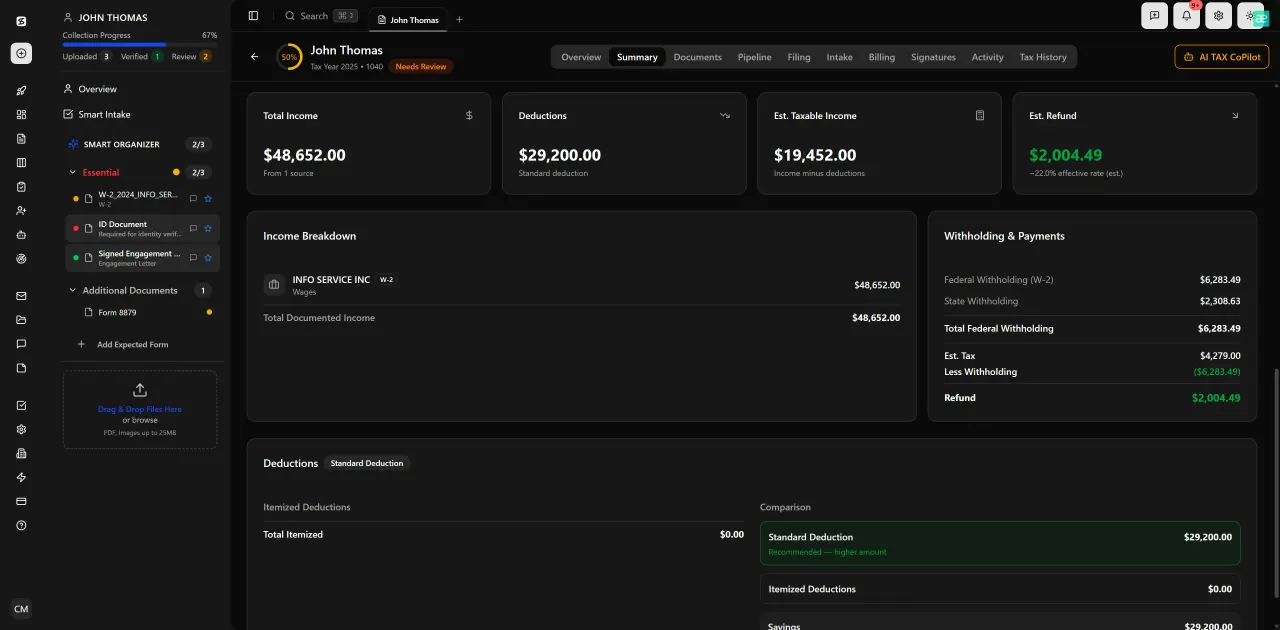
Review with AI assist — 9 agents answer questions with full client context
Tax and Legal Considerations for CPA Firm Sellers
The tax treatment of a CPA practice sale is complex and has a disproportionate impact on net proceeds. Most practice sales involve the sale of assets (client list, goodwill, equipment, and work-in-process) rather than entity shares, and the allocation of purchase price among these asset classes determines how much of your proceeds are taxed at capital gains rates versus ordinary income rates.
Under IRC §1060 and the associated IRS asset class hierarchy, buyer and seller must agree on a purchase price allocation reported on Form 8594. Sellers typically prefer to allocate maximum value to goodwill (taxed at long-term capital gains rates, currently 0%–20% plus net investment income tax for high earners) while buyers prefer to allocate to depreciable assets and covenants not to compete (both amortizable over 15 years, providing buyer tax benefits). The negotiation of this allocation is a direct transfer of economic value between parties and should never be left to a boilerplate deal structure.
State tax treatment adds another layer. Many states have their own rules on capital gains from business sales, and the state where the firm operates — not where the owner resides — often governs the source-income treatment of practice sale proceeds. Cornell Law's overview of state tax jurisdiction principles provides useful grounding, and a transaction attorney with CPA firm M&A experience is essential before signing a letter of intent.
Retirement planning integration is the final piece. The proceeds from a CPA practice sale are often the largest single financial event in the owner's life, and how they are deployed — whether into taxable accounts, a SEP-IRA or Solo 401(k) top-off in the final working years, or Roth conversion strategies — will define the owner's retirement income for decades. Beginning these conversations with a financial planner two to three years before target exit, not after the deal closes, allows far more planning flexibility. Owners who treat succession planning for CPA firms as an integrated financial planning process — not just an M&A transaction — consistently achieve better after-tax outcomes than those who address the tax and retirement components only after a buyer is identified.
Is your firm ready to command a premium at exit — or is your value trapped in manual processes?
TaxScout.ai gives CPA firms the structured client data, documented workflows, and operational infrastructure that buyers pay top dollar to acquire — flat pricing starting at $149/month for 10 seats.
Frequently Asked Questions
Most CPA practices sell for between 0.8x and 1.5x annual gross revenue, depending on client retention history, revenue mix (recurring vs. project-based), geographic market, and the degree to which the practice can operate independently of the founder. EBITDA-based valuations — typically 5x–8x — often produce higher numbers for profitable firms above $1M revenue and are increasingly used in PE-backed acquisitions.
Keep reading
Amended FBAR Procedures: How CPAs Correct Foreign Account Errors Without Triggering Penalties
Oct 12, 2026 · 1 min read
Transparency in Coverage Final Rules: What CPA Firms Must Do Now
Oct 12, 2026 · 1 min read
Backdoor Roth IRA: How CPAs Execute the Strategy for High-Income Clients
Oct 12, 2026 · 1 min read
Stay up to date
Get the latest tax tech insights delivered to your inbox.