SOC 2 Compliance for CPA Firms: What It Is and Why Clients Care
SOC 2 compliance is no longer just a checkbox for enterprise SaaS vendors — sophisticated CPA clients are asking about it, and firms that can demonstrate verified data security win engagements that others lose. This guide breaks down what SOC 2 actually means for your practice, how it fits with…
SOC 2 compliance CPA conversations used to happen only in enterprise software procurement. That has changed. Your mid-market business owner clients, family offices, and any client who has read one too many data-breach headlines now arrive at discovery calls with a prepared question: 'How do you protect our data?' A vague answer about being careful is no longer adequate — and it can cost you the engagement.
The challenge is that most guidance on SOC 2 for tax practitioners is written from the wrong direction. It tells you which software vendors to evaluate, not whether your own firm should pursue certification, what it costs, or how to communicate your security posture to clients who demand verified assurances. That gap leaves CPA firm owners in an awkward position: aware that security credentials matter but uncertain what to actually do about them. Understanding SOC 2 compliance CPA firms actually need requires cutting through vendor-focused advice to address what matters to your practice directly.
This guide is written from your seat — the firm owner who already manages IRS Publication 4557 obligations and a Written Information Security Plan, and who wants to know whether SOC 2 is worth pursuing, how much it costs, and how to turn data security into a competitive advantage rather than a compliance burden. Approaching SOC 2 compliance CPA firm owners can realistically pursue means evaluating real costs, practical steps, and how certification strengthens client relationships.
SOC 2 Compliance CPA Basics: What the Report Actually Is
SOC 2 stands for System and Organization Controls 2. It is an attestation framework developed by the American Institute of Certified Public Accountants and codified under the AT-C Section 205 attestation standard for service organizations. The report is issued by a licensed CPA firm (yes, an auditor auditing you) after examining whether your systems meet one or more of five Trust Service Criteria: Security, Availability, Processing Integrity, Confidentiality, and Privacy. For any SOC 2 compliance CPA discussion to be meaningful, it helps to first understand what the framework actually measures and who developed the underlying standards.
There are two types. A SOC 2 Type I report attests that your controls are suitably designed at a single point in time — essentially a snapshot. A SOC 2 Type II report attests that those controls operated effectively over a defined observation period, typically six to twelve months. For client-data purposes, Type II is what sophisticated clients and enterprise procurement teams actually ask for. A Type I is mostly useful as a steppingstone while you build toward Type II. For firms evaluating their SOC 2 compliance CPA approach, this trade-off compounds over time.
For tax and accounting firms, the minimum scope almost always covers the Security criterion — what the AICPA calls the 'Common Criteria.' This maps directly to the access controls, encryption, logging, and incident response procedures you already manage (or should manage) under your Written Information Security Plan. The Confidentiality and Privacy criteria are natural additions for any firm handling personally identifiable information and tax records, which is every CPA firm. Each of these factors directly shapes how SOC 2 compliance CPA plays out in practice.

Click any extracted field to see its source highlighted on the original PDF
How SOC 2 Intersects with IRS Publication 4557 and Your WISP
Tired of manual workflows slowing your firm down? See how TaxScout handles this with AI-powered automation. → Book a 15-Min Demo Understanding SOC 2 compliance CPA in this context is what separates firms that scale from those that stall.
IRS Publication 4557, Safeguarding Taxpayer Data, requires every tax preparer to implement a Written Information Security Plan. The WISP must cover physical security, employee practices, data disposal, incident response, and vendor oversight. The IRS Commissioner's guidance on data security for tax professionals reinforces that these obligations are not optional — failure to maintain a WISP leaves a firm exposed to regulatory action and professional liability. This is precisely where a deliberate SOC 2 compliance CPA strategy pays off.
Here is the practical intersection: the controls the IRS requires in your WISP overlap heavily with SOC 2's Common Criteria. Both frameworks demand documented access controls, encryption at rest and in transit, employee security training, third-party vendor risk management, and a documented incident response procedure. If your WISP is current and implemented — not just written and filed — you have already completed a large fraction of the SOC 2 readiness work. A SOC 2 engagement essentially stress-tests and independently verifies what your WISP claims you are doing. SOC 2 compliance CPA sits at the center of this decision — get it wrong and the rest unravels.
One important distinction: your WISP is a self-attested document. You write it and you maintain it. SOC 2 is independently verified by a licensed auditor. That external verification is precisely what turns a security story from a marketing claim into a credible, auditable fact — which is why it carries weight with clients who have seen too many self-reported security promises evaporate after a breach. You can explore the cybersecurity essentials guide for accounting firms for a deeper look at implementing the controls that feed both your WISP and a SOC 2 readiness program. When firms revisit their SOC 2 compliance CPA priorities, the gaps usually surface here.
The FTC Safeguards Rule also applies to CPA firms that qualify as 'financial institutions' under the Gramm-Leach-Bliley Act — which includes tax preparers and firms that provide financial planning services. The updated Safeguards Rule, effective since 2023, requires specific technical controls that again overlap with SOC 2 Security criteria. Firms pursuing SOC 2 readiness often find they satisfy Safeguards Rule requirements as a natural byproduct, making the SOC 2 compliance CPA investment even more efficient.
Tired of explaining your data security practices from scratch every time a prospective client asks?
TaxScout.ai is built on encryption in transit and at rest, role-based access with MFA, OTP client login, and PII masking tools — so your firm's security posture starts at a high baseline the moment you sign up.
→ See TaxScout Security Features

Your clients see your brand — OTP login, document upload, and real-time status
Does Your CPA Firm Actually Need SOC 2 Certification?
Not every firm needs to pursue its own SOC 2 audit. The honest answer depends on your client mix, your growth ambitions, and your current security maturity. Here is a practical framework for deciding.
You likely do need to pursue SOC 2 if: you serve mid-market companies whose procurement teams run vendor security questionnaires; you have high-net-worth clients with family offices or institutional advisors who require it contractually; you are marketing to investment funds, healthcare entities, or government contractors; or you are building toward an acquisition where buyers will conduct technical due diligence on your infrastructure. In these scenarios, a SOC 2 Type II report pays for itself by unblocking deals and reducing churn from security-conscious clients. Firms that treat SOC 2 compliance CPA as a strategic investment — rather than a one-time checkbox — consistently report stronger client retention in these segments.
You may be adequately served by vendor SOC 2 reliance if your firm is a solo practice or small team serving primarily individual filers and small businesses. In this case, the more important move is ensuring that every platform you use — your practice management software, your document storage, your email — holds its own SOC 2 Type II report and you can produce those reports on request. Most clients in this segment will accept a well-articulated vendor security posture backed by current SOC 2 reports from your tools. See other blog resources on running a compliant, paperless practice for related guidance.
A third scenario — and the most actionable for growth-stage firms — is SOC 2 readiness without immediate certification. This means implementing the controls, building the documentation, and having an auditor conduct a readiness assessment without yet paying for the full Type II observation period. This positions you to complete certification within six months if a client demands it, while allowing you to truthfully say you are 'currently undergoing SOC 2 readiness procedures' in prospect conversations. Many firms find this phased approach to SOC 2 compliance CPA makes the program far more manageable financially.
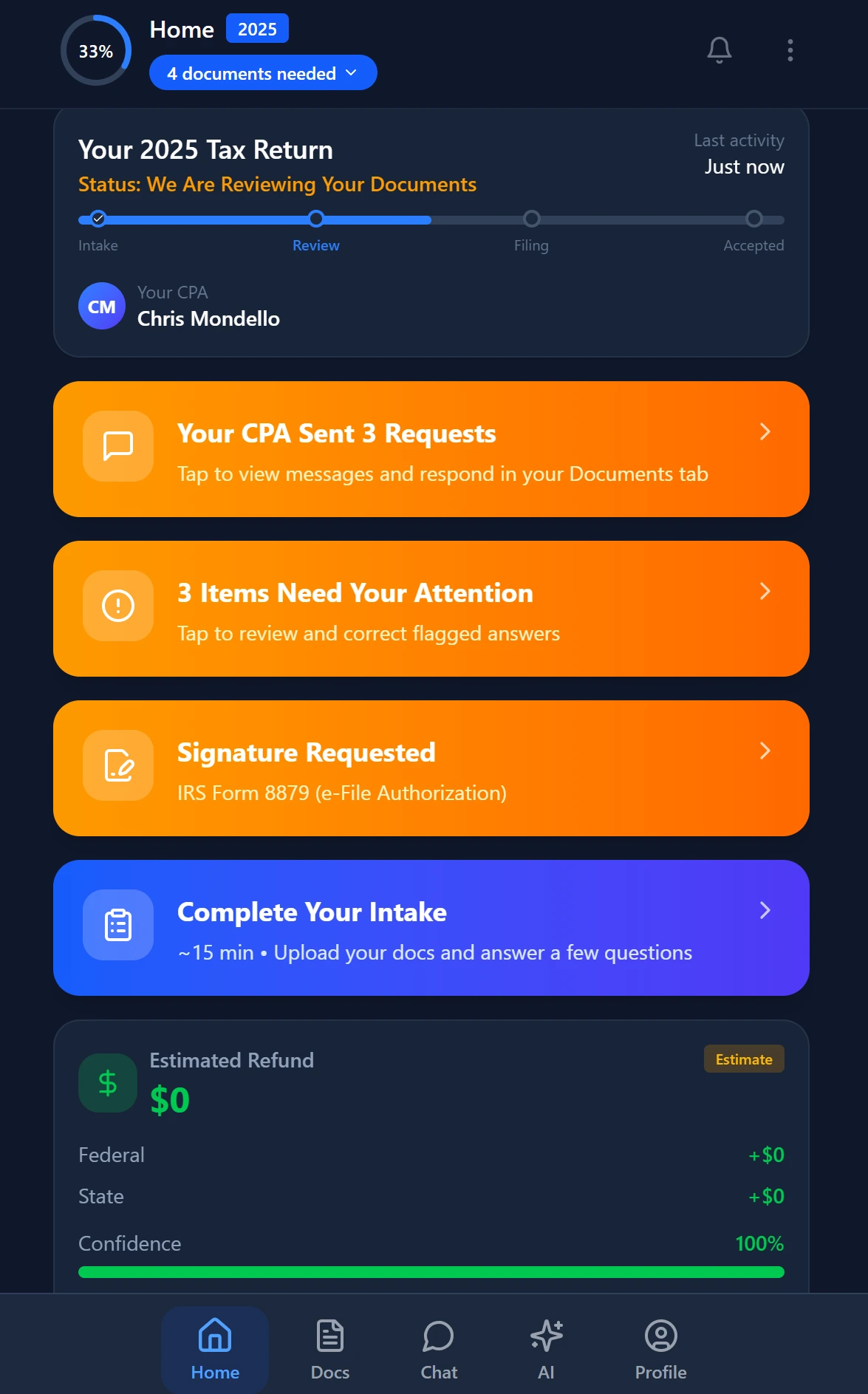
Smart intake auto-fills from uploaded documents and prior-year data
SOC 2 Type II Accounting Audit: Realistic Cost and Timeline
No competitor in the accounting software space has published an honest cost breakdown for small CPA firms pursuing their own SOC 2 Type II. Here is what the market actually looks like as of 2025-2026.
Readiness assessment (gap analysis): A licensed auditor or specialized SOC 2 consulting firm will review your current controls against the relevant Trust Service Criteria and produce a gap report. Cost range for a small-to-mid-size firm: $5,000–$15,000 depending on complexity. Timeline: 4–8 weeks.
Remediation and control implementation: This is the work you do internally — or with an IT security consultant — to close the gaps. Common items include formalizing access review procedures, deploying endpoint detection tools, implementing formal offboarding checklists, and documenting vendor management reviews. Cost varies widely: $10,000–$50,000+ depending on how much infrastructure work is needed. Timeline: 2–6 months.
Type I audit: Once controls are in place, a Type I engagement (snapshot review) typically costs $8,000–$20,000 for a small firm. Timeline from engagement to report: 6–10 weeks.
Type II observation period and audit: The auditor observes your controls in operation for a minimum of six months (most clients choose twelve months for credibility). The final Type II audit and report then runs $15,000–$40,000 for a small firm. Timeline from start of observation to final report: 8–14 months total.
All-in estimate for a small CPA firm pursuing Type II from scratch: $35,000–$100,000 over 12–18 months, including consultant fees, auditor fees, and internal time. Annual renewal audits are typically 40–60% of the initial cost. There are also emerging platforms that automate evidence collection and reduce auditor time — tools like Vanta, Drata, and Secureframe can lower total cost by 20–40% for firms with cloud-native infrastructure.
This investment is significant for a firm with under $2M in revenue. But for a firm targeting mid-market clients where a single retained engagement is worth $25,000–$75,000 per year, one closed deal attributable to the SOC 2 credential can justify the entire program. The calculus changes again if you use it to retain an existing anchor client who would otherwise move to a Big Four firm that already has the credential. When framed this way, SOC 2 compliance CPA becomes a revenue decision as much as a security one.
How to Communicate Data Security to Clients Without a SOC 2 Report
Even if your firm is not yet pursuing its own SOC 2 audit, you can build a credible, differentiated security narrative. The key is specificity. Vague claims ('we take security seriously') are worse than useless — they signal that you have not thought rigorously about the topic. Specific, verifiable claims build trust.
In your engagement letter: Add a brief data security disclosure section. State the platforms you use and confirm each holds a current SOC 2 Type II report. Name the encryption standards in use (AES-256 at rest, TLS 1.2+ in transit is the common baseline). Describe how client documents are stored and for how long. Reference your WISP and confirm it is reviewed annually. This takes one paragraph and immediately distinguishes your firm from competitors whose engagement letters say nothing about data handling. For best-practice engagement letter guidance, see the e-signatures and compliance guide.
On your website: Create a dedicated Security page (or a section on your About page). List your SOC 2-certified vendors, describe your WISP compliance, mention FTC Safeguards Rule adherence, and include a contact path for security questionnaires. If you have completed a readiness assessment, say so. Prospects researching your firm will find this — and the absence of any security information is itself a signal they will notice.
In pitch meetings: Prepare a one-page security summary document that covers: the platforms and their certifications, your WISP and review schedule, your incident response procedure, your employee security training cadence, and your multi-factor authentication policy. Hand this to HNW prospects and mid-market procurement contacts. Most competing CPA firms will not have this document, and its existence alone demonstrates operational maturity. Framing your SOC 2 compliance CPA narrative clearly in this document is often what tips a contested engagement in your favor.
TaxScout's client portal uses OTP login — no passwords that can be phished — and the platform's security architecture includes encryption at rest and in transit, role-based access controls, MFA enforcement, and data-subject deletion support. These are the kinds of platform-level credentials you can cite directly in client communications without needing your own audit.
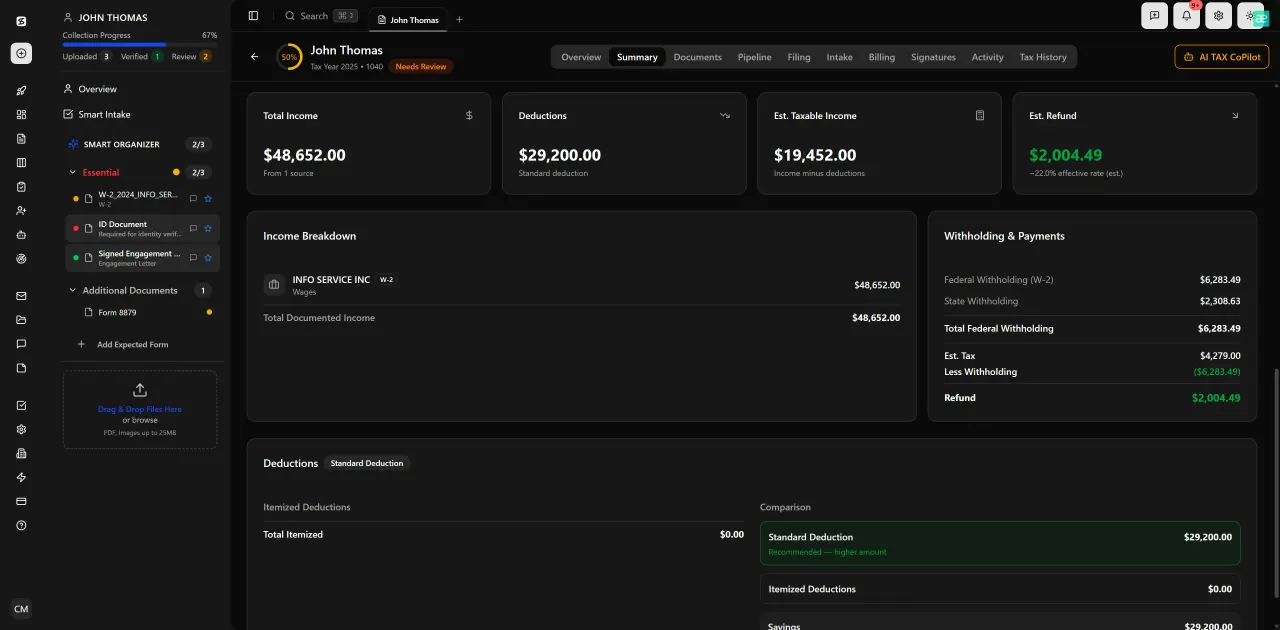
Review with AI assist — 9 agents answer questions with full client context
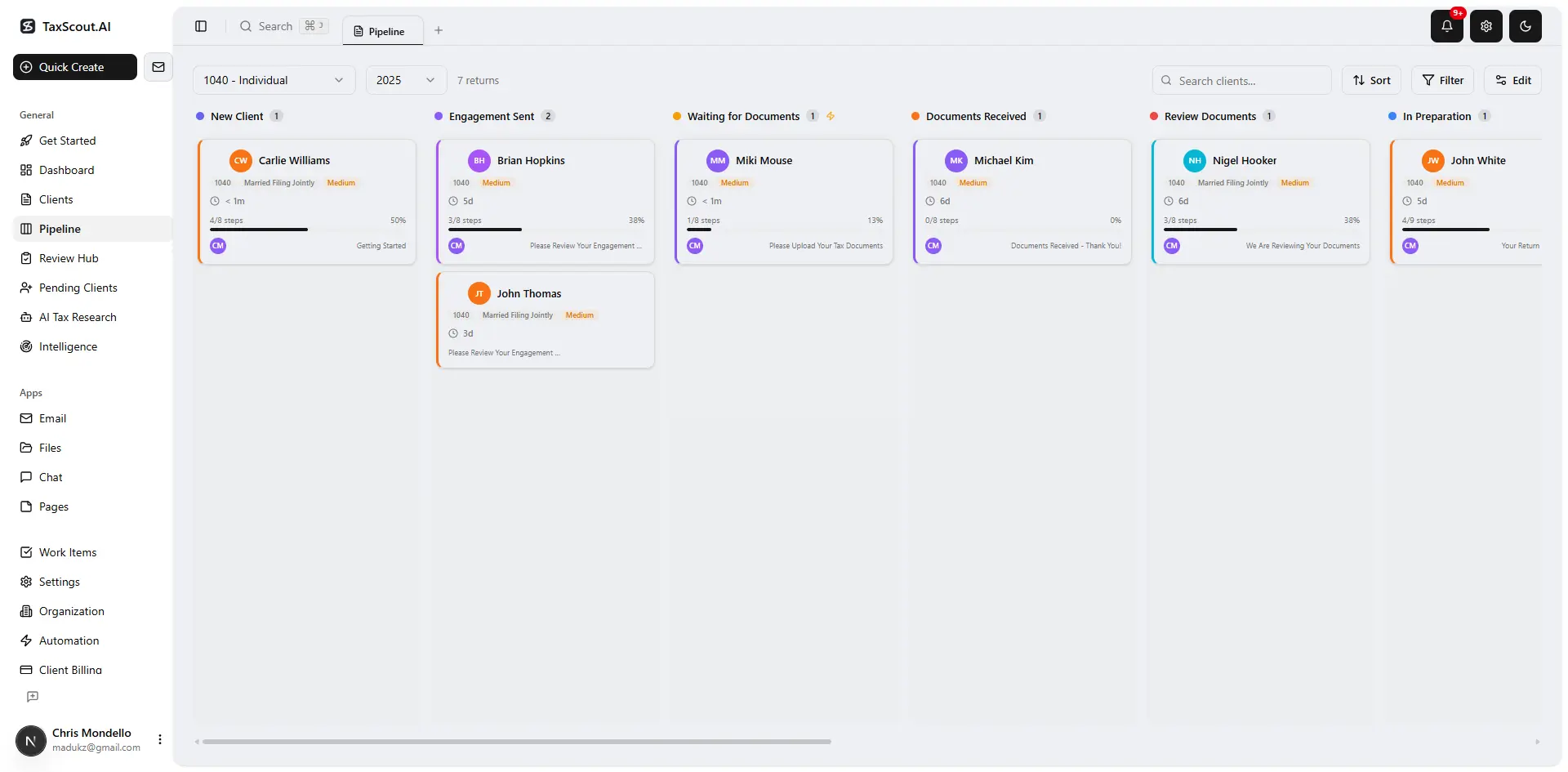
Track every return from intake to filed with drag-and-drop pipeline management
Using SOC 2 as a Competitive Differentiator with HNW and Mid-Market Clients
High-net-worth individuals and mid-market companies represent the highest-margin client segment for most CPA practices — and they are also the most likely to ask about data security. Family offices, in particular, often have a formal vendor due diligence process that mirrors what institutional investors apply to fund managers. A firm that cannot answer a 30-question security questionnaire with documented evidence is simply not a viable candidate for these engagements.
The competitive opportunity is real because most small and regional CPA firms have not made security a marketing pillar. According to the IRS Identity Theft Tax Refund Fraud Information Sharing and Analysis Center (ISAC), tax preparers are a primary target for credential theft and data exfiltration — yet most firms compete on price and turnaround speed rather than security assurance. Differentiating on a dimension where competitors are silent is one of the cleanest paths to premium positioning. This connects directly to the niche pricing strategy principle: demonstrable operational advantages command higher fees.
When pitching a mid-market manufacturing client who has a CFO and a general counsel reviewing your engagement proposal, the presence of a SOC 2 Type II report (or a credible readiness narrative backed by vendor reports) signals that your firm operates at an institutional level. It is a proxy for process maturity, professional rigor, and the kind of organized operation that will not misplace a schedule K-1 or expose their cap table to a breach. The document protection and audit trail that platforms like TaxScout provide — including file management with version control and PII masking — gives you concrete, demonstrable evidence to point to rather than vague assurances. For many firms, articulating their SOC 2 compliance CPA story clearly is the single most effective way to close competitive enterprise engagements.
A practical sequencing recommendation for growth-stage firms: first, audit your vendor stack for SOC 2 compliance and compile the reports; second, update your engagement letter and website with specific security disclosures; third, build the one-page security summary for prospect meetings; fourth, begin a SOC 2 readiness assessment if you have one or more anchor clients or target clients who require it. Each step builds on the last and each one alone improves your competitive position.
SOC 2 Compliance Posture: Pursuing Your Own Audit vs. Relying on Vendor Certifications
| Factor | Own SOC 2 Type II Audit | Vendor SOC 2 Reliance Strategy |
|---|---|---|
| Who holds the report | Your firm — issued by a licensed CPA auditor | Your software vendors (e.g., practice management, document storage) |
| Cost to your firm | $35,000–$100,000+ over 12–18 months | Time to compile and review vendor reports (no audit fees) |
| Timeline to completion | 12–18 months from readiness start | Weeks — gather current SOC 2 reports from vendors |
| Client audience | Mid-market procurement, family offices, institutional clients | Most individual filers, small businesses, standard SMB clients |
| Credibility level | Highest — independent third-party attestation of your own controls | Strong — third-party attestation of the platforms you use |
| WISP relationship | Validates and extends your existing WISP controls | WISP still required separately; vendor certs supplement it |
| IRS Pub 4557 alignment | Satisfies and exceeds all 4557 control requirements | Covers vendor risk component; your own WISP still required |
| Best for | Firms targeting mid-market, enterprise, or institutional clients | Solo practitioners and small firms serving individuals and SMBs |

Every client gets organized documents, status tracking, and a complete history
What to Look for in Your Vendors' SOC 2 Reports
Whether or not your firm pursues its own certification, every platform you use to store or process client data should hold a current SOC 2 Type II report. When you receive a vendor's SOC 2 report, here is what actually matters in the document — not just whether the report exists.
Report date and observation period: A SOC 2 Type II report covering a period that ended 18 months ago provides limited assurance. Look for reports with observation periods ending within the past 12 months. Annual renewal is the standard for credible vendors.
Scope of services and systems: Confirm that the specific service you use is in scope. Some vendors have SOC 2 reports that cover only their core infrastructure and explicitly exclude add-on modules. If you use a document management module that is out of scope, the report does not cover it.
Qualified opinions and exceptions: Read the auditor's opinion section. A 'qualified' opinion or exceptions noted in the report mean specific controls failed during the observation period. Exceptions are not automatically disqualifying — what matters is whether the vendor described a remediation plan and whether the exception affects services relevant to your client data.
Subservice organizations: SOC 2 reports frequently rely on subservice organizations (cloud hosting providers, etc.) using a 'carve-out' method. Understand whether the underlying infrastructure also has its own SOC 2 or ISO 27001 certification. AWS, Google Cloud, and Azure all publish current reports that satisfy this requirement for most vendors built on their platforms.
For a thorough look at building a compliant document management stack, see the document management guide for CPA firms, which covers vendor evaluation criteria alongside workflow considerations. The AI document extraction capabilities in TaxScout operate within the same security architecture that supports SOC 2-aligned vendor controls, giving you a consistent audit trail from intake through final return.
Want a practice management platform that takes data security as seriously as you do?
TaxScout.ai combines encryption, MFA, OTP client login, PII masking, and role-based access in one platform — plus AI-powered document processing and research agents — at a flat fee with no per-user pricing.
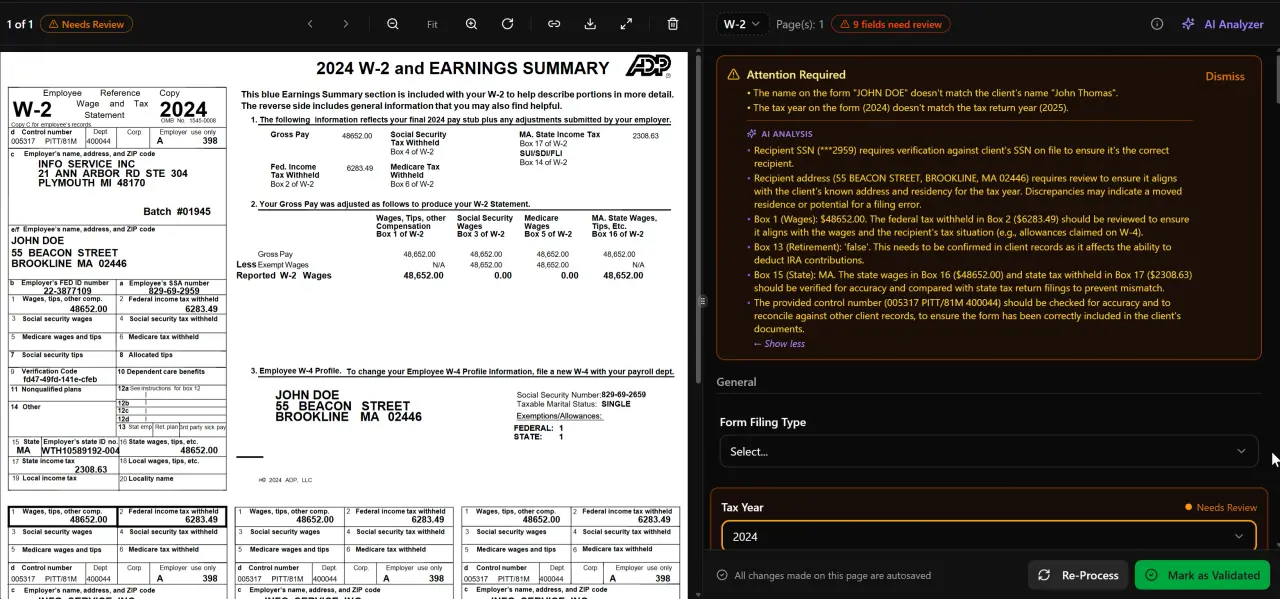
AI classifies, extracts, and validates every document automatically
Frequently Asked Questions
Most small and solo CPA firms can rely on their vendors' SOC 2 Type II reports combined with a current Written Information Security Plan (WISP) as required by IRS Publication 4557. Pursuing your own SOC 2 audit becomes necessary when you target mid-market, institutional, or HNW clients whose procurement processes require a SOC 2 report specifically for your firm as a service organization — not just your tools.
Keep reading
NACHA Phase 2 Compliance: What CPA Firms Managing ACH Payments Must Do Now
Jul 27, 2026 · 1 min read
Backdoor Roth IRA: How CPAs Execute the Strategy Without Triggering Pro-Rata Tax
Oct 12, 2026 · 1 min read
Amended FBAR Procedures: How CPAs Correct Foreign Account Errors Without Triggering Penalties
Oct 12, 2026 · 1 min read
Stay up to date
Get the latest tax tech insights delivered to your inbox.