S Corp Reasonable Compensation: How CPAs Set Defensible Salaries for Owner-Employees
Generic 'pay yourself a reasonable salary' advice doesn't protect your clients during an IRS examination. This guide walks CPAs through the exact benchmarking methodology, audit-weight factors, and file-memo workflow needed to defend every S corp reasonable compensation determination from day one.
S corp reasonable compensation is one of the most litigated and least-documented issues in small-business taxation. The IRS has published clear audit guidance, courts have handed down a consistent body of case law, and yet most CPA engagement files contain little more than a round-number salary and a vague note that it 'seemed appropriate.' When an examiner opens that file, there is almost nothing to defend. S corp reasonable compensation is one of the most litigated and least-documented issues in small-business taxation.
The underlying economics are powerful. An S corporation owner who pays herself $50,000 in W-2 wages instead of a market-rate $120,000 avoids roughly $10,780 in self-employment taxes annually — a saving that compounds every year. The IRS knows this, and Employment Tax examinations of S corporations have been a stated priority in every work plan the agency has published since 2017. Revenue Ruling 74-44 and the Tax Court's landmark decision in Watson v. Commissioner (2012) make the legal framework unambiguous: compensation must reflect what an arm's-length employer would pay for the services actually rendered. Understanding s corp reasonable compensation is critical here, because the IRS knows exactly how much owners save by suppressing W-2 wages below market rate.
This guide is not about whether your client should elect S corp status. It is about what you do after the election — specifically, how you set the salary, how you benchmark it against verifiable market data, and how you construct a file memo that can survive examination without you having to reconstruct your reasoning three years later. Getting s corp reasonable compensation right means knowing how to set the salary, benchmark it against verifiable market data, and build a file memo that survives examination.
Why the IRS Targets S Corp Reasonable Compensation
The tax incentive to underpay W-2 wages inside an S corporation is structural. Salary is subject to FICA (7.65% employee + 7.65% employer through $168,600 in 2024, then 1.45% each above that), while S corp distributions flow to shareholders without payroll tax. The IRS's own examination guidance on S corporation compensation identifies this arbitrage explicitly and instructs examiners to flag officer compensation that appears disproportionately low relative to distributions. For firms evaluating their s corp reasonable compensation approach, this trade-off compounds over time.
In Watson v. Commissioner, the Eighth Circuit affirmed that a CPA shareholder earning roughly $200,000 in net profit could not justify a $24,000 annual salary, and the court recharacterized $115,000 of distributions as wages. The resulting back FICA, penalties, and interest wiped out years of tax savings. The lesson is not to avoid the S corp structure — it is to price the salary correctly from the start and document why. Each of these factors directly shapes how s corp reasonable compensation plays out in practice.
IRS examiners use a multi-factor test drawn from the Treasury's employment tax regulations at 26 C.F.R. § 31.3121(d)-1-1) and decades of Tax Court opinions. Understanding those factors is the foundation of any defensible compensation determination. Understanding s corp reasonable compensation in this context is what separates firms that scale from those that stall.
For CPAs advising owner-employees, the recharacterization risk is compounded by the Section 199A deduction, which we cover in detail below. A salary that is too low understates the W-2 wages used in the wage-limitation calculation, potentially costing clients far more in lost QBI deductions than they save in payroll tax — a counterintuitive trap that very few articles address. This is precisely where a deliberate s corp reasonable compensation strategy pays off.
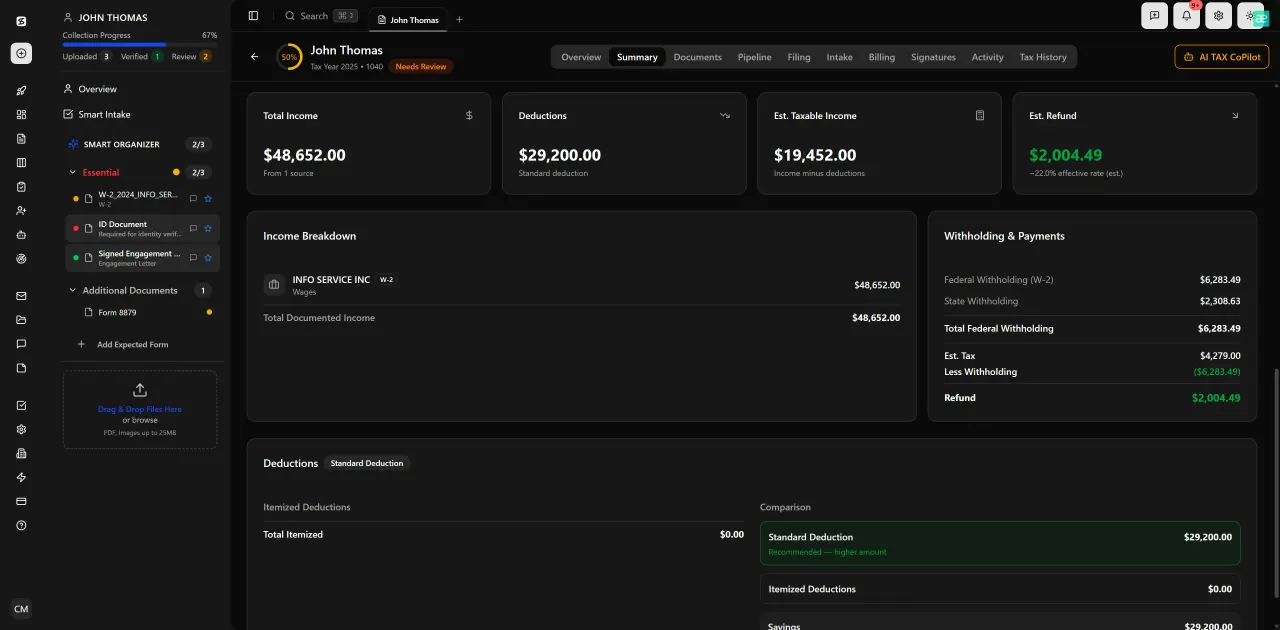
Review with AI assist — 9 agents answer questions with full client context
The IRS Multi-Factor Test for Reasonable Compensation
Tired of manual workflows slowing your firm down? See how TaxScout handles this with AI-powered automation. → Book a 15-Min Demo S corp reasonable compensation sits at the center of this decision — get it wrong and the rest unravels.
There is no statutory definition of 'reasonable compensation' — the standard is facts-and-circumstances. However, the IRS and the Tax Court have repeatedly applied a consistent list of factors that CPAs should evaluate and document for every owner-employee client. The IRS job aid for S corporation compensation examinations organizes these into three clusters. When firms revisit their s corp reasonable compensation priorities, the gaps usually surface here.
Services and Role Factors
The most heavily weighted factor is the nature and scope of the owner-employee's actual work: hours per week, specific duties, technical expertise required, and whether those services are the primary revenue driver of the business. A sole-practitioner dentist who performs all patient care is providing services that would cost $180,000–$250,000+ to replace with a hired associate. That replacement-cost benchmark anchors the compensation floor. By contrast, an S corp owner who primarily manages capital assets or passive income streams may have a much lower service-based compensation floor, though the analysis must still be documented.
Document the following in your memo: (1) a job description capturing actual duties, (2) weekly hours dedicated to the business, (3) any specialized credentials or licenses that command a premium in the marketplace, and (4) the percentage of gross revenue directly attributable to the owner's personal services versus other factors such as equipment, employees, or intellectual property.
Market and Industry Benchmarks
Examiners cross-reference owner salaries against data from the Bureau of Labor Statistics Occupational Employment and Wage Statistics program, which publishes median and percentile wage data by SOC code, industry, and geography. BLS data is free, highly defensible, and should be pulled and printed to the file every year you set or review the compensation level.
Beyond BLS, two commercial tools dominate practitioner practice: RCReports and BVR's Economic Research Institute (ERI). RCReports is purpose-built for S corporation reasonable compensation analysis and generates a narrative report mapping the owner's duties to wage data across multiple government and private databases. ERI's Salary Assessor provides industry-specific ranges with geographic cost-of-living adjustments. Either tool produces a professional output that can be attached to the engagement file and referenced directly in your memo. If your engagement cannot justify the cost of these tools, at minimum use BLS plus a comparable job posting analysis from a source like the SSA wage index to triangulate a range.
Print a dated PDF of every data source. Benchmarks change annually; the data you pulled in 2023 will not defend a 2025 compensation decision. Firms that treat s corp reasonable compensation as a one-time determination rather than an annual benchmark review are most exposed when an examiner requests documentation.
Financial Condition and Salary-to-Distribution Ratio
Examiners look at the relationship between total officer compensation and total S corp distributions. There is no safe-harbor ratio written into the Code, but practical experience suggests that salary below 30–35% of net income (before officer compensation) draws heightened scrutiny. The Tax Court's reasoning in Watson was partly driven by the 97% distribution / 3% salary pattern that was impossible to justify on any market-rate basis.
For planning purposes, compute the following metric each year: (Total W-2 officer wages) ÷ (Total officer W-2 wages + S corp distributions to officer). Document the result and your reasoning in the file. If that ratio is below 40%, make sure your market-rate analysis is especially strong, because the examiner will notice the number. When the ratio falls into this range, a well-supported s corp reasonable compensation memo becomes the primary line of defense.
Tired of rebuilding compensation memos from scratch every engagement season?
TaxScout.ai gives your firm AI research agents that search IRS guidance, Treasury regulations, and case law in real time — so your compensation analysis is grounded in current authority before you write a single sentence.
Using RCReports and BVR to Build a Benchmark Range
The practical workflow for benchmarking S corp reasonable compensation begins with a structured interview of the owner-employee. You need to capture: title and formal job description, industry NAICS code, geographic location (metro or rural, with state), hours worked per week, specific services rendered (sales, production, management, administration), any specialized degrees, certifications, or licenses, and years of relevant experience.
In RCReports, you enter this data and the tool generates a compensation range using multiple wage databases — BLS OES, OES Geographic, and proprietary survey data — weighted by the role breakdown you specify. The output is a PDF report with a stated median, 25th percentile, and 75th percentile figure. Your defensible salary determination should generally fall within that range, and your memo should explain whether you targeted the median, the 75th percentile, or a blended figure — and why.
BVR's ERI Salary Assessor operates similarly but includes additional private-sector survey data that can be valuable for executive or technical roles where BLS coverage is thin. For high-income professionals — physicians, attorneys, engineers — supplementing BLS data with specialty association salary surveys (many of which are publicly available through their respective professional societies) further strengthens the analysis.
One step most practitioners skip: compare the owner's salary to what the company actually pays non-owner employees in comparable roles, if any exist. Internal pay equity is an argument examiners can use against you if the owner's assistant earns $65,000 while the owner takes $40,000 in W-2 wages on $500,000 in distributions.
For firms that use workflow tooling to manage client engagements, the benchmarking step pairs naturally with a structured intake questionnaire sent to the client before preparation begins. TaxScout.ai's smart intake engine can pre-populate known entity data from prior returns and prompt the client for the specific role and hours information you need, reducing the back-and-forth that slows down advisory work on S corp clients.
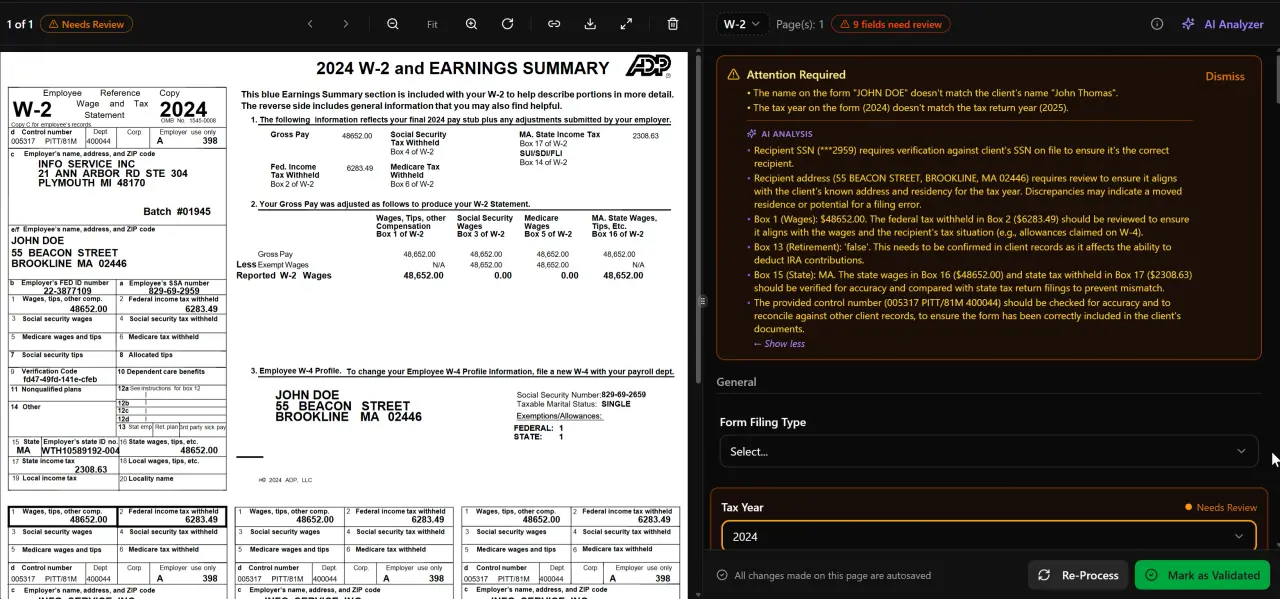
AI classifies, extracts, and validates every document automatically

Click any extracted field to see its source highlighted on the original PDF
The Section 199A Interaction Most CPAs Miss
The Section 199A qualified business income deduction creates a counterintuitive dynamic for S corp owner-employees who earn above the threshold amounts (approximately $383,900 MFJ and $191,950 single in 2024 before inflation adjustments). For these clients, the deduction is limited to the greater of: (a) 50% of W-2 wages paid by the S corporation, or (b) 25% of W-2 wages plus 2.5% of unadjusted basis of qualified property.
This means that an owner-employee who suppresses W-2 wages to reduce FICA exposure simultaneously reduces the wage limitation that determines the size of the Section 199A deduction. In many cases, the lost QBI deduction exceeds the FICA savings by a significant margin. For a client in the 32% bracket with $400,000 in S corp income, reducing wages from $120,000 to $60,000 saves roughly $9,180 in FICA — but may reduce the 199A deduction by $30,000, costing $9,600 in additional income tax at a 32% rate. The net result is a $420 net tax increase, not a saving. This is one of the most consequential reasons why s corp reasonable compensation must be modeled holistically, not optimized in isolation.
This interaction should be modeled in writing as part of every S corp compensation review for clients above the threshold amounts. The W-2 wage and UBIA limitation is a critical planning variable that cannot be optimized without first setting a defensible compensation number. Your compensation memo should reference this analysis explicitly so a future examiner can see that the salary was set with both FICA efficiency and 199A optimization in mind — not solely to minimize payroll taxes.
For a deeper look at year-round advisory planning for pass-through clients, see our article on Roth conversion strategy and year-end planning, which discusses how S corp income interacts with broader tax planning variables.
How to Write a Compensation Memo That Survives Examination
The file memo is where most practitioners fail. A compensation determination that took two hours to research is often summarized in one sentence: 'Reviewed salary; determined $95,000 is reasonable.' That sentence helps no one — not the client, not a reviewer, not an examiner, and not a successor practitioner three years later.
A defensible S corp compensation memo has six components: (1) a statement of the owner-employee's duties and hours, derived from a documented interview or questionnaire; (2) identification of the benchmark sources used and the date they were accessed; (3) the resulting compensation range from those sources, with the specific data pulled and attached; (4) the salary figure selected, with a clear statement of where it falls in the range and why (e.g., 'We selected the 55th percentile because the owner's 18 years of specialized experience and direct revenue-generation role justify a premium over the median'); (5) the current-year salary-to-distribution ratio and a comparison to the prior year; and (6) if applicable, the Section 199A wage-limitation analysis showing the modeled FICA savings versus QBI deduction impact. When each of these six elements is present, your s corp reasonable compensation determination is positioned to withstand examiner scrutiny without requiring you to reconstruct your reasoning after the fact.
This memo should be dated, signed by the responsible CPA, and attached to the engagement workpaper file before the return is filed. It should be refreshed annually — not copy-pasted from the prior year without review. Changes in business revenue, hours worked, industry conditions, or the owner's role must be reflected in updated benchmarks.
For firms building standardized workflows around complex advisory deliverables like this one, a consistent SOP structure is essential. See our guide on CPA firm standard operating procedures for a framework for templating and maintaining advisory work products like compensation memos across your practice.
Keep printed (PDF) copies of every benchmark source you cited. BLS wage tables are updated annually; if you are examined for a 2024 return in 2027, you need the 2024 BLS OES data, not the current-year file. Timestamp-anchored documentation is the difference between a memo that closes an exam quickly and one that opens a broader inquiry.
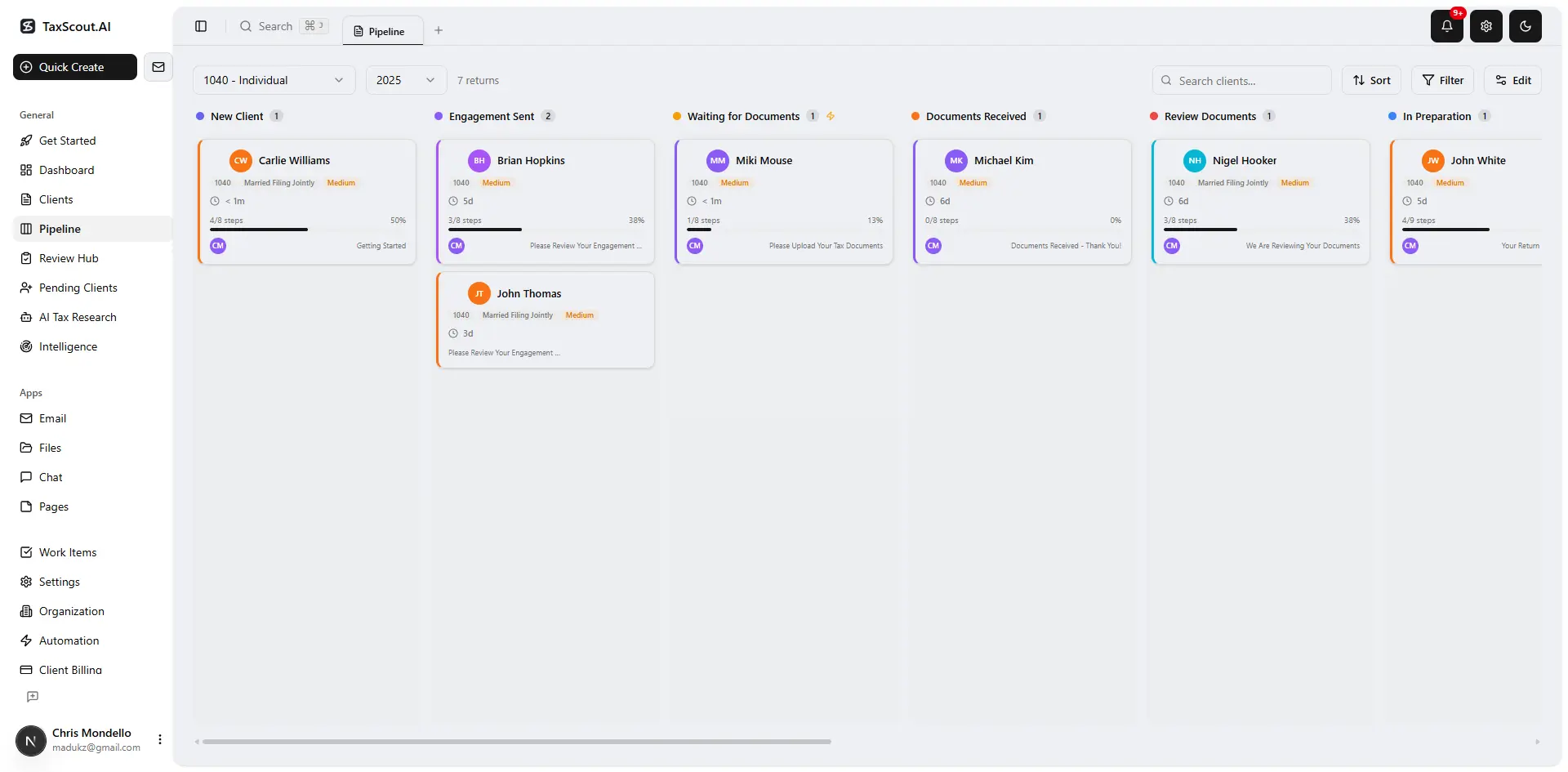
Track every return from intake to filed with drag-and-drop pipeline management

Every client gets organized documents, status tracking, and a complete history
Payroll Administration and Corporate Formalities That Support Your Position
An IRS examiner reviewing an S corp compensation issue will look beyond the memo to the payroll record itself. Common red flags that undermine an otherwise reasonable salary determination include: irregular payroll timing (paying a lump-sum W-2 in December rather than regular periodic payroll), misclassification of the owner's compensation as a shareholder loan or officer advance, failure to withhold and remit FICA on time, and salary amounts that are round numbers with no relationship to an identifiable benchmark.
Best practice is to run a regular payroll cycle — weekly, biweekly, or at minimum monthly — with proper withholding, timely Form 941 deposits, and a year-end W-2 that matches the payroll records. Corporate minutes or consent resolutions should authorize the officer compensation amount at the beginning of each calendar or fiscal year. This formality is standard in any well-governed entity, and its absence signals to an examiner that the compensation decision may have been driven by tax minimization rather than legitimate business reasoning.
Engagement letters for S corp clients should explicitly scope the annual compensation review as a professional service — both to manage expectations and to create a contemporaneous record that the determination was an active, reasoned professional judgment rather than a default. TaxScout.ai's e-signature workflow supports annual engagement letter renewal via Documenso, which means you can update the compensation review scope annually without friction.
For firms managing large rosters of pass-through clients, the pipeline management tools in TaxScout.ai make it possible to track compensation review status as a discrete stage in the S corp engagement workflow — ensuring nothing falls through the cracks during a busy filing season. You can find additional workflow resources and advisory content in other blog resources organized by practice topic.
Updating Compensation Annually and Communicating the Review to Clients
A compensation determination made in Year 1 of an S corp election that is never revisited is almost as risky as no determination at all. Revenue and profitability change. The owner's role evolves. Industry wage data shifts. A salary that was defensible at $85,000 in 2019 may be indefensible at the same amount in 2025 if the business has grown significantly and market rates have moved. Revisiting s corp reasonable compensation annually is not optional — it is the minimum standard required to keep the original determination defensible as the business evolves.
Build an annual compensation review into your S corp engagement timeline — ideally in Q4, when you can model the current-year numbers and adjust Q4 payroll before year-end if needed. The client communication around this review is itself a professional value-add: you are proactively managing their audit exposure and optimizing their 199A deduction, not just preparing a return. Frame it that way.
When communicating the review results to clients, a short written summary — one page is sufficient — that documents the benchmark range, the selected salary, and the key drivers of that decision is more useful than a verbal conversation. Clients understand their tax positions better when they see the reasoning, and that written summary becomes part of your file. For S corp clients with more complex structures, the analysis in our business valuation guide for CPAs may also be relevant, since the owner's compensation directly affects the normalizing adjustments used in any entity-level valuation.
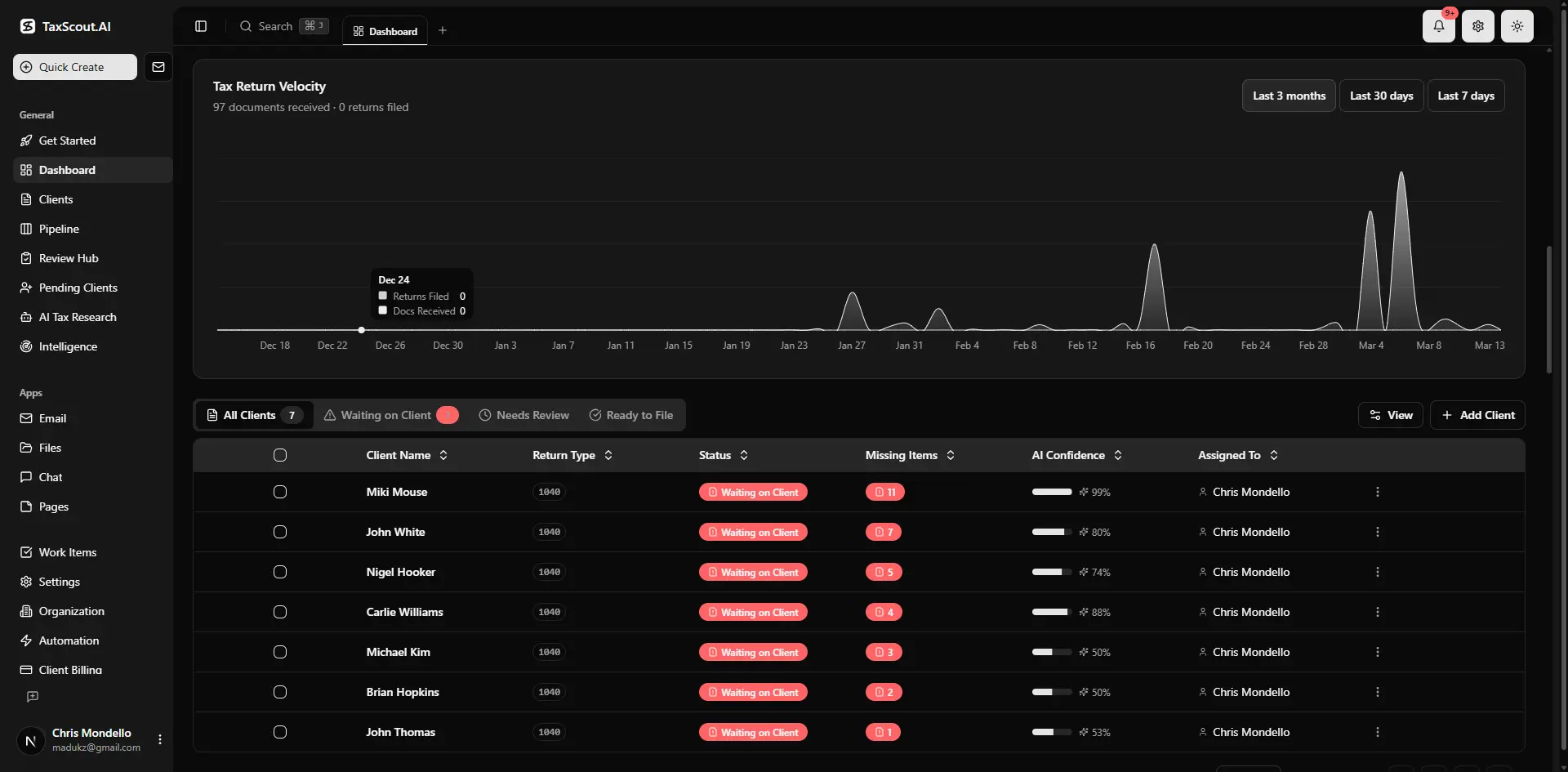
Real-time dashboard showing returns in progress, revenue, and upcoming deadlines
Key Documentation Elements: Minimum vs. Defensible S Corp Compensation File
| Documentation Element | Minimum (Common Practice) | Defensible (Examination-Ready) |
|---|---|---|
| Benchmark source | CPA's judgment or prior-year salary | BLS OES data + RCReports or ERI report, dated and printed to file |
| Owner duties documented | None or verbal | Written job description with hours/week and revenue attribution |
| Salary-to-distribution ratio | Not computed | Computed annually and compared to prior year in memo |
| Section 199A interaction | Not analyzed | FICA savings vs. QBI deduction impact modeled and documented |
| Payroll cadence | Lump-sum or irregular | Regular periodic payroll with timely 941 deposits |
| Corporate authorization | None | Annual minutes or consent resolution approving officer salary |
| Memo refresh frequency | Copy-pasted from prior year | Reviewed and updated annually with current benchmark data |
Want AI-powered research agents that pull current IRS guidance, Treasury regulations, and case law while you build compensation memos?
TaxScout.ai's 9 specialized AI research agents search IRS.gov, Treasury, Cornell Law, and more in real time — so every S corp advisory deliverable is grounded in current authority, not memory.
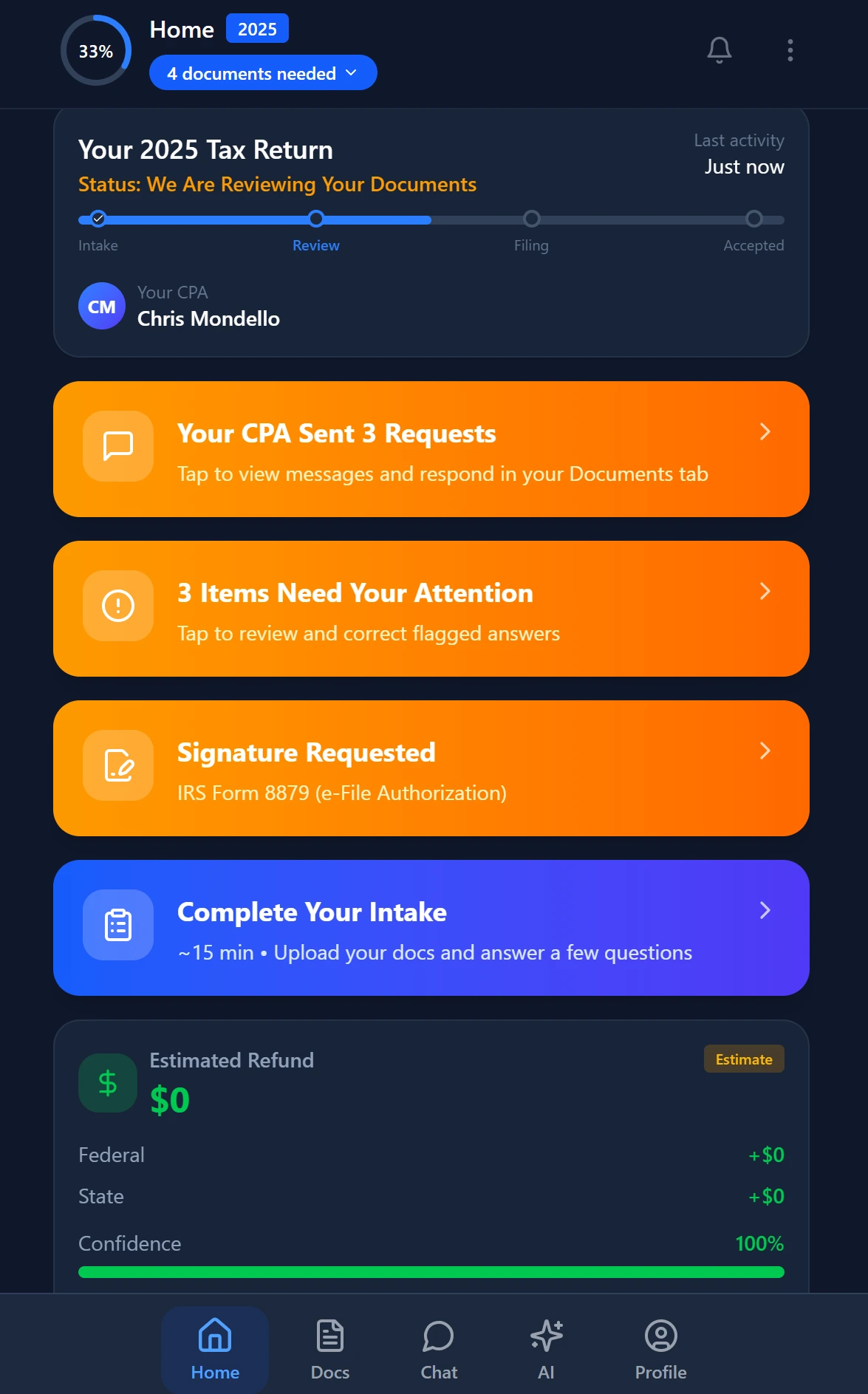
Smart intake auto-fills from uploaded documents and prior-year data
Frequently Asked Questions
The IRS applies a facts-and-circumstances test based on factors including the nature and extent of services rendered, comparable wages in the industry, the company's financial condition, and the salary-to-distribution ratio. There is no statutory safe harbor, but Revenue Ruling 74-44 and Tax Court decisions like Watson v. Commissioner establish that officer compensation must approximate what an arm's-length employer would pay for the same services. Examiners use BLS wage data and job-aid worksheets to evaluate whether reported wages are consistent with market rates.
Stay up to date
Get the latest tax tech insights delivered to your inbox.