Quarterly Publication of Individuals Who Have Chosen To Expatriate
The IRS published its fourth-quarter 2026 list of individuals who have chosen to expatriate in the Federal Register on October 30, 2026. CPA firms serving high-net-worth clients, green-card holders, and multinational families should audit their client lists now and confirm Form 8854 filings are on…
The IRS released the latest quarterly publication of individuals who have chosen to expatriate on October 30, 2026, publishing the list in the Federal Register (Doc. No. 2026-22229). The list names individuals who relinquished U.S. citizenship or terminated long-term resident status during the quarter — a statutory requirement under IRC § 6039G that has run continuously since the Health Insurance Portability and Accountability Act of 1996.
For most CPA firms, this quarterly publication is a background event. For firms serving high-net-worth clients, dual-citizen families, or clients with long-term green cards, it is an active compliance checkpoint. Appearance on the list does not itself create tax liability — but it confirms that the IRS is tracking the individual, and it starts a clock for advisors to verify that all exit-tax obligations under IRC §§ 877 and 877A have been addressed. The quarterly publication of individuals who have chosen to expatriate serves as a definitive trigger for firms to cross-reference their client rosters against confirmed expatriations.
This brief covers what the publication means operationally, which client segments are affected, which forms are in play, and what your firm should do before the end of the week. Understanding the quarterly publication of individuals who have chosen to expatriate is essential context before diving into the operational steps your firm needs to take.
What the Federal Register Publication Actually Says
The Federal Register notice is formulaic: it lists names (and sometimes last known addresses) of individuals who have notified the State Department or USCIS of expatriation during the preceding quarter. The Q4 2026 edition covers relinquishments and long-term resident terminations reported in the relevant quarter of 2026. The quarterly publication of individuals who have chosen to expatriate draws directly from State Department and USCIS records, making it the most authoritative source for confirming a client's expatriation date.
Critically, the list is not a finding of tax liability. It is a public record that satisfies the notice requirement under IRC § 6039G(d) — which requires the Secretary of the Treasury to publish the names in the Federal Register. The IRS is separately notified when a covered expatriate files Form 8854 (Initial and Annual Expatriation Statement) or when the exit tax under § 877A is triggered. For firms evaluating their quarterly publication of individuals who have chosen to expatriate approach, this trade-off compounds over time.
The priority signal for this publication is low for most general practices. It rises to medium-high the moment a name on the list matches a client in your system — or when you have a client who has recently relinquished but whose name you do not yet see, because the next quarterly list may catch up. Each of these factors directly shapes how quarterly publication of individuals who have chosen to expatriate plays out in practice.
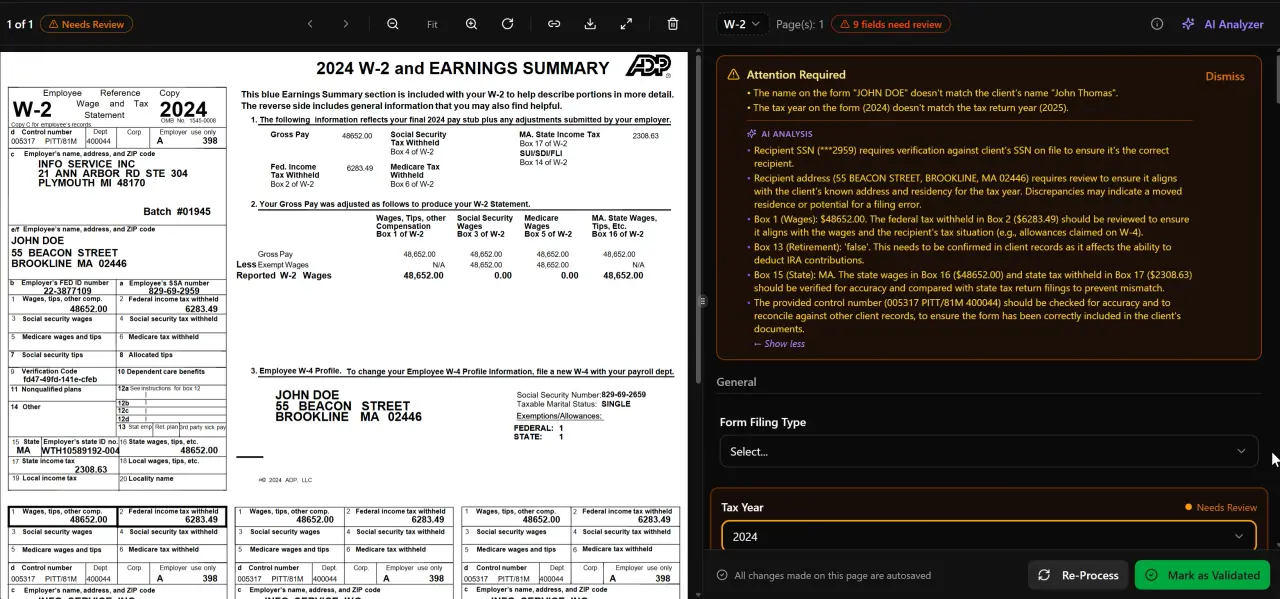
AI classifies, extracts, and validates every document automatically
Which Client Segments and Filing Types Are Affected
Tired of manual workflows slowing your firm down? See how TaxScout handles this with AI-powered automation. → Book a 15-Min Demo Understanding quarterly publication of individuals who have chosen to expatriate in this context is what separates firms that scale from those that stall.
The expatriation rules and this publication are squarely focused on individual filers — specifically, former U.S. citizens and long-term residents (green-card holders who held lawful permanent resident status in at least 8 of the prior 15 tax years). The affected filing types are: This is precisely where a deliberate quarterly publication of individuals who have chosen to expatriate strategy pays off.
Form 1040 / dual-status returns. In the year of expatriation, the individual files a dual-status return (part-year resident, part-year nonresident). The IRS dual-status alien guidance applies. The final Form 1040 covers the resident period; a Form 1040-NR covers the nonresident period. Both are due on the normal April 15 deadline unless extended. Quarterly publication of individuals who have chosen to expatriate sits at the center of this decision — get it wrong and the rest unravels.
Form 8854. Every long-term resident and every citizen who expatriates must file Form 8854 in the year of expatriation and, if subject to the mark-to-market exit tax under § 877A, potentially in subsequent years. Failure to file a complete Form 8854 triggers an automatic $10,000 penalty under IRC § 6039G(c). This is the highest-stakes compliance item your firm must confirm.
FBAR and FinCEN Form 114. If the client held foreign financial accounts during the period of U.S. tax residency, FBAR obligations remain for the resident portion of the year. See our guide to amended FBAR procedures for correcting prior-year omissions if the client is coming to you late.
S-corps and partnerships. The expatriating individual is typically not directly an S-corp or partnership filer in the exit-tax context — but if they held an interest in a pass-through entity at the date of expatriation, that interest is deemed sold at fair market value on the day before the expatriation date under § 877A(a). This triggers gain or loss at the entity level that flows to the individual's Form 8854 mark-to-market schedule. Firms with clients who hold S-corp or partnership interests must coordinate the exit-tax valuation with the entity's own Schedule K-1 reporting. Our partnership guaranteed payments guide addresses how pass-through income is characterized — the same character rules apply when the deemed-sale gain flows to Form 8854.
Nonprofits and trusts. If the covered expatriate is a beneficiary of a domestic non-grantor trust, the trust faces a 30% withholding obligation on distributions to the covered expatriate under IRC § 877A(f). The trustee — not the expatriate — bears the withholding and reporting duty. If any of your nonprofit or trust clients make distributions to individuals, confirm beneficiary status against the expatriate list.
Managing expatriate filings across disconnected email threads and spreadsheets?
TaxScout.ai centralizes client documents, tracks filing status, and flags cross-document issues — all in one platform built for CPA firms.
Covered Expatriate Thresholds to Apply This Week
Not every expatriate is a "covered expatriate" subject to the § 877A exit tax. An individual is covered if any one of three tests is met at the time of expatriation: (1) average annual net income tax liability for the five preceding years exceeds the inflation-adjusted threshold (confirm the current-year figure on IRS.gov), (2) net worth is $2 million or more on the date of expatriation, or (3) the individual failed to certify five-year tax compliance on Form 8854.
The third test is particularly dangerous — it catches otherwise non-covered expatriates who simply forgot to attach a certification to Form 8854. Flag every expatriation engagement for this certification requirement before the return is finalized.
Two exceptions exist for dual-citizens who have been taxed as residents of another country since birth and for certain individuals who expatriated before age 18½ — but these must be affirmatively documented and attached to Form 8854, not assumed.
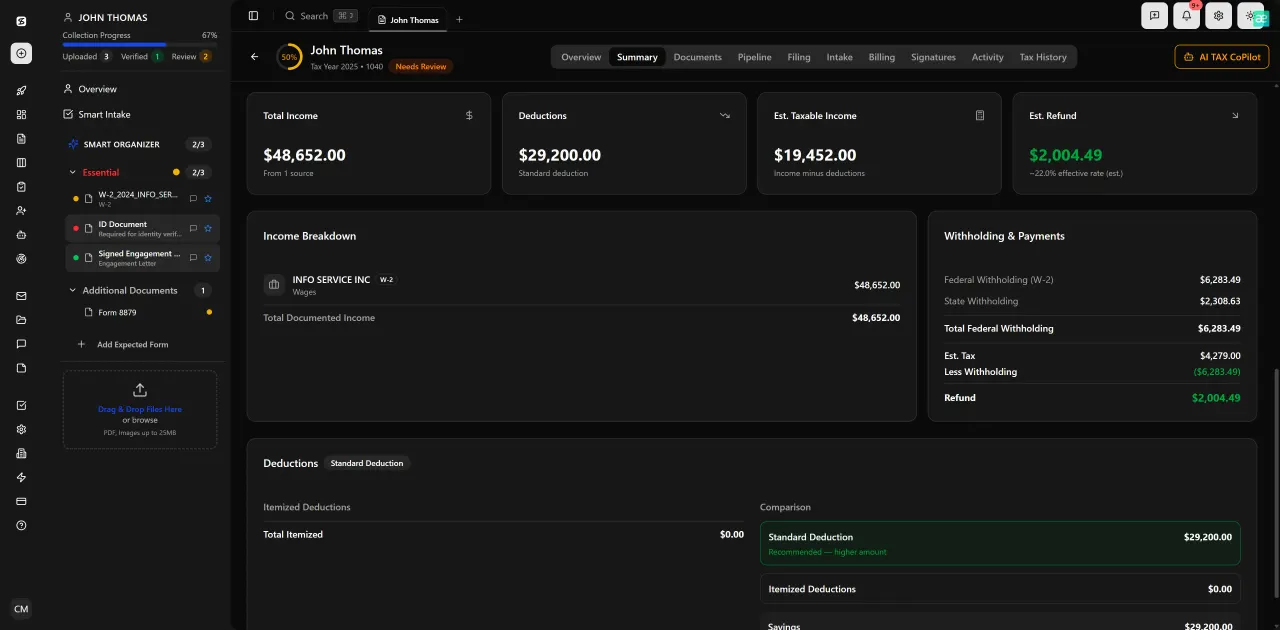
Review with AI assist — 9 agents answer questions with full client context

Click any extracted field to see its source highlighted on the original PDF
What to Do This Week: A Firm Action List
The following steps are appropriate for any CPA firm regardless of firm size. Prioritize based on client volume and specialization.
1. Cross-reference your client list against the Federal Register publication. Pull the full text of the Q4 2026 expatriate list and search for client names. Do this in your practice management system — if you use TaxScout's client management tools, a quick name search across all active and archived clients takes under two minutes.
2. Identify open or upcoming expatriation engagements. For any client who has expatriated in 2026 and is not yet on the list, add a note that they may appear in a future quarter. Confirm their Form 8854 is in the pipeline.
3. Verify Form 8854 status for every matched client. Confirm that (a) the form has been prepared, (b) the five-year certification is included, and (c) any mark-to-market gain calculation has been reconciled with Schedule K-1s from pass-through entities.
4. Check FBAR obligations for the resident period. If the expatriation occurred mid-year and the client held foreign accounts, FinCEN Form 114 is due on April 15 with an automatic extension to October 15. Do not let this fall through the cracks during tax season.
5. Notify trust and S-corp clients with covered-expatriate beneficiaries or shareholders. The 30% withholding and deemed-sale rules require coordination before any distributions are made. Engage the trustee or entity manager now, not at year-end.
6. Document the review. Whatever you find — or do not find — document that your firm reviewed this publication for the quarter. Professional liability risk rises when the record shows no awareness of publicly available IRS notices. For other IRS compliance news updates and analysis, bookmark TaxScout's news feed for future publications.
For firms that handle amended returns related to prior-year expatriation errors, the late filing penalty relief guide covers the available IRS first-time abatement and reasonable-cause arguments that apply to the Form 8854 $10,000 penalty.
Document Management and Research Tools for Expatriation Work
Expatriation engagements are document-intensive: dual-status returns, Form 8854, entity K-1s, FBAR filings, prior-year returns for the five-year income average, and foreign tax records. Managing these across email and a shared drive creates version-control risk and missed items.
TaxScout's AI document extraction processes W-2s, 1099s, K-1s, and 1040 schedules automatically, and the split-screen PDF viewer lets you cross-reference source documents against extracted fields without switching windows. For the research component — § 877A thresholds, treaty tie-breaker rules, foreign tax credit coordination — the AI research agents run real-time searches across IRS.gov, Treasury, Cornell Law, and congressional sources so you can pull current figures without leaving the client file.
Engagement letters for expatriation work should explicitly scope the Form 8854 preparation, the FBAR period, and any entity-level deemed-sale calculations to avoid scope-creep disputes. TaxScout's e-signature workflow supports engagement letters natively via Documenso, so you can get a signed scope document back before the work begins.
Want a practice management platform that keeps expatriate and international filings organized without per-user fees?
TaxScout Firm is $149/month flat — unlimited team members, all 9 AI Research Agents, and a full PDF toolbox built for complex engagements.
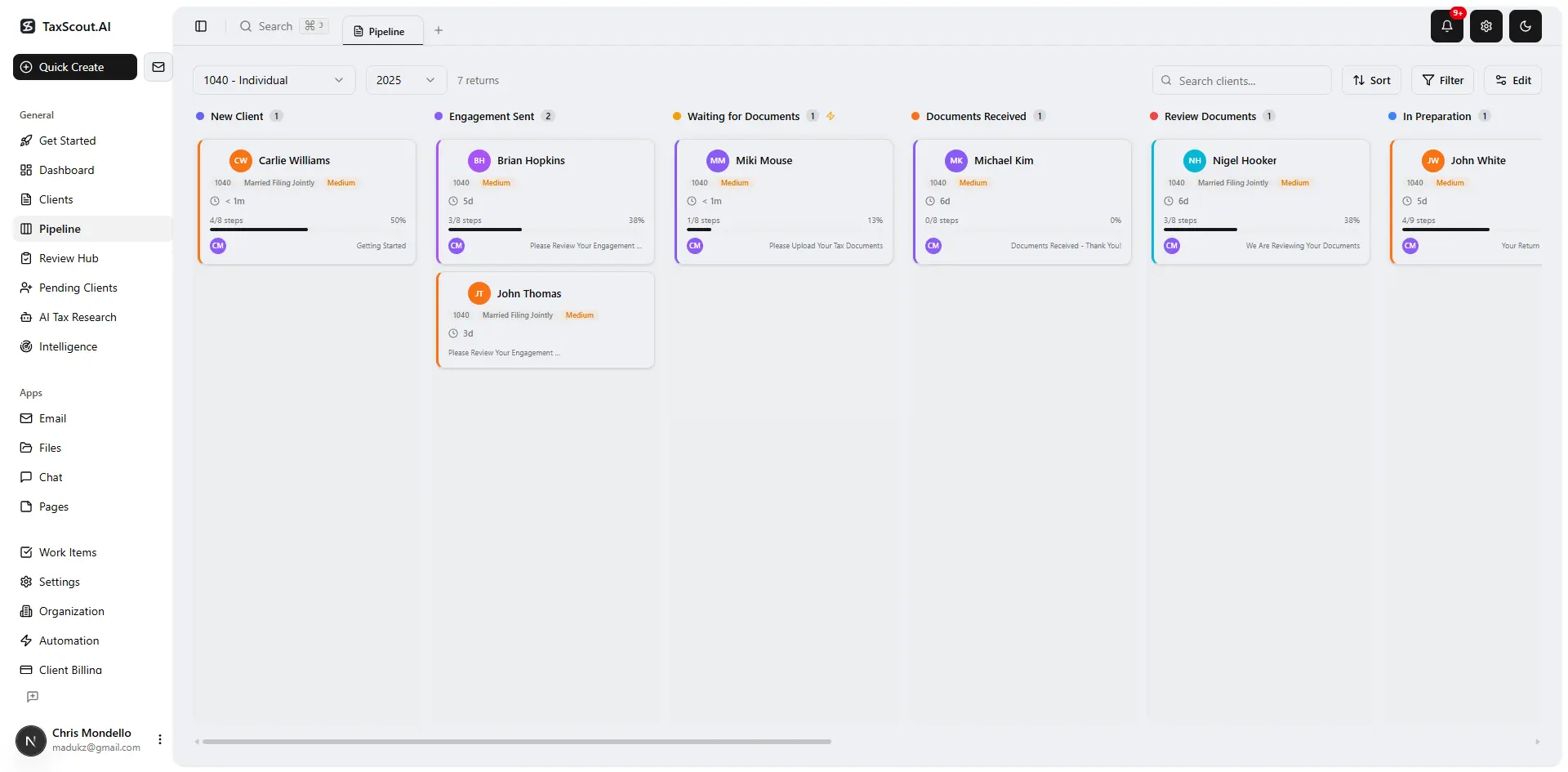
Track every return from intake to filed with drag-and-drop pipeline management
Frequently Asked Questions
It is a Federal Register notice published each quarter by the IRS that lists the names of individuals who have relinquished U.S. citizenship or terminated long-term resident (green-card) status during the preceding quarter. The publication satisfies the statutory requirement under IRC § 6039G(d). Appearance on the list does not by itself create tax liability — it signals that the IRS has been notified of the expatriation and that Form 8854 and any applicable exit-tax obligations should be confirmed.
Keep reading
Stay up to date
Get the latest tax tech insights delivered to your inbox.