Clergy Tax Returns: How CPAs Handle Minister Housing Allowances and Self-Employment
Clergy tax returns sit at the intersection of employment law, IRS code, and church governance — a combination that trips up even experienced CPAs. This guide walks through minister dual tax status, the Section 107 housing allowance exclusion, self-employment tax obligations, voluntary withholding…
Clergy tax returns are among the most technically demanding returns a CPA firm can encounter. A minister can be simultaneously an employee for federal income tax purposes and self-employed for FICA purposes — a dual status that exists nowhere else in the tax code and that creates a cascade of downstream decisions on every form you touch. Get it wrong and your client faces an unexpected self-employment tax bill, a penalty notice for under-withholding, or a housing allowance exclusion that the IRS claws back on audit.
The Section 107 housing allowance exclusion adds another layer. It is one of the most valuable tax benefits available to any individual taxpayer, but it depends on advance designation by the governing body of the church, proper documentation of actual housing expenses, and strict limits tied to fair rental value. Most CPAs who encounter a minister client for the first time spend hours in ad-hoc research before they can even begin the return. That is a workflow problem as much as a technical problem. Understanding this exclusion is central to preparing accurate clergy tax returns, since an improperly designated or undocumented allowance can result in unexpected taxable income for the minister.
This guide is written for the CPA, not the minister. It covers the legal framework, the Form 1040 and Schedule SE mechanics, the W-2 reporting conventions churches use (and misuse), voluntary withholding agreements, and how to build a repeatable annual engagement so that your second, fifth, and fifteenth minister client take no more time than a standard Schedule C client. Clergy tax returns sit at a unique intersection of tax law and religious organization rules, which is why CPAs who specialize in this area provide outsized value to their minister clients.
Minister Dual Tax Status: Employee for Income Tax, Self-Employed for FICA
The foundational rule for clergy tax returns is that most ministers are treated as employees of their church for federal income tax purposes but as self-employed individuals for self-employment tax (Social Security and Medicare) purposes. This is not elective — it is the default under IRC § 3121(b)(8) and has been consistently upheld in Tax Court. The church does not withhold FICA taxes, does not pay the employer half, and does not issue a W-2 with boxes 4 or 6 populated.
The practical consequences are significant. The minister receives a W-2 from the church showing wages in Box 1 (and often Box 14 for the housing allowance designation), but no Social Security or Medicare withholding. When you prepare the return, Schedule SE is required on all ministerial net earnings from self-employment — including the housing allowance that was excluded from income tax. That is the trap that surprises most ministers: the housing allowance reduces income tax but not self-employment tax. The SE tax base is wages plus the excluded housing allowance, subject only to the standard 92.35% net earnings adjustment. These reporting quirks are among the most common sources of errors in clergy tax returns, particularly when the preparing CPA is unfamiliar with dual-status taxation.
A minister can apply for an exemption from self-employment tax on religious grounds using Form 4361, but the bar is high — the exemption requires a sincere religious objection to public insurance, not simply a desire to avoid the tax. Once granted, it is irrevocable. For most of your clients, Schedule SE will apply every year, and quarterly estimated tax payments are the norm since FICA withholding does not exist for ministerial income. For firms evaluating their clergy tax returns approach, this trade-off compounds over time.

Click any extracted field to see its source highlighted on the original PDF
Section 107 Housing Allowance: Rules, Limits, and Documentation
The Section 107 housing allowance exclusion permits a minister to exclude from gross income (for income tax purposes only) amounts paid as a housing allowance to the extent the allowance is: (1) designated in advance by the church's governing body, (2) actually used to pay housing expenses, and (3) does not exceed the fair rental value of the home furnished and equipped, plus utilities. All three tests must be met simultaneously, and the most restrictive of the three governs the allowable exclusion. Each of these factors directly shapes how clergy tax returns plays out in practice.
The advance designation requirement is the one most frequently botched. The church board or governing body must formally designate the housing allowance — by resolution, in the employment agreement, or in a budget line item — before the calendar year begins (or before the minister begins employment, if mid-year). A retroactive designation is invalid. As the CPA, your intake process for any new minister client should include requesting the board resolution or equivalent documentation for the current and prior years. Undocumented or retroactively designated allowances are disallowed in full on audit. Understanding clergy tax returns in this context is what separates firms that scale from those that stall.
Calculating the allowable exclusion requires comparing three figures: the designated amount, actual expenses (mortgage principal and interest, rent, utilities, repairs, furnishings, property taxes, insurance), and fair rental value of the home fully furnished plus utilities. The IRS has litigated fair rental value extensively, and courts have required ministers to document comparable rentals in their market. In practice, you should ask clients to estimate fair rental value annually using local market data and keep a contemporaneous worksheet. The exclusion cannot exceed the lesser of the three figures, and any excess is includable in Box 1 income. This is precisely where a deliberate clergy tax returns strategy pays off — firms that build documentation checkpoints into their intake process catch these discrepancies before they become audit exposure.
Tired of starting from scratch every time a minister client walks in the door? Clergy tax returns sits at the center of this decision — get it wrong and the rest unravels.
TaxScout.ai gives your firm a customizable 12-stage pipeline, AI-powered document extraction for W-2s and supporting records, and client-context memory that retains prior-year housing designations — so clergy engagements run like clockwork. When firms revisit their clergy tax returns priorities, the gaps usually surface here.
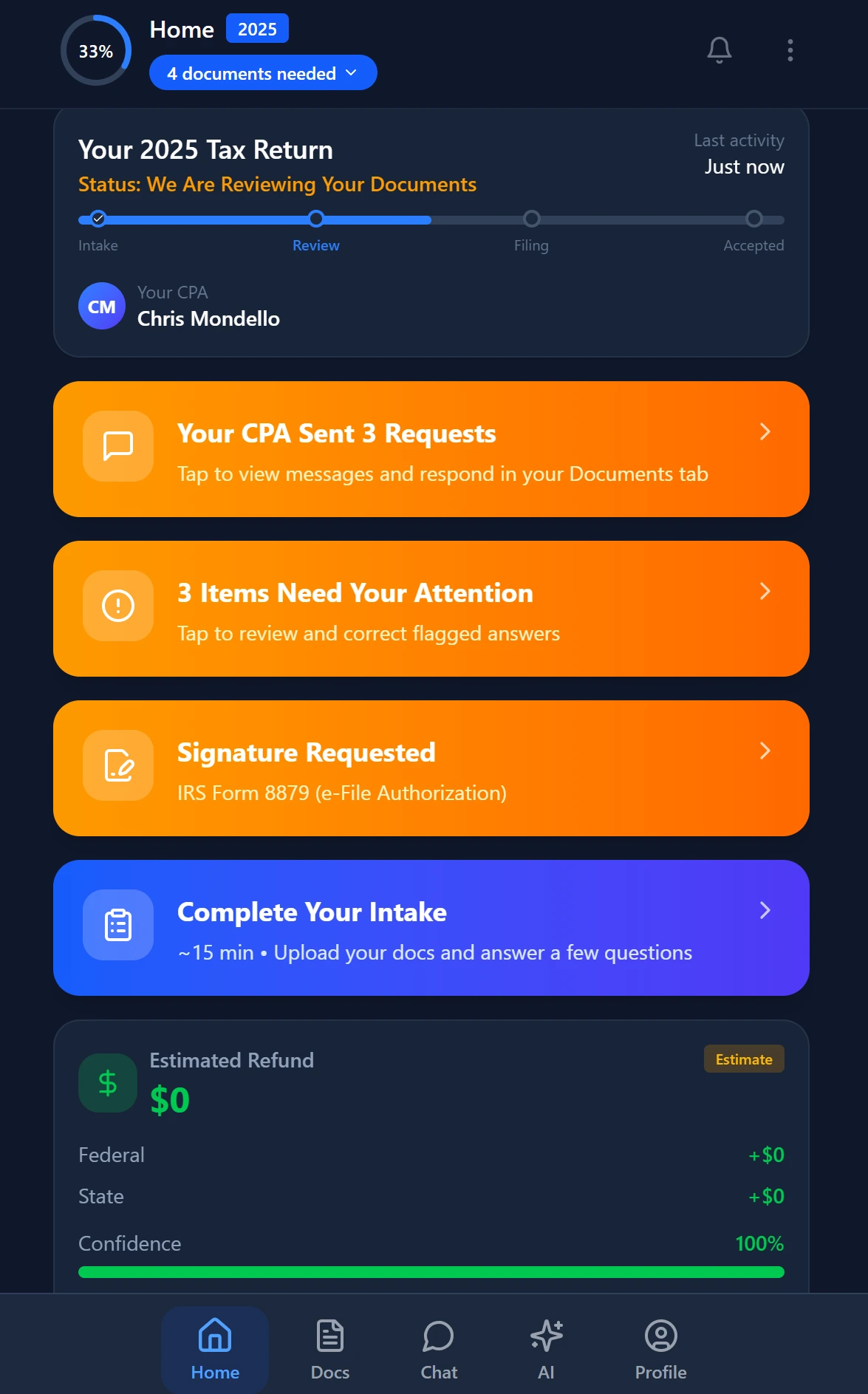
Smart intake auto-fills from uploaded documents and prior-year data
Clergy W-2 Reporting: What Churches Get Wrong and How to Fix It
Churches frequently issue incorrect W-2s for their ministers, and it falls on the CPA to identify and address the errors before filing. The most common mistake is including Social Security and Medicare withholding in Boxes 4 and 6 as if the minister were a regular employee. If a church has been withholding FICA in error, the minister has been overpaying — and the church has been over-remitting. The correction requires a W-2c and coordination with the church's payroll process. Catching these errors early is one reason that CPAs who regularly handle clergy tax returns develop a W-2 review checklist specific to ministerial compensation.
A second common error is omitting the housing allowance from Box 14. While Box 14 reporting of the housing allowance is technically informational (it is not required by the IRS), best practice is to have the church report the designated allowance there so the minister and CPA have a clear paper trail. When Box 14 is blank, you must reconstruct the designation from the board resolution. Without that documentation, the exclusion is at risk.
Box 1 should reflect only taxable wages — that is, total compensation minus the housing allowance actually excluded. If the church incorrectly includes the housing allowance in Box 1, the minister will appear to owe income tax on it. Conversely, if the church excludes more than the allowable amount, Box 1 will be understated. Reconciling the W-2 against the board resolution and actual expense worksheet is a required step in every clergy return, not an optional one. For a broader look at how AI tools now handle W-2 extraction and cross-document reconciliation, see our guide to AI document extraction for CPAs.
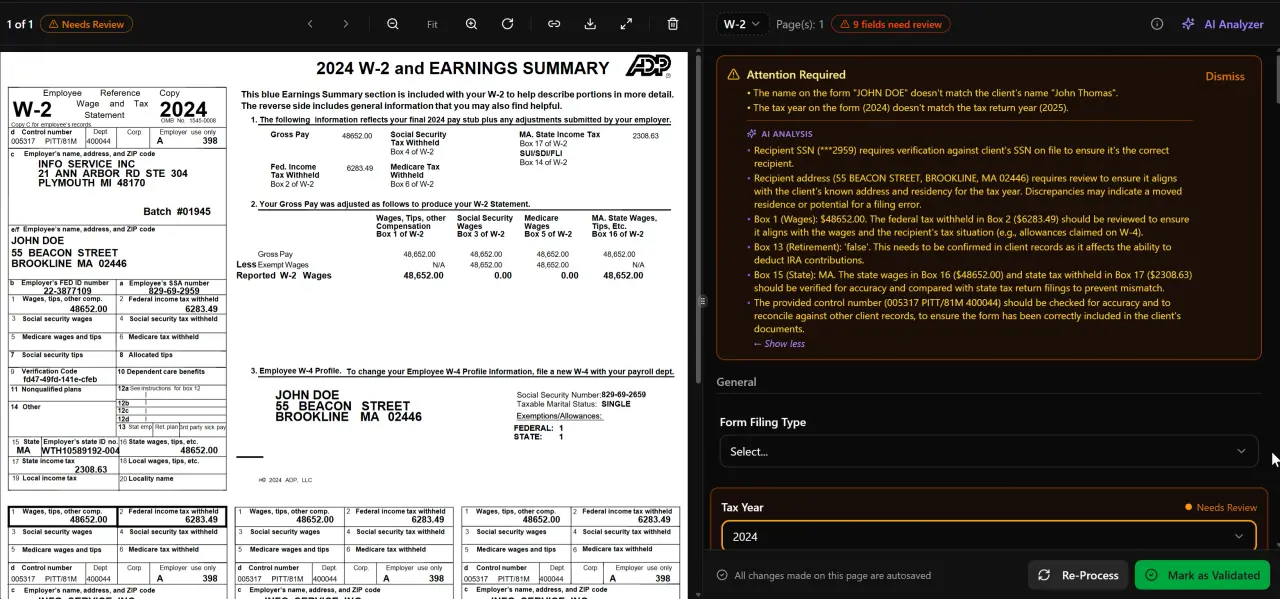
AI classifies, extracts, and validates every document automatically
Voluntary Withholding Agreements Between Ministers and Churches
Because churches are not required to withhold FICA from ministerial wages, many ministers face large estimated tax balances if they do not plan proactively. One underused but practical solution is a voluntary withholding agreement, sometimes called an income tax withholding agreement, entered into between the minister and the church under IRC § 3402(p). Under such an agreement, the church withholds additional federal income tax from the minister's wages — amounts large enough to cover both the income tax liability and the self-employment tax obligation.
The mechanics are straightforward: the minister submits a W-4 with an additional withholding amount in Step 4(c) that is calibrated to cover the projected SE tax. You as the CPA should calculate the additional withholding needed at the start of each year, factor in any housing allowance exclusion (which reduces income tax but not SE tax), and provide the minister with an updated W-4 to submit to the church. This eliminates the need for quarterly estimated payments and reduces the risk of the underpayment penalty. For CPAs who regularly prepare clergy tax returns, building this calculation into the annual engagement workflow ensures it happens consistently rather than only when a client asks.
Not every church administrator understands this arrangement, so your engagement workflow should include a one-page instruction memo to the church contact explaining the W-4 submission and the church's obligation to remit the additional withholding to the IRS. This is a value-added service that ministers rarely receive from other preparers and one that significantly differentiates your practice in the religious organization niche — a point worth reinforcing in your niche pricing strategy.

Every client gets organized documents, status tracking, and a complete history
Schedule SE Pitfalls and Estimated Payments for Ministers
The Schedule SE calculation for ministers has several nuances that differ from a standard Schedule C filer. Ministerial net earnings from self-employment include all compensation for ministerial services — wages, fees for weddings and funerals, honoraria — plus the excluded housing allowance. Non-ministerial income (such as secular employment outside the church) is subject to normal FICA withholding and does not appear on Schedule SE. Mixing the two is a common error.
Ministers who also receive income from speaking, writing books, or officiating services outside their primary church employment may be conducting a separate trade or business. Each activity must be analyzed independently to determine whether it constitutes ministerial services (SE tax applies under the special clergy rules) or secular self-employment (Schedule C applies with normal SE treatment). The distinction matters because some deductions and loss netting rules apply differently.
For quarterly estimated payments, the IRS safe harbor rules apply to ministers just as to other taxpayers. A minister who did not owe tax in the prior year is protected by the 100% prior-year safe harbor (110% if AGI exceeds $150,000). For new minister clients, building an estimated payment schedule in the first engagement and auto-scheduling reminders for estimated quarterly payments is essential practice hygiene. These planning steps are also a natural conversation starter for explaining why clergy tax returns require more proactive attention than a standard W-2 employee filing.
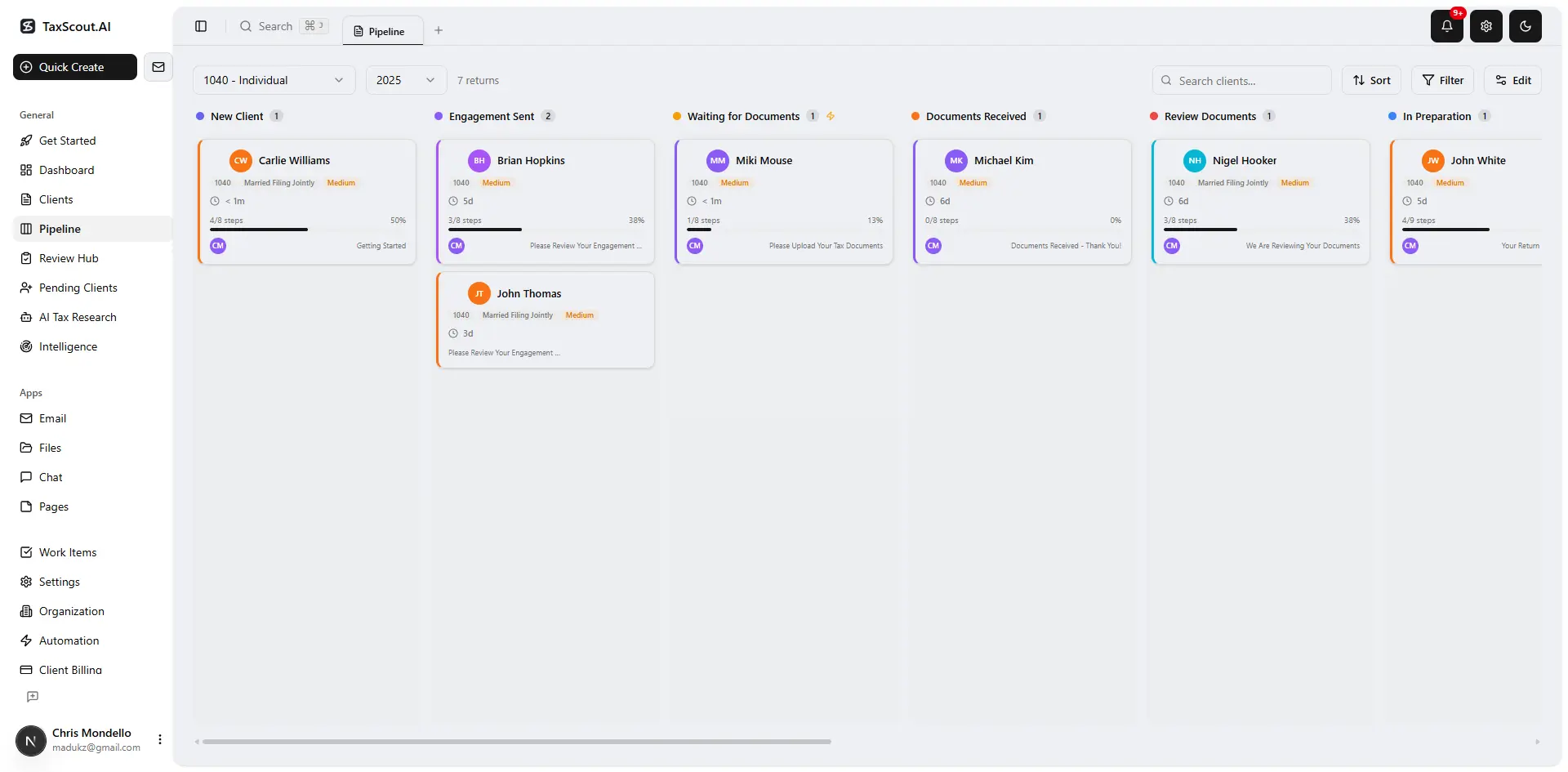
Track every return from intake to filed with drag-and-drop pipeline management
Building a Repeatable CPA Workflow for Clergy Engagements
The operational challenge with minister clients is not the complexity of any single return — it is the fact that each filing season requires gathering the same specialized documentation (board resolution, housing expense worksheet, SE income reconciliation) that you cannot obtain passively. Without a structured workflow, you spend the first 30 minutes of every clergy engagement reorienting yourself to the client's situation. A repeatable engagement model eliminates that friction.
Start with a tailored intake checklist that goes beyond the standard organizer. Your clergy intake should request: (1) current-year board resolution or governing body minutes designating the housing allowance with the dollar amount; (2) itemized housing expenses for the year (mortgage statement, utility bills, insurance premium, repair receipts); (3) an estimate of fair rental value with comparable market documentation; (4) all 1099s and honoraria records for ministerial services outside the primary church; and (5) the prior-year SE tax amount for estimated payment reconciliation. The smart intake engine in TaxScout can be configured with these custom fields so the portal surfaces exactly these prompts to your minister clients before each filing season.
Within your pipeline, clergy returns should have their own stage set — or at minimum a dedicated tag — so you can filter the kanban board during January and February to see every minister return simultaneously and confirm that board resolutions have arrived before you begin extraction. The TaxScout pipeline management tool supports 12 customizable stages with drag-and-drop workflow, making it straightforward to build a clergy-specific lane. Pair that with the AI document extraction feature, which processes W-2s, 1099s, and supporting records through a 5-layer validation pipeline with confidence scoring, and you have a system that catches W-2 discrepancies (like erroneous FICA entries) before they reach the preparer.
Key documentation checkpoints for a clergy tax return engagement
| Document or Item | Purpose | Timing |
|---|---|---|
| Board resolution designating housing allowance | Establishes advance designation required by Section 107 | Must exist before Jan 1 (or before hire date) |
| Housing expense worksheet | Determines actual expense limit for exclusion calculation | Gathered during intake, prior to return prep |
| Fair rental value estimate | Third limit in Section 107 three-part test | Client-prepared annually with market comps |
| W-2 from church (Box 1 and Box 14 review) | Verify income and housing allowance reporting accuracy | On receipt — cross-check against board resolution |
| All ministerial 1099s and honoraria records | Identify SE income outside primary church wages | During intake — easy to miss without explicit request |
| Prior-year SE tax and estimated payment history | Calculate safe-harbor compliance and Q1 payment | At engagement start |
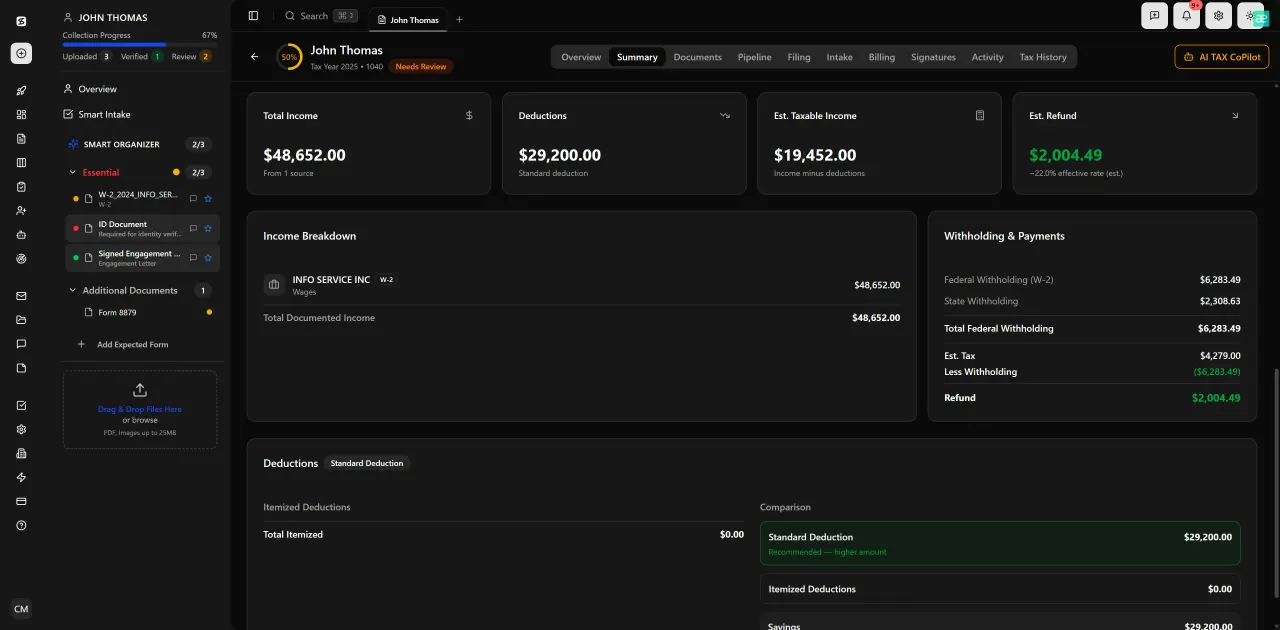
Review with AI assist — 9 agents answer questions with full client context

Your clients see your brand — OTP login, document upload, and real-time status
Engagement Letters, Fees, and Managing Clergy Client Expectations
Minister clients often arrive with expectations shaped by whoever prepared their return last — sometimes a volunteer at the church, sometimes a general-practice preparer who charged a flat Form 1040 fee without accounting for the additional complexity. Your engagement letter should explicitly scope the work: preparation of Form 1040 with Schedule SE, review and reconciliation of the housing allowance designation, and (if applicable) calculation and communication of voluntary withholding figures to the church. Scope creep on clergy returns is common when clients discover you can also advise the church on its payroll setup or 990 filing.
For flat-fee billing, consider a separate clergy surcharge or a dedicated clergy return service tier. The additional time spent on housing allowance documentation, W-2 reconciliation, and SE planning is real and should be priced accordingly. Ministers who receive that planning value are also excellent referral sources within their congregation — many of whom may be self-employed or have small businesses that need CPA services. E-signatures via TaxScout's Documenso integration allow you to send the engagement letter and Form 8879 through the client portal without a separate DocuSign subscription, keeping the workflow contained.
For firms that serve multiple religious organizations, consider whether the church itself should be an engagement client for payroll review, Form 941 compliance, and potential Form 990 preparation. The nonprofit audit preparation workflow we covered previously overlaps meaningfully with religious organization engagements, and bundling those services creates stickier, higher-value relationships. You can find other blog resources covering adjacent nonprofit and specialty tax topics to build out your firm's reference library.
State Tax Treatment of the Housing Allowance
The federal Section 107 exclusion does not automatically apply at the state level. Most states that conform to the Internal Revenue Code do adopt the exclusion by reference, but conformity is not universal. California, for example, has its own conformity rules and CPAs serving California-based ministers should verify current treatment with the California Franchise Tax Board. New York generally conforms, but any minister with multi-state income should be analyzed state by state — particularly if they officiate weddings, give lectures, or provide ministerial services in states where they are not domiciled. State conformity questions are an often-overlooked dimension of clergy tax returns that can produce unexpected liabilities if left unexamined.
The self-employment tax deduction on Schedule 1 (the 50% SE tax deduction) reduces federal AGI, which in turn affects state returns that use federal AGI as their starting point. State-level estimated payment requirements mirror the federal structure but with different thresholds and safe harbor percentages. For ministers in high-income-tax states, the combined federal SE tax, federal income tax, and state income tax burden can be substantial — making the housing allowance exclusion and voluntary withholding planning even more valuable as tools. The IRS Publication 517 covers the federal framework in detail and is worth bookmarking for client education.
The Social Security Administration also provides guidance on how ministerial SE tax earnings are credited toward Social Security benefits — a point that matters for ministers who are near retirement age and weighing the Form 4361 exemption option. Framing this analysis for the client as part of annual planning, rather than a one-time return-preparation exercise, positions you as an ongoing advisor rather than a seasonal preparer.
Want to stop rebuilding your clergy workflow from memory each filing season?
TaxScout.ai combines AI document extraction, customizable intake, and pipeline management in one flat-rate platform — no per-user fees, unlimited clients.
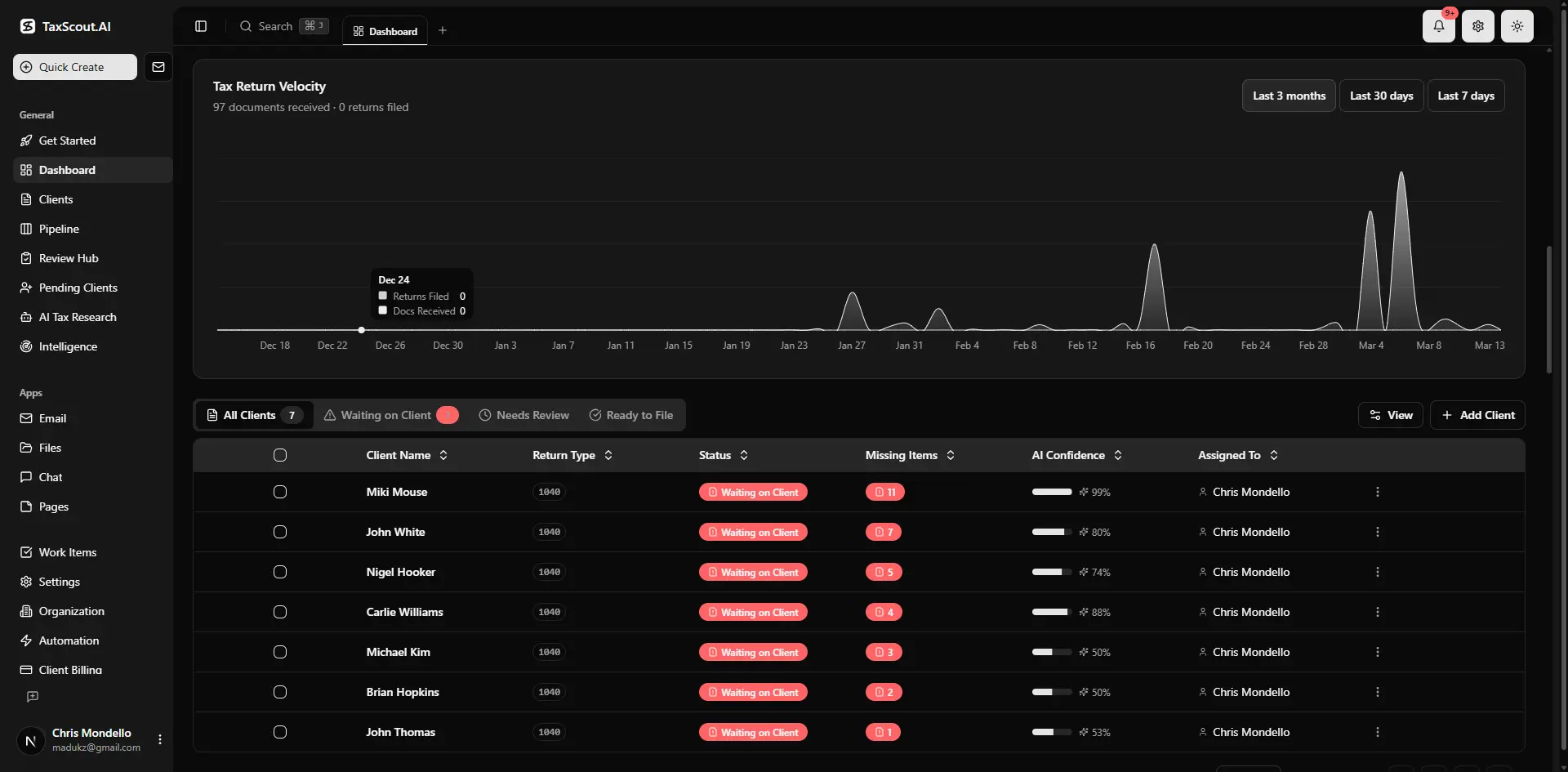
Real-time dashboard showing returns in progress, revenue, and upcoming deadlines
Frequently Asked Questions
Yes, in most cases. Under IRC § 3121(b)(8), services performed by a duly ordained minister in the exercise of ministry are excluded from the definition of employment for FICA purposes. This means the church does not withhold Social Security or Medicare taxes and does not pay the employer's share. The minister instead pays self-employment tax on Schedule SE, covering the full 15.3% (12.4% Social Security + 2.9% Medicare, subject to the net earnings adjustment). The only exception is a minister who has been granted an exemption via Form 4361 on religious grounds — a permanent, irrevocable election.
Keep reading
Backdoor Roth IRA: How CPAs Execute the Strategy Without Triggering Pro-Rata Tax
Oct 12, 2026 · 1 min read
Amended FBAR Procedures: How CPAs Correct Foreign Account Errors Without Triggering Penalties
Oct 12, 2026 · 1 min read
Transparency in Coverage Final Rules: What CPA Firms Must Do Now
Oct 12, 2026 · 1 min read
Stay up to date
Get the latest tax tech insights delivered to your inbox.