Car Loan Interest Deduction: Final IRS Rules CPA Firms Must Act On Now
On September 8, 2026, the IRS published final regulations creating a new above-the-line deduction of up to $10,000 for qualified passenger vehicle loan interest on individual returns — and paired it with mandatory information reporting for lenders paying $600 or more. CPA firms serving individual…
The car loan interest deduction is now law. On September 8, 2026, the IRS and Treasury published final regulations (2026-18219) creating a deduction of up to $10,000 per year for qualified passenger vehicle loan interest paid by individual taxpayers. The rules are effective immediately for the 2026 tax year.
For most CPA firms, this is not a passive read-and-file announcement. The regulations introduce both a new above-the-line deduction on Form 1040 and a new information reporting obligation on lenders — meaning new documents will start flowing into your practice, new questions will arrive from clients before year-end, and some existing engagement letters may no longer cover the scope of analysis your clients now expect. The car loan interest deduction sits at the center of these changes, making it essential for CPA firms to understand both its scope and its administrative implications before client questions begin arriving.
This brief cuts through the regulatory text and gives you the operational picture: what changed, who is affected across your client roster, and the specific actions worth completing before next week. Understanding the car loan interest deduction is critical to that operational picture, particularly for firms with a high volume of individual filers who own vehicles.
What the Final Regulations Actually Changed
The final rules do two distinct things. First, they codify a deduction of up to $10,000 of 'qualified passenger vehicle loan interest' paid during the tax year. The deduction is available to individuals — it is an above-the-line adjustment to gross income on Schedule 1 of Form 1040, meaning clients do not need to itemize to benefit. The vehicle must be a passenger automobile; commercial vehicles and vehicles held for business use may already be deductible under other provisions and are subject to separate analysis. In practical terms, the car loan interest deduction functions as a straightforward above-the-line adjustment, but the qualification criteria buried in the regulatory text require careful review before it can be claimed.
Second, the regulations create a new information reporting requirement. Persons engaged in a trade or business who receive $600 or more in qualifying vehicle loan interest from an individual during a calendar year are now required to report that interest — similar to the existing Form 1098 mortgage interest reporting framework. Lenders who comply will issue a new information return; lenders who do not will create reconciliation headaches for your clients and your staff. For firms evaluating their car loan interest deduction approach, this trade-off compounds over time.
The threshold and structure mirror existing IRS information reporting rules under IRC §6050H governing mortgage interest, which gives experienced preparers a useful mental model. However, the vehicle deduction carries its own definitional rules around 'qualified passenger vehicle' and 'qualified loan,' and those definitions are what determine whether a given client's interest actually qualifies. Each of these factors directly shapes how car loan interest deduction plays out in practice.
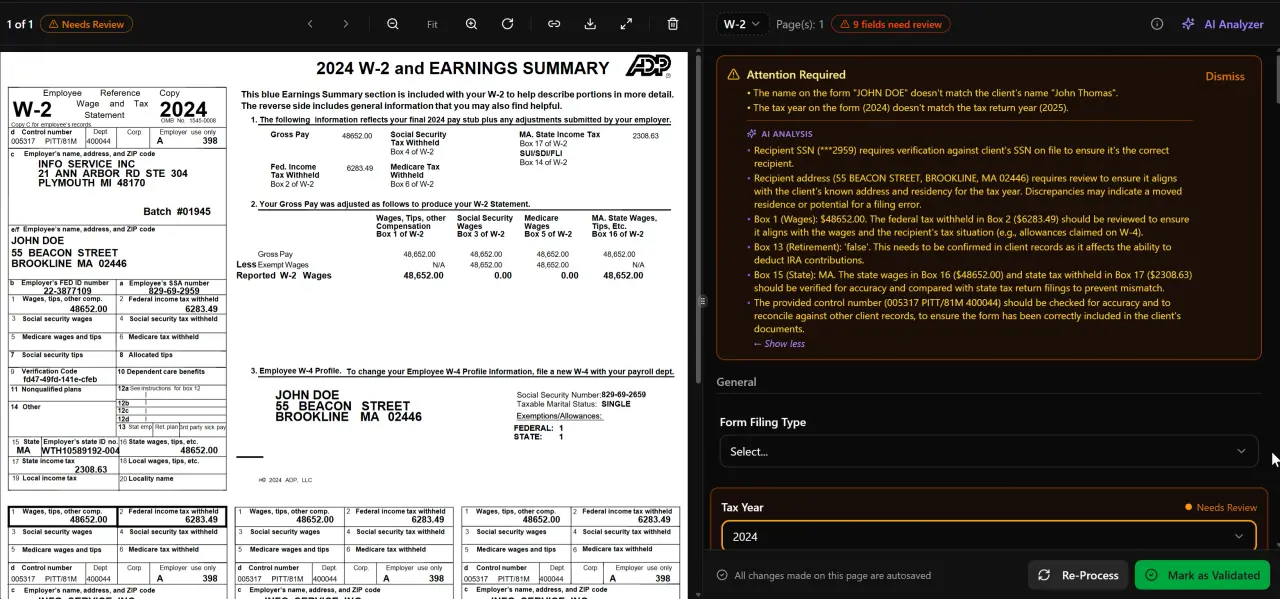
AI classifies, extracts, and validates every document automatically
Which Entity Types and Client Segments Are Affected
The deduction is available to individuals, so the primary affected filing type is Form 1040 — both W-2 employees and self-employed individuals on Schedule C. The impact by entity type is as follows: Understanding car loan interest deduction in this context is what separates firms that scale from those that stall.
Form 1040 filers (employed individuals): Broadest impact. Any client with a personal auto loan on a passenger vehicle is a candidate. The $10,000 cap means clients with larger loan balances will see partial deductions. Clients who already deduct vehicle expenses under the standard mileage rate or actual-expense method for a business vehicle need careful analysis to avoid double-dipping. This is precisely where a deliberate car loan interest deduction strategy pays off.
Schedule C sole proprietors and single-member LLCs: These clients face the most complexity. If the vehicle is used for both business and personal purposes, the business portion of interest may already flow through Schedule C, and the new deduction covers the personal-use remainder — but only if the loan is on a qualifying passenger vehicle. Misclassification risk is high here. Car loan interest deduction sits at the center of this decision — get it wrong and the rest unravels.
S-corporation and partnership clients: The deduction does not flow through at the entity level. Shareholder or partner auto loans are personal obligations; the deduction belongs on the individual's Form 1040, not the corporate or partnership return. However, if the entity reimburses the individual's vehicle expenses, the reimbursement and deduction interaction needs to be documented. See the IRS guidance on vehicle expenses for S-corps for the existing framework.
Nonprofit clients: Not affected for tax deduction purposes. However, if your nonprofit clients operate lending programs or receive vehicle loan interest payments aggregating $600 or more from individuals in the conduct of their activities, they may fall within the new information reporting obligation — an edge case worth flagging with your nonprofit practice group.
For firms tracking multi-state clients, note that state conformity is not automatic. As with many federal TCJA-era provisions, states will decide individually whether to adopt this deduction. Check state-specific updates before finalizing any year-end projections — our California tax changes 2026 CPAs must know post covers how California typically handles federal deduction conformity, and similar analysis will be needed for New York and other high-volume states.
Tired of chasing clients for new documents the moment a regulation changes?
TaxScout's AI intake engine and document extraction automatically flag new document classes — so your team knows the moment a client's lender statement arrives and what to do with it.

Click any extracted field to see its source highlighted on the original PDF
The New Information Reporting Requirement and What It Means for Document Flow
The lender-side reporting requirement is the sleeper issue in these regulations. Starting with calendar year 2026, lenders in a trade or business who receive $600 or more in qualifying vehicle loan interest from an individual are required to file an information return and furnish a copy to the borrower. This will generate a new class of year-end statements — distinct from the Form 1098 mortgage interest statement but functionally similar.
For CPA firms, this means two things. First, your document intake checklist needs to be updated immediately. Clients will start receiving these statements in January 2027 for tax year 2026. If your intake process does not ask for them, they will be missed. Second, there will be clients whose lenders are not yet compliant — especially smaller credit unions, captive finance subsidiaries, and buy-here-pay-here dealers. Those clients will need to reconstruct their interest paid from loan statements, which is a more labor-intensive task.
Firms using AI document extraction should verify that the new vehicle interest statement format is included in their document classification model. TaxScout's extraction pipeline covers the 1098 series and will be updated to recognize the new vehicle interest reporting form as guidance on the physical format is released. For now, add a manual checklist item to your intake workflow for any client with a known auto loan.
For additional context on how the $600 threshold interacts with broader 1099 reporting changes in 2026, see our earlier brief on IRS proposals for higher 1099 reporting thresholds.
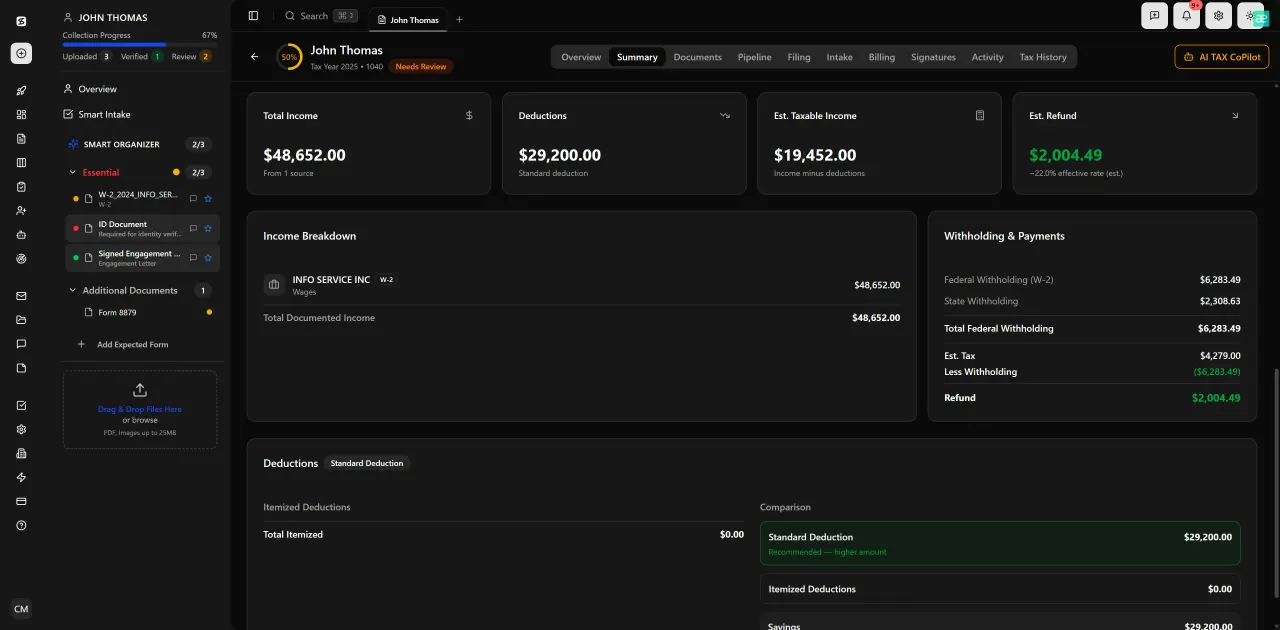
Review with AI assist — 9 agents answer questions with full client context
What to Do This Week: Action List for CPA Firms
This is an operational checklist, not a legal summary. Complete these steps before the end of the week:
1. Update your tax organizer and intake questionnaire. Add a question asking whether the client has a personal auto loan on a passenger vehicle and whether they received any vehicle interest statements. If you use TaxScout's AI intake engine, add the new document type to the gap-analysis configuration so the system surfaces it automatically during client onboarding.
2. Segment your 1040 client list. Pull a list of individual clients who have historically claimed vehicle deductions or who you know carry auto loans. This is the highest-priority review population. Clients with Schedule C activity and personal vehicles need immediate dual-use analysis.
3. Review engagement letter scope. If your standard engagement letter limits scope to prior-year return preparation, the vehicle interest analysis — including dual-use allocation and state conformity review — may fall outside scope. Update your engagement letters or issue a scope addendum before year-end advisory conversations begin. See our guide on e-signature compliance for accountants if you need to push updated letters to clients quickly.
4. Flag state conformity as an open item. Do not advise clients on state deductibility until you have confirmed your state's position. Track this as an open item in your pipeline. States like New York and California have historically decoupled from federal deductions — check New York state tax updates 2026 and your state's revenue department for guidance.
5. Brief your team. Run a 15-minute internal update — not a full CPE session, just enough for staff to recognize the new document type and know to route it correctly. Link them to the Federal Register final rule and this brief.
6. Document your process update. Under Treasury Circular 230 and your state's CPA licensing requirements, maintaining documented procedures for new regulatory developments is a professional obligation. Record the date you updated your intake checklist and briefed your team.
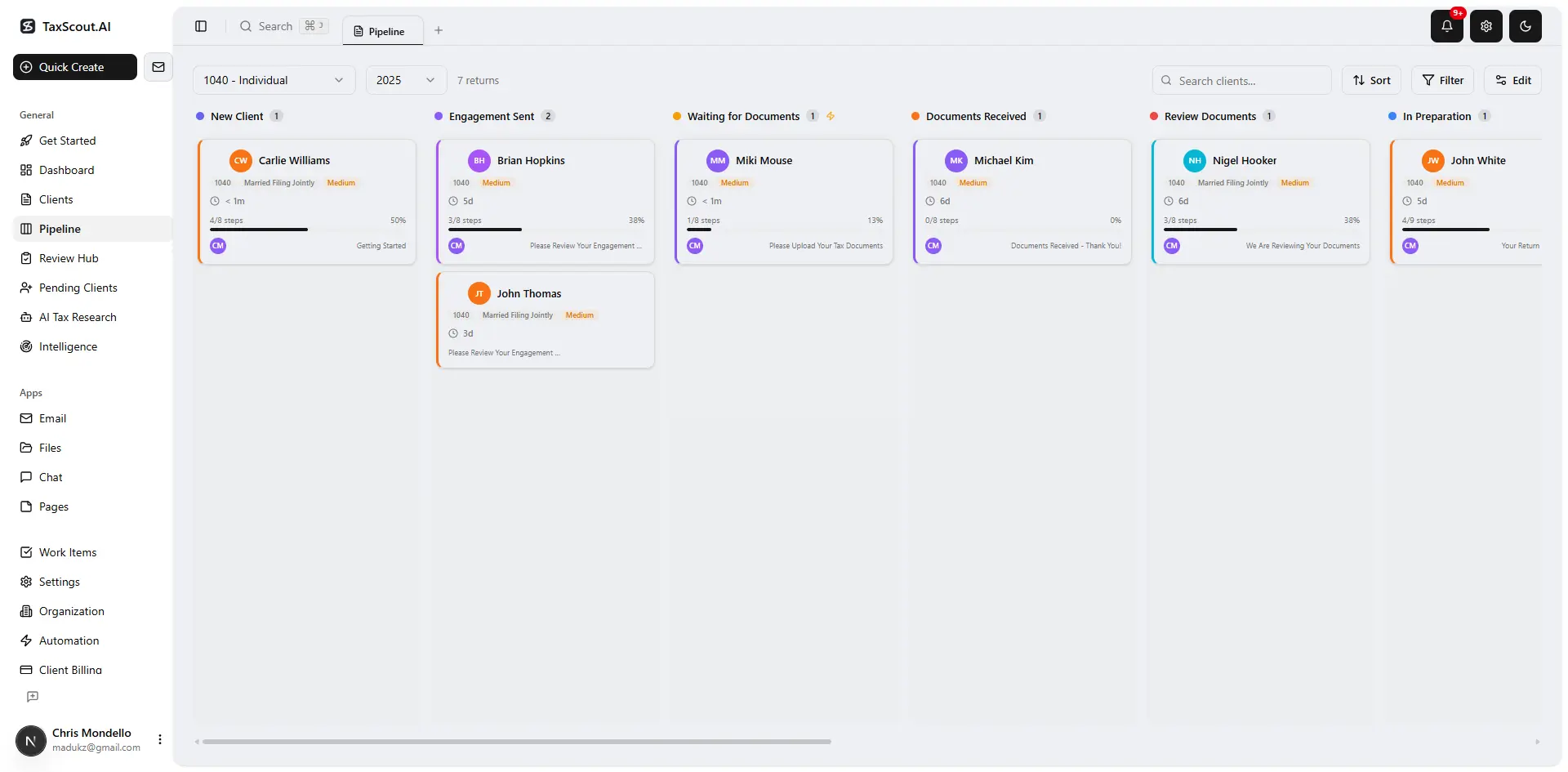
Track every return from intake to filed with drag-and-drop pipeline management
Interaction with Existing Vehicle Deduction Rules
The car loan interest deduction does not replace or supersede existing business vehicle expense rules. Clients with vehicles used exclusively for business will continue to deduct expenses (including interest) under Schedule C, Form 4562, or through accountable plan reimbursements. The new deduction targets the personal portion of vehicle loan interest that was previously nondeductible under the consumer interest rules of IRC §163(h).
The practical implication: a sole proprietor who uses a vehicle 60% for business and 40% personal will now potentially have two deduction entries — 60% of interest on Schedule C (as before) and up to 40% of interest (capped at $10,000 total) on Schedule 1 via the new provision. The total deductible interest cannot exceed the actual interest paid, and the $10,000 ceiling applies to the personal-use portion claimed on Schedule 1.
Advisors should also be aware that the IRS publication on car and truck expenses (Publication 463) will need to be updated to reflect the new provision. Until that update is published, the final regulations themselves are the authoritative source. Keep a copy in your knowledge base.
For firms that want to stay current on all legislative and regulatory changes affecting their client base without manually monitoring the Federal Register, TaxScout's AI research agents perform real-time IRS, Treasury, and Cornell Law searches — so developments like this surface in your dashboard before they become missed deductions. You can also track all breaking tax news in our news and updates hub.
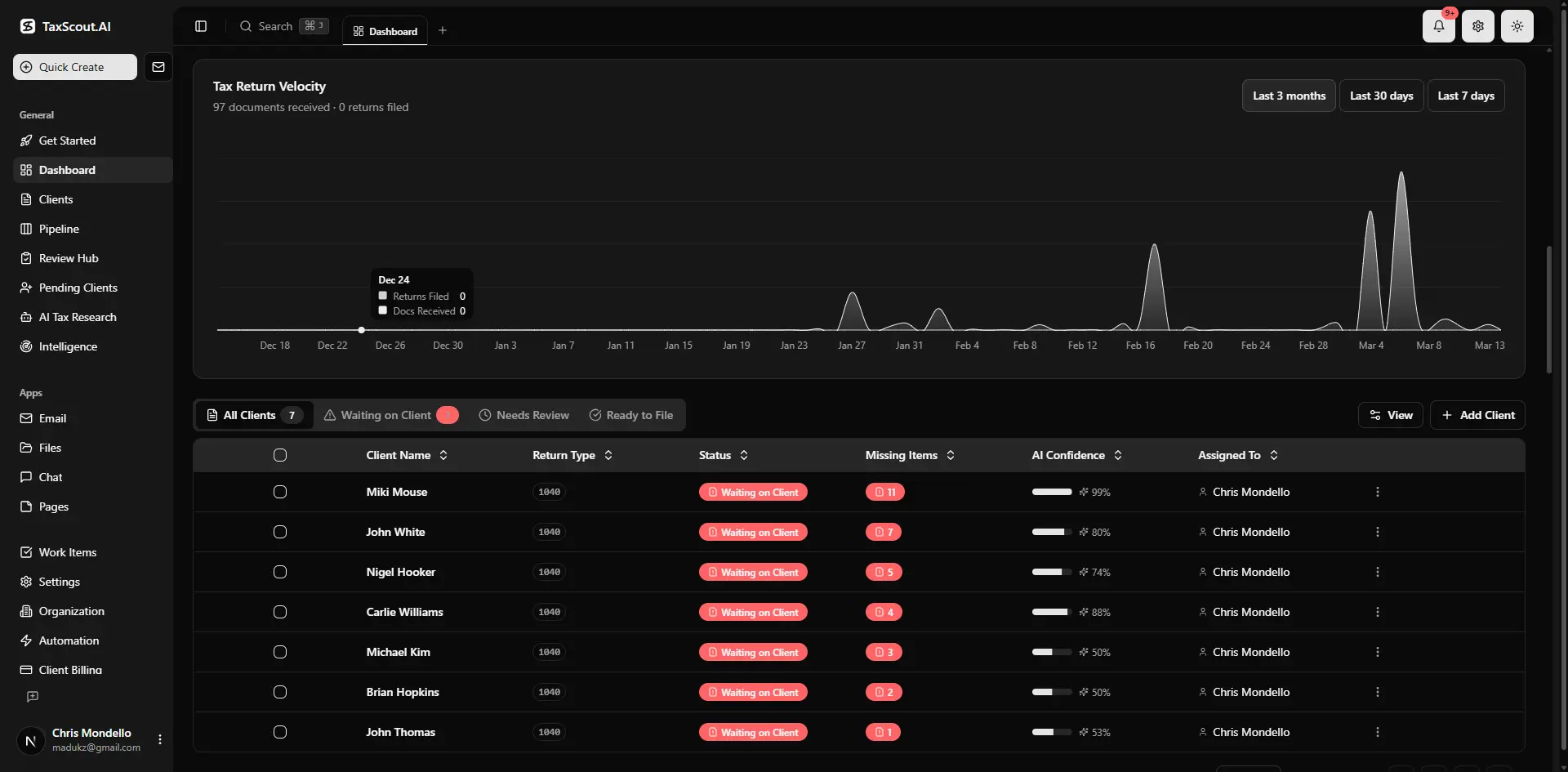
Real-time dashboard showing returns in progress, revenue, and upcoming deadlines
Key Facts at a Glance
Below is a quick reference summary of the final regulations for use in team briefings or client communications.
Deduction Parameters
Maximum deduction: $10,000 per year. Type: above-the-line (Schedule 1, Form 1040). Eligible taxpayers: individuals. Vehicle requirement: qualified passenger vehicle. Loan requirement: must be a qualifying loan on the vehicle. Effective: tax year 2026.
Reporting Parameters
Who must report: persons in a trade or business receiving $600 or more in qualifying vehicle loan interest from an individual in a calendar year. Reporting threshold: $600 aggregate per individual per calendar year. First reporting year: calendar year 2026 (statements issued January 2027). Penalty for noncompliance: standard information reporting penalties under IRC §6721/§6722 apply.
Entity Scope
Form 1040: directly affected. Schedule C / sole proprietors: affected with dual-use complexity. S-corporations / partnerships: deduction is at the individual shareholder or partner level only. Nonprofits: not a deduction issue but may have reporting obligations as lenders. C-corporations: not affected (no individual borrower at the entity level).
Want your firm to catch every new deduction before your clients have to ask about it?
TaxScout combines AI document extraction, real-time regulatory research agents, and smart intake — so new rules like the car loan interest deduction are built into your workflow before tax season starts.
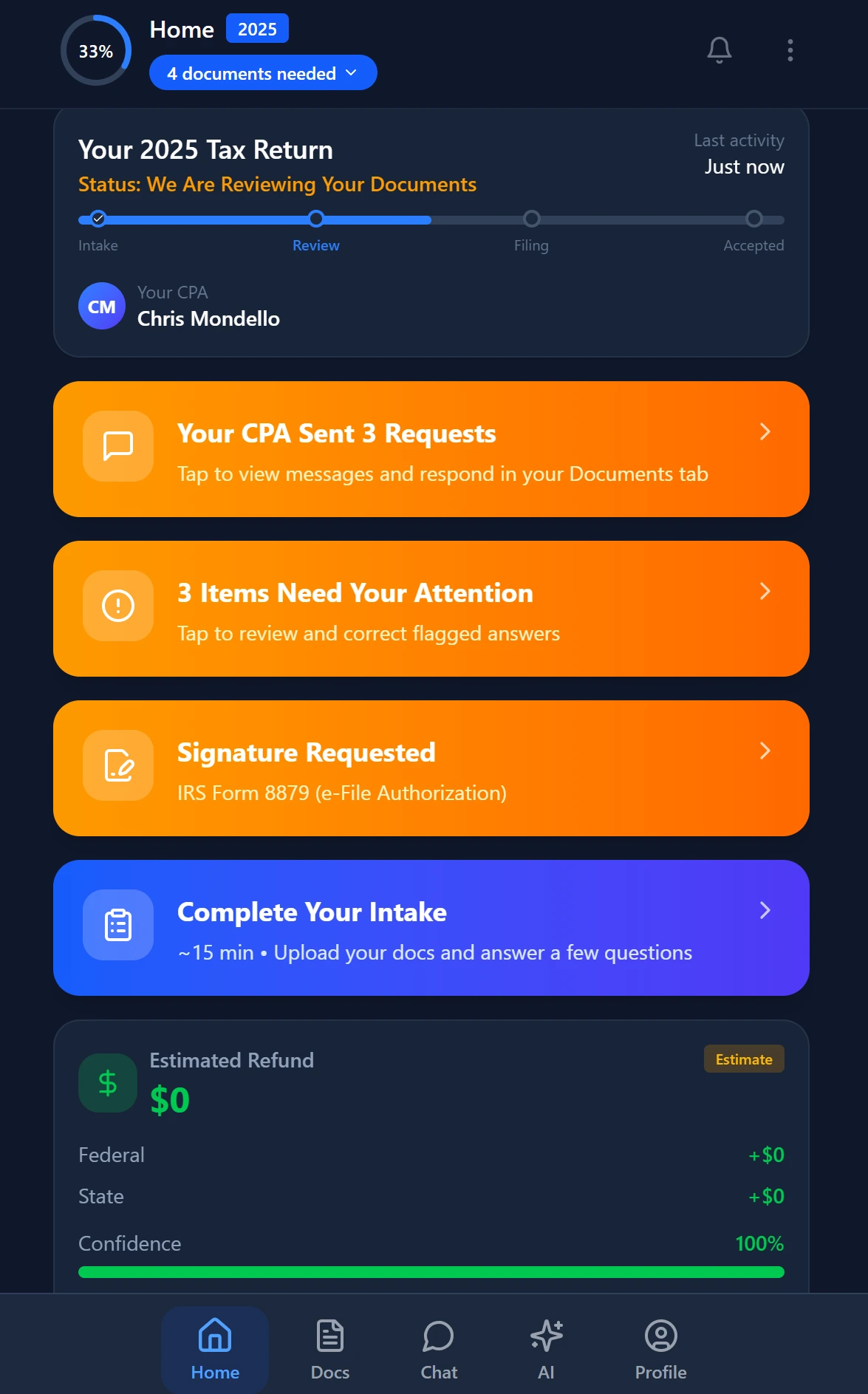
Smart intake auto-fills from uploaded documents and prior-year data
Frequently Asked Questions
The final regulations allow eligible individual taxpayers to deduct up to $10,000 per year of qualified passenger vehicle loan interest. The deduction is above-the-line on Schedule 1 of Form 1040, so clients do not need to itemize to claim it.
Keep reading
Partnership Guaranteed Payments: How CPAs Handle SE Tax and Deductibility
Oct 22, 2026 · 1 min read
Guidance Under Section 355 Concerning Device and Active Trade or Business Partial Withdrawal
Oct 22, 2026 · 1 min read
Section 1031 Boot Tax: How CPAs Calculate and Minimize Taxable Gain in Partial Exchanges
Oct 21, 2026 · 1 min read
Stay up to date
Get the latest tax tech insights delivered to your inbox.