Partnership Basis Adjustment: How CPAs Apply Section 754 Elections for Clients
Section 754 elections are among the most consequential — and most operationally complex — elections a CPA can make on behalf of a partnership client. This guide walks through exactly when the election is triggered, how to compute inside-versus-outside basis discrepancies under Sections 743(b) and…
A partnership basis adjustment under Section 754 of the Internal Revenue Code is one of the highest-value elections a CPA can make for clients who hold partnership interests — and one of the most overlooked. When a partner sells or transfers an interest, or when the partnership makes a distribution that shifts value among partners, the partnership's inside basis in its assets can become permanently misaligned with the new partner's outside basis. Without a timely Section 754 election, the incoming partner effectively pays tax twice on appreciation that accrued before they ever joined the entity.
The mechanics span two separate Code sections — Section 743(b) for transfer-triggered adjustments and Section 734(b) for distribution-triggered adjustments — each requiring distinct computational steps and distinct entries on the partnership return. Most published guidance stops at the conceptual level. This walkthrough goes further: it covers triggering events, the inside-versus-outside basis arithmetic, the actual election statement requirements, the IRS relief procedure when a deadline is missed, and the downstream depreciation and amortization burden that follows every election. Understanding these distinctions is essential because each trigger produces a different type of partnership basis adjustment that must be tracked and reported separately.
For CPA firms that service multiple partnership clients simultaneously, the administrative load compounds quickly. A single active client roster can hold a dozen open Section 754 elections at different stages of the depreciation lifecycle. We close this guide by showing how AI-assisted practice management helps firms track, document, and maintain those elections without manual spreadsheets or missed filings. Tracking each open election becomes far more manageable when firms implement a dedicated workflow that flags every pending partnership basis adjustment by client, event date, and depreciation schedule.
What Triggers a Section 754 Election
The Section 754 election is optional — no partnership is required to make it — but once made it applies to all qualifying events in that tax year and all future years unless the IRS grants permission to revoke it. Under IRC § 754, the election must be made on a timely-filed partnership return (including extensions) for the year in which a triggering event occurs. Because the election is permanent until revoked, partnerships should carefully evaluate whether the long-term administrative commitment of maintaining a partnership basis adjustment is justified by the tax benefits expected for incoming or departing partners.
Two categories of events trigger a potential adjustment. The first is a sale or exchange of a partnership interest under Section 741, including transfers at death under Section 1014. The second is certain distributions of money or property to a partner under Section 731. Not every distribution qualifies — only those in which the distributee partner recognizes gain, or in which the distributed property has a carryover basis that differs from the adjusted basis the partnership had in that property. For firms evaluating their partnership basis adjustment approach, this trade-off compounds over time.
A common mistake CPAs encounter is assuming the election applies only to arm's-length sales. In practice, a partner's death is among the most frequent triggers. When a decedent's estate or heirs receive a step-up in outside basis under IRC § 1014, the partnership's inside basis in its assets remains unchanged. Without a Section 754 election, the heir inherits a phantom gain problem that will surface on every future sale or depreciation allocation. A properly executed partnership basis adjustment at the time of the death transfer eliminates that phantom gain before it compounds across future tax years. For more on how triggering events interact with year-round deadline management, see our IRS Deadlines 2026 guide. Each of these factors directly shapes how partnership basis adjustment plays out in practice.

Click any extracted field to see its source highlighted on the original PDF
Inside Basis vs. Outside Basis: The Core Discrepancy
The inside basis versus outside basis gap is the economic problem that Section 754 solves. Outside basis is what the partner paid (or is deemed to have paid) for the partnership interest — it belongs to the partner, not the partnership. Inside basis is the partnership's own adjusted tax basis in each asset it holds — it belongs to the entity. Under normal circumstances these two numbers converge over time through allocations of income, loss, and depreciation. A transfer event breaks that convergence instantly. Understanding partnership basis adjustment in this context is what separates firms that scale from those that stall.
Consider a simple example. A two-partner LLC holds a single commercial building with an adjusted inside basis of $400,000 and a fair market value of $1,000,000. Partner A, who owns 50%, sells to incoming Partner C for $500,000. Partner C now has a $500,000 outside basis in the partnership interest, but the partnership's inside basis attributable to C's share is still only $200,000 (50% of $400,000). That $300,000 discrepancy means C would be allocated depreciation computed on the old $200,000 figure and would also recognize $300,000 of built-in gain on a future sale — gain that accrued entirely before C ever entered the partnership. This is precisely where a deliberate partnership basis adjustment strategy pays off.
A Section 754 election combined with a Section 743(b) adjustment eliminates this phantom gain by increasing the inside basis of partnership assets by $300,000 specifically for Partner C. The adjustment is partner-specific, not entity-wide: it benefits only C, appears only in C's capital account tracking, and must be maintained separately in the partnership's books. Treasury Regulation § 1.743-1 governs the mechanics of this adjustment, including the allocation of the step-up across individual assets using the Section 755 rules. Partnership basis adjustment sits at the center of this decision — get it wrong and the rest unravels.
Managing Section 754 elections across a dozen partnership clients on spreadsheets? When firms revisit their partnership basis adjustment priorities, the gaps usually surface here.
TaxScout.ai gives CPA firms AI-assisted pipeline tracking, document management, and research agents that flag open elections before deadlines pass.
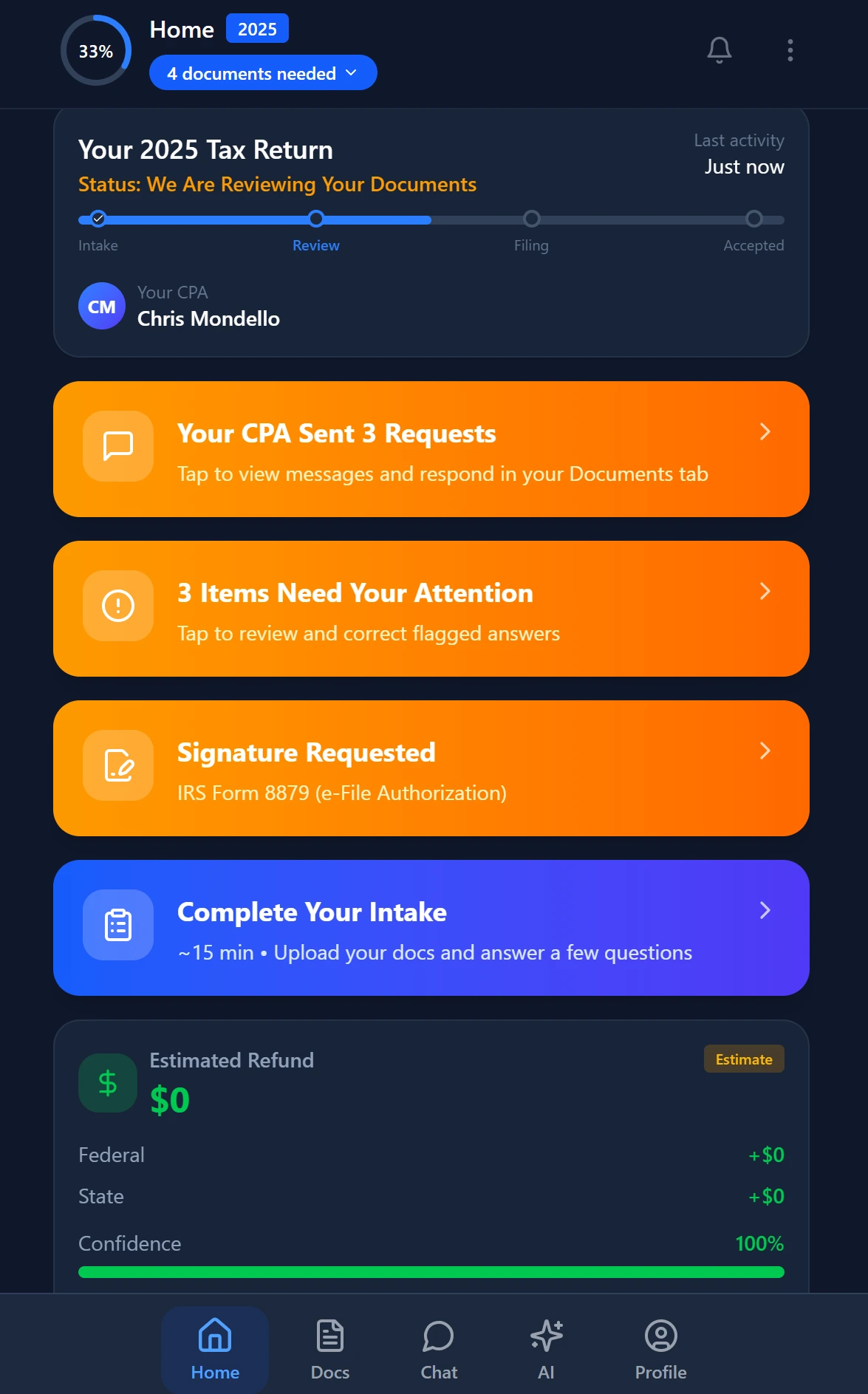
Smart intake auto-fills from uploaded documents and prior-year data
Section 743(b) vs. Section 734(b): Practical Filing Differences
CPAs must distinguish clearly between the two adjustment mechanisms because they arise from different events, apply to different asset categories, and flow through the partnership return in different ways.
A Section 743(b) adjustment is triggered by a transfer of a partnership interest — sale, exchange, gift, or death. The adjustment is always partner-specific: it increases (or decreases) the transferee's share of inside basis in partnership assets. The total adjustment equals the difference between the transferee's outside basis and their proportionate share of the partnership's inside basis in all assets. Per Treas. Reg. § 1.755-1, the adjustment is then allocated among capital gain property and ordinary income property separately, and within those buckets across individual assets in proportion to the unrealized appreciation or depreciation in each. Firms that handle multiple transfers in a single year must compute a separate partnership basis adjustment for each transferee, since the step-up amounts and asset allocations will differ depending on the timing and purchase price of each transaction.
A Section 734(b) adjustment is triggered by a distribution. It is entity-level, not partner-specific. It arises in two scenarios: (1) the distributee partner recognizes gain under Section 731(a)(1) because the cash distributed exceeds the partner's outside basis, or (2) the distributee takes a carryover basis in distributed property that is less than the partnership's inside basis in that property immediately before distribution. In the first case the partnership increases inside basis in remaining assets; in the second case it decreases inside basis. The adjustment flows to the partnership's books for all partners — a significant distinction from the 743(b) side-pocket treatment. Recognizing whether a given partnership basis adjustment is distribution-driven or transfer-driven is the first step toward correct return preparation.
On the Form 1065, both types of adjustment are disclosed on Schedule K-1 (Box 20, Code U for 743(b) adjustments) and in a statement attached to the return. Partnerships with more than 100 partners that are required to file electronically must follow the updated e-file attachment procedures the IRS published in Revenue Procedure 2023-17. Tracking which adjustments are 743(b) versus 734(b), and which partners carry which side-pocket amounts, is where manual processes break down fastest.
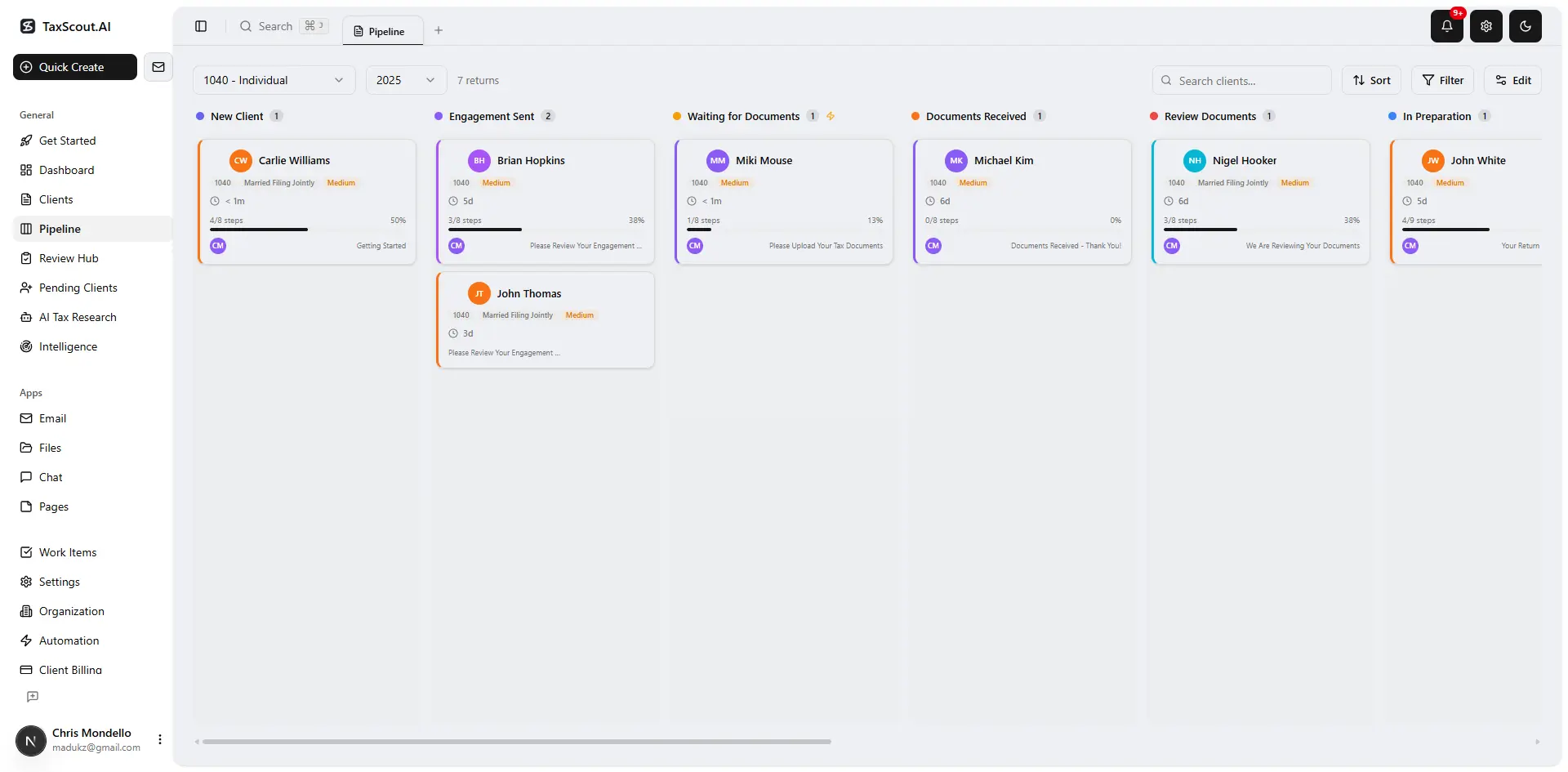
Track every return from intake to filed with drag-and-drop pipeline management
Step-by-Step Workflow for Computing and Filing the Adjustment
The following workflow reflects current IRS guidance and practice standards. It applies to a Section 743(b) transfer scenario, which is the most common engagement type. The Section 734(b) flow is analogous but begins with the distribution event rather than the transfer.
For CPA firms managing multiple partnership engagements, this workflow benefits from pipeline management tools that can track each step as a discrete stage per client, with deadlines and assigned team members visible on a single kanban board.
Step 1: Confirm the Triggering Event and Election Status
Obtain the executed transfer agreement, estate documents, or distribution records. Verify whether the partnership already has a Section 754 election on file from a prior year — if so, the adjustment is mandatory, not optional. If no prior election exists, advise the client on the cost-benefit: the election is irrevocable without IRS consent, so a partnership with mostly depreciated or loss assets may not benefit. Document your recommendation and obtain written authorization before proceeding.
Step 2: Determine Outside Basis of the Transferee
For a sale, outside basis equals the purchase price plus the transferee's share of partnership liabilities assumed under Section 752. For a death transfer, outside basis is the fair market value of the interest on the date of death (or alternate valuation date), again adjusted for liabilities. Obtain a qualified appraisal if the partnership holds real estate, closely held business interests, or other non-traded assets — the IRS can challenge basis step-ups tied to understated FMV. Confirming accurate FMV at this stage is critical because the entire partnership basis adjustment calculation flows from this number.
Step 3: Calculate the Transferee's Share of Inside Basis
Pull the partnership's balance sheet and compute the transferee's percentage share of the total adjusted tax basis in all partnership assets. This requires the partnership's depreciation schedules and asset registers, not just the book balance sheet. Differences between book and tax basis are common and matter here. The Section 743(b) adjustment is the excess of outside basis over this inside basis figure (or the deficit, if outside basis is lower — a negative adjustment).
Step 4: Allocate the Adjustment Across Assets Using Section 755
Divide partnership assets into two pools: capital gain property (Section 1231 assets, investment assets) and ordinary income property (inventory, unrealized receivables, depreciation recapture). Allocate the total adjustment within each pool in proportion to the unrealized appreciation or depreciation in each asset relative to its FMV. Assets with zero built-in gain or loss receive no allocation. This step requires the most computation and is where errors most commonly occur — a misallocation can shift the partnership basis adjustment between depreciable and non-depreciable assets, changing the client's annual depreciation benefit significantly.
Step 5: Prepare the Election Statement and Attach to Form 1065
The election statement must contain the name, address, and EIN of the partnership; a declaration that the partnership elects under Section 754 to apply the provisions of Sections 734(b) and 743(b); and, where a specific adjustment is being reported in the same year, a description of the transaction and the amount. Per Treas. Reg. § 1.754-1(b), the statement must be signed by any one general partner (or LLC manager). For electronically filed returns, attach the statement as a PDF using the proper XML attachment tag. Schedule K-1 for the transferee must include the Box 20, Code U disclosure with the total adjustment amount.
Step 6: Update Depreciation Schedules Going Forward
The adjustment creates a new, partner-specific depreciation stream. If $300,000 of the total adjustment was allocated to a building with 27.5-year remaining life, the transferee gets an additional $10,909 annual depreciation deduction that no other partner shares. This side-pocket depreciation must be tracked separately every year for the life of the asset or until the interest is transferred again. Most tax software handles this if set up correctly, but the partnership's records must clearly document the partnership basis adjustment, its allocation, and the depreciation claimed each year — documentation that becomes critical in an audit or on a subsequent sale of the interest.
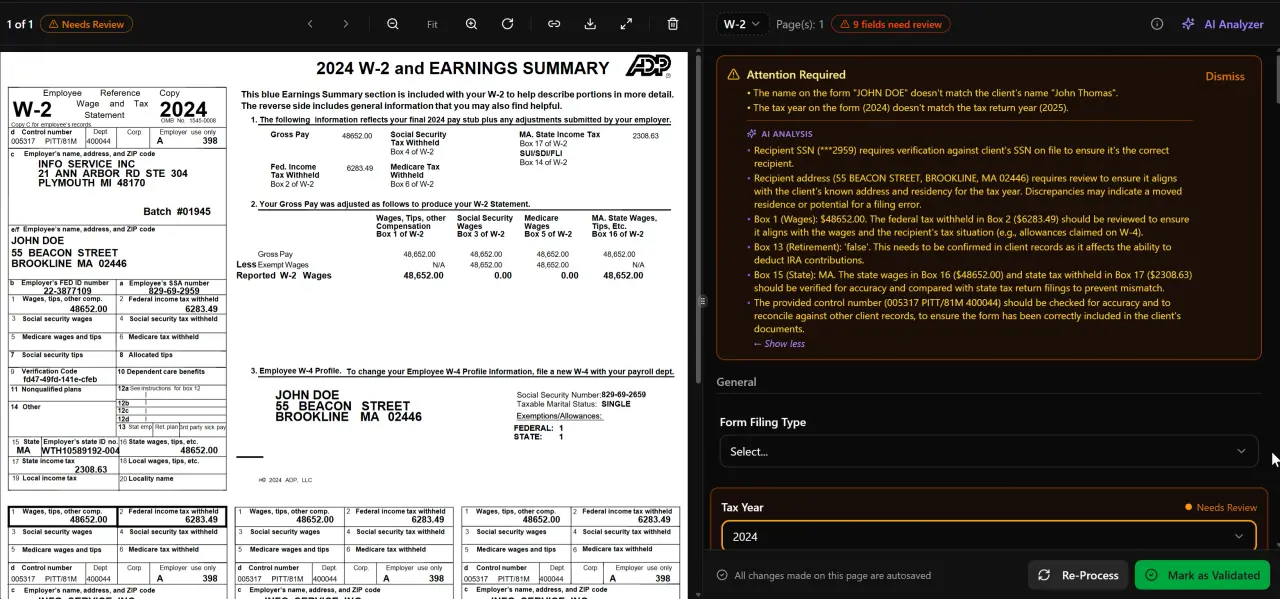
AI classifies, extracts, and validates every document automatically
Missing the Deadline: IRS Relief Under Revenue Procedure 2009-39
A Section 754 election must be filed with a timely-filed partnership return for the year of the triggering event. Extensions count — a six-month extension under Form 7004 gives the partnership until September 15 (calendar year) to file and attach the election statement. But if the return is filed late without the election, or the election statement is inadvertently omitted from an otherwise timely return, the partnership has missed the window.
The IRS grants automatic relief under Revenue Procedure 2009-39 for certain late elections, including Section 754, when the failure was due to reasonable cause and the taxpayer acted promptly on discovering the error. To qualify, the partnership must file a corrected or amended return with the election statement attached and include a penalty-of-perjury statement explaining the reasonable cause. Automatic relief is generally available if the partnership is not under IRS examination at the time of the request and acts within twelve months of the original due date.
If automatic relief is unavailable, the partnership must seek a private letter ruling under Rev. Proc. 2023-1, which involves a user fee currently set at $12,600 for most partnership ruling requests. CPAs who track filing status carefully can usually avoid this path entirely. Using AI-assisted pipeline management with deadline alerts tied to each partnership client's return due date is the most reliable operational safeguard against missed elections — and against the costly PLR process that a late partnership basis adjustment request can trigger.
Section 743(b) vs. Section 734(b): Key Differences at a Glance
| Feature | Section 743(b) | Section 734(b) |
|---|---|---|
| Triggering Event | Transfer or sale of partnership interest; death of partner | Distribution of cash or property to a partner |
| Who Benefits | Transferee partner only (partner-specific) | All partners (entity-level adjustment) |
| Direction of Adjustment | Usually upward (step-up) when FMV > inside basis | Up if gain recognized; down if carryover basis < inside basis |
| Asset Allocation Method | Section 755 — allocated to unrealized gain/loss assets | Section 755 — allocated to remaining partnership assets |
| Return Disclosure | Schedule K-1, Box 20 Code U; election statement attached to Form 1065 | Attachment to Form 1065; no K-1 line for entity-level adjustment |
| Depreciation Impact | New depreciation stream for transferee only | Shared depreciation adjustment for all partners going forward |
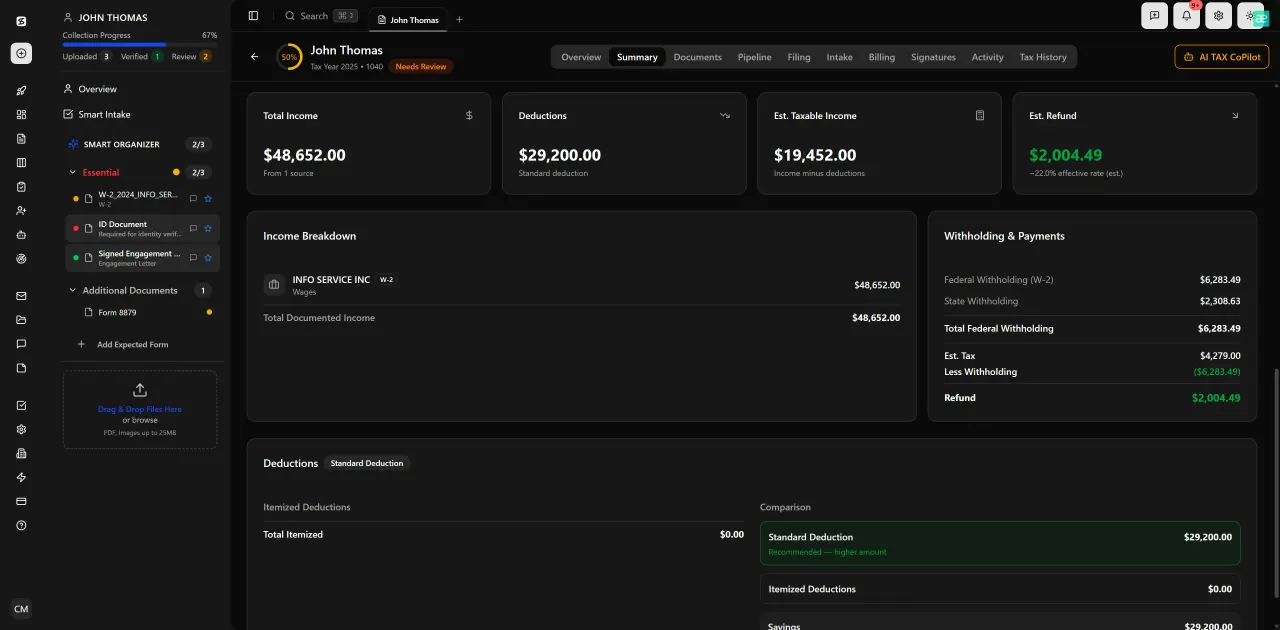
Review with AI assist — 9 agents answer questions with full client context
Tracking Multiple Open 754 Elections Across a Partnership Portfolio
A mid-size CPA firm serving 30 to 50 partnership clients can easily accumulate 15 or more active Section 754 elections at different stages: some in their first year with fresh step-up allocations just being set up, others in year eight of a 39-year depreciation stream, and a few nearing a secondary transfer that will require recalculating the existing adjustment. Managing this on spreadsheets is not only time-consuming — it is a professional liability exposure. A missed annual depreciation allocation or a stale election statement on an amended return is exactly the kind of error that generates malpractice claims.
Modern AI-native practice management addresses this in three ways. First, AI document extraction can process K-1s and prior-year returns to automatically populate a partnership's election history, identified asset adjustments, and remaining depreciation lives into the client record — eliminating the manual data entry that underlies most tracking errors. For a deeper look at how that capability works technically, see our AI document extraction guide for CPAs.
Second, AI research agents can monitor IRS regulatory updates that affect open elections — such as changes to Section 168 depreciation methods or new safe-harbor guidance under Section 755 — and surface those updates in the context of specific client files. This is far more targeted than general tax news subscriptions and connects directly to the regulatory intelligence features that practice management platforms now offer.
Third, structured pipeline management allows firms to create a dedicated workflow stage for each active election — including annual depreciation tracking, K-1 disclosure review, and transfer monitoring — so every open partnership basis adjustment has a responsible team member and a visible due date. For a broader look at how AI improves firm productivity across multiple service lines, see other blog resources on practice management and workflow strategy. Firms also benefit from reviewing cost segregation studies workflows, since many 754 adjustments involve real estate assets where cost segregation interacts with the step-up allocation under Section 755.
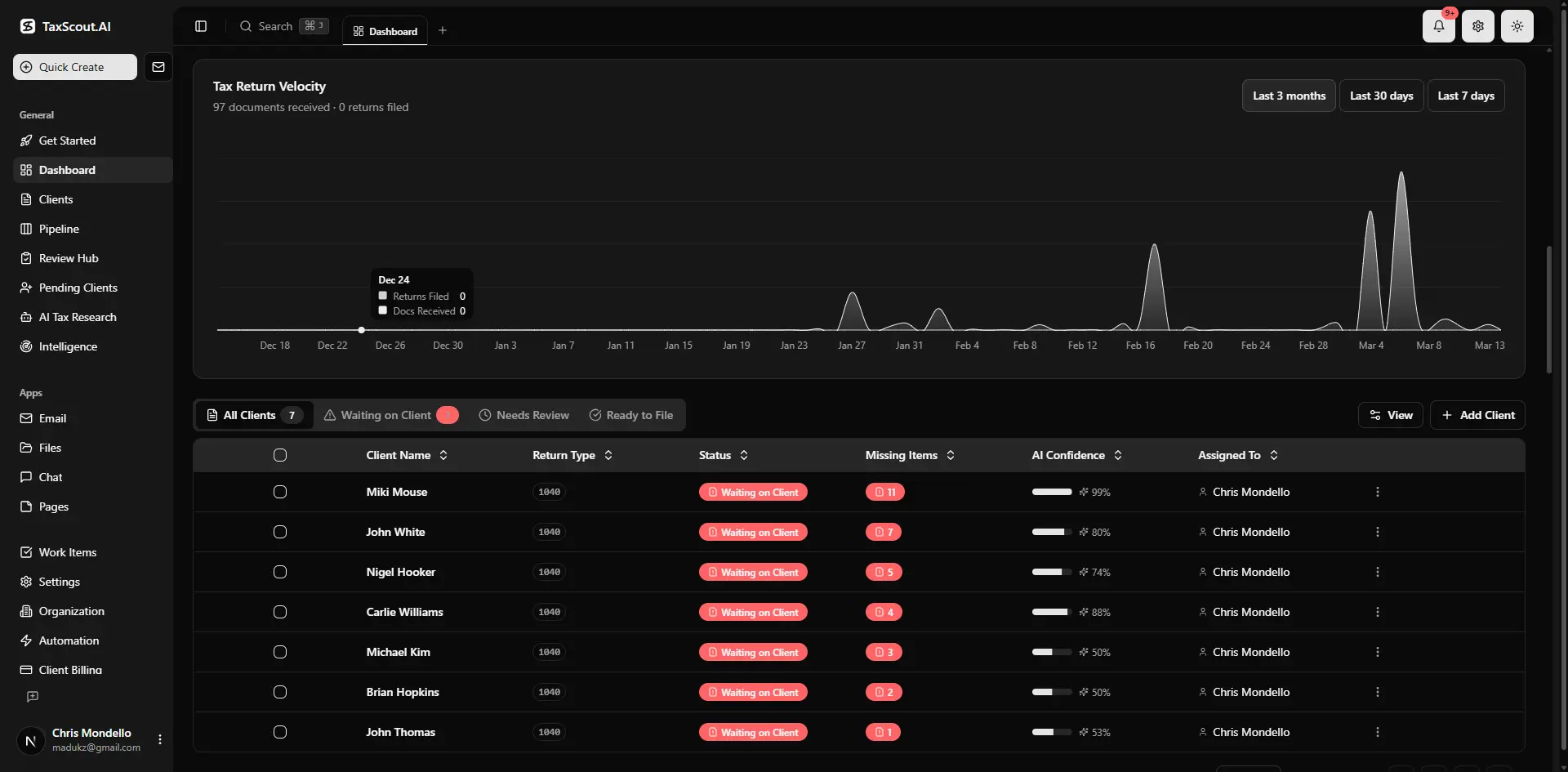
Real-time dashboard showing returns in progress, revenue, and upcoming deadlines

Every client gets organized documents, status tracking, and a complete history
Downstream Depreciation Maintenance and Audit Documentation
The Section 754 election is not a one-time filing event — it creates an ongoing maintenance obligation that persists for the life of every adjusted asset. Each year the partnership must compute and separately track the partner-specific depreciation or amortization attributable to the 743(b) adjustment, apply the correct recovery period and method (often the same as the underlying asset, but subject to limitation if the adjustment is allocated to non-depreciable assets like land), and reflect that amount correctly in the Schedule K-1 for the affected partner.
On audit, IRS examiners routinely request a complete reconciliation of the Section 754 adjustment from the year of election through the current return, including the original Section 755 allocation worksheet, all depreciation schedules showing the partner-specific layer, and the basis computation for any assets that have been sold since the election. A partnership that cannot produce this documentation — because staff turnover erased the institutional memory or because the records lived in a spreadsheet that no longer matches the current return — faces a difficult audit position. Examiners will also scrutinize whether the partnership basis adjustment was correctly re-computed following any secondary transfer of the same interest, since each transfer resets the outside basis calculation and can generate a layered adjustment on top of the original.
Using file management tools that attach structured documents directly to the partnership client record — and version-control those documents across tax years — ensures the audit trail is intact regardless of which team member prepared the current year's return. Combined with the PDF tools available in modern practice management platforms, firms can produce a clean, annotated workpaper package on demand rather than assembling it reactively under audit pressure. The security architecture of these platforms also matters: encryption at rest and role-based access ensure that sensitive basis adjustment data is protected in accordance with IRS Publication 4557 safeguarding requirements.
Ready to stop tracking Section 754 elections in a spreadsheet that only one person understands?
TaxScout.ai combines AI document extraction, 9 research agents, and structured pipeline management so your entire team can manage open elections, depreciation schedules, and filing deadlines from one platform — at a flat monthly price with no per-user fees.
Frequently Asked Questions
The election must be attached to a timely-filed Form 1065 — including extensions — for the tax year in which the triggering event (sale, transfer, death, or qualifying distribution) occurs. If the election is inadvertently omitted from an otherwise timely return, the partnership may qualify for automatic late-election relief under Revenue Procedure 2009-39, provided it acts within twelve months of the original due date and the return is not under IRS examination.
Keep reading
Tangible Property Regulations: How CPAs Apply Capitalization vs Expensing Rules
Oct 15, 2026 · 1 min read
QSBS Exclusion: How CPAs Maximize Section 1202 Gains for Startup Investors
Oct 15, 2026 · 1 min read
Section 1202 QSBS Exclusion: How CPAs Shelter Startup Gains for Founder Clients
Oct 15, 2026 · 1 min read
Stay up to date
Get the latest tax tech insights delivered to your inbox.