Bonus Depreciation 2026: How CPAs Maximize Section 168 for Business Clients
Bonus depreciation is phasing out under the TCJA schedule, but 2026 still offers a meaningful deduction window for business clients who act before year-end. This guide walks CPAs through the mechanics of Section 168(k), the Section 179 interaction decision tree, and how AI-native practice…
Bonus depreciation 2026 sits at 40 percent under the Tax Cuts and Jobs Act phaseout schedule — down from the 60 percent rate that applied in 2024, and well below the 100 percent window that expired after 2022. For business clients who acquired or plan to acquire qualified property this year, that 40 percent write-down is still substantial. For CPAs who lack a repeatable screening workflow, it is also the kind of deduction that quietly disappears until an amended return is the only remedy. For firms evaluating their bonus depreciation 2026 approach, this trade-off compounds over time.
Most of the content CPAs can find on bonus depreciation explains the tax law accurately but stops there. It does not show you how to identify which clients own qualifying assets, how to run the Section 168(k) and Section 179 comparison before committing to an election, or how to document the supporting schedules in a way that survives an IRS examination. It especially does not address how modern practice management software can automate the intake triggers that surface depreciation opportunities before the return is in progress. Understanding how bonus depreciation 2026 differs from prior years is essential context before any client conversation about asset acquisition timing.
This guide covers all of it: the 2026 phaseout math, the qualified-property rules, the Section 179 interaction, the election documentation requirements, and a concrete workflow CPAs can implement inside an AI-native platform so that no client's bonus depreciation opportunity reaches the filing deadline unexamined. By the end, you will have a repeatable process for applying bonus depreciation 2026 across your entire client base without missing a qualifying asset.
How the Section 168 Bonus Depreciation Phaseout Works in 2026
Section 168(k) of the Internal Revenue Code allows businesses to immediately expense a percentage of the cost of qualified property placed in service during the tax year. The TCJA introduced 100 percent bonus depreciation for property placed in service after September 27, 2017, and scheduled a five-point phasedown beginning January 1, 2023. Each of these factors directly shapes how bonus depreciation 2026 plays out in practice.
The resulting schedule is straightforward: 80 percent applied in 2023, 60 percent in 2024, 40 percent in 2026, and 20 percent in 2027, with zero bonus depreciation for property placed in service in 2028 and beyond under current law. Congress has debated restoration legislation repeatedly, including the Tax Relief for American Families and Workers Act proposals, but as of the date of this article no retroactive restoration has been enacted. CPAs should monitor Treasury guidance for any legislative changes before finalizing 2026 returns. Understanding bonus depreciation 2026 in this context is what separates firms that scale from those that stall.
For a client who places a $500,000 piece of manufacturing equipment in service in 2026, the first-year deduction under Section 168(k) alone is $200,000 — before considering any Section 179 election layered on top. The remaining $300,000 depreciates under the applicable MACRS recovery period. Understanding that arithmetic is the foundation, but knowing which assets qualify and how to document the election is where CPA value is actually delivered. This is precisely where a deliberate bonus depreciation 2026 strategy pays off.
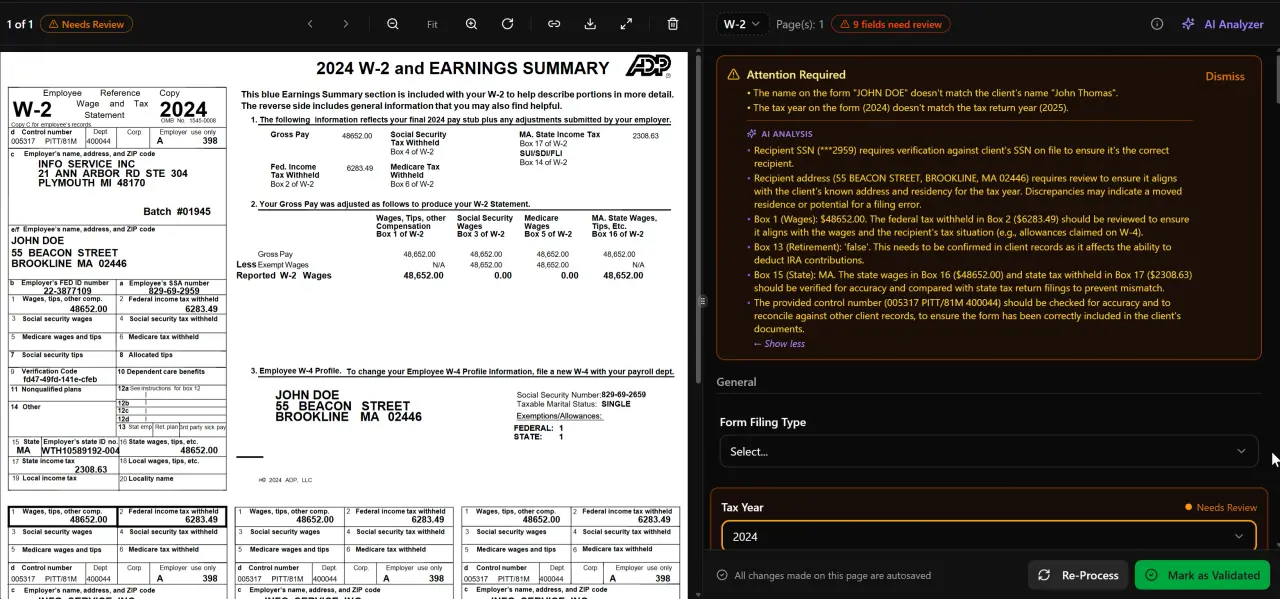
AI classifies, extracts, and validates every document automatically
Qualifying Property Rules Every CPA Must Verify
Tired of manual workflows slowing your firm down? See how TaxScout handles this with AI-powered automation. → Book a 15-Min Demo Bonus depreciation 2026 sits at the center of this decision — get it wrong and the rest unravels.
Not every asset a business client purchases in 2026 qualifies for the section 168k deduction. Under IRC Section 168(k)(2), qualified property must meet four tests: it must have a MACRS recovery period of 20 years or less (or be qualified improvement property), it must be the taxpayer's original use or meet the used-property acquisition rules introduced by TCJA, it must be acquired and placed in service within the same tax year, and it must not be specifically excluded property such as listed property used 50 percent or less for business, certain public utility property, or property subject to a floor-plan financing arrangement. When firms revisit their bonus depreciation 2026 priorities, the gaps usually surface here.
The original-use rule is where clients most frequently miss eligibility. A client who buys a used piece of equipment can still claim bonus depreciation provided the taxpayer (or a predecessor) has not previously used the property and the property was not acquired from a related party or in a nontaxable exchange. The IRS issued final regulations in 2020 clarifying the used-property acquisition rules, and those remain in force for 2026.
Qualified improvement property (QIP) — interior improvements to nonresidential real property placed in service after the building was placed in service — also qualifies, with a 15-year MACRS life and 40 percent bonus depreciation in 2026. The correction that made QIP bonus-eligible, legislated in the CARES Act in 2020, remains one of the more frequently missed categories when firms do not have a structured intake process to surface it. CPAs working through AI-native document extraction can flag QIP-related invoices during document classification and route them to a depreciation review stage before the preparer ever opens the return. Firms that build a consistent bonus depreciation 2026 screening process into their QIP workflow catch these opportunities far more reliably than those relying on preparer memory alone.
Still catching bonus depreciation opportunities by hand during review?
TaxScout's AI intake engine screens every business client's documents for fixed asset purchases above your threshold — automatically flagging Section 168 and QIP candidates before you open the return.
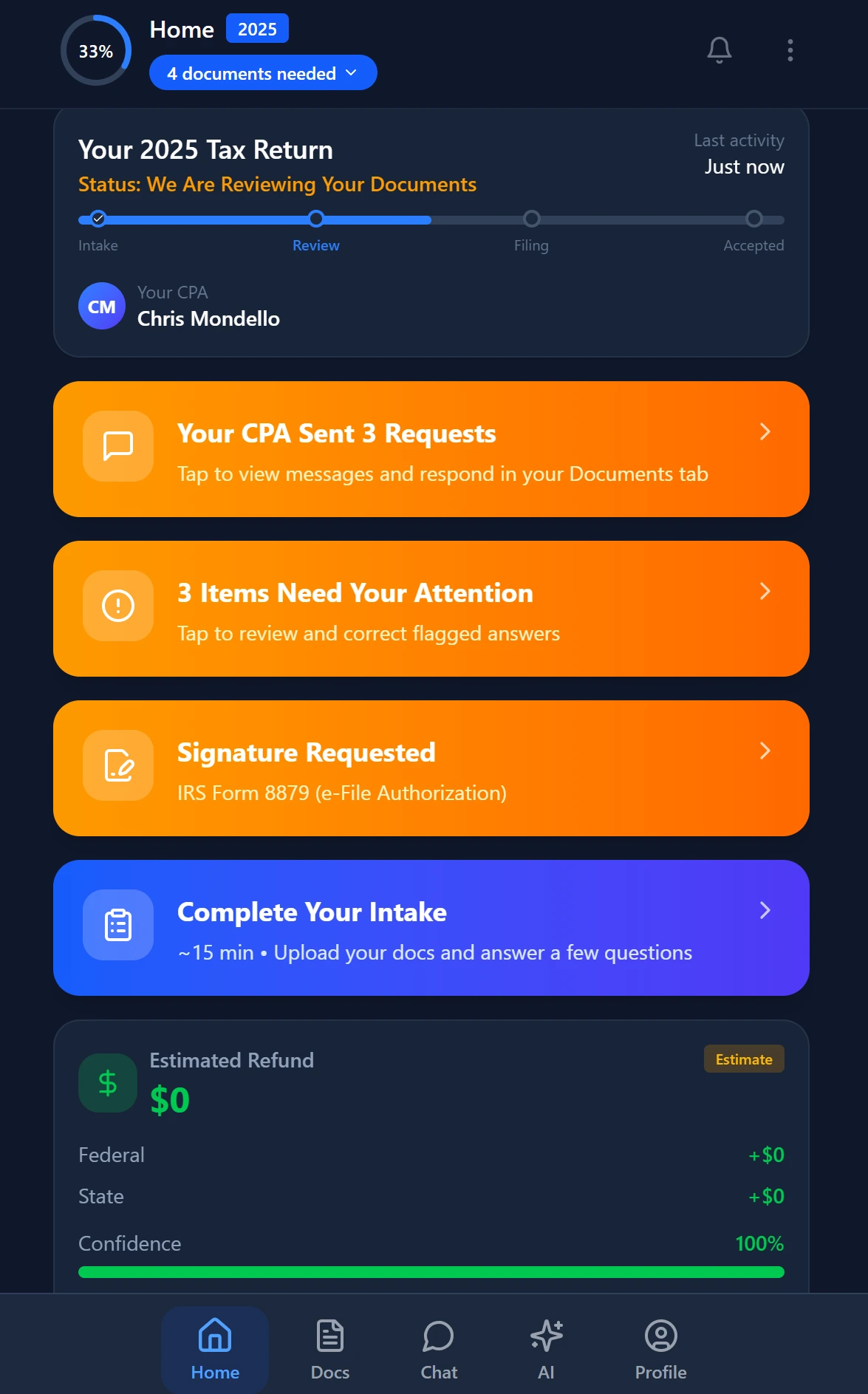
Smart intake auto-fills from uploaded documents and prior-year data
Section 179 and Bonus Depreciation Interaction: A Decision Tree for 2026
The interaction between Section 179 and bonus depreciation is one of the most practically important planning considerations for business clients in 2026, and it is almost entirely absent from competitor content on this topic. Both provisions allow accelerated expensing, but they have different income limitations, different recapture rules, and different strategic implications depending on the client's situation.
Section 179 allows expensing of qualified property up to $1,220,000 in 2026 (indexed for inflation), but the deduction is limited to taxable income from active trade or business. A client who already has a net operating loss or minimal taxable income cannot carry a Section 179 deduction forward and generate a refund — it is simply suspended. Bonus depreciation under Section 168(k), by contrast, can create or increase a net operating loss that the client carries forward under IRC Section 172. For loss-year clients, bonus depreciation is almost always the better tool, and the 40 percent rate available under bonus depreciation 2026 still produces a meaningful first-year write-down even in a challenging income year.
The decision tree for a profitable client looks different. If the client has sufficient taxable income, Section 179 should generally be applied first up to the limit, because it does not reduce the basis used in the bonus depreciation calculation for purposes of the phaseout. Then bonus depreciation is applied to remaining qualified property. The practical implication: a $600,000 asset purchase can yield up to $1,220,000 in Section 179 (if other assets are eligible) plus 40 percent bonus on any remaining basis — all in the same tax year. CPAs reviewing the glossary entry on TCJA sunset provisions should also flag that current Section 179 limits and bonus depreciation percentages are TCJA-era rules, and the post-2025 sunset landscape continues to evolve.
One additional wrinkle: Section 179 is elective, and it requires an affirmative election on the tax return. Bonus depreciation, by contrast, applies automatically unless the taxpayer makes an opt-out election under IRC Section 168(k)(7). Firms that do not have a structured election-documentation workflow risk either missing the bonus depreciation benefit entirely (no affirmative election needed, but basis tracking errors occur) or failing to document the Section 179 election in the required manner, leaving the deduction vulnerable on examination. This documentation gap is especially costly under bonus depreciation 2026, when every percentage point of the remaining 40 percent window matters.

Click any extracted field to see its source highlighted on the original PDF
Building a Repeatable Client Screening Workflow to Catch Depreciation Opportunities
The competitive gap in CPA advisory is not knowledge of the law — it is the absence of a systematic process for identifying which clients own qualifying assets before the return preparation window closes. A repeatable depreciation screening workflow has three stages: intake flagging, threshold review, and election documentation.
At the intake stage, business clients should be asked directly about fixed asset purchases above a dollar threshold — typically $2,500 or higher, matching the IRS de minimis safe harbor under the tangible property regulations. TaxScout's AI intake engine, modeled on IRS Form 13614-C, includes a four-layer prefill process that can be customized to surface fixed asset acquisition questions for any client coded as a business entity. When the client uploads invoices or fixed asset schedules through the branded client portal, the AI document classification layer identifies purchase documents and routes them to the depreciation review checklist — without any manual intervention from the preparer.
At the threshold review stage, the assigned CPA or staff member evaluates each flagged asset against the four qualified-property tests described above. This is where the split-screen PDF viewer with click-to-source field highlighting earns its value: the reviewer can open an invoice alongside the depreciation schedule side by side, verify the placed-in-service date, confirm the asset's MACRS classification, and mark the review complete — all in a single interface. The review outcome feeds the pipeline stage tracker, which can be configured as one of TaxScout's 12 customizable kanban stages, so firm managers can see exactly how many business returns have completed the depreciation screening step versus how many are pending.
At the documentation stage, the election details — Section 179 amounts, bonus depreciation opt-outs if applicable, and any special elections for listed property — are captured and attached to the client's file. For firms using Drake, CCH Axcess, UltraTax CS, Lacerte, or other tax software, TaxScout works alongside the existing tax prep environment rather than replacing it, so the documented election flows into the preparer's software workflow rather than creating a parallel process. You can read more about that integration model in the Drake Tax Software integration overview.
Configuring Intake Triggers for Fixed Asset Purchases
The intake trigger configuration is a one-time setup per client category. In TaxScout, business clients can be tagged by entity type (S-Corp, Partnership, C-Corp, Schedule C), and the intake questionnaire can include conditional logic: if the client indicates capital expenditures above the threshold, a follow-up document request automatically appears in the portal asking for purchase invoices, placed-in-service dates, and asset classifications. This is the firm-level automation layer that most practice management platforms — including workflow-centric tools like Karbon — do not provide, because they are built around task and email management rather than document-aware intake logic. For firms that serve capital-intensive clients, building this trigger around bonus depreciation 2026 thresholds ensures no qualifying purchase slips through unexamined.
Tracking Elections Across the Pipeline
Once the depreciation screening stage is complete, the pipeline management board provides a real-time view of every business return and its depreciation review status. Managers can filter by stage, spot returns where the review has not been completed close to the due date, and reassign tasks without touching the underlying tax software. For larger firms with multiple preparers, the pipeline management feature eliminates the spreadsheet-and-email coordination that typically causes elections to be missed when a return is reassigned mid-season.
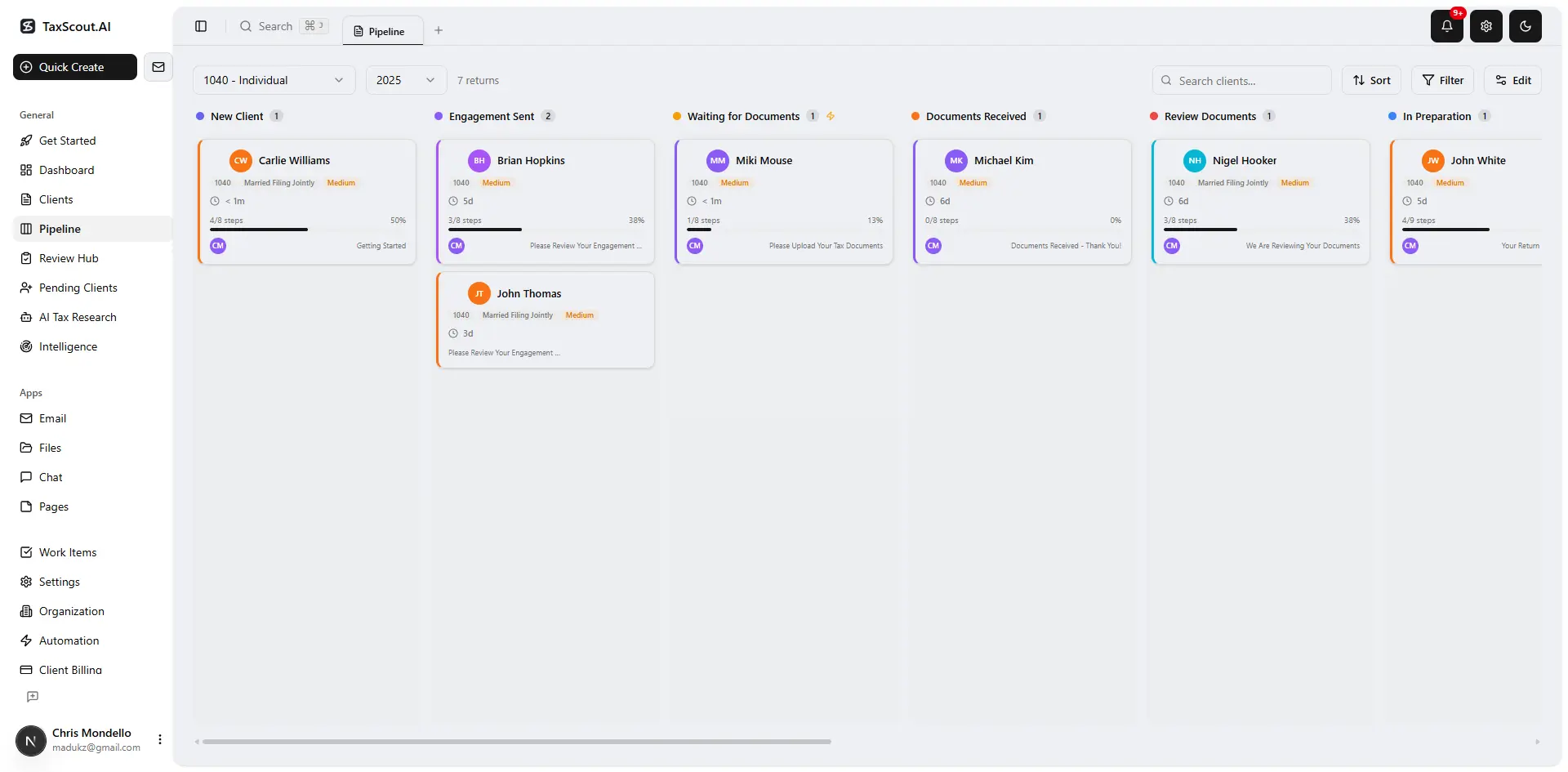
Track every return from intake to filed with drag-and-drop pipeline management
Documenting the Bonus Depreciation Election for IRS Examination Readiness
A bonus depreciation deduction that cannot be substantiated in examination is a deduction that will be disallowed. The documentation requirements are not burdensome, but they must be complete: the depreciation schedule (Form 4562) must reflect the correct asset classifications, placed-in-service dates, and applicable percentages. If a Section 179 election is made, it must appear on the return in the tax year the property is placed in service and cannot be revoked without IRS consent after the return is filed.
If the taxpayer is opting out of bonus depreciation for a specific class of property under IRC Section 168(k)(7), that election must be made on a timely filed return (including extensions) and applies to all property in the same class placed in service during the tax year. Selective opt-outs within a class are not permitted. CPAs should document the opt-out rationale in the client file — for example, where a client has a passive activity limitation that would defer the deduction anyway, or where the client prefers a smoother income profile for loan covenant compliance reasons. Thorough documentation is especially important for bonus depreciation 2026 returns, where the 40 percent rate makes each qualifying asset's classification worth scrutinizing carefully.
TaxScout's AI research agents can pull the relevant Treasury regulations, revenue procedures, and any pending IRS guidance on bonus depreciation in real time, sourcing directly from IRS.gov, Treasury, and Cornell Law. This means preparers do not have to navigate to authoritative sources manually during the documentation stage — the research is surfaced in context, alongside the client file. You can also review other blog resources on related tax planning topics, including the companion guide on cost segregation studies, which interacts directly with bonus depreciation for real property clients.

Your clients see your brand — OTP login, document upload, and real-time status
Communicating the Tax Savings Story in a Client Advisory Meeting
Identifying and documenting the bonus depreciation election is the technical deliverable. Converting it into a client advisory conversation is where CPA firms differentiate their practice and justify higher fees. The savings story for a 2026 business client with $400,000 in qualifying asset purchases looks like this: 40 percent Section 168(k) bonus depreciation produces a $160,000 first-year deduction. At a 37 percent federal marginal rate for a profitable S-Corp owner, that translates to approximately $59,200 in deferred federal income tax — real cash that stays in the business or is available for reinvestment this year rather than being paid to the IRS over the MACRS recovery period.
The advisory meeting should also cover the phaseout trajectory. If the same client plans a similar capital expenditure in 2027, the bonus depreciation rate drops to 20 percent, cutting the first-year benefit roughly in half. Accelerating purchases into the current year — or the first day of the next tax year with careful planning — can meaningfully shift the timing of deductions. Framing this urgency around bonus depreciation 2026 gives clients a concrete reason to act before year-end rather than deferring the conversation. This is the kind of forward-looking conversation that transforms a compliance relationship into an advisory services engagement, and it is well supported by the concrete numbers the 2026 phasedown schedule provides.
For CPAs who want to prepare meeting materials quickly, TaxScout's AI research agents can generate a depreciation scenario summary by pulling the client's prior-year fixed asset schedule, the current-year document uploads, and the applicable phaseout percentages into a structured briefing. The AI notetaker feature can capture the meeting discussion and create follow-up tasks directly in the pipeline, so the advisory conversation flows into documented action items without a manual transcription step. This is the kind of integrated workflow that platforms focused primarily on email management — like Karbon — do not provide, as covered in the TaxScout vs. Karbon comparison.
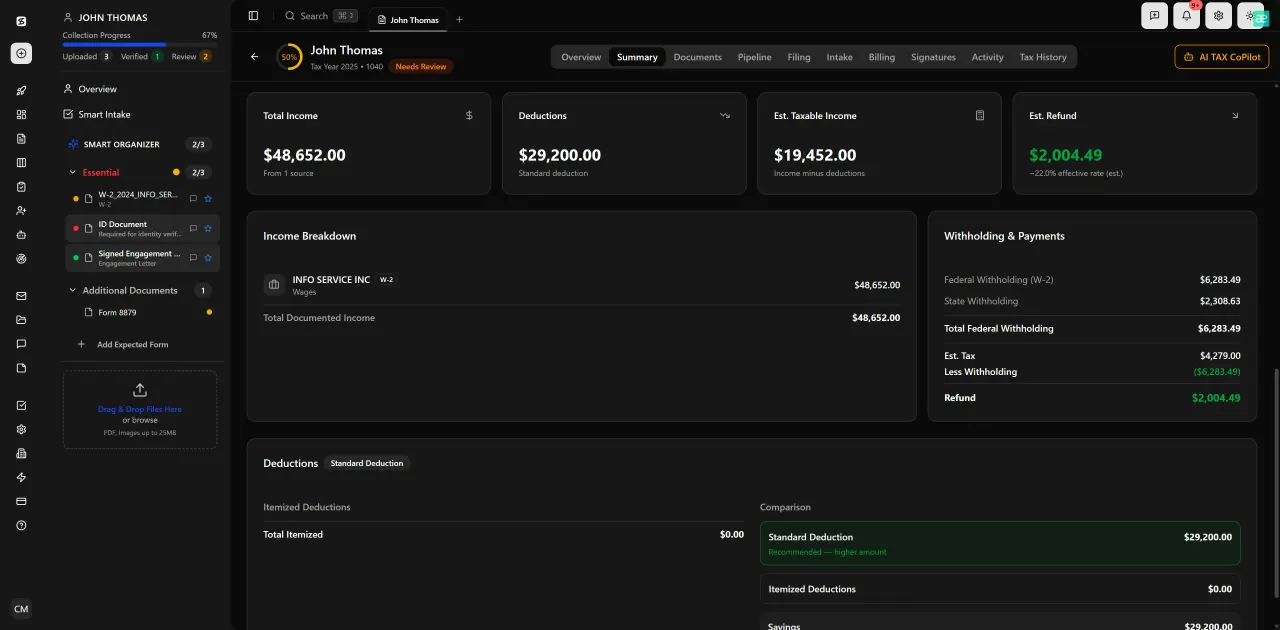
Review with AI assist — 9 agents answer questions with full client context
Bonus Depreciation Workflow Capabilities: TaxScout vs. Email-Centric Practice Management
| Capability | TaxScout | Karbon | TaxDome |
|---|---|---|---|
| AI document extraction with fixed asset flagging | Yes — AI classification routes invoices to depreciation review | No — email and task management only | No — no AI extraction layer |
| Smart intake with conditional asset purchase questions | Yes — 4-layer prefill with entity-type conditional logic | No — intake not included | Basic — no AI gap analysis |
| Pipeline stage for depreciation screening | Yes — 12 customizable stages, drag-and-drop kanban | Yes — workflow templates | Yes — workflow stages |
| AI research agents for live IRS/Treasury guidance | Yes — 9 specialized agents with real-time search | No | No |
| Split-screen PDF viewer for invoice review | Yes — click-to-source field highlighting | No | No |
| Works alongside Drake / Lacerte / CCH Axcess | Yes — designed as a complement to tax software | No direct integration | Limited |
| Pricing model | $149/month flat, unlimited team members | ~$59/user/month | ~$100/user/month |
State-Level Bonus Depreciation Conformity Issues CPAs Must Address
Federal bonus depreciation planning is only half the picture for multi-state business clients. Many states do not fully conform to Section 168(k), requiring addback adjustments on state returns that reduce or eliminate the state-level benefit. As of 2026, states including California, New York, New Jersey, and Illinois maintain partial or full decoupling from federal bonus depreciation rules, requiring CPAs to track both the federal deduction and the state addback on a client-by-client basis. For clients operating across multiple jurisdictions, the federal bonus depreciation 2026 benefit can look very different once state conformity adjustments are applied.
California, for example, does not allow bonus depreciation at all for state income tax purposes under California Revenue and Taxation Code Section 24349, requiring a full addback of the federal bonus depreciation amount and a separate state depreciation schedule. New York conforms to federal bonus depreciation for most property but has specific provisions for certain listed property. CPAs working with clients in these states should flag the state conformity analysis as a required step in the depreciation review stage — not an afterthought. The California Tax Changes 2026 guide and New York State Tax Updates 2026 articles cover the state-specific landscape in more detail.
The state conformity layer is also where TaxScout's AI research agents add disproportionate value. Rather than consulting a static conformity chart that may be outdated, preparers can run a real-time query against state tax authority sources and receive a current-year conformity analysis for each state in the client's filing profile. The state tax deadlines tracker ensures the state returns with addback schedules are filed on time alongside the federal return.
Want a platform that flags bonus depreciation candidates automatically and keeps every election documented for examination?
TaxScout combines AI intake screening, document extraction, pipeline management, and live IRS research — at a flat monthly rate with no per-user fees.

Every client gets organized documents, status tracking, and a complete history
Frequently Asked Questions
The Section 168(k) bonus depreciation rate for property placed in service in 2026 is 40 percent under the TCJA phasedown schedule. The rate was 80 percent in 2023, 60 percent in 2024, and drops to 20 percent in 2027 before expiring entirely in 2028 under current law. CPAs should monitor Treasury guidance for any legislative restoration before finalizing 2026 returns.
Keep reading
Backdoor Roth IRA: How CPAs Execute the Strategy Without Triggering Pro-Rata Tax
Oct 12, 2026 · 1 min read
Transparency in Coverage Final Rules: What CPA Firms Must Do Now
Oct 12, 2026 · 1 min read
Late Filing Penalty Relief: How CPAs Reduce or Eliminate IRS Failure-to-File Charges
Oct 12, 2026 · 1 min read
Stay up to date
Get the latest tax tech insights delivered to your inbox.