Roth Conversion Strategy: How CPAs Build Year-End Tax Plans for Clients
Most Roth conversion content is written for investors. This guide is written for CPAs — covering how to screen your client roster for conversion candidates, model bracket impact at scale, time conversions around key life events, and package the analysis as a recurring advisory service with defined…
For most CPA firms, a Roth conversion strategy conversation happens exactly once: a client asks about it during a tax review, the advisor spends twenty minutes explaining the basics, and the topic disappears until the next time someone brings it up. That reactive pattern leaves significant advisory revenue — and real client outcomes — on the table. A true roth conversion strategy goes far beyond that single conversation, requiring a structured, repeatable framework that CPAs can apply consistently across their book of business.
The CPA who builds a systematic, repeatable process for identifying conversion candidates across their entire client base, running bracket analysis on each one, and delivering a packaged recommendation converts that one-off conversation into a high-margin advisory line that recurs every Q4. This guide walks through every operational step of that process: how to screen your roster, how to model conversions using your existing tools, how to time them around life events, and how to price and deliver the service so it scales without creating a bottleneck. Embedding a roth conversion strategy into the firm's annual workflow transforms it from an ad hoc discussion into a predictable, scalable advisory service clients come to expect every year.
You will not find generic personal-finance advice here. The focus is entirely on what a CPA does inside a practice — the workflow, the models, the client communication, and the technology that makes it sustainable at volume. Instead, every section is grounded in the practical mechanics of executing a roth conversion strategy at the practice level, where client volume, time constraints, and margin all matter.
Why Roth Conversion Strategy Is a Q4 Advisory Opportunity
Roth conversions must be completed by December 31 to count in the current tax year, which means the Q4 planning window is the only time conversions can actually be executed for the year in question. That hard deadline creates a natural advisory trigger: every October and November, you have a credible reason to proactively reach out to a defined segment of your client base with a time-sensitive, high-value conversation. For firms evaluating their roth conversion strategy approach, this trade-off compounds over time.
The TCJA sunset provisions scheduled for after 2025 have added urgency to multi-year conversion planning. The current individual rate brackets — 10%, 12%, 22%, 24%, 32%, 35%, and 37% — are scheduled to revert to pre-2018 levels absent Congressional action, collapsing the 22% and 24% brackets and widening the gap that makes partial conversions especially attractive. According to IRS Revenue Procedure 2024-40, the 2025 income thresholds for each bracket are well-established, giving CPAs a defined planning surface for the current season. Each of these factors directly shapes how a roth conversion strategy plays out in practice, and firms that understand this dynamic are better positioned to deliver timely, high-confidence recommendations.
Clients who retire early, sell a business, take sabbaticals, or experience other income-disrupting events often pass through one or more years of unusually low taxable income. Those windows close permanently once Social Security, required minimum distributions, or business income resumes. A CPA who spots these windows systematically — not anecdotally — captures value that transactional tax prep firms routinely miss. For more on how practice-level analytics support this kind of proactive outreach, see our complete guide to CPA advisory resources. Understanding roth conversion strategy in this context is what separates firms that scale from those that stall.
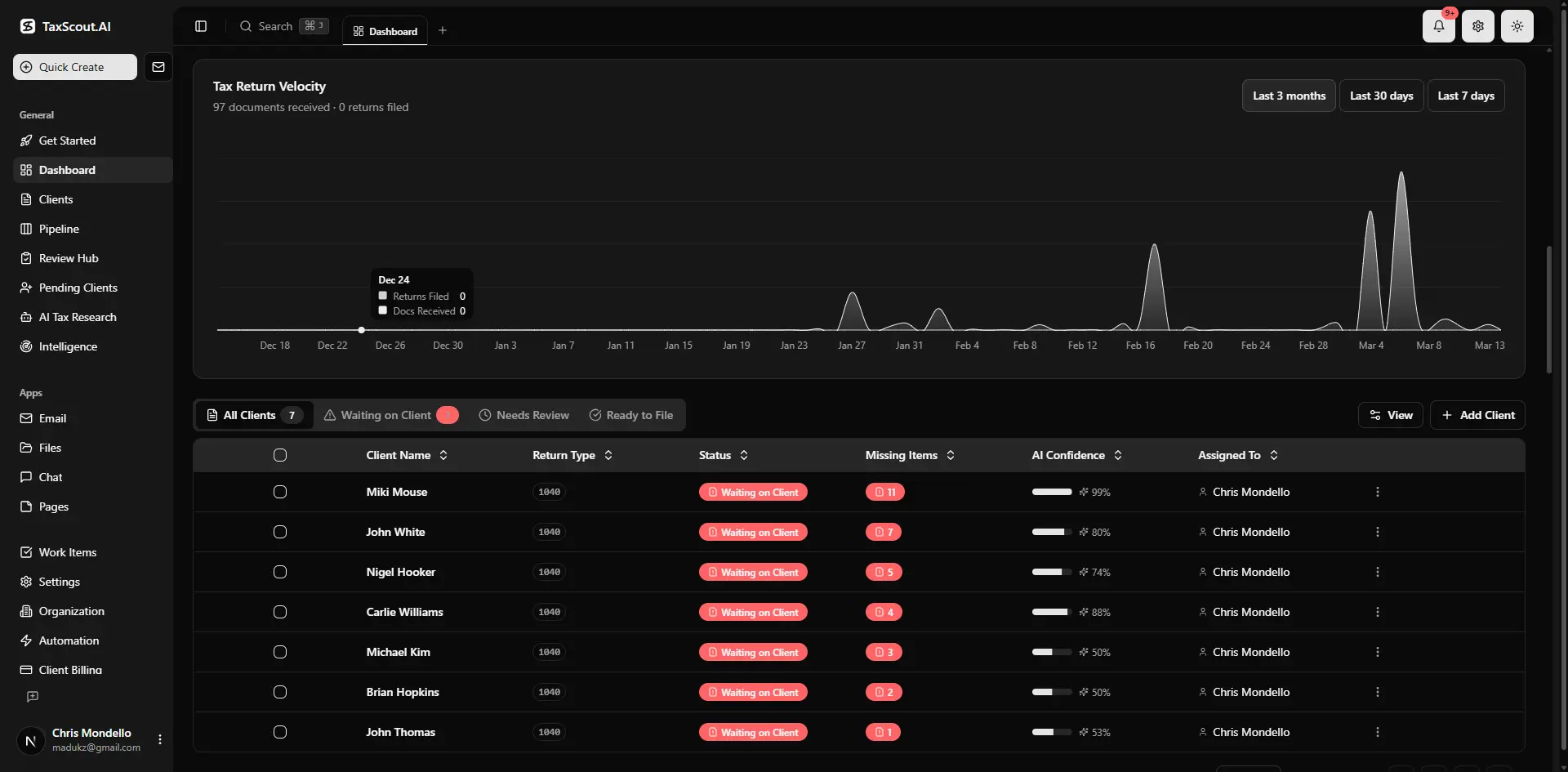
Real-time dashboard showing returns in progress, revenue, and upcoming deadlines
Screening Your Client Roster for Roth Conversion Candidates
The first operational challenge is not modeling conversions — it is identifying which clients warrant the analysis in the first place. Running a full bracket model for every client in a 200-return practice is not viable. You need a screening layer that surfaces the highest-probability candidates with minimal effort. This is precisely where a deliberate roth conversion strategy pays off.
Build a short candidate criteria checklist against your client file data: (1) traditional IRA or 401(k) balance above a threshold you define (often $100,000 or more); (2) projected current-year taxable income that leaves measurable headroom below the next tax bracket ceiling; (3) age between 50 and 72, where RMD timelines are relevant but not yet forcing distributions; (4) no immediate need for the funds within five years; (5) expected higher income in future years, whether from Social Security, pensions, RMDs, or business income. Roth conversion strategy sits at the center of this decision — get it wrong and the rest unravels.
Clients approaching age 73 — the current RMD required beginning date under SECURE 2.0 — are particularly strong candidates. Converting pre-RMD balances reduces the future RMD base, compresses the tax hit that would otherwise be forced, and can prevent Medicare IRMAA surcharges from triggering. An AI-native practice management platform can flag these clients automatically based on birthdate data and prior-year return history, turning what would be a manual spreadsheet exercise into an automated alert within your workflow. TaxScout's client management tools maintain entity structures and filing history precisely for this kind of context-aware screening. When firms revisit their roth conversion strategy priorities, the gaps usually surface here.
Spending Q4 reacting to client questions instead of proactively surfacing Roth conversion opportunities?
TaxScout's AI client memory and pipeline management let you flag conversion candidates automatically and deliver analysis at scale — without adding headcount.
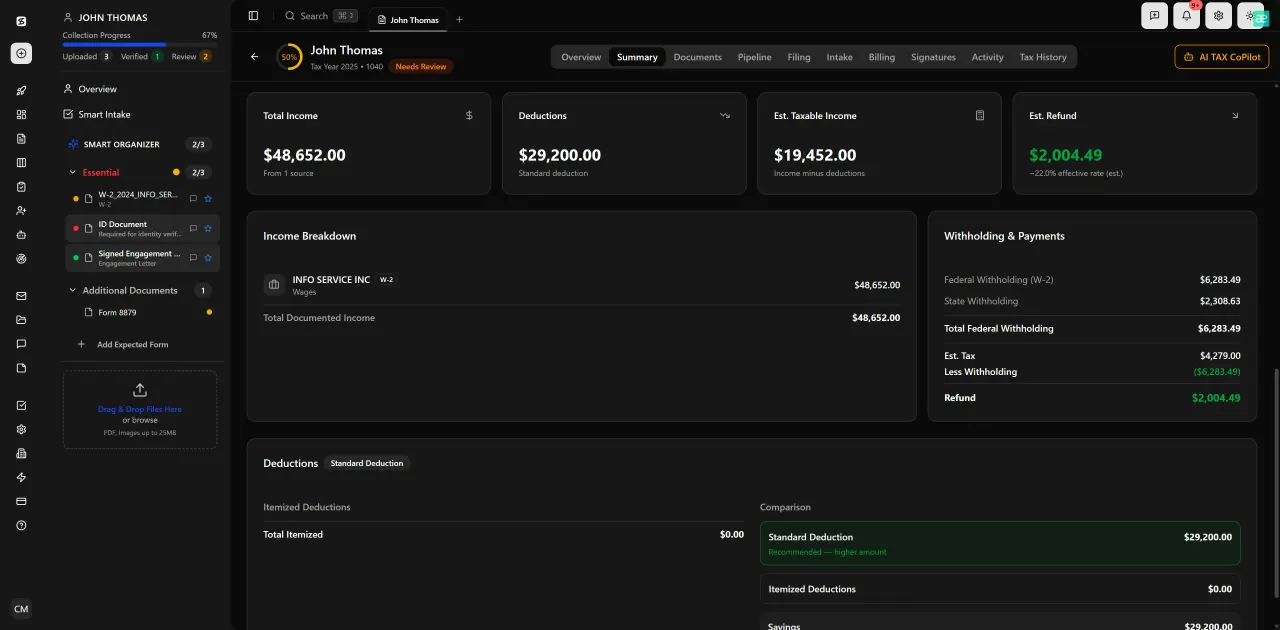
Review with AI assist — 9 agents answer questions with full client context

Click any extracted field to see its source highlighted on the original PDF
Roth Conversion Income Thresholds and Bracket Analysis
Once you have a candidate list, bracket analysis is the core modeling task. The goal of a partial Roth conversion strategy is to fill the client's current bracket up to — but not over — the ceiling, converting only the amount that will be taxed at a rate lower than the client's projected future effective rate. For 2025, the 22% bracket for married filing jointly tops out at $206,700 of taxable income; the 24% bracket runs to $394,600. Those ceilings define your conversion room for most middle-income pre-retirees.
The math is straightforward: (bracket ceiling) minus (current projected taxable income before conversion) equals the maximum conversion amount for that bracket. A client with $120,000 of projected taxable income in a year when they are between jobs has $86,700 of 22%-bracket room. Converting that amount moves pre-tax dollars into a Roth at a rate that may be meaningfully lower than their expected future marginal rate when RMDs begin. Framing this analysis as a roth conversion strategy — rather than a one-time calculation — helps clients understand why revisiting the numbers each year produces better long-term outcomes than a single conversion decision.
Do not forget state income tax in the model. States like California and New York stack their own marginal rates on top of federal, which can shift the break-even point significantly. For California-specific considerations, our post on California Tax Changes 2026 CPAs Must Know covers the current state rate structure. TaxScout's Excel 1040 calculator — 66 sheets and approximately 36,000 formulas — is well-suited for running these projections quickly across multiple scenarios without rebuilding a model from scratch each time.
The pro-rata rule under IRC Section 408 is the trap that invalidates many conversion analyses. If a client has both pre-tax and after-tax IRA balances, conversions are not treated as coming exclusively from the pre-tax portion. The taxable fraction equals (pre-tax IRA balance) divided by (total IRA balance across all accounts). Clients with significant after-tax non-deductible IRA contributions need a separate pro-rata calculation, and in some cases the backdoor Roth CPA strategy — contributing to a traditional IRA and immediately converting — only makes sense if the client has no other pre-tax IRA balance to trigger the pro-rata rule.
Timing Conversions Around Life Events
The highest-value conversion windows are not random — they cluster around predictable life events. Each event type has distinct modeling considerations that differentiate a thoughtful CPA analysis from a generic financial planning template. A well-executed roth conversion strategy accounts for these triggers explicitly, rather than treating every client's situation as a single static snapshot.
Retirement transition years are the most common trigger. In the year a client retires from W-2 income, their taxable income often drops by 40-60% before Social Security, RMDs, or pension income begins. Depending on the client's age and benefit start dates, this low-income gap may last one to five years. Every year inside that window is a potential conversion year, and the cumulative conversion across multiple years can meaningfully reduce the future RMD base.
Business sale years create the opposite dynamic: a large capital event may push a client into the top bracket, making that year a poor conversion year. However, the year after a business sale — when the client has stepped back from active income but has significant liquid assets — is often ideal. The IRS rules on installment sales under Section 453 can also create multi-year income spreading that requires coordinating conversion timing with installment receipt schedules.
Sabbaticals, career transitions, disability years, and even years with large itemized deductions (major charitable gifts, unusual medical expenses) can all create temporary bracket room. The CPA who reviews these triggers annually — not just at filing time — catches windows that close permanently. Building this review into a formal year-end tax planning checklist and scheduling client outreach in October rather than December gives the conversion enough time to actually be executed before year-end.
Coordinating with Medicare IRMAA Thresholds
For clients aged 63 and older, modified adjusted gross income two years prior determines Medicare Part B and Part D premium surcharges under the IRMAA rules. A conversion that pushes MAGI above an IRMAA tier triggers a premium surcharge that can add $1,000 or more per person annually. The Social Security Administration publishes current IRMAA thresholds and they must be factored into the conversion ceiling alongside the federal bracket analysis.
For high-income clients who are already above the base IRMAA tier, the analysis shifts to whether the conversion is large enough to jump to the next tier and what the long-term tax savings justify relative to the near-term premium cost. This tradeoff calculation is one of the clearest examples of advisory value that transactional tax prep simply does not surface. Positioning this nuance as part of a broader roth conversion strategy gives clients a framework for understanding why the recommendation changes from year to year.
Roth Conversion and the Net Investment Income Tax
Clients with significant investment income need a second ceiling check: the 3.8% net investment income tax applies to the lesser of net investment income or the amount by which MAGI exceeds $250,000 for married filers. A conversion that pushes MAGI above this threshold accelerates NIIT liability on otherwise passive income and must be modeled as part of the total tax cost, not just the marginal bracket rate.

Your clients see your brand — OTP login, document upload, and real-time status
The Backdoor Roth Strategy for High-Income Clients
Direct Roth IRA contributions are phased out for single filers with MAGI above $150,000 and married filers above $236,000 in 2025. High-income clients who cannot contribute directly can use the backdoor Roth CPA technique: make a non-deductible traditional IRA contribution (no income limit applies to contributions, only deductibility) and then convert it to Roth. The conversion is tax-free if the client has no other pre-tax IRA balances — the pro-rata rule zeroes out if the ratio is 100% after-tax. For these clients, the backdoor approach is often the most accessible roth conversion strategy available, and documenting it correctly each year is just as important as the mechanics of the conversion itself.
The mechanical steps are simple, but the documentation discipline is not. Form 8606 must be filed in the year of the non-deductible contribution and again in the conversion year, and the basis must carry forward correctly across years. CPAs who manage this for multiple clients annually need a tracking system that does not rely on remembering which clients have Form 8606 history. TaxScout's client-context AI memory retains entity structures and filing history across tax years, making it practical to surface the 8606 basis for each client during the conversion analysis without digging through prior-year paper files.
For clients with large pre-tax rollover IRA balances, a 401(k) rollback strategy — rolling the pre-tax IRA into an employer plan, leaving only the after-tax balance in the IRA, then converting — can clear the pro-rata problem. Not all employer plans accept incoming rollovers, so this requires coordination with the client's HR department, but it can unlock the backdoor strategy for clients who would otherwise be blocked by legacy IRA balances.
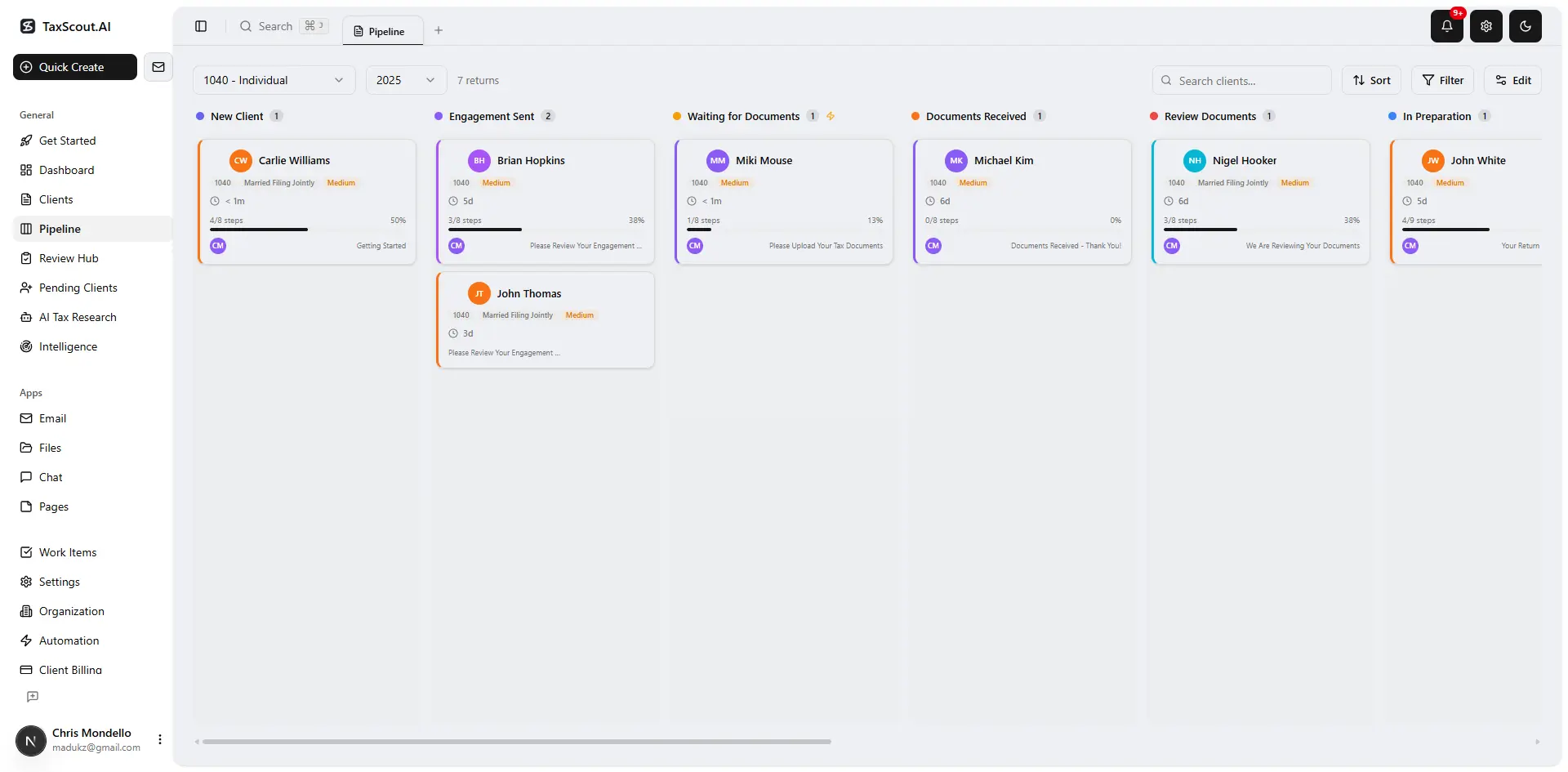
Track every return from intake to filed with drag-and-drop pipeline management
Roth Conversion Candidate Screening Matrix: Key Variables by Client Profile
| Client Profile | Ideal Conversion Timing | Key Modeling Variable | Primary Risk to Monitor |
|---|---|---|---|
| Early retiree, age 55-65 | Gap years before Social Security | Annual bracket headroom during gap | IRMAA impact at age 63+ |
| Near-RMD client, age 68-72 | Before RMD required beginning date | Projected RMD size vs. bracket room | State income tax stacking |
| High-income earner (over limits) | Any year, backdoor only | Pro-rata rule / Form 8606 basis | Pre-tax rollover IRA balance |
| Business sale client | Year after sale close | Installment receipt schedule | NIIT threshold crossover |
| Low-income transition year | Current year only | Full bracket room available | Five-year Roth clock for withdrawals |
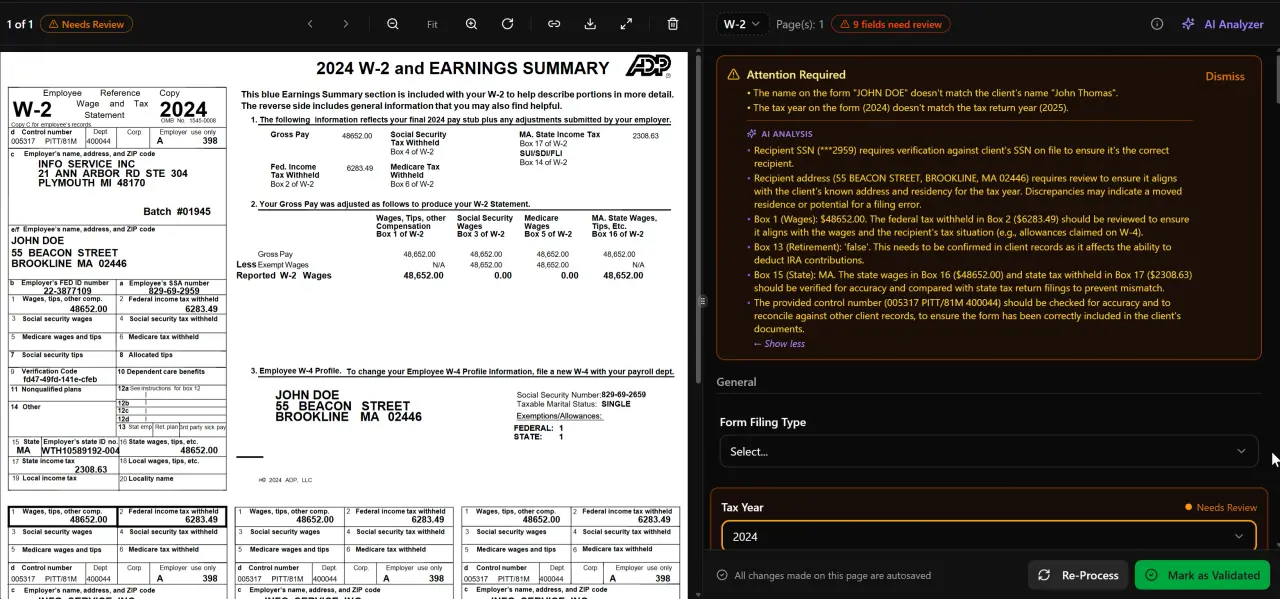
AI classifies, extracts, and validates every document automatically
Packaging Roth Conversion Analysis as a Recurring Advisory Service
The firms that generate consistent revenue from Roth conversion planning treat it as a defined, priced service — not a complimentary discussion added to a tax return review. The distinction matters operationally. A defined service has a scope, a deliverable, a price, and a recurring schedule. A complimentary discussion has none of those things and creates no revenue.
A well-scoped Roth conversion analysis service typically includes: (1) annual candidate screening against your client base in September; (2) bracket modeling with at least two conversion scenarios (fill to top of current bracket vs. partial fill to stay below the next IRMAA tier); (3) a one-page written summary with the recommended conversion amount, projected tax cost, and five-year break-even estimate; (4) coordination with the client's investment advisor or custodian to execute the conversion before December 31; (5) a brief December follow-up to confirm execution and document for the return. Clients who receive this deliverable consistently each year come to see roth conversion strategy as a core part of their annual financial planning process — not a one-time discussion.
On pricing, the flat fee billing model is the right structure here. Hourly billing creates client anxiety about clock-watching during the analysis conversation and undervalues the screening work you do before the client ever sees a recommendation. A flat annual fee of $500-$1,500 per client depending on complexity (single vs. multiple IRA accounts, presence of after-tax basis, business sale coordination) is defensible given the tax savings typically at stake. See our post on CPA firm pricing models for a broader framework on structuring advisory fees alongside compliance work.
Bundling Roth conversion analysis into a broader year-end tax planning package — alongside estimated payment reviews, capital gain harvesting, and charitable giving optimization — is a common upsell path that increases the average engagement value while giving the client a clear reason to engage before October rather than waiting until December. The TaxScout invoicing feature via Stripe Connect Express makes it straightforward to bill advisory fees separately from compliance retainers without creating a separate billing workflow.
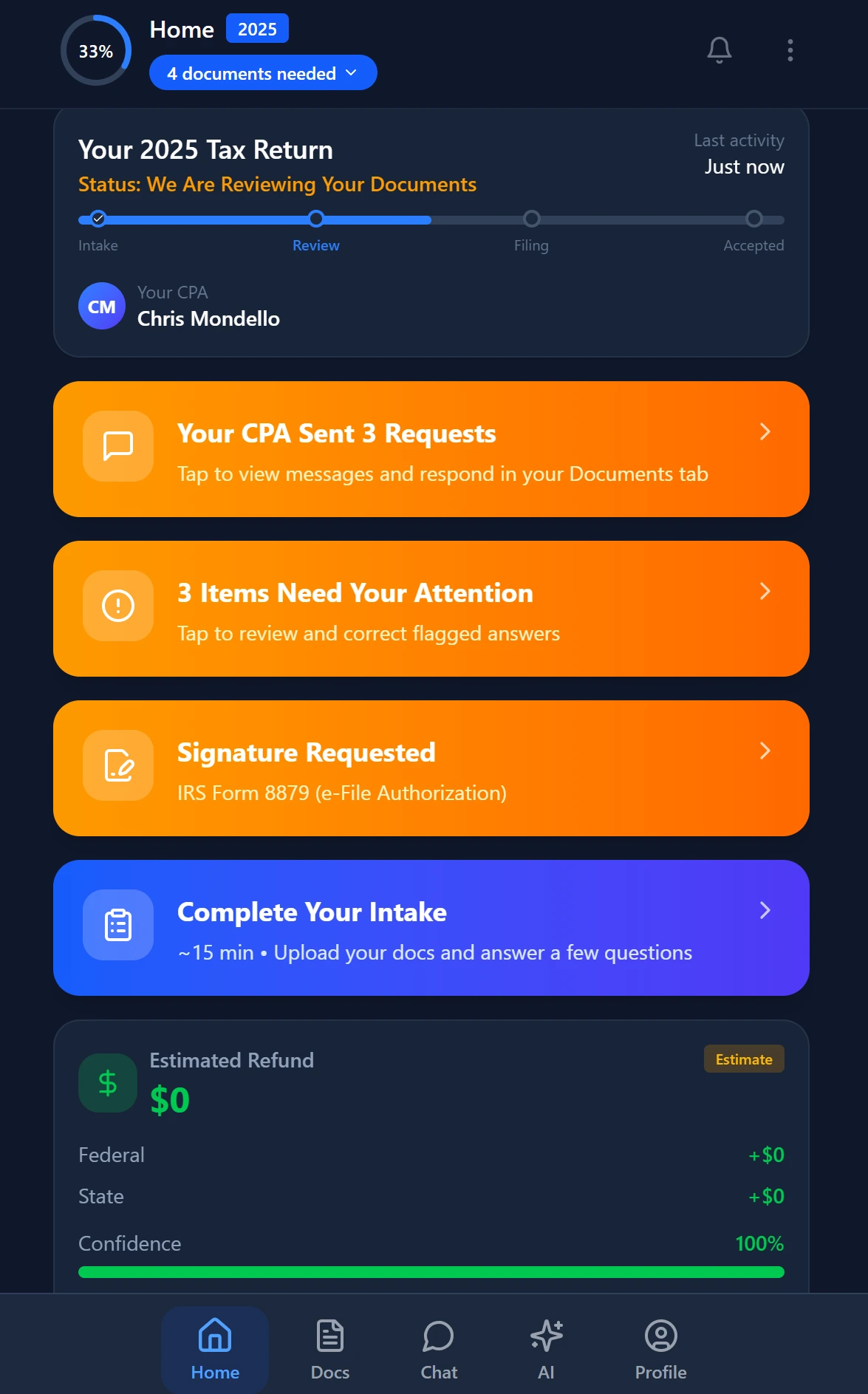
Smart intake auto-fills from uploaded documents and prior-year data
How AI-Native Practice Management Supports Roth Conversion Workflows
The bottleneck in scaling a Roth conversion advisory practice is not the analysis itself — it is the data gathering, client screening, and communication coordination that surrounds it. A CPA doing manual screening across 200 client files in September is spending three to five hours just building the candidate list, before any modeling begins. AI-native practice management tools change that equation, making it possible to operationalize a roth conversion strategy across a full client roster without proportional increases in staff time.
TaxScout's AI document extraction processes W-2s, 1099s, K-1s, and 1099-R forms through a 5-layer validation pipeline — document quality routing, AI extraction with confidence scoring, OCR cross-verification, 15 deterministic math rules, and 18 post-extraction rules — and stores the structured data in the client record. That means prior-year income, IRA distribution amounts, and basis information are available without manual re-entry when you build the conversion model. For a deeper look at how AI extraction works technically, see our guide to AI document extraction for CPAs.
The AI research agents — nine specialized agents with real-time IRS, Treasury, Cornell Law, SSA, and Congressional search — let you quickly verify current RMD tables, IRMAA thresholds, or pro-rata rule mechanics without leaving the client record. During Q4 planning season when rule details matter and time pressure is real, having those agents inside the workflow rather than in a separate browser tab reduces friction and error. The TaxScout pipeline management system with 12 customizable stages and drag-and-drop kanban makes it practical to run a parallel Roth conversion workflow alongside the main tax prep pipeline, with stage gates for candidate identified, model completed, recommendation delivered, and conversion confirmed.
For client communication, the branded client portal with OTP login eliminates the password friction that slows down document exchange during the narrow Q4 window. A client who needs to share a current IRA statement to complete the analysis can do so through the portal in minutes rather than waiting for a secure email to open. The e-signature capability via Documenso supports any advisory engagement letters or updated scope agreements needed before beginning paid advisory work.
Want to run systematic Roth conversion screening across your entire client base without spending a week on manual data gathering?
TaxScout gives CPA firms AI extraction, client-context memory, and pipeline management on a single flat-fee platform — no per-user pricing, unlimited team members.
Frequently Asked Questions
Strong candidates typically have a traditional IRA or 401(k) balance above $100,000, projected taxable income that leaves headroom below their next bracket ceiling, and a future income trajectory (RMDs, Social Security, pension) that suggests higher rates ahead. Clients approaching the RMD required beginning date at age 73, early retirees in a gap year before Social Security, or high-income clients using the backdoor Roth technique are the three most common segments worth screening annually.
Keep reading
Sole Proprietor Tax Strategy: How CPAs Build a Year-Round Planning System for Schedule C Clients
Sep 17, 2026 · 1 min read
Allocation and Apportionment of Deductions to Foreign Source Income: New IRS Proposed Rules
Sep 14, 2026 · 1 min read
Information Reporting Regarding Qualified Opportunity Zones: What CPA Firms Must Do Now
Sep 14, 2026 · 1 min read
Stay up to date
Get the latest tax tech insights delivered to your inbox.