Accounting Firm Business Plan: How to Build One That Actually Drives Growth
A static Word-document business plan is a liability, not a strategy. This guide shows CPA firm owners how to build an accounting firm business plan that draws on live pipeline, capacity, and revenue data — and why June is the ideal moment to do it.
Every accounting firm business plan starts the same way: a partner spends a Sunday afternoon writing goals into a Word doc, saves it to a shared drive, and never opens it again. Twelve months later, headcount is up, margins are down, and nobody can explain why. The document that was supposed to guide growth became an artifact of optimism — disconnected from the firm's actual numbers.
The problem is not that CPAs lack strategic vision. The problem is that the traditional business plan is a snapshot frozen at one moment in time. Your pipeline changes weekly. Capacity crunches appear in October, not just April. Client churn happens quietly, one departed engagement at a time. A plan that cannot reflect those realities cannot steer a modern firm. An accounting firm business plan that lives only in a drawer cannot respond to those realities.
This guide is different. Instead of offering another static template, it shows you how to build a CPA firm business plan that is wired directly into your practice management data — so your strategy updates as your firm evolves. We will cover what sections the plan must contain, what metrics should feed each section automatically, why post-tax-season is the best time to build it, and how AI-native tools make the whole process far less painful than it used to be. Think of a well-constructed accounting firm business plan less as a document and more as a decision-making framework your partners return to every quarter.
Why Most Accounting Firm Business Plans Fail Before Year Two
The Small Business Administration notes that business plans are most useful when they function as living documents — reviewed and revised as conditions change. Yet the typical accounting practice business plan is written once, printed once, and filed once. It bears no relationship to the AR aging report sitting in the billing module, the pipeline showing 40 open engagements, or the capacity model showing two staff members at 115% utilization. The gap between what an accounting firm business plan promises and what daily operations demand is exactly why so many firms abandon the exercise altogether.
Static plans fail for three structural reasons. First, the inputs are manually assembled, so they go stale immediately. Second, the goals are aspirational rather than tied to measurable KPIs with real owners. Third, there is no review cadence baked in — nobody has a calendar reminder to revisit section four in August. The result is a plan that describes a firm that no longer exists, projecting toward a future that nobody is actively managing. For firms evaluating their accounting firm business plan approach, this trade-off compounds over time.
A living accounting firm strategic plan fixes all three. It pulls utilization rates, revenue-per-client, client churn, and pipeline velocity from your practice management system automatically. Its goals are expressed as KPIs with baselines. And it has a quarterly review structure built in — not as a suggestion, but as a workflow stage. For a deeper look at the specific metrics that belong in your plan, see our post on KPI dashboards for accounting firms. Each of these factors directly shapes how accounting firm business plan plays out in practice.
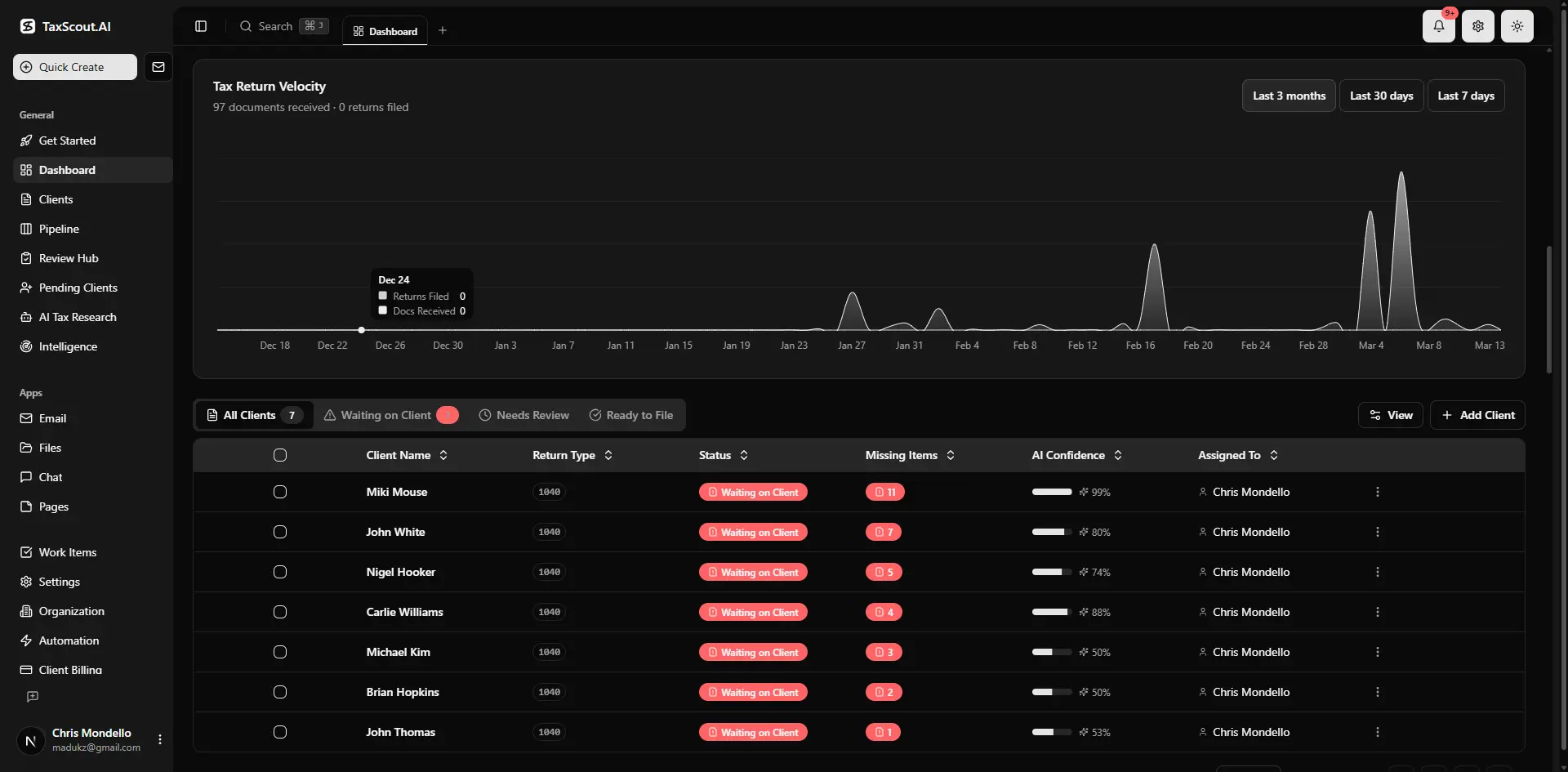
Real-time dashboard showing returns in progress, revenue, and upcoming deadlines
The Five Core Sections of a CPA Firm Business Plan
Regardless of firm size, a rigorous accounting firm business plan needs five sections: firm positioning, revenue model, capacity plan, client acquisition strategy, and operational infrastructure. Each section should map to a live data source — not a spreadsheet you update manually.
Competitor articles on this topic (including those from Financial Cents and Canopy) typically provide a generic template that looks like any other small-business plan. The difference here is that each section is explicitly tied to a metric your practice management stack already tracks. Understanding accounting firm business plan in this context is what separates firms that scale from those that stall.
Section 1: Firm Positioning and Service Mix
Define what your firm does, who it serves, and why clients choose you over a regional competitor. This is not a marketing tagline — it is a strategic constraint. If your positioning is 'boutique tax and advisory for real estate investors,' that decision should eliminate certain client types, set your price floor, and define the expertise your team must develop. The Journal of Accountancy regularly covers niche-positioning strategies that demonstrate why specialization correlates with higher realization rates. Tie this section to your client mix report: what percentage of current revenue comes from your stated niche? If the answer is less than 60%, your positioning is aspirational, not operational. This is precisely where a deliberate accounting firm business plan strategy pays off.
Section 2: Revenue Model and Pricing Strategy
Document your pricing model explicitly: hourly, flat-fee, value-based, or a hybrid. The IRS Taxpayer Advocate Service data consistently shows that tax complexity is rising, which creates pricing power for firms that can quantify the value they deliver. Your revenue plan should show current average revenue per client, your target, and the gap you intend to close through repricing, service expansion, or client mix changes. If you have already moved toward flat-fee billing, our guide on flat-fee billing for CPAs covers the mechanics of building predictable monthly recurring revenue into this section of your plan. Accounting firm business plan sits at the center of this decision — get it wrong and the rest unravels.
Section 3: Capacity Plan
This is the section most CPA firm business plans omit entirely — and it is the one most likely to determine whether you hit your revenue targets. A capacity plan answers: how many returns, advisory engagements, or bookkeeping clients can your current staff handle at sustainable utilization? What does adding one FTE do to your throughput? The Bureau of Labor Statistics Occupational Outlook Handbook projects continued demand growth for accounting services, which means capacity constraints — not market demand — are usually the binding factor for firm growth. Our dedicated post on accounting firm capacity planning walks through how to model this quantitatively. When firms revisit their accounting firm business plan priorities, the gaps usually surface here.
Section 4: Client Acquisition Strategy
Document your current acquisition channels (referrals, SEO, networking, niche directories) and their yield. How many new clients did each channel produce last year? What was the average onboarding cost? What percentage of prospects converted after a discovery call? These numbers belong in your business plan — not as historical trivia, but as the baseline your acquisition investments must beat. Connect this to your pipeline management data so the plan reflects actual conversion rates, not guesses.
Section 5: Operational Infrastructure
This section covers the technology, processes, and policies that make consistent service delivery possible. Document your current tech stack, identify gaps, and assign owners to improvements. If you are still routing client documents through email attachments, that is an infrastructure gap with a quantifiable cost in staff time. Your operational infrastructure plan should align with your capacity plan: you cannot scale from 200 to 500 returns without AI-assisted document processing and a reliable client portal that reduces manual back-and-forth. Reference your other blog resources on firm operations for frameworks you can adapt.
Tired of building strategy in a spreadsheet while your real numbers live somewhere else?
TaxScout.ai surfaces pipeline velocity, capacity utilization, and revenue-per-client in one dashboard — giving your business plan the live data it actually needs.
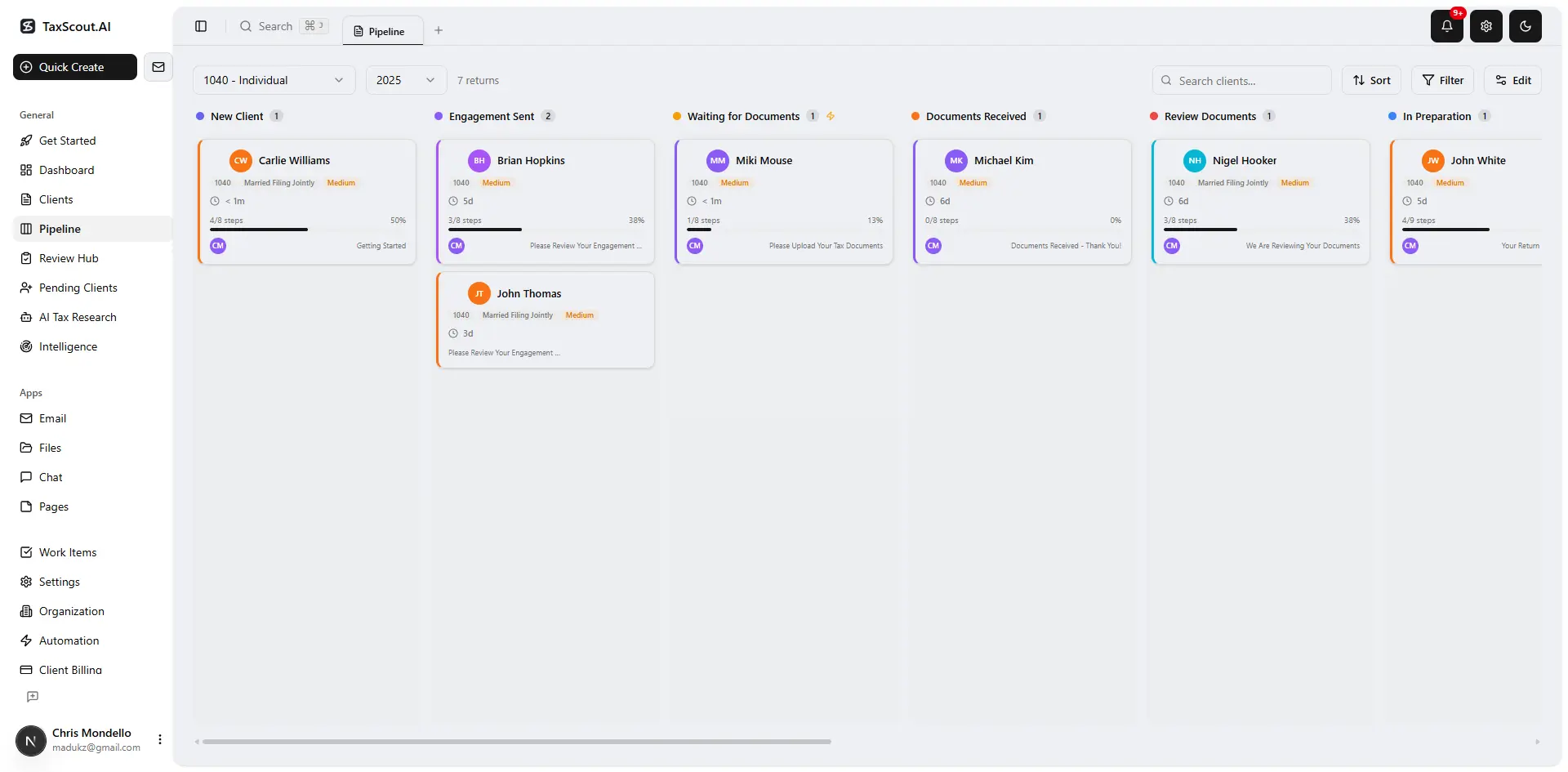
Track every return from intake to filed with drag-and-drop pipeline management

Your clients see your brand — OTP login, document upload, and real-time status
Post-Tax-Season: The Best Time to Build Your Accounting Firm Strategic Plan
June is underrated in the accounting profession. Deadlines have cleared. The team has recovered. You have a full season of fresh data — utilization rates, client complaints, workflow bottlenecks, and realization rates — that reflects what your firm actually does under pressure, not what your plan assumed it would do. Canopy's blog has noted that firm owners often sprint out of busy season into a reactive to-do list. That is the wrong move. The right move is to treat May and June as your strategic planning window.
Post-tax-season planning has a structural advantage: you are working with audited-by-experience data. You know exactly which client segments consumed the most staff time, which services had the highest realization rates, and where your onboarding process broke down. A CPA firm business plan written in June incorporates that signal. One written in January is guessing.
The practical calendar looks like this. In May, pull your full-season metrics: returns completed, average days from engagement open to return filed, AR aging, and any client churn. In June, run your plan-building sessions using that data as inputs. In July, finalize goals and assign owners. In August, conduct your first quarterly review checkpoint. This rhythm means your accounting firm strategic plan is never more than 90 days stale — and the June build session is always fed by the freshest operational data you will ever have.
The AICPA's Private Companies Practice Section has published guidance on firm management rhythms that support exactly this kind of structured post-season reflection. Building the habit now creates compounding strategic advantage over firms that plan ad hoc.
How AI Automates the Data Inputs Your Business Plan Requires
The most time-consuming part of building any business plan for an accounting firm is assembling the inputs. Utilization rates live in one tool. Revenue per client lives in billing. Client churn requires cross-referencing last year's engagement list with this year's. AR aging is in a separate module. Pulling all of that together manually takes days — and by the time you finish, the data is already slightly stale.
AI-native practice management platforms solve this by centralizing the data that business plans require. TaxScout.ai's pipeline management feature tracks every engagement across 12 customizable stages, giving you real-time conversion rates and cycle-time data. The invoicing module via Stripe Connect Express feeds revenue-per-client and AR aging directly into your dashboard. The AI document extraction layer — which processes 180+ tax form types through a 5-layer validation pipeline — generates throughput data that directly informs your capacity plan.
Specifically, the metrics your business plan needs — and that TaxScout surfaces automatically — include: returns completed per staff FTE per month, average days from document receipt to return filed, client acquisition cost by channel, realization rate by service line, and AR days outstanding. When those numbers update in real time, your plan stops being a historical document and starts functioning as a live management instrument.
For firms already using Drake, CCH Axcess, UltraTax CS, Lacerte, or ProConnect, TaxScout integrates with your existing tax software so you are not rebuilding your tech stack from scratch — you are adding the intelligence layer on top of it.

Track firm performance with real-time analytics and client activity monitoring
Static Business Plan vs. AI-Native Living Plan: What Changes
| Dimension | Static Word Doc Plan | AI-Native Living Plan |
|---|---|---|
| Data inputs | Manually assembled, goes stale immediately | Pulled automatically from pipeline, billing, and extraction data |
| Capacity model | Estimated from last year's headcount | Updated from real utilization rates per staff member |
| Revenue targets | Aspirational percentages with no baseline | Tied to current revenue-per-client with gap analysis |
| Review cadence | "We should revisit this sometime" | Quarterly checkpoint built into pipeline workflow |
| Client churn tracking | Noticed when revenue drops | Flagged in real time via engagement status and AR aging |
| Build time | Several days of manual data assembly | Hours, because inputs are already centralized |
Connecting Your CPA Firm Growth Strategy to Practice Management Workflows
A business plan that lives outside your practice management system has no enforcement mechanism. Goals remain goals. A plan that is wired into your workflows becomes operational: a revenue target becomes a pipeline stage threshold, a capacity goal becomes a staff utilization alert, a client acquisition target becomes a lead conversion report.
TaxScout's AI intake feature — modeled on IRS Form 13614-C with four-layer prefill — reduces the onboarding time per new client by eliminating manual data entry. If your CPA firm growth strategy calls for adding 50 new clients this year, the intake workflow is the operational mechanism that makes that scalable. Similarly, the AI research agents — nine specialized agents with real-time IRS, Treasury, and Cornell Law search — reduce research time per engagement, which directly expands your capacity without adding headcount.
The pricing implication is significant. TaxScout's Prep Pro plan is $149 per month flat — no per-user fees — supporting up to 10 seats and 500 returns per year. Compare that to TaxDome at approximately $100 per user per month (roughly $1,000 per month for a 10-person firm), or Canopy at approximately $45 per user per month plus $11 per client for smart intake features. If your business plan includes a section on operational cost structure — and it should — the platform comparison at /pricing belongs in that analysis. You can also review a detailed breakdown at our Canopy alternative page.
The goal is a firm where the strategy and the operations are the same document. Your plan says you will achieve 85% staff utilization by Q3. Your pipeline dashboard tells you you are at 72% in June. The gap is visible, owned, and actionable — not discovered twelve months later when you are writing next year's plan.
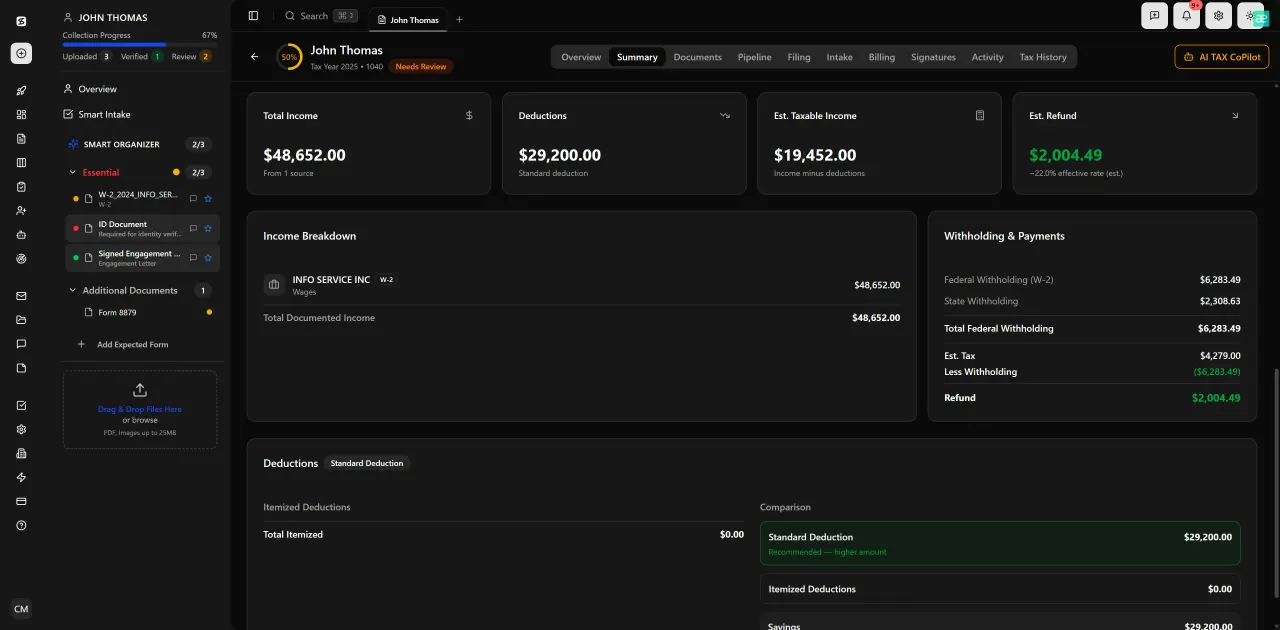
Review with AI assist — 9 agents answer questions with full client context

Smart intake auto-fills from uploaded documents and prior-year data
Building the Review Cadence That Keeps Your Plan Alive
A CPA firm business plan without a review cadence is a snapshot, not a strategy. The cadence does not need to be elaborate — it needs to be consistent. A quarterly rhythm works well for most firms: a 60-minute partner meeting in which you review four to six KPIs against plan, identify the one or two things that are off track, and assign specific corrective actions with deadlines.
The metrics that belong in every quarterly review include: revenue versus plan, new clients added versus target, staff utilization versus capacity model, AR days outstanding versus prior quarter, and client satisfaction signals (portal login rates, document turnaround time, complaint volume). If your practice management platform is capturing these automatically, the prep time for the quarterly review drops from half a day to 20 minutes.
Treasury guidance on small business financial management consistently emphasizes the link between regular financial review and sustained growth. The cadence is not bureaucracy — it is the mechanism that converts a plan into compounding advantage. Firms that review quarterly outperform firms that review annually, because they catch drift early when corrections are cheap.
Build the review into your calendar now, not after you finish writing the plan. Create a recurring workflow stage in your pipeline system for 'Quarterly Strategy Review.' Assign it an owner. Attach the KPI dashboard as a required input. That one structural decision is what separates firms that use their plan from firms that file it.
Ready to stop writing plans that gather dust and start running on live firm data?
TaxScout.ai gives CPA firms a $149/month platform with pipeline management, AI extraction, and real-time KPIs — everything your business plan needs to stay alive all year.
Frequently Asked Questions
A complete accounting firm business plan should include five core sections: firm positioning and service mix, revenue model and pricing strategy, a capacity plan tied to staff utilization, a client acquisition strategy with channel-level conversion data, and an operational infrastructure plan. Each section should be connected to a live data source in your practice management system so the plan updates as your firm's metrics change — not just at annual review time.
Keep reading
Business Valuation for CPAs: How to Price a Client Company Without Hiring an Appraiser
Sep 18, 2026 · 1 min read
Equity Partner Compensation: How CPA Firms Structure Pay for Owners
Sep 18, 2026 · 1 min read
Accountant Shortage Solutions: How CPA Firms Survive the Talent Crisis Without Overpaying
Sep 18, 2026 · 1 min read
Stay up to date
Get the latest tax tech insights delivered to your inbox.