Tax Season Cash Flow: How CPA Firms Can Smooth Revenue Year-Round
The feast-or-famine revenue cycle is the defining financial stress for most CPA firm owners — yet almost no one talks about how to fix it from the inside. This guide maps out the accounting firm revenue calendar, identifies where cash flow breaks down, and shows concrete strategies to build…
Tax season cash flow is the hidden pressure that most CPA firm owners carry quietly. In January and February, invoices go out slowly while work piles up. March and April bring a revenue flood — then silence. May through August can feel like a slow suffocation before the September extension rush provides temporary relief. If you have ever delayed your own paycheck because payroll hit during a slow patch, or held off on hiring because you could not project whether summer revenue would cover a new salary, you already understand the problem.
The uncomfortable truth is that most CPA firms are profitable on an annual basis but cash-flow negative for stretches of four to six months each year. That mismatch between when work is performed and when revenue arrives drives burnout, prevents confident investment in staff and technology, and creates a cycle where growth feels risky rather than rewarding. Yet almost all the published content on CPA firm finances focuses on client billing tactics — value-based pricing, engagement letter structure, AR collection — rather than the firm owner's own liquidity problem. Understanding tax season cash flow is the first step toward breaking this cycle and building a practice that remains financially stable throughout the entire year.
This guide takes a different angle. We will map the actual accounting firm revenue cycle, identify the operational levers that create revenue concentration risk, and walk through concrete strategies — retainer restructuring, off-season service expansion, payment timing changes, and AI-assisted workflow scheduling — that let you flatten the curve and build genuine monthly recurring revenue without doubling your headcount. Each of these strategies directly addresses tax season cash flow by redistributing both the work and the revenue that comes with it across all twelve months.
The Feast-or-Famine Revenue Calendar: Where Cash Flow Actually Breaks
Understanding tax season cash flow requires mapping the calendar honestly. For a typical tax-focused CPA firm, roughly 60 to 70 percent of annual billings are concentrated in two windows: the March–April original deadline sprint and the September–October extension crunch. The IRS Tax Deadlines 2026 guide reinforces just how compressed these windows are — S-corp and partnership returns cluster in March, individual returns in April, and nearly every extended return arrives at once in September.
The revenue gap is not just about billable hours. It is about when invoices go out and when clients pay. Many firms invoice at completion — meaning work done in February does not get billed until mid-April, and does not get paid until May. By that point, summer payroll, office rent, and software subscriptions have been drawing down the account for weeks. The Journal of Accountancy has noted that even well-run small firms often operate with fewer than 60 days of operating reserves, making any billing delay disproportionately painful. This invoicing lag is one of the most underappreciated drivers of poor tax season cash flow, yet it is also one of the easiest problems to fix with a simple policy change.
There are three structural causes. First, per-return billing models tie revenue recognition entirely to completion events rather than to time elapsed. Second, most firms have not built a meaningful off-season service menu, so May through August genuinely produce less billable work. Third, few firms use automated payment collection — they rely on clients mailing checks or initiating ACH transfers voluntarily, which adds weeks to the cash conversion cycle. Each of these is fixable, but all three require deliberate structural changes rather than simply working harder. For firms evaluating their tax season cash flow approach, this trade-off compounds over time.
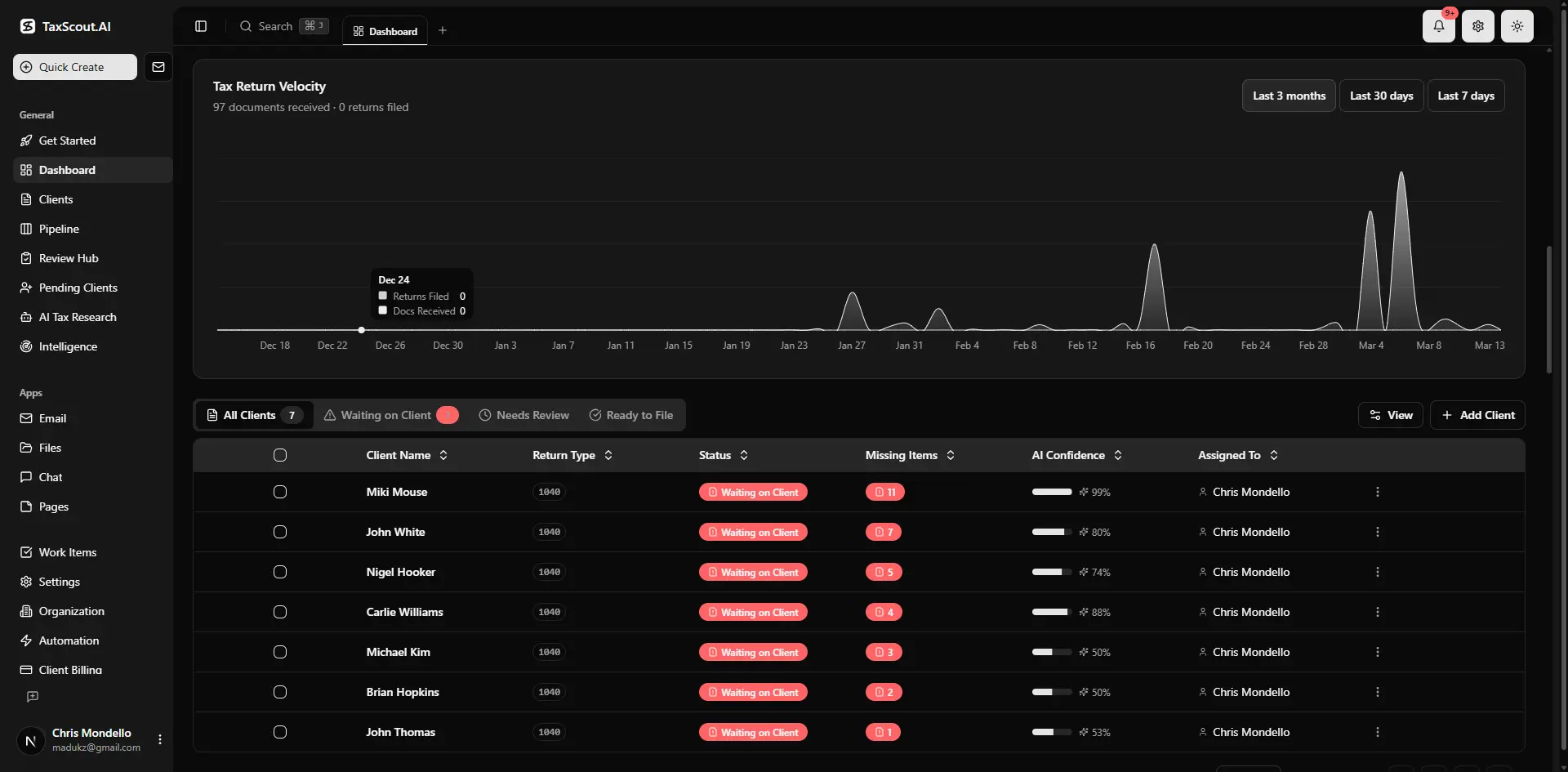
Real-time dashboard showing returns in progress, revenue, and upcoming deadlines
Retainer Models That Actually Smooth Monthly Cash Flow
The most direct fix for accounting firm recurring revenue problems is converting per-return engagements to annual retainer agreements billed monthly. This is not a new idea, but the implementation details matter enormously. A flat annual retainer that includes tax preparation, one quarterly planning call, and basic bookkeeping review gives clients clear value while spreading your revenue across 12 equal payments. For a client whose prior-year tax fee was $1,800, a $175/month retainer covering the same scope plus ongoing access means you collect the same amount — just in monthly installments rather than a single April spike. Each of these factors directly shapes how tax season cash flow plays out in practice.
The critical design question is scope definition. Retainers fail when the firm owner underestimates how much ad hoc work clients bring. The SBA's guidance on small business financial planning recommends that any service contract clearly delineate included versus out-of-scope work. Build your retainer tiers around clearly bounded deliverables: the base tier covers annual 1040 or 1120S preparation plus two calls; the growth tier adds quarterly estimated payment review and one state notice response; the advisory tier includes monthly P&L review and unlimited calls. Out-of-scope work triggers a separate SOW and invoice. Understanding tax season cash flow in this context is what separates firms that scale from those that stall.
CPA firm monthly retainer pricing should be set so that the annual total is 10 to 15 percent higher than your prior-year per-return fee — clients accept the modest premium in exchange for budgetability, and you benefit from the smoothed cash flow and reduced AR chasing. Connect your retainer invoicing directly to automated billing so payments clear on the first of each month without manual intervention. TaxScout's invoicing feature via Stripe Connect Express supports exactly this structure, allowing recurring charges with automatic receipts and zero manual follow-up. This is precisely where a deliberate tax season cash flow strategy pays off.
For existing clients currently on per-return billing, the transition works best when framed as a convenience upgrade during the post-season review call. Our post-tax season review guide covers how to structure that conversation. Lead with the client's benefit — predictable fees, no invoice surprises, direct line to you for questions — and the conversion rate is typically 40 to 60 percent of your A and B clients in the first year. Tax season cash flow sits at the center of this decision — get it wrong and the rest unravels.
Tired of invoicing in April only to wait until June for payment?
TaxScout automates recurring billing, e-signatures, and client intake so your revenue cycle works for you — not against you. When firms revisit their tax season cash flow priorities, the gaps usually surface here.
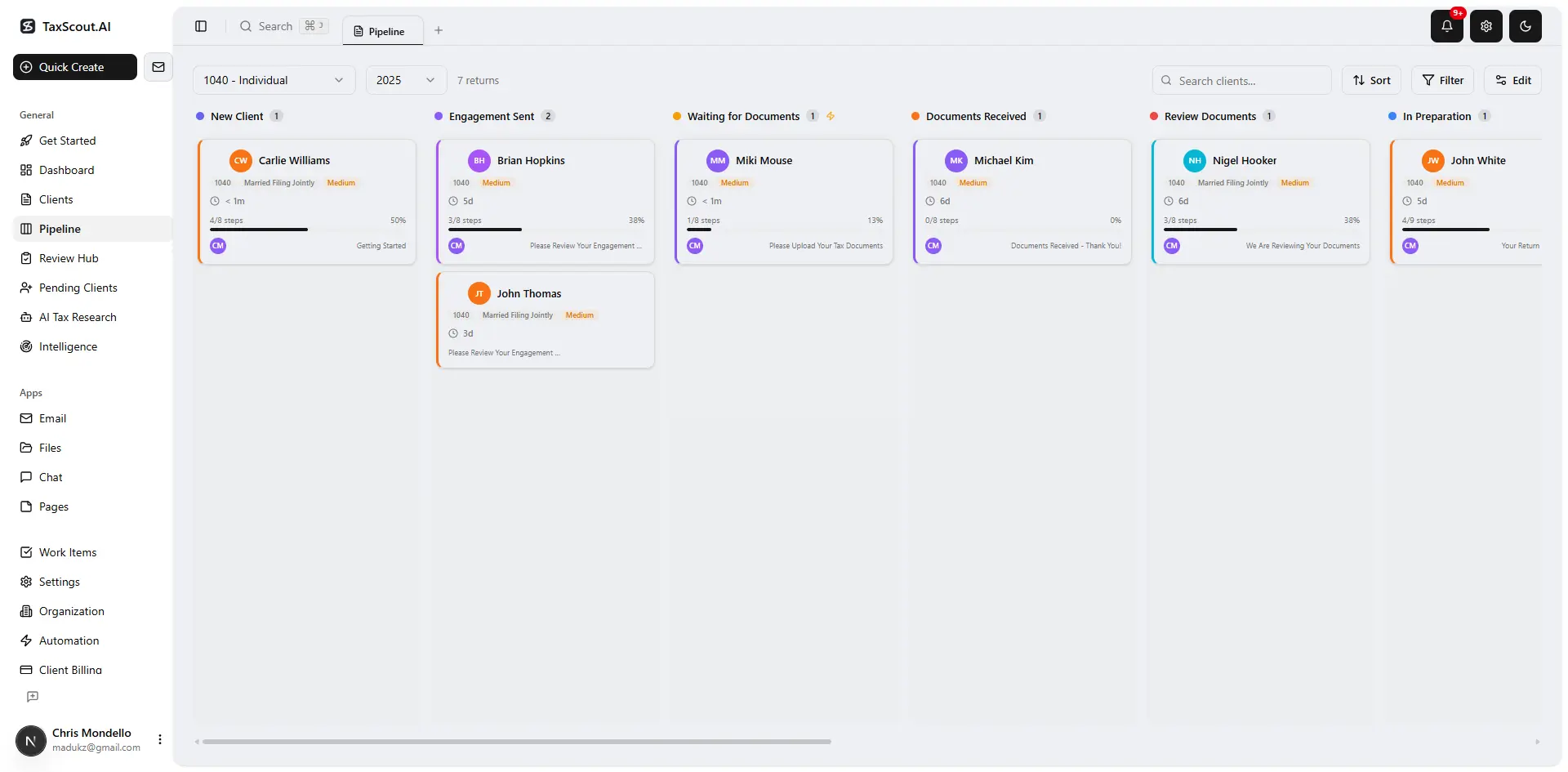
Track every return from intake to filed with drag-and-drop pipeline management

Click any extracted field to see its source highlighted on the original PDF
Off-Season Accounting Services That Generate Real Revenue
Even with a retainer program, you still need billable work to fill May through August meaningfully. The most sustainable off-season accounting services are ones that create natural demand from your existing client base rather than requiring you to acquire new clients. Payroll compliance review is a strong example: businesses that used a payroll provider all year often arrive at tax time with classification errors, misreported wages, or W-2 discrepancies that could have been caught earlier. Offering a mid-year payroll health check at a flat fee generates revenue in June while reducing your January scramble.
Entity structure reviews are another high-value summer engagement. Many small business clients are operating as sole proprietors or single-member LLCs when an S-corporation election would meaningfully reduce self-employment tax. This analysis takes two to three hours and can be priced at $500 to $1,500 depending on entity complexity. The IRS publication on S-corp elections and the Form 2553 filing window make summer the natural time to have the conversation, since elections for the following tax year must generally be filed by March 15.
Bookkeeping cleanup projects — often called 'catch-up bookkeeping' — are perennially undersupplied. Clients who managed their own books through QuickBooks or similar software accumulate uncategorized transactions, unreconciled accounts, and misclassified expenses. Pricing this on a per-month-of-history basis (e.g., $150 per month of cleanup needed) is transparent and scalable. Combine it with a standing monthly bookkeeping retainer going forward and you have converted a one-time engagement into predictable recurring income.
Payment Timing and Collection Practices That Accelerate Cash
Even the best service mix underperforms if your payment collection process is slow. CPA firm financial planning should include explicit policies around when invoices go out, what payment methods are accepted, and how overdue accounts are handled automatically rather than manually. The accounting firm payment collection guide covers this in depth, but the core principle is simple: billing at completion and waiting for client action is a choice that costs real money.
The most impactful single change is shifting to upfront or split-payment billing. For tax preparation, this means collecting 50 percent of the estimated fee when the engagement letter is signed and the remaining 50 percent at delivery — not after. The Bureau of Labor Statistics data on small business receivables consistently shows that invoices older than 30 days collect at materially lower rates. Front-loading collection is not adversarial; frame it as how you manage your practice responsibly.
Automated payment reminders eliminate the awkwardness of chasing clients personally. Set up sequences that trigger at invoice creation, three days before due date, on the due date, and at seven and fourteen days past due. Pair these with ACH auto-pay enrollment — clients who enroll in automatic monthly billing never become an AR problem. TaxScout's invoicing system handles these sequences natively, and the client portal gives clients a self-service payment interface so they can pay without requiring a phone call from your team.
Retainers amplify all of this. When 60 percent of your revenue base is on monthly auto-pay, your daily cash inflow becomes predictable regardless of whether your team is deep in extension work or at a conference. The remaining per-project billing becomes manageable as a secondary collection task rather than the primary one.

Your clients see your brand — OTP login, document upload, and real-time status
How AI Workflow Scheduling Connects to Cash Flow Management
One reason tax season cash flow problems persist even when firms implement retainers is that the underlying work still clusters in April and September. If all your retainer clients also send their documents in early April, you have smoothed your billing but not your capacity consumption — and capacity bottlenecks cause missed deadlines, overtime costs, and staff burnout that eat into margin. The revenue cycle fix is only complete when paired with workload distribution.
AI-assisted pipeline management lets you intentionally pull certain work forward or push it back without dropping anything. TaxScout's pipeline management tool tracks each return through 12 customizable stages and gives you real-time visibility into where bottlenecks are forming. When you can see in January that 80 returns are sitting in 'waiting for documents' and only 12 are in active review, you can launch automated follow-up campaigns to document-ready clients in late February — shifting their completion into March before the April pile hits.
The AI intake engine also plays a direct role. When clients complete intake and upload documents earlier — driven by smart prefill that reduces their friction — your team can process those returns earlier. Earlier completion enables earlier invoicing. Earlier invoicing generates earlier payment. A firm that processes 30 percent of its returns in February rather than April is not just less stressed; it has six additional weeks of cash in the bank before peak season overhead arrives. This is the operational mechanism that connects technology investment directly to owner cash flow.
For CPA firm capacity planning more broadly, our accounting firm capacity planning guide details how to model staff utilization across the full year and identify the off-peak windows where additional service offerings can be layered in without hiring.

Track firm performance with real-time analytics and client activity monitoring
CPA Firm Revenue Model Comparison: Per-Return vs. Retainer vs. Hybrid
| Model | Revenue Predictability | Cash Flow Timing | Client Retention Risk | Staff Planning Difficulty |
|---|---|---|---|---|
| Per-Return Billing | Low — completion-dependent | April and October spikes | High — clients can shop each year | High — impossible to hire confidently |
| Annual Retainer (Monthly) | High — 12 equal payments | Distributed evenly | Low — embedded relationship | Low — predictable revenue supports hiring |
| Hybrid (Retainer + Project SOW) | Medium-High — base plus variable | Mostly distributed, project spikes small | Low — retainer creates stickiness | Medium — base is predictable, project work varies |
CPA Firm Financial Planning: Building a 12-Month Cash Flow Model
Once you have the revenue structure right, formalize it into a 12-month cash flow model that you update quarterly. This is standard practice for the clients you advise but rarely done rigorously for the firm itself. Law Cornell's business planning resources and the Treasury Department's financial management guidance both emphasize that even small professional services firms benefit from rolling cash flow forecasting.
Your model should include five rows of monthly cash inflow: retainer revenue (known, automatic), extension billing (seasonal, estimable), project SOW revenue (variable but pipeline-trackable), new client onboarding fees (growth-dependent), and interest or investment income. On the outflow side, separate fixed costs (payroll, rent, software subscriptions) from variable costs (contractor help during peak, conference travel, CPE). The gap between inflow and outflow in each month tells you exactly which months require a cash reserve draw and which months rebuild it.
Most firms that build this model for the first time are surprised to find that their annual profit is healthy but their cash trough — typically June and July — dips below two months of fixed overhead. The solution is not cutting expenses; it is building a cash reserve from April revenue before spending it. A practical target is 90 days of fixed overhead held in a separate high-yield business savings account, replenished each April and September. This single structural change eliminates most of the financial anxiety that drives premature fee discounting and prevents investment in growth.
Track your progress toward these targets using KPI dashboards. The CPA firm KPIs to track with AI guide covers the specific metrics — realization rate, average days to collect, recurring revenue as a percentage of total — that belong in a firm owner's monthly financial review alongside client-facing metrics.
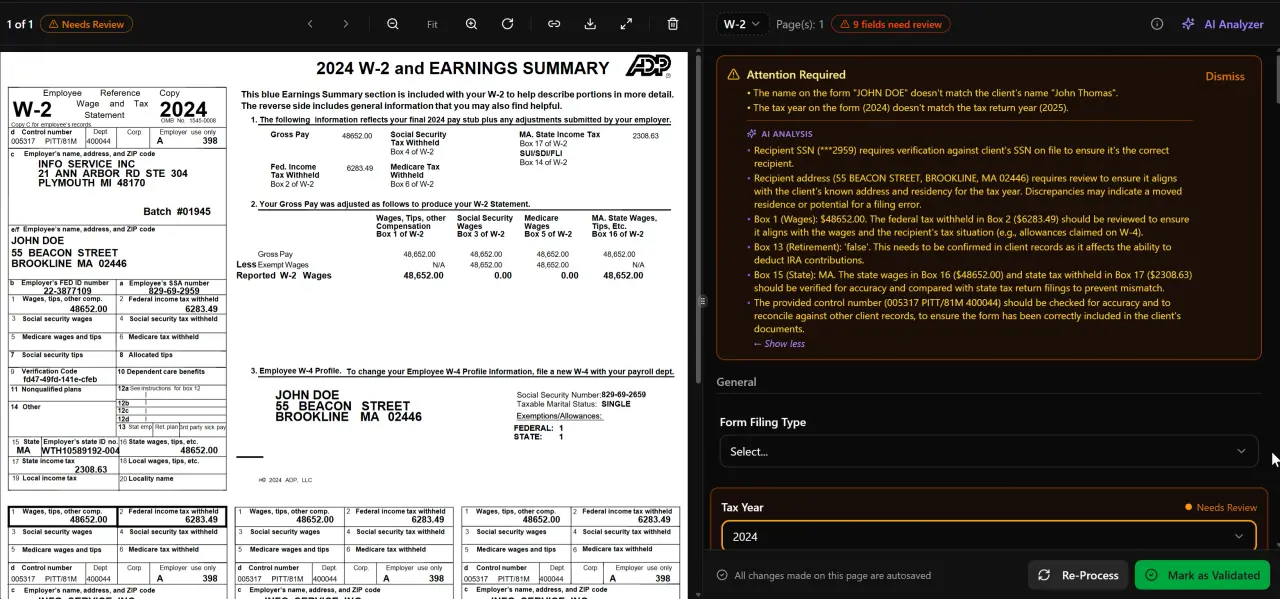
AI classifies, extracts, and validates every document automatically
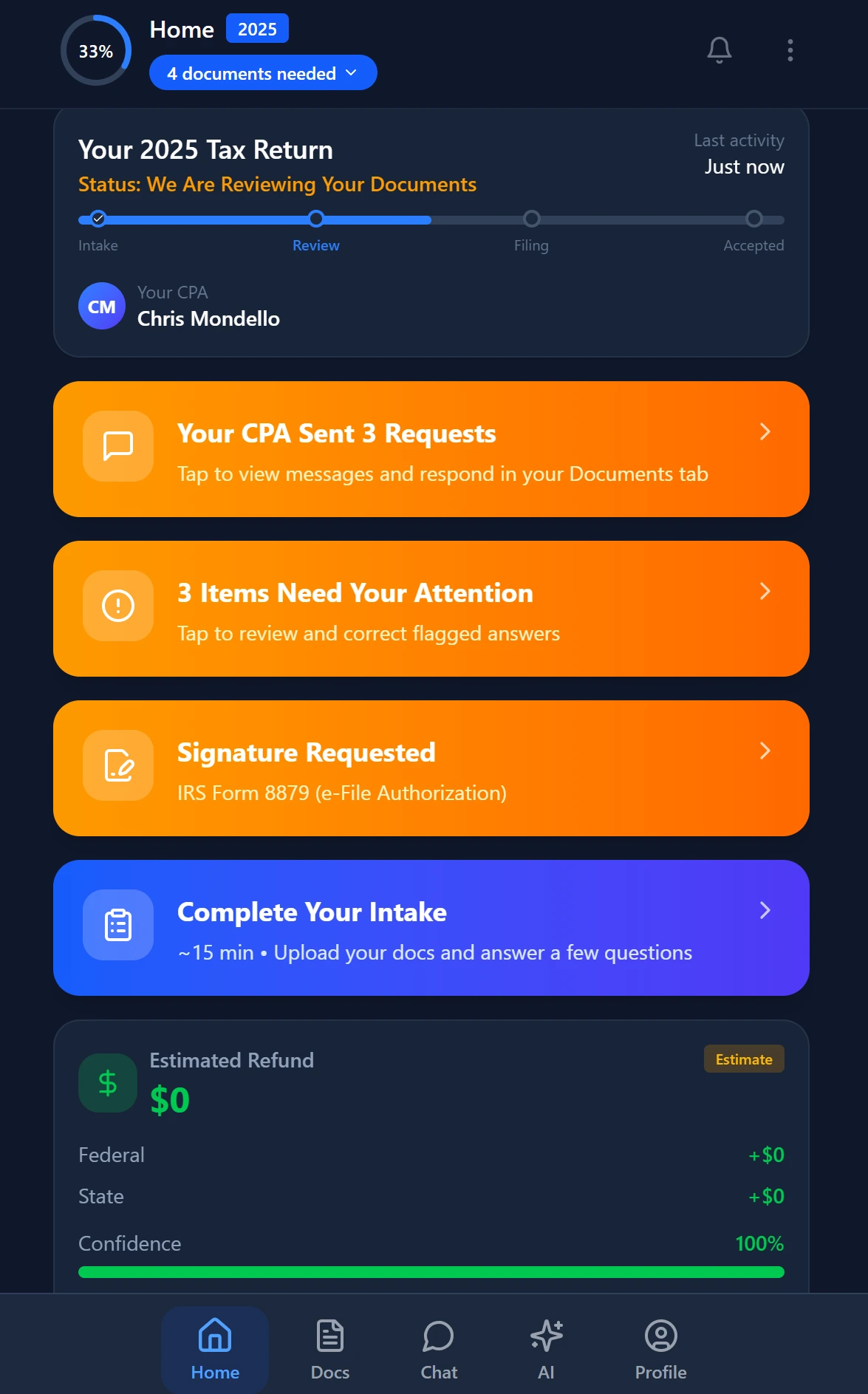
Smart intake auto-fills from uploaded documents and prior-year data
Scaling Recurring Revenue Without Adding Proportional Overhead
The risk most firm owners cite when considering retainer expansion is scope creep — the fear that monthly billing will lead to unlimited client demands. The answer is not to avoid retainers but to build the operational infrastructure that makes them scalable. Specifically: standardized service tiers with documented scope, automated intake for recurring deliverables, and AI-assisted document processing that reduces per-return labor cost as volume grows.
TaxScout's AI document extraction handles 180+ tax form types with a 5-layer validation pipeline, reducing the manual verification time per return significantly. When each return takes less staff time to process, adding 50 retainer clients does not require proportionally more staff. You can learn more about how AI extraction works and the confidence scoring model that flags exceptions for human review. The practical effect is that your team's capacity can absorb more volume in the same hours, improving margin on the retainer model without cutting service quality.
For recurring invoicing specifically, automating the billing cycle through a platform that connects engagement letters, e-signatures, and payment processing removes the administrative drag that makes retainers feel burdensome to manage. The e-signatures feature via Documenso handles engagement letter signing at onboarding, and the invoicing system triggers the first monthly charge automatically after signature. Compare this to manual per-return billing, which requires creating an invoice, emailing it, following up, and reconciling payment for each client each year. At 200 clients, that difference compounds to dozens of hours annually.
Recurring revenue also changes the math on your software and tooling investments. When you move from TaxDome's per-user pricing of roughly $100 per user per month to TaxScout's flat $149/month for up to 10 seats with no per-return fees, the savings on a 10-person team approach $350 per month — money that flows directly to the firm's operating cash. Predictable low-cost infrastructure plus predictable retainer revenue creates compounding margin improvement year over year.
Ready to stop running your firm's finances like a seasonal business?
TaxScout gives CPA firms flat-rate pricing, automated billing, AI document processing, and the pipeline tools to build a year-round revenue engine.
Frequently Asked Questions
The primary cause is revenue concentration — most CPA firms collect 60 to 70 percent of annual revenue in April and September due to per-return billing tied to tax deadlines. Combined with completion-based invoicing and slow manual collection, this creates multi-month cash troughs even at profitable firms.
Keep reading
Amended FBAR Procedures: How CPAs Correct Foreign Account Errors Without Triggering Penalties
Oct 12, 2026 · 1 min read
Transparency in Coverage Final Rules: What CPA Firms Must Do Now
Oct 12, 2026 · 1 min read
Backdoor Roth IRA: How CPAs Execute the Strategy for High-Income Clients
Oct 12, 2026 · 1 min read
Stay up to date
Get the latest tax tech insights delivered to your inbox.